Page 36
170.
(Figure: Short-Run Phillips Curve) Refer to Figure: Short-Run Phillips Curve. SRPC2 is
based on an expected inflation rate of:
A)
zero.
B)
1%.
C)
2%.
D)
5%.
171.
(Figure: Short-Run Phillips Curve) Refer to Figure: Short-Run Phillips Curve. SRPC1 is
based on an expected inflation rate of:
A)
zero.
B)
1%.
C)
2%.
D)
3%.
172.
(Figure: Short-Run Phillips Curve) Refer to Figure: Short-Run Phillips Curve. The
natural rate of unemployment is _____%.
A)
3
B)
5
C)
7
D)
8
173.
(Figure: Short-Run Phillips Curve) Refer to Figure: Short-Run Phillips Curve. The
NAIRU is _____%.
A)
3
B)
5
C)
7
D)
8
174.
Suppose the economy is in long-run equilibrium. The government has just decided to
lower income taxes. The long-run impact of this policy will be _____ in the natural rate
of unemployment and _____ in price level.
A)
a decrease; an increase
B)
a decrease; no change
C)
no change; an increase
D)
no change; no change
175.
The worst inflation in the United States in modern times occurred in the late 1970s,
when prices were increasing at an annual rate of 13%.
A)
True
B)
False
Page 37
176.
In June 2008 Zimbabwe had the world’s highest unemployment rate.
A)
True
B)
False
177.
In the classical model of the price level, there is no distinction between the short run and
the long run.
A)
True
B)
False
178.
The short-run aggregate supply curve is positively sloped because wages and prices are
not all completely flexible.
A)
True
B)
False
179.
The classical model of the price level is more accurate during low inflation than high
inflation.
A)
True
B)
False
180.
An inflation tax is the effect on the public of a reduction in the value of money caused
by inflation.
A)
True
B)
False
181.
An inflation rate of 5% will increase the purchasing power of $1 to $1.10.
A)
True
B)
False
182.
It is impossible for the U.S. government to raise revenue by printing more money
because the Federal Reserve, not the Treasury, issues most of the U.S. money supply.
A)
True
B)
False
183.
People can avoid the inflation tax by reducing their real money balances.
A)
True
B)
False
Page 38
184.
A high inflation rate leads people to increase their money holdings, leading to more
money printing and higher inflation.
A)
True
B)
False
185.
Hyperinflation is often a result of a government trying to pay for its spending by using
the inflation tax.
A)
True
B)
False
186.
Zimbabwe’s inflation problems arose mainly when its president, Robert Mugabe, seized
the farmland of the white minority and turned it over to his supporters, which disrupted
production and undermined the country’s tax base.
A)
True
B)
False
187.
To balance its budget, the government of Zimbabwe borrowed large amounts of money
in world markets.
A)
True
B)
False
188.
Policies that expand output and decrease unemployment are popular with voters but are
likely to cause inflation later.
A)
True
B)
False
189.
Policies that reduce inflation are popular with voters because they lead to higher output
and lower unemployment.
A)
True
B)
False
190.
When real output growth is above potential output growth, the output gap is positive and
the unemployment rate is below the natural rate.
A)
True
B)
False
Page 39
191.
The difference between the actual and potential GDP is the output gap.
A)
True
B)
False
192.
According to Okun’s law, unemployment must decrease by 1% for output to increase by
1%.
A)
True
B)
False
193.
In the short run, a lower unemployment rate may be achieved at the cost of a higher
inflation rate.
A)
True
B)
False
194.
In the long run, there is a negative relationship between the inflation rate and the
unemployment rate.
A)
True
B)
False
195.
In the long run, the unemployment rate will equal the natural rate of unemployment at
any price level.
A)
True
B)
False
196.
Explain why the classical model of the price level is more accurate during high inflation
than low inflation.
197.
The central bank of a government can print more money to pay for government deficits.
Why do some refer to this practice as imposing an inflation tax?
198.
Explain the political asymmetry associated with policies that can cause or cure inflation.
199.
Explain how the output gap is related to the unemployment rate and the natural
unemployment rate.
Page 40
200.
Suppose that the natural rate of unemployment is 5% and that the economy is operating
at 97.5% of potential output. Use Okun’s law to determine the unemployment rate.
201.
Suppose that the natural rate of unemployment is 5% and that the economy is operating
at 101% of potential output. Use Okun’s law to determine the unemployment rate.
202.
Suppose that you live in a city whose economic growth has been declining for several
months. Oddly, the official unemployment rate in your city has not begun to rise. How
can you explain this?
203.
The short-run Phillips curve is believed to be downward sloping with the inflation rate
on the vertical axis and the unemployment rate on the horizontal axis. Can this curve
extend below the horizontal axis? Can it extend to the left of the vertical axis? Explain.
204.
Explain why, in the short run, the unemployment rate tends to fall when the inflation
rate rises.
205.
Suppose that the public expects inflation to increase from 3% to 4% this year. How will
this affect the short-run Phillips curve?
206.
Why is the long-run Phillips curve believed to be vertical at the natural rate of
unemployment, or NAIRU?
207.
Suppose that the economy is significantly weakened, real GDP is far below potential
GDP, and the unemployment rate is high. The Federal Reserve is concerned that
monetary policy might have limited effectiveness because of deflation. How can
deflation limit the Fed’s ability to increase aggregate demand?
208.
In June 2008 _____ had the world’s highest inflation rate, _____ Germany’s rate in
1922–1923.
A)
Zimbabwe; equal to
B)
Zimbabwe; even higher than
C)
the Republic of Congo; equal to
D)
the Republic of Congo; less than
Page 41
209.
In the long run, an increase in the money supply:
A)
will increase real GDP and the price level.
B)
causes people to hold onto large sums of money.
C)
results in no change in real GDP.
D)
encourages people to save more money.
210.
The classical model of the price level:
A)
holds that the short run is distinct from the long run.
B)
holds that the economy is always producing at some point on the LRAS.
C)
works best when an economy has low levels of inflation.
D)
does not consider the effects of the real quantity of money.
211.
When an economy has high inflation:
A)
wage and price stickiness lessens or disappears.
B)
the Keynesian model of the economy is most relevant.
C)
wages become more inflexible as workers wait for prices to stabilize.
D)
changes in the money supply take much longer to affect the inflation rate.
212.
If a central bank pursues an expansionary monetary policy:
A)
the aggregate price level and level of real GDP will increase in the short run.
B)
the level of real GDP will increase, but the aggregate price level will stay the same
in the long run.
C)
nominal prices and nominal wages will be unaffected in the long run.
D)
the aggregate price level will increase and the level of real GDP will decrease in
the short run.
213.
The debt is monetized when:
A)
the budget is approved by Congress.
B)
the Fed buys back debt via open-market purchases.
C)
the government raises taxes.
D)
transfer payments are decreased.
214.
Government’s right to print money to finance deficits is referred to as:
A)
open-market sales.
B)
seignorage.
C)
fiat money implementation.
D)
crowding out.
Page 42
215.
Borrowers benefit:
A)
when government engages in seignorage.
B)
when unexpected inflation is low.
C)
when the Fed engages in continual open-market sales.
D)
when real GDP falls as a result of a decrease in AD.
216.
A government with a large deficit will also produce high inflation in the economy if it:
A)
raises taxes.
B)
reduces government spending.
C)
finances the deficit via seignorage.
D)
imposes a debt ceiling.
217.
When inflation is high:
A)
people will increase their level of real-money holdings.
B)
people will save more.
C)
lenders gain at the expense of borrowers.
D)
people will decrease their level of real-money holdings.
218.
If government decides to print money to finance a deficit:
A)
people who hold money will be penalized as inflation increases.
B)
borrowers will be penalized because they will owe more as inflation increases.
C)
real GDP will decrease in the long run.
D)
the Fed must sell bonds in the open market.
219.
During an inflationary gap:
A)
the unemployment rate is less than the natural rate of unemployment.
B)
actual output is less than potential output.
C)
the unemployment rate is equal to the natural rate of unemployment.
D)
wages and prices must fall to restore the economy to its potential output.
220.
A negative output gap is associated with a(n) _____ unemployment rate.
A)
unusually low
B)
natural
C)
unusually high
D)
unchanged
Page 43
221.
A negative output gap implies an unemployment rate:
A)
above the natural rate.
B)
below the natural rate.
C)
equal to the natural rate.
D)
that equals the frictional and structural amounts of unemployment.
222.
As a result of a downturn in the economy, a firm reduces workers’ hours but does not
fire workers. Following Okun’s law, this is one reason:
A)
the relationship between the output gap and the unemployment rate is positive.
B)
the relationship between the output gap and the unemployment is negative and less
than a one-to-one relationship.
C)
a negative output gap is associated with an unusually low unemployment rate.
D)
a positive output gap is associated with an unusually high unemployment rate.
223.
Okun’s law finds that output gaps and unemployment rates are _____ related in a _____
ratio.
A)
positively; one-to-one
B)
negatively; less than one-to-one
C)
positively; less than one-to-one
D)
negatively; one-to-one
224.
Which of the following could lead to moderate inflation?
A)
a negative supply shock
B)
a decrease in consumer confidence
C)
a contractionary fiscal policy
D)
the pursuit of a balanced budget with a deficit during an expansion
225.
Suppose that an economy’s aggregate price level increases and its aggregate level of real
GDP decreases. This could arise from a _____ shock.
A)
positive demand
B)
negative supply
C)
positive supply
D)
negative demand
226.
An economy’s short-run Phillips curve will shift up in response to:
A)
a change in the inflation rate.
B)
an increase in the unemployment rate.
C)
an increase in expected inflation.
D)
a contractionary fiscal policy.
Page 44
227.
The short-run Phillips curve:
A)
depicts the positive relationship between the unemployment rate and the inflation
rate.
B)
broke down in the 1970s because of a supply shock.
C)
illustrates that expected inflation has little effect on the natural rate of
unemployment.
D)
shows that policies may not be able to change the natural rate of unemployment.
228.
The MOST important factors affecting the rate of inflation are:
A)
expected inflation and the real growth rate.
B)
the unemployment rate and expected inflation.
C)
the real growth rate and the unemployment rate.
D)
fiscal policy effects and the presence of liquidity traps.
229.
The long-run Phillips curve:
A)
depicts the negative relationship between the unemployment rate and the inflation
rate.
B)
suggests that policies have little effect on the natural rate of unemployment in the
long run.
C)
explains how expansionary policies can affect an economy, while contractionary
policies have little effect.
D)
shows the positive relationship between the unemployment rate and the inflation
rate.
230.
The long-run Phillips curve shows that:
A)
there is a trade-off between unemployment and inflation.
B)
an expansionary policy could lead to lower unemployment temporarily.
C)
the natural rate of unemployment occurs when the actual inflation rate equals the
expected inflation rate.
D)
lower unemployment can be sustained indefinitely with continuous expansionary
policies.
231.
Disinflation:
A)
entails eliminating inflation in an economy.
B)
policy may plunge the economy into a recession.
C)
occurs as a result of policy makers’ attempts to correct a major recession.
D)
results in a fall in the unemployment rate.
Page 45
232.
When an economy has debt deflation:
A)
aggregate demand increases, since the real debt burden is reduced.
B)
aggregate demand is not affected, since real variables are not affected.
C)
aggregate demand decreases as borrowers’ real debts increase, which leads to less
spending.
D)
the economy moves quickly to its potential output.
233.
During a liquidity trap:
A)
monetary policy is ineffective, since nominal interest rates cannot fall below zero.
B)
the money market is in disequilibrium.
C)
the only tool that the Federal Reserve finds effective is expansionary monetary
policy.
D)
nominal interest rates will rise regardless of what policy the Federal Reserve
pursues.
234.
If an economy finds itself in a liquidity trap:
A)
consumers are trapped by an abundance of liquidity and are spending abundantly.
B)
the economy is trapped by the inability of monetary policy to reduce nominal
interest rates further.
C)
money markets are trapped in a state of continuous disequilibrium.
D)
monetary authorities cannot stop nominal interest rates from rising.
Answer Key
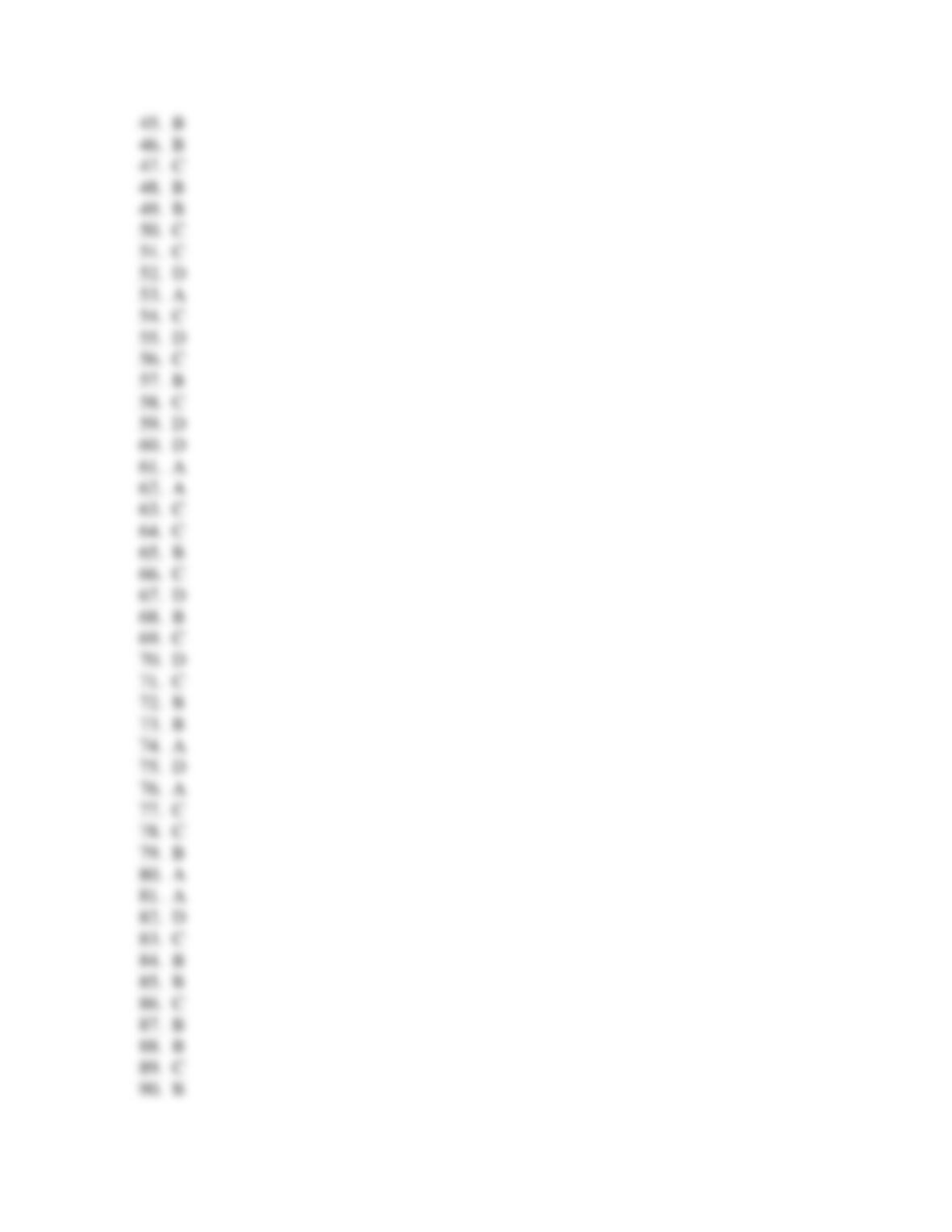
Page 47
45.
B
46.
B
47.
C
48.
B
49.
B
50.
C
51.
C
52.
D
53.
A
54.
C
55.
D
56.
C
57.
B
58.
C
59.
D
60.
D
61.
A
62.
A
63.
C
64.
C
65.
B
66.
C
67.
D
68.
B
69.
C
70.
D
71.
C
72.
B
73.
B
74.
A
75.
D
76.
A
77.
C
78.
C
79.
B
80.
A
81.
A
82.
D
83.
C
84.
B
85.
B
86.
C
87.
B
88.
B
89.
C
90.
B
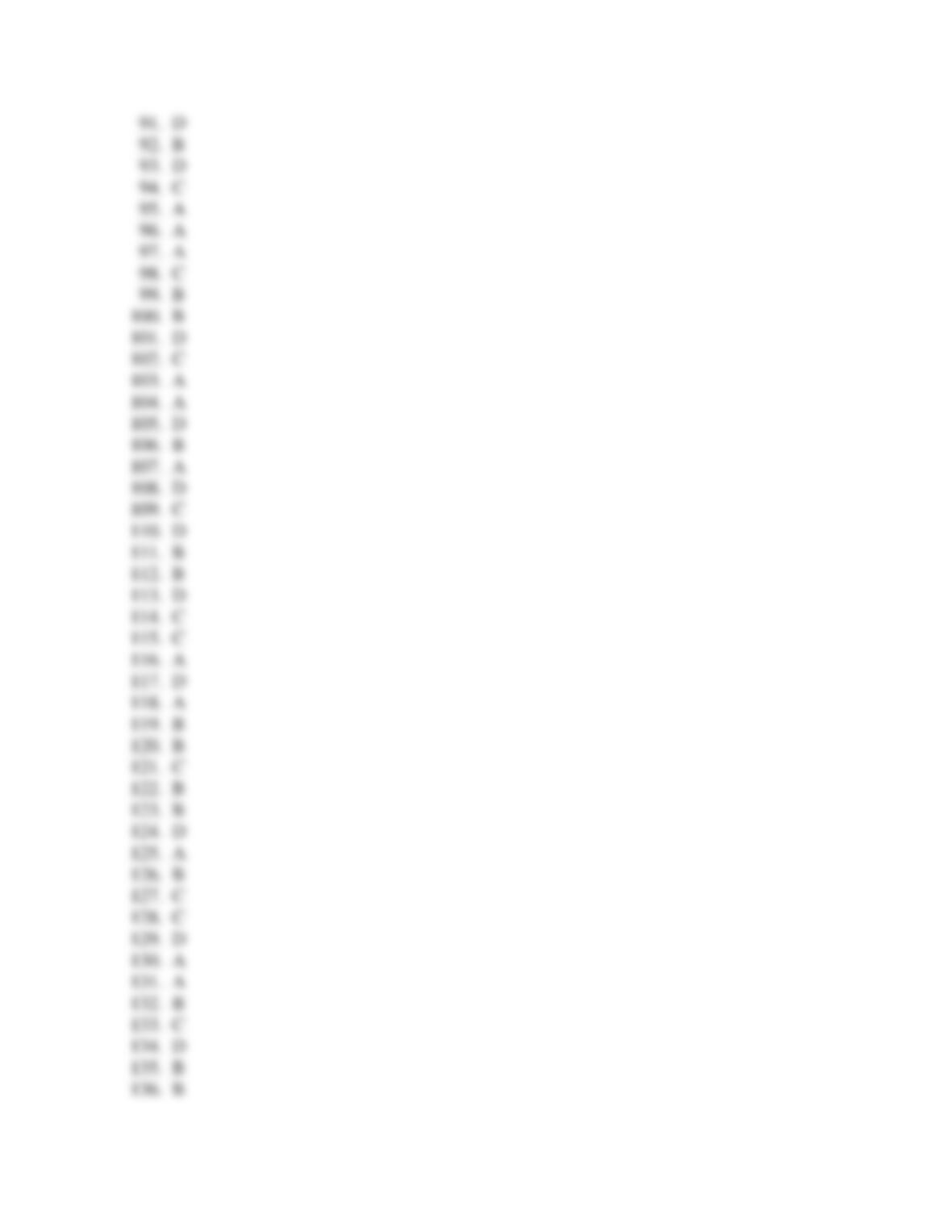
Page 48
91.
D
92.
B
93.
D
94.
C
95.
A
96.
A
97.
A
98.
C
99.
B
100.
B
101.
D
102.
C
103.
A
104.
A
105.
D
106.
B
107.
A
108.
D
109.
C
110.
D
111.
B
112.
B
113.
D
114.
C
115.
C
116.
A
117.
D
118.
A
119.
B
120.
B
121.
C
122.
B
123.
B
124.
D
125.
A
126.
B
127.
C
128.
C
129.
D
130.
A
131.
A
132.
B
133.
C
134.
D
135.
B
136.
B
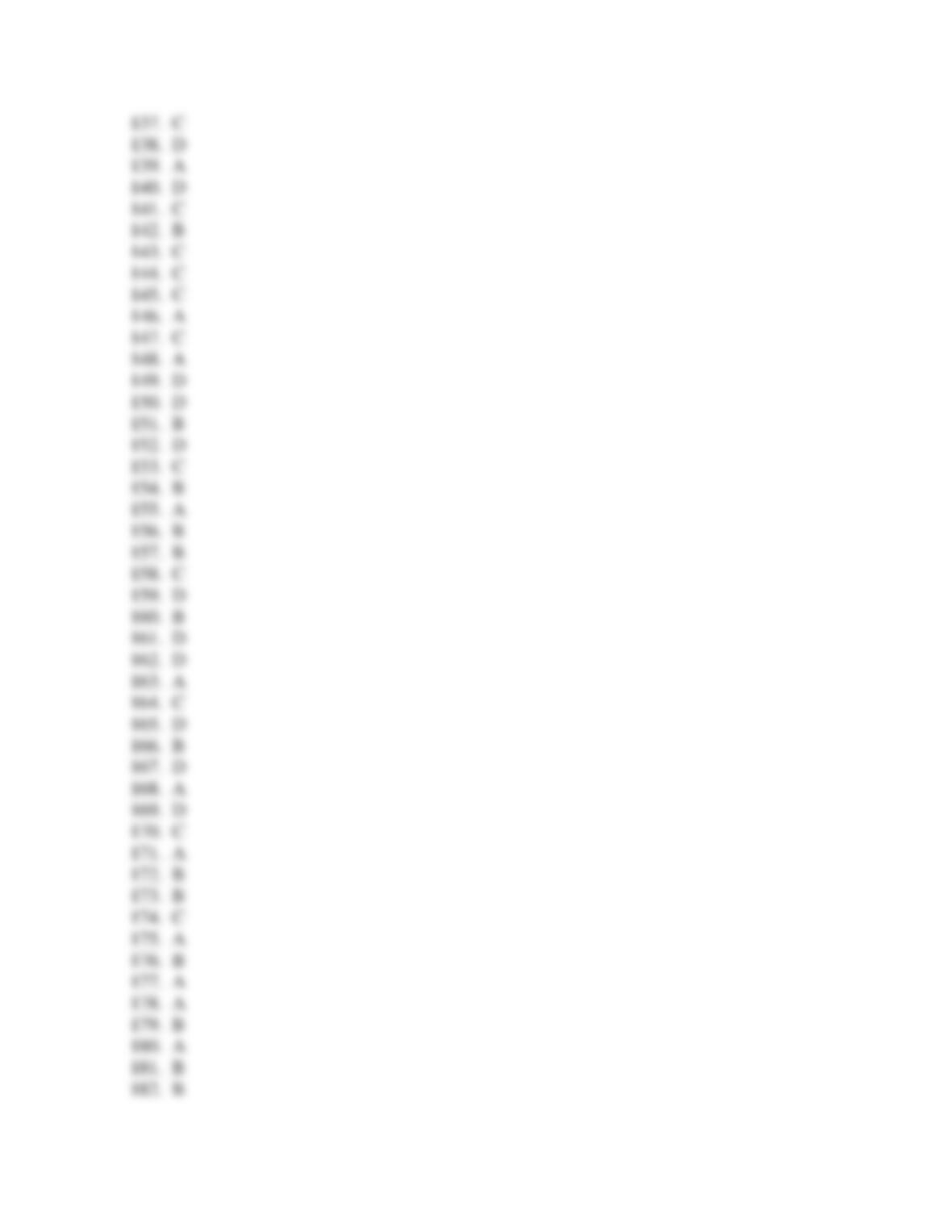
Page 49
137.
C
138.
D
139.
A
140.
D
141.
C
142.
B
143.
C
144.
C
145.
C
146.
A
147.
C
148.
A
149.
D
150.
D
151.
B
152.
D
153.
C
154.
B
155.
A
156.
B
157.
B
158.
C
159.
D
160.
B
161.
D
162.
D
163.
A
164.
C
165.
D
166.
B
167.
D
168.
A
169.
D
170.
C
171.
A
172.
B
173.
B
174.
C
175.
A
176.
B
177.
A
178.
A
179.
B
180.
A
181.
B
182.
B
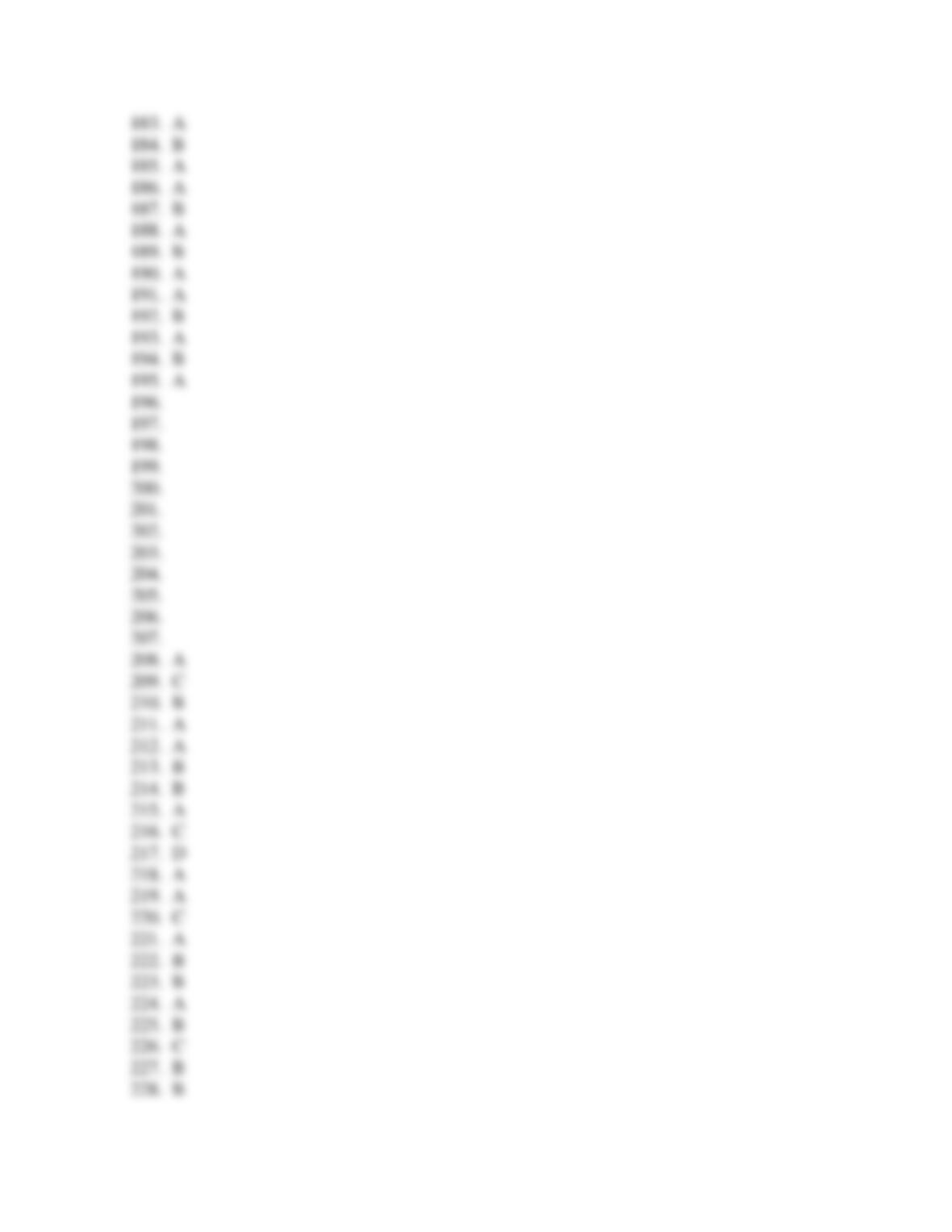
Page 50
183.
A
184.
B
185.
A
186.
A
187.
B
188.
A
189.
B
190.
A
191.
A
192.
B
193.
A
194.
B
195.
A
196.
197.
198.
199.
200.
201.
202.
203.
204.
205.
206.
207.
208.
A
209.
C
210.
B
211.
A
212.
A
213.
B
214.
B
215.
A
216.
C
217.
D
218.
A
219.
A
220.
C
221.
A
222.
B
223.
B
224.
A
225.
B
226.
C
227.
B
228.
B

Page 51
229.
B
230.
C
231.
B
232.
C
233.
A
234.
B