Page 1
Name: __________________________ Date: _____________
1.
What distinction did Zimbabwe achieve in June 2008?
A)
It was the first African nation to become a democracy.
B)
It ended apartheid.
C)
It had the world’s highest inflation rate.
D)
It had the world’s highest unemployment rate.
2.
During hyperinflation in Germany in 1922–1923, prices rose at _____% per day.
A)
0.1
B)
16
C)
50
D)
100
3.
Workers in country A have wage contracts for cost-of-living adjustments (COLAs),
which adjust wages to offset the effect of inflation, and workers in country B do not.
When the central banks of countries A and B increase the money supply:
A)
prices in country A increase faster than prices in country B.
B)
prices in country B increase faster than prices in country A.
C)
prices in countries A and B will change at the same rate.
D)
COLAs have no effect on the speed of price changes.
4.
Inflation does NOT reduce purchasing power if:
A)
prices of essential products, such as food and gasoline, don’t increase too much.
B)
nominal wages rise at the same rate as prices.
C)
it remains under 10% per year.
D)
the Federal Reserve increases the money supply enough to offset it.
5.
In the classical model, it is thought that the long-run:
A)
and short-run aggregate supply curves are both upward sloping.
B)
aggregate supply curve is vertical and the short-run aggregate supply curve is
upward sloping.
C)
and short-run aggregate supply curves are both vertical.
D)
aggregate supply curve is upward sloping and the short-run aggregate supply curve
is vertical.
Page 2
6.
The notion that the real quantity of money is always at its long-run equilibrium level is
associated with the _____ of the price level.
A)
classical model
B)
Keynesian model
C)
monetarist model
D)
modern view
Use the following to answer question 7:
7.
(Figure: AD–AS Model) Refer to Figure: AD–AS Model. Suppose that the economy is at
YE with a price level of P1. Which of the following would represent the new long-run
equilibrium position if the aggregate demand curve shifted to the right from AD1 to AD2
as a result of an increase in the money supply?
A)
YE and P2
B)
YE and P1
C)
Y1 and P2
D)
YE and P3
8.
Which of the following is the BEST explanation for an upward-sloping short-run
aggregate supply curve?
A)
Prices are perfectly flexible.
B)
Wages are perfectly flexible.
C)
Wages and prices of some goods are sticky in the short run.
D)
Wages and prices of some goods are flexible in the short run but sticky in the long
run.
Page 3
9.
Assume that workers and businesses are sensitized to inflation and are quick to raise
wages and prices in response to changes in the money supply. This implies that inflation
is _____ and there are _____ adjustments of wages and prices of intermediate goods.
A)
high; quick
B)
low; quick
C)
high; slow
D)
low; slow
10.
The classical model of the price level is most likely to be a good approximation of
reality during periods of:
A)
recession.
B)
high unemployment.
C)
low inflation.
D)
high inflation.
11.
In the short run in periods of low inflation, an increase in aggregate demand from a
position of full employment leads to:
A)
higher prices and higher unemployment.
B)
higher prices and higher output.
C)
lower prices and higher output.
D)
lower prices and higher unemployment.
12.
In the long run, an increase in aggregate demand from a position of full employment
leads to:
A)
higher prices and higher output.
B)
higher prices and the same output.
C)
higher output and lower prices.
D)
higher output and higher unemployment.
Use the following to answer questions 13-16:

Page 4
13.
(Figure: Classical Model of the Price Level) Refer to Figure: Classical Model of the
Price Level. If the central bank increases the money supply such that aggregate demand
shifts from AD1 to AD2, according to this classical model, real GDP will:
A)
not change.
B)
increase from YE to Y1.
C)
increase from Y1 to YE.
D)
establish a new potential output.
14.
(Figure: Classical Model of the Price Level) Refer to Figure: Classical Model of the
Price Level. If the central bank increases the money supply such that aggregate demand
shifts from AD1 to AD2, according to this classical model, the price level will:
A)
not change.
B)
increase from P1 to P2.
C)
increase from P1 to P3.
D)
decrease from P1 to P2.
15.
(Figure: Classical Model of the Price Level) Refer to Figure: Classical Model of the
Price Level. If the central bank increases the money supply such that aggregate demand
shifts from AD1 to AD2, according to this classical model, the SRAS will:
A)
not change, since in the classical model the SRAS and LRAS are both vertical at
potential output.
B)
decrease from SRAS1 to SRAS2.
C)
increase from SRAS2 to SRAS1.
D)
increase from SRAS1 to SRAS2.
16.
(Figure: Classical Model of the Price Level) Refer to Figure: Classical Model of the
Price Level. If the central bank increases the money supply such that aggregate
demand shifts from AD1 to AD2, according to this classical model, the equilibrium point
will:
A)
not change.
B)
immediately move from E1 to E2.
C)
immediately move from E2 to E1.
D)
immediately move from E1 to E3.
17.
During periods of low inflation, the short-run aggregate supply curve is:
A)
vertical.
B)
horizontal.
C)
upward sloping.
D)
downward sloping.

Page 5
18.
During periods of high inflation, the short-run aggregate supply curve is:
A)
vertical.
B)
horizontal.
C)
upward sloping.
D)
downward sloping.
19.
In the long run, any given percentage increase in the money supply:
A)
decreases real GDP.
B)
leads to an equal percentage increase in the overall price level.
C)
increases real GDP.
D)
leads to an equal percentage decrease in the unemployment rate.
20.
If the monetary authorities decide to increase the nominal money supply by 10% when
the economy is at its full-employment level of output, in the long run the aggregate price
level increases by _____% and real GDP _____.
A)
10; increases by 10%
B)
5; increases by 5%, according to Okun’s law
C)
10; returns to the potential level of output
D)
5; increases by 20%, given a marginal propensity to consume of 0.5
21.
The main difference between the classical model of the price level and the modern
understanding of the relationship between the money supply, the price level, and real
GDP is that according to classical economists, _____, while today’s economists _____.
A)
money is neutral in the long run; do not consider money to be neutral in the long
run.
B)
the adjustment of prices takes some time; expect changes in the money supply to be
instantaneous.
C)
did not consider money to be neutral in the long run; consider money neutral in the
long run.
D)
the adjustment of prices to changes in the money supply is instantaneous; argue
that this adjustment process takes some time.
22.
Historical evidence has led economists to conclude that during periods of high inflation,
the _____ model of the price level is a good approximation of reality because nominal
wages and prices adjust more _____ than during periods of low inflation.
A)
classical; quickly
B)
modern; slowly
C)
classical; slowly
D)
modern; quickly
Page 6
23.
As people get used to inflation:
A)
the short-run aggregate demand curve adjusts more rapidly.
B)
wages adjust faster, and the short-run aggregate supply shifts quickly to the right.
C)
wages adjust faster, and the short-run aggregate supply shifts quickly to the left.
D)
the long-run aggregate demand adjusts more slowly.
24.
In economies with persistently high inflation, an increase in the money supply will:
A)
translate into a proportional increase in the aggregate price level much faster than
usual.
B)
translate into a proportional increase in the aggregate price level only in the long
run.
C)
not affect either the aggregate price level or the aggregate output.
D)
translate into a proportional increase in the aggregate output much faster than
usual.
25.
In economies with persistently high inflation, an increase in the money supply will have:
A)
a positive effect on the real quantity of money in the long run.
B)
a negative effect on the real quantity of money, as the aggregate price level
increases by more than the money supply.
C)
a positive effect on the aggregate real output in the long run.
D)
no effect on the real quantity of money, making money neutral in the long run.
Use the following to answer questions 26-30:
Page 7
26.
(Figure: AD–AS) Refer to Figure: AD–AS. Suppose that the economy is initially at E1,
where AD1 intersects SRAS1 and LRAS. Now, suppose that the AD1 shifts to AD2. That
shift could be due to a(n):
A)
increase in the aggregate price level.
B)
decrease in government expenditure.
C)
increase in tax rates.
D)
increase in money supply.
27.
(Figure: AD–AS) Refer to Figure: AD–AS. Suppose that the economy starts at E1 and
moves to E2, where AD2 intersects SRAS1. SRAS1 will shift to SRAS2 because:
A)
real wages rise in the long run.
B)
nominal wages rise in the long run.
C)
the real money supply rises in the long run.
D)
aggregate real output rises in the long run.
28.
(Figure: AD–AS) Refer to Figure: AD–AS. Suppose that the economy starts at E1 and
moves to E2, where AD2 intersects SRAS1. Finally, the economy moves to E3. The
classical model of price level assumes that the economy moves from _____; thus,
inflation _____ and real GDP _____.
A)
E1 to E3, ignoring E2; increases; remains the same
B)
E2 to E3, ignoring E1; remains the same; increases
C)
E2 to E3; decreases; remains the same
D)
E1 to E2, ignoring E3; remains the same; remains the same
29.
(Figure: AD–AS) Refer to Figure: AD–AS. If our economy is at equilibrium with
low-level inflation and the Fed uses expansionary monetary policy, the initial effect is
that _____ will shift to _____ and the economy will move from _____.
A)
AD1; AD2; E1 to E2
B)
SRAS1; SRAS2; E2 to E3
C)
SRAS2; SRAS1; E3 to E2
D)
AD2; AD1; E2 to E1
30.
(Figure: AD–AS) Refer to Figure: AD–AS. If our economy is at equilibrium and the Fed
uses expansionary monetary policy, _____ will shift to _____ and the economy will
move from _____. Then nominal wages will _____ and _____ will shift to _____. The
economy will move from _____.
A)
AD2; AD1; E2 to E1; rise; SRAS1; SRAS2; E2 to E3
B)
SRAS1 ; SRAS2 ; E2 to E3; stay the same; AD2; AD1; E2 to E1
C)
SRAS2; SRAS1; E3 to E2; stay the same; AD2; AD1; E2 to E1
D)
AD1; AD2; E1 to E2; rise; SRAS1; SRAS2; from E2 to E3

Page 8
31.
According to the classical model of the price level, an increase in the money supply will
cause _____ and _____ increase in real GDP.
A)
inflation; no long-run
B)
inflation; a long-run
C)
no inflation; a long-run
D)
deflation; no long-run
32.
When the Treasury Department borrows from the public to finance the government’s
purchases of goods and services and the Fed buys the debt back from the public in the
form of Treasury bills, it is known as:
A)
moral suasion.
B)
money illusion.
C)
structuring the deficit.
D)
monetizing the debt.
33.
The inflation tax is the effect on the public of the:
A)
higher tax paid by individuals whose incomes are indexed to inflation.
B)
sales taxes paid during periods of inflation.
C)
reduction in the value of money caused by inflation.
D)
higher prices consumers pay due to inflation.
34.
If the Fed increases the monetary base by $40 billion through open-market operations:
A)
GDP will increase by $40 billion.
B)
the price level will increase by $40 billion.
C)
the U.S. government debt held by the public has been reduced by $40 billion.
D)
government spending has increased by $40 billion.
35.
The inflation tax is the effect on the public of:
A)
the increase in the real value of money caused by inflation.
B)
the decrease in the real value of money caused by inflation.
C)
the result of indexing wages to inflation.
D)
cost of living adjustments.
36.
Government debt is monetized when:
A)
commercial banks buy newly issued Treasury bills.
B)
the Fed conducts open-market purchases.
C)
the Fed transfers part of its financial reserves to the Treasury, which in turn buys
Treasury bills back.
D)
the Fed sells Treasury bills in the bond market.
Page 9
37.
Fiat money is:
A)
money backed by gold.
B)
money that only the government will accept to pay taxes.
C)
paper money with no intrinsic value.
D)
used only in the United States as a medium of exchange.
38.
The Fed monetizes the debt when it:
A)
prints money and buys government debt from the public.
B)
sells bonds.
C)
decreases the money supply.
D)
targets interest rates.
39.
The inflation tax is likely to be high when:
A)
there is a budget surplus.
B)
the government relies on seignorage to finance large portions of a budget deficit.
C)
the Fed decreases the money supply.
D)
corporate and personal income tax rates are increased.
40.
If the money held by the public is $3 billion and inflation is 6%, the inflation tax is:
A)
$3.18 billion.
B)
$50 billion.
C)
$180 million.
D)
$1.8 billion.
41.
Economists call the revenue generated by the government’s right to print money:
A)
seignorage.
B)
monetary policy.
C)
fiscal policy.
D)
reserve policy.
42.
Seignorage is the:
A)
government’s cost of printing and coining money.
B)
revenue generated by the government’s right to print money.
C)
money financial institutions make selling government bonds to the Fed when the
Fed creates money.
D)
revenue the government generates in tax receipts.
Page 10
43.
Historically, governments have turned to seignorage to pay their bills when the:
A)
economy is growing.
B)
government lacks the will to reduce the budget deficit by raising taxes or reducing
spending.
C)
inflation rate is low.
D)
unemployment rate is low.
44.
An inflation tax is:
A)
the reduction in purchasing power due to inflation.
B)
a tax on businesses for raising prices.
C)
a tax on people with inflated incomes.
D)
an excise tax on new automobile tires.
45.
If the public holds $300 billion in monetary purchasing power and the inflation rate is
5%, then the inflation tax that year is:
A)
$5 billion.
B)
$15 billion.
C)
$60 billion.
D)
$1,500 billion.
46.
Seignorage refers to the:
A)
problems faced by Social Security as the population ages.
B)
government’s right to print money.
C)
problems senior citizens face in retirement.
D)
problems created when the government prints too much money.
47.
The inflation tax refers to:
A)
moving into higher tax brackets.
B)
the reduction in the real value of money when inflation falls.
C)
the reduction in the real value of money when inflation rises.
D)
the tax imposed on inflation by the government.
48.
When a central bank prints money to pay government debts, causing rising prices that
erode the purchasing power of money held by the public, it is called a(n) _____ tax.
A)
payroll
B)
inflation
C)
currency
D)
budget
Page 11
49.
Real seignorage is calculated by the:
A)
real interest rate times the money supply.
B)
rate of growth of the money supply times the real money supply.
C)
real interest rate minus the inflation rate.
D)
rate of growth of the money supply divided by the price index.
50.
If a high inflation rate leads people to _____ their money holdings, this may lead to a
further increase in the money supply and _____ inflation.
A)
reduce; lower
B)
increase; lower
C)
reduce; higher
D)
increase; higher
51.
As people try to avoid the inflation tax, the government must _____ the inflation rate to
_____.
A)
lower; avoid a budget deficit
B)
lower; raise the same revenue from inflation
C)
increase; raise the same revenue from inflation
D)
increase; avoid a budget surplus, which will harm employment
52.
A large inflation tax does NOT cause people to:
A)
substitute real goods for money.
B)
substitute interest-bearing assets for money.
C)
reduce their real money holdings.
D)
sell gold.
53.
If the money supply grows by 4% and the real money supply is $100 billion, real
seignorage is:
A)
$4 billion.
B)
$25 billion.
C)
$400 billion.
D)
$2.5 trillion.
54.
If the real money supply is $500 billion and the money supply grows by 2%, then real
seignorage is:
A)
$25 trillion.
B)
$1 trillion.
C)
$10 billion.
D)
$1 billion.
Page 12
55.
From 2000 to 2008 Zimbabwe’s prices:
A)
decreased by 50%.
B)
increased by 50%.
C)
increased by 100%.
D)
increased by 80 trillion percent.
56.
Zimbabwe’s economic instability was caused primarily by:
A)
its joining the Coalition of the Willing in the Iraq war.
B)
its attempts to join the European Union.
C)
the government’s seizure of the country’s farms, which disrupted production.
D)
its high tariffs on imported goods.
57.
Politicians have an incentive to push the unemployment rate below the natural rate of
unemployment right before their reelection because the:
A)
expansionary monetary policy is used to finance the political campaigns.
B)
political benefits are immediate and the economic costs are delayed.
C)
Phillips curve is horizontal in the long run.
D)
opportunistic seignorage gains are very large.
58.
If an administration pursues expansionary policy before an election to bring down
unemployment, it can:
A)
produce inflation only if the real interest rate is zero to begin with.
B)
lower people’s expectations about inflation through a sense of false complacency.
C)
produce inflation if the targeted rate of unemployment is too low.
D)
produce disinflation if the expansionary monetary policy is unanticipated.
59.
Politicians may accept moderate inflation in an election year, since the _____ in
aggregate _____ serves to _____.
A)
increase; supply; increase output
B)
decrease; supply; decrease employment
C)
decrease; demand; decrease output
D)
increase; demand; increase output
60.
Politicians may accept moderate inflation in an election year, since the _____ in
aggregate _____ serves to _____.
A)
increase; supply; decrease employment
B)
decrease; supply; increase employment
C)
decrease; demand; increase output
D)
increase; demand; increase employment
Page 13
61.
When the output gap is negative, the actual unemployment rate is:
A)
above the natural rate.
B)
below the natural rate.
C)
equal to the natural rate.
D)
The actual and natural unemployment rates are not related to the output gap.
62.
Which statement is likely to be TRUE if actual output is equal to potential output?
A)
The actual unemployment rate is equal to the natural rate of unemployment.
B)
The actual unemployment rate is above the natural rate of unemployment.
C)
There will be zero unemployment.
D)
The natural rate of unemployment will be above the actual unemployment rate.
63.
When the output gap is _____, reflecting an inflationary gap, the unemployment rate is
_____ the natural rate of unemployment.
A)
positive; above
B)
negative; below
C)
positive; below
D)
negative; above
64.
When the actual unemployment rate is equal to the natural rate of unemployment:
A)
the unemployment rate is zero.
B)
potential output exceeds actual output.
C)
the output gap is zero.
D)
actual output exceeds potential output.
65.
If potential output is higher than actual output, then the unemployment rate is:
A)
below the natural rate.
B)
above the natural rate.
C)
equal to the natural rate.
D)
zero.
66.
When the output gap is positive, the unemployment rate is:
A)
positive.
B)
above the natural rate.
C)
below the natural rate.
D)
negative.
Page 14
Use the following to answer questions 67-74:
67.
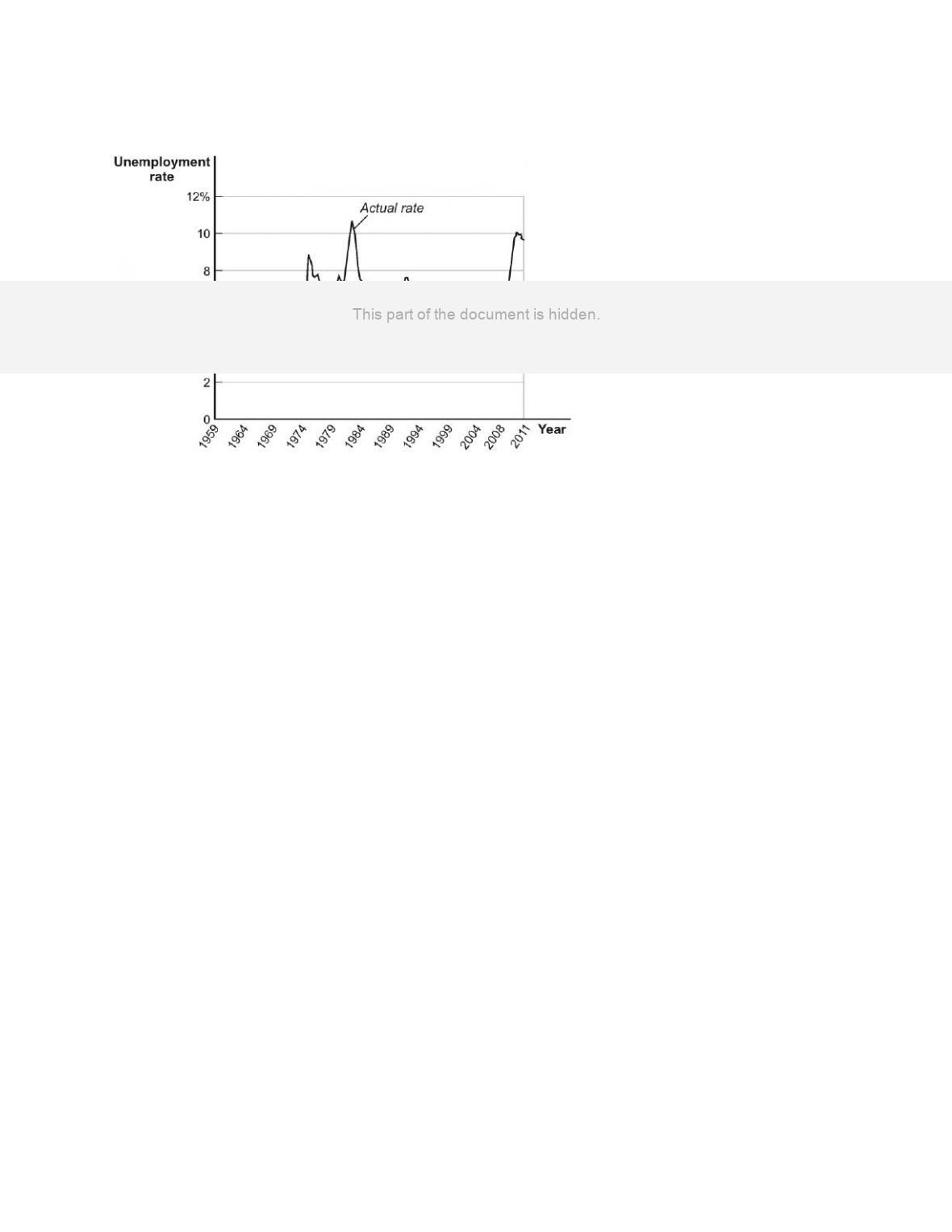
(Figure: Actual and Natural Rates of Unemployment) Refer to Figure 16-4: Actual and
Natural Rates of Unemployment. In 1982, the actual unemployment rate was
approximately:
A)
zero.
B)
4%.
C)
6%.
D)
10%.
68.
(Figure: Actual and Natural Rates of Unemployment) Refer to Figure 16-4: Actual and
Natural Rates of Unemployment. In 1982, the cyclical unemployment rate was
approximately:
A)
zero.
B)
4%.
C)
6%.
D)
10%.
69.
(Figure: Actual and Natural Rates of Unemployment) Refer to Figure 16-4: Actual and
Natural Rates of Unemployment. In 1982, the natural unemployment rate (structural
plus frictional) was approximately:
A)
zero.
B)
4%.
C)
6%.
D)
10%.
Page 15
70.
(Figure: Actual and Natural Rates of Unemployment) Refer to Figure: Actual and
Natural Rates of Unemployment. In 2011, the actual unemployment rate was
approximately:
A)
zero.
B)
3%.
C)
5%.
D)
10%.
71.
(Figure: Actual and Natural Rates of Unemployment) Refer to Figure: Actual and
Natural Rates of Unemployment. In 2011, the natural unemployment rate was
approximately:
A)
zero.
B)
3%.
C)
5.5%.
D)
9%.
72.
(Figure: Actual and Natural Rates of Unemployment) Refer to Figure: Actual and
Natural Rates of Unemployment. In 2011, the amount of cyclical unemployment was
approximately:
A)
2%
B)
40.5%
C)
9%
D)
14%
73.
(Figure: Actual and Natural Rates of Unemployment) Refer to Figure: Actual and
Natural Rates of Unemployment. In 2011 the output gap was:
A)
positive.
B)
negative.
C)
zero.
D)
impossible to determine without more information.
74.
(Figure: Actual and Natural Rates of Unemployment) Refer to Figure: Actual and
Natural Rates of Unemployment. In 2000, the output gap was:
A)
positive.
B)
negative.
C)
zero.
D)
impossible to determine without more information.
Page 16
75.
When the output gap is _____, the unemployment rate is _____ the natural rate.
A)
negative; below
B)
zero; zero
C)
inflationary; above
D)
positive; below
76.
Suppose that actual aggregate output is equal to the potential output; the actual
unemployment rate is:
A)
equal to the natural rate of unemployment.
B)
higher than the natural rate of unemployment.
C)
zero.
D)
equal to the cyclical rate of unemployment.
77.
The difference between real GDP and potential GDP is known as the:
A)
price gap.
B)
unemployment gap.
C)
output gap.
D)
budget deficit.
78.
If an economy has just had a serious recession but real GDP is expanding once again,
we can expect the unemployment rate to:
A)
fall immediately.
B)
rise immediately.
C)
rise if people who were previously discouraged enter the work force but do not find
jobs right away.
D)
fall if people who were previously discouraged enter the work force but do not find
jobs right away.
79.
The unemployment rate will fall if potential output growth is:
A)
higher than actual output growth.
B)
lower than actual output growth.
C)
equal to actual output growth.
D)
higher than the inflation rate.
80.
If actual output growth is 5% when potential output growth is 5%, then the
unemployment rate will:
A)
not change.
B)
rise.
C)
fall.
D)
be zero.
Page 17
81.
The idea that a 1% increase in the output gap will decrease the unemployment rate by
0.5% is known as _____ law.
A)
Okun’s
B)
Phillips’s
C)
Greenspan’s
D)
Keynes’s
82.
The relationship between the output gap and cyclical unemployment is expressed by:
A)
the real business cycle theory.
B)
the Taylor rule.
C)
the natural rate hypothesis.
D)
Okun’s law.
83.
The natural rate of unemployment is 4%, and the economy is producing 95% of its
potential output. Okun’s law predicts an unemployment rate of _____%.
A)
4
B)
5
C)
6.5
D)
9
84.
According to recent estimates of Okun’s law, if the unemployment rate fell by a full
percentage point, it would most probably be attributable to a _____ in real GDP.
A)
3% increase
B)
2% increase
C)
1% increase
D)
3% decrease
85.
Assume that the economy is contracting and unemployment is rising. Which of the
following would be a logical explanation for a sudden fall in the unemployment rate
even while the economy continues to contract?
A)
a reduction in the number of discouraged workers
B)
an increase in the number of discouraged workers
C)
an increase in the level of employment
D)
a decrease in the level of employment
Page 18
86.
According to current estimates of Okun’s law, if the output gap is 3%, the natural rate of
unemployment is 4%, and the expected rate of inflation is 5%, then the unemployment
rate is _____%.
A)
3.5
B)
3
C)
2.5
D)
1.5
87.
Okun’s law suggests that a _____% increase in a positive output gap _____ the
unemployment rate by _____%.
A)
1; increases; 0.5
B)
1; decreases; 0.5
C)
0.5; increases; 1
D)
0.5; decreases; 1
88.
Okun’s law is less than a 1:1 ratio because some:
A)
employers quickly lay off workers.
B)
employers change the working hours of current employees as demand changes.
C)
employees act to job share.
D)
workers are not counted as unemployed when they are actively seeking work.
89.
If the natural rate of unemployment is 5% and the actual rate of unemployment is 4%:
A)
disinflation is likely.
B)
it will not affect prices.
C)
inflation will increase.
D)
the short-run Phillips curve will shift down.
90.
A supply shock caused by an increase in the price of gasoline causes a(n) _____ in
output and a(n) _____ in prices.
A)
decrease; decrease
B)
decrease; increase
C)
increase; increase
D)
increase; decrease
91.
According to the short-run Phillips curve, when actual real GDP is _____ potential
output, the price level _____ and the unemployment rate falls.
A)
below; increases
B)
above; decreases
C)
below; decreases
D)
above; increases
Page 19
92.
The short-run Phillips curve shows:
A)
a direct relationship between unemployment and inflation.
B)
an inverse relationship between unemployment and inflation.
C)
consequences of the misperceptions theory.
D)
the optimal level of employment.
93.
The short-run Phillips curve represents the relationship between the unemployment rate
and the rate of change in:
A)
the interest rate.
B)
output.
C)
wages only.
D)
the aggregate price level.
94.
A supply shock:
A)
moves our economy along the short-run aggregate supply curve.
B)
moves us along the short-run Phillips curve.
C)
shifts the short-run Phillips curve.
D)
shifts the short-run aggregate supply curve but not the short-run Phillips curve.
95.
In 1958, _____ came up with a theory regarding the trade-off between unemployment
and inflation.
A)
A. W. H. Phillips
B)
John Maynard Keynes
C)
Joseph Schumpeter
D)
Milton Friedman
96.
_____ depicts a trade-off between unemployment and inflation.
A)
The Phillips curve
B)
Keynes’s law
C)
The multiplier
D)
The Friedman curve
97.
The notion that there is a trade-off between inflation and unemployment is expressed as
a _____ curve.
A)
Phillips
B)
Keynes
C)
Schumpeter
D)
Friedman
Page 20
98.
A Phillips curve implies a negative relationship between:
A)
consumption and saving.
B)
inflation and prices.
C)
inflation and unemployment.
D)
consumption and inflation.
99.
Each point on a Phillips curve is a different combination of:
A)
price and quantity.
B)
inflation and unemployment.
C)
the interest rate and investment.
D)
saving and disposable income.
100.
Along a Phillips curve:
A)
consumption depends on prices.
B)
the inflation rate varies inversely with the unemployment rate.
C)
the inflation rate varies directly with the unemployment rate.
D)
prices and tax rates are directly related.
101.
Suppose that the unemployment rate rises as the inflation rate declines. This situation is
consistent with a movement along the _____ Phillips curve.
A)
vertical
B)
horizontal
C)
positively sloped
D)
negatively sloped
102.
The short-run Phillips curve is:
A)
upward sloping because inflation and unemployment rates have a positive
relationship in the short run.
B)
vertical because there is no trade-off between inflation and unemployment rates in
the short run.
C)
downward sloping because there is a trade-off between inflation and
unemployment rates in the short run.
D)
horizontal because there is no trade-off between inflation and unemployment rates
in the short run.