Page 55
244.
Markets that are characterized by many buyers and many sellers are:
A)
inefficient.
B)
competitive.
C)
foreign.
D)
monopolies.
245.
Alice goes to the local supermarket to purchase one package of kale. She often pays
$1.50 for a package, but she finds they are on sale for $1 each. According to the law of
demand, one can expect shoppers like Alice to:
A)
purchase an alternative good.
B)
purchase more kale than they normally would.
C)
decide not to purchase kale .
D)
buy the same amount of kale as they always do, on average.
246.
When the price of a good increases and the quantity demanded decreases, this
demonstrates:
A)
efficiency
B)
the law of demand
C)
the supply schedule
D)
the production possibilities frontier
247.
Recent research suggests that certain plastic containers may have cancer-causing
particles in them. As a result of this research being made public, one would expect:
A)
the demand for such containers to decrease.
B)
the quantity demanded for such containers to increase.
C)
no effect.
D)
the price of the containers to change because of a movement along the demand
curve.
248.
Good X and good Y are related. If the price of good X increases and the demand for
good Y shifts left, these goods are:
A)
complements.
B)
substitutes.
C)
inferior.
D)
normal.
Page 56
249.
Suppose oranges and clementines are substitutes. Holding everything else constant, if
the price of oranges increases, then the demand for _____ will _____.
A)
clementines; increase
B)
clementines; decrease
C)
oranges; increase
D)
oranges; decrease
250.
Good X and good Y are related goods. Holding everything else constant, if the price of
good X decreases and the demand for good Y increases, good X and good Y are
probably:
A)
complements.
B)
substitutes.
C)
inferior.
D)
normal.
251.
Good X and good Y are substitutes. Holding all other things constant, this means that,
when the price of good X increases, the demand for:
A)
good X will increase.
B)
good Y will increase.
C)
both good X and good Y will increase.
D)
good Y will decrease.
252.
Holding all other things constant, and assuming that ramen noodles are an inferior good
for Vanessa, then as her income increases, her demand curve for ramen noodles:
A)
will shift left.
B)
will shift right.
C)
will not shift at all.
D)
may shift left or right, but we’re not sure by how much.
253.
If Benjamin considers sushi to be a normal good and if his income increases by 20%, his
purchases of sushi will:
A)
decrease by 20%.
B)
increase.
C)
decrease.
D)
not change.
Page 57
254.
The demand for a good will increase if:
A)
there is a decrease in the price of the good.
B)
the price of inputs needed in the production of the good decrease.
C)
there is an increase in the number of consumers in this market.
D)
the price of a complementary good increases.
255.
The horizontal summation of individual demand curves for a particular product, holding
the price constant and completed for all possible prices, gives you:
A)
market demand.
B)
market supply.
C)
complements in production.
D)
substitutes in production.
256.
Milk is an important ingredient in the production of ice cream. If the price of milk
increases, then one would expect, holding all other things constant:
A)
the supply curve for ice cream to shift left.
B)
the supply curve for ice cream to shift right.
C)
no change in the supply curve for ice cream.
D)
a movement along the supply curve for ice cream curve, resulting in more ice
cream supplied.
257.
High-fructose corn syrup, which is derived from corn, is an important ingredient in the
production of many soft drinks. If the price of corn increases, one would expect the:
A)
supply curve for soft drinks to shift left.
B)
quantity supplied of soft drinks to increase.
C)
demand for soft drinks to increase.
D)
supply curve for soft drinks to shift right.
258.
Which factor would NOT result in an increase in the supply of a good?
A)
a decrease in input prices
B)
a beneficial technological change
C)
an increase in the number of suppliers
D)
an increase in input prices
259.
A farmer finds that when he produces more corn, he also has more cornstalks that he
can sell as decorations. To the farmer, corn and cornstalks are:
A)
complements in production.
B)
substitutes in production.
C)
unrelated goods.
D)
inferior goods.
Page 58
260.
If two of a producer’s goods are substitutes in production, this suggests that the producer
(with her fixed set of resources) will need to reduce production of one good when she:
A)
produces less of the other good.
B)
produces more of the other good.
C)
has an increase in resources.
D)
produces more of the other good and has an increase in resources.
261.
Researchers find a new strain of genetically modified seeds that result in a higher yield
for corn producers. Holding all other things constant, this research will:
A)
shift the supply curve for corn left.
B)
increase the quantity supplied of corn.
C)
decrease the quantity supplied of corn.
D)
shift the supply curve for corn to the right.
262.
If suppliers expect prices for their product to rise next year, then one would expect a:
A)
shift in the demand curve for the product this year.
B)
decrease in the quantity demanded this year.
C)
shift to the left in the supply curve for the product this year.
D)
shift to the right in the supply curve for the product this year.
263.
The market for good Y, a perfectly competitive good, is made up of 15 producers who
each produce the same amount of good Y. If the price of good Y is $100 and the total
quantity supplied is 150, how many units of good Y is each producer supplying?
A)
10
B)
150
C)
100
D)
15
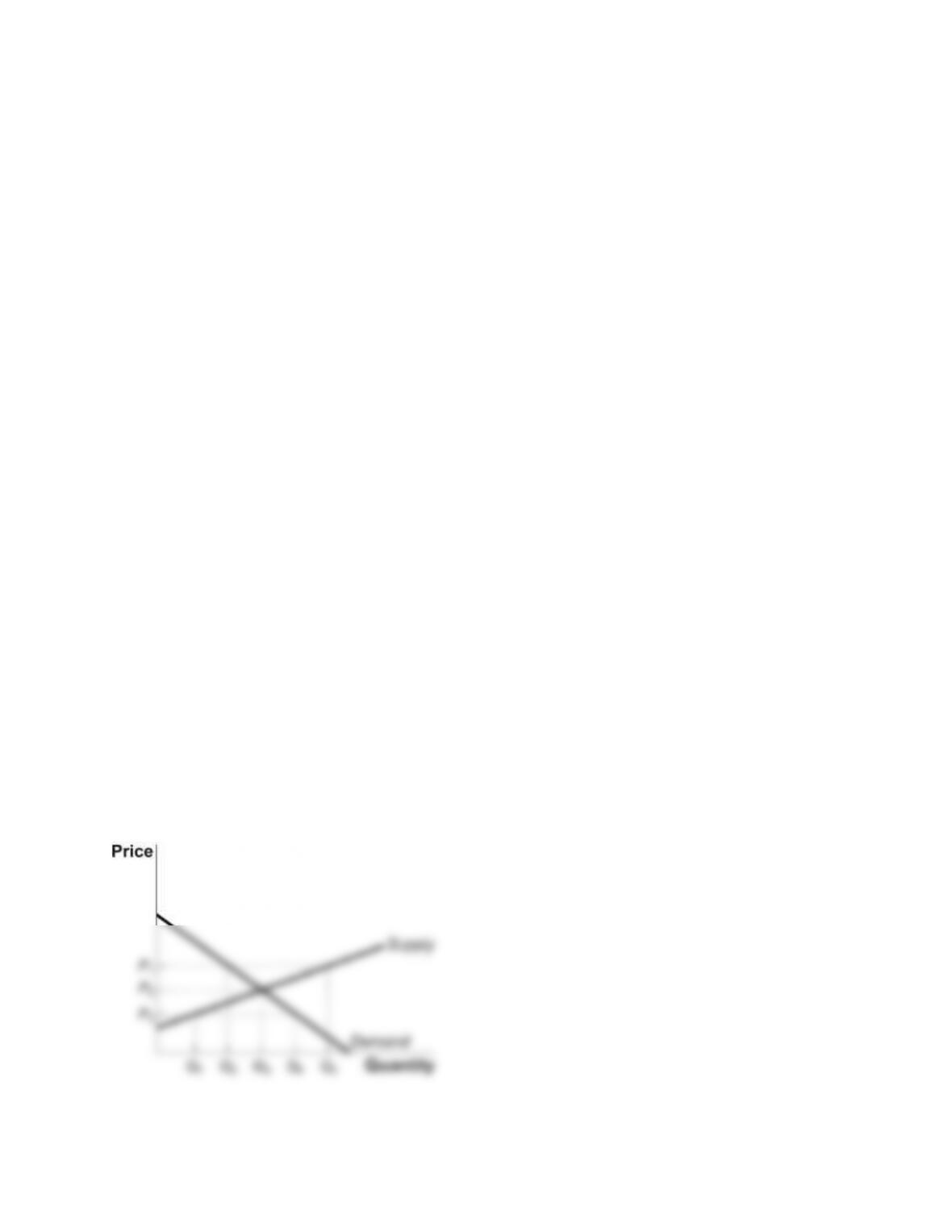
Use the following to answer questions 264-267:
Page 59
264.
(Table: Competitive Market for Good Z) Use Table: Competitive Market for Good Z. A
surplus of the good will occur at a price of
A)
$0.
B)
$5.
C)
$10.
D)
$15.
265.
(Table: Competitive Market for Good Z) Use Table: Competitive Market for Good Z.
The equilibrium price and quantity in this market are, respectively:
A)
$5 and 40 units.
B)
$20 and 60 units.
C)
$10 and 30 units.
D)
$10 and 60 units.
266.
(Table: Competitive Market for Good Z) Use Table: Competitive Market for Good Z. If
the demand curve for good Z is linear, it can be expressed as:
A)
Qd = 3P.
B)
Qd = 50 – 2P.
C)
Qd = Qs.
D)
Qd = 100 – 2P.
267.
(Table: Competitive Market for Good Z) Use Table: Competitive Market for Good Z. If
the supply curve for good Z is linear, it can be expressed as:
A)
Qs = 3P.
B)
Qs = 50 – 2P.
C)
Qs = 100 – 2P.
D)
Qs = Qd
Use the following to answer questions 268-269:
Page 60
268.
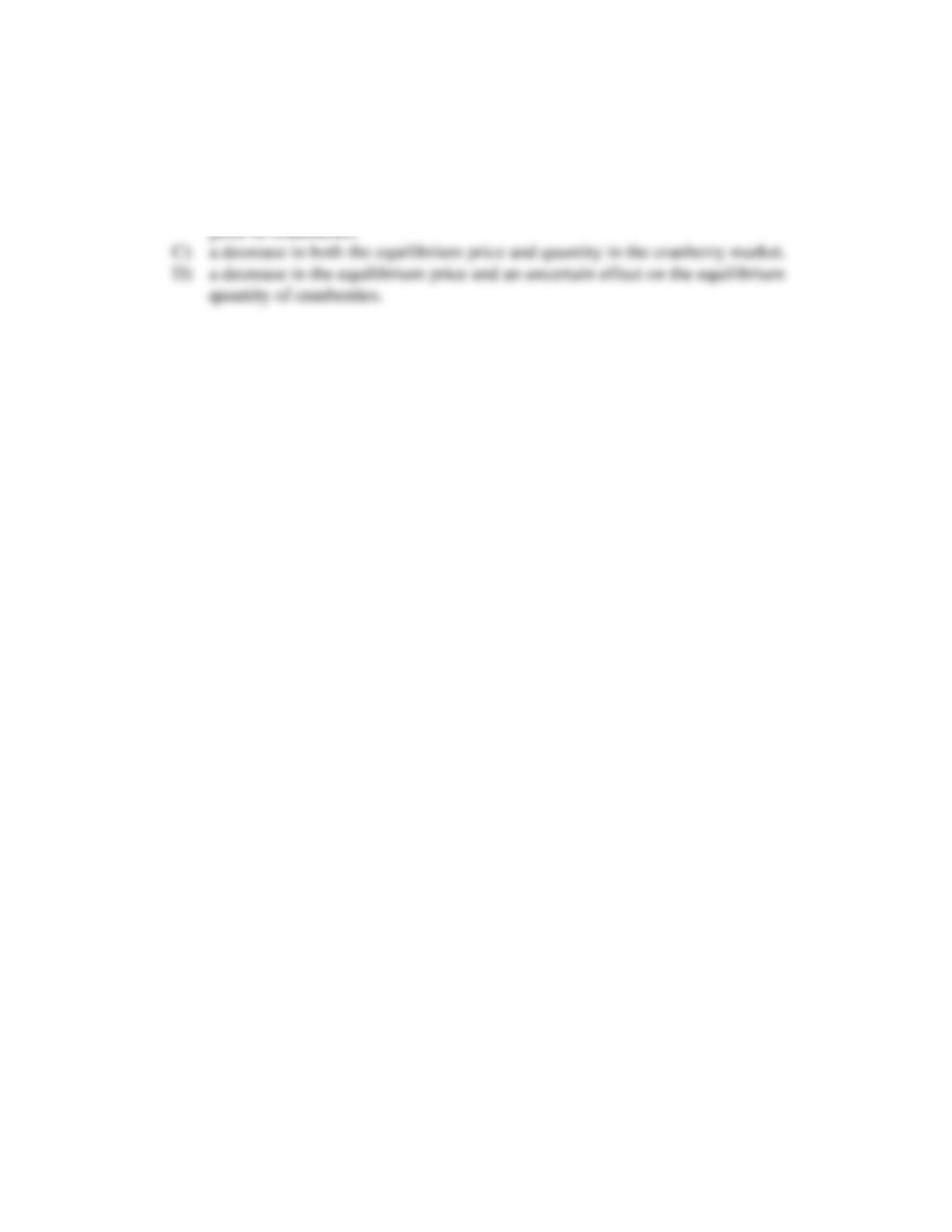
(Figure: The Market for Candy) Use Figure: The Market for Candy. Equilibrium occurs
at a price of _____, and the equilibrium quantity is equal to _____.
A)
P1; Q5
B)
P2; Q3
C)
P3; Q2
D)
P1; Q3
269.
(Figure: The Market for Candy) Use Figure: The Market for Candy. A surplus of the
good will exist at a price of:
A)
P1.
B)
P2.
C)
P3.
D)
There are no surpluses in this market.
270.
When a market is in equilibrium, the quantity:
A)
demanded is equal to zero.
B)
demanded is equal to quantity supplied.
C)
demanded is greater than quantity supplied.
D)
supplied is zero.
271.
Suppose that people expect the price of Bluetooth speakers to rise next year. As a result
of this expectation, people will MOST likely:
A)
purchase fewer Bluetooth speakers this year.
B)
observe higher prices for Bluetooth speakers this year.
C)
purchase the same amount of Bluetooth speakers since this expectation will have
no effect on consumers this year.
D)
decide to wait and purchase the Bluetooth speakers next year.
272.
Suppose that the demand curve for good Z is downward sloping. If the price of good Z
decreases because of a shift in supply, this will cause:
A)
an increase in the demand for good Z.
B)
a movement along the demand curve of good Z.
C)
no effect on the quantity demanded of good Z.
D)
fewer people to purchase good Z.

Page 61
273.
An increase in the price of sugar (an ingredient for soft drinks) and an increased concern
about tooth decay caused by the consumption of soft drinks will have which result in in
the soft drink market?
A)
There will be an increase in both the equilibrium price and quantity.
B)
Equilibrium quantity will decrease, but equilibrium price may decrease, increase,
or stay the same.
C)
There will be a decrease in both equilibrium price and quantity.
D)
Equilibrium quantity will increase, but equilibrium price may decrease, increase, or
stay the same.
274.
When an increase in the price of wheat, an important ingredient in the production of
bread, happens at the same time as an increase in the number of people consuming
bread:
A)
both the equilibrium price and quantity will increase.
B)
equilibrium quantity will decrease, but equilibrium price may decrease, increase, or
stay the same.
C)
both the equilibrium price and quantity will decrease.
D)
equilibrium price will increase, but equilibrium quantity may decrease, increase, or
stay the same.
275.
Gasoline, a derivative of oil, is a large part of transportation costs for many producers. If
the price of oil increases at the same time that incomes fall for many consumers, one
would expect the equilibrium price of many normal goods to _____, while their
equilibrium quantities would _____.
A)
fall; rise
B)
fall, rise, or stay the same; decrease
C)
decrease; fall, rise, or stay the same
D)
fall; fall
276.
Rice and potatoes are substitutes in consumption. If the price of rice rises and there is a
bumper crop of potatoes, in the market for potatoes one would expect the equilibrium
price to _____ and the equilibrium quantity to _____.
A)
fall, rise, or stay the same; rise
B)
rise; fall
C)
fall; fall
D)
rise; fall, rise, or stay the same
Page 62
277.
A beneficial technological change is developed in the production of cranberries. At the
same time, scientists discover that cranberries have significant health benefits. This will
result in:
A)
an increase in both the equilibrium price and quantity in the cranberry market.
B)
an increase in the equilibrium quantity and an uncertain effect on the equilibrium
price of cranberries.
C)
a decrease in both the equilibrium price and quantity in the cranberry market.
D)
a decrease in the equilibrium price and an uncertain effect on the equilibrium
quantity of cranberries.
Answer Key
Page 64
45.
D
46.
A
47.
A
48.
C
49.
D
50.
A
51.
D
52.
A
53.
D
54.
D
55.
A
56.
B
57.
C
58.
B
59.
A
60.
A
61.
A
62.
B
63.
D
64.
C
65.
D
66.
A
67.
C
68.
B
69.
A
70.
B
71.
C
72.
D
73.
A
74.
B
75.
D
76.
C
77.
C
78.
C
79.
C
80.
B
81.
A
82.
A
83.
D
84.
B
85.
B
86.
A
87.
A
88.
B
89.
A
90.
A

Page 65
91.
D
92.
D
93.
A
94.
C
95.
B
96.
C
97.
B
98.
B
99.
D
100.
B
101.
C
102.
D
103.
B
104.
D
105.
C
106.
B
107.
D
108.
B
109.
D
110.
A
111.
C
112.
A
113.
B
114.
A
115.
A
116.
C
117.
B
118.
C
119.
D
120.
D
121.
B
122.
C
123.
B
124.
C
125.
C
126.
A
127.
B
128.
C
129.
A
130.
B
131.
A
132.
D
133.
A
134.
B
135.
D
136.
A
Page 66
137.
B
138.
C
139.
D
140.
B
141.
C
142.
C
143.
B
144.
B
145.
C
146.
C
147.
D
148.
B
149.
A
150.
A
151.
A
152.
A
153.
A
154.
D
155.
C
156.
A
157.
D
158.
D
159.
A
160.
A
161.
C
162.
B
163.
C
164.
C
165.
B
166.
B
167.
C
168.
B
169.
D
170.
A
171.
D
172.
C
173.
B
174.
A
175.
B
176.
C
177.
C
178.
C
179.
B
180.
C
181.
C
182.
B
Page 67
183.
D
184.
D
185.
B
186.
B
187.
C
188.
A
189.
B
190.
B
191.
D
192.
D
193.
A
194.
A
195.
A
196.
C
197.
A
198.
A
199.
C
200.
C
201.
C
202.
B
203.
A
204.
A
205.
D
206.
C
207.
B
208.
D
209.
A
210.
D
211.
C
212.
A
213.
A
214.
B
215.
B
216.
B
217.
B
218.
A
219.
B
220.
A
221.
B
222.
B
223.
A
224.
B
225.
A
226.
B
227.
B
228.
A
Page 68
229.
A
230.
B
231.
A
232.
233.
234.
235.
236.
237.
238.
239.
240.
241.
242.
243.
244.
B
245.
B
246.
B
247.
A
248.
A
249.
A
250.
A
251.
B
252.
A
253.
B
254.
C
255.
A
256.
A
257.
A
258.
D
259.
A
260.
B
261.
D
262.
C
263.
A
264.
D
265.
C
266.
B
267.
A
268.
B
269.
A
270.
B
271.
B
272.
B
273.
B
274.
D

Page 69
275.
B
276.
A
277.
B