Page 21
114.
Suppose that initially a bank has excess reserves of $800 and the reserve ratio is 20%.
Then Andy deposits $1,000 of cash in his checking account and the bank lends $600 to
Molly. That bank can lend an additional:
A)
$200.
B)
$1,000.
C)
$800.
D)
$2,400.
115.
Suppose that initially a bank has excess reserves of $800 and the reserve ratio is 30%.
Then Andy deposits $1,000 of cash in his checking account and the bank lends $600 to
Molly. That bank can lend an additional:
A)
$100.
B)
$800.
C)
$900.
D)
$300.
116.
Suppose a bank has excess reserves of $50 and the reserve ratio is 20%. If Andy
deposits $5,000 of cash in his checking account and the bank lends $2,500 to Molly, the
money supply:
A)
is increased by $7,500.
B)
is increased by $2,500.
C)
remains unchanged.
D)
is decreased by $5,000.
117.
Suppose your grandma sends you $100 for your birthday and you deposit it in your
checking account. The reserve ratio is 10%. Based upon this deposit, the bank’s reserves
have increased by _____ and the bank’s checkable deposits have increased by _____.
A)
$100; $100
B)
$100; $90
C)
$90; $100
D)
$10; $100
118.
If banks were required to keep 100% of deposits in reserves, they could:
A)
make more loans.
B)
make no loans.
C)
make more deposits.
D)
use excess reserves for loans.

Page 22
119.
If a bank has deposits of $100,000, cash in its vault of $10,000, and $15,000 on deposit
at the Federal Reserve and if the required reserve ratio is 20%, then the bank has:
A)
no excess reserves.
B)
excess reserves of $5,000.
C)
insufficient reserves to meet requirements.
D)
an insufficient deposit to loan ratio.
120.
Suppose that a bank receives a $5,000 deposit and the reserve ratio is 25%. Based on
this deposit alone, the bank can lend out:
A)
$4,500.
B)
$4,000.
C)
$3,750.
D)
$3,500.
121.
Suppose that a bank receives a $5,000 deposit and the reserve ratio is 25%. The bank is
required to keep in reserve:
A)
$1,250.
B)
$1,000.
C)
$200.
D)
$500.
122.
Suppose that your grandma sends you $100 for your birthday and you deposit that $100
in your checking account. The reserve ratio is 10%. Based upon this deposit, the bank’s
excess reserves have increased by _____, and if the bank lends these new excess
reserves, the money supply could eventually grow by as much as an additional _____.
A)
$90; $1,000
B)
$100; $900
C)
$90; $900
D)
$100; $1,000
123.
In a deposits-only monetary system with a 5% required reserve ratio, a bank deposit of
$1,000 could increase the total amount of bank deposits by up to:
A)
$5,000.
B)
$10,000.
C)
$20,000.
D)
$50,000.
Page 23
124.
The money multiplier and the required reserve ratio are:
A)
independent of one another.
B)
directly related to one another.
C)
inversely related.
D)
both greater than 1.
125.
Suppose that there are no excess reserves in the banking system and the current amount
of demand deposits is $100,000. If the monetary authorities lower the required reserve
ratio from 10% to 5%:
A)
the amount of excess reserves in the banking system will fall.
B)
the amount of excess reserves in the banking system will remain the same.
C)
the money-creating potential of the banking system will decline.
D)
the money-creating potential of the banking system will rise.
126.
Suppose that an economy has $200,000 of demand deposits and $40,000 of excess
reserves, with a 10% required reserve ratio. If the monetary authorities raise the required
reserve ratio to 20%:
A)
excess reserves will rise by 10%.
B)
excess reserves will fall by 10%.
C)
there will be no more excess reserves in the system.
D)
excess reserves will decrease by $20,000.
127.
The _____ multiplier is equal to _____.
A)
reserve; the required reserve ratio
B)
bank loan; the required reserve ratio divided by 1
C)
money; 1 divided by the required reserve ratio
D)
excess reserve; change in reserves divided by the change in deposits
128.
Suppose that a bank gets a new deposit of $100 cash and it has a 20% required reserve
ratio. If the bank lends the maximum amount of money allowed, then the money supply
(including the original deposit) increases by:
A)
$20.
B)
$100.
C)
$500.
D)
$1,000.
Page 24
129.
Suppose the banking system does NOT hold excess reserves and the reserve ratio is
20%. If Sam deposits $500 cash in his checking account, the banking system can
increase the money supply by an additional:
A)
$5,000.
B)
$2,000.
C)
$2,500.
D)
$400.
130.
Suppose that the banking system does NOT hold excess reserves and the reserve ratio is
25%. If Molly deposits $1,000 cash in her checking account, the banking system can
increase the money supply by an additional:
A)
$5,000.
B)
$1,000.
C)
$3,000.
D)
$4.000.
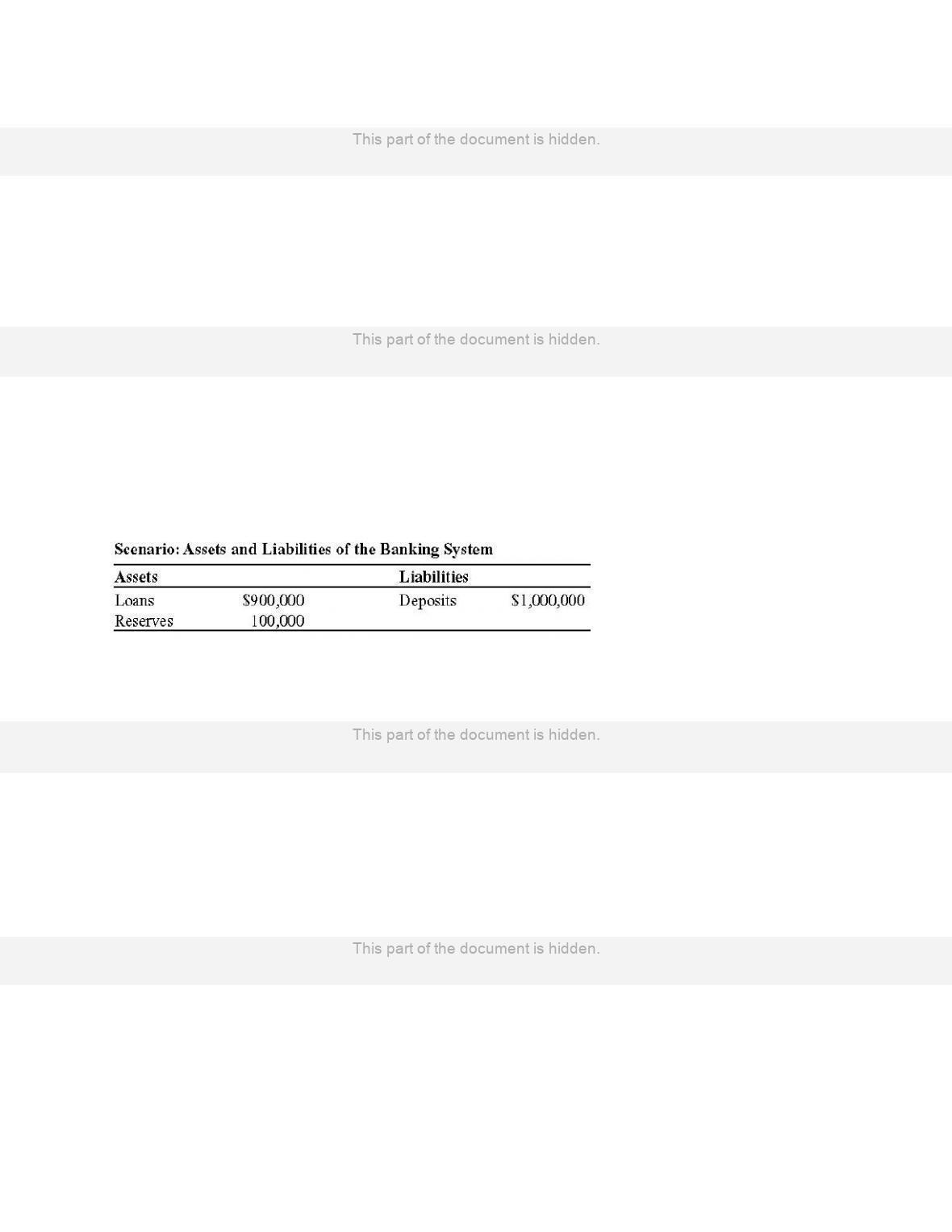
Use the following to answer questions 131-134:
131.
(Scenario: Assets and Liabilities of the Banking System) Refer to Scenario: Assets and
Liabilities of the Banking System. If the reserve ratio is 5% and the banking system
does NOT want to hold excess reserves, how much more can be added to the money
supply?
A)
about $667,000
B)
about $111,000
C)
$250,000
D)
$1 million
132.
(Scenario: Assets and Liabilities of the Banking System) Refer to Scenario: Assets and
Liabilities of the Banking System. If the reserve ratio is 9% and the banking system
does NOT want to hold excess reserves, how much more can be added to the money
supply?
A)
about $667,000
B)
about $111,000
C)
$250,000
D)
$1 million
Page 25
133.
(Scenario: Assets and Liabilities of the Banking System) Refer to Scenario: Assets and
Liabilities of the Banking System. If the reserve ratio is 8% and the banking system
does NOT want to hold excess reserves, how much more can be added to the money
supply?
A)
about $667,000
B)
about $111,000
C)
$250,000
D)
$1 million
134.
(Scenario: Assets and Liabilities of the Banking System) Refer to Scenario: Assets and
Liabilities of the Banking System. If the reserve ratio is 6% and the banking system
does NOT want to hold excess reserves, how much more can be added to the money
supply?
A)
about $667,000
B)
about $111,000
C)
$250,000
D)
$1 million
135.
Assume that the banks do not hold any excess reserves and the reserve ratio is 20%. If
Sarah deposits $5,000 in cash in her checking account, the money supply can potentially
increase by an additional:
A)
$20,000.
B)
$25,000.
C)
$5,000.
D)
$1,000.
136.
Suppose that the reserve ratio is 25%; the money multiplier is:
A)
5.
B)
0.25.
C)
4.
D)
0.04.
137.
The money multiplier is equal to:
A)
1 divided by the reserve ratio.
B)
1 divided by excess reserves.
C)
1 minus the reserve ratio.
D)
the reserve ratio plus excess reserves divided by the reserve ratio.
Page 26
138.
Suppose that the required reserve ratio is 25% and a customer deposits $300 in her
checkable deposit. The money supply will _____ if the banking system does NOT hold
any excess reserves.
A)
increase by an additional $1,200
B)
increase by an additional $900
C)
increase by an additional $300
D)
be unchanged
139.
Which factor is a component of both the monetary base and the money supply?
A)
bank reserves at the Fed
B)
currency in bank vaults
C)
demand deposits
D)
currency in circulation
140.
When a bank deposit is withdrawn and kept as currency, bank reserves decrease and the:
A)
monetary base decreases.
B)
monetary base does not change.
C)
monetary base increases.
D)
money supply decreases.
141.
The money multiplier is equal to:
A)
the ratio of the money supply to the monetary base.
B)
the ratio of the monetary base to the money supply.
C)
the money supply divided by the reserve ratio.
D)
about 3.9 in the United States.
142.
The monetary base is the sum of:
A)
reserves held by the banks and currency in circulation.
B)
checkable bank deposits and bank reserves.
C)
savings deposits and currency in circulation.
D)
checkable bank deposits and currency in circulation.
143.
Which statement is TRUE?
A)
Currency in circulation is not part of the monetary base.
B)
Bank reserves are part of the monetary base.
C)
Most of the monetary base consists of checkable deposits.
D)
The money multiplier is the ratio of the monetary base to the money multiplier.
Page 27
144.
Suppose the required reserve ratio is 10% and a depositor withdraws $500 from her
checkable deposit. The money supply will _____ if the banking system does NOT hold
any excess reserves.
A)
be unchanged
B)
decrease by $500
C)
decrease by $4,500
D)
decrease by $5,000
145.
Scenario: Money Creation
The reserve requirement is 20%. Leroy receives $1,000 as a graduation present and
deposits the money in his checking account. The bank does NOT want to hold excess
reserves. Immediately after the deposit, reserves _____ and demand deposits _____ by
$1,000.
A)
increase by $1,000; increase
B)
increase by $1,000; decrease
C)
decrease by $1,000; decrease
D)
decrease by $200; increase
146.
Scenario: Money Creation
The reserve requirement is 20%. Leroy receives $1,000 as a graduation present and
deposits the money in his checking account. The bank does NOT want to hold excess
reserves. How much of the $1,000 deposit is the bank required to keep in reserves?
A)
$1,000
B)
$100
C)
$200
D)
$800
147.
Scenario: Money Creation
The reserve requirement is 20%. Leroy receives $1,000 as a graduation present and
deposits the money in his checking account. The bank does NOT want to hold excess
reserves. How much of the $1,000 deposit can the bank lend out?
A)
$1,000
B)
$200
C)
$800
D)
$0

Page 28
148.
Scenario: Money Creation
The reserve requirement is 20%. Leroy receives $1,000 as a graduation present and
deposits the money in his checking account. The bank does NOT want to hold excess
reserves. What is the maximum possible expansion in the money supply as a result of
this initial deposit?
A)
$1,000
B)
$1,800
C)
$4,000
D)
$5,000
149.
Scenario: Money Creation
The reserve requirement is 20%. Leroy receives $1,000 as a graduation present and
deposits the money in his checking account. The bank does NOT want to hold excess
reserves. By how much did the monetary base change?
A)
$0
B)
$800
C)
$1,000
D)
$4,000
150.
Scenario: Money Supply Changes
The reserve requirement is 10% and Jack withdraws $5,000 travel money from his
checkable deposit. Assume that banks do not hold any excess reserves and that the
public holds no currency, only checkable bank deposits. After the withdrawal reserves
_____, and checkable deposits _____ by $5,000.
A)
decrease by $5,000; decrease
B)
decrease by $5,000; increase
C)
increase by $5,000; decrease
D)
increase by $500; increase
151.
Scenario: Money Supply Changes
The reserve requirement is 10% and Jack withdraws $5,000 travel money from his
checkable deposit. Assume that banks do not hold any excess reserves and that the
public holds no currency, only checkable bank deposits. As a result of the withdrawal,
required reserves _____ by _____.
A)
increase; $5,000
B)
increase; $500
C)
decrease; $5,000
D)
decrease; $500

Page 29
152.
Scenario: Money Supply Changes
The reserve requirement is 10% and Jack withdraws $5,000 travel money from his
checkable deposit. Assume that banks do not hold any excess reserves and that the
public holds no currency, only checkable bank deposits. As a result of the withdrawal,
excess reserves _____ by _____.
A)
increase; $5,000
B)
increase; $500
C)
decrease; $4,500
D)
decrease; $500
153.
Scenario: Money Supply Changes
The reserve requirement is 10% and Jack withdraws $5,000 travel money from his
checkable deposit. Assume that banks do not hold any excess reserves and that the
public holds no currency, only checkable bank deposits. By how much must the bank’s
loans decrease as a result of the withdrawal?
A)
$5,000
B)
$4,500
C)
$500
D)
$0
154.
Scenario: Money Supply Changes
The reserve requirement is 10% and Jack withdraws $5,000 travel money from his
checkable deposit. Assume that banks do not hold any excess reserves and that the
public holds no currency, only checkable bank deposits. By how much will the money
supply contract as a result of the withdrawal?
A)
$0
B)
$5,000
C)
$45,000
D)
$50,000
155.
Scenario: Money Supply Changes II
Charlotte withdraws $8,000 from her checkable bank deposit to pay tuition this
semester. Assume that the reserve requirement is 20% and that banks do not hold excess
reserves. After the withdrawal, reserves _____, and checkable deposits _____.
A)
increase by $8,000; increase by $8,000
B)
increase by $1,600; decrease by $1,600
C)
decrease by $8,000; decrease by $8,000
D)
decrease by $1,600; decrease by $1,600
Page 30
156.
Scenario: Money Supply Changes II
Charlotte withdraws $8,000 from her checkable bank deposit to pay tuition this
semester. Assume that the reserve requirement is 20% and that banks do not hold excess
reserves. As a result of the withdrawal, required reserves:
A)
decrease by $1,600.
B)
decrease by $6,400.
C)
decrease by $8,000.
D)
don’t change.
157.
Scenario: Money Supply Changes II
Charlotte withdraws $8,000 from her checkable bank deposit to pay tuition this
semester. Assume that the reserve requirement is 20% and that banks do not hold excess
reserves. As a result of the withdrawal, excess reserves _____ by _____.
A)
increase; $8,000
B)
decrease; $8,000
C)
decrease; $6,400
D)
decrease; $1,600
158.
Scenario: Money Supply Changes II
Charlotte withdraws $8,000 from her checkable bank deposit to pay tuition this
semester. Assume that the reserve requirement is 20% and that banks do not hold excess
reserves. As a result of the withdrawal, loans _____ by _____.
A)
increase; $8,000
B)
decrease; $8,000
C)
decrease; $6,400
D)
decrease; $1,600
159.
Scenario: Money Supply Changes II
Charlotte withdraws $8,000 from her checkable bank deposit to pay tuition this
semester. Assume that the reserve requirement is 20% and that banks do not hold excess
reserves. By how much will the money supply contract as a result of the withdrawal?
A)
$40,000
B)
$0
C)
$8,000
D)
$32,000
Page 31
160.
Scenario: Holding Cash
Suppose that the public holds 50% of the money supply in currency and the reserve
requirement is 20%. Banks hold no excess reserves. A customer deposits $6,000 in her
checkable deposit. As a result of the deposit, required reserves will increase by:
A)
$0.
B)
$1,200.
C)
$3,000.
D)
$6,000.
161.
Scenario: Holding Cash
Suppose that the public holds 50% of the money supply in currency and the reserve
requirement is 20%. Banks hold no excess reserves. A customer deposits $6,000 in her
checkable deposit. As a result of the deposit, the bank’s loans will increase by:
A)
$6,000.
B)
$1,200.
C)
$3,000.
D)
$4,800.
162.
Scenario: Holding Cash
Suppose that the public holds 50% of the money supply in currency and the reserve
requirement is 20%. Banks hold no excess reserves. A customer deposits $6,000 in her
checkable deposit. Assume that after receiving the deposit, the bank lends out its excess
reserves. When the loan is spent, _____ of the loan will be a checkable deposit and
_____ will be held by the public as cash.
A)
$6,000; $0
B)
$4,800; $1,200
C)
$2,400; $2,400
D)
$3,000; $3,000
163.
Scenario: Holding Cash
Suppose that the public holds 50% of the money supply in currency and the reserve
requirement is 20%. Banks hold no excess reserves. A customer deposits $6,000 in her
checkable deposit. The money multiplier is:
A)
2.
B)
greater than 5.
C)
5.
D)
less than 5.
Page 32
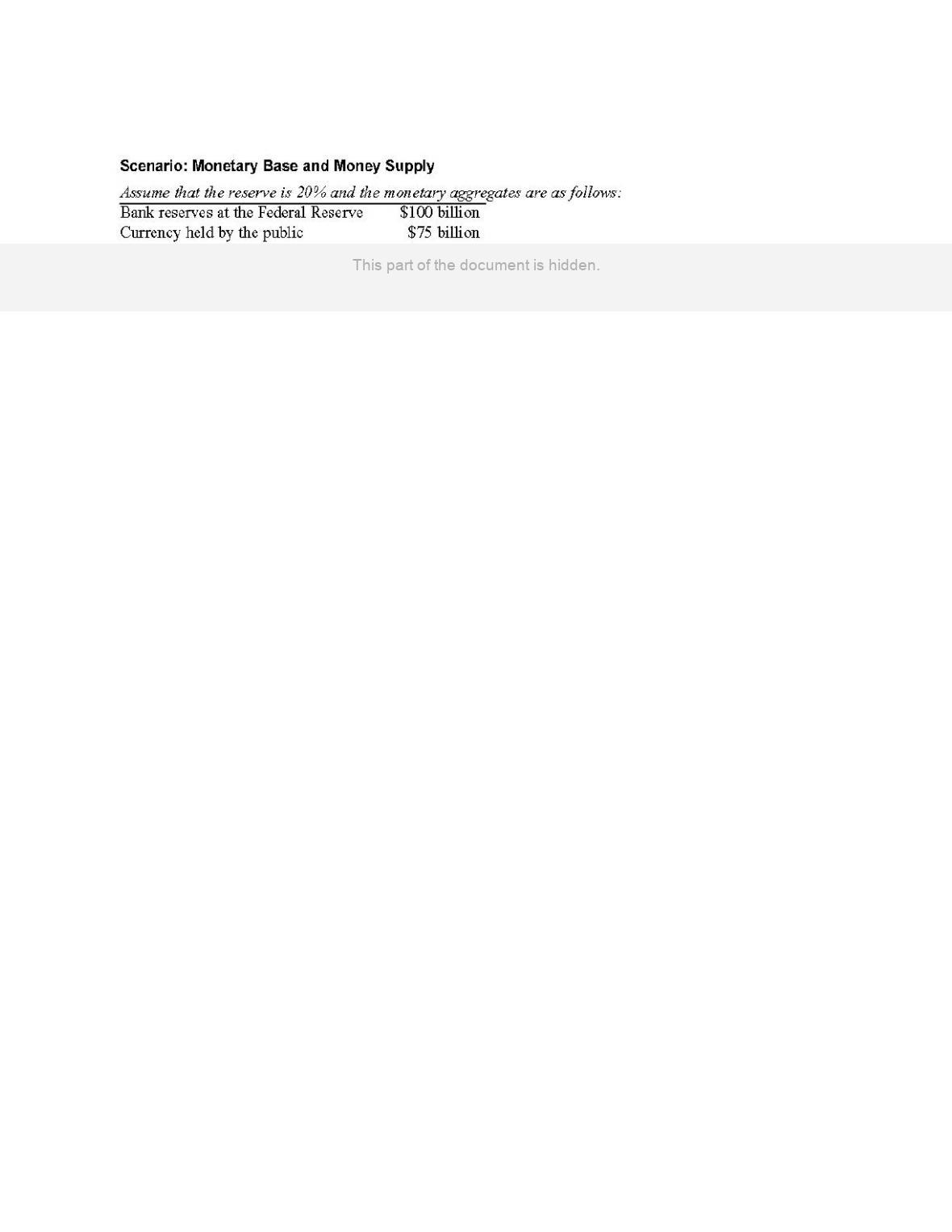
Use the following to answer questions 164-168:
164.
(Scenario: Monetary Base and Money Supply) How much is M1?
A)
$325 billion
B)
$330 billion
C)
$380 billion
D)
$480 billion
165.
(Scenario: Monetary Base and Money Supply) How much is the monetary base?
A)
$325 billion
B)
$330 billion
C)
$225 billion
D)
$175 billion
166.
(Scenario: Monetary Base and Money Supply) How much are required reserves?
A)
$50 billion
B)
$100 billion
C)
$150 billion
D)
$250 billion
167.
(Scenario: Monetary Base and Money Supply) How much are excess reserves?
A)
$50 billion
B)
$100 billion
C)
$150 billion
D)
$250 billion
168.
(Scenario: Monetary Base and Money Supply) By how much can checkable bank
deposits increase?
A)
$100 billion
B)
$250 billion
C)
$500 billion
D)
$1,650 billion
Page 33
169.
Decisions about monetary policy are made by:
A)
the president and Congress.
B)
the President’s Council of Economic Advisers.
C)
the Federal Open Market Committee.
D)
representatives of banks that are members of the Federal Reserve System.
170.
In the United States, the institution that is charged with determining the size of the
monetary base and with regulating the banking system is the:
A)
Treasury Department.
B)
Commerce Department.
C)
U.S. Senate Banking Committee.
D)
Federal Reserve.
171.
The Federal Reserve System is the _____ for the United States.
A)
central bank
B)
government-owned bank
C)
U.S. Treasury bank
D)
social insurance system
172.
The Federal Reserve Bank of the United States is:
A)
a purely private central bank.
B)
a purely public central bank.
C)
part of the U.S. government.
D)
not exactly part of the U.S. government but not really a private institution either.
173.
The Federal Reserve System was established in:
A)
1913.
B)
1971.
C)
1857.
D)
1873.
174.
The U.S. Federal Reserve, the Bank of England, the Bank of Japan, and the ECB are all:
A)
central banks.
B)
large commercial banks.
C)
investment banks.
D)
a combination of savings and loans and credit unions.
Page 34
175.
How many members are there on the Federal Reserve Board of Governors?
A)
3
B)
7
C)
100
D)
435
176.
William McChesney Martin, Alan Greenspan, and Ben Bernanke were all:
A)
speakers of the U.S. House of Representatives.
B)
candidates for vice president of the United States.
C)
chairs of the Federal Reserve.
D)
U.S. senators during the Great Depression.
177.
Open market operations are carried out by the Federal Reserve Bank of:
A)
San Francisco.
B)
Kansas City.
C)
Philadelphia.
D)
New York.
178.
The central bank of the United States is called the:
A)
Congressional Budget Office.
B)
Internal Revenue Service.
C)
Federal Reserve Bank.
D)
Federal Deposit Insurance Corporation.
179.
In the structure of the Federal Reserve, which component is part of the government?
I. the Board of Governors
II. the 12 regional Federal Reserve Banks
A)
I only
B)
II only
C)
I and II
D)
neither I nor II
180.
Which function is one that pertains to the Federal Reserve System?
I. collecting corporate income tax
II. setting personal income tax rates
III. holding bank reserves
A)
I only
B)
II only
C)
III only
D)
I, II, and III
Page 35
181.
Which function is one that pertains to the Federal Reserve System?
I. conducting fiscal policy
II. examining and supervising commercial banks in the Fed regions
III. evaluating corporate mergers
A)
I only
B)
II only
C)
III only
D)
I, II, and III
182.
Which function is one that pertains to the Federal Reserve System?
I. conducting monetary policy
II. examining and supervising commercial banks in the Fed regions
III. providing liquidity to financial institutions
A)
I only
B)
II only
C)
III only
D)
I, II, and III
183.
The major tools of monetary policy available to the Federal Reserve System include:
A)
reserve requirements, margin regulations, and moral suasion.
B)
reserve requirements, open-market operations, and the discount rate.
C)
open-market operations, margin regulations, and moral suasion.
D)
the discount rate, margin regulations, and moral suasion.
184.
The tools of conducting monetary policy include:
A)
changes in the required reserve requirement.
B)
changes in the prime rate.
C)
open market purchases of corporate stock.
D)
changes in tax rates.
185.
If the Federal Reserve increases the discount rate:
A)
the money supply is likely to decrease.
B)
the money supply is likely to increase.
C)
the money supply is not likely to change.
D)
the federal funds rate must decrease.

Page 36
186.
If it looks as if a bank won’t meet the Federal Reserve Bank’s reserve requirement,
normally it will first turn to the:
A)
other member banks and borrow money at the federal funds rate.
B)
Federal Reserve and borrow money at the discount rate.
C)
open market and borrow money there.
D)
Congress to borrow funds.
187.
Federal funds are:
A)
government tax receipts.
B)
loans between banks.
C)
government expenditures.
D)
bank deposits at the Federal Reserve.
188.
The discount rate is the interest rate the Federal Reserve charges on loans to:
A)
consumers.
B)
the federal government.
C)
state governments.
D)
banks.
189.
The three main monetary policy tools are:
A)
interest rates, taxes, and government purchases.
B)
currency, near-moneys, and reserve ratio.
C)
deposit insurance, discount rate, and money multiplier.
D)
reserve requirements, the discount rate, and open-market operations.
190.
When banks borrow from and lend reserves to each other, they are participating in the
_____ market.
A)
subprime mortgage
B)
long-term capital
C)
money
D)
federal funds
191.
The federal funds rate is the interest rate at which:
A)
banks borrow funds directly from the Federal Reserve.
B)
banks borrow from other banks with excess reserves.
C)
the influential companies borrow from banks.
D)
households’ savings are invested in the Federal Reserve.
Page 37
192.
Which factor would be classified as a tool of monetary policy used by the Federal
Reserve?
I. reserve requirements
II. the discount rate
A)
I only
B)
II only
C)
I and II
D)
neither I nor II
193.
Which factor would be classified as a tool of monetary policy used by the Federal
Reserve?
I. open market operations
II. government purchases of goods and services
A)
I only
B)
II only
C)
I and II
D)
neither I nor II
194.
Which factor would be classified as a tool of monetary policy used by the Federal
Reserve?
I. tax rates
II. government purchases of goods and services
A)
I only
B)
II only
C)
I and II
D)
neither I nor II
195.
The Fed’s minimum required reserve requirement for checkable bank deposits is
_____%.
A)
05
B)
3
C)
10
D)
50
196.
Loans of reserves from one bank to another are made in the _____ market.
A)
commodity
B)
foreign exchange
C)
stock
D)
federal funds
Page 38
197.
When the Fed decreases the reserve requirement, banks lend _____ of their deposits,
which leads to a(n) _____ in the money supply.
A)
less; decrease
B)
less; increase
C)
more; decrease
D)
more; increase
198.
When the Fed increases the reserve requirement, banks lend _____ of their deposits,
which leads to a(n) _____ in the money supply.
A)
less; decrease
B)
less; increase
C)
more; decrease
D)
more; increase
199.
If the Fed decreases the reserve requirement from 10% to 5%, the money multiplier will
_____ and the money supply will most likely _____.
A)
decrease; decrease
B)
decrease; increase
C)
increase; decrease
D)
increase; increase
200.
Normally the discount rate is _____ the federal funds rate.
A)
above
B)
below
C)
equal to
D)
after the discount, less expensive than
201.
When the Fed decreases the discount rate, the spread between the discount rate and the
fed funds rate _____ and the cost of being short of reserves _____.
A)
increases; increases
B)
increases; decreases
C)
decreases; increases
D)
decreases; decreases
202.
When the Fed decreases the discount rate, banks are likely to _____ their lending and
the money supply _____.
A)
increase; increases
B)
increase; decreases
C)
decrease; increases
D)
decrease; decreases
Page 39
203.
The tool of monetary policy with which the Federal Reserve buys and sells government
bonds is called:
A)
moral suasion.
B)
reserve requirements.
C)
the discount rate.
D)
open-market operations.
204.
Which factor is a tool used by the Federal Reserve in the conduct of monetary policy?
A)
changes in the prime rate
B)
issuing new government bonds and retiring old ones
C)
buying and selling corporate bonds
D)
buying and selling federal government bonds
205.
The Federal Reserve’s main assets are:
A)
currency in circulation and bank reserves.
B)
the facilities of the 12 district banks.
C)
corporate stocks and bonds.
D)
U.S. Treasury bills.
206.
The Federal Reserve’s main liabilities are:
A)
currency and bank reserves.
B)
the facilities of the 12 district banks.
C)
corporate stocks and bonds.
D)
U.S. Treasury bills.
207.
U.S. Treasury bills are a(n):
A)
liability of the U.S. government but an asset to the Federal Reserve.
B)
asset of the U.S. government but a liability to the Federal Reserve.
C)
part of the net worth of the U.S. government.
D)
liability to both the U.S. government and the Federal Reserve.
208.
The Federal Reserve never buys U.S. Treasury bills directly from the federal
government because it could:
A)
make the budget deficit worse.
B)
be a route to disastrous inflation.
C)
lead to a recession.
D)
reduce the power of the Fed.
Page 40
209.
To change the money supply, the Federal Reserve most frequently uses:
A)
changes in the required reserve ratios.
B)
changes in the discount rate.
C)
open-market operations.
D)
changes in the inflation rate.
210.
Open-market operations occur when the Federal Reserve:
A)
buys U.S. Treasury bills from the federal government.
B)
buys or sells foreign currency.
C)
buys or sells existing U.S. Treasury bills.
D)
sells U.S. Treasury bills to the federal government.
211.
If the Federal Reserve conducts an open-market purchase, bank reserves _____ and the
money supply _____.
A)
decrease; decreases
B)
increase; increases
C)
decrease; increases
D)
increase; decreases
212.
Suppose that the Federal Reserve were to buy $100 million of U.S. Treasury bills. The
money supply would:
A)
stay the same.
B)
decrease by $100 million.
C)
increase by $100 million.
D)
increase by more than $100 million.
213.
When the Federal Reserve decreases bank’s reserves through an open-market operation:
A)
deposits increase, currency in circulation increases, and the monetary base remains
the same.
B)
the monetary base decreases, the money multiplier decreases, and the money
supply increases.
C)
loans increase, the federal funds rate rises, and the discount rate rises.
D)
the monetary base decreases, loans decrease, and the money supply decreases.
214.
Bonds of the U.S. government that mature in less than a year are called:
A)
commercial paper.
B)
U.S. Treasury bills.
C)
federal funds.
D)
U.S. reserves.