Page 59
309.
There are very few U.S. states with rules that require a balanced budget.
A)
True
B)
False
310.
When the Great Recession struck, the U.S. federal government’s budget deficit
increased from just $160 billion to $2 trillion.
A)
True
B)
False
311.
Due to rules requiring states to have balanced budgets, many states experienced a large
increase in layoffs once money from the 2009 stimulus ended.
A)
True
B)
False
312.
In the United States a large number of states are required to have an annually balanced
budget, which worsens the severity of the business cycle.
A)
True
B)
False
313.
The main problem facing the government of Greece in 2010 was that it had a large
budget surplus.
A)
True
B)
False
314.
In 2010, many lenders refused to make more loans to Greece because they were not
confident that Greece was able to repay its debt.
A)
True
B)
False
315.
In 2010, Greece received emergency loans from other European countries and the
International Monetary Fund. These loans required the Greek government to cut
spending, which worsened the Greek recession.
A)
True
B)
False
316.
A fiscal year for the federal government runs from January 1 to December 31.
A)
True
B)
False
Page 60
317.
Public debt is government debt held by individuals and institutions outside the
government.
A)
True
B)
False
318.
If at the beginning of the year the public debt is $12 trillion, government spending and
transfers are $2 trillion, and tax revenues are $3 trillion, at the end of the year the public
debt is $13 trillion.
A)
True
B)
False
319.
If debt increases faster than GDP, the ratio of debt to GDP will fall.
A)
True
B)
False
320.
When governments borrow in financial markets to pay for budget deficits, interest rates
may increase and crowd out private investment spending.
A)
True
B)
False
321.
As a country’s public debt grows, the portion of its budget devoted to interest payments
on the debt will decrease.
A)
True
B)
False
322.
If a country has a very high level of public debt, lenders may insist on austerity
measures of raising taxes and decreasing government spending, which worsens
economic conditions.
A)
True
B)
False
323.
The ratio of debt to GDP is a way to assess the ability of a government to pay its debts
because it is an indicator of the taxes that the government can collect to pay the debt.
A)
True
B)
False
Page 61
324.
If the ratio of debt to GDP increases over time, it means that the government’s burden of
paying the debt is decreasing and default is less likely.
A)
True
B)
False
325.
If a government has large consecutive budget deficits and if the public debt is growing
faster than GDP, its ratio of debt to GDP will increase.
A)
True
B)
False
326.
If a government has large consecutive budget deficit but its GDP is growing faster than
its debt, the ratio of debt to GDP will increase.
A)
True
B)
False
327.
The promise to pay Social Security benefits to the baby boomers is an example of the
implicit liabilities of the U.S. government.
A)
True
B)
False
328.
What is meant by the term social insurance? Give an example of a social insurance
program.
329.
The economy is in a recessionary gap. What are the fiscal policy options available to the
government?
330.
The economy is in an inflationary gap. What are the fiscal policy options available to
the government?
331.
Many economists caution against extremely active stabilization policy because of time
lags in its use. Explain this rationale.
332.
Suppose that real GDP is $500, potential GDP is $1,000, and the marginal propensity to
consume is 0.9. If the government is going to spend and does not impose taxes, what
specific fiscal policy action should policy makers take?
Page 62
333.
Suppose that real GDP is $1,500, potential GDP is $1,200, and the marginal propensity
to consume is 0.8. If the government is going to close the gap by changing government
purchases of goods and services and imposes no taxes, what specific fiscal policy action
should policy makers take?
334.
Suppose that real GDP is $1,300, potential GDP is $1,800, and the marginal propensity
to consume is 0.6. If the government is going to close the gap by changing government
purchases of goods and services and imposes no taxes, what specific fiscal policy action
should policy makers take?
335.
Why does a $1,000 tax cut generate a smaller multiplier effect than a $1,000 increase in
government purchases?
336.
Explain the difference between automatic stabilizers and discretionary fiscal policy
measures. Provide examples to clarify the distinctions.
337.
Suppose that economic policy makers want to increase real GDP by $100 with as little
impact on the budget balance as possible. Should they increase government purchases of
goods and services, increase transfer payments, or decrease taxes?
338.
Why does the budget surplus get smaller or the deficit get larger, even without
discretionary fiscal policy, when unemployment increases?
339.
Explain why a constitutional amendment requiring the federal government to balance
the budget annually is a bad idea.
340.
Most economists do not support a law that requires the federal budget to be balanced
every year. Explain why.
341.
The primary taxes at the U.S. federal level are:
A)
the property tax, sales taxes, and income taxes.
B)
personal income taxes, corporate profit taxes, and social insurance taxes.
C)
sales taxes and fees.
D)
property taxes and user fees.
Page 63
342.
In terms of dollar costs, in the United States the three primary transfer payments are:
A)
Social Security, Medicare, and Medicaid.
B)
Social Security, education, and welfare.
C)
welfare, interest payments on the debt, and military spending.
D)
Social Security, interest payments on the debt, and education.
343.
Sales taxes, property taxes, income taxes, and fees of various kinds:
A)
fund government spending at the federal level.
B)
provide revenue for state and local governments.
C)
are the state governments’ least used types of revenue generation.
D)
are implicit liabilities.
344.
Transfer payments are payments that:
A)
governments make to households although the government did not receive a good
or service from the household.
B)
governments make to households when the government receives a good or service.
C)
erode the purchasing power of the economy.
D)
are essentially tax refunds.
345.
Social insurance is:
A)
essentially any type of spending by the federal government.
B)
available only when the economy is in an inflation.
C)
a government program designed to protect individuals or families from economic
hardship.
D)
available only when the economy is below the full employment level.
346.
If the economy exhibited an inflationary gap, the government should follow a(n) _____
policy, which would shift the AD curve to the _____.
A)
expansionary; right
B)
contractionary; right
C)
expansionary; left
D)
contractionary; left
347.
When potential output is less than actual aggregate output:
A)
the economy faces an inflationary gap.
B)
the SRAS curve intersects the AD curve to the left of the LRAS curve.
C)
the government should follow an expansionary policy to correct the problem.
D)
a decrease in taxes would solve the problem.
Page 64
348.
When the government decreases spending, the:
A)
AD curve will shift to the left.
B)
SRAS curve will shift to the left.
C)
budget balance will move toward a deficit.
D)
government debt will increase.
349.
An economy is in the midst of a recession. A government policy aimed at moving the
economy back to potential GDP is a(n):
A)
increase in taxes.
B)
increase in government purchases for infrastructure improvements.
C)
increase in the property tax.
D)
decrease in unemployment benefits.
350.
An expansionary fiscal policy:
A)
in the presence of a budget deficit would decrease the government debt.
B)
would shift AD to the right and increase the government budget deficit.
C)
would shift AD to the left and decrease the government budget deficit.
D)
would not be effective in the presence of a budget surplus.
351.
Time lags make:
A)
fiscal policy more effective than monetary policy.
B)
monetary policy more effective than fiscal policy.
C)
correct use of both fiscal and monetary policy challenging.
D)
both fiscal and monetary policy more effective.
352.
Time lags in the implementation of fiscal policy:
A)
make use of fiscal policy easier.
B)
render such policies useless.
C)
must be considered in implementation.
D)
are less problematic than those facing monetary policy.
353.
Holding everything else constant, the multiplier effect for taxes is _____ that for
changes in autonomous aggregate spending.
A)
the same as
B)
less than
C)
bigger than
D)
not relevant to
Page 65
354.
The marginal propensity to consume:
A)
is the change in consumption divided by the change in saving.
B)
is usually higher for unemployed individuals than for people who are very wealthy.
C)
is equal to the marginal propensity to save plus 1.
D)
tells policy makers the additional amount of investment spending that would
accompany an additional amount of government spending.
355.
When policy makers make a deliberate fiscal policy decision:
A)
it is called discretionary fiscal policy.
B)
it is an example of an automatic stabilizer.
C)
no lag effects will result.
D)
the value of the multiplier will be reduced.
356.
Automatic stabilizers act like:
A)
automatic expansionary fiscal policy when the economy is in inflation.
B)
automatic expansionary fiscal policy when the economy is in a recession.
C)
an additional multiplier effect.
D)
automatic contractionary policy when the economy is in a recession.
357.
When the government decides to increase taxes to fight an inflationary gap, it is:
A)
most likely to increase the budget deficit.
B)
an example of discretionary fiscal policy.
C)
an example of an automatic stabilizer.
D)
likely to dampen the effects of inflation but not to lead to a correction.
358.
The government’s budget balance is:
A)
T – G.
B)
G – T – TR.
C)
T – G – TR.
D)
T + TR – G.
359.
During a recessionary gap:
A)
holding everything else constant, the budget deficit would increase.
B)
contractionary fiscal policy would help correct this problem.
C)
an increase in taxes or a decrease in government purchases would shift the AD
curve to the right.
D)
unemployment would most likely be falling.
Page 66
360.
Holding everything else constant, the government’s budget balance during an expansion
will:
A)
move toward a larger surplus or reduced deficit.
B)
remain the same.
C)
move toward a reduced deficit or a smaller surplus.
D)
be equal to 100.
361.
Economists generally believe that during an expansion, an economy should:
A)
balance its budget.
B)
run a budget deficit.
C)
run a budget surplus.
D)
be able to pay off all of its debt.
362.
The government deficit:
A)
is essentially the same as the government debt.
B)
is much higher than the government debt.
C)
measures the difference between the amount government spends and the amount it
collects in tax revenues in a given period.
D)
is the total amount of money a government owes at a particular time.
363.
Public debt is:
A)
the total debt owed by the government to individuals and institutions outside of
government.
B)
the total amount that the government owes during a given fiscal year.
C)
likely to increase when the government uses contractionary fiscal policy.
D)
the amount that the government owes itself.
364.
The public ratio of debt to GDP for the United States in 2013 was:
A)
more or less the same as that of other wealthy countries.
B)
the largest ratio in the world.
C)
less than 5%.
D)
over 200%.
365.
A government encounters a recessionary gap and uses expansionary fiscal policy to
correct the problem. It may:
A)
find the policy ineffective, especially if the level of public debt is already very
high, since additional government borrowing may put pressure on future budgets.
B)
find the policy effective if it has to borrow to increase government spending.
C)
cause its budget balance to move toward a surplus.
D)
decrease the level of public debt in the short run.
Page 67
366.
_____ occur(s) when government spending results in persistent deficits that necessitate
borrowing, leading to a reduction in private investment.
A)
Implicit liabilities
B)
Transfer payments
C)
Crowding out
D)
Automatic stabilizers
367.
If a government’s debt is increasing but its GDP is increasing faster, the government’s:
A)
total debt is falling.
B)
ratio of debt to GDP is falling.
C)
deficit is falling.
D)
ability to pay is falling.
368.
Social Security and Medicare:
A)
are implicit liabilities.
B)
are often included in debt statistics.
C)
are discretionary types of fiscal policy.
D)
result in less spending by government.
369.
Funding for Social Security and Medicare:
A)
must come from government borrowing.
B)
comes from dedicated taxes.
C)
is likely to increase with the retirement of baby boomers.
D)
can be accomplished with lower taxes in the future.
370.
The multiplier effect of government purchases of goods and services:
A)
has a more direct and bigger impact than an equal amount of tax changes.
B)
has a less direct and smaller impact than an equal amount of tax changes.
C)
is a type of automatic stabilizer.
D)
is useful for recessions but not for inflation.
371.
The 2009 American Recovery and Reinvestment Act was an example of a(n):
A)
automatic stabilizer.
B)
contractionary government policy.
C)
contractionary monetary policy.
D)
expansionary fiscal policy.
Page 68
372.
The inclusion of a tax rate in the model results in a new multiplier that is:
A)
larger than the original multiplier.
B)
the same as the original multiplier if the economy is in a recession.
C)
smaller than the original multiplier.
D)
not affected by automatic stabilizers.
373.
If the tax rate is 0.1 and the marginal propensity to consume is 0.5, the multiplier is:
A)
2.
B)
1.8.
C)
2.1.
D)
1.
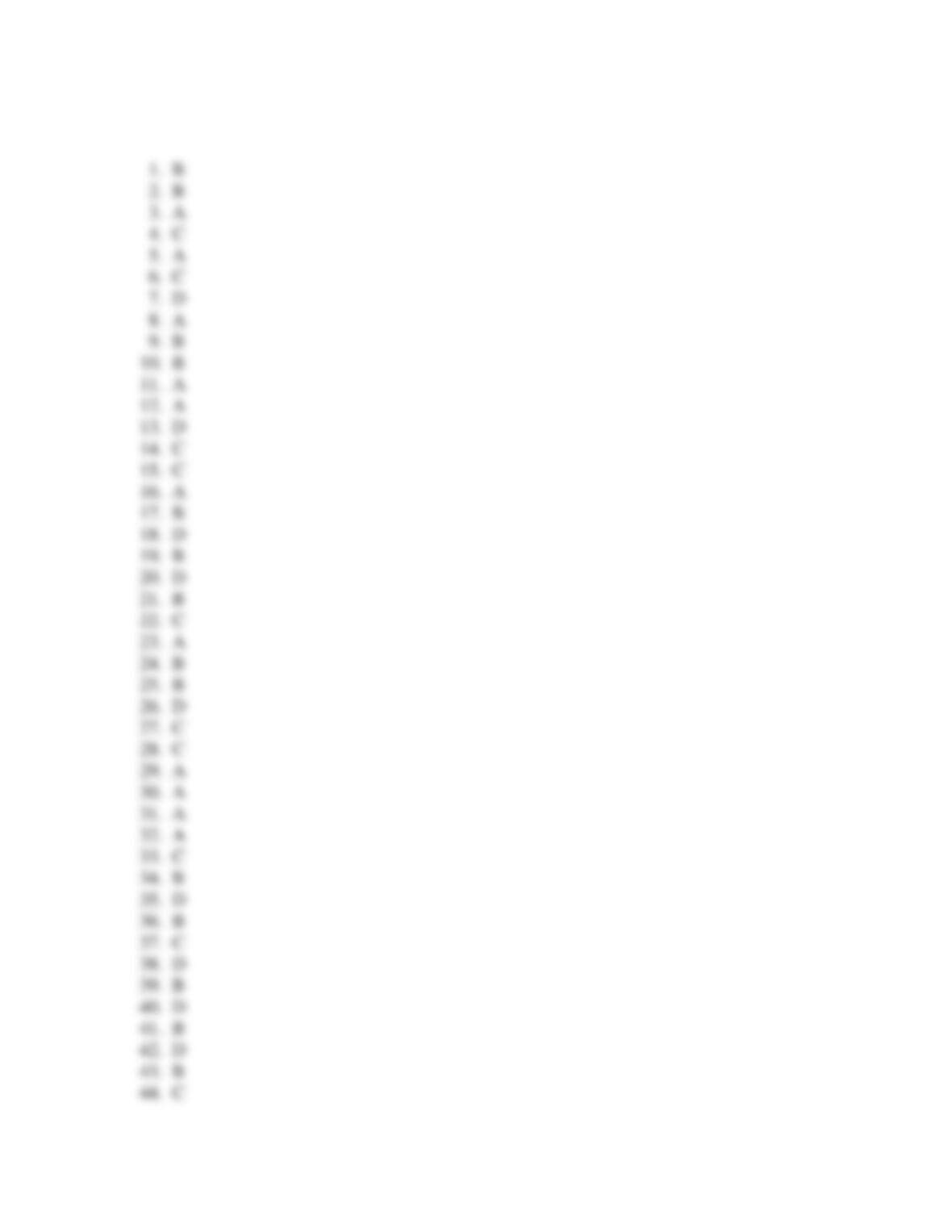
Answer Key
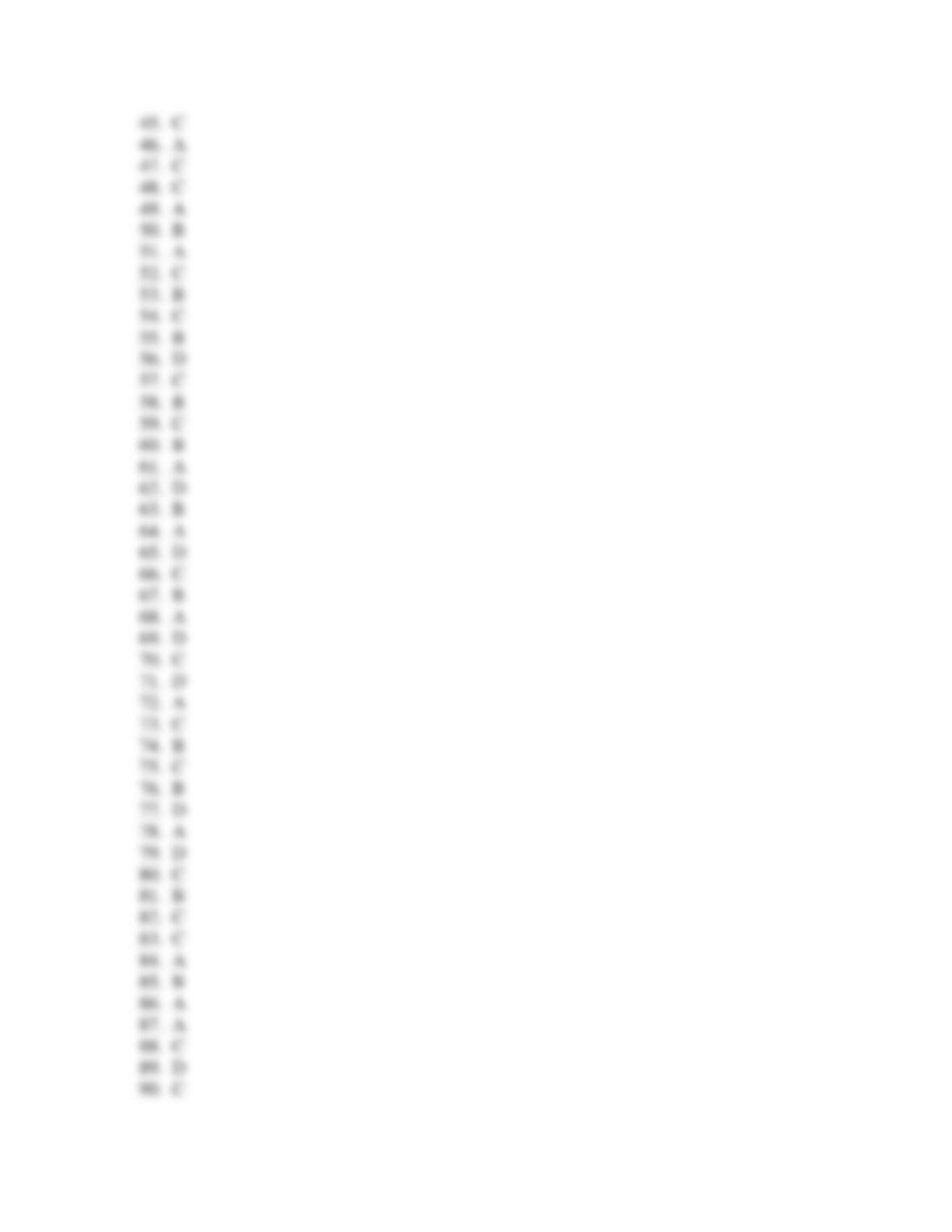
Page 70
45.
C
46.
A
47.
C
48.
C
49.
A
50.
B
51.
A
52.
C
53.
B
54.
C
55.
B
56.
D
57.
C
58.
B
59.
C
60.
B
61.
A
62.
D
63.
B
64.
A
65.
D
66.
C
67.
B
68.
A
69.
D
70.
C
71.
D
72.
A
73.
C
74.
B
75.
C
76.
B
77.
D
78.
A
79.
D
80.
C
81.
B
82.
C
83.
C
84.
A
85.
B
86.
A
87.
A
88.
C
89.
D
90.
C
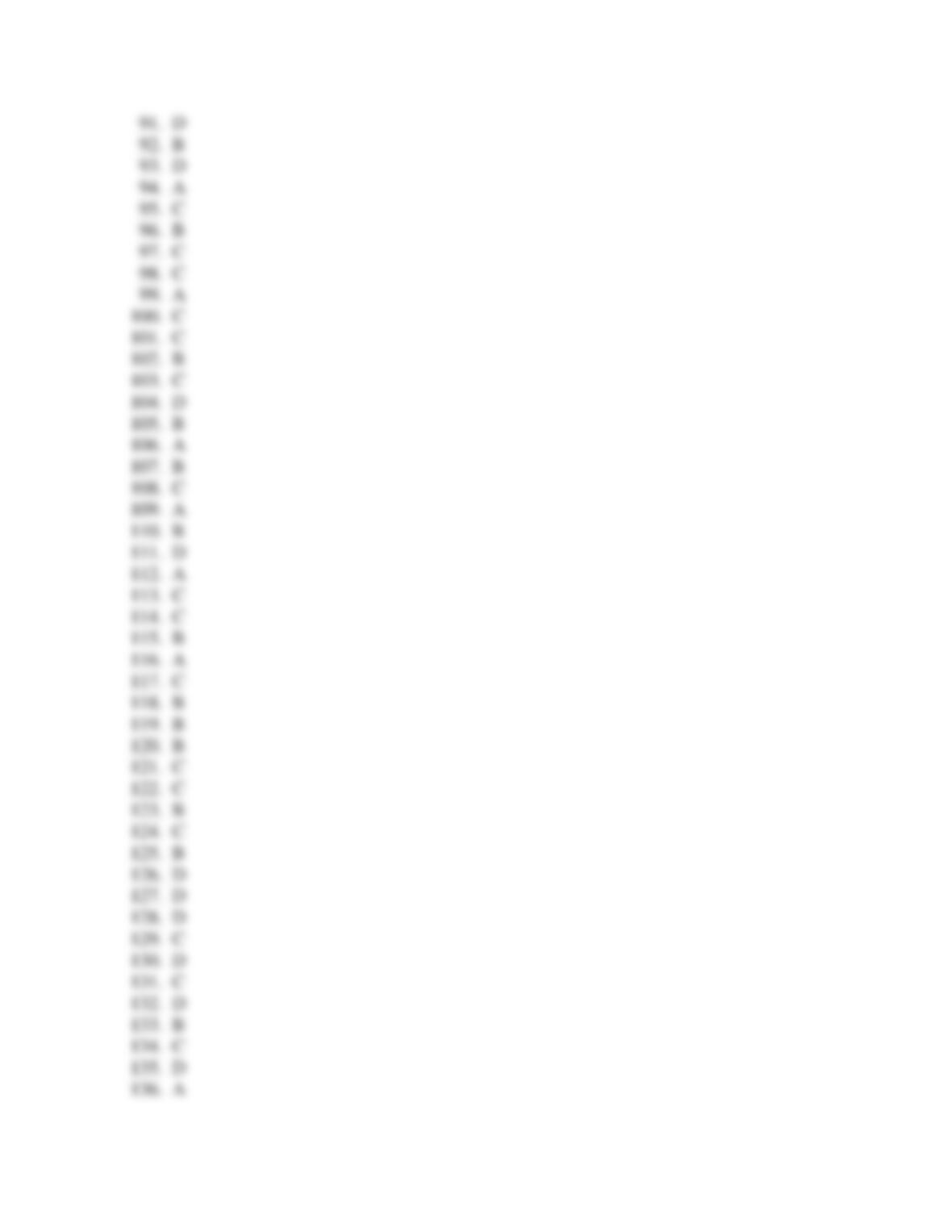
Page 71
91.
D
92.
B
93.
D
94.
A
95.
C
96.
B
97.
C
98.
C
99.
A
100.
C
101.
C
102.
B
103.
C
104.
D
105.
B
106.
A
107.
B
108.
C
109.
A
110.
B
111.
D
112.
A
113.
C
114.
C
115.
B
116.
A
117.
C
118.
B
119.
B
120.
B
121.
C
122.
C
123.
B
124.
C
125.
B
126.
D
127.
D
128.
D
129.
C
130.
D
131.
C
132.
D
133.
B
134.
C
135.
D
136.
A
Page 72
137.
C
138.
C
139.
C
140.
D
141.
A
142.
C
143.
D
144.
A
145.
D
146.
C
147.
D
148.
B
149.
D
150.
C
151.
D
152.
C
153.
C
154.
C
155.
C
156.
B
157.
B
158.
C
159.
D
160.
B
161.
D
162.
C
163.
C
164.
B
165.
A
166.
D
167.
A
168.
A
169.
D
170.
B
171.
C
172.
A
173.
D
174.
A
175.
C
176.
C
177.
A
178.
C
179.
C
180.
B
181.
A
182.
B
Page 73
183.
B
184.
A
185.
D
186.
C
187.
C
188.
A
189.
A
190.
C
191.
A
192.
B
193.
A
194.
B
195.
C
196.
A
197.
B
198.
A
199.
B
200.
B
201.
A
202.
B
203.
C
204.
B
205.
A
206.
D
207.
D
208.
C
209.
B
210.
B
211.
B
212.
C
213.
D
214.
A
215.
D
216.
B
217.
A
218.
A
219.
A
220.
D
221.
C
222.
D
223.
D
224.
D
225.
C
226.
C
227.
B
228.
B
Page 74
229.
C
230.
C
231.
D
232.
B
233.
A
234.
C
235.
D
236.
D
237.
C
238.
D
239.
C
240.
A
241.
A
242.
A
243.
A
244.
B
245.
C
246.
A
247.
B
248.
C
249.
C
250.
C
251.
A
252.
B
253.
C
254.
D
255.
A
256.
B
257.
A
258.
B
259.
A
260.
B
261.
B
262.
A
263.
A
264.
A
265.
B
266.
B
267.
B
268.
A
269.
B
270.
A
271.
B
272.
A
273.
B
274.
A
Page 75
275.
A
276.
A
277.
B
278.
B
279.
A
280.
B
281.
A
282.
B
283.
A
284.
A
285.
B
286.
A
287.
B
288.
A
289.
B
290.
A
291.
B
292.
B
293.
A
294.
B
295.
A
296.
B
297.
A
298.
B
299.
B
300.
A
301.
B
302.
A
303.
B
304.
A
305.
A
306.
B
307.
A
308.
A
309.
B
310.
B
311.
A
312.
A
313.
B
314.
A
315.
A
316.
B
317.
A
318.
B
319.
B
320.
A
Page 76
321.
B
322.
A
323.
A
324.
B
325.
A
326.
B
327.
A
328.
329.
330.
331.
332.
333.
334.
335.
336.
337.
338.
339.
340.
341.
B
342.
A
343.
B
344.
A
345.
C
346.
D
347.
A
348.
A
349.
B
350.
B
351.
C
352.
C
353.
B
354.
B
355.
A
356.
B
357.
B
358.
C
359.
A
360.
A
361.
C
362.
C
363.
A
364.
A
365.
A
366.
C

Page 77
367.
B
368.
A
369.
B
370.
A
371.
D
372.
C
373.
B