
Page 21
94.
(Figure: Fiscal Policy Options) Refer to Figure: Fiscal Policy Options. If the aggregate
demand curve is ADʺ, the most appropriate discretionary fiscal policy is to _____
government transfer payments and _____ income tax rates.
A)
decrease; increase
B)
decrease; decrease
C)
increase; increase
D)
increase; decrease
95.
(Figure: Fiscal Policy Options) Refer to Figure: Fiscal Policy Options. If the aggregate
demand curve is AD:
A)
a contractionary fiscal policy may be warranted.
B)
an expansionary fiscal policy may be warranted.
C)
no change in discretionary fiscal policy is warranted.
D)
the economy is in an inflationary gap.
96.
(Figure: Fiscal Policy Options) Refer to Figure: Fiscal Policy Options. If the aggregate
demand curve is AD’:
A)
a contractionary fiscal policy may be warranted.
B)
an expansionary fiscal policy may be warranted.
C)
the economy is in long-run equilibrium.
D)
the economy is experiencing an inflationary gap.
97.
(Figure: Fiscal Policy Options) Refer to Figure: Fiscal Policy Options. If the aggregate
demand curve is AD”:
A)
the economy is in long-run equilibrium.
B)
an expansionary fiscal policy may be warranted.
C)
a contractionary fiscal policy may be warranted.
D)
the economy is in a recessionary gap.
98.
Expansionary fiscal policy does NOT include a(n):
A)
increase in government transfers.
B)
increase in government purchases.
C)
increase in tax rates.
D)
reduction in marginal tax rates.
99.
A contractionary fiscal policy is one that reduces aggregate demand by decreasing:
A)
government purchases.
B)
the money supply.
C)
interest rates.
D)
taxes.
Page 22
100.
Policy makers use a contractionary fiscal policy when they want to close:
A)
a recessionary gap.
B)
any kind of output gap.
C)
an inflationary gap.
D)
an open economy.
Use the following to answer questions 101-102:
101.
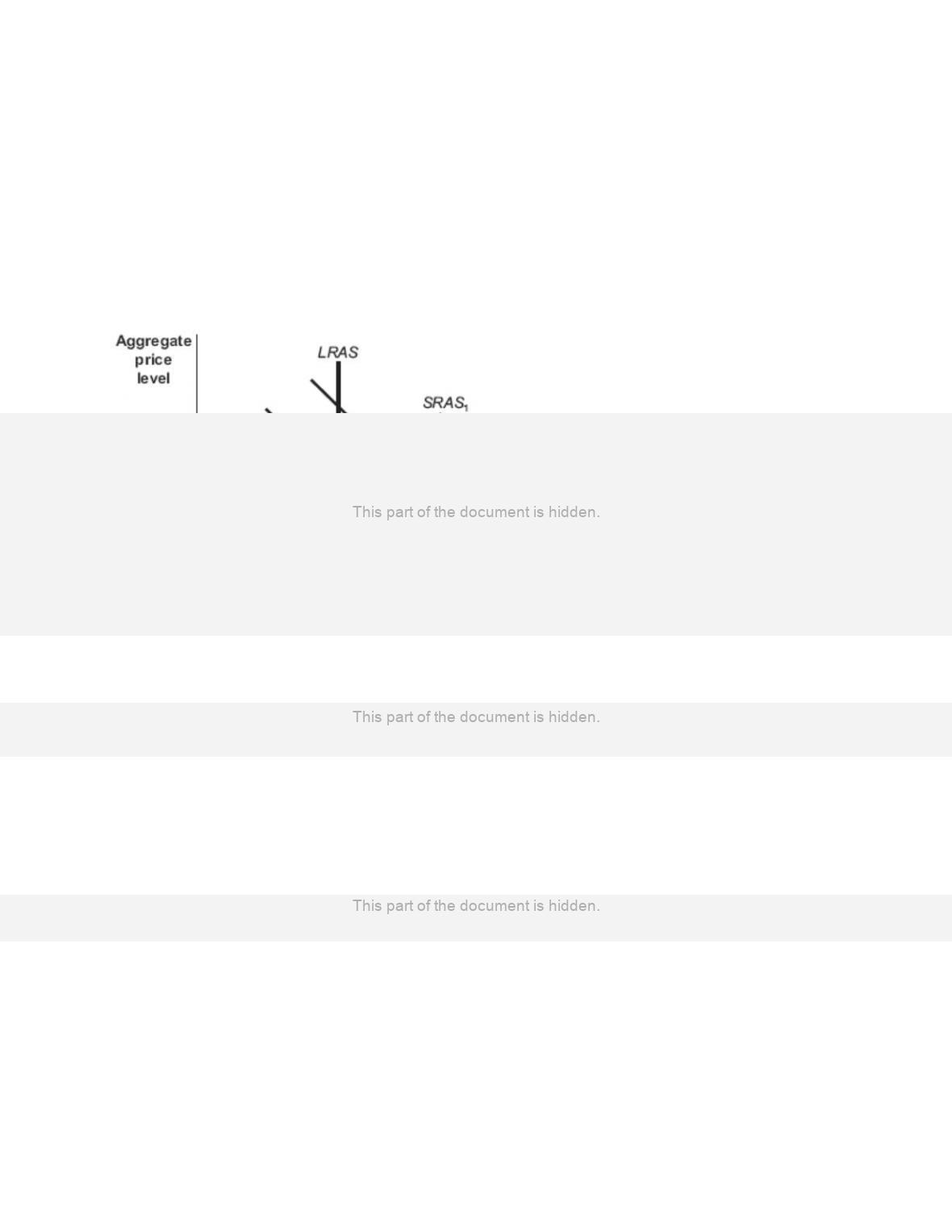
(Figure: AD–AS) Refer to Figure: AD–AS. Suppose the economy is producing the output
level Yp and a negative demand shock shifts the AD1 curve to AD3. The economy now
has a(n) _____ gap, which can be closed by _____ fiscal policy.
A)
inflationary; expansionary
B)
recessionary; contractionary
C)
recessionary; expansionary
D)
inflationary; contractionary
102.
(Figure: AD–AS) Refer to Figure: AD–AS. Consider an economy that is producing an
output level of Y1. The economy has a(n) _____ gap, which can be closed by _____
fiscal policy.
A)
recessionary; expansionary
B)
inflationary; contractionary
C)
inflationary; expansionary
D)
recessionary; contractionary

Page 23
103.
Which statement is NOT an argument against the use of expansionary fiscal policy?
A)
Government spending may crowd out private spending.
B)
Government borrowing may crowd out private investment spending.
C)
Government borrowing may reduce the marginal propensity to consume.
D)
Government budget deficits may lead to reduced private spending.
104.
Government spending will NOT crowd out private spending if:
A)
all of the resources in the economy are employed.
B)
aggregate income is at its potential level.
C)
there is an inflationary gap.
D)
there is a recessionary gap.
105.
If _____, expansionary fiscal policy is most likely to crowd out private spending.
A)
the unemployment rate is 15%
B)
aggregate income is $500 billion above its potential level
C)
aggregate income is $800 billion below its potential level
D)
aggregate output is $300 billion below its potential level
106.
Government borrowing will not crowd out private investment spending if
unemployment is _____ and the fiscal expansion causes a(n) _____ in incomes and a(n)
_____ in saving at each interest rate.
A)
high; increase; increase
B)
high; increase; decrease
C)
low; increase; decrease
D)
low; decrease; decrease
107.
After passage of the stimulus in 2009 government borrowing _____, and interest
rates_____.
A)
increased; increased to record levels
B)
increased; remained very low
C)
decreased; increased
D)
decreased; decreased
Page 24
108.
Some argue that budget deficits will lead to reduced private spending because:
A)
the government will purchase so many goods and services that it will lead to a
shortage of consumer goods and services.
B)
budget deficits will reduce interest rates on savings and decrease consumers’
wealth.
C)
consumers, anticipating higher taxes, will reduce consumption to save money to
pay the future taxes.
D)
the government will have to increase transfer payments to finance the deficit.
109.
The theory of Ricardian equivalence argues that expansionary fiscal policy:
A)
will have no effect on the economy because consumers, anticipating higher taxes to
pay for government spending, will decrease spending today to save for the higher
taxes.
B)
is not effective because it causes higher interest rates and crowds out investment
spending.
C)
is effective, but contractionary fiscal policy is not.
D)
is more effective than expansionary monetary policy.
110.
If the economy is at full employment, expansionary fiscal policy is most likely to lead
to:
A)
lower inflation rates.
B)
higher inflation rates.
C)
increases in unemployment.
D)
decreases in interest rates.
111.
One of the shortcomings of fiscal policy is that:
A)
it has significant time lags, which make it more effective.
B)
it takes effect immediately, so it is the best policy to use in an economic crisis.
C)
it affects aggregate demand indirectly through the interest rate.
D)
it has time lags, so sometimes it may end up destabilizing the economy.
112.
Government’s efforts to stabilize the business cycle through fiscal policy can destabilize
the economy because of:
A)
the time necessary to draw up a budget appropriate to the circumstances.
B)
a negative interaction between fiscal and monetary policy due to the multiplier
effect.
C)
a tendency of prices to change faster than the interest rate.
D)
business cycles that are closely synchronized to the political cycle.
Page 25
113.
Discretionary fiscal policy may fail to stabilize the economy or may even make the
economy less stable because of:
A)
its ineffectiveness.
B)
government waste.
C)
lags in deciding on and implementing a policy change.
D)
the business cycle.
114.
Time lags associated with policy decision making and implementation suggest that:
A)
increases in spending to fight a recessionary gap can be timed correctly.
B)
increases in spending to fight a recessionary gap may occur too early.
C)
increases in spending to fight a recessionary gap may occur too late.
D)
most information is old before the public is aware of it.
115.
Suppose the government increases taxes by more than is necessary to close an
inflationary gap. What is the MOST likely result?
A)
Equilibrium real GDP will be more than anticipated.
B)
The economy will move into a recession.
C)
The economy will generate a larger inflationary gap than anticipated.
D)
This will not have any adverse effects on the economy, since inflation has been
abated.
116.
Suppose that the government increases spending more than is necessary to close a
recessionary gap. What is the MOST likely result?
A)
Inflation will increase.
B)
The price level will decline.
C)
The equilibrium real GDP will fall.
D)
The equilibrium real GDP will fall short of potential GDP.
117.
Decreasing funding for space exploration will shift the _____ curve to the _____.
A)
short-run aggregate supply; left
B)
short-run aggregate supply; right
C)
aggregate demand; left
D)
aggregate demand; right
118.
The decision to build more aircraft carriers to keep employment high is an example of:
A)
prudent defense spending.
B)
expansionary fiscal policy.
C)
neutral fiscal policy.
D)
being prepared to defend our country.

Page 26
119.
Examples of fiscal policy do NOT include:
A)
increasing Medicaid reimbursements.
B)
reducing the money supply to raise the interest rate.
C)
increasing personal income tax deductions for home ownership.
D)
reducing federal subsidies to state universities.
120.
President Johnson’s use of a temporary 10% surcharge on income taxes is a classic
example of _____ policy.
A)
expansionary fiscal
B)
contractionary fiscal
C)
expansionary monetary
D)
contractionary monetary
121.
Assume that the marginal propensity to consume is 0.8 and potential output is $800
billion. The government spending multiplier is:
A)
0.8.
B)
1.25.
C)
5.
D)
4.
122.
Assume that marginal propensity to consume is 0.8 and potential output is $800 billion.
If the actual real GDP is $700 billion, _____ government spending by _____ would
bring the economy to potential output.
A)
increasing; $25 billion
B)
increasing; $100 billion
C)
increasing; $20 billion
D)
decreasing; $100 billion
123.
The multiplier effect of changes in government purchases of goods and services is equal
to:
A)
1 / (1 – MPS).
B)
1 / (1 – MPC).
C)
MPS / (1 – MPC).
D)
MPC / (1 – MPS).

Page 27
124.
If the marginal propensity to save is 0.25, investment spending is $700 million, and the
government increases its purchases of goods and services by $100 million, then real
GDP increases by:
A)
$25 million.
B)
$175 million.
C)
$400 million.
D)
$2,800 million.
125.
A $100 million increase in government spending increases equilibrium GDP by:
A)
$100 million.
B)
more than $100 million.
C)
less than $100 million.
D)
zero.
126.
If the marginal propensity to consume is 0.9, then the government spending multiplier
is:
A)
0.1.
B)
1.11.
C)
9.
D)
10.
127.
If the marginal propensity to consume is 0.8 and the government spending decreases by
$50 million, then equilibrium GDP will decrease by:
A)
$40 million.
B)
$50 million.
C)
$200 million.
D)
$250 million.
128.
If the government spends an extra $5 billion on goods and services, GDP will:
A)
go up by $5 billion.
B)
remain unchanged.
C)
increase by less than $5 billion.
D)
increase by more than $5 billion.
129.
If the marginal propensity to save is 0.1, then the government spending multiplier has a
value of
A)
0.1.
B)
9.
C)
10.
D)
0.11.
Page 28
Use the following to answer question 130:
130.
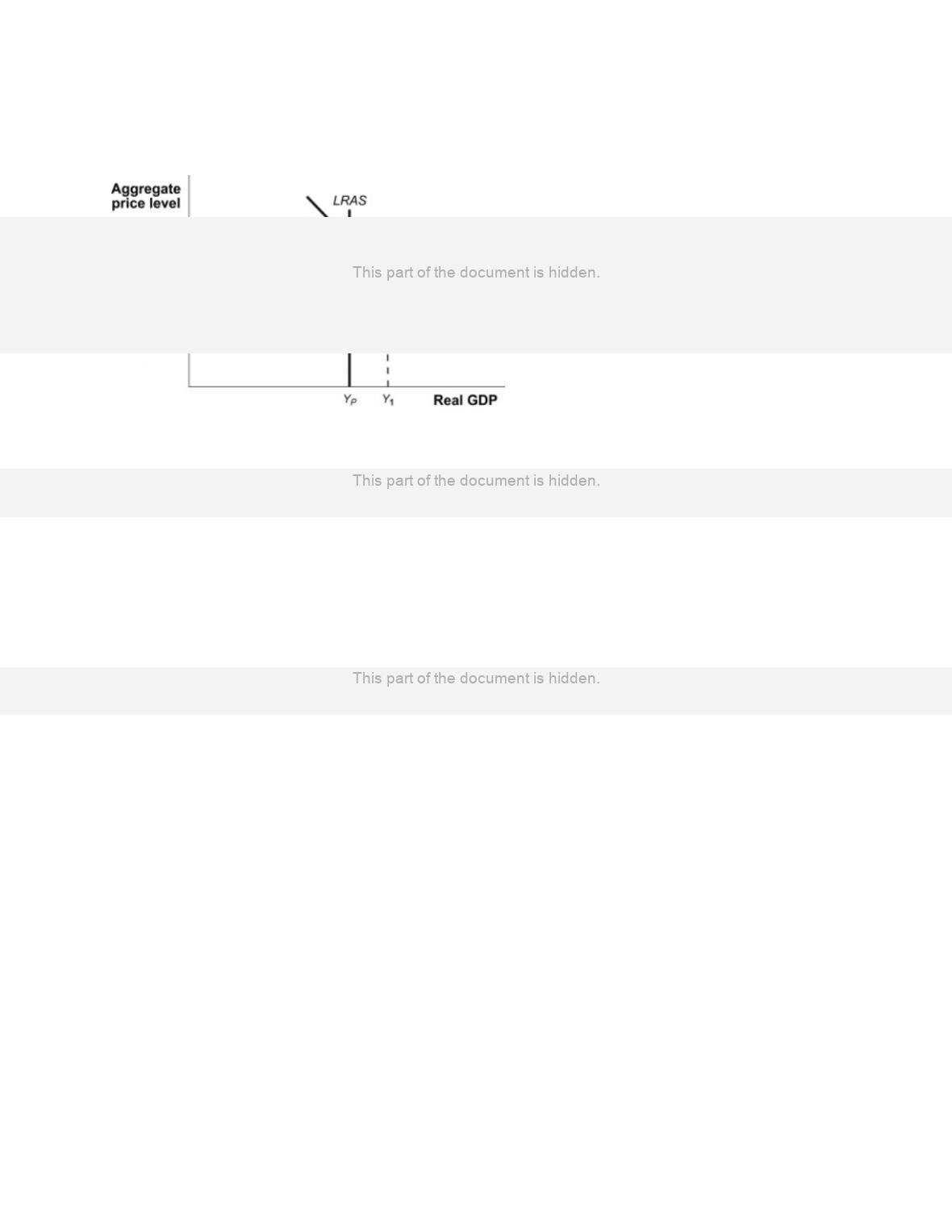
(Figure: Short-Run Equilibrium) Refer to Figure: Short-Run Equilibrium. The economy
is in short-run equilibrium. To move the economy to potential GDP, the government
should reduce its spending by an amount equal to:
A)
(Y1 – YP).
B)
(Y1 – YP) / (1 – MPC).
C)
(Y1 – YP)MPC.
D)
(Y1 – YP)(1 – MPC).
131.
The income expenditure model predicts that if the marginal propensity to consume is
0.75 and the federal government increases spending by $100 billion, real GDP will
increase by:
A)
$100 billion.
B)
$750 billion.
C)
$400 billion.
D)
$300 billion.
132.
The income–expenditure model predicts that if the marginal propensity to consume is
0.8 and the federal government decreases spending by $200 billion, real GDP will fall
by:
A)
$160 billion.
B)
$200 billion.
C)
$800 billion.
D)
$1,000 billion.
Page 29
133.
The marginal propensity to consume is typically:
A)
equal to one.
B)
between zero and one.
C)
greater than one.
D)
often negative.
134.
If the marginal propensity to consume is 0.75, the multiplier for government purchases
of goods and services will be:
A)
0.75.
B)
1.33.
C)
4.
D)
7.5.
135.
If the marginal propensity to consume is 0.75 and government purchases of goods and
services decrease by $30 billion, real GDP will:
A)
increase by $30 billion.
B)
increase by $22.5 billion.
C)
decrease by $30 billion.
D)
decrease by $120 billion.
136.
If policy makers want to increase real GDP by $100 billion and the marginal propensity
to consume is 0.75, they should _____ government purchases of goods and services by
_____.
A)
increase; $25 billion
B)
increase; $33 billion
C)
increase; $100 billion
D)
decrease; $100 billion
137.
If policy makers want to decrease real GDP by $100 billion and the marginal propensity
to consume is 0.6, they should _____ government purchases of goods and services by
_____.
A)
decrease; $100 billion
B)
decrease; $60 billion
C)
decrease; $40 billion
D)
increase; $100 billion

Page 30
138.
A change in government transfers shifts the aggregate demand curve by _____ than a
change in government spending for goods and services and has a _____ effect on real
GDP.
A)
more; smaller
B)
more; larger
C)
less; smaller
D)
less; larger
139.
A change in taxes shifts the aggregate demand curve by _____ than a change in
government spending for goods and services and has a _____ effect on real GDP.
A)
more; smaller
B)
more; larger
C)
less; smaller
D)
less; larger
140.
For a marginal propensity to consume of 0.9, the multiplier effect of an increase of $100
billion in government purchases of goods and services is larger than the multiplier effect
of a tax cut of $100 billion because:
A)
the government pays a higher price than households for the same goods and
services.
B)
production of the goods and services the government purchases has a bigger impact
on real GDP than production of consumer goods.
C)
many households fail to file their income tax and claim their refund.
D)
in the first round of spending only $90 billion of the tax cut will be spent and $10
billion will be saved, while the entire $100 billion of government purchases will be
spent.
141.
If the marginal propensity to consume is 0.75, the multiplier for taxes and transfer
payments is:
A)
less than 4.
B)
equal to 4.
C)
greater than 4.
D)
equal to 0.75.
142.
If the marginal propensity to consume is 0.75 and taxes increase by $30 billion, real
GDP will:
A)
increase by exactly $30 billion.
B)
decrease by exactly $30 billion.
C)
decrease by less than $120 billion.
D)
decrease by more than $120 billion.

Page 31
143.
If the marginal propensity to consume is 0.75 and transfer payments increase by $30
billion, real GDP will:
A)
increase by exactly $30 billion.
B)
decrease by exactly $30 billion.
C)
increase by more than $120 billion.
D)
increase by less than $120 billion.
144.
If policy makers want to increase real GDP by $100 billion and the marginal propensity
to consume is 0.75, they should _____ taxes by _____.
A)
decrease; more than $25 billion
B)
decrease; less than $25 billion
C)
increase; more than $25 billion
D)
increase; less than $25 billion
145.
If policy makers want to decrease real GDP by $100 billion and the marginal propensity
to consume is 0.6, they should _____ transfer payments by _____ $40 billion.
A)
increase; less than
B)
increase; more than
C)
decrease; less than
D)
decrease; more than
146.
If the marginal propensity to consume is 0.9, then the tax multiplier will be:
A)
impossible to determine.
B)
greater than 10.
C)
less than 10.
D)
zero, because there is no multiplier effect from taxes.
147.
Suppose an economy is producing real GDP of $300 billion. The potential output is
equal to $400 billion, and the marginal propensity to consume is equal to 0.80. The
government should ____ taxes by _____ to bring the economy to potential output.
A)
raise; $25 billion
B)
cut; $20 billion
C)
raise; $20 billion
D)
cut; $25 billion

Page 32
148.
Consider an economy whose households save 20% of increases in their income. If the
government lowers its transfers by $100 billion, then the real GDP will:
A)
decrease by $125 billion.
B)
decrease by $400 billion.
C)
increase by $125 billion.
D)
decrease by $500 billion.
149.
Suppose that marginal propensity to consume is equal to 0.9 and the government
increases its spending by $200 billion. This increase in spending is financed by a $200
billion increase in taxes. As a result of this, GDP will:
A)
not change at all.
B)
decrease by $200 billion.
C)
increase by $2,000 billion.
D)
increase by $200 billion.
150.
Suppose the marginal propensity to consume is 0.8 and the government cuts taxes by
$40 billion. Real GDP will _____ by _____.
A)
increase; $200 billion
B)
decrease; $200 billion
C)
increase; $160 billion
D)
decrease; $160 billion
151.
Assume that marginal propensity to consume is 0.8 and potential output is $800 billion.
The tax multiplier is:
A)
exactly 0.8.
B)
impossible to determine.
C)
greater than 5.
D)
less than 5.
152.
The multiplier effect of changes in government transfers is:
A)
greater than the multiplier effect of a change in government spending.
B)
zero because transfer payments do not affect aggregate demand.
C)
less than the multiplier effect of a change in government spending.
D)
impossible to determine.

Page 33
153.
If the marginal propensity to save is 0.25, investment spending is $600 million, and the
government increases its transfers by $100 million, then real GDP increases by:
A)
$25 million.
B)
$150 million.
C)
$300 million.
D)
$1,800 million.
154.
Changes in taxes and government transfers shift the aggregate demand curve _____
government purchases.
A)
by more than
B)
by exactly as much as
C)
by less than
D)
in inverse proportion to
155.
If the marginal propensity to consume is 0.8 and government transfers decrease by $50
million, then equilibrium GDP will decrease by:
A)
$40 million.
B)
$50 million.
C)
$200 million.
D)
$250 million.
156.
A cut in taxes will have the most effect on aggregate demand if it is given to:
A)
people with a low marginal propensity to consume.
B)
people with a high marginal propensity to consume.
C)
everyone in the economy.
D)
those who hold a large amount of wealth.
157.
Discretionary fiscal policy entails:
A)
changing the money supply to influence interest rates and investment spending.
B)
using government spending or tax policy to affect aggregate demand.
C)
lifting trade barriers on imports.
D)
setting policy to raise the natural rate of unemployment.
158.
Discretionary fiscal policy refers to changes in:
A)
interest rates.
B)
the money supply.
C)
government spending or taxes to close a recessionary or inflationary gap.
D)
taxes to account for externalities and control pollution.

Page 34
159.
Suppose the government increases spending to fund tuition assistance for qualified
college students. Automatic stabilizers will _____ the _____ effect of the _____ in
aggregate demand.
A)
increase; contractionary; decrease
B)
decrease; contractionary; increase
C)
increase; expansionary; increase
D)
decrease; expansionary; increase
160.
Congress increases personal income tax rates to balance the budget. Automatic
stabilizers will _____ the _____ effect of the _____ in aggregate demand.
A)
increase; contractionary; decrease
B)
decrease; contractionary; decrease
C)
increase; expansionary; increase
D)
decrease; expansionary; increase
161.
When the economy expands, income tax receipts will:
A)
rise, but sales tax revenues will remain the same.
B)
fall, but sales tax revenues will rise.
C)
stay the same unless the government changes the tax rates.
D)
rise, and sales tax revenues will rise.
162.
The automatic stabilizer in government tax revenue that occurs when GDP rises _____
the multiplier.
A)
has no effect on
B)
increases
C)
decreases
D)
may either increase or decrease
163.
The fact that tax receipts fall during a recession:
A)
makes the multiplier stronger.
B)
has no impact on the multiplier.
C)
reduces the adverse effect of the initial fall in aggregate demand.
D)
acts as an automatic contractionary fiscal policy.
164.
Fiscal policies that require no government action but that are expansionary when the
economy contracts and contractionary when the economy expands are known as:
A)
discretionary fiscal policy.
B)
automatic stabilizers.
C)
autonomous spending policies.
D)
destabilizing fiscal policies.
Page 35
165.
Because the revenue from personal income taxes increases as disposable income
increases:
A)
the multiplier effect decreases.
B)
the marginal propensity to consume decreases as income increases.
C)
the multiplier effect increases.
D)
the marginal propensity to save increases as income decreases.
166.
Government tax revenue rises and falls with the business cycle as:
A)
the multiplier effect of taxes and government transfers.
B)
a discretionary fiscal policy.
C)
the multiplier effect of government purchases.
D)
an automatic stabilizer.
167.
Automatic stabilizers are government spending and taxation changes that cause fiscal
policy to be _____ when the economy contracts.
A)
expansionary
B)
contractionary
C)
neutral
D)
ineffective
168.
An example of an automatic stabilizer is:
A)
tax receipts rising when GDP rises.
B)
a discretionary increase in taxes.
C)
government purchases of goods and services rising when GDP rises.
D)
government transfers rising when GDP rises.
169.
An automatic stabilizer that works when the economy contracts is a:
A)
rise in tax receipts.
B)
fall in government purchases.
C)
discretionary decrease in government purchases.
D)
rise in government transfers as more people receive unemployment insurance
benefits.
170.
Which factor is an automatic stabilizer?
A)
military spending
B)
unemployment compensation payments
C)
disability payments to war veterans
D)
Medicare payments
Page 36
171.
Which statement is CORRECT?
A)
Automatic stabilizers indicate deliberate action by policy makers.
B)
Discretionary fiscal policy shows automatic adjustments without any specific effort
by policy makers.
C)
Discretionary fiscal policy indicates deliberate action by policy makers.
D)
Automatic stabilizers are risky to use and sometimes can get the economy
destabilized.
172.
When the economy is in a recession, tax receipts _____ and unemployment insurance
payments _____.
A)
decrease; increase
B)
increase; increase
C)
increase; decrease
D)
decrease; decrease
173.
If the government increases its spending when the economy is expanding, automatic
stabilizers _____ the government spending multiplier.
A)
may or may not affect
B)
will increase
C)
will not affect
D)
will decrease
174.
Government transfer payments rise when the economy is contracting and fall when the
economy is expanding. In this role, transfer payments are described as:
A)
automatic stabilizers.
B)
discretionary fiscal policy.
C)
balanced budget policy.
D)
deficit reduction policy.
175.
Assume the marginal propensity to consume is 0.8 and potential output is $800 billion.
If actual real GDP is $700 billion, which of the following policies would bring the
economy to potential output?
A)
Decrease taxes by $100 billion.
B)
Increase taxes by $100 billion.
C)
Decrease taxes by $25 billion.
D)
Decrease government transfers by $25 billion.
Page 37
176.
Assume the marginal propensity to consume is 0.8 and potential output is $800 billion.
If actual real GDP is $850 billion, which of the following policies would bring the
economy to potential output?
A)
Increase taxes by $50 billion.
B)
Increase taxes by $10 billion.
C)
Increase taxes by $12.5 billion.
D)
Increase transfers by $12.5 billion.
177.
Scenario: Fiscal Policy
Consider the economy of Arcadia. Its households spend 75% of increases in their
income. There are no taxes and no foreign trade. Its currency is the arc. Potential output
is 600 billion arcs. Suppose actual real GDP in Arcadia is 500 billion arcs. This
economy has:
A)
a recessionary gap.
B)
production at the full employment level.
C)
an inflationary gap.
D)
a liquidity trap.
178.
Scenario: Fiscal Policy
Consider the economy of Arcadia. Its households spend 75% of increases in their
income. There are no taxes and no foreign trade. Its currency is the arc. Potential output
is 600 billion arcs. The government spending multiplier is:
A)
5.
B)
0.75.
C)
4.
D)
3.
179.
Scenario: Fiscal Policy
Consider the economy of Arcadia. Its households spend 75% of increases in their
income. There are no taxes and no foreign trade. Its currency is the arc. Potential output
is 600 billion arcs. If actual output is 500 billion arcs, to restore the economy to
potential output the government should _____ by 25 billion arcs.
A)
increase taxes
B)
decrease taxes
C)
increase spending
D)
decrease spending

180.
Scenario: Fiscal Policy
Consider the economy of Arcadia. Its households spend 75% of increases in their
income. There are no taxes and no foreign trade. Its currency is the arc. Potential output
is 600 billion arcs. Suppose the government decides to tax its citizens. The tax multiplier
is:
A)
greater than the government spending multiplier.
B)
less than the government spending multiplier.
C)
zero, because changes in taxes have no effect on aggregate demand.
D)
impossible to determine.
181.
Scenario: Fiscal Policy
Consider the economy of Arcadia. Its households spend 75% of increases in their
income. There are no taxes and no foreign trade. Its currency is the arc. Potential output
is 600 billion arcs. Suppose that actual output is 700 billion arcs, and the government of
Arcadia decides to tax its citizens. To bring the economy to potential output, the
government should:
A)
increase taxes by 33.33 billion arcs.
B)
increase taxes by 3.33 billion arcs.
C)
keep taxes at zero.
D)
increase both taxes and government spending by 0.33 billion arcs.
182.
Suppose that the economy is in a recessionary gap. A $100 billion _____ is likely to
increase real GDP by the LARGEST amount.
A)
decrease in taxes
B)
increase in government purchases
C)
increase in transfer payments
D)
increase in government purchases, paid for by a $100 billion increase in taxes
183.
Assume that the marginal propensity to consume is 0.8 and potential output is $800
billion. If real GDP is $700 billion:
A)
there is an inflationary gap.
B)
there is a recessionary gap.
C)
the economy is in long-run equilibrium.
D)
government transfers should be decreased.
184.
Assume that the marginal propensity to consume is 0.8 and potential output is $800
billion. If GDP is $850 billion:
A)
there is an inflationary gap.
B)
there is a recessionary gap.
C)
the economy is in long-run equilibrium.
D)
taxes should be decreased.
Page 39
185.
Assume that the marginal propensity to consume is 0.8 and potential output is $800
billion. If real GDP is $850 billion, to bring the economy to potential output the
government should:
A)
decrease spending by $50 billion.
B)
increase spending by $50 billion.
C)
decrease transfers by $50 billion.
D)
decrease spending by $10 billion.
186.
Suppose the economy is operating at an output of $4,000 billion. Assume furthermore
that potential output is $5,000 billion and the marginal propensity to consume is 0.75.
_____ would close this recessionary gap.
A)
A $25 billion increase in government spending
B)
A $25 billion increase in taxes
C)
A $250 billion increase in government spending
D)
A $1,000 billion increase in government spending
187.
Suppose that the economy is operating at an output level of $5,400 billion. Assume
furthermore that potential output is $5,000 billion and the marginal propensity to
consume is 0.75. _____ would close this inflationary gap.
A)
A $400 billion tax hike
B)
Raising government purchases of goods and services by $400 billion
C)
Decreasing government purchases of goods and services by $100 billion
D)
Increasing government purchases of goods and services by $100 billion
188.
Assume that the marginal propensity to consume is 0.8. Government purchases of goods
and services increase by $100 billion, financed by a $100 billion tax increase. Real GDP
will:
A)
expand by $100 billion.
B)
contract by $100 billion.
C)
expand by $500 billion.
D)
expand by $400 billion.
189.
The federal budget tends to move toward _____ as the economy ____.
A)
deficit; contracts
B)
deficit; expands
C)
surplus; contracts
D)
a balanced budget; contracts
Page 40
190.
Which equation represents the government budget balance MOST accurately?
A)
T + G + TR
B)
T + G – TR
C)
T – G – TR
D)
T + TR – G
191.
The budget balance is calculated as:
A)
T – G – TR.
B)
T + G – TR.
C)
T – G + TR.
D)
T + G + TR.
192.
The government budget balance equals taxes _____ purchases _____ transfers.
A)
plus; plus
B)
minus; minus
C)
minus; plus
D)
plus; minus
193.
Expansionary fiscal policies
A)
make the budget surplus smaller.
B)
make the budget deficit smaller.
C)
affect only taxes.
D)
affect only government purchases of goods and services.
194.
The government has a budget deficit if:
A)
its total revenues are equal to its total expenditures.
B)
its total revenues are less than its total expenditures.
C)
its total revenues are greater than its total expenditures.
D)
the money supply is less than total expenditures.
195.
The government has a budget surplus if _____ expenditures.
A)
its revenues are equal to
B)
its revenues are less than
C)
its revenues are greater than
D)
the money supply is less than