Page 1
Name: __________________________ Date: _____________
1.
Sources of federal tax revenue do NOT include:
A)
the personal income tax.
B)
sales taxes.
C)
social insurance taxes.
D)
the corporate profits tax.
2.
The federal government’s LARGEST source of revenue is:
A)
property taxes.
B)
personal income and corporate profit taxes.
C)
sales taxes.
D)
social insurance taxes.
3.
Social insurance programs are:
A)
government programs intended to protect families against economic hardships.
B)
private insurance policies to protect families from hardships caused by government
actions.
C)
private insurance policies that cover gaps in government-provided health care.
D)
programs to help unemployed people have a social life.
4.
Which factor is a government transfer?
A)
wages paid to U.S. senators
B)
purchases of tanks for the army
C)
Social Security payments to retired auto workers
D)
payments to contractors for repairs on interstate highways
5.
Sources of state and local revenue do NOT include:
A)
social insurance taxes.
B)
property taxes.
C)
sales taxes.
D)
income taxes.
6.
Which example does NOT illustrate government purchases of goods and services?
A)
a federal prosecutor’s salary
B)
new pavement for interstate highway I-95
C)
a surgeon’s bill reimbursed under the Medicare program
D)
equipping U.S. air marshals with electroshock weapons
Page 2
7.
Which example does NOT illustrate government transfers?
A)
Medicaid-paid prescription drugs for low-income individuals
B)
unemployment insurance
C)
a Social Security disability pension
D)
a reimbursement of personal income tax withheld from wages
8.
Government payments to households for which no good or service is provided in return
are called:
A)
transfer payments.
B)
government purchases.
C)
consumption expenditures.
D)
investment expenditures.
9.
Medicaid, Medicare, and Social Security are examples of:
A)
unilateral payments.
B)
transfer payments.
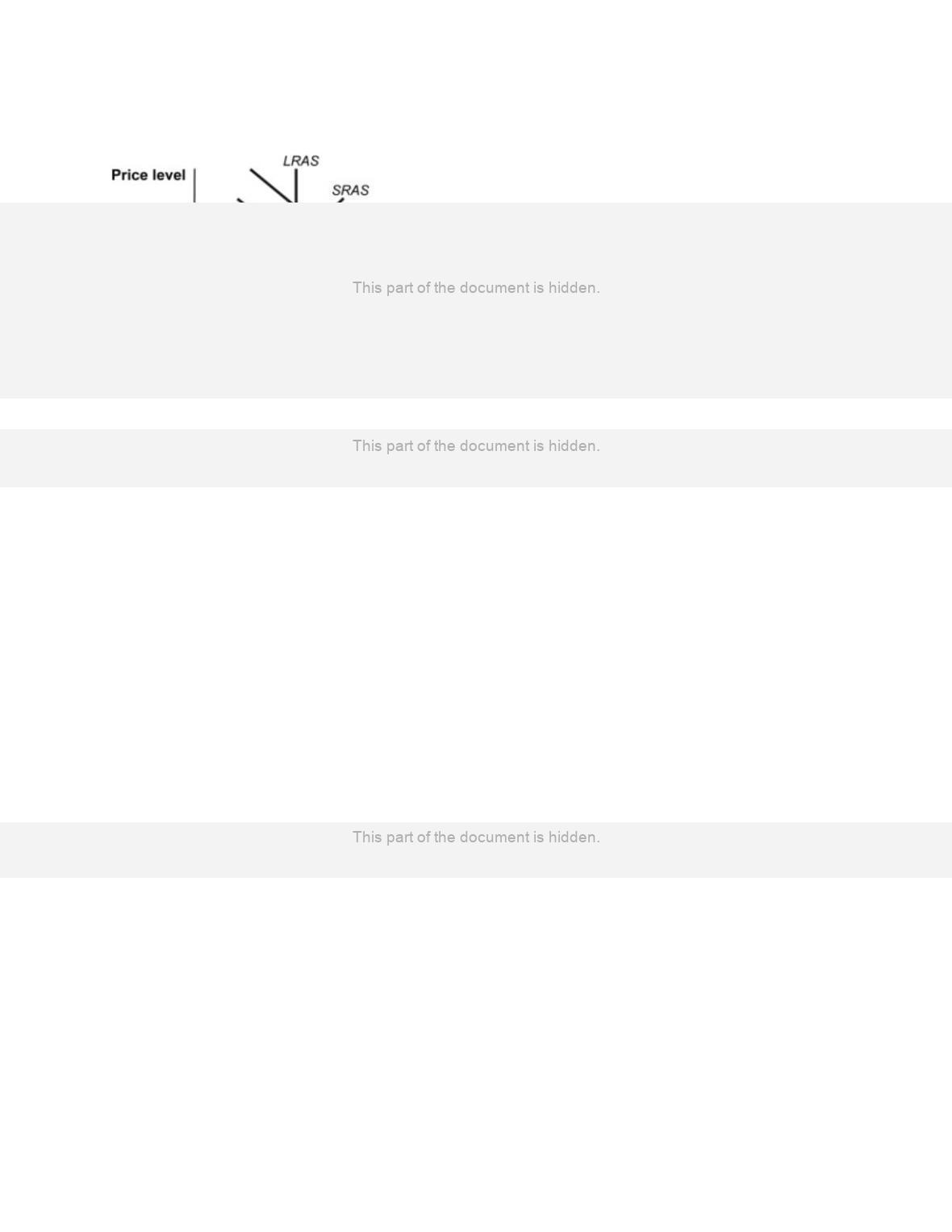
C)
monetary policy.
D)
taxes.
10.
The LARGEST source of federal tax revenues is:
A)
property taxes.
B)
personal income taxes.
C)
corporate income taxes.
D)
sales taxes.
11.
Which source of tax revenue is the LARGEST one for the U.S. federal government?
A)
personal income taxes
B)
corporate profit taxes
C)
sales taxes
D)
social insurance taxes
12.
Which type of payment is NOT a government transfer payment?
A)
the federal payroll
B)
Social Security
C)
Medicare
D)
Medicaid
Page 3
13.
Spending for Medicare and Medicaid accounts for approximately _____% of federal
spending.
A)
11
B)
14
C)
15
D)
21
14.
A change in taxes or a change in government transfers affects consumption through its
effect on:
A)
autonomous consumption.
B)
the marginal propensity to save.
C)
disposable income.
D)
government spending.
15.
The basic equation of national income accounting is GDP = C + I + G + X – IM. When
the government uses fiscal policy to make changes to taxes and transfers, this policy
primarily affects:
A)
IM.
B)
I.
C)
C.
D)
X.
16.
Consumer spending will likely rise if:
A)
government transfers rise.
B)
the government raises tax rates.
C)
government transfers fall.
D)
the government raises tax rates or government transfers fall.
17.
Consumer spending will likely fall if:
A)
government transfers rise.
B)
the government raises tax rates.
C)
the government lowers tax rates.
D)
government transfers rise or tax rates are lowered.
18.
Which factor is NOT a tool of fiscal policy?
A)
changing tax rates
B)
government transfers
C)
government purchases of goods and services
D)
changes in the money supply
Page 4
19.
Suppose that the economy is in a recessionary gap. To move equilibrium aggregate
output closer to the level of potential output, the BEST fiscal policy option is to:
A)
decrease government purchases.
B)
decrease taxes.
C)
decrease government transfers.
D)
increase real interest rates.
20.
If the actual output lies below potential output, then an appropriate fiscal policy would
be to _____, which will shift the _____ curve to the _____.
A)
increase government purchases; AD; left
B)
increase transfer payments; AS; right
C)
increase tax rates; AD; right
D)
increase government purchases; AD; right
21.
Suppose that the economy is in an inflationary gap. To move equilibrium aggregate
output closer to the level of potential output, the BEST fiscal policy option is to:
A)
lower tax rates.
B)
decrease government purchases.
C)
increase the investment tax credit.
D)
lower the real interest rate.
22.
If the current equilibrium output lies above potential output, then an appropriate fiscal
policy would be to _____, which will shift the AD curve to the _____.
A)
decrease government purchases; right
B)
increase government purchases; left
C)
decrease government purchases; left
D)
raise tax rates; right
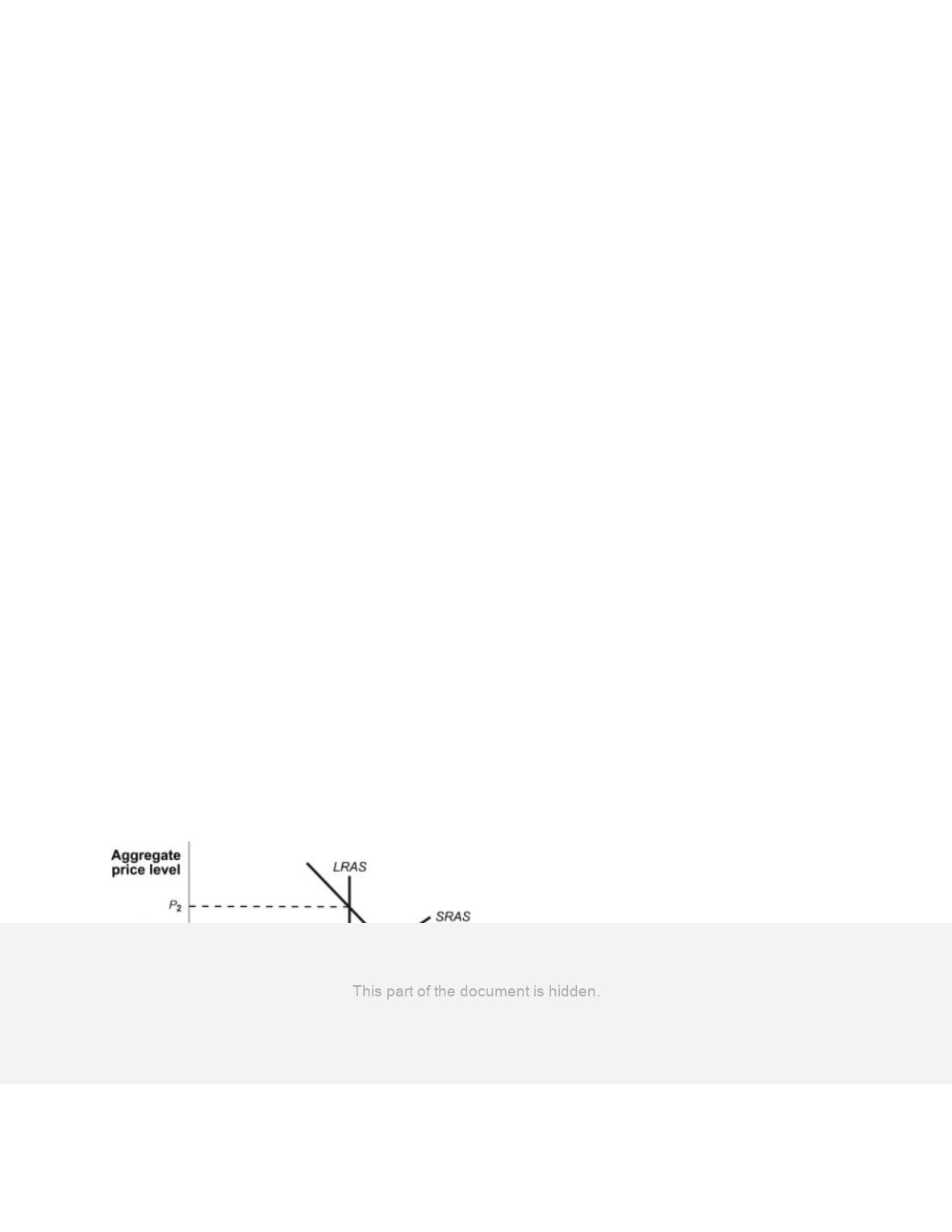
Use the following to answer questions 23-27:

Page 5
23.
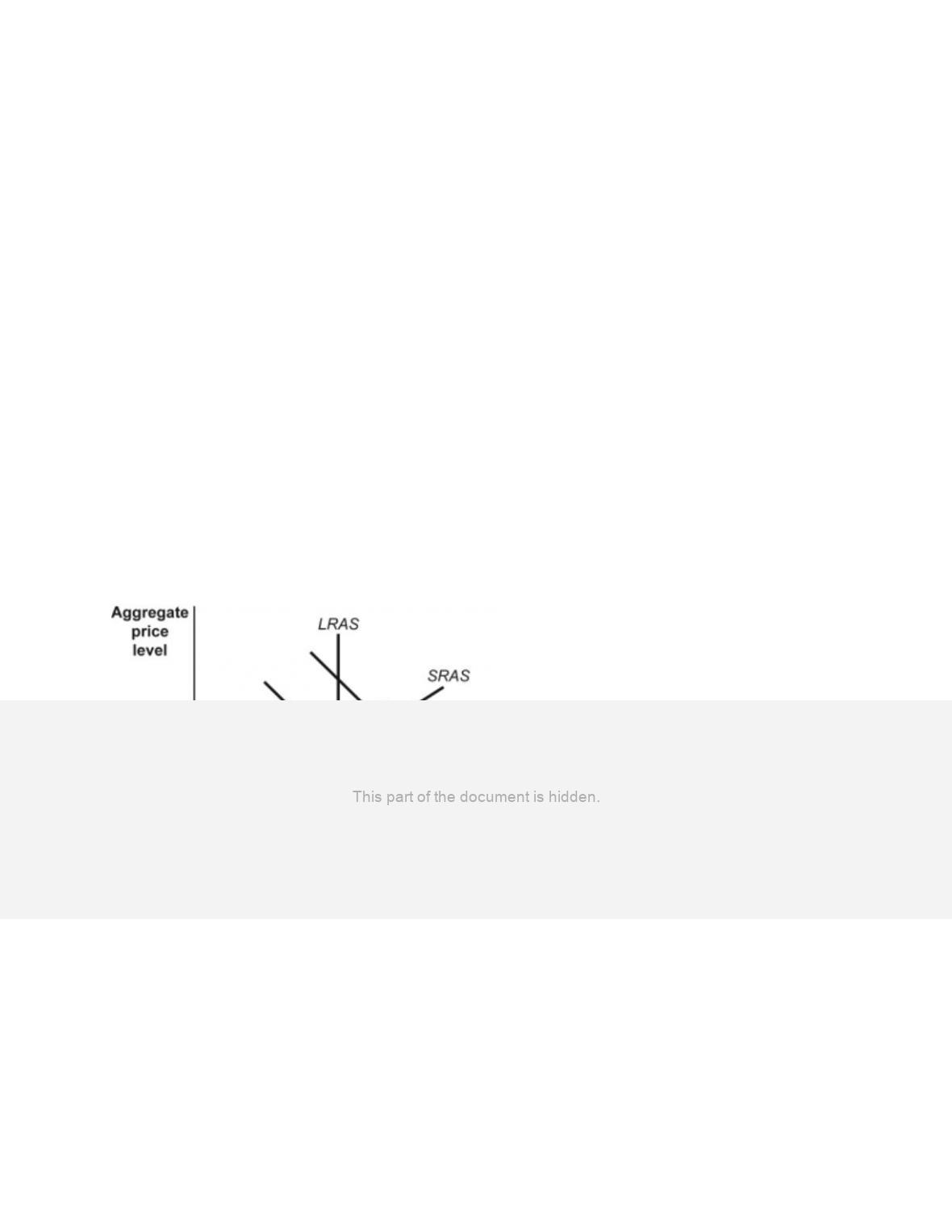
(Figure: Short-Run Equilibrium) Refer to Figure: Short-Run Equilibrium. Appropriate
fiscal policy action is:
A)
a decrease in transfer payments.
B)
an increase in government purchases.
C)
a decrease in tax rates.
D)
an increase in transfer payments.
24.
(Figure: Short-Run Equilibrium) Refer to Figure: Short-Run Equilibrium. It reflects a
short-run inflationary gap. According to the labeling on the graph, the size of the
inflationary gap is equal to:
A)
P2 – P1.
B)
Y1 – YP.
C)
P2 – P0.
D)
P1 – P0.
25.
(Figure: Short-Run Equilibrium) Refer to Figure: Short-Run Equilibrium. If the
economy is at equilibrium at Y1 and P1, it is in a(n):
A)
recessionary gap.
B)
inflationary gap.
C)
high level of unemployment.
D)
liquidity trap.
26.
(Figure: Short-Run Equilibrium) Refer to Figure: Short-Run Equilibrium. If the
economy is at equilibrium at Y1 and P1, the government should use _____ fiscal policy
to shift the aggregate demand curve to the _____.
A)
expansionary; right
B)
expansionary; left
C)
contractionary; right
D)
contractionary; left
27.
(Figure: Short-Run Equilibrium) Refer to Figure: Short-Run Equilibrium. If the
economy is at equilibrium at Y1 and P1, the appropriate policy to return the economy to
potential output would be a(n):
A)
increase in transfer payments.
B)
increase in government spending.
C)
increase in taxes.
D)
decrease in taxes.
Page 6
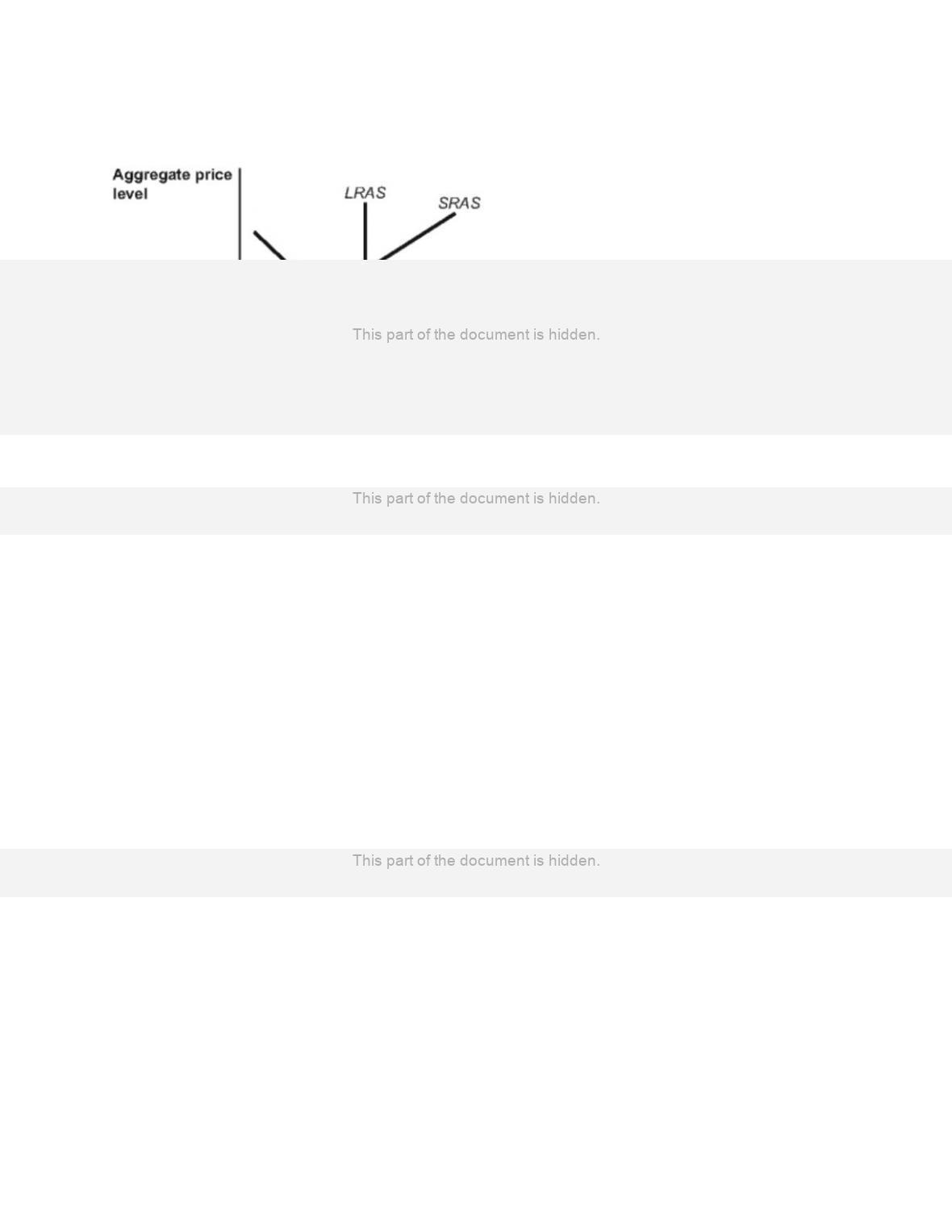
Use the following to answer questions 28-31:
28.
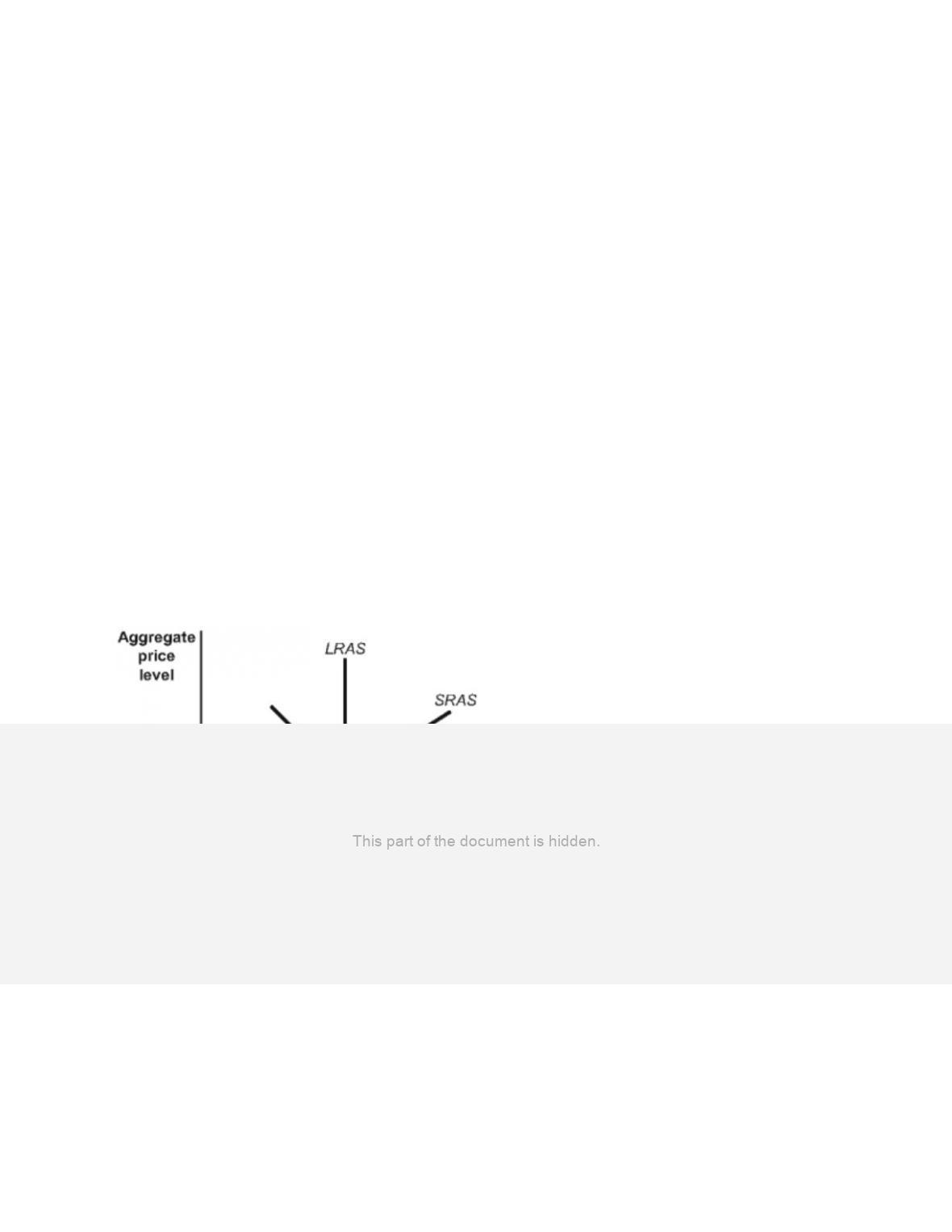
(Figure: Short- and Long-Run Equilibrium) Refer to Figure: Short- and Long-Run
Equilibrium. The government should _____ aggregate demand by _____ taxes to close
the _____ gap.
A)
expand; increasing; inflationary
B)
reduce; cutting; inflationary
C)
expand; cutting; recessionary
D)
reduce; increasing; recessionary
29.
(Figure: Short- and Long-Run Equilibrium) Refer to Figure: Short- and Long-Run
Equilibrium. If the economy is at equilibrium at E1, it is in a(n):
A)
recessionary gap.
B)
inflationary gap.
C)
low level of unemployment.
D)
liquidity trap.
30.
(Figure: Short- and Long-Run Equilibrium) Refer to Figure: Short- and Long-Run
Equilibrium. If the economy is at equilibrium at E1, the government should use _____
fiscal policy to shift the aggregate demand curve to the _____.
A)
expansionary; right
B)
expansionary; left
C)
contractionary; right
D)
contractionary; left
Page 7
31.
(Figure: Short- and Long-Run Equilibrium) Refer to Figure: Short- and Long-Run
Equilibrium. If the economy is at equilibrium at E1, the appropriate policy to return the
economy to potential output is a(n):
A)
increase in transfer payments.
B)
decrease in transfer payments.
C)
increase in taxes.
D)
decrease in government spending.
32.
If the economy is at equilibrium below potential output, there is a(n) _____ gap, and
_____ fiscal policy is appropriate.
A)
recessionary; expansionary
B)
inflationary; expansionary
C)
recessionary; contractionary
D)
inflationary; contractionary
33.
Expansionary fiscal policy:
A)
increases long-run aggregate supply.
B)
decreases long-run aggregate supply.
C)
increases aggregate demand.
D)
decreases aggregate demand.
34.
If the economy is at potential output and consumption spending suddenly decreases
because of a fall in consumer confidence, the appropriate fiscal policy is:
A)
a decrease in government transfers.
B)
an increase in government spending.
C)
a decrease in government spending.
D)
an increase in the money supply to decrease interest rates.
35.
Which factor is an expansionary fiscal policy?
A)
an increase in the money supply that decreases interest rates
B)
an increase in taxes that reduces the budget deficit and decreases consumption
C)
a decrease in government spending
D)
an increase in unemployment benefits
36.
If the economy is at equilibrium above potential output, there is a(n) _____ gap, and
_____ fiscal policy is appropriate.
A)
recessionary; expansionary
B)
inflationary; contractionary
C)
recessionary; contractionary
D)
inflationary; expansionary
Page 8
37.
If overall spending declines and thus the economy contracts, the government could
counter this by:
A)
raising tax rates.
B)
decreasing government transfers.
C)
increasing government spending.
D)
decreasing government spending.
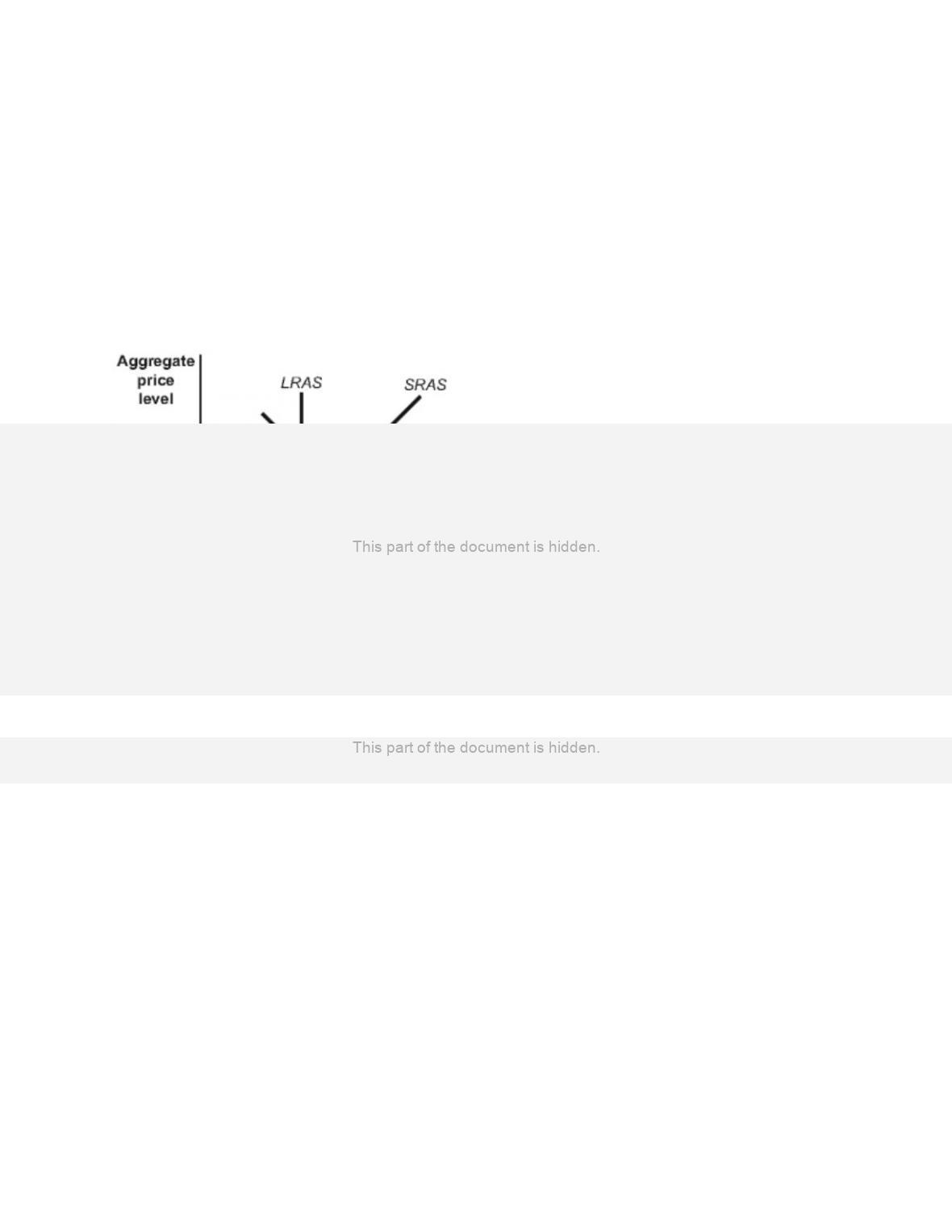
Use the following to answer questions 38-41:
38.
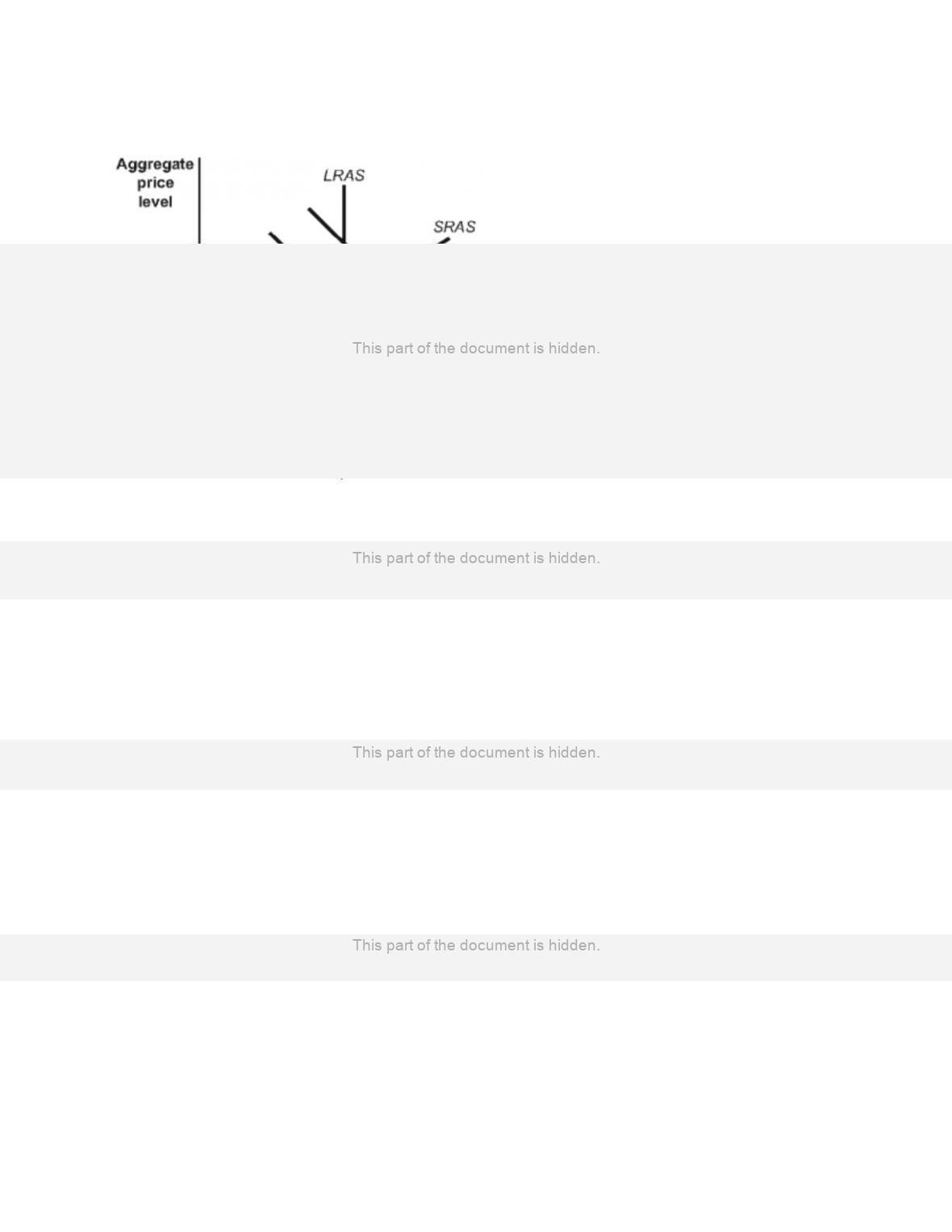
(Figure: Short- and Long-Run Equilibrium II) Refer to Figure: Short- and Long-Run
Equilibrium II. Which action would be the appropriate response on the part of the
government upon viewing the state of the economy?
A)
Increase government spending to close the recessionary gap.
B)
Decrease government spending to close the recessionary gap.
C)
Lower tax rates to close the inflationary gap.
D)
Raise tax rates to close the inflationary gap.
39.
(Figure: Short- and Long-Run Equilibrium II) Refer to Figure: Short- and Long-Run
Equilibrium II. If the economy is at equilibrium at E1, it is in a(n):
A)
recessionary gap.
B)
inflationary gap.
C)
high level of unemployment.
D)
liquidity trap.

Page 9
40.
(Figure: Short- and Long-Run Equilibrium II) Refer to Figure: Short- and Long-Run
Equilibrium II. If the economy is at equilibrium at E1, the government should use _____
fiscal policy to shift the aggregate demand curve to the _____.
A)
expansionary; right
B)
expansionary; left
C)
contractionary; right
D)
contractionary; left
41.
(Figure: Short- and Long-Run Equilibrium II) Refer to Figure: Short- and Long-Run
Equilibrium II. If the economy is at equilibrium at E1, the appropriate policy to return
the economy to potential output would be a(n):
A)
increase in government spending.
B)
decrease in government spending.
C)
increase in transfer payments.
D)
decrease in taxes.
42.
A reduction in government transfers _____, therefore shifting the aggregate demand
curve to the _____.
A)
increases labor costs to companies, increasing investment; left
B)
decreases government purchases of goods and services, decreasing consumption;
right
C)
increases the marginal propensity to save, decreasing consumption; right
D)
decreases disposable income and consumption; left
43.
A cut in taxes _____, shifting the aggregate demand curve to the _____.
A)
decreases government transfers and consumption; right
B)
increases disposable income and consumption; right
C)
decreases the marginal propensity to save, increasing consumption; left
D)
increases corporate profits and investment; left
44.
An increase in government transfers is an example of _____fiscal policy because it
shifts the aggregate demand curve to the _____ aggregate output.
A)
expansionary; left, increasing
B)
contractionary; left, decreasing
C)
expansionary; right, increasing
D)
contractionary; right, decreasing
Page 10
45.
To close a recessionary gap with fiscal policy, the government could:
A)
increase national savings so that the interest rate falls.
B)
lower the annual income exempt from paying the personal income tax.
C)
lower the corporate income tax rate.
D)
lower the amount of unemployment insurance benefits.
46.
To close an inflationary gap with fiscal policy, the government could:
A)
reduce budget allocations to interstate highway maintenance.
B)
increase federal subsidies to state universities.
C)
lower the corporate income tax rate.
D)
raise the average amount awarded for a disability pension.
47.
Contractionary fiscal policy includes:
A)
increasing government purchases.
B)
increasing government transfers.
C)
raising tax rates.
D)
decreasing money growth.
Use the following to answer questions 48-54:
48.
(Figure: Inflationary and Recessionary Gaps) Refer to Figure: Inflationary and
Recessionary Gaps. At E1, the economy:
A)
is in a long-run equilibrium.
B)
has an inflationary gap.
C)
has a recessionary gap.
D)
has low unemployment.
Page 11
49.
(Figure: Inflationary and Recessionary Gaps) Refer to Figure: Inflationary and
Recessionary Gaps. At E2, the economy:
A)
is in a long-run equilibrium.
B)
has an inflationary gap.
C)
has a recessionary gap.
D)
has high unemployment.
50.
(Figure: Inflationary and Recessionary Gaps) Refer to Figure: Inflationary and
Recessionary Gaps. At E3, the economy:
A)
is in a long-run equilibrium.
B)
has an inflationary gap.
C)
has a recessionary gap.
D)
is stagnating.
51.
(Figure: Inflationary and Recessionary Gaps) Refer to Figure: Inflationary and
Recessionary Gaps. A movement from AD1 to AD3 could be caused by:
A)
increased government purchases.
B)
decreased government transfers.
C)
higher tax rates.
D)
decreased government purchases.
52.
(Figure: Inflationary and Recessionary Gaps) Refer to Figure: Inflationary and
Recessionary Gaps. A movement from AD3 to AD1 could be caused by:
A)
increased government purchases.
B)
increased government transfers.
C)
higher tax rates.
D)
lower tax rates.
53.
(Figure: Inflationary and Recessionary Gaps) Refer to Figure: Inflationary and
Recessionary Gaps. Which equation measures an inflationary gap?
A)
Y3 – Y1
B)
Y3 – Y2
C)
Y2 – Y1
D)
Y3 – Y0
Page 12
54.
(Figure: Inflationary and Recessionary Gaps) Refer to Figure: Inflationary and
Recessionary Gaps. Which equation measures a recessionary gap?
A)
Y3 – Y1
B)
Y3 – Y2
C)
Y2 – Y1
D)
Y3 – Y0
55.
A government might want to increase aggregate demand to:
A)
close an inflationary gap.
B)
close a recessionary gap.
C)
reduce prices.
D)
reduce employment.
56.
An inflationary gap occurs when:
A)
prices are too low.
B)
real output is too low.
C)
potential output exceeds actual output.
D)
actual output exceeds potential output.
Use the following to answer questions 57-61:

Page 13
57.
(Figure: Fiscal Policy I) Refer to Figure: Fiscal Policy I. Suppose that this economy is in
equilibrium at E1. If there is an increase in government purchases, _____ will shift to the
_____, causing a(n) _____ in the price level and a(n) _____ in real GDP.
A)
AD2; left; increase; decrease
B)
AD2; left; decrease; decrease
C)
AD1; right; increase; increase
D)
AD1; right; decrease; increase
58.
(Figure: Fiscal Policy I) Refer to Figure: Fiscal Policy I. Suppose that this economy is
in equilibrium at E2. If there is a decrease in government purchases, _____ will shift to
the _____, causing a(n) _____ in the price level and a(n) _____ in real GDP.
A)
AD2; left; increase; decrease
B)
AD2; left; decrease; decrease
C)
AD1; right; increase; increase
D)
AD1; right; decrease; increase
59.
(Figure: Fiscal Policy I) Refer to Figure: Fiscal Policy I. Suppose that this economy is in
equilibrium at E1. If there is a decrease in taxes, _____ will shift to the _____, causing
a(n) _____ in the price level and a(n) _____ in real GDP.
A)
AD2; left; increase; decrease
B)
AD2; left; decrease; decrease
C)
AD1; right; increase; increase
D)
AD1; right; decrease; increase
60.
(Figure: Fiscal Policy I) Refer to Figure: Fiscal Policy I. Suppose that this economy is
in equilibrium at E2. If there is an increase in taxes_____ will shift to the _____, causing
a(n) _____ in the price level and a(n) _____ in real GDP.
A)
AD2; left; increase; decrease
B)
AD2; left; decrease; decrease
C)
AD1; right; increase; increase
D)
AD1; right; decrease; increase
61.
(Figure: Fiscal Policy I) Refer to Figure: Fiscal Policy I. Suppose that this economy is
in equilibrium at E2. If there is an increase in government transfers_____ will shift to the
_____, causing a(n) _____ in the price level and a(n) _____ in real GDP.
A)
AD2; right; increase; increase
B)
AD2; left; decrease; decrease
C)
AD1; right; increase; increase
D)
AD1; right; decrease; increase
Page 14
Use the following to answer questions 62-68:
62.
(Figure: Fiscal Policy II) Refer to Figure: Fiscal Policy II. Suppose that this economy is
in equilibrium at E1. If there is a decrease in government transfers, _____ will shift to
the _____, causing a(n) _____ in the price level and a(n) _____ in real GDP.
A)
AD2; left; increase; decrease
B)
AD2; left; decrease; decrease
C)
AD1; right; increase; increase
D)
AD1; left; decrease; decrease
63.
(Figure: Fiscal Policy II) Refer to Figure: Fiscal Policy II. Suppose that this economy is
in equilibrium at E2. If there is a decrease in government transfers, _____ will shift to
the _____, causing a(n) _____ in the price level and a(n) _____ in real GDP.
A)
AD2; left; increase; decrease
B)
AD2; left; decrease; decrease
C)
AD1; right; increase; increase
D)
AD1; left; decrease; decrease
64.
(Figure: Fiscal Policy II) Refer to Figure: Fiscal Policy II. Suppose that this economy is
in equilibrium at E2. If there is an increase in government transfers, _____ will shift to
the _____, causing a(n) _____ in the price level and a(n) _____ in real GDP.
A)
AD2; right; increase; increase
B)
AD2; left; decrease; decrease
C)
AD1; right; increase; increase
D)
AD1; left; decrease; decrease

Page 15
65.
(Figure: Fiscal Policy II) Refer to Figure: Fiscal Policy II. Suppose that this economy is
in equilibrium at E1. If there is a decrease in government purchases, _____ will shift to
the _____, causing a(n) _____ in the price level and a(n) _____ in real GDP.
A)
AD2; left; increase; decrease
B)
AD2; left; decrease; decrease
C)
AD1; right; increase; increase
D)
AD1; left; decrease; decrease
66.
(Figure: Fiscal Policy II) Refer to Figure: Fiscal Policy II. Suppose that this economy is
in equilibrium at E1. If there is an increase in government purchases, _____ will shift to
the _____, causing a(n) _____ in the price level and a(n) _____ in real GDP.
A)
AD2; left; increase; decrease
B)
AD2; left; decrease; decrease
C)
AD1; right; increase; increase
D)
AD1; right; decrease; increase
67.
(Figure: Fiscal Policy II) Refer to Figure: Fiscal Policy II. Suppose that this economy is
in equilibrium at E1. If there is an increase in taxes, _____ will shift to the _____,
causing a(n) _____ in the price level and a(n) _____ in real GDP.
A)
AD1; left; increase; decrease
B)
AD1; left; decrease; decrease
C)
AD2; right; increase; increase
D)
AD2; right; decrease; increase
68.
(Figure: Fiscal Policy II) Refer to Figure: Fiscal Policy II. Suppose that this economy is
in equilibrium at E1. If there is a decrease in taxes, _____ will shift to the _____,
causing a(n) _____ in the price level and a(n) _____ in real GDP.
A)
AD1; right; increase; increase
B)
AD1; left; decrease; decrease
C)
AD2; right; increase; increase
D)
AD2; right; decrease; increase
69.
Fiscal policy that increases aggregate demand is:
A)
balanced.
B)
supplemental.
C)
contractionary.
D)
expansionary.
Page 16
70.
Fiscal policy that decreases aggregate demand is:
A)
balanced.
B)
supplemental.
C)
contractionary.
D)
expansionary.
71.
Expansionary fiscal policy includes:
A)
increasing taxes.
B)
increasing the money supply.
C)
decreasing government expenditures.
D)
increasing government expenditures.
72.
Expansionary fiscal policy includes:
A)
decreasing taxes.
B)
increasing taxes.
C)
increasing the money supply.
D)
decreasing government expenditures.
73.
Contractionary fiscal policy includes:
A)
decreasing taxes.
B)
decreasing the money supply.
C)
decreasing government expenditures.
D)
increasing government expenditures.
74.
Contractionary fiscal policy includes:
A)
decreasing taxes.
B)
increasing taxes.
C)
increasing the money supply.
D)
increasing government expenditures.
75.
An expansionary fiscal policy either _____ government spending or _____ taxes.
A)
increases; increases
B)
decreases; increases
C)
increases; decreases
D)
decreases; decreases
Page 17
76.
A contractionary fiscal policy either _____ government spending or _____ taxes.
A)
increases; increases
B)
decreases; increases
C)
increases; decreases
D)
decreases; decreases
77.
An expansionary fiscal policy:
A)
usually decreases a government budget deficit or increases a government budget
surplus.
B)
may include decreases in government spending.
C)
may include increases in taxes.
D)
may include decreases in taxes.
78.
A contractionary fiscal policy:
A)
decreases a government budget deficit or increases a government budget surplus.
B)
may include increases in government spending.
C)
may include reductions in taxes.
D)
may include discretionary increases in transfer payments.
79.
A recessionary gap can be closed with:
A)
contractionary monetary policy.
B)
an increase in taxes.
C)
a decrease in government purchases.
D)
expansionary fiscal policy.
80.
An inflationary gap can be closed with:
A)
expansionary monetary policy.
B)
a decrease in taxes.
C)
a decrease in government purchases.
D)
expansionary fiscal policy.
81.
Expansionary fiscal policy shifts the aggregate demand curve to the _____ and is used
to close a(n) _____ gap.
A)
right; inflationary
B)
right; recessionary
C)
left; inflationary
D)
left; recessionary
Page 18
82.
Contractionary fiscal policy shifts the aggregate demand curve to the _____ and is used
to close a(n) _____ gap.
A)
right; inflationary
B)
right; recessionary
C)
left; inflationary
D)
left; recessionary
83.
If there is an inflationary gap in the economy, discretionary fiscal policy will likely
include action to:
A)
shift aggregate demand to the right.
B)
prevent the aggregate demand curve from shifting.
C)
shift aggregate demand to the left.
D)
shift both aggregate demand and short-run aggregate supply to the left.
84.
If there is a recessionary gap, discretionary fiscal policy would likely include action to:
A)
shift aggregate demand to the right.
B)
shift aggregate demand to the left.
C)
leave aggregate demand alone and shift short-run aggregate supply to the left.
D)
shift aggregate demand to the right and shift short-run aggregate supply to the left.
Use the following to answer questions 85-90:
85.
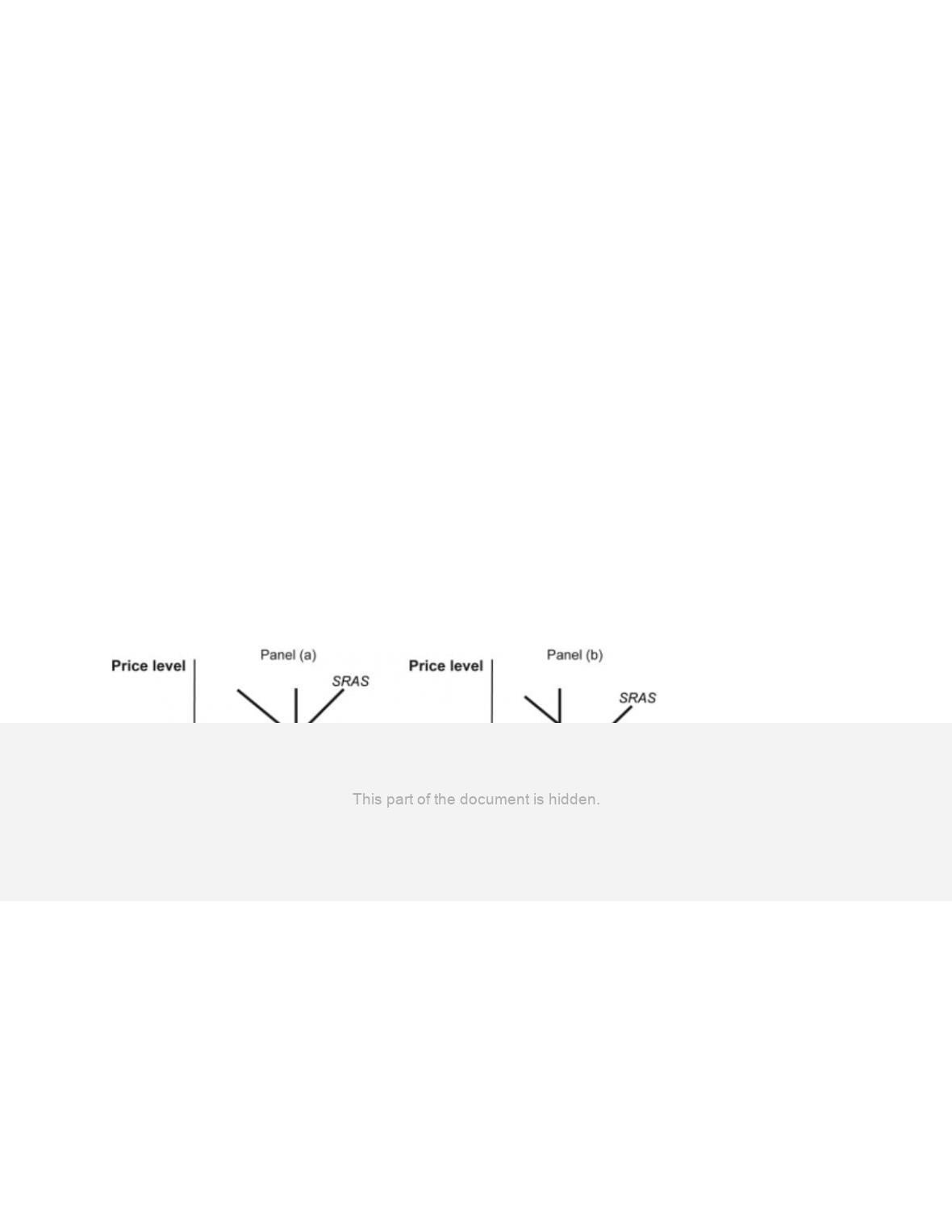
(Figure: Fiscal Policy Choices) Refer to Figure: Fiscal Policy Choices. In panel (a), the
economy is initially at output level Y1 and there is:
A)
an inflationary gap.
B)
a recessionary gap.
C)
equilibrium at full employment.
D)
no gap.

Page 19
86.
(Figure: Fiscal Policy Choices) Refer to Figure: Fiscal Policy Choices. In panel (b), if
real GDP is equal to Y1, there is:
A)
an inflationary gap.
B)
a recessionary gap.
C)
equilibrium at full employment.
D)
no gap.
87.
(Figure: Fiscal Policy Choices) Refer to Figure: Fiscal Policy Choices. It would be
appropriate to use contractionary fiscal policy to shift aggregate demand in _____ from
_____.
A)
panel (b); AD1 to AD2
B)
panel (a); AD2 to AD1
C)
panel (a); AD1 to AD2
D)
panel (b); AD2 to AD1
88.
(Figure: Fiscal Policy Choices) Refer to Figure: Fiscal Policy Choices. It would be
appropriate to use expansionary fiscal policy to shift aggregate demand in _____ from
_____.
A)
panel (b); AD1 to AD2
B)
panel (a); AD2 to AD1
C)
panel (a); AD1 to AD2
D)
panel (b); AD2 to AD1
89.
(Figure: Fiscal Policy Choices) Refer to Figure: Fiscal Policy Choices. If the
government uses discretionary fiscal policy for the economy in panel (a) when real GDP
is Y1, government spending is likely to be _____ and taxes are likely to be _____.
A)
reduced; cut
B)
increased; increased
C)
reduced; increased
D)
increased; cut
90.
(Figure: Fiscal Policy Choices) Refer to Figure: Fiscal Policy Choices. If the
government uses discretionary fiscal policy for the economy in panel (b) when real GDP
is Y1, government spending is likely to be _____ and taxes are likely to be _____.
A)
reduced; cut
B)
increased; increased
C)
reduced; increased
D)
increased; cut
Page 20
Use the following to answer questions 91-97:
91.
(Figure: Fiscal Policy Options) Refer to Figure: Fiscal Policy Options. If the aggregate
demand curve is AD, the most appropriate discretionary fiscal policy is to _____
government spending and _____ income tax rates.
A)
decrease; increase
B)
decrease; maintain
C)
increase; increase
D)
maintain; maintain
92.
(Figure: Fiscal Policy Options) Refer to Figure: Fiscal Policy Options. If the aggregate
demand curve is AD’, the most appropriate discretionary fiscal policy is to _____
government spending and _____ income tax rates.
A)
increase; increase
B)
increase; decrease
C)
decrease; increase
D)
decrease; decrease
93.
(Figure: Fiscal Policy Options) Refer to Figure: Fiscal Policy Options. If the aggregate
demand curve is ADʺ, the most appropriate discretionary fiscal policy is to _____
government spending and _____ income tax rates.
A)
increase; decrease
B)
increase; increase
C)
decrease; decrease
D)
decrease; increase