
Page 41
199.
(Figure: Policy Alternatives) Refer to Figure: Policy Alternatives. Assume that the
economy depicted in panel (a) is in short-run equilibrium with AD1 and SRAS1. If the
economy is left to correct itself:
A)
real interest rates will fall, which will shift SRAS rightward.
B)
lower wages will result in a gradual shift from SRAS1 to SRAS2.
C)
long-run equilibrium will be established at YP and P3.
D)
the aggregate demand curve will shift leftward.
200.
(Figure: Policy Alternatives) Refer to Figure: Policy Alternatives. Assume that the
economy depicted in panel (a) is in short-run equilibrium at a real GDP level of Y1. The
economy will correct itself:
A)
rapidly, without use of fiscal policy.
B)
in the long run as wages fall.
C)
in the short run as wages rise.
D)
because the aggregate demand curve shifts.
201.
(Figure: Policy Alternatives) Refer to Figure: Policy Alternatives. The economy in panel
(b) is initially in short-run equilibrium at real GDP level Y1 and price level P2. At real
GDP level Y1 there is:
A)
an inflationary gap.
B)
a recessionary gap.
C)
no gap.
D)
long-run equilibrium.
202.
Inflationary and recessionary gaps are closed by self-correcting adjustments that shift:
A)
the SRAS curve.
B)
the AD curve.
C)
the LRAS curve.
D)
both the SRAS curve and the LRAS curve.
203.
An inflationary gap is automatically closed by _____ wages that shift the SRAS curve
_____.
A)
falling; rightward
B)
falling; leftward
C)
rising; rightward
D)
rising; leftward

Page 42
204.
An inflationary gap will be eliminated because there is _____ pressure on wages,
shifting the _____.
A)
downward; long-run aggregate supply curve to the right
B)
downward; long-run aggregate supply curve to the left
C)
downward; aggregate demand curve to the left
D)
upward; short-run aggregate supply curve to the left
205.
A recessionary gap can be closed by _____ wages that shifts the _____.
A)
falling; SRAS curve rightward
B)
falling; LRAS curve rightward
C)
falling; SRAS curve leftward
D)
rising; SRAS curve rightward
206.
A recessionary gap will be eliminated because there is _____ pressure on wages,
shifting the _____.
A)
downward; short-run aggregate supply curve rightward
B)
downward; short-run aggregate supply curve leftward
C)
downward; aggregate demand curve downward
D)
upward; aggregate demand curve leftward
207.
As a recessionary gap self-corrects, the equilibrium price level _____ and the
equilibrium real output _____.
A)
rises; decreases
B)
rises; increases
C)
falls; decreases
D)
falls; increases
208.
As an inflationary gap self-corrects, the equilibrium price level _____ and the
equilibrium real output _____.
A)
rises; decreases
B)
rises; increases
C)
falls; decreases
D)
falls; increases

Page 43
209.
Suppose that the economy is in long-run macroeconomic equilibrium and aggregate
demand increases. As the economy moves to short-run macroeconomic equilibrium,
there is a(n) _____ gap with _____.
A)
recessionary; high inflation
B)
recessionary; low inflation
C)
inflationary; high unemployment
D)
inflationary; low unemployment
210.
If the short-run macroeconomic equilibrium is to the _____ of the economy’s potential
output, then there is a(n) _____ gap and the aggregate price level is expected to _____.
A)
right; inflationary; fall
B)
right; recessionary; rise
C)
left; inflationary; fall
D)
left; recessionary; fall
211.
In the long run, inflationary and recessionary gaps are self-correcting because
eventually:
A)
nominal wages rise to close an inflationary gap or fall to close a recessionary gap.
B)
the government applies the right combination of fiscal and monetary policies.
C)
the multiplier compensates for the negative supply or demand shocks.
D)
nominal wages rise to close a recessionary gap and fall to close an inflationary gap.
212.
A recessionary gap occurs when:
A)
potential output is below aggregate output.
B)
potential output is receding.
C)
aggregate output is below potential output.
D)
aggregate output is above potential output.
213.
A recessionary gap gradually:
A)
increases short-run aggregate supply.
B)
decreases short-run aggregate supply.
C)
increases aggregate demand.
D)
decreases aggregate demand.
214.
If there is an inflationary gap, nominal wages _____, and the _____ curve shifts _____
until the economy reaches long-run equilibrium.
A)
fall; aggregate demand; left
B)
rise; aggregate demand; right
C)
fall; short-run aggregate supply; right
D)
rise; short-run aggregate supply; left

Page 44
215.
An inflationary gap gradually:
A)
increases short-run aggregate supply.
B)
decreases short-run aggregate supply.
C)
increases aggregate demand.
D)
decreases aggregate demand.
216.
In the long run, the economy is:
A)
unstable.
B)
self-correcting.
C)
inflexible.
D)
uncontrollable.
217.
If actual GDP is less than potential output, then the economy is:
A)
in an inflationary gap.
B)
in a recessionary gap.
C)
in a long-run equilibrium.
D)
at full employment.
218.
Suppose the economy is in a short-run equilibrium and actual output is greater than
potential output. The economy is in:
A)
an inflationary gap; nominal wages will increase and SRAS will shift to the left
until actual GDP is equal to potential GDP in the long run.
B)
a recessionary gap; nominal wages will decrease and AD will shift to the left until
actual GDP is equal to potential GDP in the long run.
C)
an inflationary gap; prices of goods will increase and AD will shift to the right until
the economy is in long-run equilibrium.
D)
a recessionary gap; prices of goods will decrease and LRAS will shift to the left
until the economy is in long-run equilibrium.
219.
If the economy is in a recessionary gap:
A)
it will remain in a recession forever without any kind of government intervention.
B)
nominal wages will fall and SRAS will shift to the right until the economy is at full
employment.
C)
AD will shift to the right and prices of goods will rise until the economy goes back
to producing potential output.
D)
nominal wages will rise, SRAS will shift to the left, and the economy will
eventually restore itself.

Page 45
220.
Suppose that an economy is in an inflationary gap in the short run. In the long run:
A)
the economy’s self-correcting mechanism will restore GDP to its potential level.
B)
inflation will spiral unless the government takes dramatic fiscal measures.
C)
sustained inflation will reduce the value of money.
D)
fiscal and monetary policies may lower prices, but output will remain higher than
potential level.
221.
In the long run, the economy is:
A)
self-correcting, as commodity prices rise during recessionary gaps and fall during
inflationary gaps to move the economy to long-run equilibrium.
B)
self-correcting, as prices of goods that are sticky in the short run become very
flexible in the long run and thus move the economy to full employment.
C)
fluctuating, as nominal wages rise and fall during short-run economic fluctuations.
D)
self-correcting, as nominal wages rise during recessionary gaps and fall during
inflationary gaps to move the economy to long-run equilibrium.
222.
A negative demand shock can cause:
A)
a liquidity trap.
B)
crowding out.
C)
a recessionary gap.
D)
an inflationary gap.
223.
An advantage of stabilizing macroeconomic policy over economic self-correction is
that:
A)
stabilization policies achieve potential output with a lower aggregate price level.
B)
economic self-correction can take a decade or more.
C)
economic self-correction affects the aggregate price level but not the aggregate
output level.
D)
stabilization policies are particularly effective to address supply shocks.
224.
Which curve is easiest to shift with government policy?
A)
the short-run aggregate supply curve
B)
the long-run aggregate supply curve
C)
the aggregate demand curve
D)
the short-run and long-run aggregate supply curves are both easy to shift
Page 46
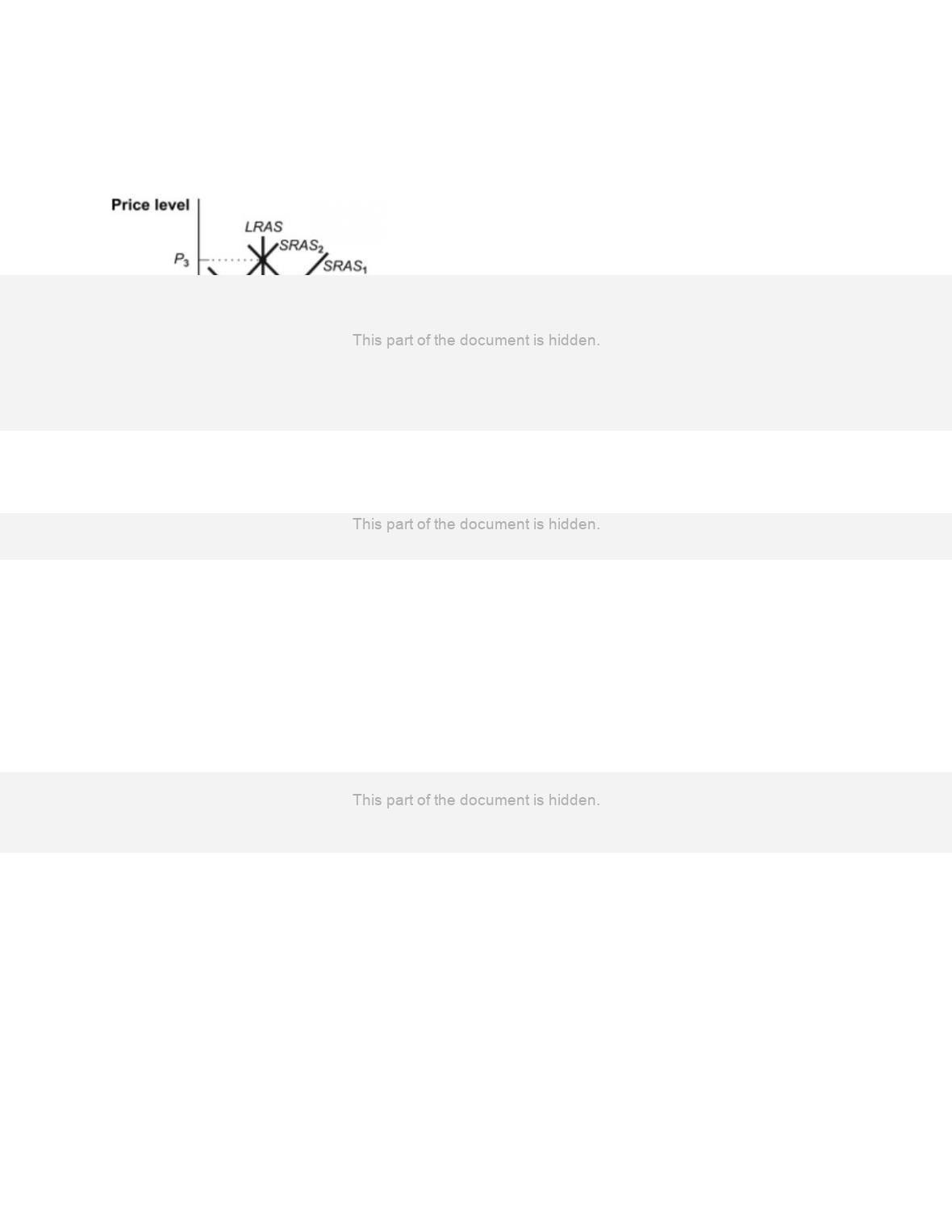
Use the following to answer questions 225-226:
Figure: An Increase in Aggregate Demand
225.
(Figure: An Increase in Aggregate Demand) Refer to Figure: An Increase in Aggregate
Demand. Assume that the economy is initially in long-run equilibrium at YP and P1.
Now suppose that there is an increase in the level of government purchases at each price
level. This will:
A)
shift the aggregate demand curve from AD2 to AD1.
B)
shift the aggregate demand curve from AD1 to AD2.
C)
lead to increased output and a decrease in the price level.
D)
lead to decreased output and a decreased price level.
226.
(Figure: An Increase in Aggregate Demand) Refer to Figure: An Increase in Aggregate
Demand. At the Y2 level of real GDP:
A)
an inflationary gap equal to the sum of Y2 and YP occurs.
B)
an inflationary gap equal to the difference between Y2 and YP occurs.
C)
the solution at Y2 is a long-run equilibrium.
D)
a recessionary gap equal to the difference between Y2 and YP occurs.
227.
Policy CANNOT offset the effects of a:
A)
positive demand shock by decreasing government spending.
B)
negative demand shock by cutting taxes.
C)
negative supply shock by increasing money supply.
D)
positive demand shock by increasing taxes.
Page 47
228.
Stabilization policies have:
A)
not reduced the effects of business cycles caused by either demand shocks or
supply shocks.
B)
reduced the economic fluctuations caused by demand shocks but have not been
effective against supply shocks.
C)
reduced the economic costs of supply shocks but have not been so successful
against demand shocks.
D)
reduced economic fluctuations by neutralizing the effects of both supply and
demand shocks.
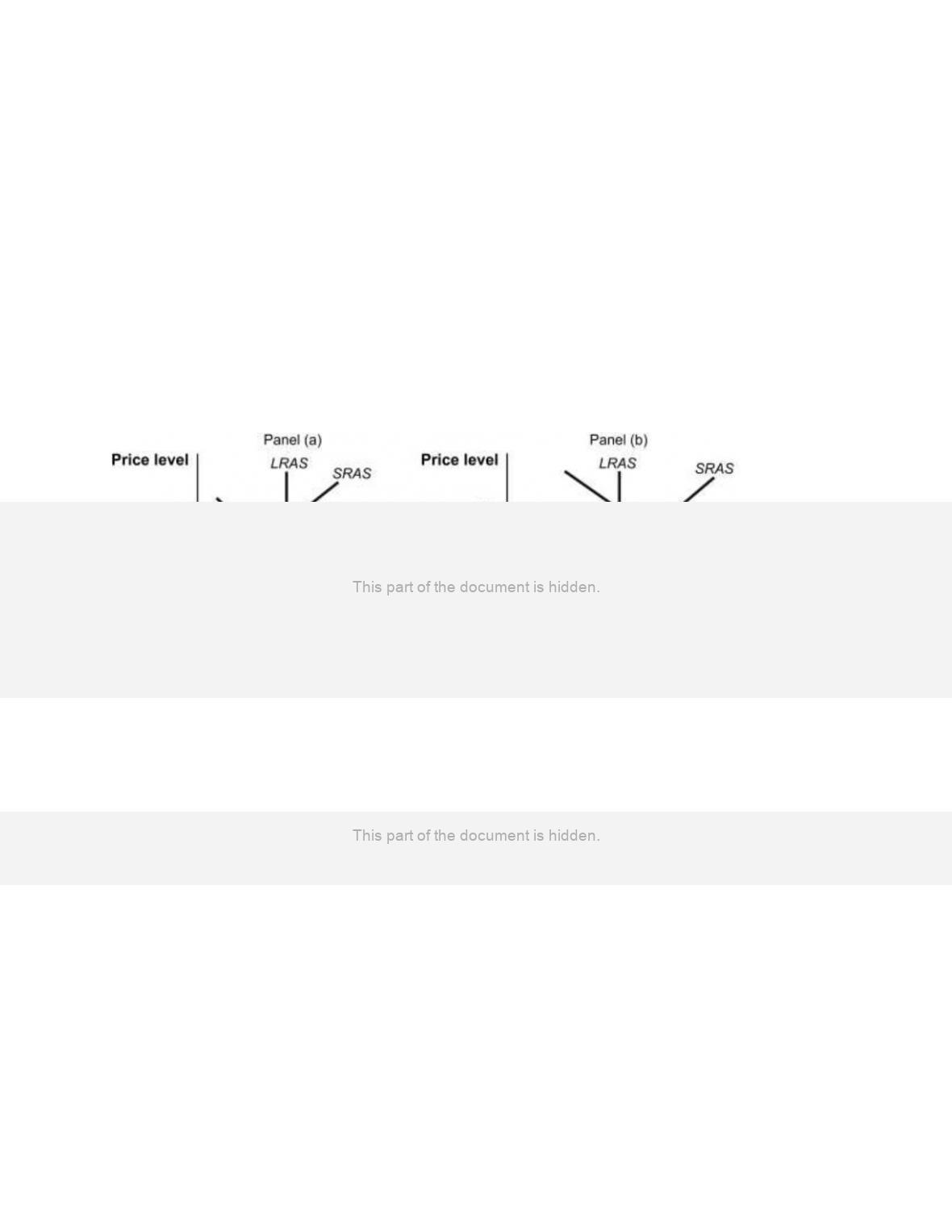
Use the following to answer questions 229-234:
Figure: Inflationary and Recessionary Gaps
229.
(Figure: Inflationary and Recessionary Gaps) Refer to Figure: Inflationary and
Recessionary Gaps. In panel (a), an expansionary policy designed to move the economy
from Y1 to Yp would attempt to shift the:
A)
aggregate demand curve to the left by increasing aggregate demand.
B)
aggregate demand curve to the right by increasing aggregate demand.
C)
SRAS curve to the left.
D)
LRAS curve to the left.
230.
(Figure: Inflationary and Recessionary Gaps) Refer to Figure: Inflationary and
Recessionary Gaps. If the economy is in short-run equilibrium at Y1 in panel (a), the
economy is in:
A)
a recessionary gap.
B)
an inflationary gap.
C)
simultaneous short-run and long-run equilibrium.
D)
full employment.
Page 48
231.
(Figure: Inflationary and Recessionary Gaps) Refer to Figure: Inflationary and
Recessionary Gaps. If the economy is in short-run equilibrium at Y1 in panel (a), to
return to potential output at YP policy makers should use:
A)
contractionary policy.
B)
expansionary policy.
C)
policies to shift the SRAS to the left.
D)
policies to shift the LRAS to the left.
232.
(Figure: Inflationary and Recessionary Gaps) Refer to Figure: Inflationary and
Recessionary Gaps. If the economy is in short-run equilibrium at Y1 in panel (b), the
economy is in:
A)
a recessionary gap.
B)
an inflationary gap.
C)
simultaneous short-run and long-run equilibrium.
D)
a high level of unemployment.
233.
(Figure: Inflationary and Recessionary Gaps) Refer to Figure: Inflationary and
Recessionary Gaps. If the economy is in short-run equilibrium at Y1 in panel (b), to
return to potential output at YP policy makers should use:
A)
contractionary stabilization policy.
B)
expansionary stabilization policy.
C)
policies to shift the SRAS to the left.
D)
policies to shift the LRAS to the left.
234.
(Figure: Inflationary and Recessionary Gaps) Refer to Figure: Inflationary and
Recessionary Gaps. If the economy is in short-run equilibrium at Y1 in panel (b), a
contractionary policy to bring the economy back to potential output at YP would attempt
to shift the:
A)
SRAS to the left.
B)
LRAS to the left.
C)
aggregate demand curve to the left by decreasing aggregate demand.
D)
aggregate demand curve to the right by increasing aggregate demand.
Page 49
235.
When the economy is in a recessionary gap, the government can improve economic
outcomes by:
A)
increasing taxes and aggregate spending via the multiplier.
B)
increasing the money supply, lowering the interest rate, increasing investment
spending and consumption spending, and thus increasing aggregate demand.
C)
cutting government expenditure, decreasing investment spending and consumption
spending, and thus increasing aggregate supply.
D)
increasing nominal wages, shifting the short run aggregate supply to the left and
thus removing the recessionary gap.
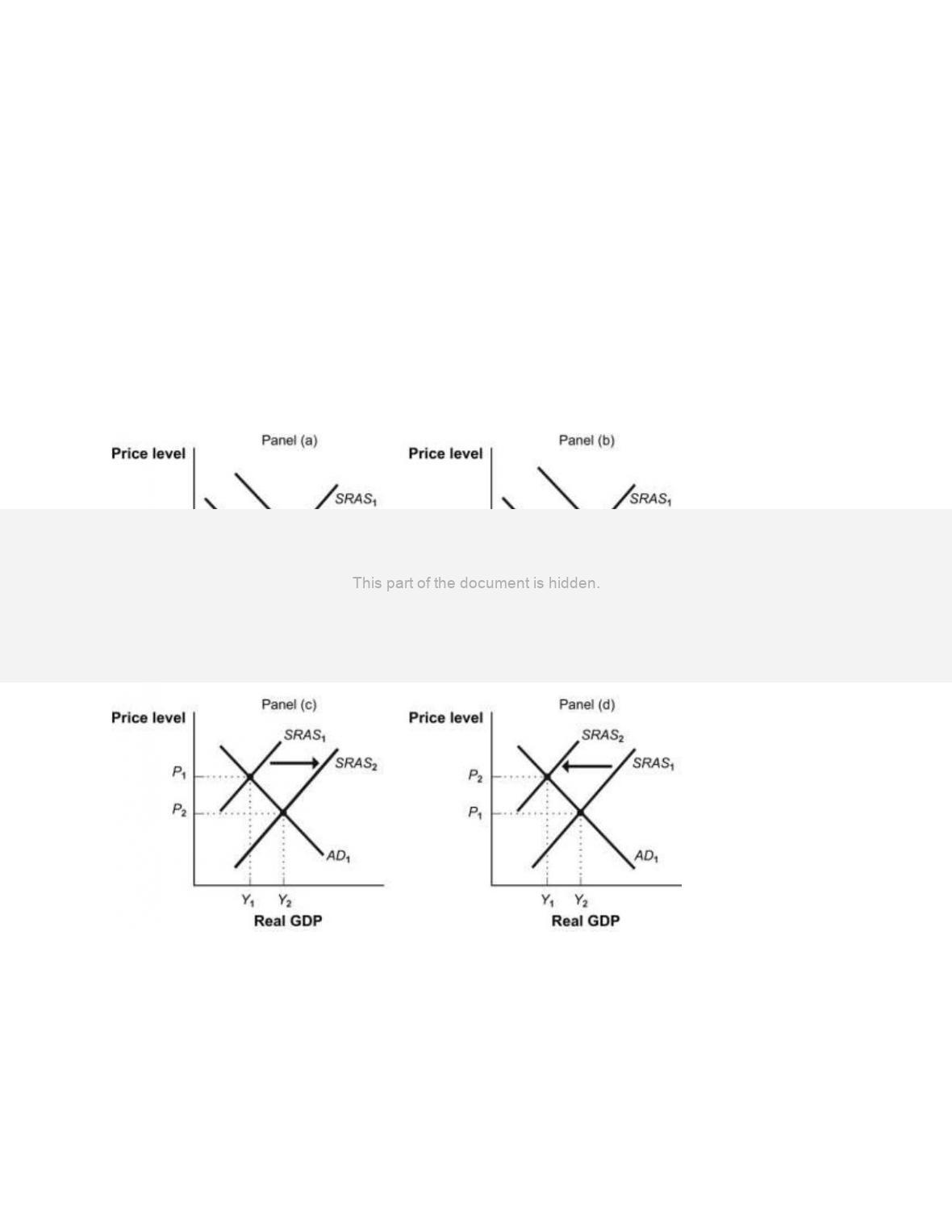
Use the following to answer questions 236-239:
Figure: Shifts of the AD–AS Curves
Page 50
236.
(Figure: Shifts of the AD–AS Curves) Refer to Figure: Shifts of the AD–AS Curves. A
short run decrease in investment spending is illustrated by panel:
A)
(a).
B)
(b).
C)
(c).
D)
(d).
237.
(Figure: Shifts of the AD–AS Curves) Refer to Figure: Shifts of the AD–AS Curves. A
short run increase in net exports is illustrated by panel:
A)
(a).
B)
(b).
C)
(c).
D)
(d).
238.
(Figure: Shifts of the AD–AS Curves) Refer to Figure: Shifts of the AD–AS Curves. A
decrease in wages in the short run is illustrated by panel:
A)
(a).
B)
(b).
C)
(c).
D)
(d).
239.
(Figure: Shifts of the AD–AS Curves) Refer to Figure: Shifts of the AD–AS Curves. An
increase in wages in the short run is illustrated by panel:
A)
(a).
B)
(b).
C)
(c).
D)
(d).
240.
A positive demand shock will result from:
A)
a sudden increase in nominal wages.
B)
an increase in the potential GDP.
C)
a move by the Federal Reserve to lower the interest rate.
D)
consumers and firms becoming more pessimistic.
Page 51
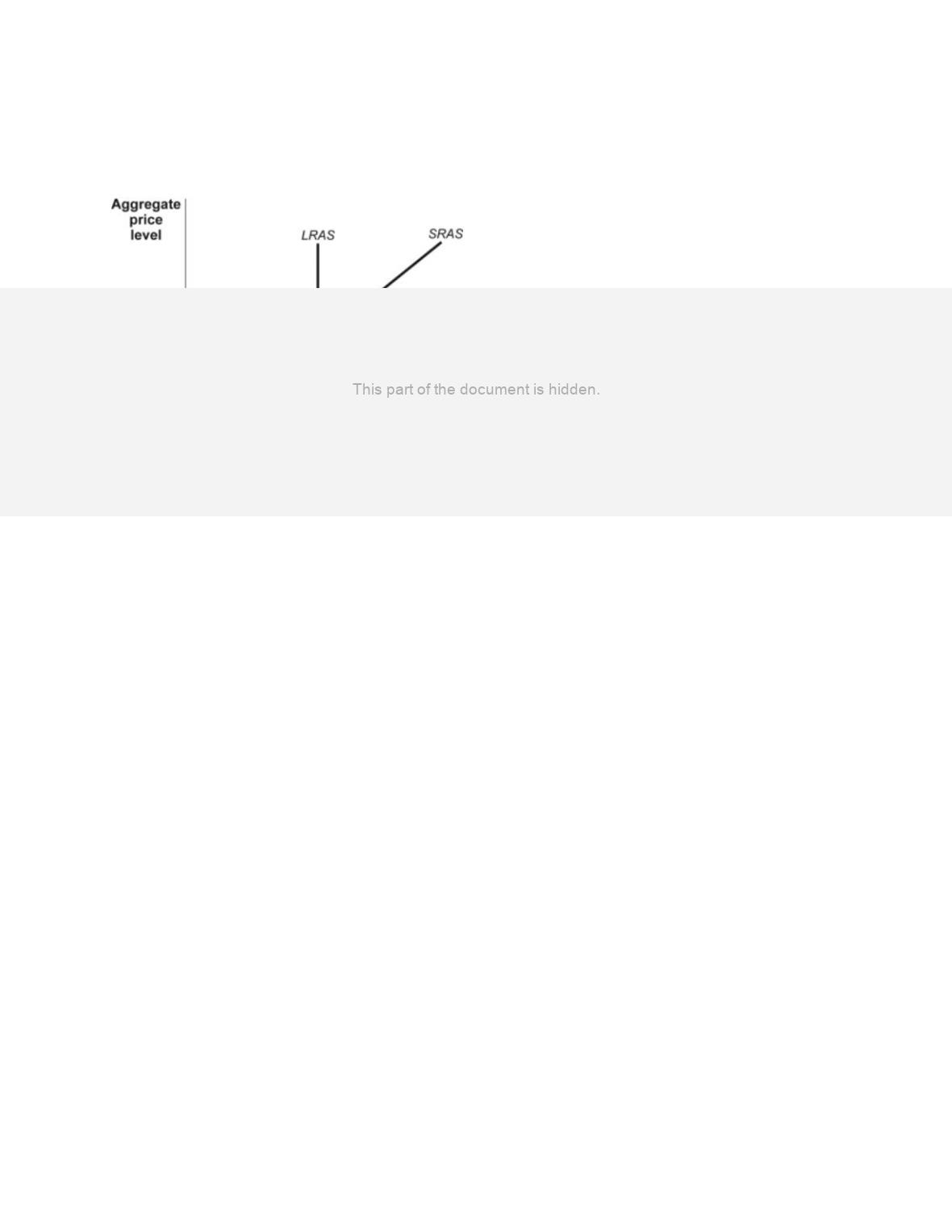
Use the following to answer questions 241-244:
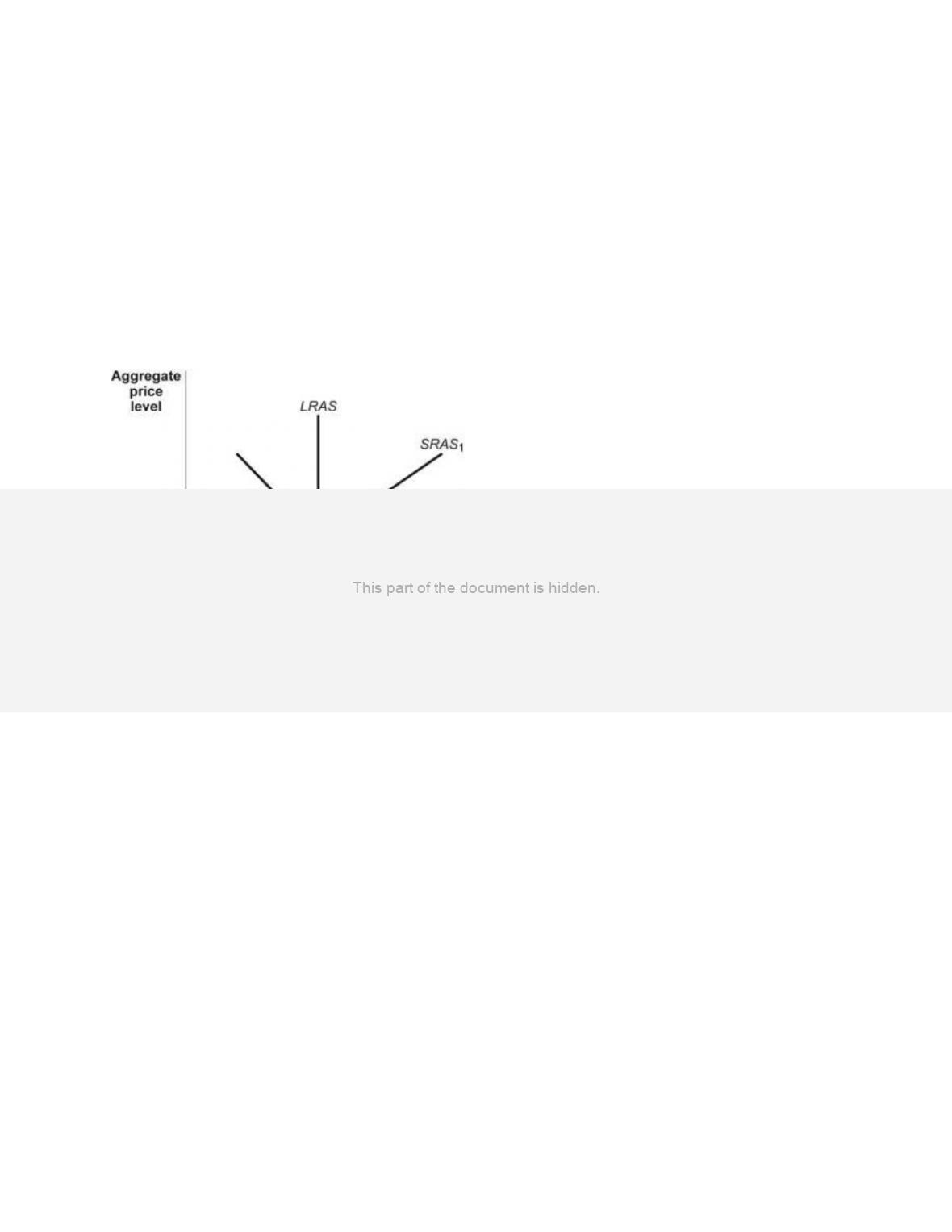
Figure: AD–AS Model I
241.
(Figure: AD–AS Model I) Refer to Figure: AD–AS Model I. If the economy is at point X,
there is a(n) _____ gap with _____ unemployment.
A)
inflationary; low
B)
inflationary; high
C)
recessionary; low
D)
recessionary; high
242.
(Figure: AD–AS Model I) Refer to Figure: AD–AS Model I. If the economy is at point X,
nominal wages _____, and the _____ curve shifts _____ until the economy reaches
long-run equilibrium.
A)
fall; aggregate demand; left
B)
rise; aggregate demand; right
C)
fall; short-run aggregate supply; right
D)
fall; short-run aggregate supply; left
243.
(Figure: AD–AS Model I) Refer to Figure: AD–AS Model I. If the economy is at point X,
the appropriate fiscal policy is to:
A)
increase taxes and decrease government spending.
B)
decrease taxes and increase government spending.
C)
increase the money supply and interest rates.
D)
decrease the money supply and interest rates.
Page 52
244.
(Figure: AD–AS Model I) Refer to Figure: AD–AS Model I. If the economy is at point X,
the appropriate monetary policy is to:
A)
increase taxes and decrease government spending.
B)
decrease taxes and increase government spending.
C)
increase the money supply and decrease interest rates.
D)
decrease the money supply and increase interest rates.
Use the following to answer questions 245-254:
Figure: AD–AS Model II
245.
(Figure: AD–AS Model II) Refer to Figure: AD–AS Model II. Which occurrence will
raise the price level?
A)
SRAS curve shifts to the left.
B)
SRAS curve shifts to the right.
C)
AD curve shifts to the left.
D)
The economy moves down the aggregate demand curve.
246.
(Figure: AD–AS Model II) Refer to Figure: AD–AS Model II. If commodity prices rise,
the _____ curve will shift to the _____.
A)
SRAS; left
B)
SRAS; right
C)
AD; left
D)
AD; right
Page 53
247.
(Figure: AD–AS Model II) Refer to Figure: AD–AS Model II. If nominal wages fall, in
the short run the _____ curve will shift to the _____.
A)
SRAS; left
B)
SRAS; right
C)
LRAS; right
D)
AD; right
248.
(Figure: AD–AS Model II) Refer to Figure: AD–AS Model II. If productivity increases,
the _____ curve will shift to the _____.
A)
SRAS; left
B)
SRAS; right
C)
AD; left
D)
AD; right
249.
(Figure: AD–AS Model II) Refer to Figure: AD–AS Model II. As the size of the labor
force increases over time, the _____ curve will shift to the _____.
A)
LRAS; right
B)
LRAS; left
C)
AD; left
D)
AD; right
250.
(Figure: AD–AS Model II) Refer to Figure: AD–AS Model II. When consumers and
firms become more optimistic, in the short run the _____ curve will shift to the _____.
A)
SRAS; left
B)
SRAS; right
C)
AD; right
D)
AD; left
251.
(Figure: AD–AS Model II) Refer to Figure: AD–AS Model II. When firms decrease
their investment spending, in the short run the _____ curve will shift to the _____.
A)
LRAS; left
B)
LRAS; right
C)
AD; right
D)
AD; left

Page 54
252.
(Figure: AD–AS Model II) Refer to Figure: AD–AS Model II. If the value of household
wealth increases, the _____ curve will shift to the _____.
A)
SRAS; left
B)
SRAS; right
C)
AD; right
D)
AD; left
253.
(Figure: AD–AS Model II) Refer to Figure: AD–AS Model II. If there is a significant
increase in government spending, in the short run the _____ curve will shift to the
_____.
A)
SRAS; left
B)
SRAS; right
C)
AD; left
D)
AD; right
254.
(Figure: AD–AS Model II) Refer to Figure: AD–AS Model II. If the central bank reduces
the quantity of money that is circulating in the economy, the _____ curve will shift to
the _____.
A)
LRAS; right
B)
LRAS; left
C)
AD1; left
D)
AD1; right
Use the following to answer questions 255-257:
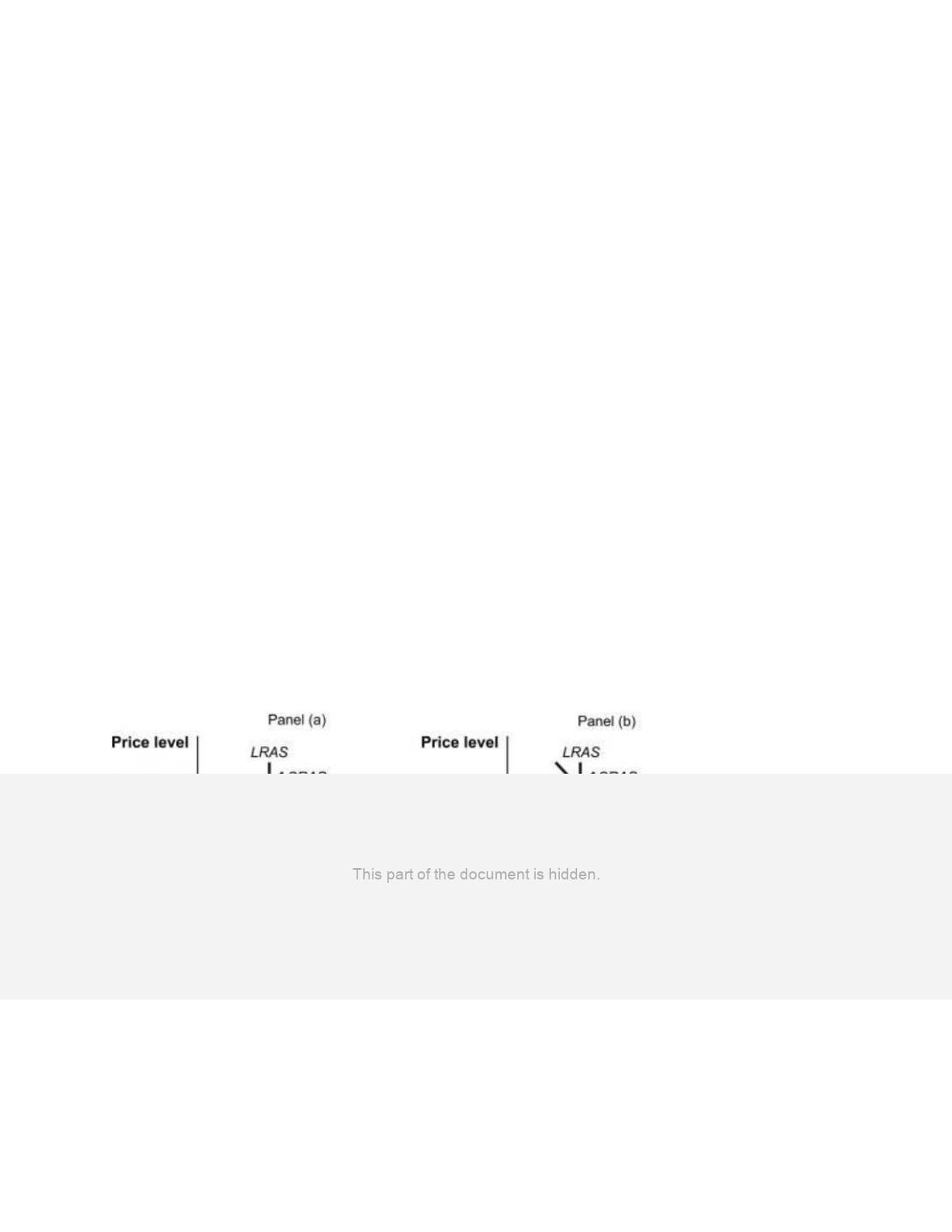
Figure: AD–AS
Page 55
255.
(Figure: AD–AS) Refer to Figure: AD–AS. Suppose the economy is in an inflationary
gap so that SRAS1 intersects AD2. The size of the gap is equal to:
A)
Y1 – YP.
B)
Y1.
C)
Y1 – Y2.
D)
YP – Y2.
256.
(Figure: AD–AS) Refer to Figure: AD–AS. Suppose that initially the economy is at
long-run equilibrium. If the government cuts taxes, _____ will shift to the _____.
A)
SRAS; right
B)
SRAS; left
C)
AD1; right to AD2
D)
AD1; left to AD3
257.
(Figure: AD–AS) Refer to Figure: AD–AS. Assume that the economy is in long-run
equilibrium. If the Federal Reserve lowers the key interest rate:
A)
the aggregate demand curve will shift to AD2.
B)
the aggregate demand curve will stay unchanged at AD1.
C)
there will be a downward movement along the aggregate demand curve AD1.
D)
the aggregate demand curve will shift to AD3.
Use the following to answer questions 258-266:
Figure: Policy Alternatives

Page 56
258.
(Figure: Policy Alternatives) Refer to Figure: Policy Alternatives. In panel (b), the
economy is initially in short-run equilibrium at real GDP level Y1 and price level P2. If
the government decides to intervene, it will MOST likely:
A)
increase taxes.
B)
decrease the quantity of money.
C)
increase its spending.
D)
decrease its spending.
259.
(Figure: Policy Alternatives) Refer to Figure: Policy Alternatives. If the economy is in
equilibrium at Y1 in panel (a), it is in:
A)
a recessionary gap.
B)
an inflationary gap.
C)
simultaneous short-run and long-run equilibrium.
D)
full employment.
260.
(Figure: Policy Alternatives) Refer to Figure: Policy Alternatives. If the economy is in
equilibrium at Y1 in panel (a), it is in:
A)
full employment.
B)
an inflationary gap.
C)
a liquidity trap.
D)
stagflation.
261.
(Figure: Policy Alternatives) Refer to Figure: Policy Alternatives. If the economy is in
equilibrium at Y1 in panel (a) and government spending increases, the result will likely
be:
A)
an increase in unemployment.
B)
a decrease in interest rates.
C)
inflation.
D)
deflation.
262.
(Figure: Policy Alternatives) Refer to Figure: Policy Alternatives. If the economy is in
equilibrium at Y1 in panel (a) and the government does not intervene, the result will
likely be:
A)
a shift of AD1 to the left.
B)
a shift of SRAS1 to SRAS2.
C)
a shift of LRAS to the left.
D)
no change in AD or SRAS.
Page 57
263.
(Figure: Policy Alternatives) Refer to Figure: Policy Alternatives. If the economy is in
equilibrium at Y1 in panel (a) and the government decides to intervene, it will MOST
likely:
A)
increase taxes.
B)
decrease the money supply.
C)
increase its spending.
D)
decrease its spending.
264.
(Figure: Policy Alternatives) Refer to Figure: Policy Alternatives. If the economy is in
equilibrium at Y1 in panel (b), it is in:
A)
a recessionary gap.
B)
an inflationary gap.
C)
simultaneous short-run and long-run equilibrium.
D)
full employment.
265.
(Figure: Policy Alternatives) Refer to Figure: Policy Alternatives. If the economy is in
equilibrium at Y1 in panel (a) and the government decreases taxes, the result will likely
be a(n):
A)
increase in unemployment.
B)
decrease in interest rates.
C)
decrease in aggregate demand.
D)
increase in aggregate demand.
266.
(Figure: Policy Alternatives) Refer to Figure: Policy Alternatives. If the economy is in
equilibrium at Y1 in panel (b) and the government does not intervene, the result will
likely be a shift of:
A)
AD1 to AD2.
B)
SRAS to the left.
C)
LRAS to the left.
D)
SRAS to the right.
267.
An inflationary gap caused by a demand shock can be addressed by _____ to _____.
A)
raising government spending; lower the unemployment rate
B)
raising taxes; lower the unemployment rate
C)
lowering government spending; lower the aggregate price level
D)
lowering taxes; lower the aggregate price level

Page 58
268.
In response to a negative supply shock, the government decreases taxes. The MOST
likely result of the government’s tax decrease is a(n) _____ in unemployment and a(n)
_____ in the aggregate price level.
A)
decrease; increase
B)
decrease; decrease
C)
increase; increase
D)
increase; decrease
269.
Using monetary policy to address a recessionary gap caused by a supply shock involves
_____ to _____.
A)
decreasing the money supply; lower the aggregate price level
B)
increasing interest rates; decrease investment spending
C)
decreasing interest rates; lower the aggregate price level
D)
increasing the money supply; lower the unemployment rate
270.
Deflation was a problem in both the Great Depression and the recession of 1979–1982.
A)
True
B)
False
271.
The aggregate demand curve shows a negative relationship between the price level and
the quantity of aggregate output demanded.
A)
True
B)
False
272.
The aggregate demand curve shows that at higher price levels the quantity of aggregate
output demanded will be less than at lower price levels.
A)
True
B)
False
273.
When the price level increases, people want to hold more money.
A)
True
B)
False
274.
When the price level increases and people want to hold more money, interest rates
decrease.
A)
True
B)
False
Page 59
275.
If the price level decreases by 20%, the purchasing power of $1,000 will increase to
$1,200.
A)
True
B)
False
276.
If the price level increases by 20%, the purchasing power of $1,000 will increase to
$1,200.
A)
True
B)
False
277.
Other things equal, in the income–expenditure model, a decrease in the price level will
cause the planned aggregate expenditure curve to shift downward, resulting in a lower
level of real GDP.
A)
True
B)
False
278.
In the income–expenditure model, if the price level increases, the wealth and interest
rate effects will decrease planned expenditures.
A)
True
B)
False
279.
An increase in Social Security benefits will likely increase consumption and shift the
aggregate demand curve to the right.
A)
True
B)
False
280.
The higher the existing physical capital stock, the higher is aggregate demand.
A)
True
B)
False
281.
Because of the multiplier effect, an increase in government spending of $200 billion will
increase aggregate output by less than that amount.
A)
True
B)
False