
Page 21
101.
The short-run aggregate supply curve is:
A)
upward sloping.
B)
vertical.
C)
horizontal.
D)
downward sloping.
102.
When short-run aggregate supply increases, it means that the short-run aggregate supply
curve shifts to the _____ and the quantity of aggregate output that producers are willing
to supply _____.
A)
right; decreases
B)
right; increases
C)
left; decreases
D)
left; increases
103.
When short-run aggregate supply decreases, it means that the short-run aggregate supply
curve shifts to the _____ and the quantity of aggregate output that producers are willing
to supply _____.
A)
right; decreases
B)
right; increases
C)
left; decreases
D)
left; increases
104.
An increase in the minimum wage would likely:
A)
cause a movement up the short-run aggregate supply curve from left to right.
B)
cause a movement down the short-run aggregate supply curve from right to left.
C)
shift the short-run aggregate supply curve to the right.
D)
shift the short-run aggregate supply curve to the left.
105.
Suppose that productivity increases as workers’ health improves. This increase in
productivity will:
A)
cause a movement up the short-run aggregate supply curve from left to right.
B)
cause a movement down the short-run aggregate supply curve from right to left.
C)
shift the short-run aggregate supply curve to the right.
D)
shift the short-run aggregate supply curve to the left.
106.
Which factor will shift the short-run aggregate supply curve to the RIGHT?
A)
a widespread decrease in commodity prices
B)
an increase in nominal wages
C)
a decrease in productivity
D)
a decrease in government purchases of goods and services
107.
The short-run aggregate supply curve may shift to the right if:
A)
productivity increases.
B)
nominal wages increase.
C)
personal income taxes decrease.
D)
commodity prices rise.
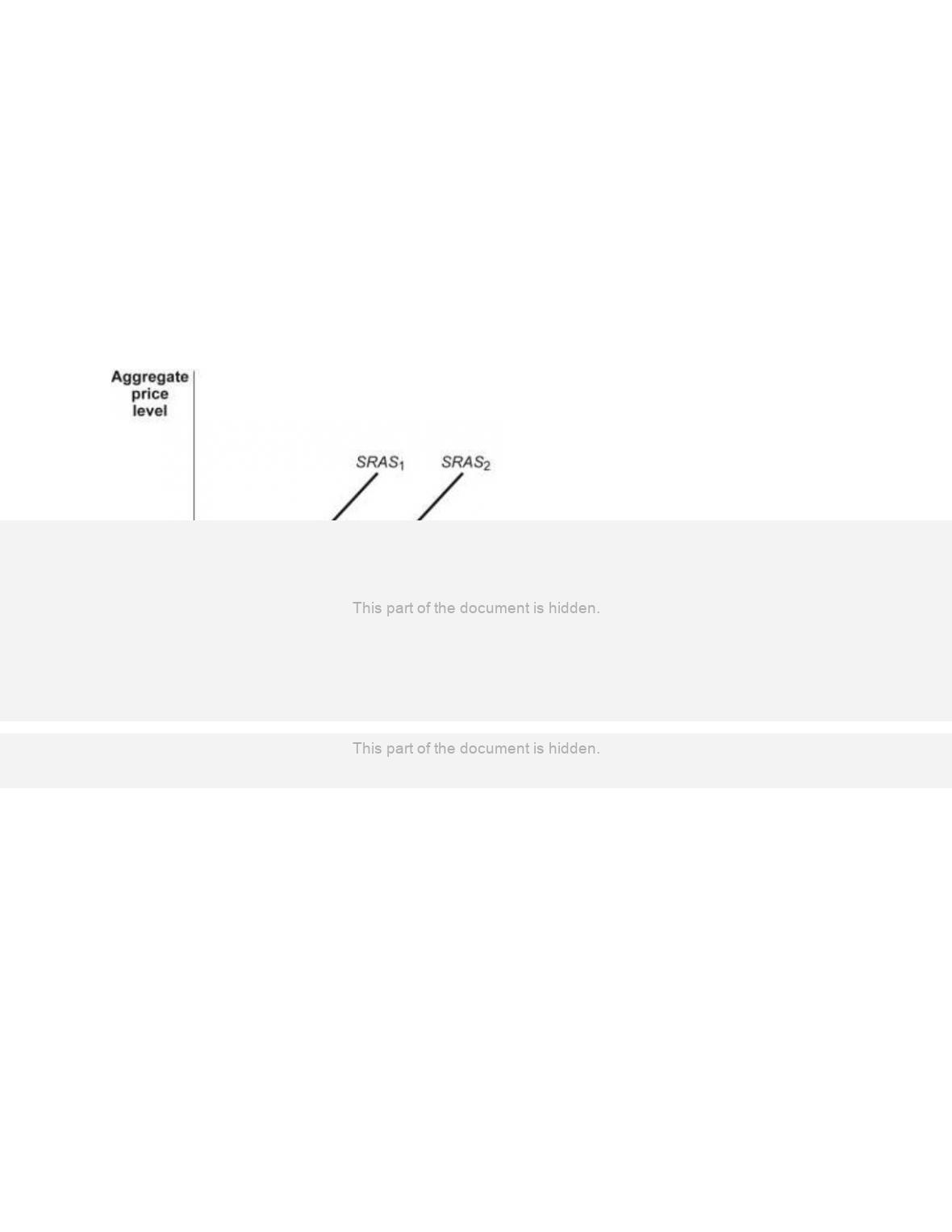
Use the following to answer question 108:
Figure: Aggregate Supply Movements
Which statement is correct?
A)
An increase in the price level is responsible for pushing the curve to the right.
supply curve to the right.
C)
Short-run aggregate supply has increased.
D)
Short-run aggregate supply has decreased.
109.
A change in _____ would cause a shift of the short-run aggregate supply curve.
A)
the quantity of real output supplied
B)
the price level
C)
commodity prices
D)
aggregate demand

Page 23
110.
A(n) _____ would likely shift the short-run aggregate supply curve to the left.
A)
decrease in consumer spending
B)
decrease in the price of oil
C)
increase in the price of oil
D)
increase in consumer spending
111.
A decrease in energy prices will:
A)
increase short-run aggregate supply.
B)
decrease the quantity of aggregate output supplied in the short run.
C)
decrease aggregate demand.
D)
decrease short-run aggregate supply.
112.
A rise in labor productivity will MOST likely result in a(n):
A)
increase in aggregate demand.
B)
decrease in aggregate demand.
C)
decrease in aggregate supply.
D)
increase in aggregate supply.
113.
Which factor will increase short-run aggregate supply?
A)
a law that requires health insurance for all employees
B)
an increase in the aggregate price level
C)
a large decrease in the price of oil
D)
an increase in the minimum wage
114.
The short-run aggregate supply curve would NOT shift to the left as a result of a(n):
A)
decrease in productivity.
B)
increase in nominal wages.
C)
increase in interest rates.
D)
increase in the price of commodities used for production.
115.
A simultaneous rise in productivity and nominal wages would shift the short-run
aggregate supply curve to the:
A)
right if the rise in nominal wages is larger than the rise in productivity.
B)
right if the cost per unit of output rises.
C)
left if the cost per unit of output falls.
D)
left if the rise in nominal wages is larger than the rise in productivity.
Page 24
116.
During the Great Depression, the United States underwent a movement _____ along the
short-run aggregate supply curve; during the 1979 oil crisis, the United States
underwent a _____ shift in the short-run aggregate supply curve.
A)
down; leftward
B)
up; leftward
C)
up; rightward
D)
down; rightward
117.
The short-run aggregate supply curve will shift to the right if:
A)
commodity prices rise.
B)
nominal wages rise.
C)
productivity decreases.
D)
nominal wages fall.
118.
The short-run aggregate supply curve will shift to the left if:
A)
the aggregate price level falls.
B)
commodity prices rise.
C)
tax revenues fall.
D)
productivity increases.
119.
If nominal wages fall, then the short-run aggregate _____ curve shifts to the _____.
A)
supply; right
B)
supply; left
C)
demand; right
D)
demand; left
120.
A shift to the right of the short-run aggregate supply curve may be caused by a(n):
A)
decrease in productivity.
B)
increase in productivity.
C)
increase in the price of inputs.
D)
increase in wages.
121.
A general increase in wages will result primarily in the _____ curve shifting to the
_____.
A)
aggregate demand; right
B)
aggregate demand; left
C)
short-run aggregate supply; right
D)
short-run aggregate supply; left

Page 25
122.
A general decrease in wages will result primarily in the _____ curve shifting to the
_____.
A)
aggregate demand; right
B)
aggregate demand; left
C)
short-run aggregate supply; right
D)
short-run aggregate supply; left
123.
Changes in short-run aggregate supply can be caused by changes in:
A)
wages.
B)
wealth.
C)
government spending.
D)
consumption spending.
124.
Changes in short-run aggregate supply can be caused by changes in:
A)
wealth.
B)
commodity prices.
C)
government spending.
D)
the price level.
125.
The short-run aggregate supply curve will shift to the:
A)
right if commodity prices increase.
B)
left if productivity increases.
C)
left if nominal wages increase.
D)
right if government spending increases.
126.
In the long run, nominal wages are:
A)
sticky downward but flexible upward.
B)
sticky upward but flexible downward.
C)
sticky both upward and downward.
D)
flexible, because contracts and informal agreements are renegotiated in the long
run.
127.
In the long run, the aggregate price level has:
A)
no effect on the quantity of aggregate output.
B)
a positive effect on the quantity of aggregate output.
C)
a negative effect on the quantity of aggregate output.
D)
an effect on aggregate output but none on employment.

Page 26
128.
In the long run, changes in the aggregate price level will be accompanied by _____
proportional changes in input prices.
A)
less than
B)
more than
C)
equal
D)
opposite
129.
The long-run aggregate supply curve is:
A)
upward sloping.
B)
downward sloping.
C)
horizontal.
D)
vertical.
130.
The point where the long-run aggregate supply curve intercepts the horizontal axis is:
A)
the point that reflects the economy’s actual output.
B)
the economy’s potential output.
C)
the level of real GDP the economy would produce if all prices were flexible and
wages were fixed.
D)
impossible to attain.
131.
According to the long-run aggregate supply curve, when _____, the quantity of
aggregate output supplied _____.
A)
nominal wages rise; falls
B)
the aggregate price level rises; does not change
C)
the aggregate price level rises; falls
D)
the price of commodities falls; rises
132.
Because the aggregate price level has no effect on aggregate output in the long run, the
long-run aggregate supply curve is:
A)
upward sloping.
B)
vertical.
C)
horizontal.
D)
downward sloping.
133.
The long-run aggregate supply curve is vertical because in the long run:
A)
technological progress outpaces raises in nominal wages.
B)
all factors of production increase.
C)
the price of labor is flexible, while the price of physical capital is fixed.
D)
all prices are flexible.

Page 27
134.
The long-run supply curve illustrates how the aggregate output supplied is _____ the
aggregate price level.
A)
positively related to
B)
negatively related to
C)
unrelated to
D)
a one-to-one correspondence with
135.
If all prices, including the nominal wage rate, double in the long run, then aggregate
output supplied will:
A)
double.
B)
rise.
C)
fall.
D)
remain unchanged.
136.
Potential output is the level of real GDP that:
A)
occurs when the economy has only cyclical unemployment.
B)
the economy would produce if all prices, including nominal wages, were fully
flexible.
C)
occurs when the actual rate of unemployment is zero.
D)
the economy would produce if all prices, including nominal wages, were sticky.
137.
Potential output:
A)
is the level of output that the economy would produce if all prices, including
nominal wages, were fully flexible.
B)
varies with the price level.
C)
depends on the level of consumer confidence.
D)
is greater in periods of expansion than in recessions.
138.
The level of output that the economy would produce if all prices, including nominal
wages, were fully flexible is called:
A)
real GDP.
B)
Keynesian GDP.
C)
structural GDP.
D)
potential GDP.
139.
The long run in macroeconomic analysis is a period:
A)
in which wages and some other prices are sticky.
B)
in which prices and nominal wages are flexible.
C)
longer than one year.
D)
in which the capital stock is held constant.

Page 28
140.
The long run in macroeconomic analysis is a period:
A)
in which nominal wages and other prices are flexible.
B)
in which wages are sticky.
C)
of less than one year.
D)
of one to two years.
141.
In the long run, wages and prices are considered to be:
A)
sticky.
B)
constant.
C)
flexible.
D)
irrelevant.
142.
The long-run level of output is known as _____ output.
A)
recognized
B)
structural
C)
potential
D)
balanced budget
143.
The point at which the long-run aggregate supply curve touches the x-axis is known as:
A)
potential output.
B)
the accelerator point.
C)
the multiplier point.
D)
the self-correcting economy point.
144.
Potential output would NOT be increased by:
A)
an increase in physical capital.
B)
a decrease in the aggregate price level.
C)
an increase in human capital.
D)
technological innovation.
145.
Producing an aggregate output level that is higher than potential output is possible only
if nominal wages:
A)
fully adjust downward..
B)
fully adjust upward.
C)
haven’t yet fully adjusted upward.
D)
haven’t yet fully adjusted downward.

Page 29
146.
An aggregate output level lower than potential output means there will be:
A)
high interest rates.
B)
high inflation.
C)
low unemployment.
D)
high unemployment.
147.
Suppose that the aggregate output level is lower than potential output. Which statement
is FALSE?
A)
Workers are abundant.
B)
Jobs are scarce.
C)
Nominal wages will fall over time.
D)
The short-run aggregate supply curve will gradually shift to the left.
148.
Which statement is TRUE with respect to short-run and long-run aggregate supply?
A)
The economy can be on both curves simultaneously.
B)
If the economy is on the short-run aggregate supply curve, it cannot also be on the
long-run aggregate supply curve.
C)
If the economy is on the long-run aggregate supply curve, it cannot also be on the
short-run aggregate supply curve.
D)
The economy can never rest on both curves simultaneously.
149.
When the economy is on the short-run aggregate supply curve and to the left of the
long-run aggregate supply curve, actual aggregate output will eventually equal potential
output as _____ fall(s) and the _____ aggregate _____ curve shifts to the _____.
A)
nominal wages; long-run; supply; left
B)
the aggregate price level; long-run; supply; left
C)
nominal wages; short-run; supply; right
D)
the aggregate price level; short-run; demand; right
150.
Producing a short-run level of aggregate output that exceeds the economy’s potential
output results in a(n) _____ adjustment in _____.
A)
downward; nominal wages
B)
downward; profits per unit of output
C)
downward; production costs
D)
upward; nominal wages
Page 30
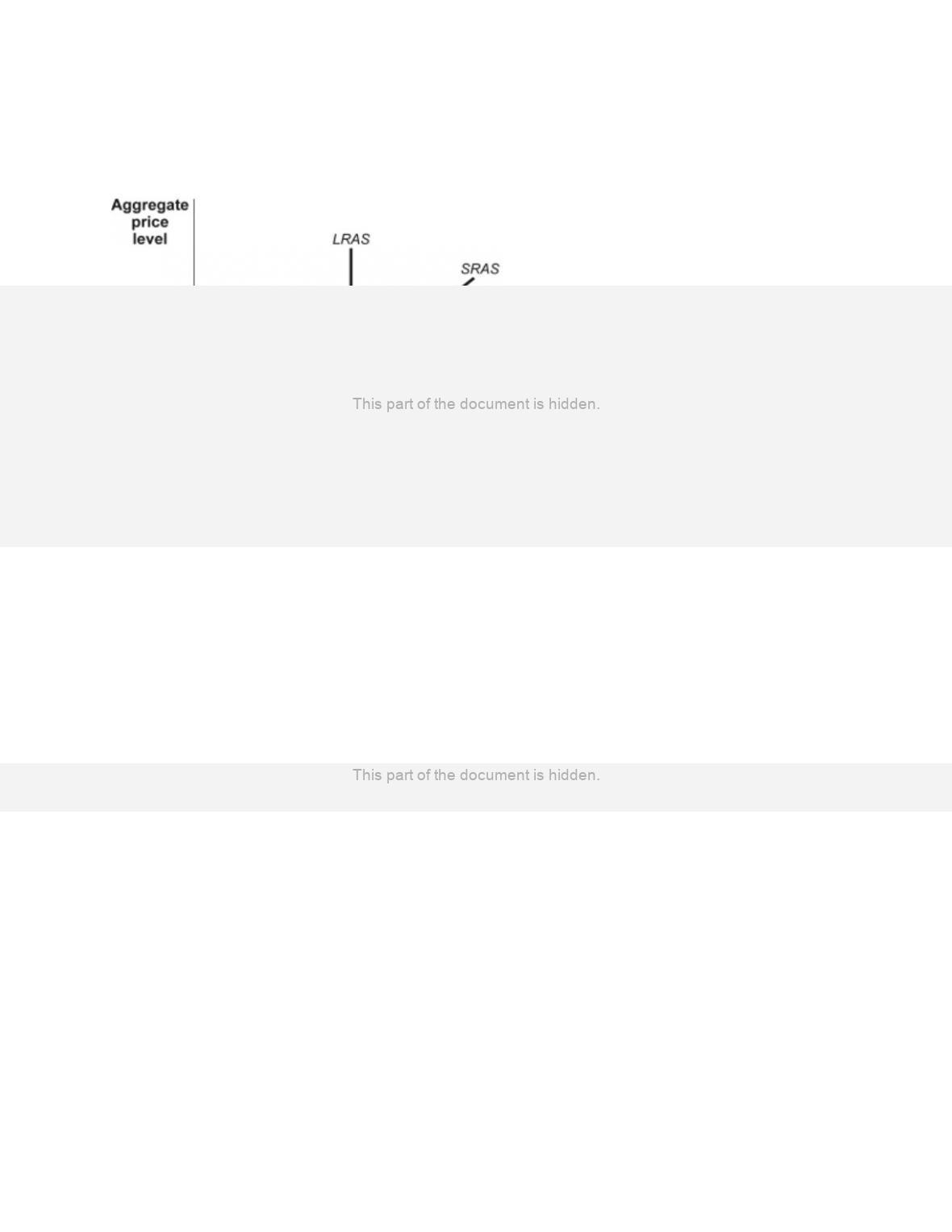
Use the following to answer questions 151-153:
Figure: Aggregate Supply
151.
(Figure: Aggregate Supply) Refer to Figure: Aggregate Supply. If the economy is at
point E:
A)
actual output is less than potential output.
B)
actual output is more than potential output.
C)
actual output is equal to potential output.
D)
potential output will decrease.
152.
(Figure: Aggregate Supply) Refer to Figure: Aggregate Supply. If the economy is at
point E, nominal wages will _____, and the short-run aggregate supply curve will shift
_____ until actual potential is _____ potential output.
A)
increase; left; equal to
B)
increase; right; greater than
C)
decrease; right; equal to
D)
decrease; right; less than
153.
(Figure: Aggregate Supply) Refer to Figure: Aggregate Supply. At point F, potential
output is _____ than actual output and unemployment is _____.
A)
less; high
B)
less; low
C)
higher; high
D)
higher; low
Page 31
154.
In the late 1970s, the U.S. economy slid to the _____ along the aggregate _____ curve.
A)
left; supply
B)
right; supply
C)
left; demand
D)
right; demand
155.
A major reason for the end of the Great Depression was an increase in government
spending:
A)
for social security.
B)
for space exploration
C)
for environmental protection.
D)
during World War II.
156.
A(n) _____ will shift the aggregate demand curve.
A)
interest rate effect of an aggregate price level change
B)
wealth effect of an aggregate price level change
C)
demand expectation
D)
demand shock
157.
In the short run, a positive demand shock _____ aggregate output and _____ the
aggregate price level.
A)
reduces; increases
B)
increases; reduces
C)
reduces; reduces
D)
increases; increases
158.
Demand shocks do NOT include a(n):
A)
reduction in money supply.
B)
tax increase.
C)
increase in government expenditure.
D)
increase in commodity prices.
159.
A positive demand shock leads to:
A)
higher prices and higher employment.
B)
higher prices and higher unemployment.
C)
higher prices and lower output.
D)
lower prices and lower output.

Page 32
160.
Suppose that political instability in the Middle East interrupts the supply of oil. The
_____ curve shifts _____, output _____, and prices _____.
A)
short-run aggregate supply; right; increases; decrease
B)
short-run aggregate supply; left; decreases; increase
C)
aggregate demand; left; decreases; decrease
D)
aggregate demand; right; increases; increase
161.
A natural disaster that destroys part of a country’s infrastructure is a type of negative
_____ shock and therefore shifts the _____ curve to the _____.
A)
demand; aggregate demand; right
B)
supply; aggregate demand; left
C)
supply; short-run aggregate supply; left
D)
demand; long-run aggregate supply; left
162.
A negative short-run supply shock _____ aggregate output and _____ the aggregate
price level.
A)
reduces; increases
B)
increases; reduces
C)
reduces; reduces
D)
increases; increases
163.
An increase in the price of imported oil leads to a _____ shock.
A)
positive supply
B)
negative supply
C)
positive demand
D)
negative demand
164.
Stagflation may result from a(n):
A)
increase in the supply of money.
B)
decrease in the supply of money.
C)
increase in the price of oil.
D)
decrease in the price of oil.
165.
Unexpectedly rising commodity prices lead to a _____ shock.
A)
positive supply
B)
positive demand
C)
negative supply
D)
negative demand
Page 33
166.
Stagflation is usually caused by a _____ shock.
A)
negative demand
B)
positive supply
C)
negative supply
D)
positive demand
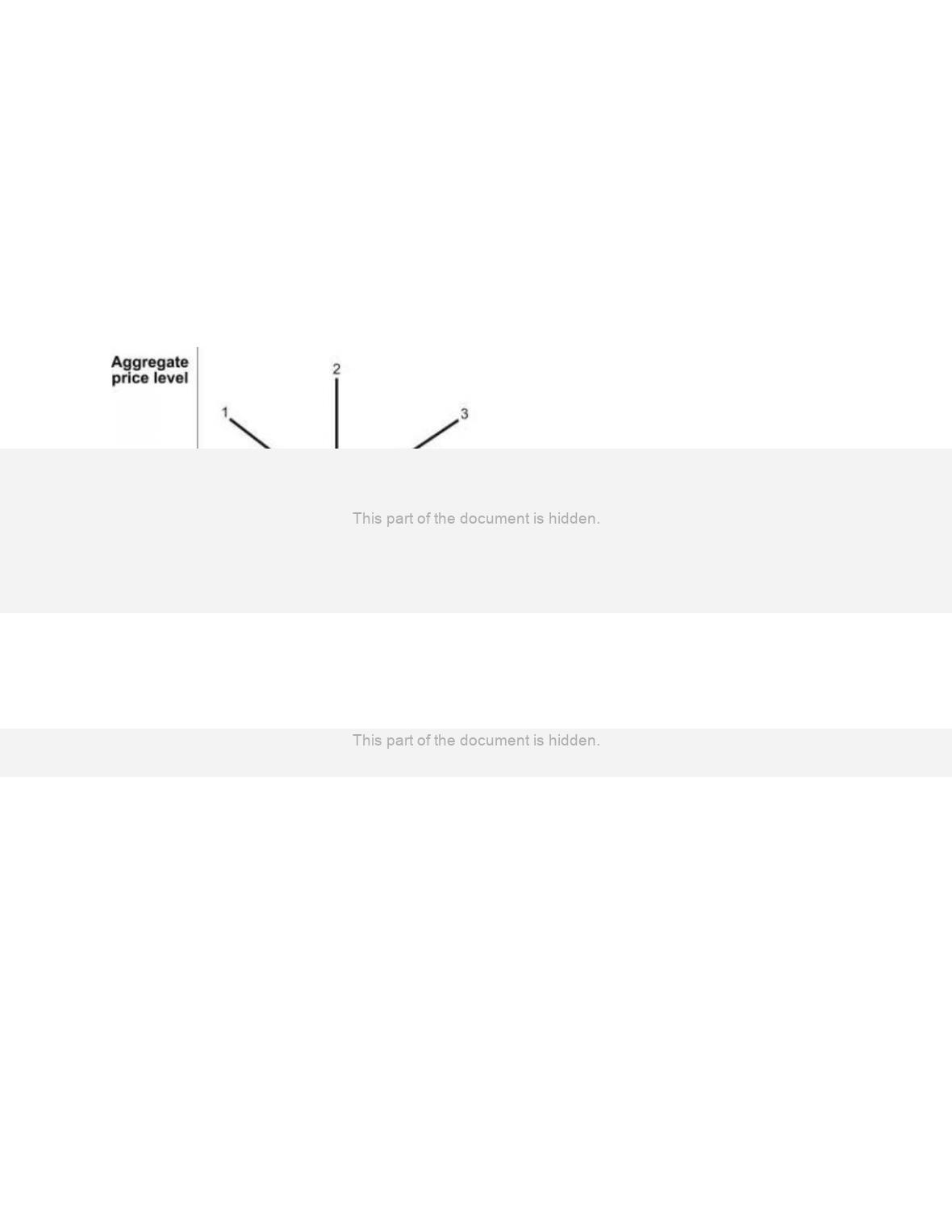
Use the following to answer question 167:
Figure: Macroeconomics Equilibrium
167.
(Figure: Macroeconomics Equilibrium) Refer to Figure: Macroeconomic Equilibrium.
Curve 1 refers to _____, curve 2 refers to _____, and curve 3 refers to _____.
A)
long-run aggregate supply; short-run aggregate supply; aggregate demand
B)
aggregate demand; short-run aggregate supply; long-run aggregate supply
C)
short-run aggregate supply; long-run aggregate supply; aggregate demand
D)
aggregate demand; long-run aggregate supply; short-run aggregate supply
168.
In the short run, the equilibrium price level and the equilibrium level of total output are
determined by the intersection of:
A)
LRAS and SRAS.
B)
LRAS and aggregate demand.
C)
SRAS and aggregate demand.
D)
potential output and LRAS.

Page 34
169.
An increase in investment spending leads to _____ in the price level and _____ in real
GDP in the short run.
A)
an increase; no change
B)
a decrease; no change
C)
no change; no change
D)
an increase; an increase
170.
An increase in aggregate demand will generate _____ in real GDP and _____ in the
price level in the short run.
A)
an increase; an increase
B)
an increase; no change
C)
a decrease; no change
D)
no change; an increase
171.
A decrease in aggregate demand will generate _____ in real GDP and _____ in the price
level in the short run.
A)
an increase; no change
B)
a decrease; no change
C)
a decrease; a decrease
D)
no change; an increase
172.
Suppose the equilibrium aggregate price level and the equilibrium level of real GDP are
both rising. This is probably the effect of a(n) _____ in aggregate _____.
A)
increase; supply
B)
increase; demand
C)
decrease; supply
D)
decrease; demand
173.
Suppose that the U.S. government doubles its spending on health care. The _____ curve
shifts _____, output _____, and prices _____.
A)
short-run aggregate supply; right; increases; decrease
B)
short-run aggregate supply; left; decreases; increase
C)
aggregate demand; left; decreases; decrease
D)
aggregate demand; right; increases; increase
Page 35
174.
An improvement in the business outlook of firms is a type of positive _____ shock and
therefore shifts the _____ curve to the _____.
A)
supply; long-run aggregate supply; right
B)
demand; aggregate demand; left
C)
supply; short-run aggregate supply; right
D)
demand; aggregate demand; right
175.
An economic policy maker would rank a _____ shock as the MOST preferred type.
A)
positive demand
B)
negative demand
C)
positive supply
D)
negative supply
176.
An economic policy maker would rank a _____ shock as the LEAST preferred type.
A)
positive demand
B)
negative demand
C)
positive supply
D)
negative supply
177.
If membership in labor unions falls, production costs will:
A)
increase, and SRAS will shift to the left, decreasing equilibrium GDP and
increasing the aggregate price level.
B)
fall, there will be a downward movement along SRAS, equilibrium GDP will
increase, and aggregate price level will fall.
C)
not change and AD will shift to the right, increasing equilibrium GDP and
aggregate price level.
D)
fall and SRAS will shift to the right, increasing equilibrium GDP and lowering the
aggregate price level.
178.
Suppose the equilibrium aggregate price level is rising and the equilibrium level of real
GDP is falling. Which factor MOST likely caused these changes?
A)
an increase in short-run aggregate supply
B)
an increase in aggregate demand
C)
a decrease in short-run aggregate supply
D)
a decrease in aggregate demand

Page 36
179.
Suppose the economy is operating in long-run equilibrium and a positive demand shock
hits. We expect a short-run increase in real GDP and the price level and a long-run
_____ in real GDP and _____ the price level.
A)
decrease; increase
B)
increase; increase
C)
decrease; decrease
D)
increase; decrease
180.
Potential real GDP is $10,000 and the current level of real GDP is $9,000. The output
gap is therefore _____%.
A)
–90
B)
–110
C)
–10
D)
10
181.
In the long run, as the economy self-corrects, an increase in aggregate demand will
cause the price level to _____ and potential output to _____.
A)
rise; increase
B)
fall; decrease
C)
rise; remain stable
D)
fall; remain stable
182.
In the long run, as the economy self-corrects, a decrease in aggregate demand, all other
things unchanged, will cause the price level to _____ and potential output to _____.
A)
rise; increase
B)
fall; decrease
C)
rise; remain stable
D)
fall; remain stable
183.
The intersection of an economy’s aggregate demand and long-run aggregate supply
curves:
A)
determines its equilibrium real GDP in both the long run and the short run.
B)
determines its equilibrium price level in both the long run and the short run.
C)
occurs at the economy’s potential output in long-run equilibrium.
D)
occurs at high levels of cyclical unemployment.

Page 37
184.
If the economy is in a recessionary gap, actual output will be _____ potential output.
A)
below
B)
the same as
C)
above
D)
in equilibrium with
185.
If the SRAS curve intersects the aggregate demand curve to the right of LRAS, the result
will be:
A)
a recessionary gap.
B)
an inflationary gap.
C)
cyclical unemployment.
D)
long-run equilibrium.
186.
When the economy is producing output below potential, it has a(n):
A)
full-employment output.
B)
natural level of employment.
C)
recessionary gap.
D)
inflationary gap.
187.
A recessionary gap occurs if:
A)
actual real GDP is less than potential output.
B)
actual real GDP is greater than potential output.
C)
actual real GDP is equal to potential output.
D)
unemployment is less than the natural rate.
188.
Graphically, a recessionary gap is measured as the:
A)
difference between the actual price level and the equilibrium price level.
B)
difference between actual GDP and potential output.
C)
vertical distance between aggregate demand and aggregate supply at actual real
GDP.
D)
vertical distance between aggregate demand and aggregate supply at potential
output.
Page 38
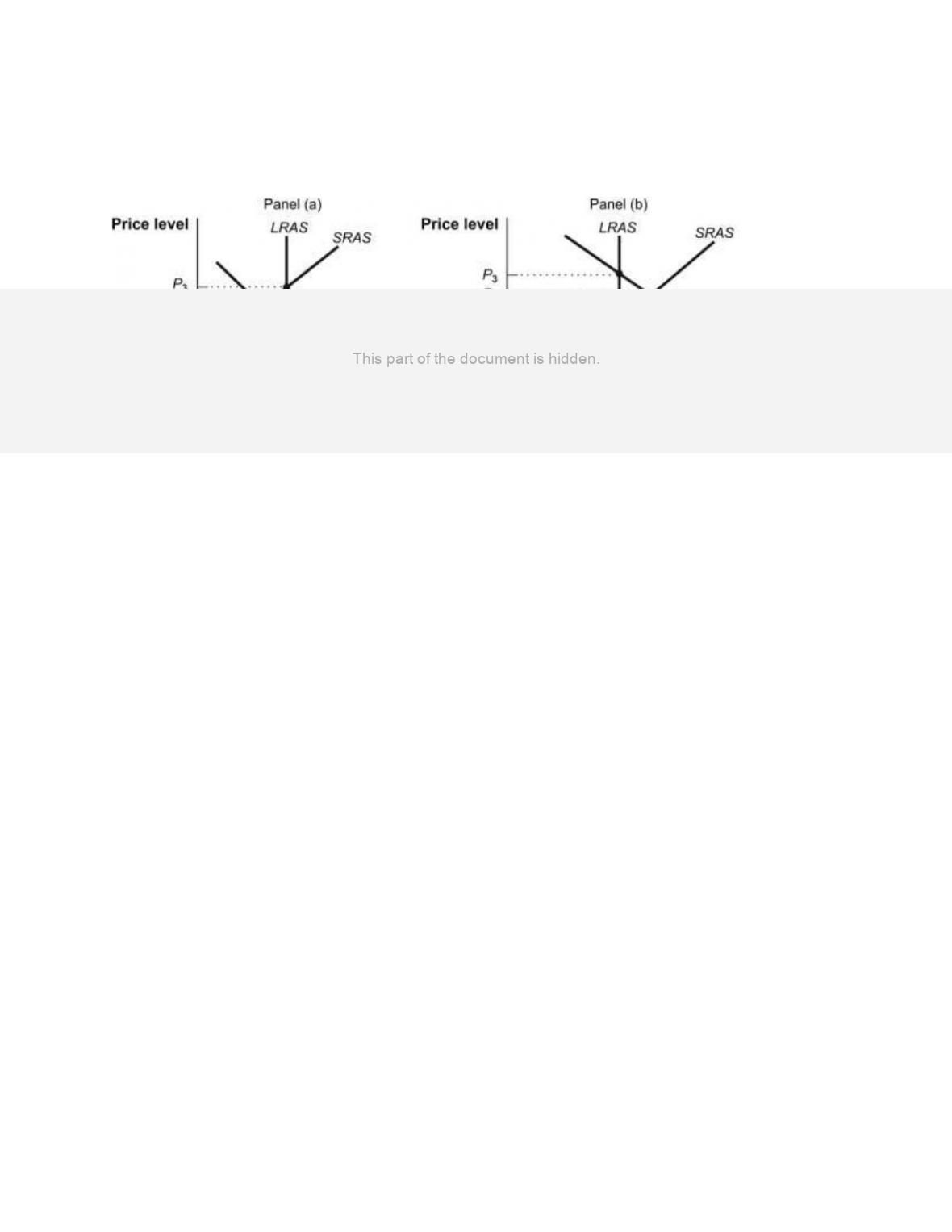
Use the following to answer questions 189-192:
Figure: Inflationary and Recessionary Gaps
189.
(Figure: Inflationary and Recessionary Gaps) Refer to Figure: Inflationary and
Recessionary Gaps. The intersection of SRAS with AD in panel (a) indicates an
economy:
A)
in a recessionary gap.
B)
in an inflationary gap.
C)
in long-run equilibrium.
D)
with an unusually low unemployment rate.
190.
(Figure: Inflationary and Recessionary Gaps) Refer to Figure: Inflationary and
Recessionary Gaps. Yp in panel (b):
A)
is potential output.
B)
indicates a decrease in aggregate demand.
C)
indicates a recessionary gap.
D)
is associated with considerable unemployment.
191.
(Figure: Inflationary and Recessionary Gaps) Refer to Figure: Inflationary and
Recessionary Gaps. The level of income associated with Y1 in panel (b):
A)
is equal to potential output.
B)
reveals an inflationary gap compared with Yp.
C)
is a long-run equilibrium.
D)
is caused by flexible wages and prices.

Page 39
192.
(Figure: Inflationary and Recessionary Gaps) Refer to Figure: Inflationary and
Recessionary Gaps. The intersection of AD with SRAS in panel (b) indicates:
A)
a short-run equilibrium.
B)
a long-run equilibrium.
C)
that unemployment is too high.
D)
stagflation.
193.
An inflationary gap:
A)
is generally regarded as desirable, especially by people living on a fixed income.
B)
means that the economy is operating beyond its potential output.
C)
means that there are pressures for wages to fall.
D)
means that SRAS will soon shift rightward.
194.
When the economy is producing output above the potential, it has:
A)
a Keynesian gap.
B)
falling wages.
C)
a recessionary gap.
D)
an inflationary gap.
195.
An inflationary gap occurs if:
A)
actual real GDP is less than potential output.
B)
actual real GDP is greater than potential output.
C)
actual real GDP is equal to potential output.
D)
unemployment is greater than the natural rate.
Use the following to answer questions 196-197:
Page 40
196.
(Figure: An Increase in Aggregate Demand) Refer to Figure: An Increase in Aggregate
Demand. The short-run equilibrium at Y2 and P2:
A)
exerts pressure for nominal wages to fall as workers seek to restore lost purchasing
power.
B)
exerts pressure for prices to fall, since real GDP exceeds potential real GDP.
C)
results in a recessionary gap.
D)
results in an inflationary gap.
197.
(Figure: An Increase in Aggregate Demand) Refer to Figure: An Increase in Aggregate
Demand. Because of the pressures at the short-run equilibrium at Y2 and P2:
A)
the SRAS will shift to the right.
B)
the SRAS curve will shift to the left.
C)
unemployment will decrease.
D)
LRAS will shift to the right.
Use the following to answer questions 198-201:
Figure: Policy Alternatives
198.
(Figure: Policy Alternatives) Refer to Figure: Policy Alternatives. Suppose that the
initial equilibrium is at real GDP level Y1 and price level P2 in panel (a). At real GDP
level Y1 there is:
A)
an inflationary gap.
B)
a recessionary gap.
C)
no gap.
D)
long-run equilibrium.