Page 1
Name: __________________________ Date: _____________
1.
Stagflation is a combination of _____ unemployment and _____ inflation.
A)
increasing; increasing
B)
decreasing; decreasing
C)
increasing; decreasing
D)
decreasing; increasing
2.
The economic slump in the 1970s looked different from the slump at the beginning of
the Great Depression because it was:
A)
the result of a lack of confidence that led businesses and consumers to spend less.
B)
largely caused by events in the Middle East that led to sudden cuts in world oil
production and soaring prices for oil.
C)
the direct result of a contractionary monetary policy.
D)
the result solely of a negative demand shock.
3.
In 2011, the Federal Reserve worried about:
A)
the threat of stagflation, the simultaneous existence of high inflation and high
unemployment.
B)
hyperinflation, and it used strong disinflationary policies to bring the rise in prices
under control.
C)
a healthy, booming economy, and it used fine-tuning methods to keep the growing
economy on track.
D)
a deep recession with falling prices, and it used stabilization policies to take the
economy out of the slump.
4.
In 2011, the Federal Reserve was facing:
A)
hyperinflation, which can be reversed only with disinflationary policies.
B)
stagflation, a combination of high inflation and high unemployment, which cannot
be reversed easily.
C)
the deepest recession since the Great Depression combined with rapidly falling
prices.
D)
a very severe deflation, rare in history, which was experienced only by Japan.
5.
The Great Depression was caused by _____ shocks, and the stagflation of the 1970s was
caused by _____ shocks.
A)
demand; demand
B)
demand; supply
C)
supply; demand
D)
supply; supply
Page 2
6.
The three consequences of the decline in demand during the Great Depression were
_____ prices, _____ output, and a surge in unemployment.
A)
falling; declining
B)
falling; increasing
C)
rising; increasing
D)
rising; declining
Use the following to answer question 7:
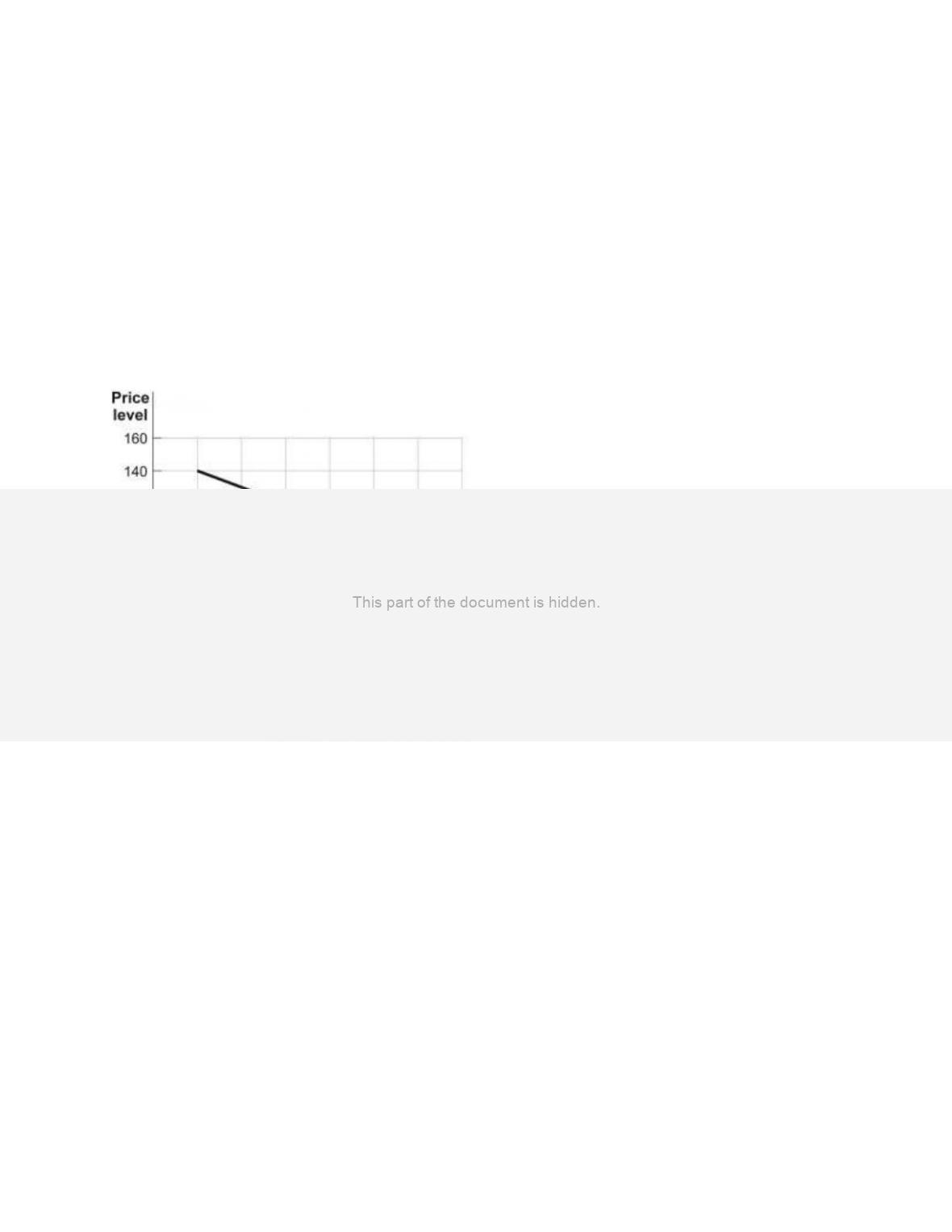
Figure: Aggregate Demand
7.
(Figure: Aggregate Demand) Refer to Figure: Aggregate Demand. The quantity of
output demanded if the price level is 120 is:
A)
$9 trillion.
B)
$10 trillion.
C)
$11 trillion.
D)
$12 trillion.
8.
The negative relationship between the aggregate price level and aggregate output
demanded gives the aggregate demand curve a _____ slope.
A)
positive
B)
vertical
C)
horizontal
D)
negative
Page 3
9.
The aggregate demand curve shows the relationship between the aggregate price level
and (the) aggregate:
A)
productivity.
B)
unemployment rate.
C)
quantity of output demanded by households, businesses, the government, and the
rest of the world.
D)
quantity of output demanded by businesses only.
10.
According to the aggregate demand curve, when the aggregate price level _____, the
quantity of aggregate output _____.
A)
rises; supplied falls
B)
falls; demanded falls
C)
rises; demanded falls
D)
rises; demanded does not change
11.
The relationship between the aggregate price level and the quantity of aggregate output
demanded by households, businesses, the government, and the rest of the world is
represented by the _____ demand.
A)
market
B)
surplus
C)
aggregate
D)
simple
12.
A graphical representation of the relationship between the total quantity of goods and
services demanded and the price level is the:
A)
aggregate demand curve.
B)
average price level.
C)
circular-flow model.
D)
GDP curve.
13.
The aggregate demand curve:
A)
slopes downward.
B)
slopes upward.
C)
is horizontal at potential output.
D)
is vertical at potential output.
Page 4
14.
In general, a change in the price level, all other things unchanged, causes:
A)
a movement along the aggregate demand curve.
B)
a shift of the aggregate demand curve.
C)
both a movement along the aggregate demand curve and a shift in the curve.
D)
no change in the purchasing power of assets.
15.
The _____ curve shows the negative relationship between the aggregate price level and
the quantity of aggregate output demanded in the economy.
A)
aggregate demand
B)
short-run aggregate supply
C)
long-run aggregate supply
D)
investment demand
16.
When the aggregate price level increases, the purchasing power of many assets falls,
causing a decrease in consumer spending. This, the _____ effect, is a reason the _____
curve slopes _____.
A)
interest rate; aggregate demand; downward
B)
wealth; aggregate demand; downward
C)
interest rate; investment demand; downward
D)
wealth; short-run aggregate supply; upward
17.
According to the wealth effect, when prices decrease, the purchasing power of assets
_____ and consumer spending _____.
A)
decreases; decreases
B)
increases; decreases
C)
decreases; increases
D)
increases; increases
18.
Besides consumption, the component(s) of aggregate demand is/are:
A)
investment expenditures.
B)
investment expenditures and government expenditures.
C)
investment expenditures and net exports.
D)
investment expenditures, government expenditures, and net exports.
19.
The wealth effect suggests:
A)
a positive relationship between the price level and consumption spending.
B)
that price level changes do not affect real wealth.
C)
a negative relationship between the price level and consumption spending.
D)
that when the price level increases, the real value of money increases also.
Page 5
20.
The aggregate demand curve is negatively sloped in part because of the impact of:
A)
the wealth effect on consumption.
B)
the interest rate effect on government spending.
C)
the stickiness of nominal wages and salaries.
D)
the flexibility of nominal wages and salaries.
21.
The aggregate demand curve is negatively sloped in part because of the impact of
interest rates on:
A)
potential output.
B)
price level.
C)
consumption and investment spending.
D)
government purchases.
22.
The interest rate effect is the tendency for changes in the price level to affect:
A)
the quantity of investment demanded and thus interest rates.
B)
export demand and thus aggregate demand.
C)
interest rates and thus the quantity of investment spending and consumption.
D)
real incomes and lead to shifts in potential output.
23.
The aggregate demand curve slopes:
A)
downward for the same reasons that an ordinary demand curve does.
B)
downward in part because when the price level falls, the real wealth of the public
falls, and this induces people to change their consumption.
C)
downward in part because as the price level falls, the ability of households and
firms to borrow cheaply increases.
D)
upward, unlike an ordinary demand curve.
24.
The aggregate demand curve is downward sloping because of:
A)
the inverse relationship between price and quantity demanded.
B)
changes in expectation of future prices.
C)
unexpected changes in commodity prices.
D)
the wealth effect of a change in aggregate price level.
25.
The wealth effect is reflected in:
A)
increases in interest rates to savers.
B)
the upward slope in aggregate supply.
C)
the upward slope in aggregate demand.
D)
the downward slope in aggregate demand.

Page 6
26.
According to the interest rate effect, an increase in the price level causes people to
_____ their money holdings, which _____ interest rates and _____ investment spending.
A)
increase; increases; decreases
B)
decrease; increases; decreases
C)
increase; decreases; decreases
D)
decrease; decreases; increases
27.
Which factor is one of the reasons that the aggregate demand curve slopes downward?
A)
the paradox of thrift
B)
the interest rate effect
C)
the substitution effect
D)
the income effect
28.
Which statement is FALSE?
A)
A rise in the price level lowers real wealth and results in a lower level of consumer
spending.
B)
A rise in the price level increases the demand for money, raises the interest rate,
and reduces investment spending.
C)
A fall in the price level will generally lead to a rise in the level of aggregate output
demanded.
D)
A fall in the price level will reduce the demand for money, raise the interest rate,
and increase investment spending.
29.
The aggregate demand curve is negatively sloped because of the:
A)
substitution effect of an aggregate price level change.
B)
wealth effect of an aggregate price level change.
C)
elasticity effect of an aggregate price level change.
D)
fiscal policy effect.
30.
The interest rate effect of a change in the aggregate price level causes the:
A)
long-run aggregate supply curve to be vertical.
B)
aggregate demand curve to be negatively sloped.
C)
short-run aggregate supply curve to be positively sloped.
D)
aggregate demand curve to be positively sloped.
31.
The interest rate effect of the price level is reflected in the:
A)
increase in interest rates to savers.
B)
upward slope in aggregate supply.
C)
upward slope in aggregate demand.
D)
downward slope in aggregate demand.

Page 7
32.
The interest rate effect of a change in the aggregate price level occurs when:
A)
a higher price level decreases the purchasing power of money, resulting in an
increase in the interest rate.
B)
the Fed uses contractionary monetary policy, causing an increase in the interest
rate.
C)
government borrowing in the loanable funds market raises the interest rate.
D)
the price of a bond increases, reducing the interest rate.
33.
According to the interest rate effect, a decrease in the price level causes people to _____
their money holdings, which _____ interest rates and _____ investment spending.
A)
increase; increases; decreases
B)
decrease; increases; decreases
C)
increase; decreases; decreases
D)
decrease; decreases; increases
34.
The interest rate effect leads to a downward-sloping aggregate demand curve because a
higher price level causes consumption to _____ and investment to _____.
A)
decrease; decrease
B)
decrease; increase
C)
increase; decrease
D)
increase; increase
35.
If the price level rises by 10%, the purchasing power of $10,000 will:
A)
increase to $11,000.
B)
decrease to $9,000.
C)
decrease to $1,000.
D)
remain constant.
36.
If the price level falls by 10%, the purchasing power of $10,000 will:
A)
increase to $11,000.
B)
decrease to $9,000.
C)
decrease to $1,000.
D)
remain constant.
Page 8
Use the following to answer questions 37-38:
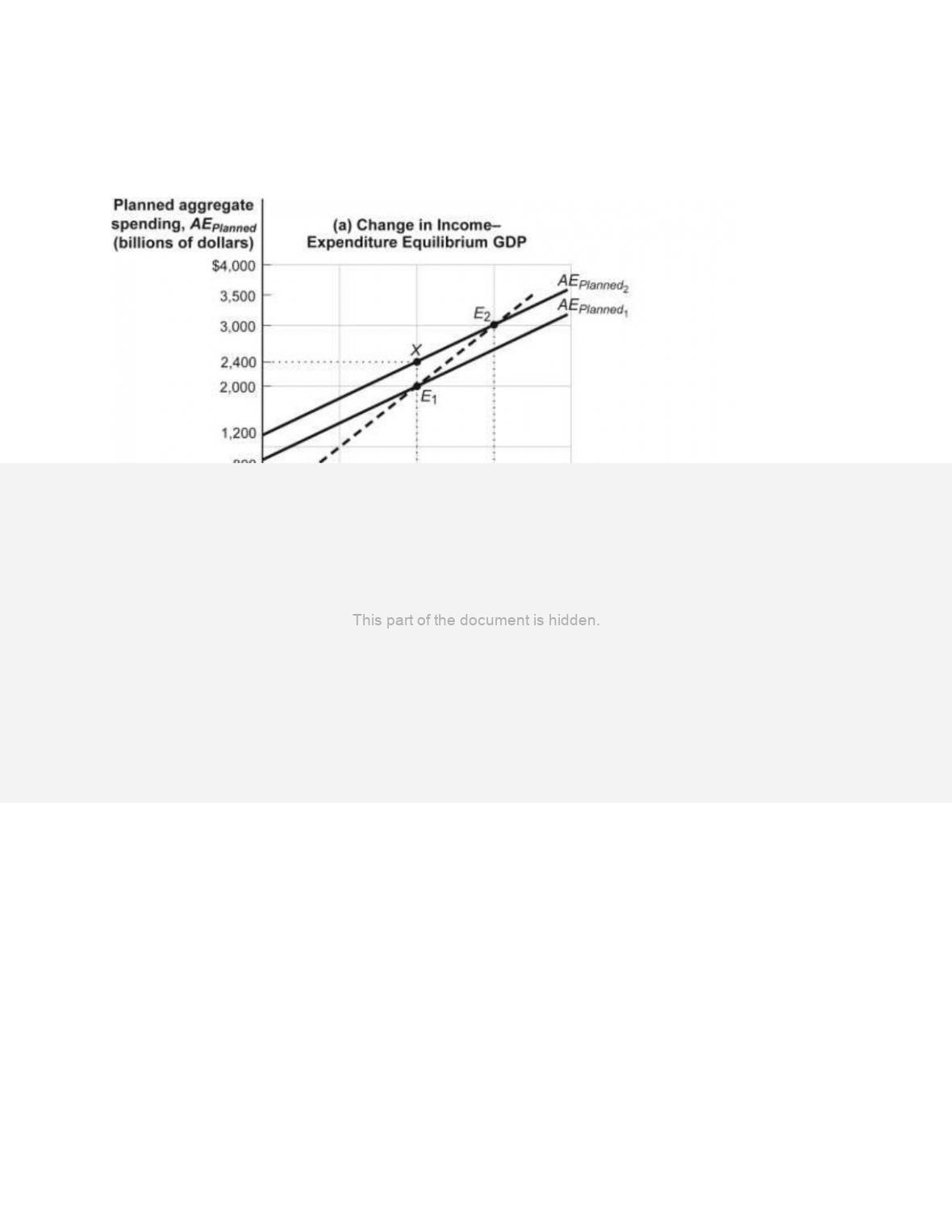
Figure: The Multiplier
37.
(Figure: The Multiplier) Refer to Figure: The Multiplier. If this economy is at Y1 and the
price level decreases:
A)
AD1 will shift to the left, reflecting a multiplied decrease in real GDP at every price
level.
B)
AD1 will shift to the right, reflecting a multiplied increase in real GDP at every
price level.
C)
an upward movement along the AD1 will take place, reflecting an increase in the
price level.
D)
a downward movement along the AD1 will take place, reflecting a decrease in the
price level.
Page 9
38.
(Figure: The Multiplier) Refer to Figure: The Multiplier. If this economy is at Y1 and
investment spending increases:
A)
AD1 will shift to the left, reflecting a multiplied decrease in real GDP at every price
level.
B)
AD1 will shift to the right, reflecting a multiplied increase in real GDP at every
price level.
C)
an upward movement along the AD1 will take place, reflecting an increase in the
price level.
D)
a downward movement along the AD1 will take place, reflecting a decrease in the
price level.
39.
Suppose that the stock market crashes, which causes a large decrease in the value of
many households’ financial assets. The most likely outcome is a _____ the aggregate
demand curve.
A)
rightward shift of
B)
leftward shift of
C)
movement up
D)
movement down
40.
Changes in _____ will not shift the aggregate demand curve.
A)
expectations
B)
wealth
C)
the existing stock of physical capital
D)
the price level
41.
The aggregate demand curve would NOT shift to the left as a result of:
A)
a fall in consumers’ wealth.
B)
a decrease in the amount of money in circulation.
C)
more pessimistic consumer expectations.
D)
lower labor productivity.
42.
If prices are constant, but the value of financial assets increases, aggregate _____ shifts
to the _____.
A)
supply; left
B)
supply; right
C)
demand; left
D)
demand; right
Page 10
43.
As a result of a decrease in the value of the dollar in relation to other currencies, U.S.
imports decrease and exports increase. Consequently, there is a(n):
A)
increase in short-run aggregate supply.
B)
decrease in the quantity of aggregate output supplied in the short run.
C)
increase in aggregate demand.
D)
decrease in the quantity of aggregate output demanded.
44.
An increase in aggregate demand is seen as a(n) _____ the aggregate demand curve.
A)
shift to the right of
B)
downward movement along
C)
upward movement along
D)
shift to the left of
45.
A decrease in aggregate demand is seen as a(n) _____ the aggregate demand curve.
A)
downward movement along
B)
upward movement along
C)
shift to the left of
D)
shift to the right of
46.
If the stock of physical capital increases, all other things unchanged, the aggregate
demand curve will:
A)
shift to the right.
B)
shift to the left.
C)
remain constant.
D)
become positively sloped.
47.
Changes in aggregate demand can be caused by changes in:
A)
the stock of physical capital.
B)
business costs.
C)
raw materials costs.
D)
the expenses of complying with government regulations.
48.
Suppose that consumer expectations improve. The aggregate demand curve will
undergo a:
A)
shift to the left.
B)
movement upward.
C)
shift to the right.
D)
movement downward.

Page 11
49.
Assuming that prices remain constant, suppose that consumer assets and wealth lose
value. The aggregate demand curve will undergo a:
A)
shift to the left.
B)
movement upward.
C)
shift to the right.
D)
movement downward.
50.
Which factor would shift the aggregate demand curve to the LEFT?
A)
monetary policy that raises the interest rate
B)
an increase in the aggregate price level
C)
an increase in consumer wealth
D)
stronger consumer optimism about income
51.
Suppose that a presidential candidate who promised large personal income tax cuts is
elected. Which outcome is MOST likely?
A)
a decrease in short-run aggregate supply
B)
a decrease in aggregate demand
C)
an increase in short-run aggregate supply
D)
an increase in aggregate demand
52.
An increase in government spending on health care is likely to shift the _____ curve to
the _____.
A)
short-run aggregate supply; right
B)
short-run aggregate supply; left
C)
aggregate demand; right
D)
aggregate demand; left
53.
A decrease in the money supply is likely to cause a(n) _____ in borrowing, a(n) _____
interest rates and a(n) _____ in aggregate demand.
A)
decrease; increase; decrease
B)
decrease; increase; increase
C)
increase; decrease; decrease
D)
increase; decrease; increase
54.
Raising taxes shifts the _____ curve to the _____.
A)
aggregate demand; left
B)
long-run aggregate supply; left
C)
aggregate demand; right
D)
short-run aggregate supply; left
Page 12
55.
Increasing the quantity of money in circulation shifts the _____ curve to the _____.
A)
aggregate demand; left
B)
long-run aggregate supply; right
C)
aggregate demand; right
D)
short-run aggregate supply; right
56.
The only government policy that has a DIRECT effect on the aggregate demand curve
is:
A)
changing the quantity of money.
B)
raising or lowering the tax rate.
C)
changing the level of government purchases of final goods and services.
D)
changing the level of government transfers.
57.
A decrease in the supply of money shifts the aggregate _____ curve to the _____.
A)
supply; left
B)
supply; right
C)
demand; left
D)
demand; right
58.
If government increases income tax rates, the aggregate demand curve is likely to:
A)
shift to the right.
B)
shift to the left.
C)
remain constant.
D)
become positively sloped.
59.
An increase in government spending, all other things unchanged, will cause the
aggregate demand curve to:
A)
become positively sloped.
B)
remain constant.
C)
shift to the right.
D)
shift to the left.
60.
Changes in aggregate demand can be caused by changes in:
A)
wages.
B)
business costs.
C)
raw materials costs.
D)
government spending.

Page 13
61.
Aggregate demand will shift to the RIGHT if:
A)
the aggregate price level increases.
B)
government purchases increase.
C)
taxes go up.
D)
the money supply shrinks.
62.
Examples of fiscal policy do NOT include:
A)
government spending on infrastructure to stimulate aggregate demand.
B)
reducing the interest rate by increasing the money supply.
C)
an economic stimulus package.
D)
a $1,500 per family tax rebate.
63.
Reducing taxes in response to a recession is an example of _____ policy.
A)
monetary
B)
investment
C)
consumption
D)
fiscal
64.
The economy is in a recession. The desired FISCAL policy is a(n):
A)
decrease in government transfer payments.
B)
increase in government purchases of goods and services.
C)
increase in tax rates.
D)
decrease in interest rates.
65.
A change in _____ has the MOST direct effect on aggregate demand.
A)
taxes
B)
interest rates
C)
the money supply
D)
government spending
66.
Government purchases of goods and services _____, while changes in taxes and transfer
payments _____.
A)
are exercises of fiscal policy; are exercises of monetary policy
B)
are exercises of monetary policy; are exercises of fiscal policy
C)
influence aggregate demand directly; influence aggregate demand indirectly
D)
influence aggregate demand indirectly; influence aggregate demand directly
Page 14
67.
If the Fed increases the quantity of money in circulation, interest rates _____,
investment spending _____, and the aggregate demand curve shifts to the _____.
A)
decrease; increases; right
B)
increase; increases; right
C)
decrease; increases; left
D)
increase; decreases; left
68.
If the Fed decreases the quantity of money in circulation, interest rates _____,
investment spending _____, and the aggregate demand curve shifts to the _____.
A)
decrease; increases; right
B)
decrease; decreases; left
C)
increase; decreases; left
D)
increase; decreases; right
69.
Aggregate demand will NOT increase when:
A)
household wealth rises but prices are constant.
B)
government purchases of goods rise.
C)
the quantity of money increases.
D)
interest rates increase.
70.
Aggregate demand will decrease if:
A)
the aggregate price level falls.
B)
the government raises tax rates.
C)
productivity declines.
D)
the money supply increases.
71.
Aggregate demand will increase if:
A)
the public becomes more optimistic.
B)
the aggregate price level falls.
C)
government spending is reduced.
D)
household wealth decreases.

Page 15
Use the following to answer questions 72-75:
Figure: Shift of the Aggregate Demand Curve
72. (Figure: Shift of the Aggregate Demand Curve) Refer to Figure: Shift of the Aggregate
Demand Curve. A movement from point A on AD1 to point C on AD2 could have resulted from
a(n):
A) lower price level.
B) higher price level.
C) increase in the total quantity of consumer goods and services demanded.
D) significant decrease in the consumers’ income.
72.
(Figure: Shift of the Aggregate Demand Curve) Refer to Figure: Shift of the Aggregate
Demand Curve. A movement from point B on AD1 to point E on AD2 could have been
the result of:
A)
an increase in consumer optimism.
B)
an increase in consumer pessimism.
C)
an increase in personal income taxes.
D)
the central bank reducing the quantity of money.
Page 16
73.
(Figure: Shift of the Aggregate Demand Curve) Refer to Figure: Shift of the Aggregate
Demand Curve. A movement from point C on AD2 to point A on AD1 may have been the
result of:
A)
an increase in investment spending following optimistic GDP forecasts.
B)
a decrease in investment spending following pessimistic GDP forecasts.
C)
decreases in the taxes paid by businesses.
D)
lower interest rates.
74.
(Figure: Shift of the Aggregate Demand Curve) Refer to Figure: Shift of the Aggregate
Demand Curve. An increase in aggregate demand is illustrated by a movement from:
A)
AD1 to AD2.
B)
point C to point A.
C)
point B to point A.
D)
point C to point E.
75.
(Figure: Shift of the Aggregate Demand Curve) Refer to Figure: Shift of the Aggregate
Demand Curve. A movement from AD1 to AD2 may have been the result of:
A)
an increase in government spending.
B)
a decrease in government spending.
C)
increases in personal income taxes.
D)
a decrease in consumer wealth.
76.
When demand declined in the Great Depression of 1929–1933, the GDP deflator:
A)
increased by 15%.
B)
increased by 26%.
C)
decreased by 15%.
D)
decreased by 26%.
77.
During the Great Depression, the United States moved to the _____ along its _____
curve.
A)
right; aggregate demand
B)
right; short-run aggregate supply
C)
left; aggregate demand
D)
left; short-run aggregate supply
Page 17
78.
The aggregate supply curve shows the relationship between the _____ and the quantity
of aggregate output supplied.
A)
price of oil
B)
aggregate price level
C)
price of money
D)
level of employment
79.
The aggregate supply curve shows the relationship between the aggregate price level
and the aggregate:
A)
output supplied.
B)
money supply.
C)
unemployment rate.
D)
employment.
80.
The aggregate supply curve shows the relationship of prices to:
A)
sales.
B)
the quantity of output people want to buy.
C)
the quantity of output producers are willing to provide.
D)
both the amount of output people want to buy and the amount of output producers
want to provide.
81.
As a result of a sharp decrease in aggregate demand between 1929 and 1933, real GDP
was _____ its 1929 level.
A)
29% below
B)
100% below
C)
29% above
D)
50% above
82.
As a result of a sharp decrease in aggregate demand between 1929 and 1933, the
unemployment rate changed from _____% in 1929 to _____% in 1933.
A)
0; 3
B)
3: 25
C)
40; 5
D)
25; 0
Page 18
83.
If Nike sells basketball shoes for $150 per pair and the cost of producing and selling a
pair of basketball shoes is $15, Nike’s profit per unit on a pair of basketball shoes is:
A)
$135.
B)
$160
C)
$165.
D)
$10.
84.
When the price level decreases, firms in perfectly competitive markets will:
A)
decrease output and increase the price.
B)
decrease output.
C)
increase output and decrease the price.
D)
increase output.
85.
When the price level increases, firms in perfectly competitive markets will:
A)
decrease output and increase the price.
B)
decrease output.
C)
increase output and decrease the price.
D)
increase output.
86.
When the price level decreases, firms in imperfectly competitive markets will:
A)
decrease output and increase the price.
B)
decrease output.
C)
decrease output and decrease the price.
D)
increase output.
87.
The short-run aggregate supply curve slopes upward because a _____ aggregate price
level leads to _____.
A)
higher; lower output as costs of production increase
B)
higher; higher output, since most production costs are fixed in the short run
C)
lower; higher output, since production costs tend to fall in the short run
D)
lower; higher profit and higher productivity
88.
The short-run aggregate supply curve is positively sloped because:
A)
wages and other costs of production respond immediately to changes in prices.
B)
profit is lower when prices increase, so output decreases.
C)
workers are willing to work for lower wages rather than be laid off.
D)
higher prices lead to higher profit and higher output.
Page 19
89.
According to the short-run aggregate supply curve, when the _____ rises, the quantity of
aggregate output _____ rises.
A)
profit per unit; demanded
B)
aggregate price level; supplied
C)
aggregate price level; demanded
D)
interest rate; supplied
90.
The positive relationship between the aggregate price level and aggregate output
supplied gives the short-run aggregate supply curve a(n) _____ slope.
A)
positive
B)
vertical
C)
horizontal
D)
negative
91.
The short-run aggregate supply curve is positively sloped because:
A)
business people are subject to money illusion.
B)
wages are sticky.
C)
workers care about nominal wages, not real wages.
D)
of diminishing returns to labor.
92.
Profit per unit equals:
A)
price per unit minus cost per unit.
B)
price per unit divided by cost per unit.
C)
cost per unit minus price per unit.
D)
price per unit minus the nominal wage rate.
93.
The short-run aggregate supply curve illustrates:
A)
the price level at which real output will be consumed.
B)
the price level at which real output will be in equilibrium.
C)
the positive relationship between the aggregate price level and aggregate output
supplied.
D)
the negative relationship between the aggregate price level and aggregate output
supplied.
94.
In the short run, wages and some prices are considered to be:
A)
sticky.
B)
unpredictable.
C)
extremely flexible.
D)
irrelevant.
Page 20
95.
The short run in macroeconomic analysis is a period:
A)
in which many production costs can be taken as fixed.
B)
in which wages become fully flexible.
C)
of two months, and the long run is more than 12 months.
D)
in which interest rates are fixed.
96.
The short-run aggregate supply curve is:
A)
downward sloping.
B)
upward sloping.
C)
horizontal at the natural level of employment.
D)
vertical at the natural level of employment.
97.
The short-run aggregate supply curve slopes upward because of:
A)
wage and price stickiness.
B)
wage and price flexibility.
C)
increasing technology.
D)
a reduction in resource availability at higher price levels.
98.
The _____ curve shows the positive relationship between the aggregate price level and
the quantity of aggregate output supplied when wages and prices are not fully flexible.
A)
aggregate demand
B)
short-run aggregate supply
C)
aggregate spending
D)
long-run aggregate supply
99.
An increase in the aggregate price level will increase:
A)
short-run aggregate supply.
B)
the quantity of aggregate output supplied in the short run.
C)
aggregate demand.
D)
the quantity of aggregate output demanded.
100.
Nominal wages are sticky because:
A)
wages are slow to rise when there are labor shortages and slow to fall even when
the level of unemployment is significant.
B)
wages remain fixed in the long run, increasing the profitability of the firms.
C)
wages are slow to fall when there are labor shortages and slow to rise even when
the level of unemployment is significant.
D)
in the long run all wages are adjusted for inflation.