Page 61
252.
The financial meltdown in 2008–2009 was partially the result of a faulty economic
model that misestimated the value of mortgage-backed securities.
A)
True
B)
False
253.
The value of a mortgage-backed security is tied to the interest on the national debt paid
by the Federal Reserve.
A)
True
B)
False
254.
After 2000, the market for mortgage-backed securities grew rapidly because Wall Street
financial theorists claimed they had a model that could accurately assess what their price
should be.
A)
True
B)
False
255.
On any given production possibility frontier, we see the minimum quantity of one good
that can be produced for any given production of the other.
A)
True
B)
False
256.
Suppose residents of Montana operate on their production possibility frontier, and they
want to increase production of both wheat and fly-fishing rods. According to the
production possibility frontier, this cannot happen without new resources or
technological improvement.
A)
True
B)
False
257.
A typical bowed-out production possibility frontier between two goods, guns and butter,
shows that the opportunity cost of butter in terms of guns increases as more butter is
produced. This implies that the opportunity cost of guns in terms of butter decreases as
more guns are produced.
A)
True
B)
False
258.
If the United States is more productive than Mexico in all lines of production, then the
United States cannot benefit from trade with Mexico.
A)
True
B)
False
Page 62
259.
Bangladesh produces much of the clothing we wear because it can produce more clothes
than can the United States.
A)
True
B)
False
260.
Nations can gain from trade with other nations, even if they are less productive in all
industries than the nations with which they trade.
A)
True
B)
False
Use the following to answer questions 261-262:
\\
261.
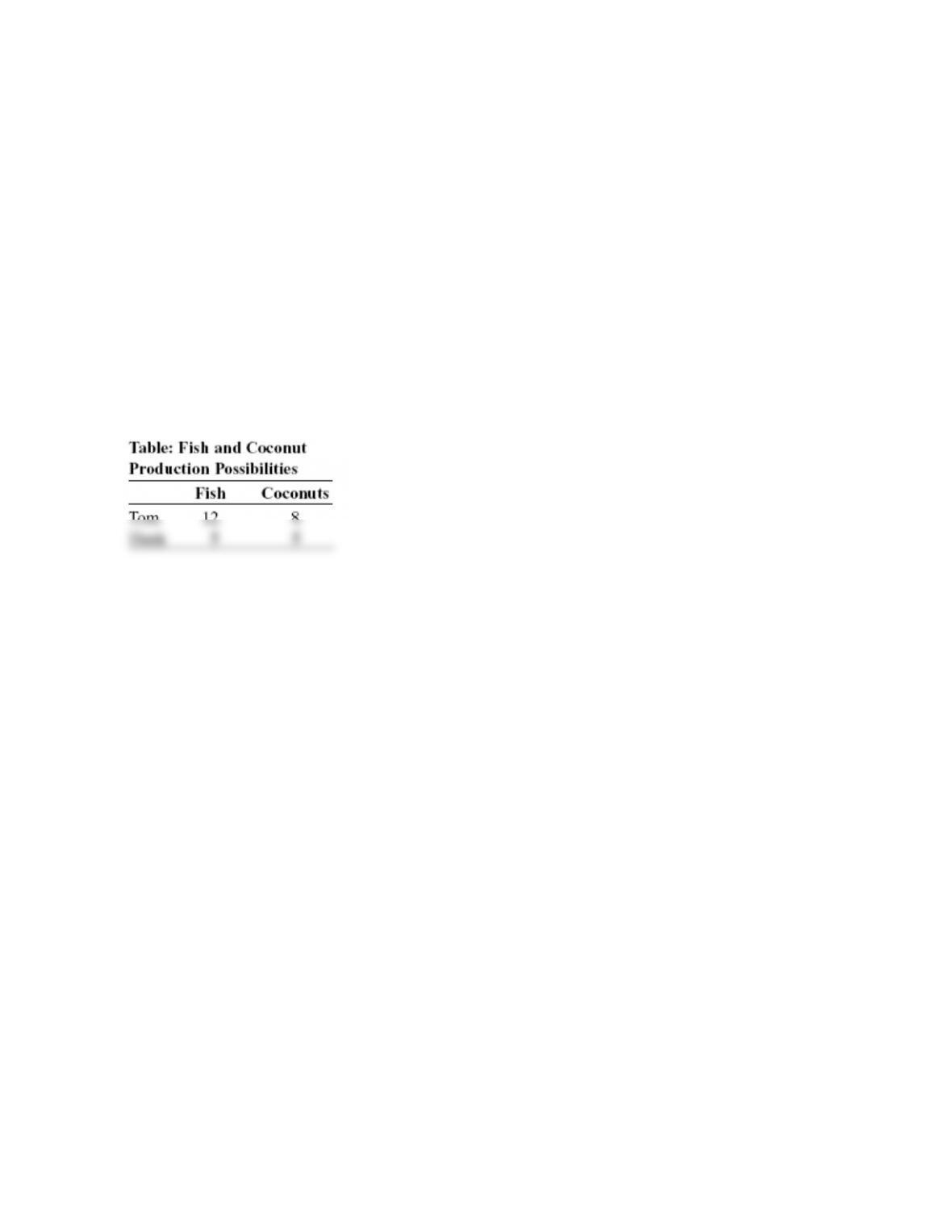
(Table: Fish and Coconut Production Possibilities) Use Table: Fish and Coconut
Production Possibilities. The table shows the maximum number of fish or coconuts that
Tom and Hank can produce when each produces only one of the goods. The table
implies that Hank has an absolute advantage in the production of both goods.
A)
True
B)
False
262.
(Table: Fish and Coconut Production Possibilities) Use Table: Fish and Coconut
Production Possibilities. The table shows the maximum number of fish or coconuts that
Tom and Hank can produce when each produces only one of the goods. The table
implies that Tom has a comparative advantage in the production of both goods.
A)
True
B)
False
263.
Absolute advantage is the basis for gains from trade.
A)
True
B)
False
Page 63
264.
The principle of comparative advantage suggests that, if New York and Florida
exchange taxi parts for oranges, each state will be made worse off.
A)
True
B)
False
265.
A firm is an organization that produces goods and/or services.
A)
True
B)
False
266.
Fertilizer, used to grow pumpkins, is a factor of production.
A)
True
B)
False
267.
Labor and capital are the only two factors of production.
A)
True
B)
False
268.
The basis of the circular-flow diagram is that the money flowing into each sector or
market is greater than the money that flows out.
A)
True
B)
False
269.
The basis of the circular-flow diagram is that the money flowing into each sector or
market is equal to the money that flows out.
A)
True
B)
False
270.
In the product market, households buy goods and services.
A)
True
B)
False
271.
In the factor market, households buy goods and services.
A)
True
B)
False
Page 64
272.
In the factor market, firms buy goods and services.
A)
True
B)
False
273.
In the factor market, firms buy resources.
A)
True
B)
False
274.
If Mary accepts a job as a nurse, she has sold a factor of production in the factor market.
A)
True
B)
False
275.
If Jim buys a lunch at a restaurant, he has bought a factor of production in the factor
market.
A)
True
B)
False
276.
An apple is a resource sold in the factor market.
A)
True
B)
False
277.
“Teachers in northern New Hampshire should earn more money” is a normative
statement.
A)
True
B)
False
278.
Positive economics is the branch of economics that makes prescriptions about the way
the economy should work.
A)
True
B)
False
279.
“Steel tariffs will prevent job losses in the steel industry” is a positive statement.
A)
True
B)
False
Page 65
280.
“The unemployment rate should be higher” is a normative statement.
A)
True
B)
False
281.
“Many economists agree that income taxes should be increased for rich people” is a
positive statement.
A)
True
B)
False
282.
Economists disagree more over normative economics than positive economics.
A)
True
B)
False
283.
Explain how an economic model contributed to the financial crisis in 2008–2009.
284.
Consider a point inside the production possibility frontier for a simple economy that
produces only two goods, X and Y. Why is this point described as feasible but not
efficient?
285.
Explain why economists believe that production possibility frontiers have a bowed-out
curvature, rather than a straight line.
286.
Leaders of a small town are tired of looking at a vacant and dilapidated warehouse that
sits on a prime piece of real estate. The town finds an investor who purchases the
warehouse and promises to renovate the old building and build condominiums in the old
building. Is this economic growth?
287.
Explain how technological progress is a source of economic growth.
Page 66
Use the following to answer question 288:
\\
288.
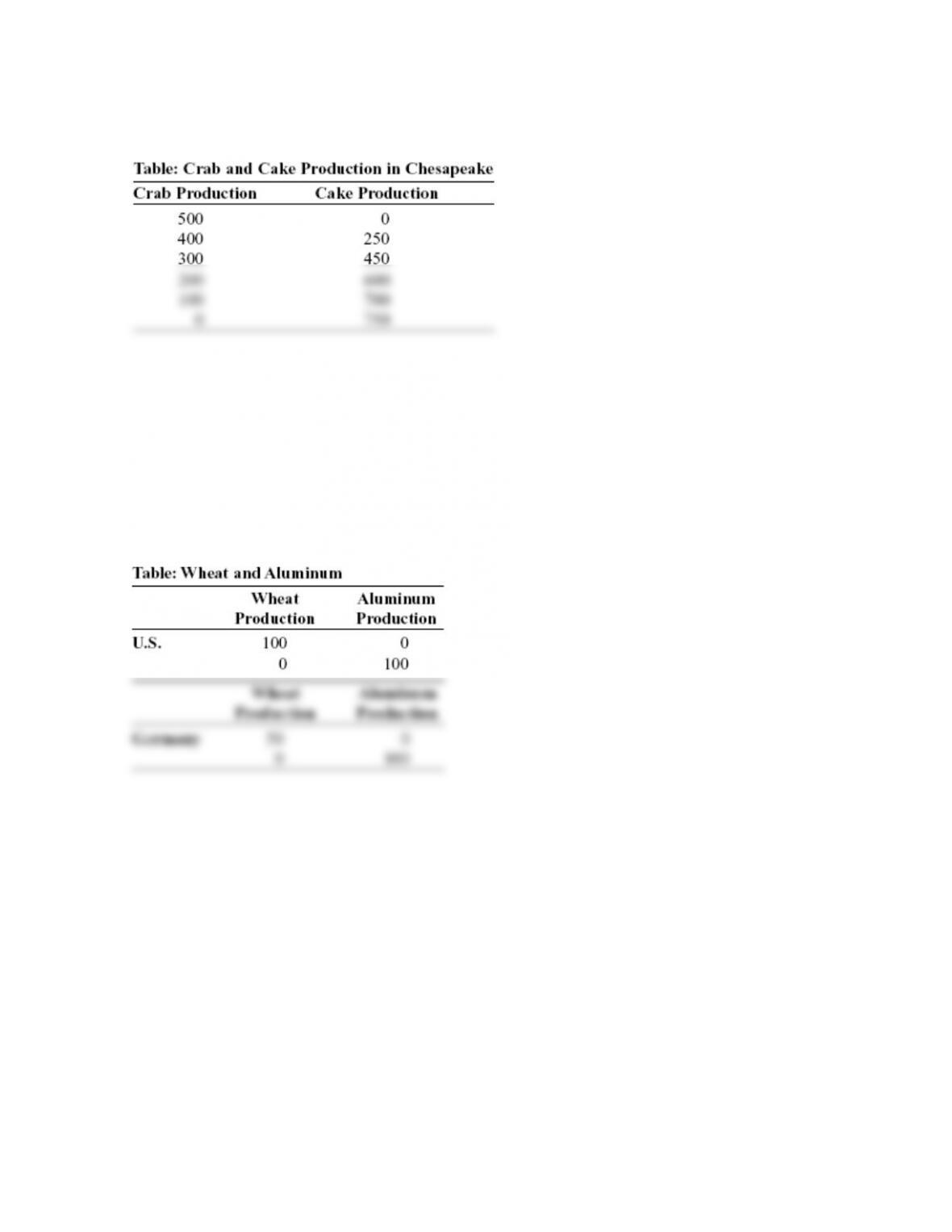
(Table: Crab and Cake Production in Chesapeake) Use Table: Crab and Cake
Production in Chesapeake. What is the opportunity cost of increasing the production of
crabs from zero to 100? What is the opportunity cost of increasing the production of
crabs from 400 to 500? Explain the difference in your answers.
Use the following to answer question 289:
\\
289.
(Table: Wheat and Aluminum) Use Table: Wheat and Aluminum. The table shows the
maximum possible production of wheat and aluminum for both the United States and
Germany. Are gains from trade possible between these nations? Explain.
Page 67
Use the following to answer question 290:
\\
290.
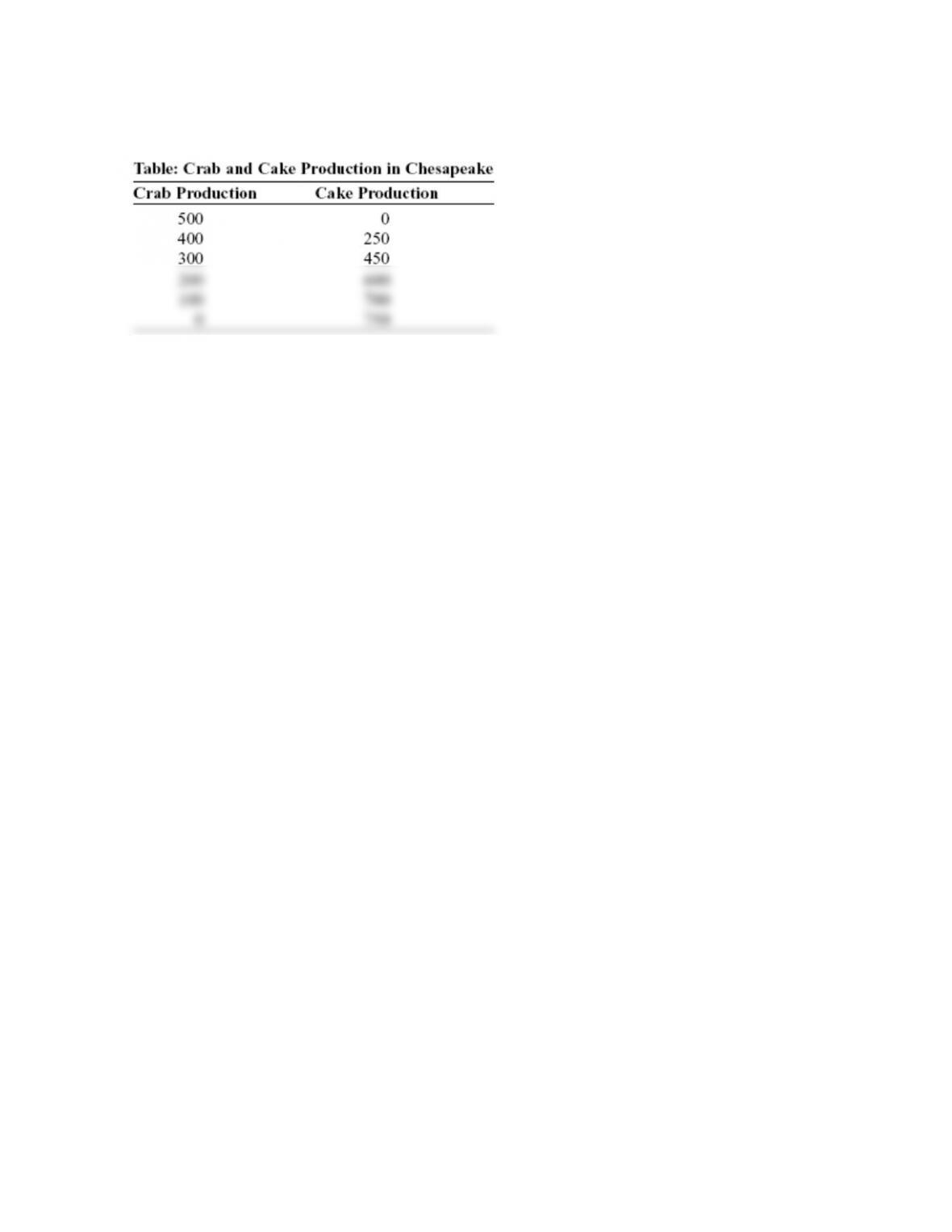
(Table: Crab and Cake Production in Chesapeake) Use Table: Crab and Cake
Production in Chesapeake. The table shows the maximum annual output combinations
of crabs and cakes. Given the scarce resources and limited technology, as Chesapeake
uses more resources for the
production of cakes, fewer resources are available to produce crabs. Can this nation
produce 200 crabs and 500 cakes? Is this efficient? Explain.
291.
Consider a nation with a large economy, like the United States, and a nation with a
small economy, like the Dominican Republic. How can the United States, with absolute
advantage in production of almost all goods, benefit from trade with the Dominican
Republic?
292.
You are reading an editorial in your local newspaper. The editorial says: “The United
States had a trade deficit of $18.4 billion in February 2008. This is a clear indication to
our leaders that we must renegotiate our trade agreements with China to make them
fairer for the American worker.” What part of this editorial is positive and what part is
normative?
293.
Economists use models to explain real-life situations because:
A)
such models tend to be exactly what is occurring in each situation.
B)
assumptions found in such models tend to make analyzing the situation more
difficult.
C)
simplifications and assumptions often yield results that can help to explain the
more difficult real-life situations.
D)
real-life situations are not relevant to the building of models.
Page 68
294.
Economic models often:
A)
vary greatly in assumptions and simplifications.
B)
are correct.
C)
provide similar answers.
D)
fail to explain any of the real-life scenarios they are supposed to help solve.
295.
“All other relevant factors remain unchanged” is another way of saying:
A)
all other things equal.
B)
allow several variables to change to understand how those variables affect one
variable held constant.
C)
allow all variables to change and attempt to understand how the variables interact
with each other.
D)
no variables change.
296.
Alexander has a straight-line, or linear, production possibility frontier when he produces
soybeans and corn. If he uses all of his resources to grow soybeans, he can produce 200
bushels of soybeans; if he uses all of his resources for corn production, he can produce
400 bushels of corn. Alexander CANNOT produce _____ bushels of soybeans and
_____ bushels of corn.
A)
200; 0
B)
200; 600
C)
0; 400
D)
100; 200
297.
Frances has a linear production possibility frontier when she produces tomatoes and
green beans. If she uses all of her resources, she can produce 400 bushels of tomatoes or
800 bushels of green beans. Frances is NOT producing efficiently if she produces _____
bushels of tomatoes and _____ bushels of green beans.
A)
400; 0
B)
200; 400
C)
200; 200
D)
0; 800
298.
Alison has a linear production possibility frontier in bracelets and necklaces. In one
hour, she can produce 5 bracelets or 10 necklaces. What is the opportunity cost to make
1 necklace?
A)
5 bracelets
B)
10 necklaces
C)
0.5 bracelet
D)
2 necklaces
Page 69
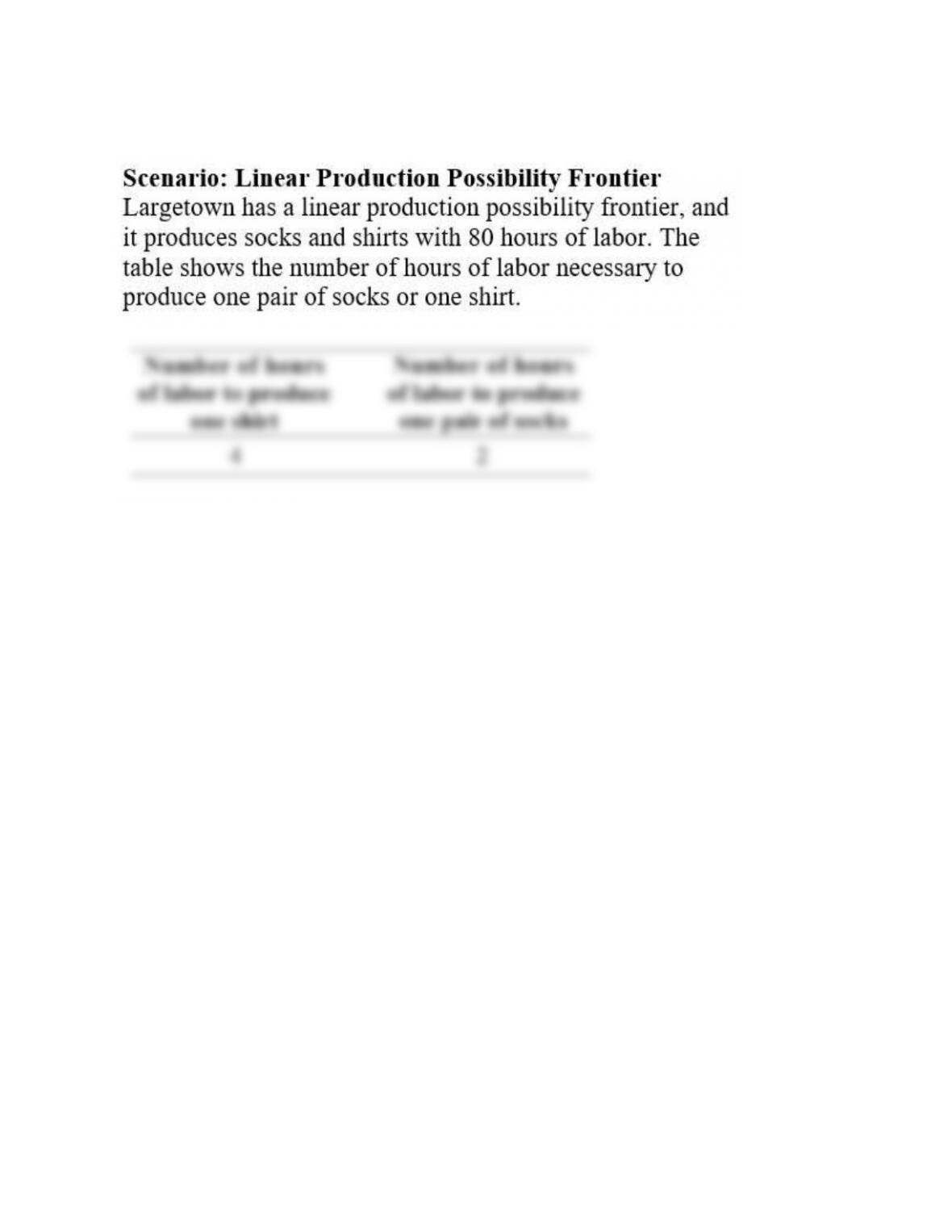
Use the following to answer questions 299-302:
299.
(Scenario: Linear Production Possibility Frontier) Use Scenario: Linear Production
Possibility Frontier. What is the maximum number of pairs of socks Largetown can
produce?
A)
40
B)
20
C)
2
D)
4
300.
(Scenario: Linear Production Possibility Frontier) Use Scenario: Linear Production
Possibility Frontier. If Largetown decides to devote half of its labor time to the
production of socks and half of the time to the production of shirts, it can produce _____
shirts and _____ pairs of socks.
A)
10; 20
B)
20; 10
C)
30; 30
D)
0; 30
Page 70
301.
(Scenario: Linear Production Possibility Frontier) Use Scenario: Linear Production
Possibility Frontier. If Largetown’s labor resource decreases by 40 hours, the
opportunity cost of producing shirts:
A)
increases.
B)
decreases.
C)
does not change.
D)
may or may not change depending upon the number of pairs of socks it wishes to
produce.
302.
(Scenario: Linear Production Possibility Frontier) Use Scenario: Linear Production
Possibility Frontier. Largetown CANNOT produce _____ shirts and _____ pairs of
socks.
A)
20; 0
B)
40; 40
C)
0; 40
D)
10; 20
303.
Smallville has a linear production possibility frontier in the production of good X and
good Y. It can produce 6 of X per hour or 8 of Y per hour. Suppose it has 240 hours of
labor and divides labor hours equally between production of good X and good Y. What
is the MAXIMUM number of good Y it can produce in the time it has allocated to Y
production?
A)
960
B)
30
C)
720
D)
6
Use the following to answer questions 304-307:
Page 71
304.
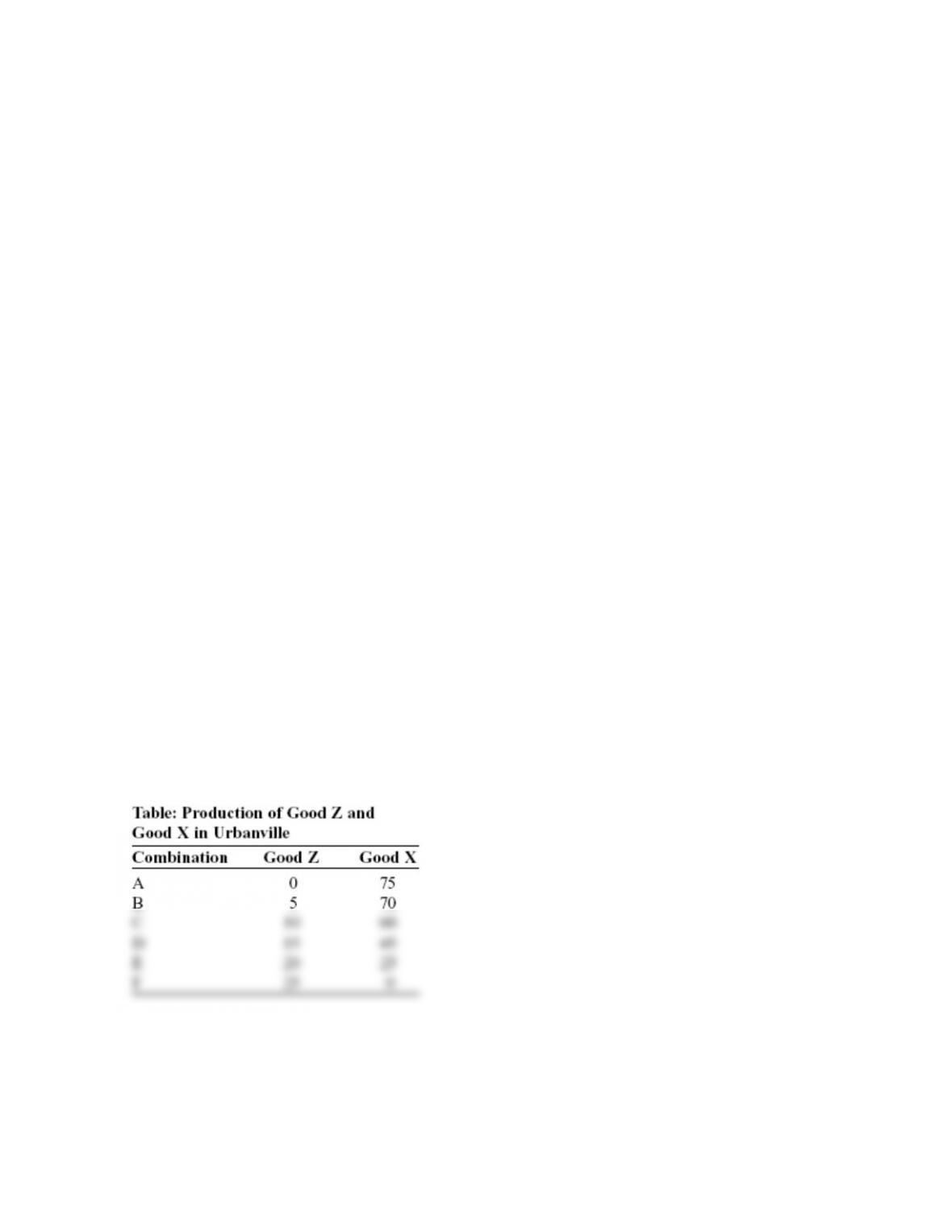
(Table: Production of Good Z and Good X in Urbanville) Use Table: Production of
Good Z and Good X in Urbanville. This table shows the production possibility frontier
for Urbanville. Suppose Urbanville is producing 5 of Z and 50 of X; this combination is:
A)
feasible but inefficient.
B)
feasible and efficient.
C)
not feasible but efficient.
D)
neither feasible nor efficient.
305.
(Table: Production of Good Z and Good X in Urbanville) Use Table: Production of
Good Z and Good X in Urbanville. This table shows the production possibility frontier
for Urbanville. Suppose Urbanville is producing 15 of Z and 45 of X; this combination
is:
A)
both allocatively and productively efficient.
B)
productively efficient.
C)
allocatively efficient.
D)
neither productively nor allocatively efficient.
306.
(Table: Production of Good Z and Good X in Urbanville) Use Table: Production of
Good Z and Good X in Urbanville. This table shows the production possibility frontier
for Urbanville. Suppose Urbanville is producing at combination C and moves to
combination D. What is the opportunity cost of this move?
A)
15 of X
B)
5 of Z
C)
15 of Z
D)
45 of X
307.
(Table: Production of Good Z and Good X in Urbanville) Use Table: Production of
Good Z and Good X in Urbanville. This table shows the production possibility frontier
for Urbanville. Suppose Urbanville is producing at combination F, what is the
opportunity cost of a move to combination E?
A)
5 of Z
B)
20 of Z
C)
25 of X
D)
0 of X
308.
If an economy produces the desired mix of goods from its available resources, then this
mix of goods is:
A)
allocatively efficient.
B)
both productively and allocatively efficient.
C)
productively efficient.
D)
neither productively nor allocatively efficient.
Page 72
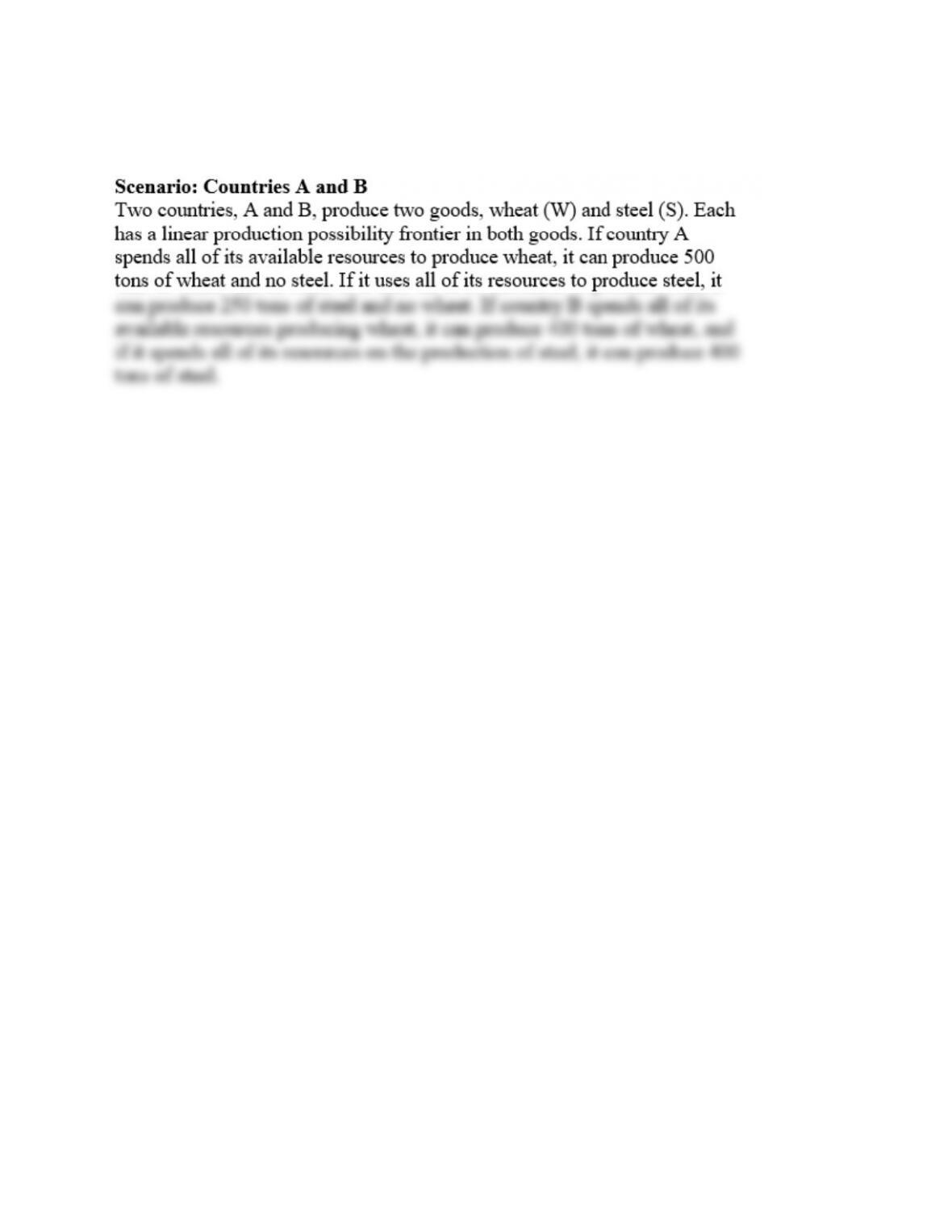
Use the following to answer questions 309-313:
309.
(Scenario: Countries A and B) Use Scenario: Countries A and B. Given this
information, country _____ has a comparative advantage in the production of wheat,
and country _____ has a comparative advantage in the production of steel.
A)
A; A
B)
A; B
C)
B; B
D)
B; A
310.
(Scenario: Countries A and B) Use Scenario: Countries A and B. If each country
devotes half of its resources to the production of wheat and half to the production of
steel, then their combined total production of wheat will be _____ tons and their
combined total production of steel will be _____ tons.
A)
450; 325
B)
900; 650
C)
500; 250
D)
400; 400
311.
(Scenario: Countries A and B) Use Scenario: Countries A and B. If country B produces
300 tons of steel, how many tons of wheat can it produce?
A)
100
B)
200
C)
300
D)
400
Page 73
312.
(Scenario: Countries A and B) Use Scenario: Countries A and B. If countries A and B
both specialize and trade:
A)
only country A will gain.
B)
only country B will gain.
C)
country A and country B will gain if they both specialize in the good in which they
have a comparative advantage.
D)
neither country will gain.
313.
(Scenario: Countries A and B) Use Scenario: Countries A and B. Given this
information, the country that has the absolute advantage in wheat is _____, and the
country that has the absolute advantage in steel is _____.
A)
A; A
B)
A; B
C)
B; B
D)
B; A
314.
Positive economics:
A)
describes opinions and perspectives on how the world should work.
B)
is based on opinion polls.
C)
describes how the world does work.
D)
is the same as normative economics.
315.
Which statement(s) reflect(s) a normative view?
I. The United States should increase the minimum wage to $10 per hour.
II. There is a federal minimum wage in the United States.
III. The federal minimum wage in the United States is less than $10 per hour.
A)
I, II, and III
B)
None is normative.
C)
I and II
D)
I

Answer Key

Page 75
45.
B
46.
A
47.
B
48.
A
49.
C
50.
B
51.
B
52.
C
53.
A
54.
B
55.
A
56.
B
57.
C
58.
D
59.
A
60.
B
61.
D
62.
A
63.
A
64.
B
65.
C
66.
D
67.
C
68.
C
69.
B
70.
D
71.
A
72.
C
73.
B
74.
A
75.
D
76.
C
77.
A
78.
A
79.
B
80.
D
81.
D
82.
A
83.
A
84.
A
85.
B
86.
A
87.
A
88.
A
89.
C
90.
B

Page 76
91.
A
92.
A
93.
D
94.
B
95.
A
96.
D
97.
C
98.
C
99.
C
100.
B
101.
B
102.
D
103.
C
104.
C
105.
A
106.
A
107.
B
108.
B
109.
D
110.
B
111.
C
112.
B
113.
B
114.
A
115.
A
116.
B
117.
A
118.
A
119.
D
120.
A
121.
D
122.
B
123.
D
124.
A
125.
A
126.
D
127.
C
128.
D
129.
B
130.
A
131.
A
132.
D
133.
B
134.
B
135.
B
136.
D

Page 77
137.
A
138.
D
139.
A
140.
D
141.
B
142.
D
143.
D
144.
D
145.
C
146.
B
147.
C
148.
D
149.
B
150.
D
151.
B
152.
A
153.
A
154.
C
155.
D
156.
B
157.
A
158.
B
159.
A
160.
C
161.
A
162.
B
163.
A
164.
B
165.
B
166.
B
167.
B
168.
A
169.
B
170.
D
171.
B
172.
D
173.
A
174.
B
175.
B
176.
A
177.
C
178.
C
179.
B
180.
B
181.
A
182.
D
Page 78
183.
C
184.
C
185.
B
186.
C
187.
C
188.
C
189.
C
190.
B
191.
D
192.
D
193.
C
194.
C
195.
D
196.
A
197.
C
198.
C
199.
A
200.
C
201.
B
202.
D
203.
A
204.
C
205.
B
206.
D
207.
A
208.
C
209.
B
210.
D
211.
A
212.
D
213.
C
214.
B
215.
D
216.
B
217.
C
218.
A
219.
A
220.
C
221.
D
222.
A
223.
A
224.
D
225.
B
226.
C
227.
B
228.
A

Page 79
229.
C
230.
A
231.
A
232.
A
233.
C
234.
D
235.
B
236.
D
237.
A
238.
A
239.
B
240.
B
241.
C
242.
D
243.
B
244.
B
245.
A
246.
B
247.
B
248.
B
249.
A
250.
B
251.
A
252.
A
253.
B
254.
A
255.
B
256.
A
257.
B
258.
B
259.
B
260.
A
261.
B
262.
B
263.
B
264.
B
265.
A
266.
B
267.
B
268.
B
269.
A
270.
A
271.
B
272.
B
273.
A
274.
A
Page 80
275.
B
276.
B
277.
A
278.
B
279.
A
280.
A
281.
B
282.
A
283.
284.
285.
286.
287.
288.
289.
290.
291.
292.
293.
C
294.
A
295.
A
296.
B
297.
C
298.
C
299.
A
300.
A
301.
C
302.
B
303.
A
304.
A
305.
B
306.
A
307.
A
308.
A
309.
B
310.
A
311.
A
312.
C
313.
B
314.
C
315.
D