Page 21
83.
(Figure: Wine and Wheat) Use Figure: Wine and Wheat. If this economy is producing
on the production possibility frontier, what would allow it to produce at point C?
==
A)
an improvement in technology
B)
a decrease in resources
C)
a decrease in production
D)
policies expanding social programs for seniors
84.
The U.S. production possibility frontier would _____ if all computers using Microsoft
operating systems contracted a virus that corrupted all information on those computers.
A)
shift in
B)
shift out
C)
not change
D)
The answer cannot be determined from the information provided.
85.
The U.S. production possibility frontier will _____ if there is a large influx of
working-age immigrants.
A)
shift in
B)
shift out
C)
not change
D)
The answer cannot be determined from the information provided.
86.
In Kessy’s old kitchen, he could bake 10 cookies or mix 15 glasses of lemonade in one
day. Now Kessy has a larger oven and refrigerator. How does this affect his production
possibility frontier?
A)
It shifts his production possibility frontier out.
B)
It shifts his production possibility frontier in.
C)
He will be less efficient.
D)
He will not be able to produce as much as before.
Page 22
Use the following to answer questions 87-93:
\\
87.
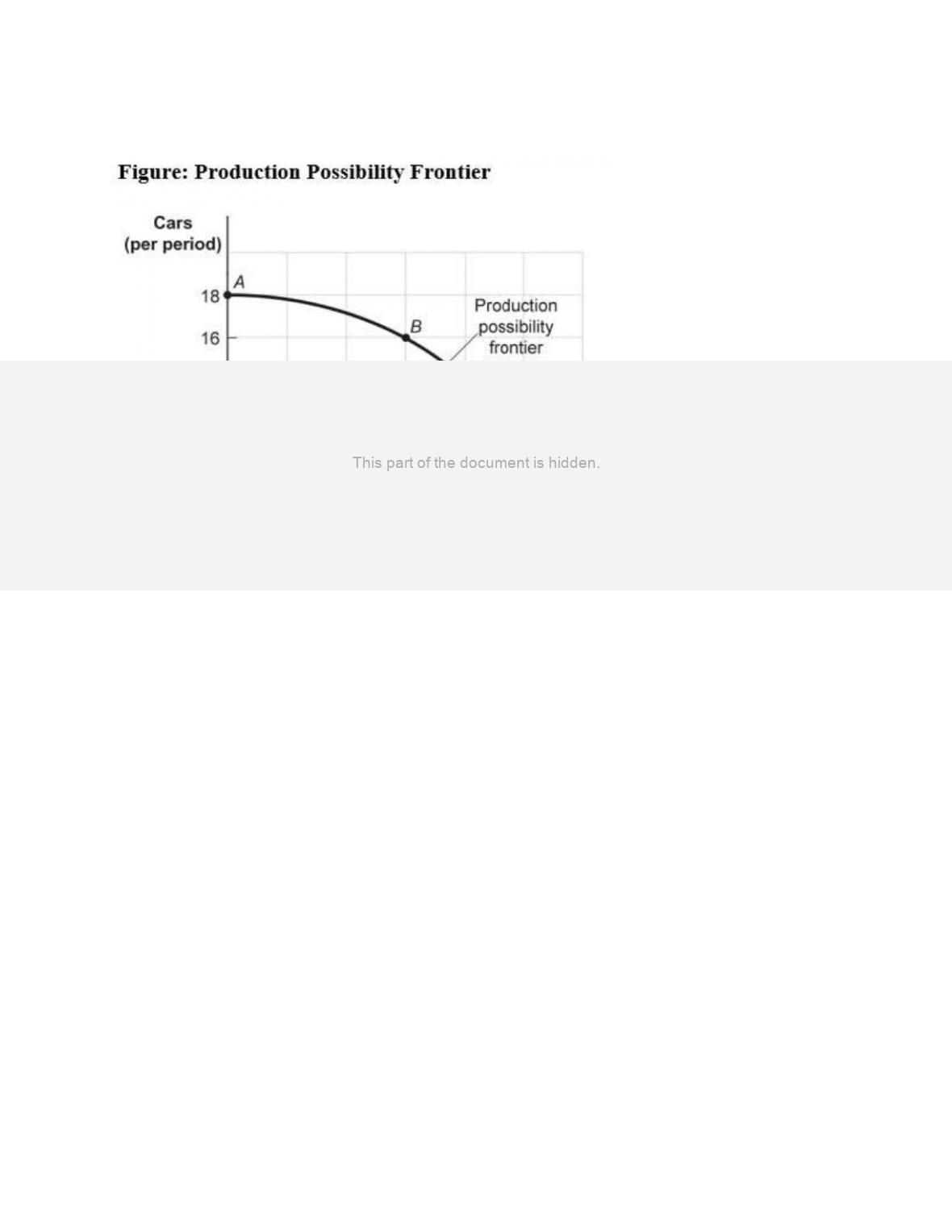
(Figure: Production Possibility Frontier) Use Figure: Production Possibilities Frontier.
Points A, B, E, and F:
A)
indicate combinations of cars and computers that society can produce using all of
its resources efficiently.
B)
show that the opportunity cost of cars increases as more cars are produced but that
of more computers decreases as more computers are produced.
C)
indicate that society wants computers more than cars.
D)
indicate constant opportunity costs for cars and increasing opportunity costs for
computers.
88.
(Figure: Production Possibility Frontier) Use Figure: Production Possibilities Frontier.
This production possibility frontier is:
A)
bowed out because of increasing opportunity costs.
B)
bowed in because of increasing opportunity costs.
C)
bowed out because of constant cost of cars and computers.
D)
linear because of constant costs.

Page 23
89.
(Figure: Production Possibility Frontier) Use Figure: Production Possibilities Frontier. If
the economy is operating at point B, producing 16 cars and 12 computers per period, a
decision to move to point E and produce 18 computers:
A)
indicates that you can have more computers and more cars simultaneously.
B)
makes it clear that this economy has decreasing opportunity costs.
C)
entails a loss of 8 cars per period.
D)
entails a loss of 4 cars per period.
90.
(Figure: Production Possibility Frontier) Use Figure: Production Possibilities Frontier.
The combination of cars and computers at point H:
A)
can be attained but would cost too much.
B)
cannot be attained given the level of technology and the resources available.
C)
has no meaning since it is not what consumers want.
D)
is attainable but would increase unemployment.
91.
(Figure: Production Possibility Frontier) Use Figure: Production Possibilities Frontier. If
the economy is producing 8 cars and 12 computers per period:
A)
the economy has ongoing unemployment or inefficiency.
B)
the notion of increasing opportunity cost is invalidated.
C)
the economy is still efficient but has made a decision not to buy as much as it
could.
D)
something must be done to reduce the amount of employment.
92.
(Figure: Production Possibility Frontier) Use Figure: Production Possibilities Frontier. A
movement from point C producing 12 cars and 16 computers per period to point B
means a _____of _____ cars and a _____ of _____ computers per period.
A)
gain; 4; loss; 4
B)
gain; 2; loss; 4
C)
gain; 4; loss; 6
D)
loss; 2; gain; 4
93.
(Figure: Production Possibility Frontier) Use Figure: Production Possibilities Frontier.
Which rate of production per period is NOT efficient?
A)
18 cars and no computers
B)
8 cars and 18 computers
C)
16 cars and 12 computers
D)
no cars and 18 computers
Page 24
94.
If farmer Sam MacDonald can produce 200 pounds of cabbages and no potatoes or no
cabbages and 100 pounds of potatoes and if he faces a linear production possibility
frontier, the opportunity cost of producing an additional pound of potatoes is _____
pound(s) of cabbage.
A)
0.5
B)
2
C)
100
D)
200
95.
If farmer Sam MacDonald can produce 200 pounds of cabbages and no potatoes or no
cabbages and 100 pounds of potatoes and if he faces a linear production possibility
frontier, the opportunity cost of producing an additional pound of cabbage is _____
pound(s) of potatoes.
A)
0.5
B)
2
C)
100
D)
200
96.
The slope of a typical production possibility frontier is:
A)
0.
B)
vertical.
C)
positive.
D)
negative.
Use the following to answer questions 97-99:
\\
97.
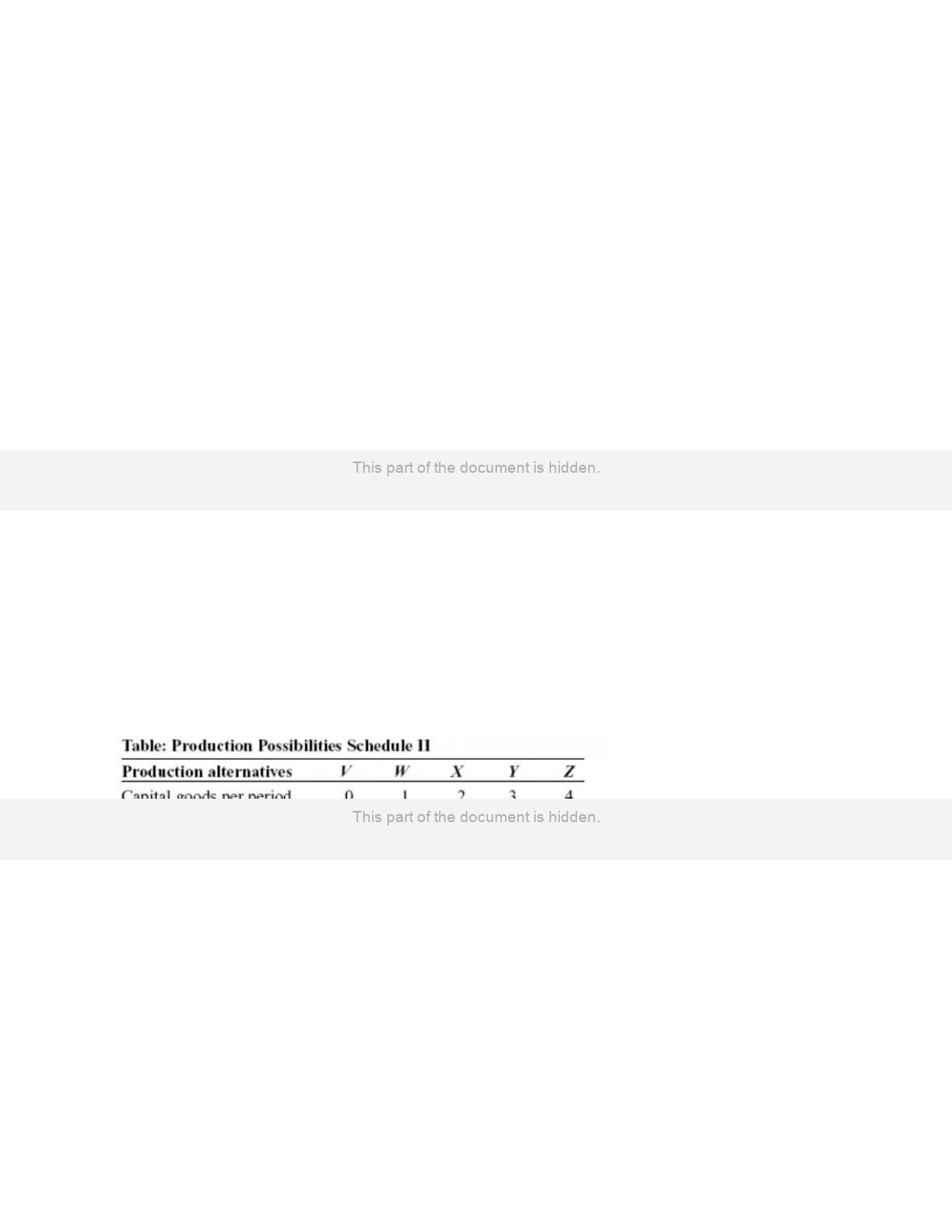
(Table: Production Possibilities Schedule II) Use Table: Production Possibilities
Schedule II. If the economy is producing at Y, the opportunity cost of producing at Z is
_____ units of consumer goods per period.
A)
1
B)
6
C)
8
D)
14
Page 25
98.
(Table: Production Possibilities Schedule II) Use Table: Production Possibilities
Schedule II. If an economy is producing at X, the opportunity cost to it of producing at Y
is _____ units of consumer goods per period.
A)
2
B)
1
C)
6
D)
18
99.
(Table: Production Possibilities Schedule II) Use Table: Production Possibilities
Schedule II. The production of 8 units of consumer goods and 2 units of capital goods
per period would result in:
A)
full employment.
B)
no unused resources.
C)
some unused or inefficiently used resources.
D)
increased economic growth.
Use the following to answer questions 100-101:
\\
100.
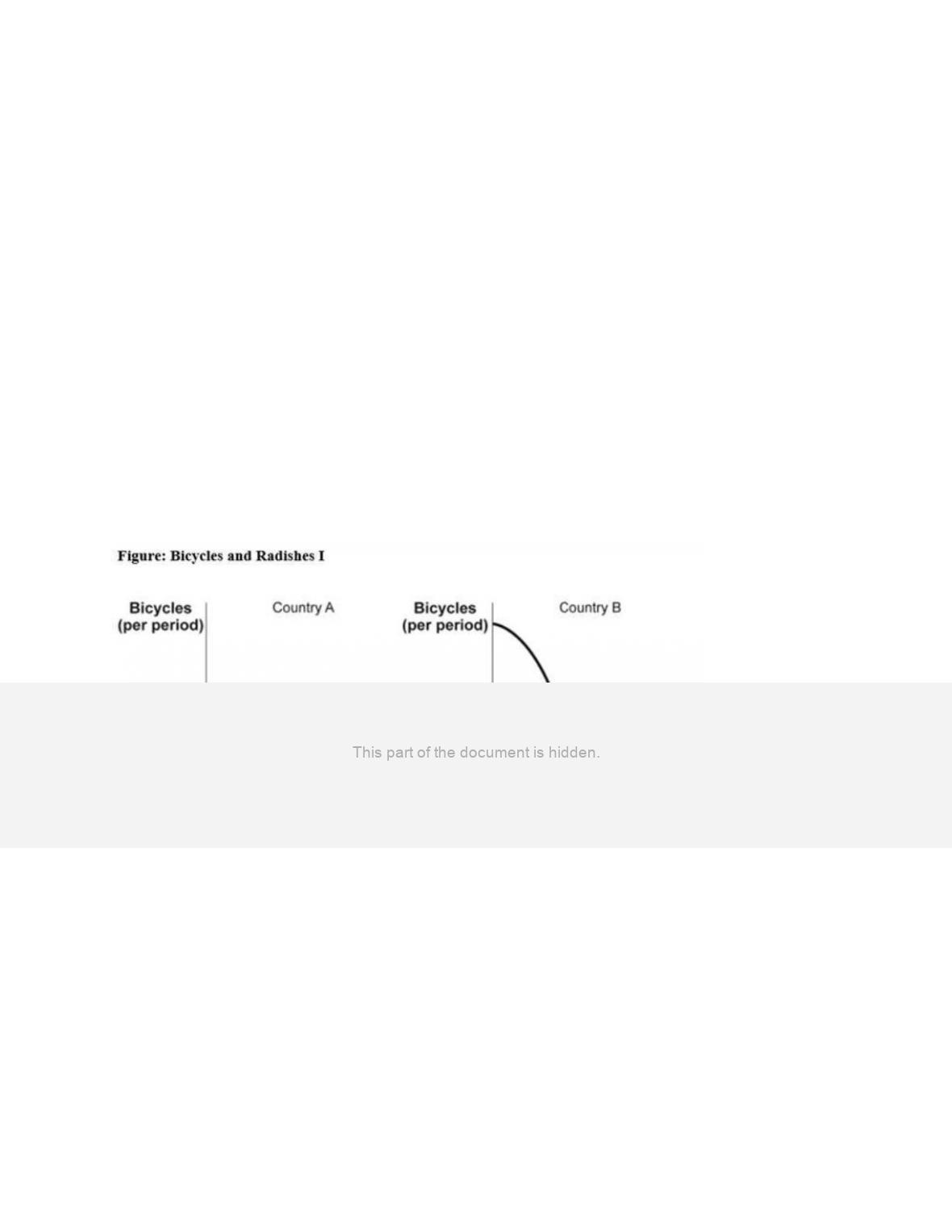
(Figure: Bicycles and Radishes I) Use Figure: Bicycles and Radishes I. The figure
shows the production possibility frontiers for two countries that produce only radishes
and bicycles. The axes of the two graphs are measured in equivalent units. Country A is
operating at point M, and country B is operating at point N. The opportunity cost of
producing an additional ton of radishes would be greater in:
A)
country A.
B)
country B.
C)
neither; the opportunity cost would be the same in both countries.
D)
There is not enough information to answer the question.
Page 26
101.
(Figure: Bicycles and Radishes I) Use Figure: Bicycles and Radishes I. The figure
shows production possibility frontiers for two countries that produce only radishes and
bicycles. The axes of the two graphs are measured in equivalent units. Country A is
operating at point M, and country B is operating at point N. Suppose country A
discovers a new technology that greatly increases its ability to produce bicycles but has
no effect on its ability to produce radishes. This would:
A)
lower the opportunity cost of producing radishes in country A.
B)
increase the opportunity cost of producing radishes in country A.
C)
not affect the opportunity cost of producing radishes in country A.
D)
increase the opportunity cost of producing radishes in country B.
Use the following to answer question 102:
\\
102.
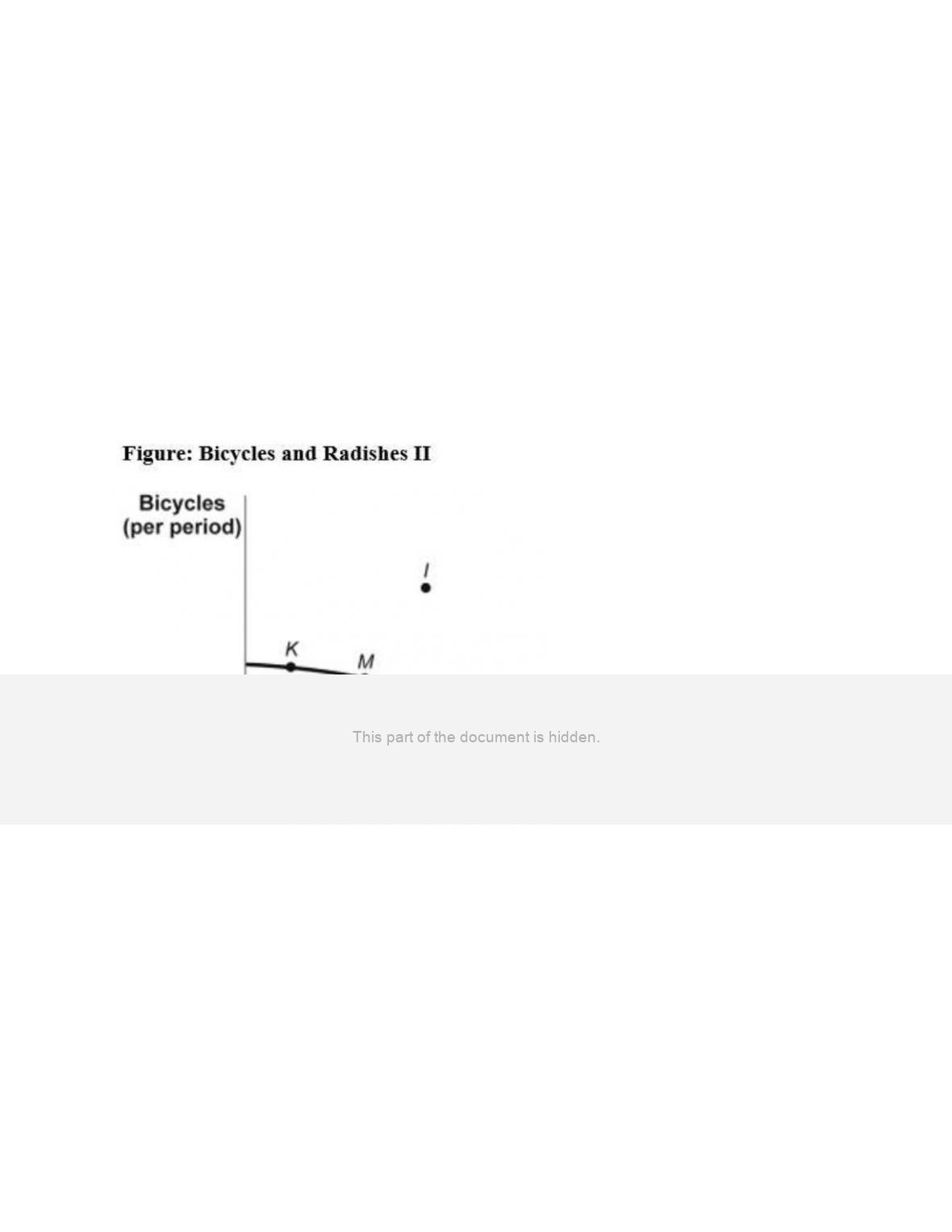
(Figure: Bicycles and Radishes II) Use Figure: Bicycles and Radishes II. The country
depicted in this figure is operating at point M. It could achieve production at point I only
if it:
A)
used its resources more efficiently.
B)
devoted more resources to radish production.
C)
devoted more resources to bicycle production.
D)
increased the quantities of capital, natural resources, or labor available or improved
its technology.
Page 27
Use the following to answer questions 103-104:
103.
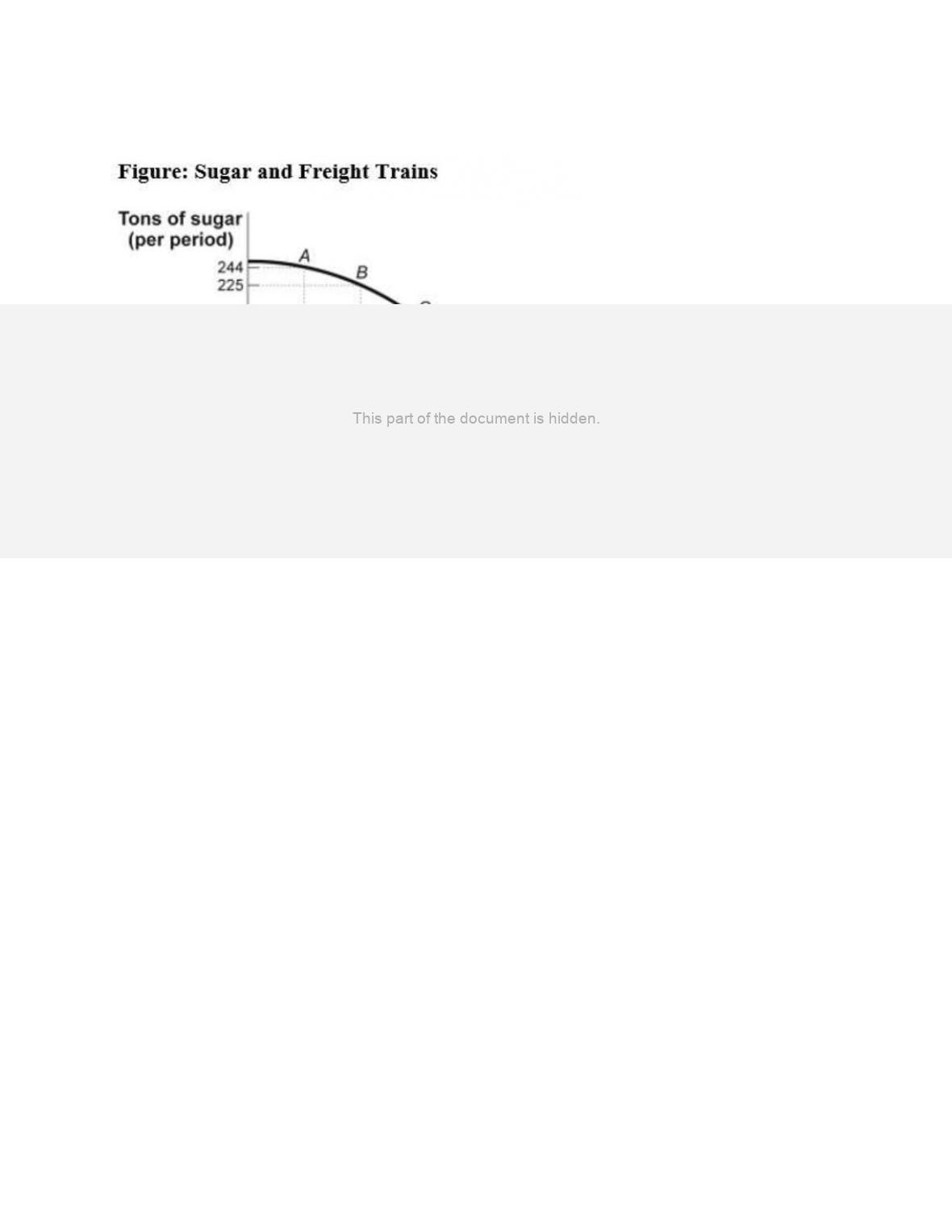
(Figure: Sugar and Freight Trains) Use Figure: Sugar and Freight Trains. Suppose the
economy is operating at point B. The opportunity cost of producing the third freight
train would be _____ tons of sugar.
A)
6
B)
19
C)
45
D)
80
104.
(Figure: Sugar and Freight Trains) Use Figure: Sugar and Freight Trains. Suppose the
economy is operating at point C. The opportunity cost of producing the fourth freight
train would be:
A)
19 tons of sugar.
B)
45 tons of sugar.
C)
80 tons of sugar.
D)
3 freight trains.
Page 28
Use the following to answer questions 105-109:
\\
105.
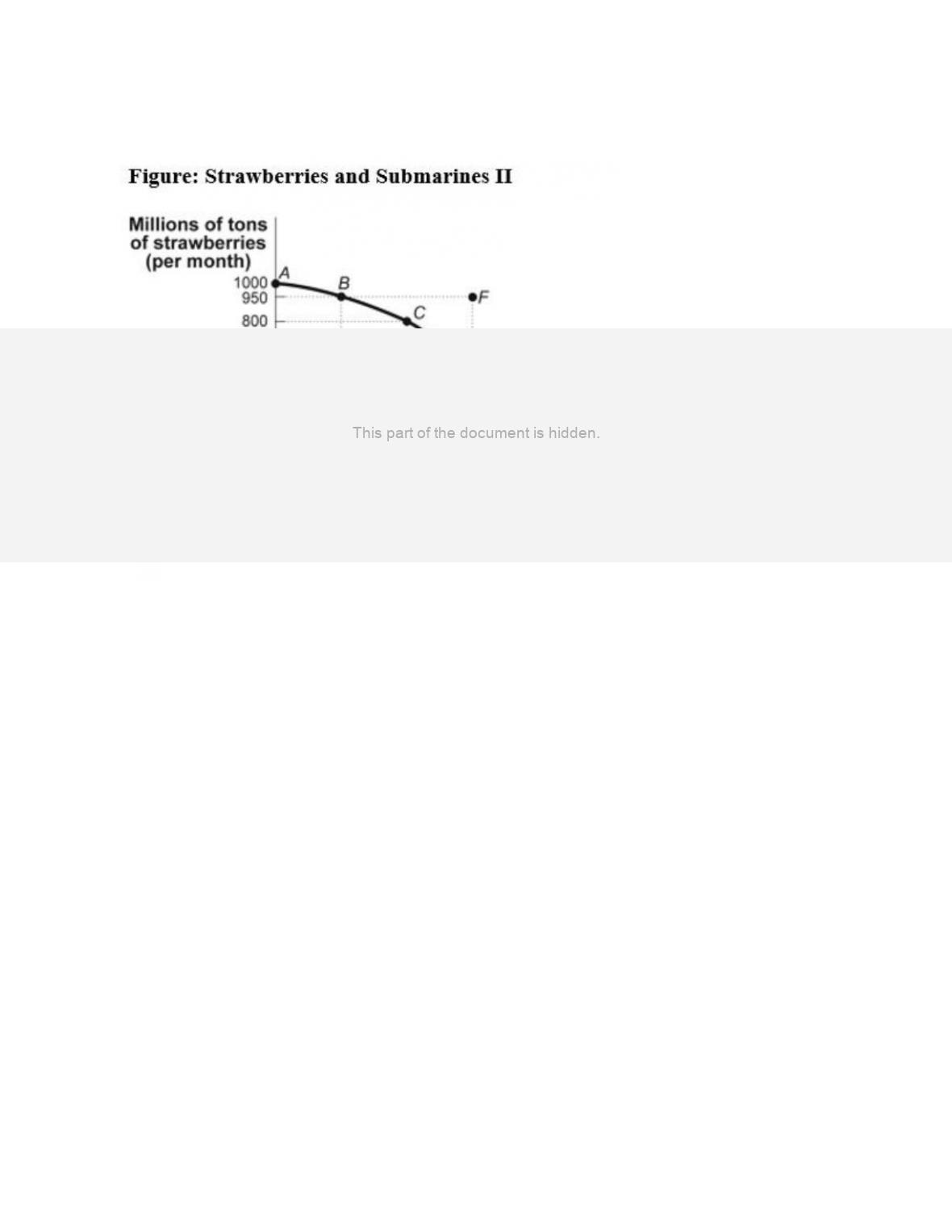
(Figure: Strawberries and Submarines II) Use Figure: Strawberries and Submarines II.
Point F is:
A)
unattainable, all other things unchanged.
B)
attainable if the quantity and/or quality of factors decreases.
C)
attainable if the economy is able to reach full employment.
D)
feasible but not efficient.
106.
(Figure: Strawberries and Submarines II) Use Figure: Strawberries and Submarines II.
Suppose the economy is operating at point A. The first submarine, which is achieved at
point B, would have an opportunity cost of _____ million tons of strawberries.
==
A)
50
B)
150
C)
400
D)
950
Page 29
107.
(Figure: Strawberries and Submarines II) Use Figure: Strawberries and Submarines II.
Assume that the economy is operating at point A. The opportunity cost of moving to
point C is equal to _____ million tons of strawberries:
A)
800
B)
200
C)
2
D)
50
108.
(Figure: Strawberries and Submarines II) Use Figure: Strawberries and Submarines II.
The downward slope of the production possibility frontier implies that resources:
A)
must be used efficiently.
B)
are scarce.
C)
should not be wasted.
D)
should be allocated so that approximately equal amounts of both goods are
produced.
109.
(Figure: Strawberries and Submarines II) Use Figure: Strawberries and Submarines II.
Suppose the economy is operating at point B. Achieving production at point F would
require that the economy:
A)
achieve full employment and an efficient allocation of resources.
B)
reduce its production of strawberries.
C)
reduce its production of submarines.
D)
improve its technology or increase its resources.
110.
Efficient production occurs when the economy is _____ its production possibility
frontier.
A)
operating inside
B)
operating on
C)
operating outside
D)
moving beyond
111.
Assume an economy is operating on its production possibility frontier, which shows the
production of military and civilian goods. If the output of military goods is increased,
the output of civilian goods:
A)
will increase, too.
B)
will not change.
C)
must decrease.
D)
may increase or decrease.
Page 30
112.
The process observed when an economy’s production possibility frontier shifts outward
is:
A)
comparative advantage.
B)
economic growth.
C)
full employment.
D)
specialization.
113.
Increases in resources or improvements in technology will tend to cause a society’s
production possibility frontier to:
A)
shift inward.
B)
shift outward.
C)
remain unchanged.
D)
become vertical.
Use the following to answer questions 114-116:
\\

Page 31
114.
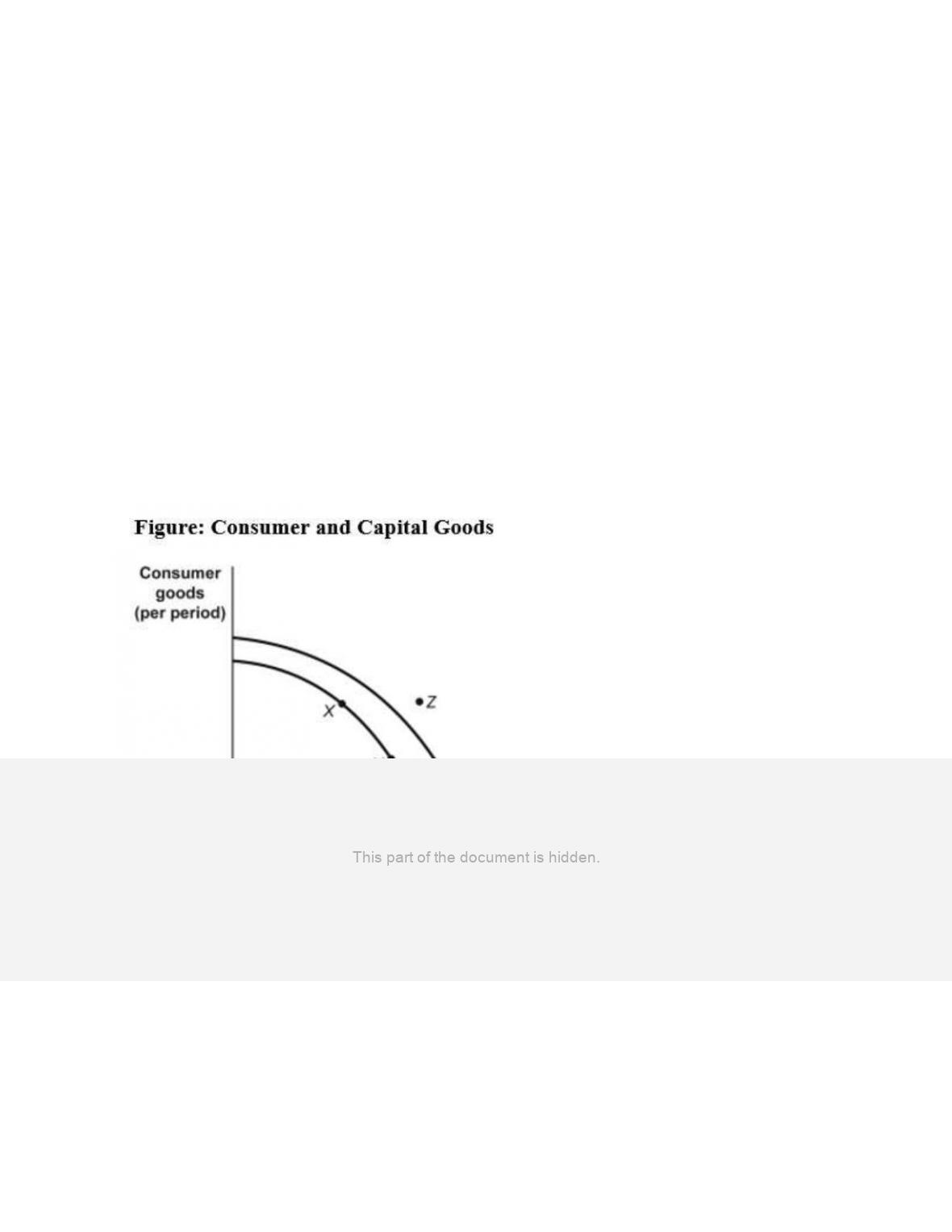
(Figure: Consumer and Capital Goods) Use Figure: Consumer and Capital Goods. If the
economy is operating at point Y and its relevant production possibility frontier is curve
1:
A)
the economy is at full employment and is efficient.
B)
the economy is less than fully employed.
C)
the economy is not efficient.
D)
economic growth is not possible in the future.
115.
(Figure: Consumer and Capital Goods) Use Figure: Consumer and Capital Goods. The
movement from curve 1 to curve 2 indicates a(n):
A)
growing ability of the economy to produce capital and consumer goods.
B)
increase in the stock market.
C)
decrease in the factors of production.
D)
shift of the production possibility frontier toward producing fewer goods.
116.
(Figure: Consumer and Capital Goods) Use Figure: Consumer and Capital Goods.
Technological improvements will likely:
A)
shift the production possibility frontier inward to curve 1.
B)
shift the production possibility frontier outward to curve 2.
C)
lead to increased unemployment.
D)
leave the production possibility frontier unchanged.
117.
Abe starts exercising regularly, and after a few months he can do twice as much of
everything. In a single day, Abe can now make 10 hamburgers or 8 milkshakes, rather
than the 5 hamburgers and 4 milkshakes he made in the past. We now know that Abe’s
production possibility frontier has _____, but his opportunity costs of making
milkshakes have _____.
A)
shifted right; not changed
B)
shifted right; decreased
C)
not changed; increased
D)
not changed; decreased
118.
When a nation’s economy grows:
A)
its production possibility frontier shifts outward.
B)
its production possibility frontier shifts inward.
C)
it has been able to reach full employment.
D)
it has moved to a more consumer-oriented position on its production possibility
frontier.

Page 32
119.
As long as people have different _____, everyone has a comparative advantage in
something.
A)
direct costs
B)
benefits
C)
utility
D)
opportunity costs
120.
Because of trade, a country may:
A)
consume outside its production possibility frontier.
B)
consume inside its production possibility frontier.
C)
find its production possibility frontier shifting outward.
D)
avoid opportunity costs.
121.
An economy is said to have a comparative advantage if it:
A)
can produce more of all goods than another economy.
B)
can produce fewer of all goods than another economy.
C)
has the highest cost of producing a particular good, compared with other
economies.
D)
has the lowest cost of producing a particular good, compared with other economies.
122.
The economy with the LOWEST opportunity cost of producing a particular good is said
to have a(n):
A)
technological advantage.
B)
comparative advantage.
C)
production possibility frontier.
D)
increasing opportunity cost.
123.
An economy is said to have a comparative advantage in the production of a good if it
can produce that good:
A)
with more resources than another economy.
B)
with a higher opportunity cost than another economy.
C)
outside its production possibilities curve.
D)
at a lower opportunity cost than another economy.
Page 33
Use the following to answer question 124:
\\
124.
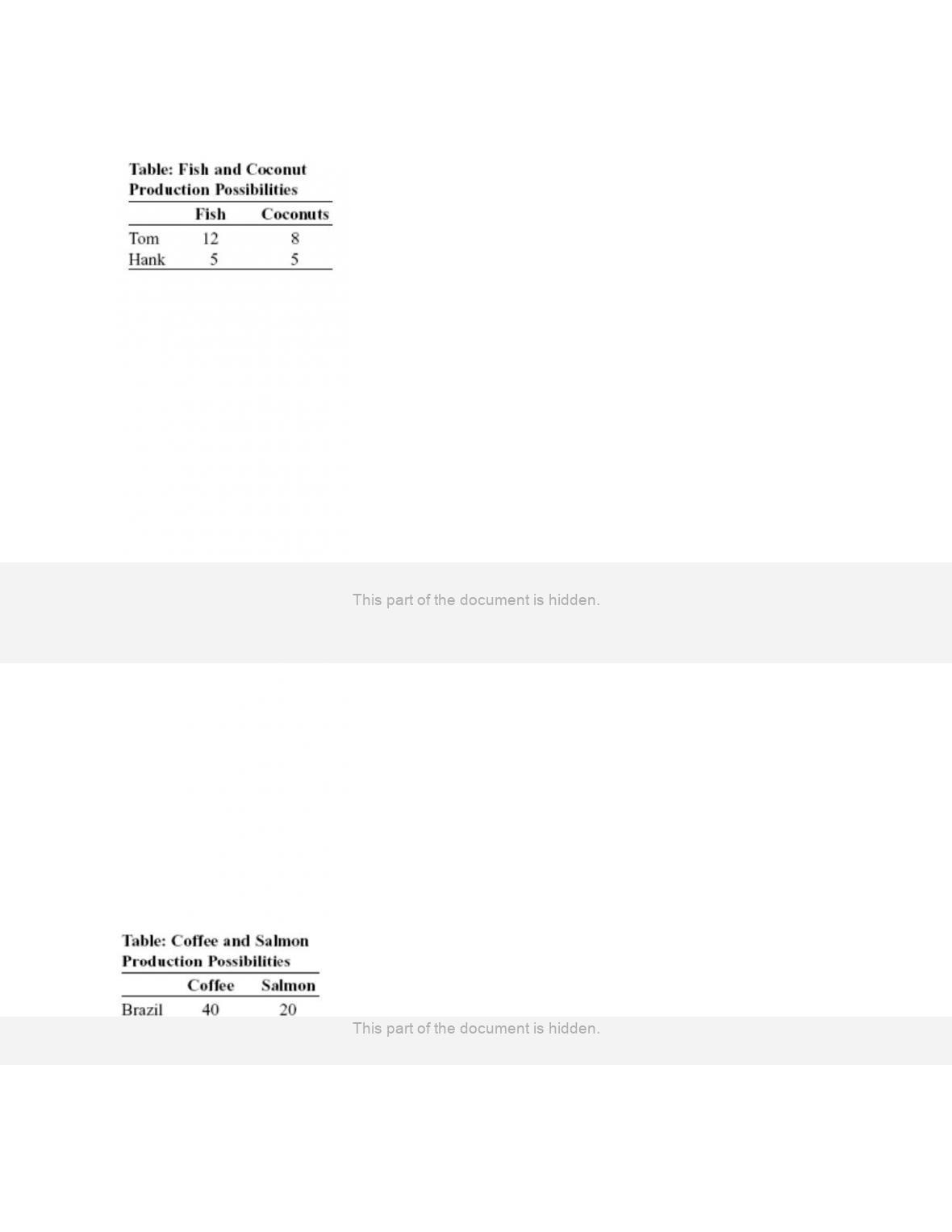
(Table: Fish and Coconut Production Possibilities) Use Table: Fish and Coconut
Production Possibilities. The table shows the maximum number of fish and coconuts
that Tom and Hank can produce if they produce only one good. In the absence of trade,
Tom produces and consumes 9 fish and 2 coconuts, and Hank produces and consumes 3
fish and 2 coconuts. Now they decide to engage in trade. Which statement is
INCORRECT?
A)
For both to become better off, each should specialize in the production of some
good. However, since Hank is equally productive in both goods, it doesn’t matter
which good each specializes in.
B)
For both to become better off, each should specialize completely in the production
of the good in which he has a comparative advantage.
C)
After trade, it is possible for Tom to consume 9 fish and 2.5 coconuts and for Hank
to consume 3 fish and 2.5 coconuts.
D)
For each individual, the consumption point after trade will lie outside that
individual’s production possibility frontier.
125.
In one hour, the United States can produce 25 tons of steel or 250 automobiles. In one
hour, Japan can produce 30 tons of steel or 275 automobiles. This information implies
that:
A)
Japan has a comparative advantage in the production of automobiles.
B)
the United States has an absolute advantage in the production of steel.
C)
Japan has a comparative advantage in the production of both goods.
D)
the United States has a comparative advantage in the production of automobiles.
Use the following to answer questions 126-127:
\\

Page 34
126.
(Table: Coffee and Salmon Production Possibilities) Use Table: Coffee and Salmon
Production Possibilities. The table shows the maximum amounts of coffee and salmon
that Brazil and Alaska can produce if they just produce one good. The opportunity cost
of producing 1 unit of coffee for Brazil is _____ salmon.
A)
2
B)
0.25
C)
1
D)
0.5
127.
(Table: Coffee and Salmon Production Possibilities) Use Table: Coffee and Salmon
Production Possibilities. The table shows the maximum amounts of coffee and salmon
that Brazil and Alaska can produce if they just produce one good. The opportunity cost
of producing 1 unit of salmon for Alaska is _____ coffee(s).
A)
2
B)
0.25
C)
1
D)
0.5
128.
Free trade between countries:
A)
should be based on absolute advantage.
B)
always involves wealthy countries exploiting less developed nations.
C)
will shift the domestic production possibility frontier to the right.
D)
will allow for greater levels of consumption than without trade.
129.
If they spend all night writing computer programs, Laurence can write 10 programs, and
Carrie Anne can write 5. If they spend all night making sunglasses, Laurence can make
6 pairs, and Carrie Anne can make 4. Given this information and supposing Laurence
and Carrie Anne have constant opportunity costs, we know that _____ has an absolute
advantage in _____.
A)
Laurence; programs but not in sunglasses.
B)
Laurence; both programs and sunglasses.
C)
Carrie Anne; programs but not in sunglasses.
D)
Carrie Anne; both programs and sunglasses.

Page 35
130.
If they spend all night writing computer programs, Laurence can write 10 programs, and
Carrie Anne can write 5. If they spend all night making sunglasses, Laurence can make
6 pairs, and Carrie Anne can make 4. We know that:
A)
Laurence’s opportunity cost of writing programs is less than Carrie Anne’s.
B)
Laurence’s opportunity costs of writing programs and of making sunglasses are less
than Carrie Anne’s.
C)
Carrie Anne’s opportunity costs of writing programs and of making sunglasses are
less than Laurence’s.
D)
Carrie Anne’s opportunity cost of writing programs is less than Laurence’s.
131.
If they spend all night writing computer programs, Laurence can write 10 programs, and
Carrie Anne can write 5. If they spend all night making sunglasses, Laurence can make
6 pairs, and Carrie Anne can make 4. We know that _____ has a comparative advantage
in _____.
A)
Laurence; programs
B)
Laurence; both programs and sunglasses
C)
Carrie Anne; programs
D)
Carrie Anne; both programs and sunglasses
132.
Which statement is TRUE?
A)
Some very talented people have a comparative advantage in everything they do.
B)
Some very untalented people have a comparative advantage in nothing they do.
C)
Some very talented people have a very low opportunity cost in everything they do.
D)
It is possible to have an absolute disadvantage but a comparative advantage in
something.
133.
In a single day, Sarah can produce 10 hamburgers, and Abe can produce 5 hamburgers.
Therefore, _____ has a(n) _____ advantage in making hamburgers.
A)
Sarah; comparative
B)
Sarah; absolute
C)
Abe; comparative
D)
Abe; absolute
134.
If they produce only hamburgers, in a single day Sarah can produce 10 hamburgers, and
Abe can produce 5 hamburgers. If they make milkshakes only, in a single day Sarah can
produce 10 milkshakes, and Abe can produce 4 milkshakes. Therefore, _____ has an
absolute advantage and a comparative advantage in making _____.
A)
Sarah; hamburgers.
B)
Sarah; milkshakes.
C)
Abe; hamburgers.
D)
Abe; milkshakes.
Page 36
135.
Roommates Sarah and Zoe are hosting a Halloween party and have to make food for
their guests and costumes for themselves. To finish both tasks as quickly as possible,
Sarah and Zoe know that each of them should focus on just one task, but they don’t
know who should do what. Sarah and Zoe should determine which roommate:
A)
has the absolute advantage in cooking.
B)
has the comparative advantage in cooking.
C)
can cook the most in a given amount of time.
D)
can complete the cooking in the least amount of time.
136.
Economists generally believe that a country should specialize in the production of a
good or service if the:
A)
production possibility frontier is further from the origin than that of any other
country.
B)
production possibility frontier is closer to the origin than that of any other country.
C)
country can produce the product using more resources than any other country.
D)
country can produce the product while forgoing fewer alternative products than any
other country.
Use the following to answer questions 137-139:
137.
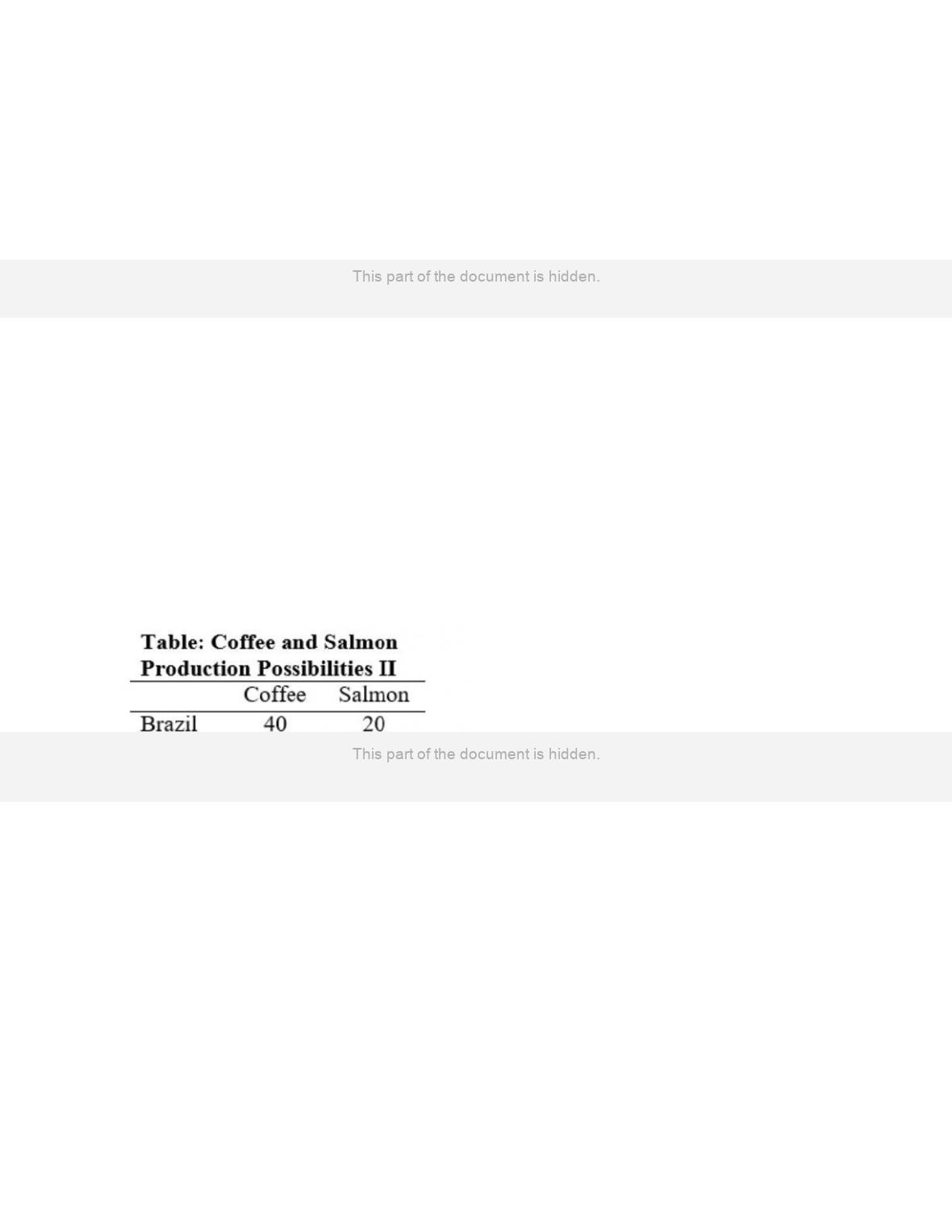
(Table: Coffee and Salmon Production Possibilities II) Use Table: Coffee and Salmon
Production Possibilities II. This table shows the maximum amounts of coffee and
salmon, both measured in pounds, that Brazil and Alaska can produce if they just
produce one good. Brazil has an absolute advantage in producing:
A)
coffee only.
B)
salmon only.
C)
both coffee and salmon.
D)
neither coffee nor salmon.

Page 37
138.
(Table: Coffee and Salmon Production Possibilities II) Use Table: Coffee and Salmon
Production Possibilities II. This table shows the maximum amounts of coffee and
salmon, both measured in pounds, that Brazil and Alaska can produce if they just
produce one good. Alaska has an absolute advantage in producing:
A)
coffee only.
B)
salmon only.
C)
both coffee and salmon.
D)
neither coffee nor salmon.
139.
(Table: Coffee and Salmon Production Possibilities II) Use Table: Coffee and Salmon
Production Possibilities II. This table shows the maximum amounts of coffee and
salmon, both measured in pounds, that Brazil and Alaska can produce if they just
produce one good. Brazil has a comparative advantage in producing:
A)
coffee only.
B)
salmon only.
C)
both coffee and salmon.
D)
neither coffee nor salmon
140.
An economy is said to have a comparative advantage in the production of one good if it:
A)
can produce more of all goods than another economy.
B)
can produce fewer of all goods than another economy.
C)
has the highest opportunity cost of producing a particular good.
D)
has the lowest opportunity cost of producing a particular good.
141.
An economy that has the LOWEST opportunity cost of producing a particular good is
said to have a(n):
A)
absolute advantage in production of that good.
B)
comparative advantage in production of that good.
C)
production possibility frontier.
D)
increasing opportunity cost in production of that good.
142.
The concept of comparative advantage is based on:
A)
absolute labor productivity.
B)
relative labor costs.
C)
dollar prices of labor.
D)
relative opportunity costs.

Page 38
143.
An economy is said to have a comparative advantage in the production of a good if it
can produce that good:
A)
with more resources than another economy.
B)
at a higher opportunity cost than another economy.
C)
outside its production possibility frontier.
D)
at a lower opportunity cost than another economy.
144.
If the opportunity cost of manufacturing machinery is lower in the United States than in
Britain and the opportunity cost of manufacturing sweaters is higher in the United States
than in Britain, then the United States will:
A)
export both sweaters and machinery to Britain.
B)
import both sweaters and machinery from Britain.
C)
export sweaters to Britain and import machinery from Britain.
D)
import sweaters from Britain and export machinery to Britain.
145.
If the opportunity cost of manufacturing machinery is higher in the United States than in
Britain and the opportunity cost of manufacturing sweaters is lower in the United States
than in Britain, then the United States will:
A)
export both sweaters and machinery to Britain.
B)
import both sweaters and machinery from Britain.
C)
export sweaters to Britain and import machinery from Britain.
D)
import sweaters from Britain and export machinery to Britain.
146.
Trade can be beneficial to an economy because:
A)
it results in a more efficient use of the combined resources of some of the trading
countries, even though it reduces efficiency in others.
B)
more goods and services can be obtained at lower opportunity cost.
C)
it prevents specialization in activities in which countries have a comparative
advantage.
D)
it eliminates unemployment.
147.
If Brazil gives up three automobiles for each ton of coffee it produces, while Peru gives
up seven automobiles for each ton of coffee it produces, then Brazil has a comparative
advantage in _____ production and should specialize in _____.
A)
automobile; coffee
B)
coffee; automobiles
C)
coffee; coffee
D)
automobile; automobiles
Page 39
148.
If countries engage in international trade:
A)
they give up the ability to specialize in production.
B)
worldwide levels of production are lower.
C)
they can consume inside their production possibility frontiers.
D)
they can consume outside their production possibility frontiers.
Use the following to answer questions 149-156:
\\
149.
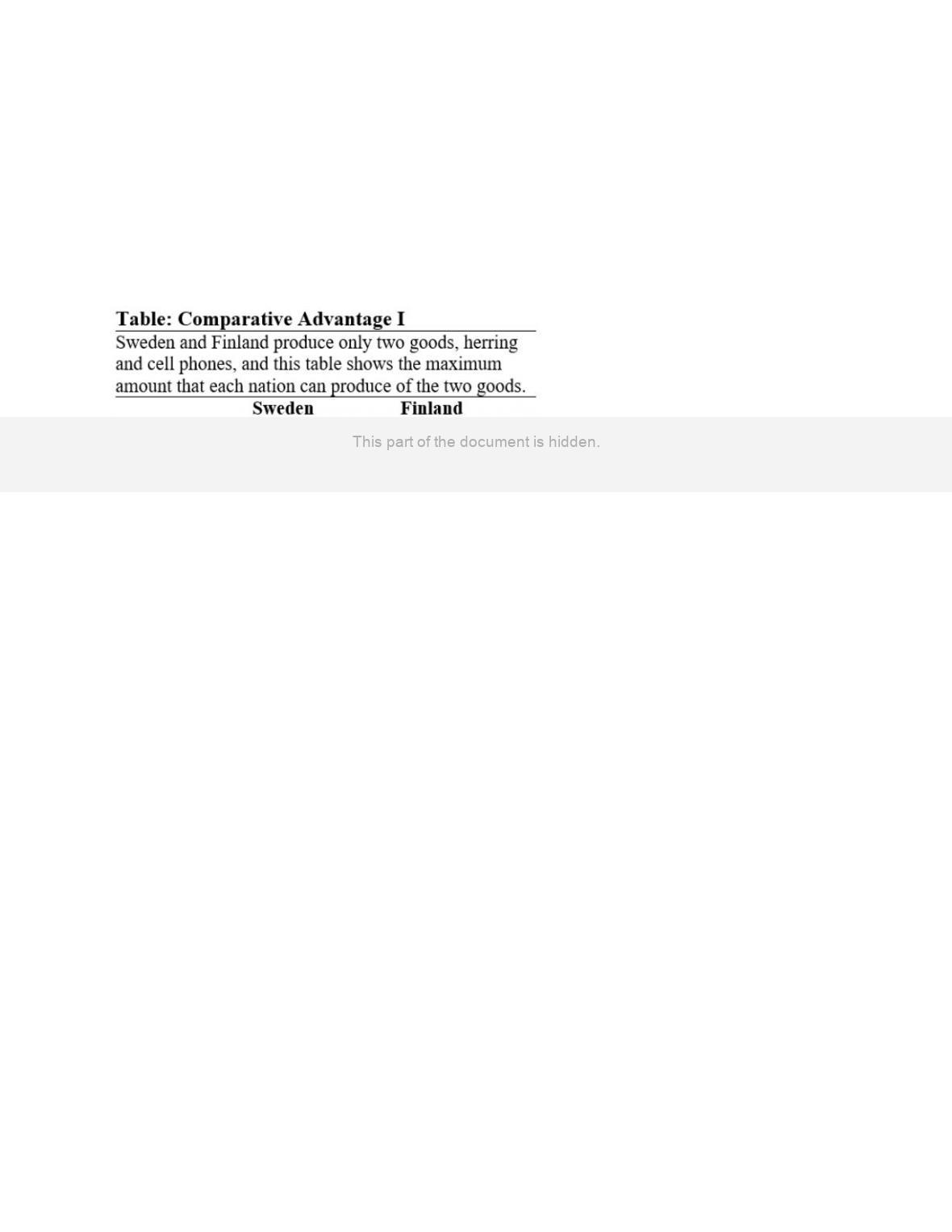
(Table: Comparative Advantage I) Use Table: Comparative Advantage I. Sweden has an
absolute advantage in producing:
A)
cell phones only.
B)
herring only.
C)
both cell phones and herring.
D)
neither cell phones nor herring.
150.
(Table: Comparative Advantage I) Use Table: Comparative Advantage I. Finland has an
absolute advantage in producing:
A)
cell phones only.
B)
herring only.
C)
both cell phones and herring.
D)
neither cell phones nor herring.
151.
(Table: Comparative Advantage I) Use Table: Comparative Advantage I. Sweden has a
comparative advantage in producing:
A)
cell phones only.
B)
herring only.
C)
both cell phones and herring.
D)
neither cell phones nor herring.
Page 40
152.
(Table: Comparative Advantage I) Use Table: Comparative Advantage I. Finland has a
comparative advantage in producing:
A)
cell phones only.
B)
herring only.
C)
both cell phones and herring.
D)
neither cell phones nor herring.
153.
(Table: Comparative Advantage I) Use Table: Comparative Advantage I. The
opportunity cost of producing 1 box of cell phones for Sweden is _____ box(es) of
herring.
A)
10
B)
0.2
C)
5
D)
0.1
154.
(Table: Comparative Advantage I) Use Table: Comparative Advantage I. The
opportunity cost of producing 1 box of cell phones for Finland is _____ box(es) of
herring.
A)
10
B)
0.5
C)
5
D)
0.1
155.
(Table: Comparative Advantage I) Use Table: Comparative Advantage I. The
opportunity cost of producing 1 box of herring for Sweden is _____ box(es) of cell
phones.
A)
10
B)
0.5
C)
5
D)
0.1
156.
(Table: Comparative Advantage I) Use Table: Comparative Advantage I. The
opportunity cost of producing 1 box of herring for Finland is _____ box(es) of cell
phones.
A)
10
B)
0.2
C)
5
D)
0.1