
Page 61
262.
(Table: Variable Costs for Lots) Use Table: Variable Costs for Lots. During the winter,
Alexa runs a snow-clearing service in a perfectly competitive industry. Assume that
costs are constant in each interval; so, for example, the marginal cost of clearing each of
the lots from 1 through 10 is $20. Also assume that she can only plow the quantities of
the lots given in the table (and not numbers in between). Her only fixed cost is $1,000
for a snowplow. Her variable costs include fuel, her time, and hot coffee. If the price per
cleared lot is $14, how many lots should Alexa clear?
A)
0
B)
40
C)
50
D)
20
263.
(Table: Variable Costs for Lots) Use Table: Variable Costs for Lots. During the winter,
Alexa runs a snow-clearing service in a perfectly competitive industry. Assume that
costs are constant in each interval; so, for example, the marginal cost of clearing each of
the lots from 1 through 10 is $20. Also assume that she can only plow the quantities of
the lots given in the table (and not numbers in between). Her only fixed cost is $1,000
for a snowplow. Her variable costs include fuel, her time, and hot coffee. If the price to
clear a lot is $60, how many lots should Alexa clear?
A)
50
B)
40
C)
30
D)
20
264.
(Table: Variable Costs for Lots) Use Table: Variable Costs for Lots. During the winter,
Alexa runs a snow-clearing service in a perfectly competitive industry. Assume that
costs are constant in each interval; so, for example, the marginal cost of clearing each of
the lots from 1 through 10 is $20. Also assume that she can only plow the quantities of
the lots given in the table (and not numbers in between). Her only fixed cost is $1,000
for a snowplow. Her variable costs include fuel, her time, and hot coffee. If the price to
clear a lot is $60, what is Alexa’s profit or loss at the optimal output?
A)
$3,000
B)
$1,100
C)
$900
D)
$3,850

Page 62
265.
(Table: Variable Costs for Lots) Use Table: Variable Costs for Lots. During the winter,
Alexa runs a snow-clearing service in a perfectly competitive industry. Assume that
costs are constant in each interval; so, for example, the marginal cost of clearing each of
the lots from 1 through 10 is $20. Also assume that she can only plow the quantities of
the lots given in the table (and not numbers in between). Her only fixed cost is $1,000
for a snowplow. Her variable costs include fuel, her time, and hot coffee. If the price to
clear a lot is $60, what is Alexa’s profit per unit at the optimal output?
A)
$60
B)
$42
C)
$35
D)
$18
266.
(Table: Variable Costs for Lots) Use Table: Variable Costs for Lots. During the winter,
Alexa runs a snow-clearing service in a perfectly competitive industry. Assume that
costs are constant in each interval; so, for example, the marginal cost of clearing each of
the lots from 1 through 10 is $20. Also assume that she can only plow the quantities of
the lots given in the table (and not numbers in between). Her only fixed cost is $1,000
for a snowplow. Her variable costs include fuel, her time, and hot coffee. If the price to
clear a lot is $30, how many lots should Alexa clear?
A)
50
B)
40
C)
30
D)
0
267.
(Table: Variable Costs for Lots) Use Table: Variable Costs for Lots. During the winter,
Alexa runs a snow-clearing service in a perfectly competitive industry. Assume that
costs are constant in each interval; so, for example, the marginal cost of clearing each of
the lots from 1 through 10 is $20. Also assume that she can only plow the quantities of
the lots given in the table (and not numbers in between). Her only fixed cost is $1,000
for a snowplow. Her variable costs include fuel, her time, and hot coffee. If the price to
clear a lot is $30, what is Alexa’s profit at the optimal output?
A)
$1,200
B)
$450
C)
$0
D)
–$550

Page 63
268.
(Table: Variable Costs for Lots) Use Table: Variable Costs for Lots. During the winter,
Alexa runs a snow-clearing service in a perfectly competitive industry. Assume that
costs are constant in each interval; so, for example, the marginal cost of clearing each of
the lots from 1 through 10 is $20. Also assume that she can only plow the quantities of
the lots given in the table (and not numbers in between). Her only fixed cost is $1,000
for a snowplow. Her variable costs include fuel, her time, and hot coffee. If the price to
clear a lot is $30, what is Alexa’s profit per unit at the optimal output?
A)
–$13.75
B)
$720
C)
$0
D)
–$12.25
269.
(Table: Variable Costs for Lots) Use Table: Variable Costs for Lots. During the winter,
Alexa runs a snow-clearing service in a perfectly competitive industry. Assume that
costs are constant in each interval; so, for example, the marginal cost of clearing each of
the lots from 1 through 10 is $20. Also assume that she can only plow the quantities of
the lots given in the table (and not numbers in between). Her only fixed cost is $1,000
for a snowplow. Her variable costs include fuel, her time, and hot coffee. At what price
does Alexa’ s short-run supply curve start?
A)
$200
B)
$15
C)
$50
D)
$42
270.
(Table: Variable Costs for Lots) Use Table: Variable Costs for Lots. During the winter,
Alexa runs a snow-clearing service in a perfectly competitive industry. Assume that
costs are constant in each interval; so, for example, the marginal cost of clearing each of
the lots from 1 through 10 is $20. Also assume that she can only plow the quantities of
the lots given in the table (and not numbers in between). Her only fixed cost is $1,000
for a snowplow. Her variable costs include fuel, her time, and hot coffee. Which point
falls on Alexa’s short-run supply curve?
A)
P = $40, Q = 10
B)
P = $10, Q = 200
C)
P = $25, Q = 40
D)
P = $16, Q = 0
Page 64
271.
(Table: Variable Costs for Lots) Use Table: Variable Costs for Lots. During the winter,
Alexa runs a snow-clearing service in a perfectly competitive industry, which is made
up of 50 identical firms. Assume that costs are constant in each interval; so, for
example, the marginal cost of clearing each of the lots from 1 through 10 is $20. Also
assume that she can only plow the quantities of the lots given in the table (and not
numbers in between). Her only fixed cost is $1,000 for a snowplow. Her variable costs
include fuel, her time, and hot coffee. Which point falls on the industry short-run supply
curve?
A)
P = $40, Q = 60
B)
P = $10, Q = 10,000
C)
P = $25, Q = 2,000
D)
P = $25, Q = 40
Use the following to answer questions 272-289:
272.
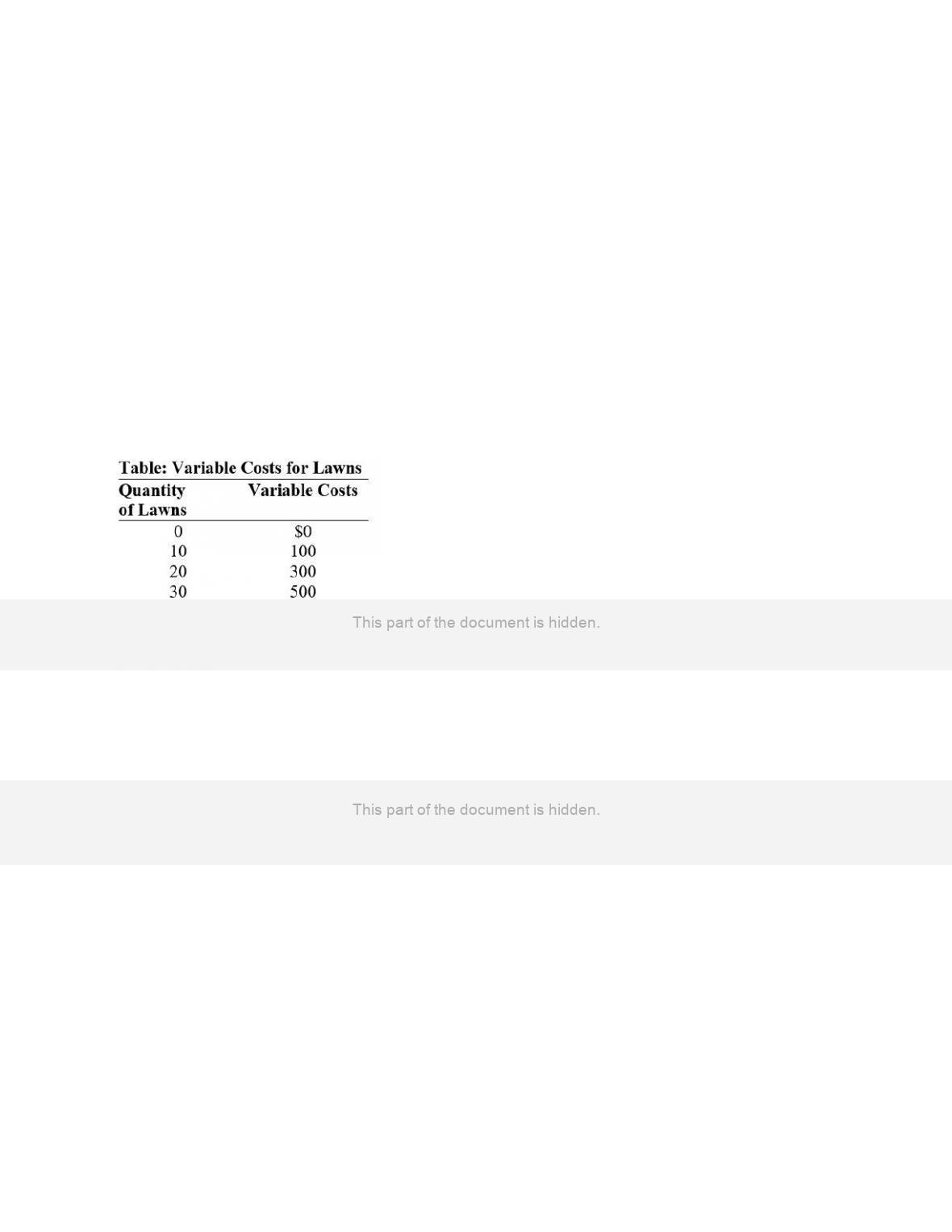
(Table: Variable Costs for Lawns) Use Table: Variable Costs for Lawns. During the
summer, Alex runs a lawn-mowing service in a perfectly competitive industry. Assume
that costs are constant in each interval; so, for example, the marginal cost of mowing
each of the lawns from 1 through 10 is $10. Also assume that he can only mow the
quantities of lawn given in the table (and not numbers in between). His only fixed cost
is $1,000 for the mower. His variable costs include fuel, his time, and mower parts.
What is Alex’s break-even price?
A)
$100.00
B)
$10.00
C)
$50.00
D)
$27.50

Page 65
273.
(Table: Variable Costs for Lawns) Use Table: Variable Costs for Lawns. During the
summer, Alex runs a lawn-mowing service, and lawn-mowing is a perfectly competitive
industry. Assume that costs are constant in each interval; so, for example, the marginal
cost of mowing each of the lawns from 1 through 10 is $10. Also assume that he can
only mow the quantities of lawn given in the table (and not numbers in between). His
only fixed cost is $1,000 for the mower. His variable costs include fuel, his time, and
mower parts. If the price for mowing a lawn is $60, how many lawns will Alex mow?
A)
0
B)
20
C)
50
D)
40
274.
(Table: Variable Costs for Lawns) Use Table: Variable Costs for Lawns. During the
summer, Alex runs a lawn-mowing service, and lawn-mowing is a perfectly competitive
industry. Assume that costs are constant in each interval; so, for example, the marginal
cost of mowing each of the lawns from 1 through 10 is $10. Also assume that he can
only mow the quantities of lawn given in the table (and not numbers in between). His
only fixed cost is $1,000 for the mower. His variable costs include fuel, his time, and
mower parts. If the price for mowing a lawn is $60, how much is Alex’s total revenue at
the profit-maximizing output?
A)
$60
B)
$1,100
C)
$2,400
D)
$2,100
275.
(Table: Variable Costs for Lawns) Use Table: Variable Costs for Lawns. During the
summer, Alex runs a lawn-mowing service, and lawn-mowing is a perfectly competitive
industry. Assume that costs are constant in each interval; so, for example, the marginal
cost of mowing each of the lawns from 1 through 10 is $10. Also assume that he can
only mow the quantities of lawn given in the table (and not numbers in between). His
only fixed cost is $1,000 for the mower. His variable costs include fuel, his time, and
mower parts. If the price for mowing a lawn is $60, how much is Alex’s total cost at the
profit-maximizing output?
A)
$60
B)
$1,100
C)
$2,400
D)
$2,100
Page 66
276.
(Table: Variable Costs for Lawns) Use Table: Variable Costs for Lawns. During the
summer, Alex runs a lawn-mowing service, and lawn-mowing is a perfectly competitive
industry. Assume that costs are constant in each interval; so, for example, the marginal
cost of mowing each of the lawns from 1 through 10 is $10. Also assume that he can
only mow the quantities of lawn given in the table (and not numbers in between). His
only fixed cost is $1,000 for the mower. His variable costs include fuel, his time, and
mower parts. If the price for mowing a lawn is $60, how much is Alex’s profit at the
profit-maximizing output?
A)
$10
B)
$2,400
C)
$300
D)
$2,100
277.
(Table: Variable Costs for Lawns) Use Table: Variable Costs for Lawns. During the
summer, Alex runs a lawn-mowing service, and lawn-mowing is a perfectly competitive
industry. Assume that costs are constant in each interval; so, for example, the marginal
cost of mowing each of the lawns from 1 through 10 is $10. Also assume that he can
only mow the quantities of lawn given in the table (and not numbers in between). His
only fixed cost is $1,000 for the mower. His variable costs include fuel, his time, and
mower parts. If the price for mowing a lawn is $60, how much is Alex’s profit per unit
at the profit-maximizing output?
A)
$7.50
B)
$32.50
C)
$20.00
D)
$60.00
278.
(Table: Variable Costs for Lawns) Use Table: Variable Costs for Lawns. During the
summer, Alex runs a lawn-mowing service, and lawn-mowing is a perfectly competitive
industry. Assume that costs are constant in each interval; so, for example, the marginal
cost of mowing each of the lawns from 1 through 10 is $10. Also assume that he can
only mow the quantities of lawn given in the table (and not numbers in between). His
only fixed cost is $1,000 for the mower. His variable costs include fuel, his time, and
mower parts. If the price for mowing a lawn is $40, how many lawns will Alex mow?
A)
0
B)
20
C)
30
D)
40

Page 67
279.
(Table: Variable Costs for Lawns) Use Table: Variable Costs for Lawns. During the
summer, Alex runs a lawn-mowing service, and lawn-mowing is a perfectly competitive
industry. Assume that costs are constant in each interval; so, for example, the marginal
cost of mowing each of the lawns from 1 through 10 is $10. Also assume that he can
only mow the quantities of lawn given in the table (and not numbers in between). His
only fixed cost is $1,000 for the mower. His variable costs include fuel, his time, and
mower parts. If the price for mowing a lawn is $40, how much is Alex’s total revenue at
the profit-maximizing output?
A)
$1,000
B)
$1,200
C)
$500
D)
$1,500
280.
(Table: Variable Costs for Lawns) Use Table: Variable Costs for Lawns. During the
summer, Alex runs a lawn-mowing service, and lawn-mowing is a perfectly competitive
industry. Assume that costs are constant in each interval; so, for example, the marginal
cost of mowing each of the lawns from 1 through 10 is $10. Also assume that he can
only mow the quantities of lawn given in the table (and not numbers in between). His
only fixed cost is $1,000 for the mower. His variable costs include fuel, his time, and
mower parts. If the price for mowing a lawn is $40, how much is Alex’s total cost at the
profit-maximizing output?
A)
$1,000
B)
$1,200
C)
$500
D)
$1,500
281.
(Table: Variable Costs for Lawns) Use Table: Variable Costs for Lawns. During the
summer, Alex runs a lawn-mowing service, and lawn-mowing is a perfectly competitive
industry. Assume that costs are constant in each interval; so, for example, the marginal
cost of mowing each of the lawns from 1 through 10 is $10. Also assume that he can
only mow the quantities of lawn given in the table (and not numbers in between). His
only fixed cost is $1,000 for the mower. His variable costs include fuel, his time, and
mower parts. If the price for mowing a lawn is $40, how much is Alex’s profit at the
profit-maximizing output?
A)
–$10
B)
–$300
C)
$300
D)
–$1,000
Page 68
282.
(Table: Variable Costs for Lawns) Use Table: Variable Costs for Lawns. During the
summer, Alex runs a lawn-mowing service, and lawn-mowing is a perfectly competitive
industry. Assume that costs are constant in each interval; so, for example, the marginal
cost of mowing each of the lawns from 1 through 10 is $10. Also assume that he can
only mow the quantities of lawn given in the table (and not numbers in between). His
only fixed cost is $1,000 for the mower. His variable costs include fuel, his time, and
mower parts. If the price for mowing a lawn is $40, how much is Alex’s profit per unit
at the profit-maximizing output?
A)
–$10.00
B)
$10.00
C)
$23.33
D)
–$20.00
283.
(Table: Variable Costs for Lawns) Use Table: Variable Costs for Lawns. During the
summer, Alex runs a lawn-mowing service, and lawn-mowing is a perfectly competitive
industry. Assume that costs are constant in each interval; so, for example, the marginal
cost of mowing each of the lawns from 1 through 10 is $10. Also assume that he can
only mow the quantities of lawn given in the table (and not numbers in between). His
only fixed cost is $1,000 for the mower. His variable costs include fuel, his time, and
mower parts. If the price for mowing a lawn is $70, how many lawns will Alex mow?
A)
20
B)
30
C)
40
D)
50
284.
(Table: Variable Costs for Lawns) Use Table: Variable Costs for Lawns. During the
summer, Alex runs a lawn-mowing service, and lawn-mowing is a perfectly competitive
industry. Assume that costs are constant in each interval; so, for example, the marginal
cost of mowing each of the lawns from 1 through 10 is $10. Also assume that he can
only mow the quantities of lawn given in the table (and not numbers in between). His
only fixed cost is $1,000 for the mower. His variable costs include fuel, his time, and
mower parts. If the price for mowing a lawn is $70, how much is Alex’s total revenue at
the profit-maximizing output?
A)
$3,500
B)
$2,800
C)
$2,100
D)
$1,800

285.
(Table: Variable Costs for Lawns) Use Table: Variable Costs for Lawns. During the
summer, Alex runs a lawn-mowing service, and lawn-mowing is a perfectly competitive
industry. Assume that costs are constant in each interval; so, for example, the marginal
cost of mowing each of the lawns from 1 through 10 is $10. Also assume that he can
only mow the quantities of lawn given in the table (and not numbers in between). His
only fixed cost is $1,000 for the mower. His variable costs include fuel, his time, and
mower parts. If the price for mowing a lawn is $70, how much is Alex’s total cost at the
profit-maximizing output?
A)
$3,500
B)
$2,800
C)
$2,100
D)
$1,500
286.
(Table: Variable Costs for Lawns) Use Table: Variable Costs for Lawns. During the
summer, Alex runs a lawn-mowing service, and lawn-mowing is a perfectly competitive
industry. Assume that costs are constant in each interval; so, for example, the marginal
cost of mowing each of the lawns from 1 through 10 is $10. Also assume that he can
only mow the quantities of lawn given in the table (and not numbers in between). His
only fixed cost is $1,000 for the mower. His variable costs include fuel, his time, and
mower parts. If the price for mowing a lawn is $70, how much is Alex’s profit at the
profit-maximizing output?
A)
$3,500
B)
–$300
C)
$700
D)
$1,700
287.
(Table: Variable Costs for Lawns) Use Table: Variable Costs for Lawns. During the
summer, Alex runs a lawn-mowing service, and lawn-mowing is a perfectly competitive
industry. Assume that costs are constant in each interval; so, for example, the marginal
cost of mowing each of the lawns from 1 through 10 is $10. Also assume that he can
only mow the quantities of lawn given in the table (and not numbers in between). His
only fixed cost is $1,000 for the mower. His variable costs include fuel, his time, and
mower parts. If the price for mowing a lawn is $70, how much is Alex’s profit per unit
at the profit-maximizing output?
A)
–$10
B)
$10
C)
$34
D)
$14

Page 70
288.
(Table: Variable Costs for Lawns) Use Table: Variable Costs for Lawns. During the
summer, Alex runs a lawn-mowing service, and lawn-mowing is a perfectly competitive
industry. Assume that costs are constant in each interval; so, for example, the marginal
cost of mowing each of the lawns from 1 through 10 is $10. Also assume that he can
only mow the quantities of lawn given in the table (and not numbers in between). His
only fixed cost is $1,000 for the mower. His variable costs include fuel, his time, and
mower parts. Which point falls on Alex’s short-run supply curve?
A)
P = $5, Q = 10
B)
P = $10, Q = 100
C)
P = $60, Q = 40
D)
P = $20, Q = 300
289.
(Table: Variable Costs for Lawns) Use Table: Variable Costs for Lawns. During the
summer, Alex runs a lawn-mowing service, and lawn-mowing is a perfectly competitive
industry with 100 firms. Assume that costs are constant in each interval; so, for
example, the marginal cost of mowing each of the lawns from 1 through 10 is $10. Also
assume that he can only mow the quantities of lawn given in the table (and not numbers
in between). His only fixed cost is $1,000 for the mower. His variable costs include fuel,
his time, and mower parts. Which point falls on the industry short-run supply curve?
A)
P = $5, Q = 100
B)
P = $8, Q = 1,000
C)
P = $40, Q = 1,100
D)
P = $70, Q = 5,000
290.
If a perfectly competitive firm reduces its output, the market price will increase.
A)
True
B)
False
291.
Microsoft’s Windows operating system is a standardized product, since everyone who
buys a particular version of the product gets exactly the same thing. This means that
Microsoft is a perfectly competitive firm.
A)
True
B)
False
292.
If the Kansas corn market is perfectly competitive, it means there is easy entry into this
market.
A)
True
B)
False
Page 71
293.
Markets for new drugs are not usually perfectly competitive since the companies that
manufacture these drugs are usually granted patents, restricting entry into the industry.
A)
True
B)
False
294.
A perfectly competitive firm’s demand curve is perfectly elastic at the
market-determined price.
A)
True
B)
False
295.
In the short run, if a perfectly competitive firm chooses to produce, then its profits are
maximized by producing the quantity of output where marginal cost equals marginal
revenue.
A)
True
B)
False
296.
According to the optimal output rule, profits are maximized when firms produce where
the difference between marginal revenue and marginal cost is the largest.
A)
True
B)
False
297.
Lawn mowing is a perfectly competitive industry. Alex’s Lawn-Mowing Service should
shut down in the short run whenever his profits are negative.
A)
True
B)
False
298.
In the short run, the fixed costs of running a farm should play no role in determining the
level of production.
A)
True
B)
False
299.
A perfectly competitive firm’s short-run supply curve is its marginal cost curve above its
intersection with the average variable cost curve.
A)
True
B)
False

Page 72
300.
The short-run individual supply curve for a perfectly competitive firm is given by the
marginal cost curve above minimum average fixed cost.
A)
True
B)
False
301.
Cindy’s Nails operates in the perfectly competitive pedicure industry. The city is
considering requiring nail salons to be certified by a health inspector. The certification
will cost $1,000 annually and is thus a fixed cost. The certification will affect Cindy’s
decision to operate in the long run but will not affect the number of pedicures she
chooses to perform in the short run.
A)
True
B)
False
302.
The short-run industry supply curve is the sum of the marginal cost curves above
average variable cost for all of the firms in the industry, assuming that the number of
firms is constant.
A)
True
B)
False
303.
The short-run industry supply curve is the sum of the individual supply curves of all of
the firms in the industry, given a fixed number of firms.
A)
True
B)
False
304.
In the long run, firms will leave an industry if the market price is consistently less than
their break-even price.
A)
True
B)
False
305.
The long-run industry supply curve is usually more elastic than the short-run industry
supply curve, but if entering firms make intensive use of an input that is in limited
supply, then it is possible for the long-run curve to be less elastic than the short-run
curve.
A)
True
B)
False
Page 73
306.
Suppose the beef industry is perfectly competitive and the demand for beef rises. As
long as the demand does not subsequently fall, beef producers can expect to earn
economic profits in both the short run and the long run.
A)
True
B)
False
307.
A market that is in long-run equilibrium must also be in short-run equilibrium.
A)
True
B)
False
308.
The short-run industry supply curve is more elastic than is the long-run industry supply
curve.
A)
True
B)
False
309.
Lawn mowing is a perfectly competitive industry. Alex’s Lawn-Mowing Service should
close if Alex expects his long-run economic profits to equal zero.
A)
True
B)
False
310.
In the long run, when there are economic profits, firms enter the industry, which will
increase the market supply and increase the price until economic profits are zero.
A)
True
B)
False
311.
In the long run, when there are economic losses, firms leave the industry, which will
decrease the market supply and increase the price until economic losses are zero.
A)
True
B)
False
312.
In the long run, when economic profit is zero, firms leave the industry, which will
increase the market supply and increase the price until economic profits are positive.
A)
True
B)
False

313.
In long-run equilibrium in a perfectly competitive market, all firms will be operating at
their lowest possible average total cost.
A)
True
B)
False
314.
In long-run equilibrium in a perfectly competitive market, all firms will be operating at
the same level of marginal cost.
A)
True
B)
False
315.
Why is the market for soybeans a better example of perfect competition than is the
market for cars?
316.
Why are perfectly competitive firms described as price takers?
317.
State and explain the price-taking firm’s optimal output rule.
318.
Why does it make sense for a firm to shut down in the short run if the price falls below
minimum average variable cost?
319.
Sam is one of many growers who sell potatoes to a large food-processing plant. The
price of a bushel of potatoes is $4, and Sam sells 100 bushels at that price. He has $250
of fixed cost. Sam figures that, if he produces one more bushel of potatoes, his total
variable costs will increase from $175 to $180. Is Sam currently earning a positive
economic profit? Should he stay in business in the short run? Show how you came to
your answer. Also, should Sam produce any more bushels of potatoes (i.e., a 101st
bushel) at a price of $4? Explain.
320.
A perfectly competitive industry is in long-run equilibrium. Now suppose that the fixed
costs of firms in the industry decrease. Describe how this change will affect short-run
economic profits. How will this industry adjust in the long run?
321.
A perfectly competitive tomato industry is in long-run equilibrium. Now suppose that
some consumers are getting sick by eating tomatoes that contain salmonella. Describe
how this change will affect short-run economic profits. What will happen to the number
of tomato growers in the long run? How will price and output in this industry adjust in
the long run?
Page 75
322.
Consider a perfectly competitive corn industry that has positive economic profit.
Describe how the long-run industry supply curve might slope upward, rather than be
horizontal.
323.
Explain how the long-run perfectly competitive equilibrium is efficient.
Use the following to answer questions 324-325:
324.
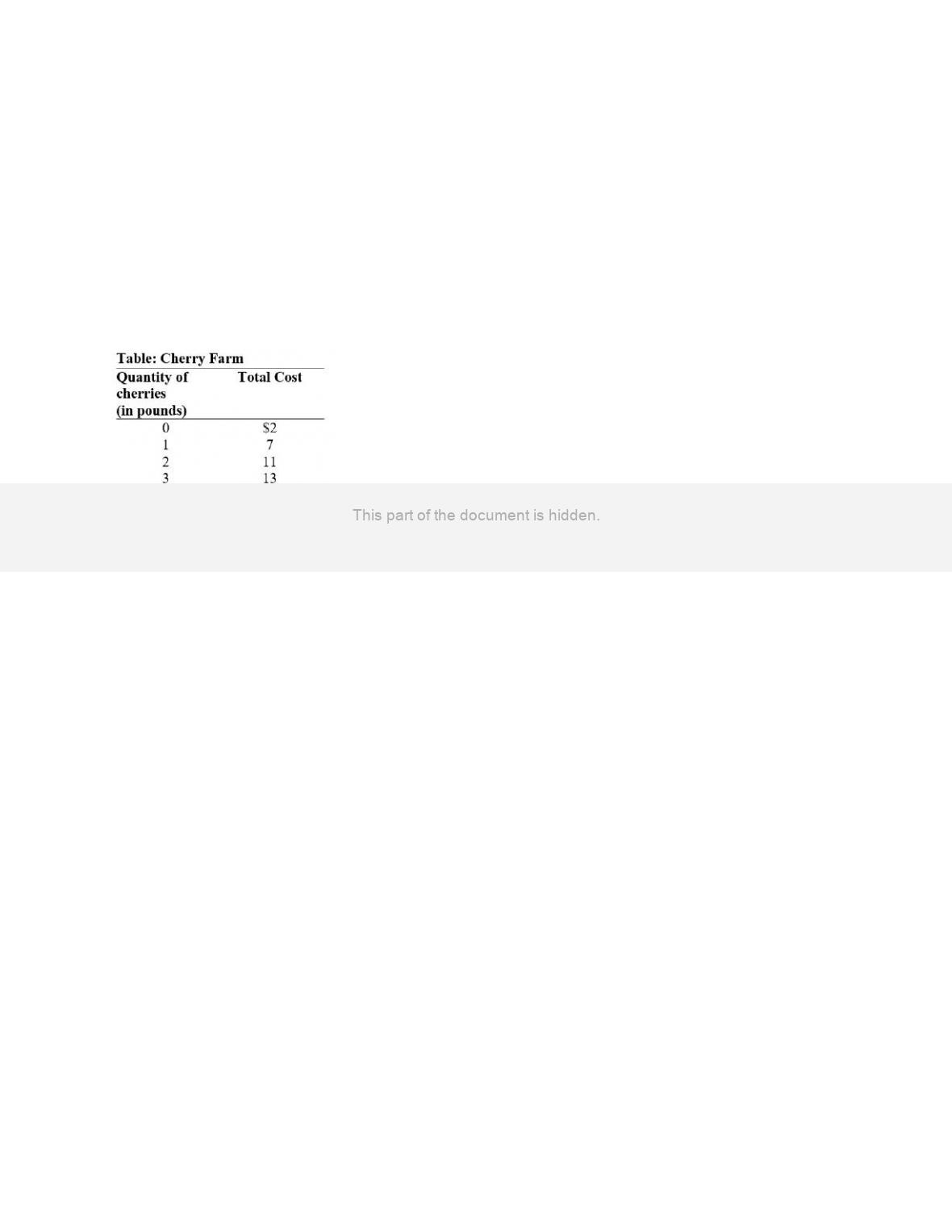
(Table: Cherry Farm) Use Table: Cherry Farm. If Hank and Helen have one of 100
identical farms in the perfectly competitive cherry industry, explain how Hank and
Helen and the industry will react in the short run and the long run to a price of $8 per
pound for cherries.
325.
(Table: Cherry Farm) Use Table: Cherry Farm. If Hank and Helen have one of 100
identical farms in the perfectly competitive cherry industry, explain how Hank and
Helen and the industry will react in the short run and the long run to a price of $3.75 per
pound for cherries.