Page 41
180.
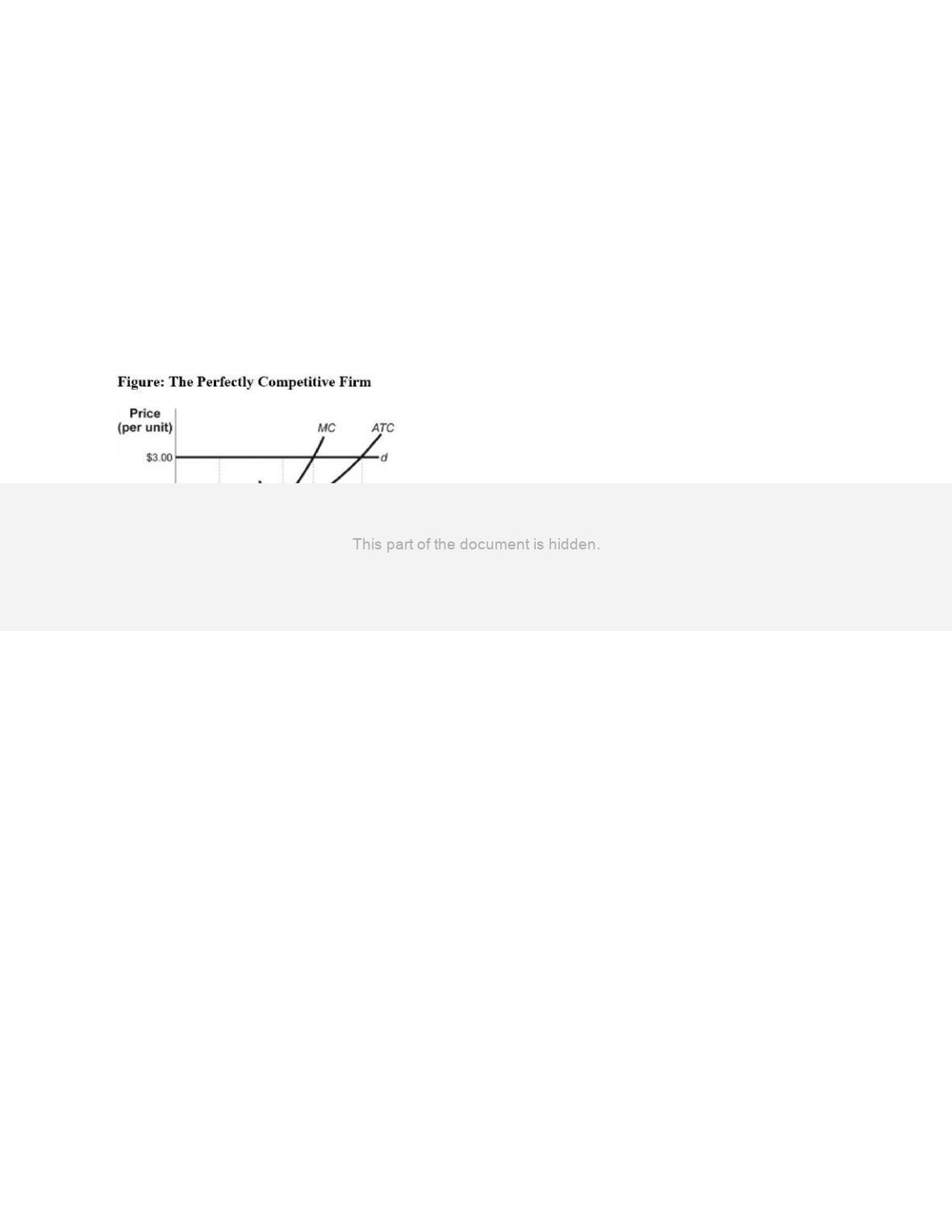
(Figure: The Perfectly Competitive Firm) Use Figure: The Perfectly Competitive Firm.
The figure shows a perfectly competitive firm that faces demand curve d and maximizes
profit. If the firm faces a market price of $3, its total profit per day is:
A)
$0.
B)
$250.
C)
$600.
D)
$300.
Use the following to answer questions 181-182:
181.
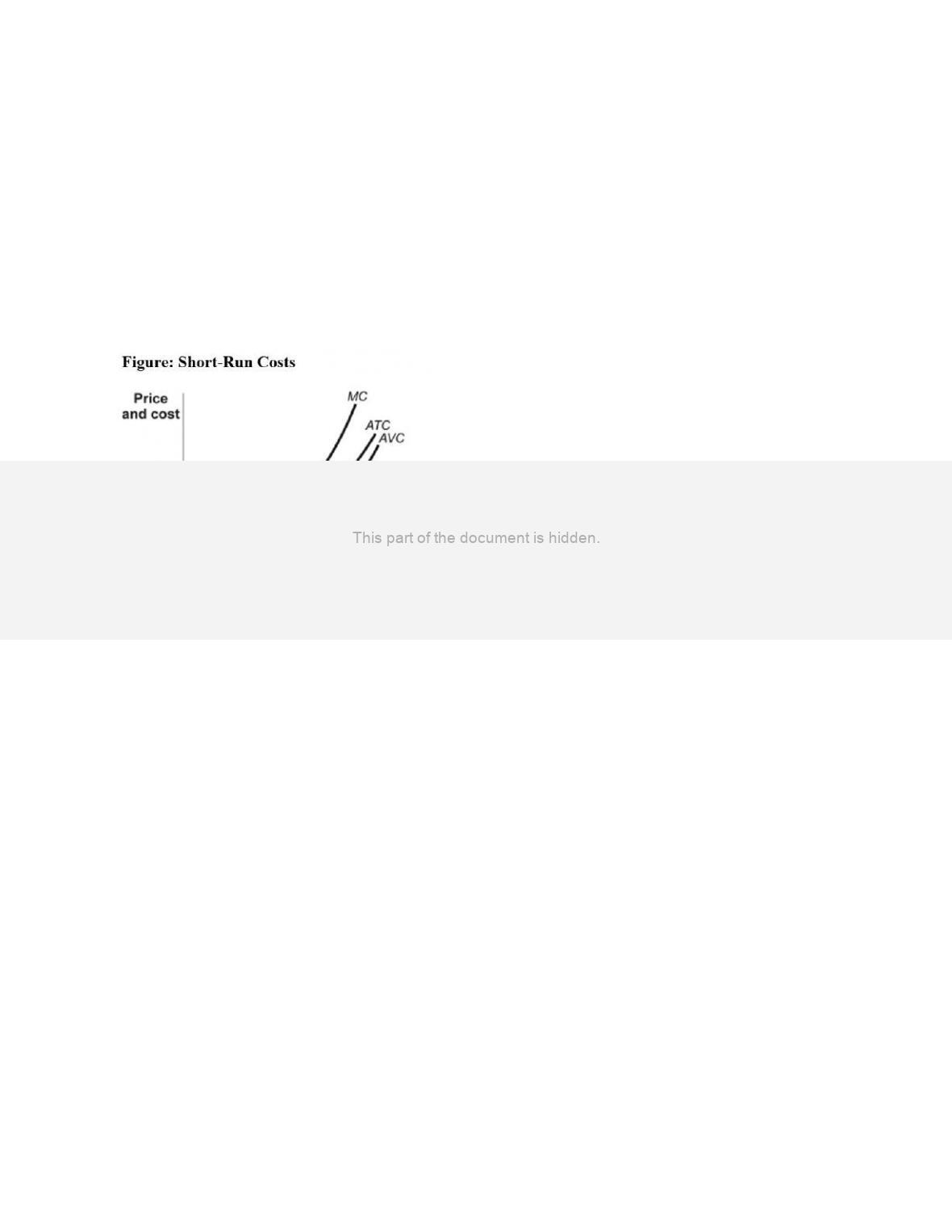
(Figure: Short-Run Costs) Use Figure: Short-Run Costs. At the given price, the MOST
profitable level of output occurs at quantity:
A)
N.
B)
P.
C)
S.
D)
T.
182.
(Figure: Short-Run Costs) Use Figure: Short-Run Costs. This firm’s short-run supply
curve begins at quantity:
A)
Q.
B)
R.
C)
S.
D)
T.
Page 42
183.
The short-run industry supply curve:
A)
shows the total quantity supplied by all firms in an industry for each possible price
when the number of producers is fixed.
B)
is drawn on the assumption that the number of firms in the industry doesn’t
increase, but it allows for a decrease in the number of firms due to bankrupt firms
leaving the industry.
C)
is a meaningful concept only if all firms in the industry are identical.
D)
is of limited usefulness since it is not relevant when markets are perfectly
competitive.
184.
The supply curve found by taking the horizontal summation of the short-run supply
curves of all of the firms in a perfectly competitive industry is called the _____ curve.
A)
marginal cost
B)
short-run market supply
C)
interim market supply
D)
competitive
185.
In perfect competition, the assumption of easy entry and exit implies that, in the _____
run, all firms in the industry will earn _____ economic profits.
A)
long; zero
B)
short; positive
C)
short; zero
D)
long; positive
186.
If firms are making positive economic profits in the short run, then in the long run:
A)
the short-run industry supply curve will shift leftward.
B)
new firms will enter the industry.
C)
industry output will rise and the price will rise.
D)
firms will leave the industry.
187.
The market for beef is in long-run equilibrium at $3.25 per pound. The announcement
that mad cow disease has been discovered in the United States reduces the demand for
beef sharply, and the price falls to $2.00 per pound. If the long-run supply curve is
horizontal, when the long-run equilibrium is reestablished, the price will be:
A)
$3.25 per pound.
B)
$2.00 per pound.
C)
greater than $2.00 per pound but less than $3.25 per pound.
D)
More information is needed to answer this question.
Page 43
188.
Suppose economic profits exist in perfect competition in the short run. Firms will enter
in the long run because of easy entry, the short-run market _____ curve will shift to the
right, and _____ will _____.
A)
supply; output; increase
B)
demand; supply; fall
C)
supply; demand; also shift to the right
D)
demand; price; increase
189.
Short-run economic profits in a perfectly competitive industry encourage firms to _____
the industry, and short-run losses encourage firms to _____ the industry.
A)
exit; enter
B)
enter; enter
C)
enter; exit
D)
exit; exit
190.
Suppose that some firms in a perfectly competitive industry earn negative economic
profits in the short run. In the long run, the:
A)
short-run industry supply curve will not shift.
B)
short-run industry supply curve will shift to the left.
C)
number of firms in the industry will not change.
D)
number of firms in the industry will increase.
191.
If firms are taking economic losses in the short run, then in the long run, firms will leave
the industry, industry output will _____, and economic losses will _____.
A)
fall; decrease
B)
rise; decrease
C)
rise; increase
D)
fall; increase
192.
Suppose that the market for candy canes operates under conditions of perfect
competition, that it is initially in long-run equilibrium, that the price of each candy cane
is $0.10, and that the market demand curve is downward sloping. The price of sugar
rises, increasing the marginal and average total costs of producing candy canes by
$0.05. In the short run, a typical producer of candy canes will be making:
A)
an economic profit.
B)
zero economic profit.
C)
negative economic profit.
D)
The answer is impossible to determine from the information given.

193.
Suppose that the market for candy canes operates under conditions of perfect
competition, that it is initially in long-run equilibrium, that the price of each candy cane
is $0.10, and that the market demand curve is downward sloping. The price of sugar
rises, increasing the marginal and average total cost of producing candy canes by $0.05;
there are no other changes in production costs. In the long run, we will observe:
A)
firms leaving the industry.
B)
firms entering the industry.
C)
some firms entering and some firms leaving.
D)
neither entry to nor exit from the industry.
194.
Suppose that the market for candy canes operates under conditions of perfect
competition, that it is initially in long-run equilibrium, that the price of each candy cane
is $0.10, and that the market demand curve is downward sloping. The price of sugar
rises, increasing the marginal and average total cost of producing candy canes by $0.05;
there are no other changes in production costs. Once all of the adjustments to long-run
equilibrium have been made, the price of candy canes will equal:
A)
$0.05.
B)
$0.10.
C)
$0.15.
D)
The question is impossible to answer without knowing exactly how many firms
entered and/or left the industry.
195.
Suppose that the market for haircuts in a community is perfectly competitive and that
the market is initially in long-run equilibrium. Subsequently, an increase in population
increases the demand for haircuts. In the short run, the market price will _____ and the
output of a typical firm will _____.
A)
rise; rise
B)
rise; fall
C)
fall; rise
D)
fall; fall
196.
Suppose that the market for haircuts in a community is perfectly competitive and that
the market is initially in long-run equilibrium. Subsequently, an increase in population
increases the demand for haircuts. In the short run, the typical firm is likely to:
A)
earn an economic profit.
B)
incur an economic loss.
C)
have no change in its economic profit.
D)
have neither an economic profit nor an economic loss.
Page 45
197.
Suppose that the market for haircuts in a community is a perfectly competitive
constant-cost industry and that the market is initially in long-run equilibrium.
Subsequently, an increase in population increases the demand for haircuts. In the long
run, firms will _____ the market, driving the price of haircuts _____ and the profits of
individual firms _____.
A)
enter; up; back to zero
B)
enter; down; back to zero
C)
leave; up; up
D)
leave; up; back to zero
198.
Assuming a downward-sloping demand curve, a decrease in production costs for firms
in a perfectly competitive market initially in long-run equilibrium will cause a(n):
A)
permanent increase in the price.
B)
economic profit for firms in the short run.
C)
increase in demand.
D)
increase in firms’ marginal revenue.
199.
In perfect competition, a change in fixed cost will:
A)
cause a change in the price in the short run.
B)
cause a change in output in the short run.
C)
encourage entry or exit in the long run such that price will change enough to leave
firms earning zero profits.
D)
cause a change in variable cost.
200.
In a perfectly competitive market:
A)
the price will change to reflect any change in production cost.
B)
the existence of profits leads firms to exit the industry, while losses lead firms to
enter the industry.
C)
economic profits are positive in the long run.
D)
perfect competition generates prices greater than marginal costs.
201.
A curve that shows the quantity of a good or service supplied at various prices after all
long-run adjustments to a price change have been completed is a long-run _____ curve.
A)
marginal revenue
B)
marginal cost
C)
industry supply
D)
production
Page 46
202.
Which statement is TRUE?
A)
The long-run industry supply curve relates the price of a good or service to the
quantity produced after all adjustments to a price change have been made.
B)
Every point on a long-run industry supply curve shows a price and quantity
supplied at which firms in the industry are earning positive economic profit.
C)
For establishing the long-run industry supply curve, factor costs and the number of
firms are held constant.
D)
In perfectly competitive industries, the long-run supply curve is always horizontal.
203.
Lilly is the price-taking owner of an apple orchard. The price of apples is high enough
that Lilly is earning positive economic profits. In the long run, Lilly should expect
_____ apple prices due to the _____ firms.
A)
lower; entry of new
B)
higher; exit of existing
C)
lower; exit of existing
D)
higher; entry of new
204.
Which scenario is MOST likely to cause firms to exit a perfectly competitive industry?
A)
Consumer tastes and preferences for this product get stronger, making them more
interested in the good.
B)
A technological advance allows all firms to produce more efficiently.
C)
The price of a key variable input falls.
D)
Consumer income falls.
Use the following to answer question 205:
Page 47
205.
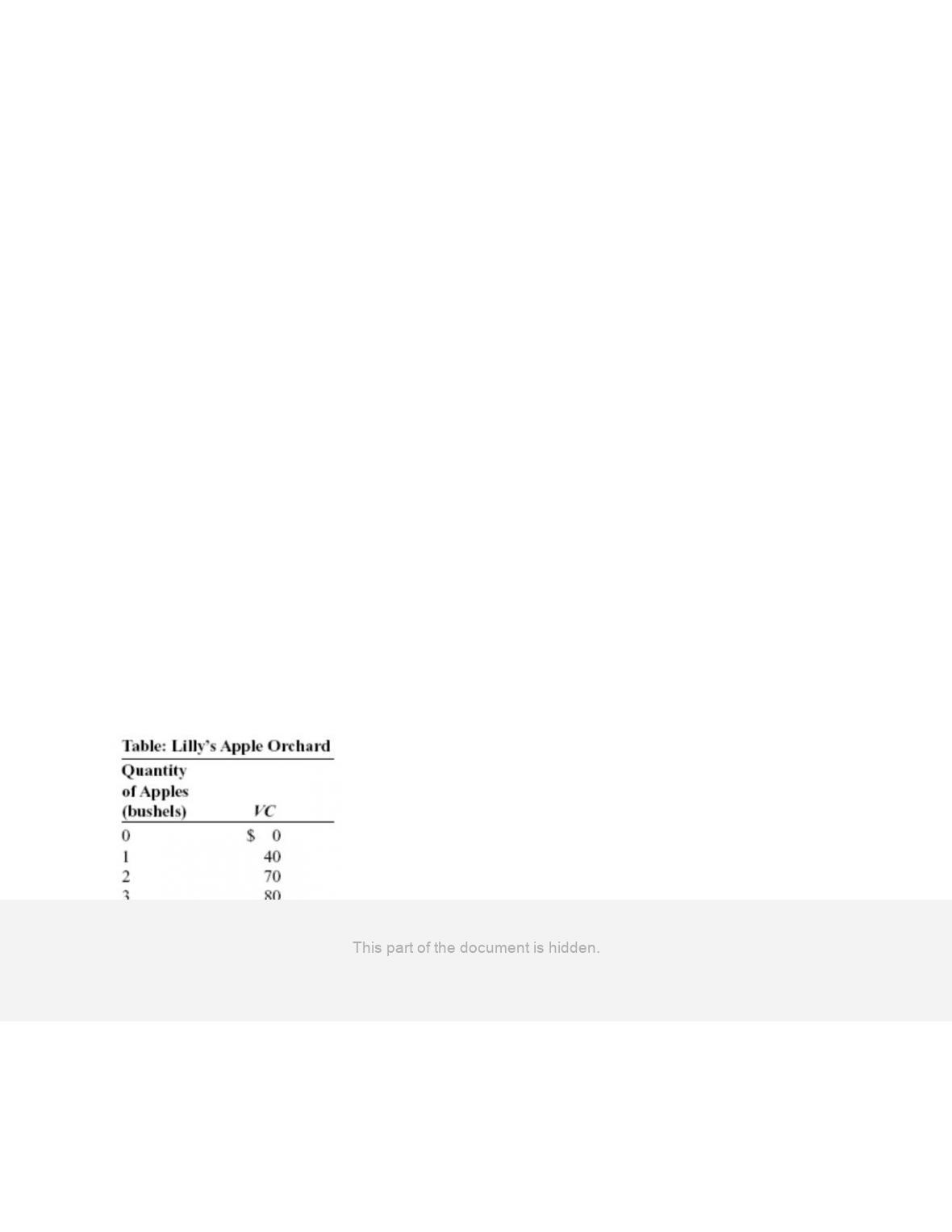
(Table: Lilly’s Apple Orchard) Use Table: Lilly’s Apple Orchard. Lilly is the
price-taking owner of an apple orchard; the orchard’s variable costs are given in the
table. Her orchard has fixed costs of $30. If the price of a bushel of apples is $85, we
would expect total industry output to _____ and Lilly’s output to _____ in the long run.
A)
rise; rise
B)
fall; fall
C)
fall; rise
D)
rise; fall
Use the following to answer questions 206-207:
206.
(Figure: The Perfectly Competitive Firm) Use Figure: The Perfectly Competitive Firm.
The firm faces demand curve d and maximizes profit. In a long-run equilibrium, this
firm will produce _____ units of output and sell its output for _____.
A)
100; $1.00
B)
250; $1.90
C)
300; $2.00
D)
400; $3.00
207.
(Figure: The Perfectly Competitive Firm) Use Figure: The Perfectly Competitive Firm.
The figure shows a perfectly competitive firm that faces demand curve d and maximizes
profit. The firm’s economic profit in the long run will be:
A)
$0.
B)
$250.
C)
$275.
D)
$300.
Page 48
208.
If some firms in a perfectly competitive industry are earning positive economic profits,
then in the long run, the:
A)
industry is in equilibrium.
B)
short-run industry supply curve will shift to the right.
C)
number of firms in the industry will not change.
D)
number of firms in the industry will decrease.
209.
Suppose that some firms in a perfectly competitive industry are earning positive
economic profits. In the long run, the:
A)
industry is in equilibrium.
B)
industry supply curve will shift to the left.
C)
number of firms in the industry will not change.
D)
number of firms in the industry will increase.
210.
Suppose that the market for haircuts in a community is perfectly competitive and that
the market is initially in long-run equilibrium. Subsequently, a decrease in population
decreases the demand for haircuts. In the short run, we expect that the market price will
_____ and the output of a typical firm will _____.
A)
rise; rise
B)
rise; fall
C)
fall; rise
D)
fall; fall
211.
In perfectly competitive long-run equilibrium:
A)
all firms make positive economic profits.
B)
all firms produce at the minimum point of their average total cost curves.
C)
the industry supply curve must be upward-sloping.
D)
all firms face the same price, but the value of marginal cost will vary directly with
firm size.
212.
When economic profits in an industry are zero:
A)
firms are really doing badly.
B)
firms are doing as well as they could do in other markets.
C)
firms should exit so they can make an economic profit in some other market.
D)
the industry is not in long-run equilibrium.
Page 49
213.
When a perfectly competitive firm is in long-run equilibrium, the firm is producing at
_____ cost.
A)
maximum average total
B)
maximum average variable
C)
minimum marginal
D)
minimum average total
214.
Provided that there are no external benefits or costs, resources are efficiently allocated
for a perfectly competitive firm when:
A)
P = MR.
B)
P = AVC.
C)
P = MC.
D)
MC = AVC.
215.
In a long-run equilibrium, economic profits in a perfectly competitive industry are:
A)
positive.
B)
zero.
C)
negative.
D)
indeterminate.
216.
When a perfectly competitive industry is in long-run equilibrium, its firms:
A)
earn more than zero economic profits.
B)
combine their variable and fixed resources inefficiently.
C)
are not in short-run equilibrium.
D)
allocate all of their resources efficiently.
217.
A perfectly competitive industry is in a state of long-run equilibrium. Which expression
must be TRUE?
A)
P = MR = MC > ATC.
B)
P = MR = MC < AVC.
C)
P = MR = MC = ATC.
D)
P > MR = MC = AVC.
218.
A perfectly competitive industry is said to be efficient because the:
A)
marginal cost of production of the last unit of output is minimized in the long run.
B)
product is standardized across firms in the industry.
C)
average total cost of production of the industry’s output is minimized in the long
run.
D)
market price of the good is equal to economic profit for all firms in the industry.
Page 50
Use the following to answer questions 219-231:
219.
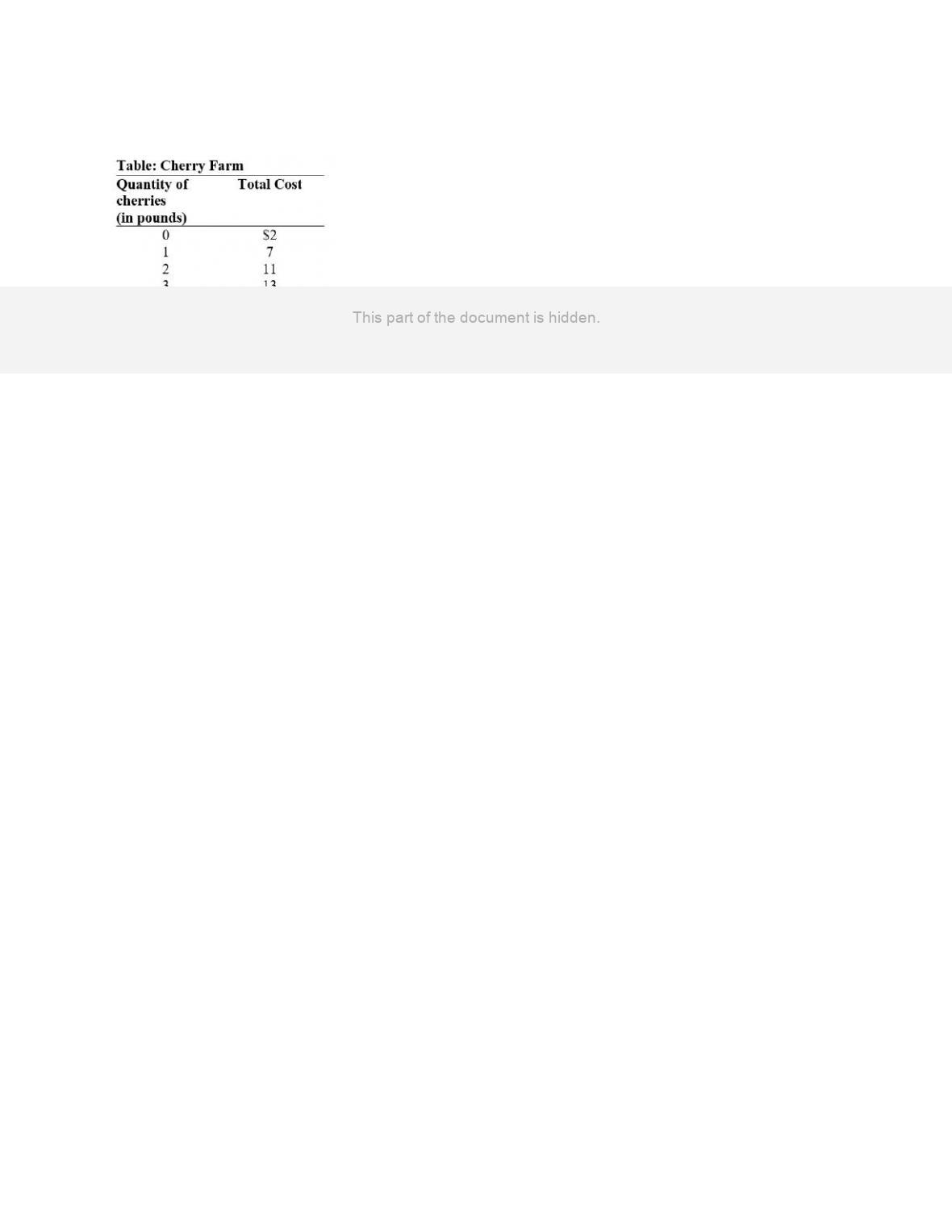
(Table: Cherry Farm) Use Table: Cherry Farm. If Hank and Helen have one of 100
farms in the perfectly competitive cherry industry and if the price is $5, in the short run
the industry will supply _____ pounds.
A)
100
B)
200
C)
400
D)
500
220.
(Table: Cherry Farm) Use Table: Cherry Farm. If Hank and Helen have one of 100
farms in the perfectly competitive cherry industry and if the price is $4, in the short run
the industry will supply _____ pounds.
A)
200
B)
400
C)
600
D)
700
221.
(Table: Cherry Farm) Use Table: Cherry Farm. If Hank and Helen have one of 100
farms in the perfectly competitive cherry industry and if the price is $3, in the short run
the industry will supply _____ pounds.
A)
0
B)
200
C)
300
D)
400
Page 51
222.
(Table: Cherry Farm) Use Table: Cherry Farm. Suppose there are 100 farms in this
industry with identical cost curves, as shown in the table. Which point would fall on the
industry short-run supply curve?
A)
$2, 300 pounds
B)
$11, 200 pounds
C)
$3, 500 pounds
D)
$8, 600 pounds
223.
(Table: Cherry Farm) Use Table: Cherry Farm. Suppose there are 100 farms in this
industry with identical cost curves, as shown in the table. Which point would fall on the
industry short-run supply curve?
A)
$5, 100 pounds
B)
$4, 200 pounds
C)
$4, 400 pounds
D)
$2, 500 pounds
224.
(Table: Cherry Farm) Use Table: Cherry Farm. Suppose there are 100 farms in this
industry with identical cost curves, as shown in the table. At what price will the industry
be in long-run equilibrium?
A)
$2
B)
$3
C)
$4
D)
$5
225.
(Table: Cherry Farm) Use Table: Cherry Farm. Suppose there are 100 farms in this
industry with identical cost curves, as shown in the table. If all farms are the same size,
how much will each farm produce in long-run equilibrium?
A)
0 pounds
B)
4 pounds
C)
5 pounds
D)
7 pounds
226.
(Table: Cherry Farm) Use Table: Cherry Farm. Suppose all farms have identical cost
curves, as shown in the table. How much will the industry produce in long-run
equilibrium if there are 100 farms in the industry in the long run?
A)
600 pounds
B)
500 pounds
C)
400 pounds
D)
0 pounds
Page 52
227.
(Table: Cherry Farm) Use Table: Cherry Farm. Suppose there are 100 farms in this
industry with identical cost curves, as shown in the table. If all farms are the same size,
how much economic profit will each farm earn when the industry is in long-run
equilibrium?
A)
$0
B)
$100
C)
–$200
D)
$1,000
228.
(Table: Cherry Farm) Use Table: Cherry Farm. Suppose there are 100 farms in this
industry with identical cost curves, as shown in the table. If the price is $6 per pound:
A)
firms will enter the industry.
B)
firms will exit the industry.
C)
the industry is in long-run equilibrium.
D)
the industry has minimized average total cost.
229.
(Table: Cherry Farm) Use Table: Cherry Farm. Suppose there are 100 farms in this
industry with identical cost curves, as shown in the table. If the price is $3.60 per pound:
A)
firms will enter the industry.
B)
firms will exit the industry.
C)
the industry is in long-run equilibrium.
D)
no firms will produce in the industry in the short run.
230.
(Table: Cherry Farm) Use Table: Cherry Farm. Suppose there are 100 farms in this
industry with identical cost curves, as shown in the table. If the price is $4 per pound:
A)
firms will enter the industry.
B)
firms will exit the industry.
C)
the industry is in long-run equilibrium.
D)
the industry has maximized average total cost.
231.
(Table: Cherry Farm) Use Table: Cherry Farm. Suppose there are 100 farms in this
industry with identical cost curves, as shown in the table. If the price is $10 per pound:
A)
firms will enter the industry.
B)
firms will exit the industry.
C)
the industry is in long-run equilibrium.
D)
the industry has minimized average total cost.
Page 53
Use the following to answer questions 232-241:
232.
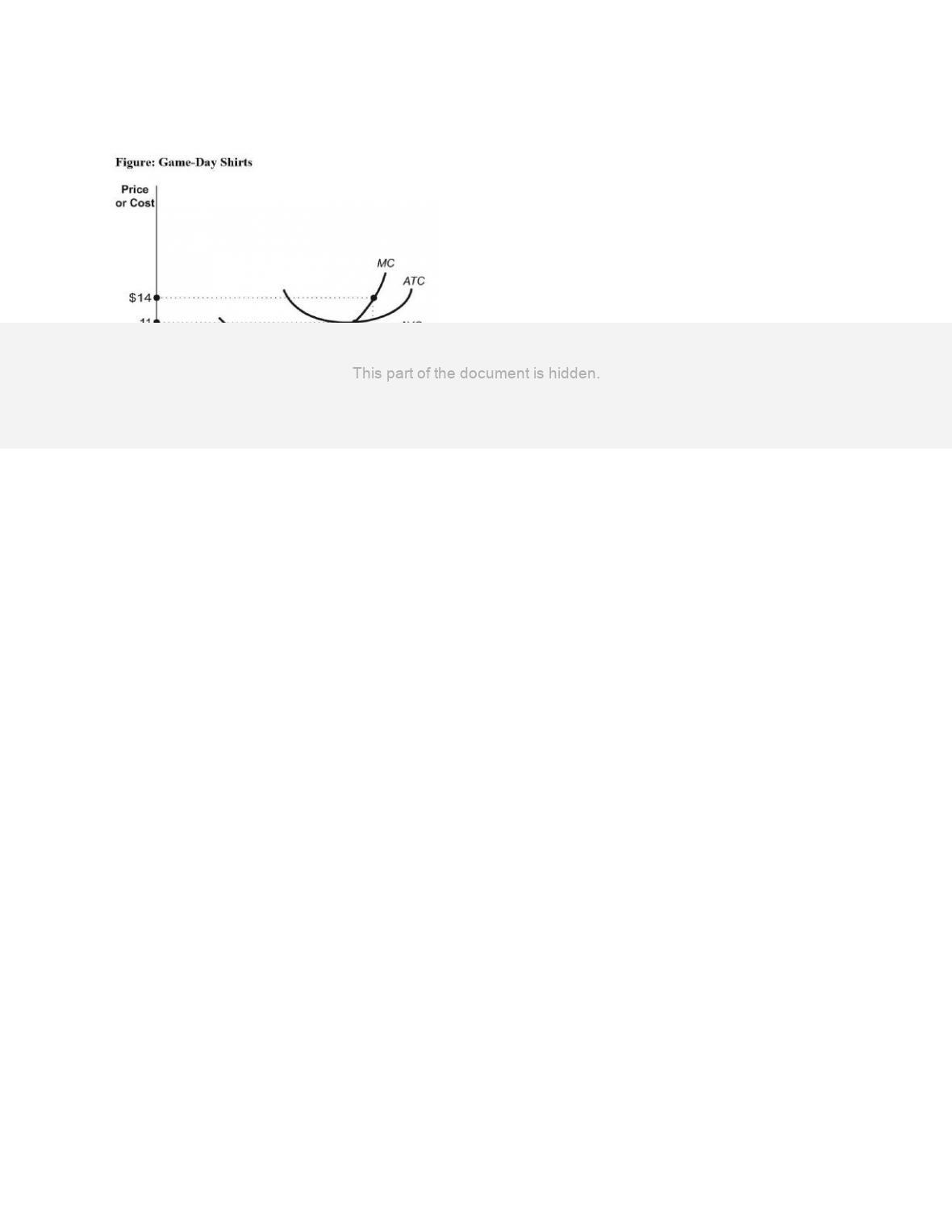
(Figure: Game-Day Shirts) Use Figure: Game-Day Shirts. Rick is one of 10 vendors
who sell game-day T-shirts at football games in a perfectly competitive market. His
costs are identical to the costs of the other 9 vendors. If the price of a shirt is $14, the
short-run industry supply will be _____ shirts.
A)
140
B)
200
C)
220
D)
240
233.
(Figure: Game-Day Shirts) Use Figure: Game-Day Shirts. Rick is one of 10 vendors
who sell game-day T-shirts at football games in a perfectly competitive market. His
costs are identical to the costs of the other 9 vendors. If the price of a shirt is $11, the
short-run industry supply will be _____ shirts.
A)
140
B)
200
C)
220
D)
240
234.
(Figure: Game-Day Shirts) Use Figure: Game-Day Shirts. Rick is one of 10 vendors
who sell game-day T-shirts at football games in a perfectly competitive market. His
costs are identical to the costs of the other 9 vendors. If the price of a shirt is $9, the
short-run industry supply will be _____ shirts.
A)
140
B)
200
C)
220
D)
240
Page 54
235.
(Figure: Game-Day Shirts) Use Figure: Game-Day Shirts. Rick is one of 10 vendors
who sell game-day T-shirts at football games in a perfectly competitive market. His
costs are identical to the costs of the other 9 vendors. If the price of a shirt is $6, the
short-run industry supply will be _____ shirts.
A)
0
B)
140
C)
220
D)
240
236.
(Figure: Game-Day Shirts) Use Figure: Game-Day Shirts. Rick is one of 10 vendors
who sell game-day T-shirts at football games in a perfectly competitive market. His
costs are identical to the costs of the other 9 vendors. If the industry is in long-run
equilibrium, how many shirts will each vendor sell?
A)
14
B)
20
C)
22
D)
24
237.
(Figure: Game-Day Shirts) Use Figure: Game-Day Shirts. Rick is one of 10 vendors
who sell game-day T-shirts at football games in a perfectly competitive market. His
costs are identical to the costs of the other 9 vendors. If the industry is in long-run
equilibrium, the price of each shirt will be:
A)
$6.
B)
$9.
C)
$11.
D)
$14.
238.
(Figure: Game-Day Shirts) Use Figure: Game-Day Shirts. Rick is one of 10 vendors
who sell game-day T-shirts at football games in a perfectly competitive market. His
costs are identical to the costs of the other 9 vendors. When the industry is in long-run
equilibrium, the price of each shirt will be _____, and the total quantity supplied in the
market will be _____.
A)
$6; 0
B)
$9; 200
C)
$11; 220
D)
$14; 240
Page 55
239.
(Figure: Game-Day Shirts) Use Figure: Game-Day Shirts. Rick is one of 10 vendors
who sell game-day T-shirts at football games in a perfectly competitive market. His
costs are identical to the costs of the other 9 vendors. If the price of a shirt is $14, in the
long run:
A)
new firms will enter the industry.
B)
existing firms will exit the industry.
C)
the industry is in equilibrium.
D)
the industry has minimized average total cost.
240.
(Figure: Game-Day Shirts) Use Figure: Game-Day Shirts. Rick is one of 10 vendors
who sell game-day T-shirts at football games in a perfectly competitive market. His
costs are identical to the costs of the other 9 vendors. If the price of a shirt is $9, in the
long run:
A)
new firms will enter the industry.
B)
existing firms will exit the industry.
C)
the industry is in equilibrium.
D)
the industry has minimized average total cost.
241.
(Figure: Game-Day Shirts) Use Figure: Game-Day Shirts. Rick is one of 10 vendors
who sell game-day T-shirts at football games in a perfectly competitive market. His
costs are identical to the costs of the other 9 vendors. If the price of a shirt is $11, in the
long run:
A)
firms will enter the industry.
B)
firms will exit the industry.
C)
the industry is in equilibrium.
D)
the industry has maximized average total cost.
242.
Perfect competition is a model of the market that does NOT assume:
A)
a large number of firms.
B)
firms facing downward-sloping demand curves.
C)
firms producing identical goods.
D)
many buyers.
243.
When perfect competition prevails, which characteristic of firms are we likely to
observe?
A)
None of them ever has diminishing marginal returns.
B)
They all try to operate where price equals average variable cost.
C)
They all try to operate where price equals total cost.
D)
They are all price takers.
Page 56
244.
Which statement is NOT an assumption that economists make when using the model of
perfect competition?
A)
Firms seek to maximize profits.
B)
The products of each firm in a particular market are identical.
C)
Each firm sets its price equal to its average total cost.
D)
Entry into and exit from the industry are easy.
Use the following to answer questions 245-260:
245.
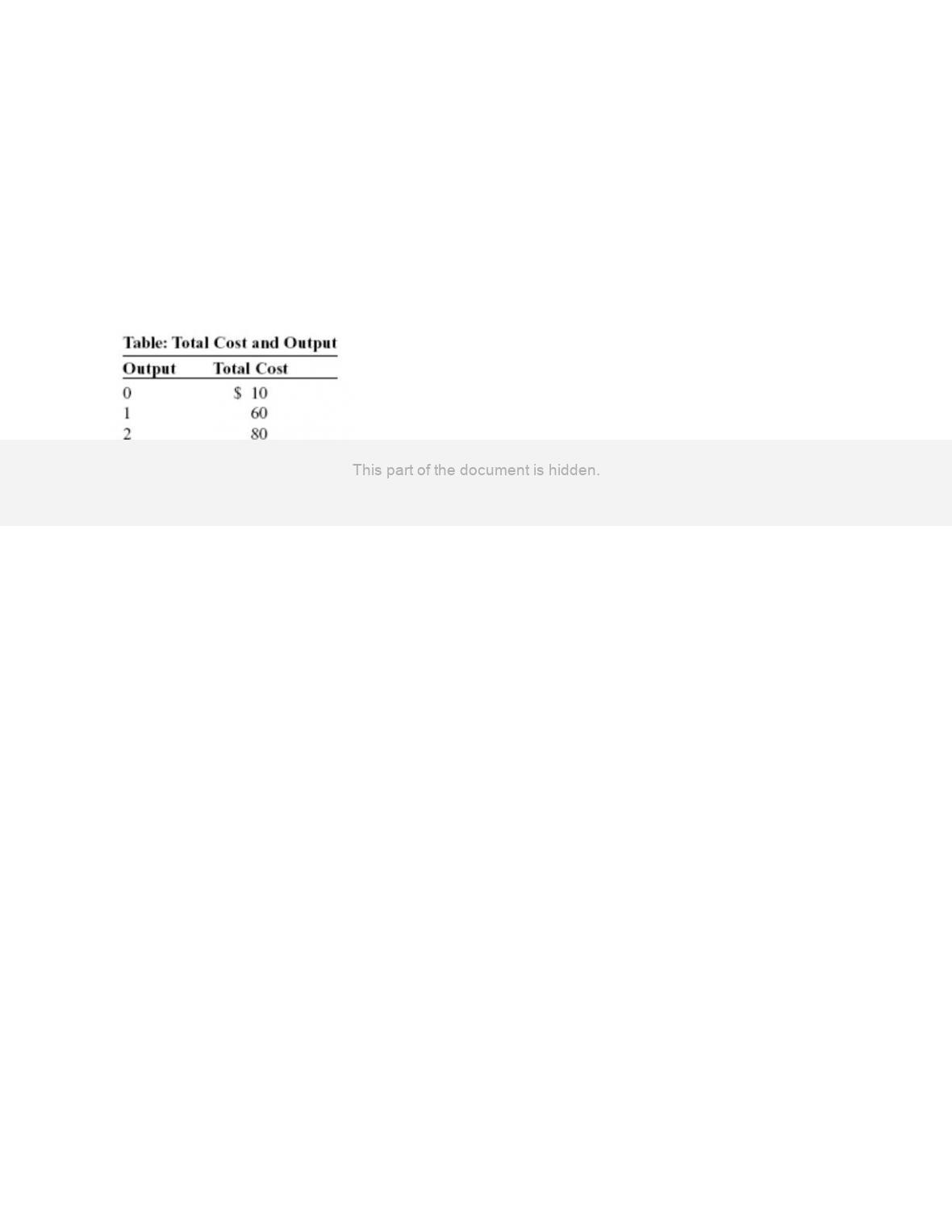
(Table: Total Cost and Output) Use Table: Total Cost and Output, which describes
Sergei’s costs for his perfectly competitive all-natural ice cream firm. If the market price
of a tub of ice cream is $67.50, how many tubs of ice cream will Sergei’s firm produce?
A)
1
B)
2
C)
3
D)
4
246.
(Table: Total Cost and Output) Use Table: Total Cost and Output, which describes
Sergei’s total costs for his perfectly competitive all-natural ice cream firm. If the market
price of a tub of ice cream is $67.50, how much is Sergei’s total revenue at the
profit-maximizing output?
A)
$270.00
B)
$170.00
C)
$100.00
D)
$67.50

Page 57
247.
(Table: Total Cost and Output) Use Table: Total Cost and Output, which describes
Sergei’s total costs for his perfectly competitive all-natural ice cream firm. If the market
price of a tub of ice cream is $67.50, how much is Sergei’s total cost at the
profit-maximizing output?
A)
$270.00
B)
$170.00
C)
$135.00
D)
$67.50
248.
(Table: Total Cost and Output) Use Table: Total Cost and Output, which describes
Sergei’s total costs for his perfectly competitive all-natural ice cream firm. If the market
price of a tub of ice cream is $67.50, how much is Sergei’s profit at the
profit-maximizing output?
A)
$680.00
B)
$270.00
C)
$102.50
D)
$100.00
249.
(Table: Total Cost and Output) Use Table: Total Cost and Output, which describes
Sergei’s total costs for his perfectly competitive all-natural ice cream firm. If the market
price of a tub of ice cream is $50, what quantity will Sergei produce to maximize profit?
A)
2
B)
3
C)
4
D)
5
250.
(Table: Total Cost and Output) Use Table: Total Cost and Output, which describes
Sergei’s total costs for his perfectly competitive all-natural ice cream firm. If the market
price of a tub of ice cream is $50, how much is Sergei’s profit at the profit-maximizing
output?
A)
$680
B)
$330
C)
$150
D)
$40

Page 58
251.
(Table: Total Cost and Output) Use Table: Total Cost and Output, which describes
Sergei’s total costs for his perfectly competitive all-natural ice cream firm. If the market
price of a tub of ice cream is $35, how many tubs of ice cream will Sergei produce in
the short run?
A)
1
B)
2
C)
3
D)
4
252.
(Table: Total Cost and Output) Use Table: Total Cost and Output, which describes
Sergei’s total costs for his perfectly competitive all-natural ice cream firm. If the market
price of a tub of ice cream is $35, how much is Sergei’s profit at the optimal short-run
output?
A)
–$5
B)
$110
C)
$180
D)
$330
253.
(Table: Total Cost and Output) Use Table: Total Cost and Output, which describes
Sergei’s total costs for his perfectly competitive all-natural ice cream firm. If the market
price of a tub of ice cream is $20, how many tubs of ice cream will Sergei produce in
the short run?
A)
0
B)
1
C)
2
D)
3
254.
(Table: Total Cost and Output) Use Table: Total Cost and Output, which describes
Sergei’s total costs for his perfectly competitive all-natural ice cream firm. If the market
price of a tub of ice cream is $20, how much is Sergei’s profit at the optimal short-run
output?
A)
$100
B)
$0
C)
–$5
D)
–$10
Page 59
255.
(Table: Total Cost and Output) Use Table: Total Cost and Output, which describes
Sergei’s total costs for his perfectly competitive all-natural ice cream firm. What is the
minimum price that Sergei needs to receive for a tub of ice cream to stay in business in
the short run?
A)
$10.00
B)
$20.00
C)
$33.33
D)
$36.67
256.
(Table: Total Cost and Output) Use Table: Total Cost and Output, which describes
Sergei’s total costs for his perfectly competitive all-natural ice cream firm. What is the
minimum price that Sergei needs to receive for a tub of ice cream to stay in business in
the long run?
A)
$10.00
B)
$20.00
C)
$33.33
D)
$36.67
257.
(Table: Total Cost and Output) Use Table: Total Cost and Output, which describes
Sergei’s total costs for his perfectly competitive all-natural ice cream firm. How many
tubs of ice cream will Sergei produce in the long run?
A)
1
B)
2
C)
3
D)
4
258.
(Table: Total Cost and Output) Use Table: Total Cost and Output, which describes
Sergei’s total costs for his perfectly competitive all-natural ice cream firm. Where does
Sergei’s short-run supply curve begin (assuming he can only produce whole quantities
of output)?
A)
P = $0, Q = 0
B)
P = $36.67, Q = 3
C)
P = $33.33, Q = 3
D)
P = $170, Q = 4
259.
(Table: Total Cost and Output) Use Table: Total Cost and Output, which describes
Sergei’s total costs for his perfectly competitive all-natural ice cream firm. Which point
falls on Sergei’s short-run supply curve (assuming he can only produce whole quantities
of output)?
A)
P = $10, Q = 0
B)
P = $20, Q = 2
C)
P = $110, Q = 3
D)
P = $70, Q = 5
260.
(Table: Total Cost and Output) Use Table: Total Cost and Output, which describes
Sergei’s total costs for his perfectly competitive all natural ice cream firm. If there are
100 firms in the all-natural ice cream industry, which point falls on the industry
short-run supply curve (assuming firms can only produce whole quantities of output)?
A)
P = $10, Q = 0
B)
P = $20, Q = 200
C)
P = $110, Q = 3
D)
P = $70, Q = 5
Use the following to answer questions 261-271:
261.
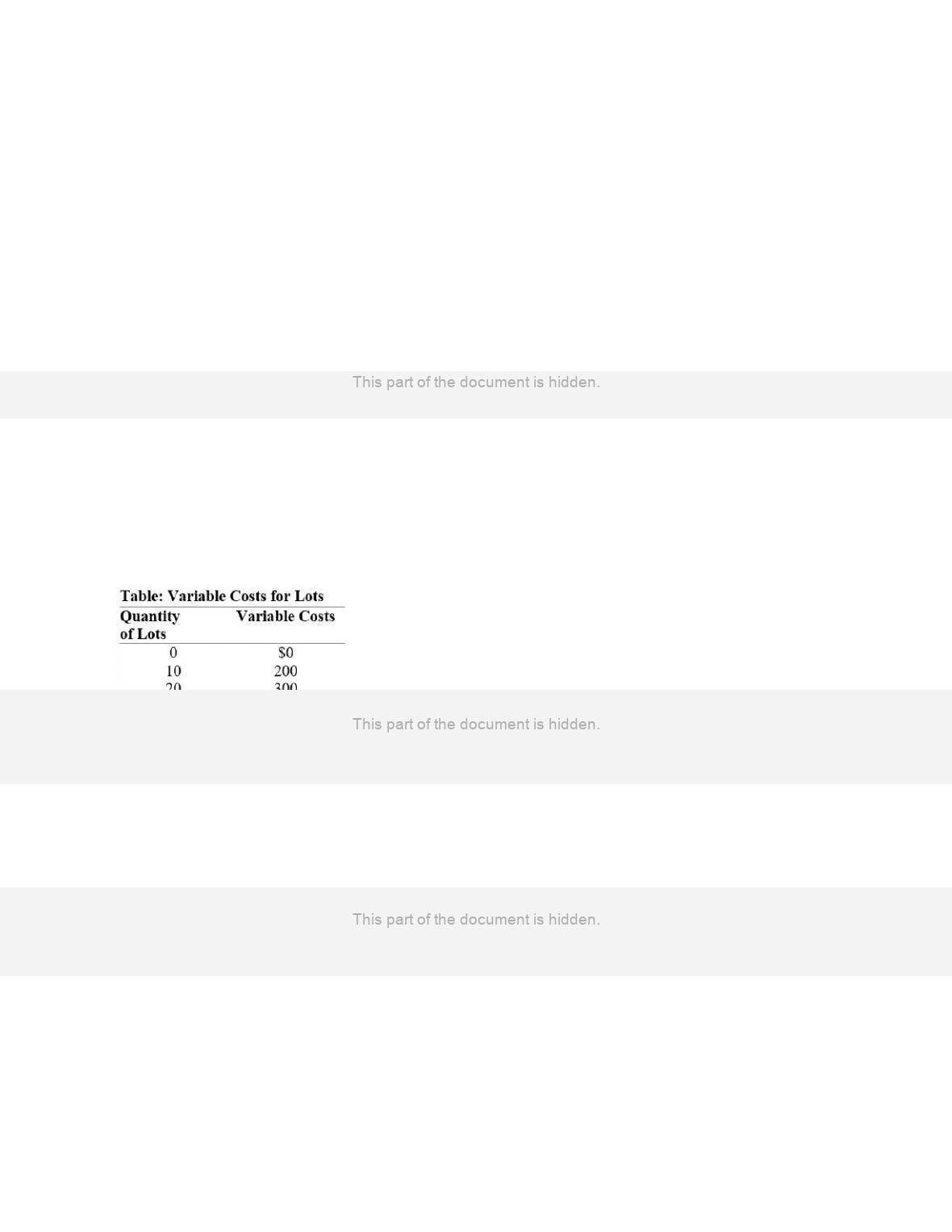
(Table: Variable Costs for Lots) Use Table: Variable Costs for Lots. During the winter,
Alexa runs a snow-clearing service in a perfectly competitive industry. Assume that
costs are constant in each interval; so, for example, the marginal cost of clearing each of
the lots from 1 through 10 is $20. Also assume that she can only plow the quantities of
the lots given in the table (and not numbers in between). Her only fixed cost is $1,000
for a snowplow. Her variable costs include fuel, her time, and hot coffee. What is
Alexa’s shut-down price in the short run?
A)
$20
B)
$15
C)
$50
D)
$42