
Page 21
110.
In the short run, if P < AVC at the quantity where MR = MC and fixed cost is greater
than zero, a perfectly competitive firm produces _____ and takes an economic _____.
A)
output; profit
B)
output; loss
C)
no output; profit
D)
no output; loss
111.
A firm’s shut-down point is the minimum value of _____ cost.
A)
total
B)
average variable
C)
average total
D)
marginal
112.
A perfectly competitive firm’s short-run supply curve is its _____ cost curve above its
intersection with the firm’s _____ cost curve.
A)
average variable; marginal
B)
marginal; average fixed
C)
marginal; average total
D)
marginal; average variable
113.
A perfectly competitive firm’s marginal cost curve above the average variable cost curve
is its _____ curve.
A)
input demand
B)
short-run supply
C)
marginal revenue
D)
total revenue
114.
A competitive firm operating in the short run is maximizing profits and just breaking
even. Its costs include a monthly state license fee of $100 that must be paid for as long
as the firm operates. If the license fee is raised to $150, what should the firm do to
maximize profits in the short run?
A)
increase price
B)
increase output
C)
reduce output
D)
not change output
Page 22
115.
Which statement is TRUE?
A)
If the price falls below the average total cost, the firm will earn economic profits.
B)
Price and marginal revenue are the same in perfect competition.
C)
Economic profit per unit is found by subtracting AVC from the price.
D)
Economic profit is always positive in the short run.
116.
Wenqin is a farmer, and in the short run she produces 100 bushels of wheat. Her average
total cost per bushel is $1.75, total revenue is $450, and total fixed costs are $100.
Wenqin’s:
A)
average fixed cost is $1.50.
B)
economic profit per bushel is $2.75.
C)
average variable cost is $1.25.
D)
economic profit is $250.
Use the following to answer question 117:
117.
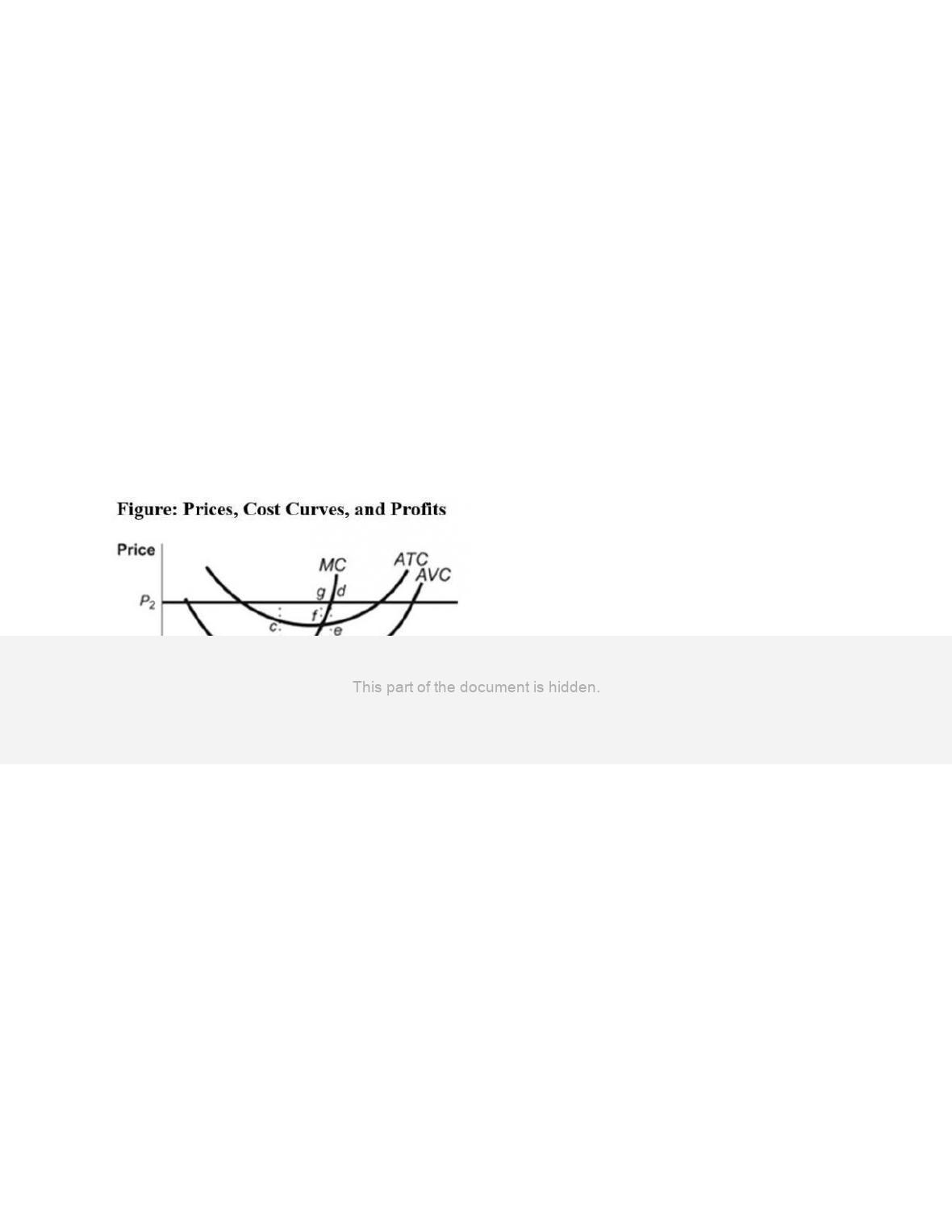
(Figure: Prices, Cost Curves, and Profits) Use Figure: Prices, Cost Curves, and Profits.
If the price is P1 and the firm decides to produce at output Q1, then the firm earns:
A)
a loss equal to (ba) × Q1.
B)
a loss equal to (ca) × Q1.
C)
a loss equal to (bc) × Q1.
D)
zero.
118.
(Figure: Prices, Cost Curves, and Profits) Use Figure: Prices, Cost Curves, and Profits.
If the price is P2 and the firm is profit-maximizing, then the firm’s profit is:
A)
(fg) × Q3.
B)
(de) × Q2.
C)
(fg) × Q2.
D)
(de) × P2.

Page 23
Use the following to answer questions 119-121:
119.
(Figure: Cost Curves for Corn Producers) Use Figure: Cost Curves for Corn Producers.
The market for corn is perfectly competitive. If the price of a bushel of corn is $14, in
the short run, the farmer will produce _____ of corn and earn an economic _____ equal
to _____.
A)
4 bushels; profit; $0
B)
4 bushels; profit; just less than $80 per bushel
C)
2 bushels; profit; $0
D)
2 bushels; loss; just more than $80 per bushel
120.
(Figure: Cost Curves for Corn Producers) Use Figure: Cost Curves for Corn Producers.
The market for corn is perfectly competitive. If the price of a bushel of corn is $4, in the
short run the farmer will produce _____ bushels of corn and earn an economic _____
equal to _____.
A)
0; loss; average fixed costs
B)
0; loss; total fixed costs
C)
3; loss; $30 per bushel
D)
3; profit; $20 per bushel
121.
(Figure: Cost Curves for Corn Producers) Use Figure: Cost Curves for Corn Producers.
The market for corn is perfectly competitive. If the price of a bushel of corn is $10, then
in the short run the farmer will produce _____ bushels of corn and take an economic
loss equal to _____.
A)
0; average fixed costs
B)
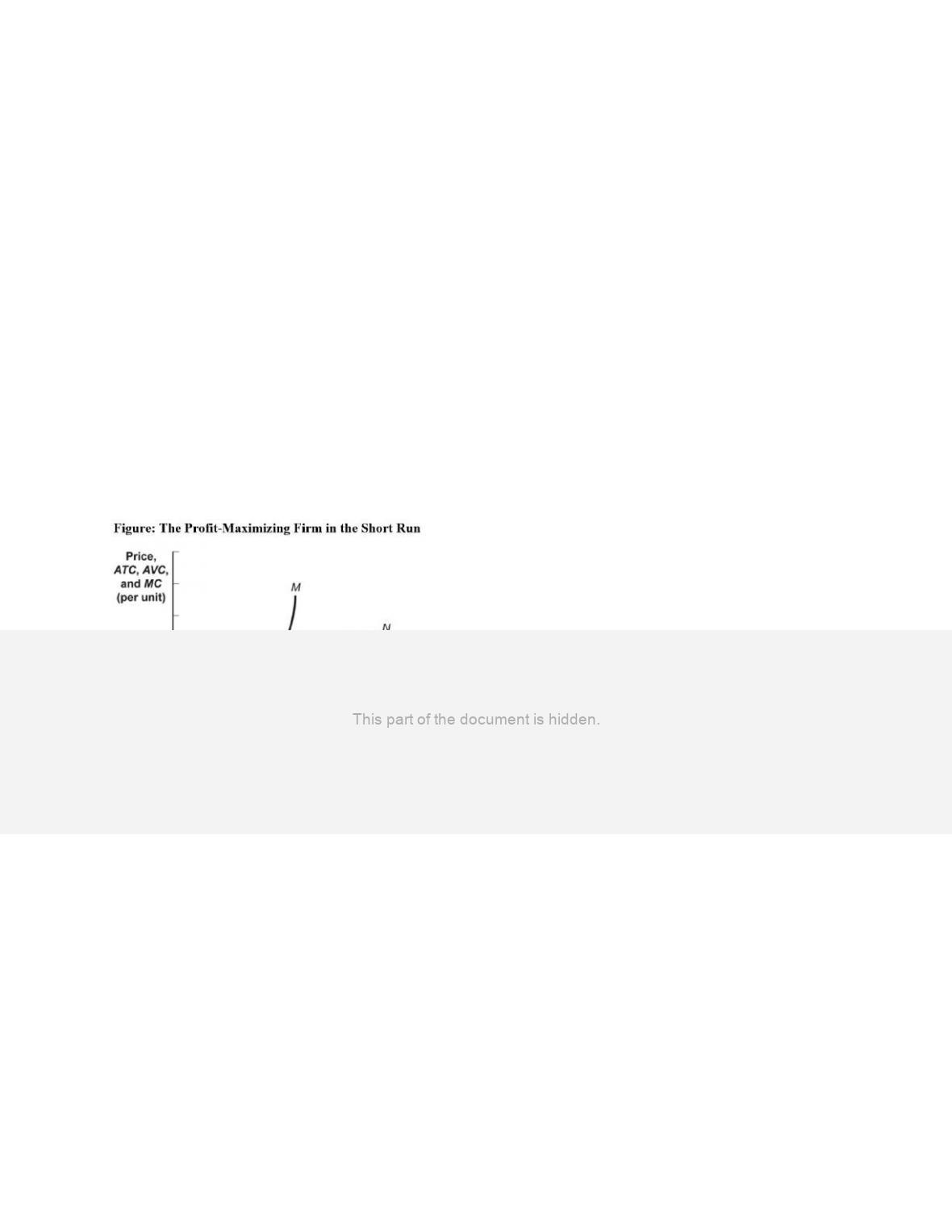
0; total variable costs
C)
3; total fixed costs
D)
3; $22 per bushel
Page 24
Use the following to answer questions 122-124:
122.
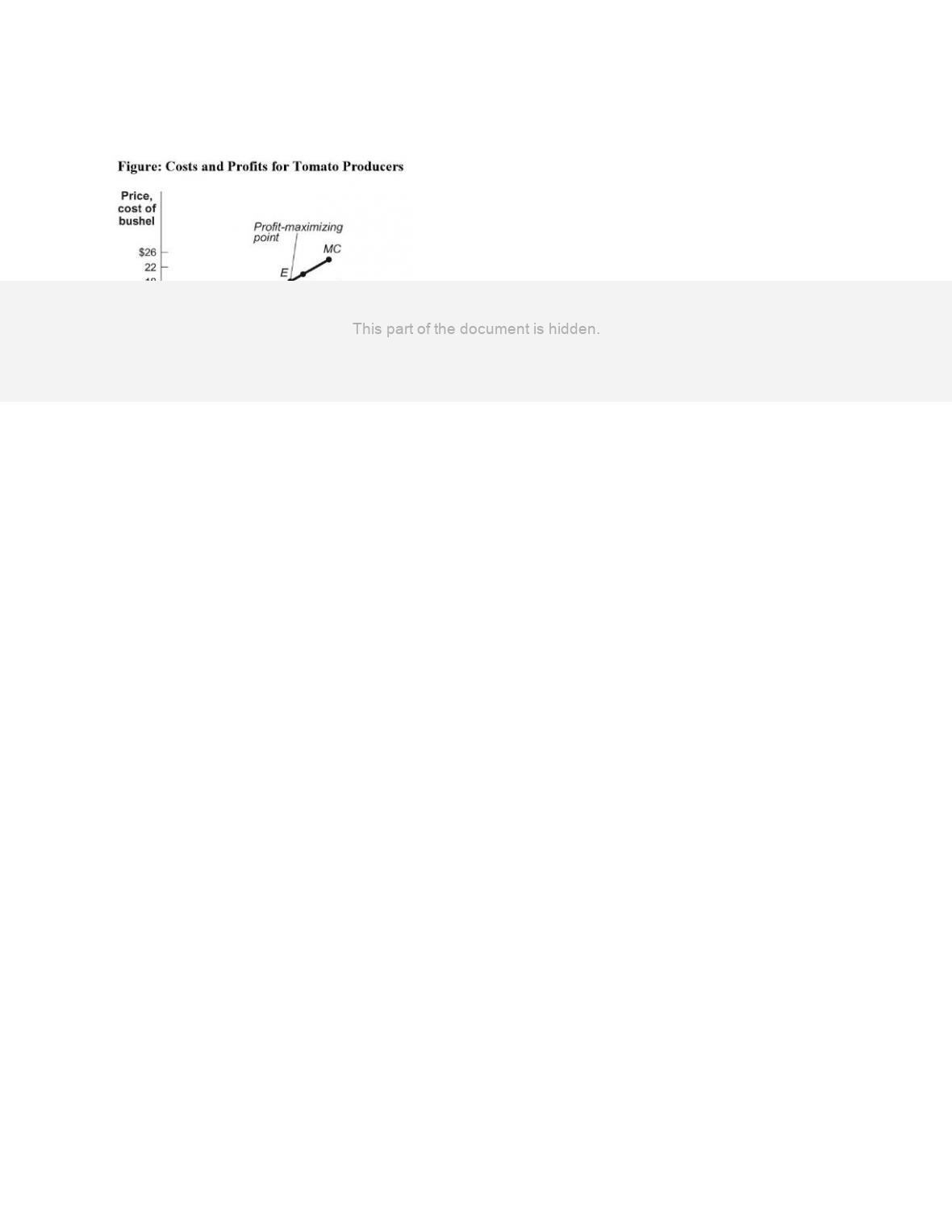
(Figure: Costs and Profits for Tomato Producers) Use Figure: Costs and Profits for
Tomato Producers. The market for tomatoes is perfectly competitive. The market price
of a bushel of tomatoes is $18. If the market price increases to $20, the farmer’s
marginal revenue _____ and the profit-maximizing output _____.
A)
increases; increases
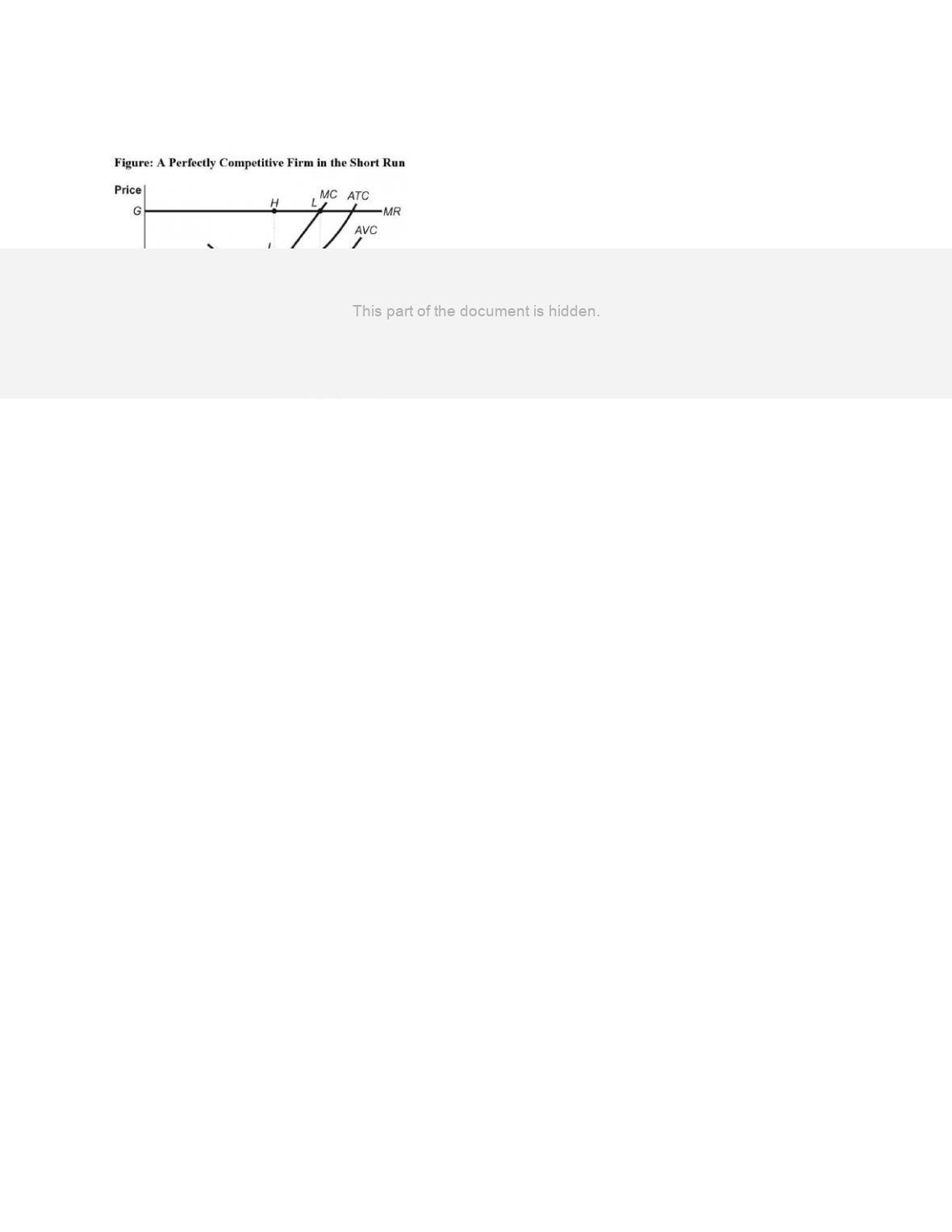
B)
increases; decreases
C)
decreases; increases
D)
decreases; decreases
123.
(Figure: Costs and Profits for Tomato Producers) Use Figure: Costs and Profits for
Tomato Producers. The market for tomatoes is perfectly competitive. The market price
of a bushel of tomatoes is $18. If the market price falls to $16, the farmer’s marginal
revenue _____ and the profit-maximizing output _____.
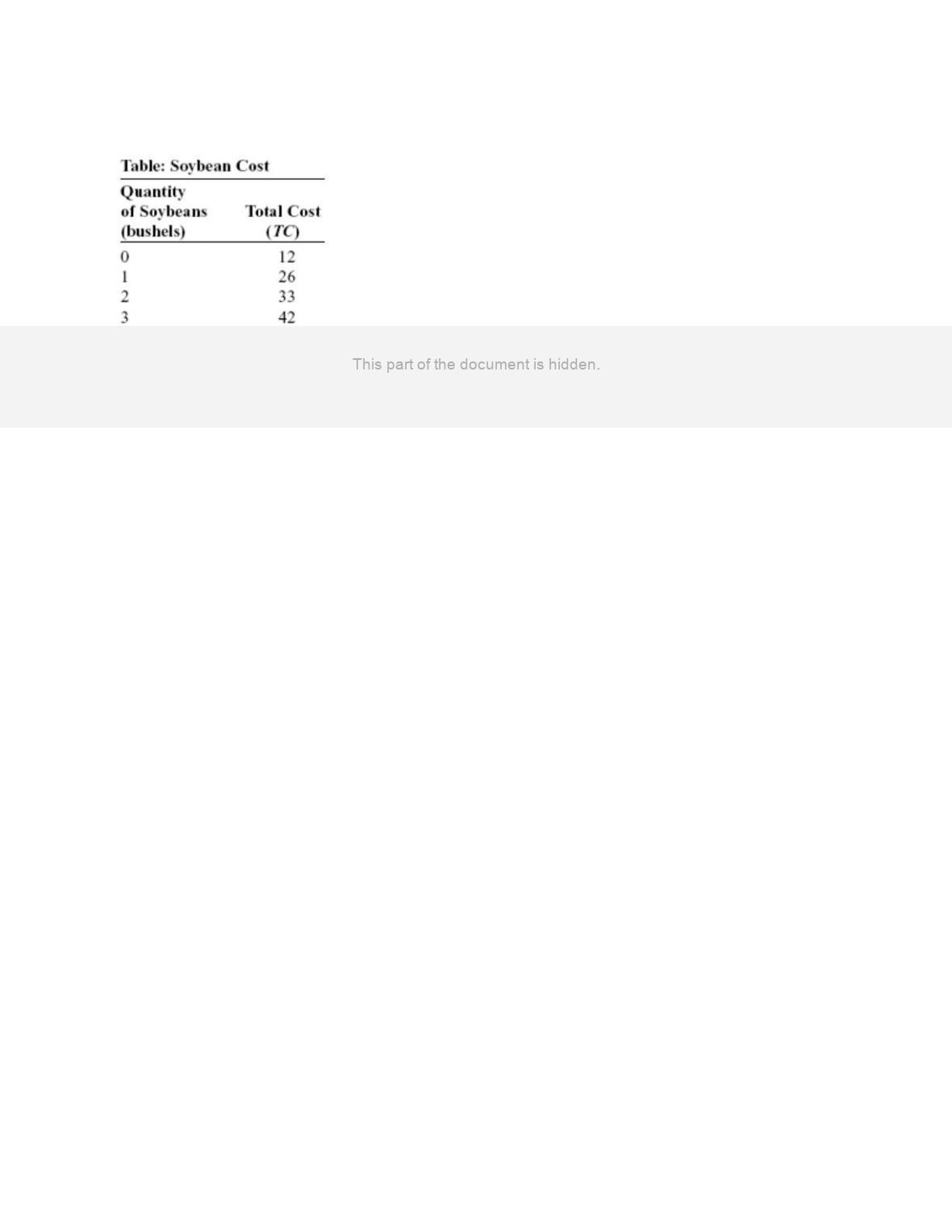
A)
increases; decreases
B)
increases; increases
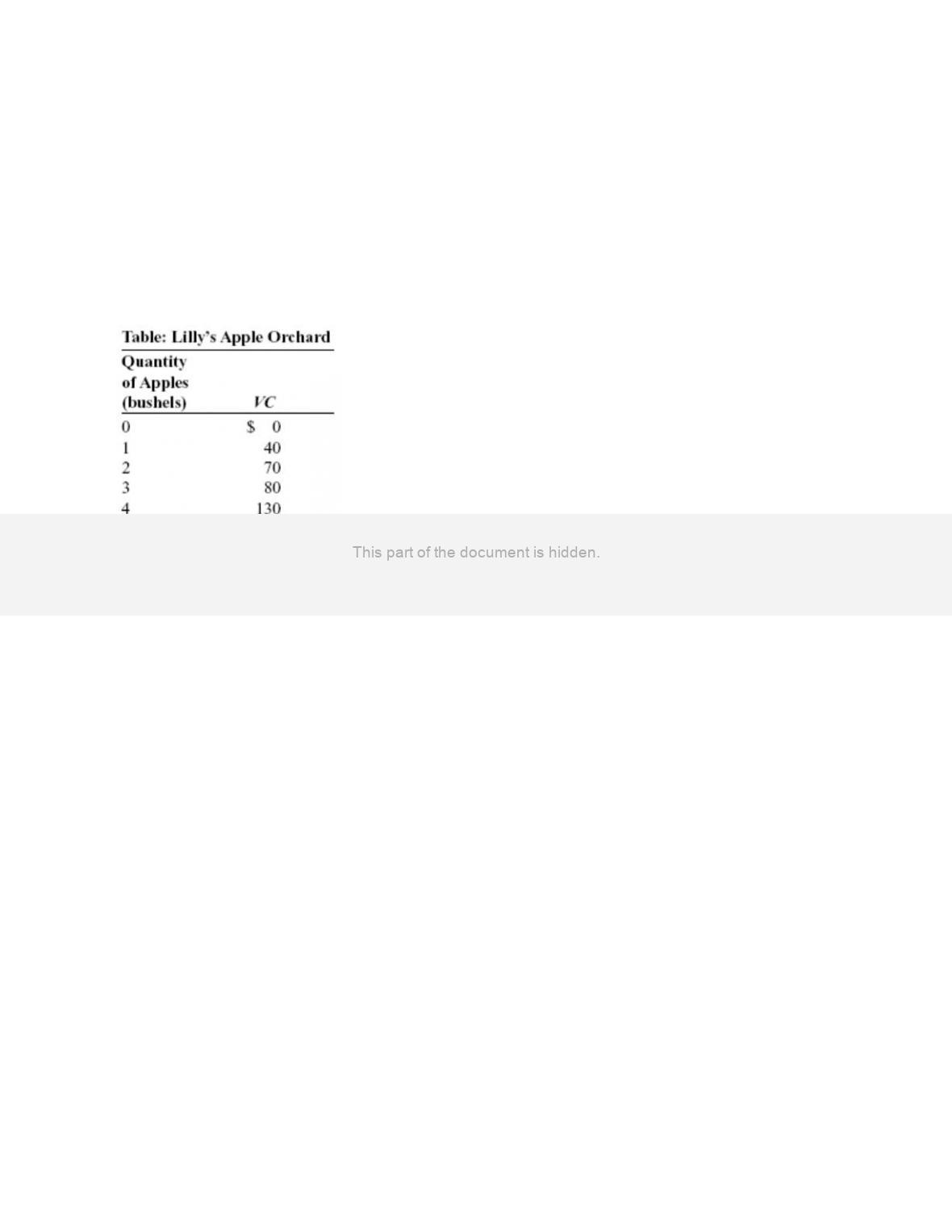
C)
decreases; increases
D)
decreases; decreases
124.
(Figure: Total Cost for Tomato Producers) Use Figure: Total Cost for Tomato
Producers. The market for tomatoes is perfectly competitive. The market price of a
bushel of tomatoes is $14. The farmer’s total cost at the profit-maximizing number of
bushels is:
A)
$3.50.
B)
$14.00.
C)
$56.00.
D)
$72.00.
Page 25
Use the following to answer question 125:
125.
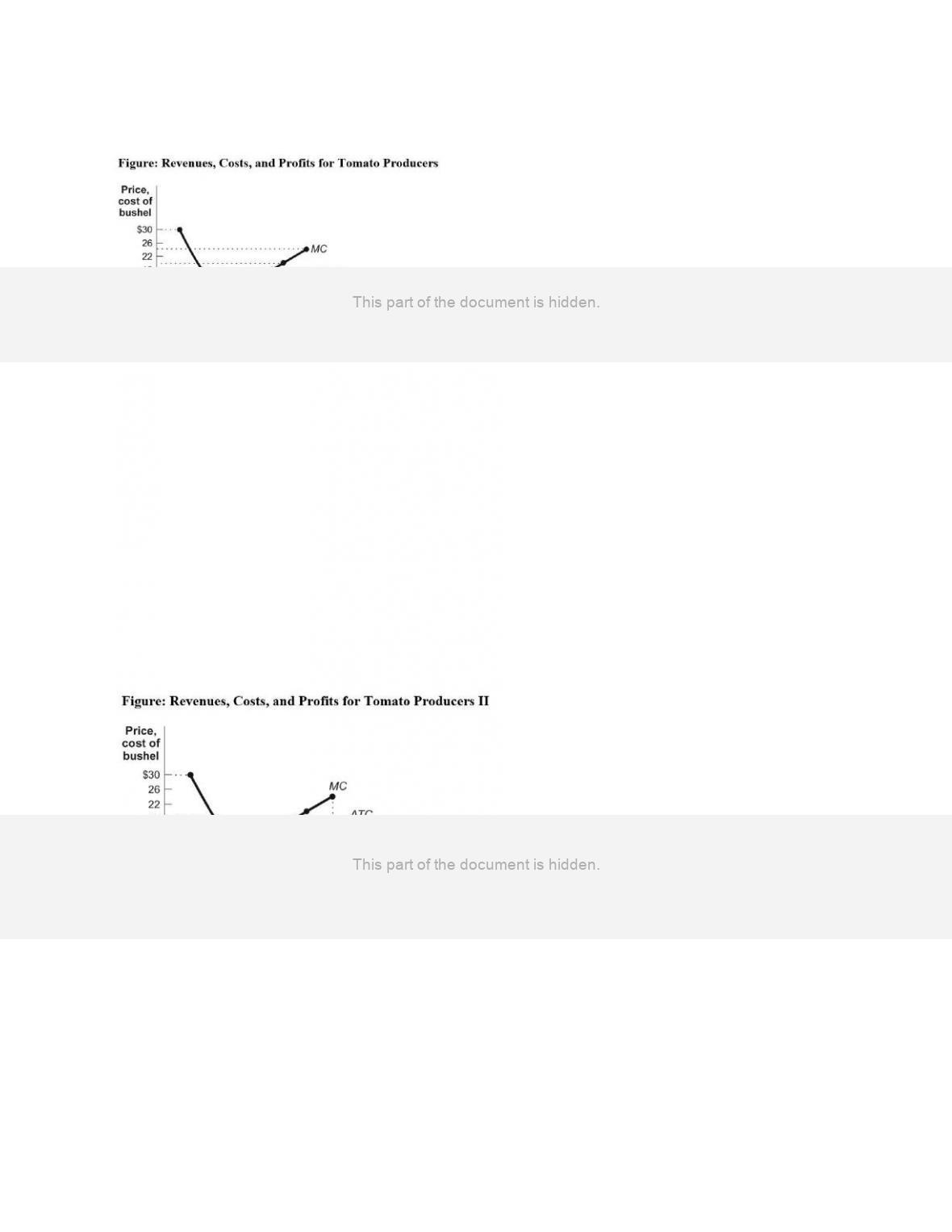
(Figure: Revenues, Costs, and Profits for Tomato Producers) Use Figure: Revenues,
Costs, and Profits for Tomato Producers. The market for tomatoes is perfectly
competitive. The market price of a bushel of tomatoes is $18. At the profit-maximizing
quantity of output in the figure, the farmer’s total revenue is _____, total cost is _____,
and economic profit is _____.
A)
$90; $14; $76
B)
$90; $70; $20
C)
$30; $42; –$12
D)
$48; $56; –$8
Use the following to answer question 126:
Page 26
126.
(Figure: Revenues, Costs, and Profits for Tomato Producers II) Use Figure: Revenues,
Costs, and Profits for Tomato Producers II. The market for tomatoes is perfectly
competitive. The market price of a bushel of tomatoes is $10. At the farmer’s
profit-maximizing output, total revenue is _____, total cost is _____, and economic
profit is _____.
A)
$90; $72; $18
B)
$56; $56; $0
C)
$30; $48; –$18
D)
$48; $56; –$8
Use the following to answer questions 127-132:
127.
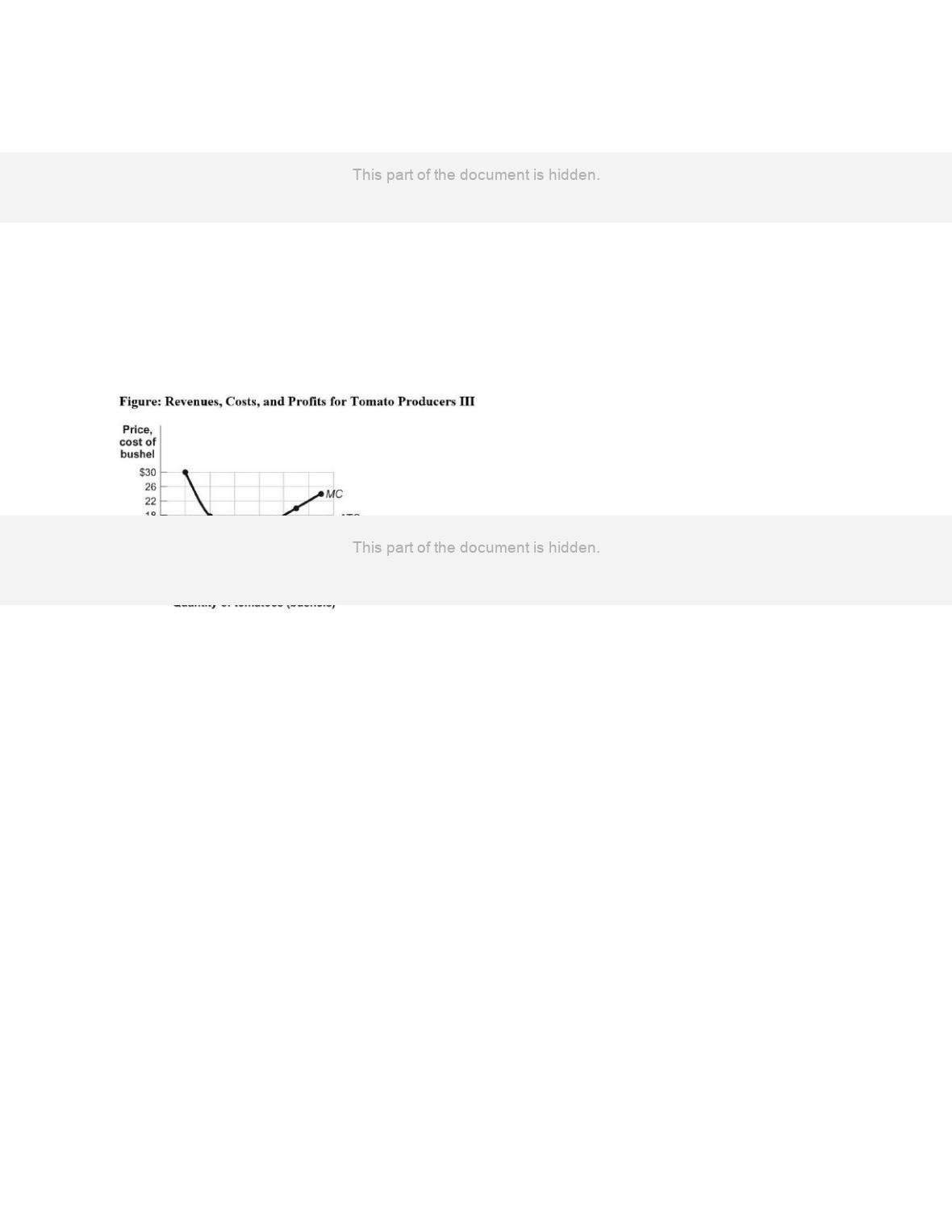
(Figure: Revenues, Costs, and Profits for Tomato Producers III) Use Figure: Revenues,
Costs, and Profits for Tomato Producers III. The market for tomatoes is perfectly
competitive. If market price of a bushel of tomatoes is $18, in the short run the farmer’s
profit-maximizing output is _____ bushels.
A)
2
B)
3
C)
4
D)
5
128.
(Figure: Revenues, Costs, and Profits for Tomato Producers III) Use Figure: Revenues,
Costs, and Profits for Tomato Producers III. The market for tomatoes is perfectly
competitive. If the market price of a bushel of tomatoes is $14, in the short run the
farmer’s profit-maximizing output is _____ bushels.
A)
2
B)
3
C)
4
D)
5
Page 27
129.
(Figure: Revenues, Costs, and Profits for Tomato Producers III) Use Figure: Revenues,
Costs, and Profits for Tomato Producers III. The market for tomatoes is perfectly
competitive. If the market price of a bushel of tomatoes is $8, in the short run the
farmer’s profit-maximizing output is _____ bushels.
A)
0
B)
1
C)
2.5
D)
3
130.
(Figure: Revenues, Costs, and Profits for Tomato Producers III) Use Figure: Revenues,
Costs, and Profits for Tomato Producers III. The market for tomatoes is perfectly
competitive. If the market price of a bushel of tomatoes is $18, this farm will:
A)
minimize its losses by shutting down.
B)
minimize its losses by continuing to produce.
C)
break even.
D)
earn an economic profit.
131.
(Figure: Revenues, Costs, and Profits for Tomato Producers III) Use Figure: Revenues,
Costs, and Profits for Tomato Producers III. The market for tomatoes is perfectly
competitive. If the market price of a bushel of tomatoes is $12, in the short run this farm
will:
A)
minimize its losses by shutting down.
B)
minimize its losses by continuing to produce.
C)
break even.
D)
earn an economic profit.
132.
(Figure: Revenues, Costs, and Profits for Tomato Producers III) Use Figure: Revenues,
Costs, and Profits for Tomato Producers III. The market for tomatoes is perfectly
competitive. The farm’s short-run supply curve is the _____ cost curve above a price of
_____.
A)
average total; $14
B)
average variable; $10
C)
marginal; $10
D)
marginal; $14

Page 28
Use the following to answer questions 133-138:
133.
(Figure: Marginal Decision Rule) Use Figure: The Marginal Decision Rule. At q2, or the
_____, the _____ price is equal to marginal cost.
A)
minimum-cost output; shut-down
B)
profit-maximizing quantity; market
C)
maximum-cost output; break-even
D)
profit-minimizing quantity; break-even
134.
(Figure: Marginal Decision Rule) Use Figure: The Marginal Decision Rule. If P1 is the
market price and if this firm is maximizing profit, it should produce:
A)
a quantity at which MR < MC.
B)
at quantity q2.
C)
at quantity q1, where MR > MC.
D)
a quantity greater than q1 but less than q2.
135.
(Figure: Marginal Decision Rule) Use Figure: The Marginal Decision Rule. Given the
market price P1, B is the _____ curve.
A)
marginal revenue
B)
marginal cost
C)
marginal product
D)
average fixed cost
136.
(Figure: Marginal Decision Rule) Use Figure: The Marginal Decision Rule. Economic
profit:
A)
is earned only for quantities between q1 and q2.
B)
is earned only for quantities between the origin and q1.
C)
is maximized at q1.
D)
cannot be determined from the information provided.
Page 29
137.
(Figure: Marginal Decision Rule) Use Figure: The Marginal Decision Rule. As long as
the price is above the minimum variable cost, this firm should produce quantity _____,
where _____ equals _____ and economic profit is maximized.
A)
q1; MR; MC
B)
q2; price; MC
C)
q2; MR; TR
D)
q1; TR; TC
138.
(Figure: Marginal Decision Rule) Use Figure: The Marginal Decision Rule. To the left
of point C (e.g., at q1):
A)
economic profit is the vertical distance between curves B and MC.
B)
the firm is not maximizing profits.
C)
the firm is maximizing profits but not total revenue.
D)
the firm should produce less.
Use the following to answer questions 139-152:
139.
(Figure: The Profit-Maximizing Firm in the Short Run) Use Figure: The
Profit-Maximizing Firm in the Short Run. M is the _____ curve.
A)
ATC
B)
MR
C)
MC
D)
AVC
Page 30
140.
(Figure: The Profit-Maximizing Firm in the Short Run) Use Figure: The
Profit-Maximizing Firm in the Short Run. N is the _____ curve.
A)
ATC
B)
MR
C)
MC
D)
AVC
141.
(Figure: The Profit-Maximizing Firm in the Short Run) Use Figure: The
Profit-Maximizing Firm in the Short Run. If the market price is P3, the firm will
produce quantity _____ and _____ in the short run.
A)
q2; make a profit
B)
q1; break even
C)
q2; incur a loss
D)
q4; incur a loss
142.
(Figure: The Profit-Maximizing Firm in the Short Run) Use Figure: The
Profit-Maximizing Firm in the Short Run. If the market price is P4, the firm will
produce quantity _____ and _____ in the short run.
A)
q1; break even
B)
q3; make a profit
C)
q4; break even
D)
q5; lose fixed costs
143.
(Figure: The Profit-Maximizing Firm in the Short Run) Use Figure: The
Profit-Maximizing Firm. O is the _____ curve.
A)
ATC
B)
MR
C)
MC
D)
AVC
144.
(Figure: The Profit-Maximizing Firm in the Short Run) Use Figure: The
Profit-Maximizing Firm in the Short Run. Curve M must cross curves N and O:
A)
at their maximum points.
B)
to the left of their minimum points.
C)
at their minimum points.
D)
to the right of their minimum points.
Page 31
145.
(Figure: The Profit-Maximizing Firm in the Short Run) Use Figure: The
Profit-Maximizing Firm in the Short Run. If the market price is less than P2, the firm
will _____ in the short run.
A)
produce q1 and break even
B)
produce q1 and incur a loss smaller than total fixed cost
C)
shut down
D)
produce q3 and make a profit
146.
(Figure: The Profit-Maximizing Firm in the Short Run) Use Figure: The
Profit-Maximizing Firm in the Short Run. Which statement is TRUE?
A)
AFC is represented by the vertical distance between curve M and curve N at any
level of output.
B)
AFC is represented by the vertical distance between curve N and curve O at any
level of output.
C)
This figure illustrates the long run because all costs are variable.
D)
Quantity q2 is to the left of the shut-down point.
147.
(Figure: The Profit-Maximizing Firm in the Short Run) Use Figure: The
Profit-Maximizing Firm in the Short Run. The MC curve is represented by:
A)
none of the curves.
B)
curve O.
C)
curve M.
D)
curve N.
148.
(Figure: The Profit-Maximizing Firm in the Short Run) Use Figure: The
Profit-Maximizing Firm in the Short Run. The ATC curve is represented by:
A)
curve N.
B)
curve M.
C)
curve O.
D)
none of the curves.
149.
(Figure: The Profit-Maximizing Firm in the Short Run) Use Figure: The
Profit-Maximizing Firm in the Short Run. Which curve is the AVC curve?
A)
curve M
B)
none of the curves
C)
curve N
D)
curve O

Page 32
150.
(Figure: The Profit-Maximizing Firm in the Short Run) Use Figure: The
Profit-Maximizing Firm in the Short Run. If the market price is P4, marginal revenue:
A)
and price are the same.
B)
is less than P4.
C)
is greater than P4.
D)
and price are unrelated.
151.
(Figure: The Profit-Maximizing Firm in the Short Run) Use Figure: The
Profit-Maximizing Firm in the Short Run. If the market price is P4:
A)
firms will leave the industry and the price will fall in the long run.
B)
there will be economic profits and firms will enter the industry in the long run.
C)
the market supply curve will shift to the left and price will fall in the long run.
D)
the firm will produce q4.
152.
(Figure: The Profit-Maximizing Firm in the Short Run) Use Figure: The
Profit-Maximizing Firm in the Short Run. At q2, ATC is the vertical distance between q2
on the horizontal axis and:
A)
curve M.
B)
curve N.
C)
curve O.
D)
P4.
Page 33
Use the following to answer questions 153-163:
153. (Figure: A Perfectly Competitive Firm in the Short Run) Use Figure: A Perfectly
Competitive Firm in the Short Run. The firm’s total cost of producing its most profitable level of
output is:
A) BS.
B) DK.
C) 0FKD.
D) 0GLD.
Ans: C
Refer To: Ref 12-10 Figure: A Perfectly Competitive Firm in the Short Run
bloomslevel: Analyzing
chaptername: Chapter 12
levelofdifficulty: Difficult
questiontype: Multiple Choice
sequence: 12153
topic: Comprehensive: Production and Profits
153.
(Figure: A Perfectly Competitive Firm in the Short Run) Use Figure: A Perfectly
Competitive Firm in the Short Run. The firm’s total cost of producing its most profitable
level of output is:
A)
BS.
B)
DK.
C)
0FKD.
D)
0GLD.
Page 34
154.
(Figure: A Perfectly Competitive Firm in the Short Run) Use Figure: A Perfectly
Competitive Firm in the Short Run. The firm’s total revenue from the sale of its most
profitable level of output is:
A)
0GLD.
B)
0GHB.
C)
BH.
D)
DL.
155.
(Figure: A Perfectly Competitive Firm in the Short Run) Use Figure: A Perfectly
Competitive Firm in the Short Run. The firm’s total economic profit at its most
profitable level of output is:
A)
0GHB.
B)
EFJS.
C)
EGHS.
D)
FGLK.
156.
(Figure: A Perfectly Competitive Firm in the Short Run) Use Figure: A Perfectly
Competitive Firm in the Short Run. The lowest price that will yield non-negative
economic profit is indicated by the letter:
A)
G.
B)
F.
C)
E.
D)
N.
157.
(Figure: A Perfectly Competitive Firm in the Short Run) Use Figure: A Perfectly
Competitive Firm in the Short Run. The firm will produce in the short run if the price is
greater than or equal to:
A)
F.
B)
E.
C)
N.
D)
P.
158.
(Figure: A Perfectly Competitive Firm in the Short Run) Use Figure: A Perfectly
Competitive Firm in the Short Run. The firm will shut down in the short run if the price
falls below:
A)
G.
B)
F.
C)
E.
D)
P.
Page 35
159.
(Figure: A Perfectly Competitive Firm in the Short Run) Use Figure: A Perfectly
Competitive Firm in the Short Run. If the market price is G, the firm’s total cost of
producing its most profitable level of output is:
A)
BS.
B)
DK.
C)
0FKD.
D)
0ESB.
160.
(Figure: A Perfectly Competitive Firm in the Short Run) Use Figure: A Perfectly
Competitive Firm in the Short Run. If market price is G, the firm’s total revenue from
the sale of its most profitable level of output is:
A)
0GLD.
B)
0GHB.
C)
BH.
D)
DL.
161.
(Figure: A Perfectly Competitive Firm in the Short Run) Use Figure: A Perfectly
Competitive Firm in the Short Run. If the market price is G, the firm’s total economic
profit at its most profitable level of output is:
A)
0GHB.
B)
EFJS.
C)
EGHS.
D)
FGLK.
162.
(Figure: A Perfectly Competitive Firm in the Short Run) Use Figure: A Perfectly
Competitive Firm in the Short Run. The minimum price that the firm must receive to
produce in the short run is:
A)
F.
B)
E.
C)
N.
D)
P.
163.
(Figure: A Perfectly Competitive Firm in the Short Run) Use Figure: A Perfectly
Competitive Firm in the Short Run. The firm’s short-run supply curve is the:
A)
entire MC curve.
B)
rising part of the MC curve beginning at point W.
C)
rising part of the MC curve beginning at the point at which the firm starts earning
economic profit.
D)
MC curve below point P.
Page 36
Use the following to answer questions 164-167:
164.
(Table: Soybean Cost) Use Table: Soybean Cost. If the market price of a bushel of
soybeans is $15, how many bushels will the farmer produce to maximize short-run
profit?
A)
2
B)
5
C)
3
D)
7
165.
(Table: Soybean Cost) Use Table: Soybean Cost. If the market price of a bushel of
soybeans is $15, what will be the farmer’s short-run profit at the optimal level of
production?
A)
$75
B)
$69
C)
$6
D)
$5
166.
(Table: Soybean Cost) Use Table: Soybean Cost. What is the break-even price for this
farmer?
A)
$13.00
B)
$13.50
C)
$14.00
D)
$14.50
Page 37
167.
(Table: Soybean Cost) Use Table: Soybean Cost. What is the shut-down price for this
farmer?
A)
$10
B)
$11
C)
$12
D)
$13
Use the following to answer questions 168-169:
168.
(Table: Lilly’s Apple Orchard) Use Table: Lilly’s Apple Orchard. Lilly is the
price-taking owner of an apple orchard. Her orchard has fixed costs of $30. If the price
of a bushel of apples is $25, how many bushels will Lilly produce to maximize profit?
A)
0
B)
1
C)
2
D)
3
169.
(Table: Lilly’s Apple Orchard) Use Table: Lilly’s Apple Orchard. Lilly is the
price-taking owner of an apple orchard. Her orchard has fixed costs of $30. If the price
of a bushel of apples is $35, at the profit maximizing point, her economic profit will be:
A)
–$30.
B)
–$5.
C)
$0.
D)
$5.
Page 38
Use the following to answer questions 170-176:
170.
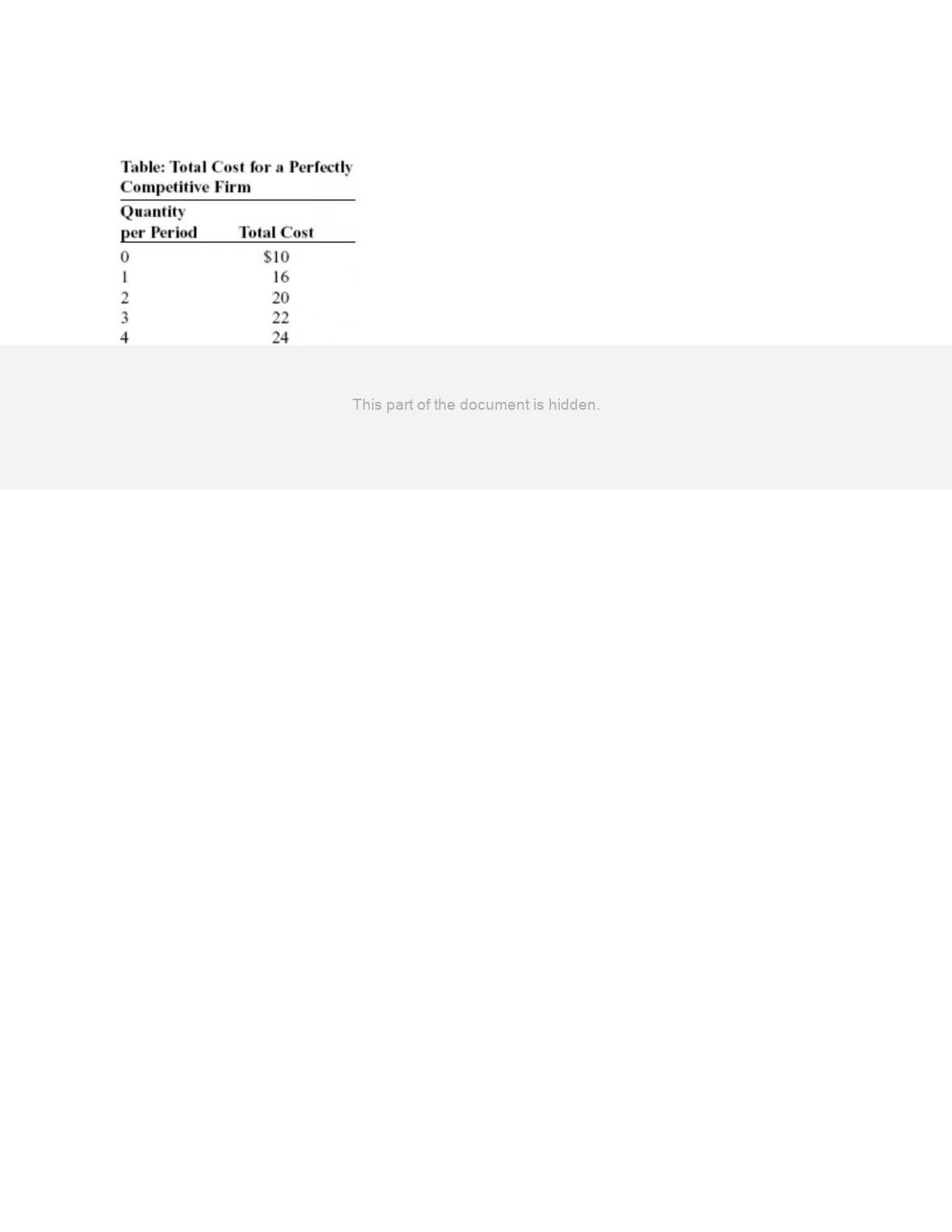
(Table: Total Cost for a Perfectly Competitive Firm) Use Table: Total Cost for a
Perfectly Competitive Firm. If the market price is $4.50, the profit-maximizing output is
_____ units.
A)
5
B)
7
C)
8
D)
9
171.
(Table: Total Cost for a Perfectly Competitive Firm) Use Table: Total Cost for a
Perfectly Competitive Firm. If the market price is $3.50, the profit-maximizing output is
_____ units.
A)
5
B)
7
C)
8
D)
9
172.
(Table: Total Cost for a Perfectly Competitive Firm) Use Table: Total Cost for a
Perfectly Competitive Firm. If the market price is $5.50, the profit-maximizing quantity
of output is _____ units.
=
A)
5
B)
7
C)
8
D)
9
Page 39
173.
(Table: Total Cost for a Perfectly Competitive Firm) Use Table: Total Cost for a
Perfectly Competitive Firm. If the market price is $4.50, profit at the profit-maximizing
quantity of output is:
A)
$2.00.
B)
$4.50.
C)
$5.00.
D)
$34.00.
174.
(Table: Total Cost for a Perfectly Competitive Firm) Use Table: Total Cost for a
Perfectly Competitive Firm. The firm will produce at a non-negative economic profit in
the short run if the price is at least:
A)
$2.00.
B)
$2.50.
C)
$3.50.
D)
$4.25.
175.
(Table: Total Cost for a Perfectly Competitive Firm) Use Table: Total Cost for a
Perfectly Competitive Firm. In the short run, the firm will produce, but at a loss, if the
price is:
A)
$2.00.
B)
$2.50.
C)
$3.50.
D)
$4.50.
176.
(Table: Total Cost for a Perfectly Competitive Firm) Use Table: Total Cost for a
Perfectly Competitive Firm. The firm will stop production and shut down at any price
less than:
A)
$2.50.
B)
$2.83.
C)
$3.50.
D)
$5.00.
Page 40
Use the following to answer questions 177-180:
177.
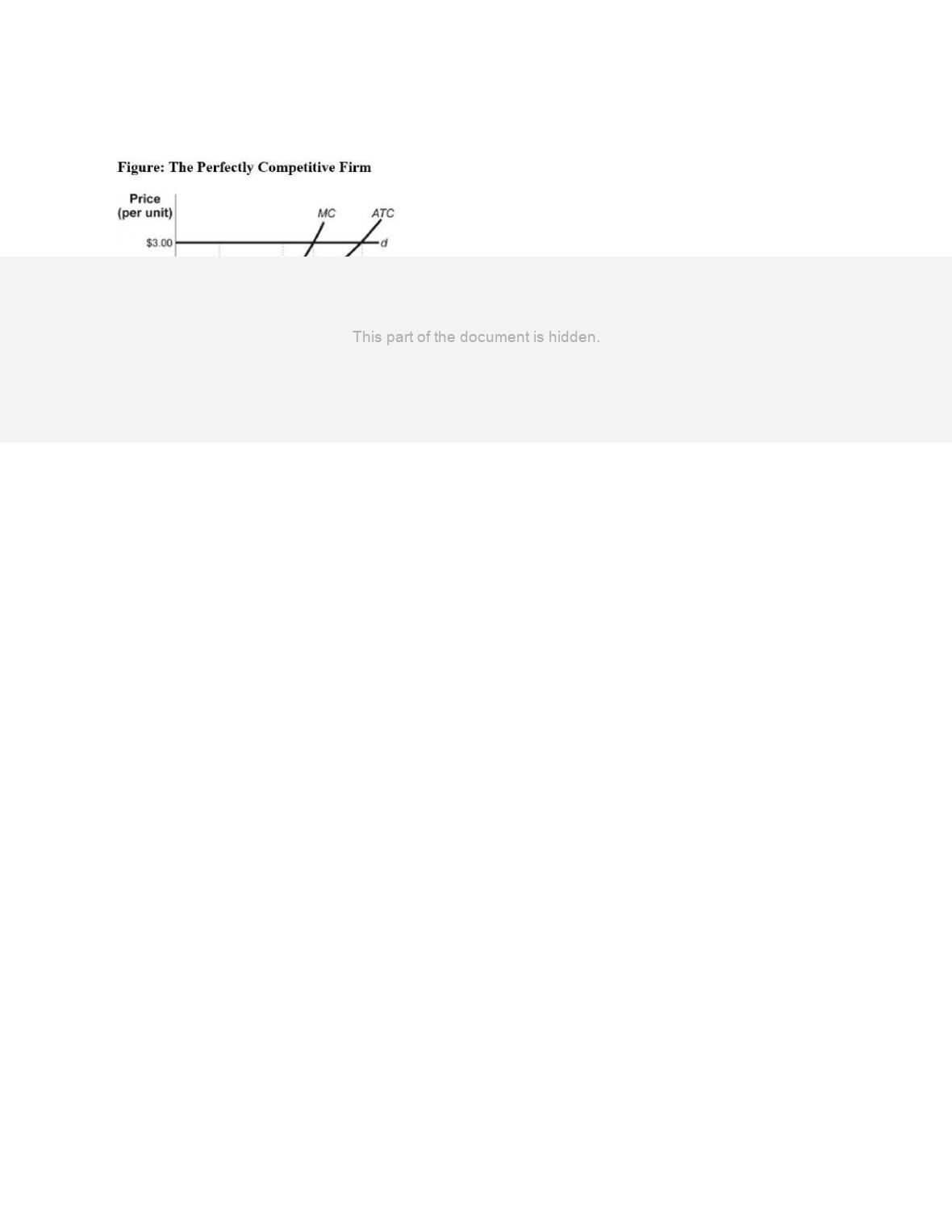
(Figure: The Perfectly Competitive Firm) Use Figure: The Perfectly Competitive Firm.
The figure shows a perfectly competitive firm that faces demand curve d and maximizes
profit. If the market price is $3, the firm will produce _____ units of output per day.
A)
100
B)
250
C)
300
D)
400
178.
(Figure: The Perfectly Competitive Firm) Use Figure: The Perfectly Competitive Firm.
The figure shows a perfectly competitive firm that faces demand curve d and maximizes
profit. Given the market price, the firm’s total revenue per day is:
A)
$475.
B)
$600.
C)
$900.
D)
$1,200.
179.
(Figure: The Perfectly Competitive Firm) Use Figure: The Perfectly Competitive Firm.
The figure shows a perfectly competitive firm that faces demand curve d and maximizes
profit. Given the market price, the firm’s total cost per day is:
A)
$475.
B)
$600.
C)
$900.
D)
$1,200.