
Page 1
Name: __________________________ Date: _____________
1.
If a California avocado stand operates in a perfectly competitive market, that stand’s
owner will be a price:
A)
maker.
B)
taker.
C)
discriminator.
D)
maximizer.
2.
If all firms in an industry are price takers:
A)
each firm can sell at the price it wants to charge, provided it is not too different
from the prices other firms are charging.
B)
each firm takes the market price as given for its output level, recognizing that the
price will change if it alters its output significantly.
C)
an individual firm cannot alter the market price even if it doubles its output.
D)
the market sets the price, and each firm can take it or leave it by setting a different
price.
3.
The assumptions of perfect competition imply that:
A)
individuals in the market accept the market price as given.
B)
individuals can influence the market price.
C)
the price will be fair.
D)
the price will be high.
4.
Price takers are individuals in a market who:
A)
select a price from a wide range of alternatives.
B)
select the lowest price available in a competitive market.
C)
select the average of prices available in a competitive market.
D)
have no ability to affect the price of a good in a market.
5.
Individuals in a market who must take the market price as given are:
A)
quantity minimizers.
B)
quantity takers.
C)
price takers.
D)
price searchers.

Page 2
6.
Perfect competition is characterized by:
A)
rivalry in advertising.
B)
fierce quality competition.
C)
the inability of any one firm to influence price.
D)
widely recognized brands.
7.
When a firm cannot affect the market price of the good that it sells, it is said to be a:
A)
price taker.
B)
natural monopoly.
C)
dominant firm.
D)
cartel.
8.
The assumptions of perfect competition imply that:
A)
individuals in the market determine the market price.
B)
firms in the market accept the market price as given.
C)
there will be no new competition due to natural monopolies.
D)
the price will be decreasing yearly.
9.
In the model of perfect competition:
A)
the consumer is at the mercy of powerful firms that can set prices wherever they
prefer.
B)
individual firms can influence the price, but only slightly.
C)
no individual or firm has enough power to affect price.
D)
the price is determined by how many years are left in the product’s patent.
10.
A perfectly competitive firm is a:
A)
price taker.
B)
price searcher.
C)
cost maximizer.
D)
quantity taker.
11.
If a Florida strawberry wholesaler operates in a perfectly competitive market, that
wholesaler will have a _____ share of the market, and consumers will consider her
strawberries and her competitors’ strawberries to be _____. Therefore, _____
advertising will take place in this market.
A)
large; standardized; no
B)
small; standardized; little or no
C)
small; differentiated; no
D)
large; differentiated; extensive
Page 3
12.
One characteristic of a perfectly competitive market is that there are _____ sellers of the
good or service.
A)
one or two
B)
a few
C)
usually fewer than 10
D)
many
13.
Which statement is NOT a characteristic of a perfectly competitive industry?
A)
Firms seek to maximize profits.
B)
Profits may be positive in the short run.
C)
There are many firms.
D)
Products are differentiated.
14.
In a perfectly competitive industry, each firm:
A)
is a price maker.
B)
produces about half of the total industry output.
C)
produces a differentiated product.
D)
produces a standardized product.
15.
For the Colorado beef industry to be classified as perfectly competitive, ranchers in
Colorado must have _____ on prices and beef must be a _____ product.
A)
no noticeable effect; standardized
B)
a huge effect; standardized
C)
a huge effect; differentiated
D)
no noticeable effect; differentiated
16.
Which statement describes a necessary condition for perfect competition?
A)
A small number of firms control a large share of the total market.
B)
Movement into and out of the market is limited.
C)
Firms produce a standardized product.
D)
Extensive advertising is used to promote the firm’s product.
17.
Which statement is NOT characteristic of perfect competition?
A)
All firms produce the same standardized product.
B)
There are many producers, and each has only a small market share.
C)
There are many producers; one firm has a 25% market share, and all of the
remaining firms have a market share of less than 2% each.
D)
There are no obstacles to entry into or exit from the industry.
Page 4
18.
The perfectly competitive model does NOT assume:
A)
a great number of buyers.
B)
easy entry to and exit from the market.
C)
a standardized product.
D)
that firms attempt to maximize their total revenue.
19.
The market for breakfast cereal contains hundreds of similar products, such as Froot
Loops, cornflakes, and Rice Krispies, that are considered to be different products by
different buyers. This situation violates the perfect competition assumption of:
A)
many buyers and sellers.
B)
a standardized product.
C)
ease of entry.
D)
ease of exit.
20.
An assumption of the model of perfect competition is:
A)
discrimination.
B)
difficult entry and exit.
C)
many buyers and sellers.
D)
limited information.
21.
The competitive model of markets does NOT assume:
A)
a large number of buyers.
B)
easy entry into and exit from the market.
C)
a standardized product.
D)
patents and copyrights that serve as barriers to entry into the industry.
22.
_____ almost always take the market price as given; that is, they are considered _____.
However, this is often not true of _____.
A)
Consumers; quantity minimizers; producers
B)
Producers; quantity takers; consumers
C)
Consumers and producers; price takers; firms that produce a differentiated product
D)
Producers; price searchers; consumers
23.
An assumption of the model of perfect competition is:
A)
identical goods.
B)
difficult entry and exit.
C)
few buyers and sellers.
D)
cooperation and interdependence between sellers.
Page 5
24.
People in the eastern part of Beirut are prevented by border guards from traveling to the
western part of Beirut to shop for or sell food. This situation violates the perfect
competition assumption of:
A)
price-setting behavior.
B)
a small number of buyers and sellers.
C)
differentiated goods.
D)
ease of entry and exit.
25.
When perfect competition prevails, which characteristic of firms are we likely to
observe?
A)
They erect and maintain barriers to new firms.
B)
There are not many of them.
C)
They all try to highlight the substantial product differentiation between producers.
D)
They are all price takers.
26.
In perfect competition:
A)
a firm’s total revenue is found by multiplying the market price by the firm’s
quantity of output.
B)
the firm’s total revenue curve is a downward-sloping line.
C)
at any price, the more sold, the higher is a firm’s marginal revenue.
D)
the firm’s total revenue curve is nonlinear.
27.
A firm’s total output times the price at which it sells that output is _____ revenue.
A)
net
B)
total
C)
average
D)
marginal
28.
Total revenue is a firm’s:
A)
change in revenue resulting from a unit change in output.
B)
ratio of revenue to quantity.
C)
difference between revenue and cost.
D)
total output times the price of that output.
29.
If a perfectly competitive firm increases production from 10 units to 11 units and the
market price is $20 per unit, total revenue for 11 units is:
A)
$10.
B)
$20.
C)
$200.
D)
$220.
Page 6
30.
If a perfectly competitive firm decreases production from 11 units to 10 units and the
market price is $20 per unit, total revenue for 10 units is:
A)
–$20.
B)
$20.
C)
$200.
D)
$210.
31.
The difference between total revenue and total cost is:
A)
economic profit or loss.
B)
nominal revenue.
C)
average revenue.
D)
marginal revenue.
32.
In a perfectly competitive industry, the market demand curve is usually:
A)
perfectly inelastic.
B)
perfectly elastic.
C)
downward-sloping.
D)
relatively elastic.
33.
The demand curve faced by a single perfectly competitive firm is:
A)
perfectly inelastic.
B)
perfectly elastic.
C)
downward sloping.
D)
relatively but not perfectly elastic.
34.
Marginal revenue:
A)
is the slope of the average revenue curve.
B)
equals the market price in perfect competition.
C)
is the change in quantity divided by the change in total revenue.
D)
is the price divided by the change in quantity.
35.
The marginal revenue received by a firm in a perfectly competitive market:
A)
is greater than the market price.
B)
is less than the market price.
C)
is equal to its average revenue.
D)
increases with the quantity of output sold.
Page 7
36.
If a perfectly competitive gardening shop sells 30 evergreen bushes at $10 per bush, its
marginal revenue is:
A)
$10.
B)
more than $10.
C)
less than $10.
D)
$300.
37.
Marginal revenue is a firm’s:
A)
ratio of profit to quantity.
B)
ratio of average revenue to quantity.
C)
price per unit times the number of units sold.
D)
increase in total revenue when it sells an additional unit of output.
38.
Perfectly competitive firms will:
A)
maximize total revenue by using the marginal decision rule.
B)
increase output up to the point that the marginal revenue of an additional unit of
output is greater than the marginal cost.
C)
increase output up to the point that the marginal revenue of an additional unit of
output is equal to the marginal cost.
D)
always attempt to minimize average variable cost.
39.
For a perfectly competitive firm, marginal revenue:
A)
is less than price.
B)
is greater than price.
C)
decreases as the firm increases output.
D)
is equal to price.
40.
A perfectly competitive firm will maximize profits when the:
A)
marginal revenue equals marginal cost.
B)
marginal revenue is lower than average variable cost.
C)
price is lower than marginal cost.
D)
price is higher than marginal cost.

Page 8
41.
The equilibrium price of a guidebook is $35 in the perfectly competitive guidebook
industry. Our firm produces 10,000 guidebooks for an average total cost of $38,
marginal cost of $30, and average variable cost of $30. Our firm, in the short run,
should:
A)
raise the price of guidebooks because the firm is losing money.
B)
keep output the same because the firm is producing at minimum average variable
cost.
C)
produce more guidebooks because the next guidebook produced will increase profit
by $5.
D)
shut down because the firm is losing money.
42.
Zoe’s Bakery operates in a perfectly competitive industry and has standard cost curves.
The variable costs at Zoe’s Bakery increase, so all of the cost curves (except fixed cost)
shift upward. The demand for Zoe’s pastries does not change, nor does the firm shut
down. To maximize profits after the variable cost increase, Zoe’s Bakery will _____ its
price and _____ its level of production.
A)
raise; increase
B)
decrease; increase
C)
raise; decrease
D)
do nothing to; decrease
43.
The slope of the total revenue curve is:
A)
marginal cost.
B)
net revenue.
C)
equal to marginal revenue and is constant under perfect competition.
D)
equal to marginal revenue and varies under perfect competition.
44.
The slope of the total cost curve is:
A)
marginal cost.
B)
marginal revenue.
C)
constant under perfect competition.
D)
always negative.
45.
For a firm producing at any level of output LOWER than the most profitable one, an
increase in output adds:
A)
more to total cost than to total revenue.
B)
more to total revenue than to total cost.
C)
the same amount to total revenue as to total cost.
D)
to total revenue but not to total cost.
Page 9
46.
For a firm producing at any level of output GREATER than the most profitable one, a
reduction in output decreases total revenue _____ total cost.
A)
by less than it decreases
B)
by more than it decreases
C)
by the same amount as it decreases
D)
but not
47.
A perfectly competitive firm maximizes profit in the short run by producing the quantity
at which:
A)
TR = TC.
B)
MR = MC.
C)
Q × (P – ATC) = 0.
D)
P < AVC.
48.
The price received by a firm in a perfectly competitive market:
A)
is equal to the market price.
B)
is less than the market price.
C)
is greater than the market price.
D)
decreases with the quantity of output sold by the firm.
49.
The marginal revenue received by a firm in a perfectly competitive market:
A)
is unrelated to the market price.
B)
is less than the market price.
C)
is greater than the market price.
D)
is the change in total revenue divided by the change in output.
50.
For a firm in a perfectly competitive market, _____ revenue equals _____.
A)
marginal; total revenue
B)
marginal; market price
C)
net; price
D)
net; marginal revenue
51.
If a perfectly competitive firm sells 10 units of output at $30 per unit, its marginal
revenue is:
A)
$10.
B)
$30.
C)
more than $30.
D)
$300.
Page 10
52.
Price in a perfectly competitive industry:
A)
is determined by each firm, depending on its costs of production.
B)
is always equal to marginal revenue for the firm.
C)
must be greater than average total cost or the firm will shut down in the short run.
D)
is indeterminate in the short run.
53.
Marginal revenue is a firm’s:
A)
ratio of the change in total revenue to the change in output.
B)
ratio of average revenue to total revenue.
C)
profit per unit times the number of units sold.
D)
increase in profit when it sells an additional unit of output.
54.
If a firm in perfect competition sells 10 units of output at $5 per unit, its marginal
revenue is:
A)
$5.
B)
more than $5 but less than $50.
C)
$50.
D)
$250.
55.
If a perfectly competitive firm sells 300 units of output at $1 per unit, its marginal
revenue is:
A)
less than $1.
B)
$1.
C)
more than $1 but less than $300.
D)
$300.
56.
In perfect competition:
A)
price and average variable cost are the same.
B)
price and marginal revenue are the same.
C)
price and total revenue are the same.
D)
total revenue and total variable cost are the same.
57.
The profit-maximizing level of output for a perfectly competitive firm in the short run
occurs where _____ equals _____.
A)
marginal cost; price
B)
marginal revenue; price
C)
total revenue; total cost
D)
average revenue; average total cost
Page 11
58.
If a perfectly competitive firm is producing a quantity where MC > MR, then profit:
A)
is maximized.
B)
can be increased by increasing production.
C)
can be increased by decreasing production.
D)
can be increased by decreasing the price.
59.
If a perfectly competitive firm is producing a quantity where MC < MR, then profit:
A)
is maximized.
B)
can be increased by increasing production.
C)
can be increased by decreasing production.
D)
can be increased by decreasing the price.
60.
If a perfectly competitive firm is producing a quantity where MC = MR, then profit:
A)
is maximized.
B)
can be increased by increasing production.
C)
can be increased by decreasing production.
D)
can be increased by decreasing the price.
61.
If a perfectly competitive firm is producing a quantity where P < MC, then profit:
A)
is maximized.
B)
can be increased by decreasing the price.
C)
can be increased by increasing production.
D)
can be increased by decreasing production.
62.
If a perfectly competitive firm is producing a quantity where P > MC, then the firm can
increase profit by:
A)
making no change in output or price because it is already maximizing profit.
B)
increasing the price.
C)
decreasing the price.
D)
increasing production.
63.
If a perfectly competitive firm is producing a quantity where P = MC, then profit:
A)
is maximized.
B)
can be increased by decreasing the quantity.
C)
can be increased by decreasing the price.
D)
can be increased by increasing production.
Page 12
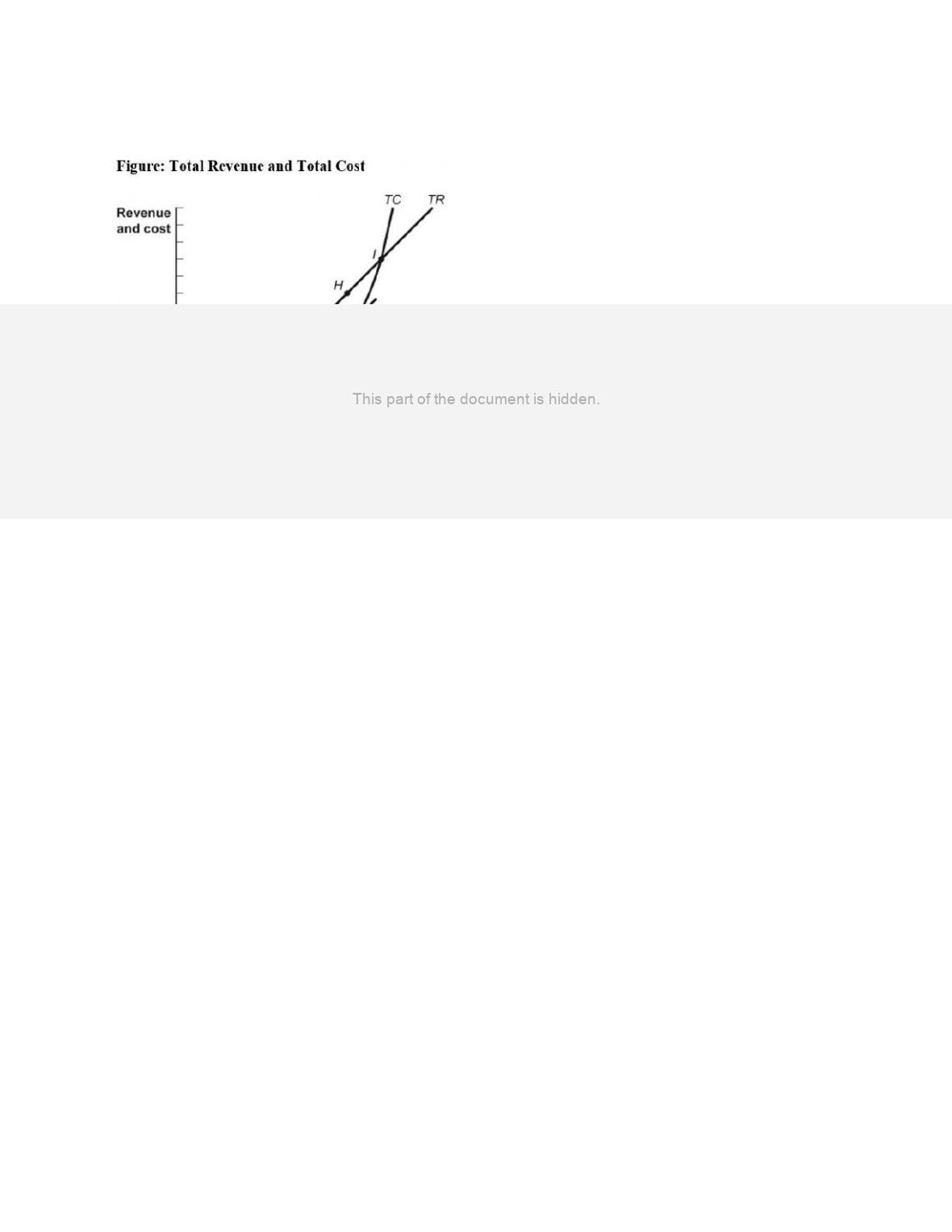
Use the following to answer question 64:
64.
(Figure: Total Revenue and Total Cost) Use Figure: Total Revenue and Total Cost. The
MOST profitable level of output occurs at quantity:
A)
F.
B)
K.
C)
L.
D)
M.
65.
If the price is greater than average total cost at the profit-maximizing quantity of output
in the short run, a perfectly competitive firm will:
A)
produce at a loss.
B)
produce at a profit.
C)
shut down production.
D)
produce more than the profit-maximizing quantity.
66.
In the short run, a perfectly competitive firm produces output and earns an economic
profit if:
A)
P > ATC.
B)
P = ATC.
C)
P < MC.
D)
P < ATC.

Page 13
67.
In the short run, a perfectly competitive firm produces output and earns ZERO
economic profit if:
A)
P < ATC.
B)
P = ATC.
C)
P < MC.
D)
P > ATC.
68.
Which statement is TRUE?
A)
Profit per unit is price minus MC.
B)
Total economic profit is per-unit profit times quantity.
C)
If price is less than ATC, the firm will break even in the short run.
D)
If price is less than marginal cost, the perfectly competitive firm should raise the
price and increase output.
69.
A perfectly competitive firm will earn a profit in the short run when it produces the
profit-maximizing quantity of output and the price is:
A)
greater than marginal cost.
B)
less than marginal cost.
C)
less than average variable cost.
D)
greater than average total cost.
70.
If the price is greater than average total cost at the profit-maximizing quantity of output
in the short run, a perfectly competitive firm will:
A)
continue to produce at a loss.
B)
produce at a profit.
C)
shut down production.
D)
reduce its fixed costs.
71.
For a perfectly competitive firm in the short run, if the firm produces the quantity at
which _____, the firm _____.
A)
P > ATC; is profitable
B)
P < ATC; breaks even
C)
P = ATC; incurs a loss
D)
P < ATC; is profitable
Page 14
72.
In the short run, a perfectly competitive firm produces output and breaks even if the firm
produces the quantity at which:
A)
P < ATC.
B)
P = ATC.
C)
P > ATC.
D)
P = (TR/Q + TC/Q) × Q.
73.
In the short run, if P = ATC, a perfectly competitive firm:
A)
produces output and earns zero economic profit.
B)
produces output and earns an economic profit.
C)
produces output and incurs an economic loss.
D)
does not produce output and incurs an economic loss.
74.
In the short run, if P > ATC, a perfectly competitive firm:
A)
produces output and earns zero economic profit.
B)
produces output and earns an economic profit.
C)
produces output and incurs an economic loss.
D)
does not produce output and earns economic profit.
75.
In perfectly competitive markets, if the price is _____, the firm will _____.
A)
greater than ATC; make an economic profit
B)
greater than the minimum ATC; break even
C)
less than ATC; make an economic profit
D)
less than ATC; break even
76.
A perfectly competitive firm will earn a profit and will continue producing the
profit-maximizing quantity of output in the short run if the price is:
A)
less than the average fixed cost.
B)
less than marginal cost.
C)
greater than average variable cost but less than average total cost.
D)
greater than average total cost.
77.
Consider a perfectly competitive firm in the short run. Assume that the firm produces
the profit-maximizing output and earns economic profits. Which statement is definitely
FALSE?
A)
Price is equal to marginal cost.
B)
Price is equal to marginal revenue.
C)
Price is equal to average total cost.
D)
Marginal cost is greater than average total cost.
Page 15
78.
Suppose a perfectly competitive firm can increase its profits by increasing its output.
Then it must be true that the firm’s _____ exceeds its _____.
A)
marginal revenue; marginal cost
B)
price; average total cost but is less than marginal cost
C)
marginal cost; marginal revenue
D)
price; marginal revenue
79.
A competitive firm operating in the short run is producing at the output level at which
ATC is at a minimum. If ATC = $8 and MR = $9, to maximize profits (or minimize
losses), this firm should:
A)
increase output.
B)
reduce output.
C)
increase price.
D)
do nothing; because it is already maximizing profits.
80.
Zoe’s Bakery operates in a perfectly competitive industry. When the market price of iced
cupcakes is $5, the profit-maximizing output level is 150 cupcakes. Her average total
cost is $4, and her average variable cost is $3. Zoe’s marginal cost is _____, and her
short-run profits are _____.
A)
$5; $150
B)
$5; $300
C)
$1; $150
D)
$1; $300
81.
A perfectly competitive firm is definitely earning an economic profit when:
A)
MR > MC.
B)
P > ATC.
C)
P > MC.
D)
P < ATC.
82.
Mikail’s perfectly competitive camera memory card–producing factory is making
positive economic profits. If the price of memory cards is $9, Mikail’s output is 3,000
cards a month, and his monthly average total cost is $7, what are his monthly profits?
A)
$6,000
B)
$27,000
C)
$21,000
D)
$2
Page 16
83.
Suppose Sarah’s pottery studio is charging the market price, which is slightly higher
than her average total cost. This means that Sarah:
A)
is breaking even.
B)
should shut down immediately.
C)
is earning a small economic profit.
D)
is incurring a small economic loss.
84.
The break-even price for a perfectly competitive firm is equal to the:
A)
minimum value of average variable cost.
B)
marginal revenue, provided that marginal revenue is equal to marginal cost.
C)
average fixed cost at the given output level.
D)
minimum value of average total cost.
85.
Consider a perfectly competitive firm in the short run. Assume that it is sustaining
economic losses but continues to produce at the profit-maximizing (loss-minimizing)
output. Which statement is FALSE?
A)
Marginal cost is less than average total cost.
B)
Marginal cost is equal to marginal revenue.
C)
Price is equal to marginal cost.
D)
Marginal cost is less than average variable cost.
86.
Zoe, the owner of Zoe’s Bakery, determines that, at her optimal level of production in
the short run, P < ATC and P > AVC. In the short run, Zoe should:
A)
continue to operate, even though she is taking an economic loss.
B)
continue to operate, as she is making an economic profit.
C)
shut down immediately, as she is taking an economic loss.
D)
raise the price until she has maximized her profits.
87.
A perfectly competitive small organic farm produces 1,000 cauliflower heads in the
short run. At this quantity, ATC = $6 and AFC = $2. The market price is $3 per head and
is equal to MC. To maximize profits or minimize losses, this farm should:
A)
increase output in the short run.
B)
reduce output but continue to produce in the short run.
C)
shut down in the short run.
D)
do nothing because it is already maximizing profits.
Page 17
88.
If the price is below average total cost, then in the short run a perfectly competitive firm
should:
A)
shut down.
B)
continue to produce to minimize losses.
C)
raise price.
D)
There is not enough information given to answer this question.
89.
During the summer, Alex runs a mowing service, and lawn mowing is a perfectly
competitive industry. In the short run, Alex will shut down if the:
A)
total revenues can’t cover fixed costs.
B)
total revenues can’t cover variable costs.
C)
total revenues can’t cover total costs.
D)
price exceeds the average total cost.
90.
Many furniture stores run “going out of business” sales but never actually go out of
business. Assume that furniture is sold in a perfectly competitive market. For a furniture
firm to actually shut down in the short run, the price of furniture must be _____ than the
_____ average variable cost.
A)
higher; maximum
B)
lower; minimum
C)
higher; minimum
D)
lower; maximum
91.
The short-run supply curve for a perfectly competitive firm is its:
A)
demand curve above its marginal revenue curve.
B)
marginal revenue curve to the right of its marginal cost curve.
C)
marginal cost curve above its average variable cost curve.
D)
average total cost curve below its marginal cost curve.
92.
The LOWEST point on a perfectly competitive firm’s short-run supply curve
corresponds to the minimum point on the _____ curve.
A)
ATC
B)
AVC
C)
AFC
D)
MC
Page 18
93.
If the price is consistently below the average variable cost, then in the short run a
perfectly competitive firm should:
A)
raise the price.
B)
sell more output.
C)
shut down.
D)
lower the price to sell more.
94.
A perfectly competitive firm will incur an economic loss but will continue to produce a
positive quantity of output in the short run if the price is:
A)
less than marginal cost.
B)
less than average variable cost.
C)
greater than average total cost.
D)
greater than average variable cost and less than average total cost.
95.
If the price is greater than the average variable cost and less than the average total cost
at the profit-maximizing quantity of output in the short run, a perfectly competitive firm
will:
A)
produce at an economic loss.
B)
produce at an economic profit.
C)
shut down production.
D)
produce more than the profit-maximizing quantity.
96.
The short-run shut-down price is the:
A)
price at which economic profit is zero.
B)
minimum of the AVC curve.
C)
intersection of the MC and ATC curves.
D)
minimum of the AFC curve.
97.
For a perfectly competitive firm, the short-run supply curve is the:
A)
entire MC curve.
B)
rising part of the MC curve beginning at the shut-down point.
C)
rising part of the MC curve beginning where the firm starts earning economic
profit.
D)
MC curve below the shut-down point.

Page 19
98.
A perfectly competitive firm will continue producing in the short run as long as it can
cover its _____ cost.
A)
total
B)
average fixed
C)
variable
D)
fixed
99.
The short-run supply curve for a perfectly competitive firm is the ____ cost curve above
the _____ price.
A)
average total; break-even
B)
average variable; shut-down
C)
marginal; break-even
D)
marginal; shut-down
100.
Which statement is TRUE?
A)
If price falls below average variable cost, the firm will shut down in the short run.
B)
Total revenue and marginal revenue are the same in perfect competition.
C)
Economic profit per unit is found by subtracting MC from price.
D)
Economic profit is always positive in the long run.
101.
In perfect competition, the profit-maximizing level of output occurs where the:
A)
MR = MC
B)
price < marginal cost above minimum AVC.
C)
MR > MC below minimum AVC.
D)
P = MR above MC.
102.
A perfectly competitive firm will incur an economic loss but will continue producing
output in the short run if the price is:
A)
less than marginal cost.
B)
greater than average fixed cost and less than average variable cost.
C)
greater than average total cost.
D)
greater than average variable cost but less than average total cost.
103.
If the price is greater than the average variable cost and less than the average total cost
at the profit-maximizing quantity of output in the short run, a perfectly competitive firm
will:
A)
continue to produce at an economic loss.
B)
earn an economic profit.
C)
encourage other firms to enter the industry.
D)
produce more than the profit-maximizing quantity.

Page 20
104.
In the short run, if AVC < P < ATC, a perfectly competitive firm:
A)
produces output and earns an economic profit.
B)
produces output and incurs an economic loss.
C)
does not produce output and earns an economic profit.
D)
does not produce output and earns zero economic profit.
105.
In the short run, a perfectly competitive firm produces output and incurs an economic
loss if:
A)
P > ATC.
B)
P < AVC.
C)
AVC > P > ATC.
D)
AVC < P < ATC.
106.
A perfectly competitive firm will not produce any output in the short run and will shut
down if the price is:
A)
greater than marginal cost.
B)
less than marginal cost.
C)
less than average variable cost.
D)
greater than average variable cost and less than average total cost.
107.
The shut-down point in the short run is the:
A)
point at which economic profit is zero.
B)
minimum point of AVC.
C)
intersection of the MC and ATC curves.
D)
minimum point of AFC.
108.
If the price is less than the average variable cost at the quantity of output where MR =
MC, in the short run a perfectly competitive firm will:
A)
produce at a loss.
B)
produce at a profit.
C)
shut down production.
D)
produce more than the profit-maximizing quantity.
109.
Assume that in the short run a perfectly competitive firm does not produce output and
has economic losses. This occurs at the quantity where MR = MC and:
A)
P = ATC and FC = 0.
B)
P < AVC and FC > 0.
C)
AVC > P > ATC and FC = 0.
D)
AVC < P < ATC and FC > 0.