
Page 21
80.
(Table: Production Function for Soybeans) Use Table: Production Function for
Soybeans. Assume that the fixed input, capital, is 10 acres of land and a tractor, which
have a combined cost of $150 per day. The cost of labor is $100 per worker per day.
The variable cost of producing 60 bushels of soybeans is:
A)
$5.
B)
$100.
C)
$150.
D)
$300.
81.
(Table: Production Function for Soybeans) Use Table: Production Function for
Soybeans. Assume that the fixed input, capital, is 10 acres of land and a tractor, which
have a combined cost of $150 per day. The cost of labor is $100 per worker per day.
The total cost of producing 60 bushels of soybeans is:
A)
$150.
B)
$450.
C)
$750.
D)
$900.
82.
(Table: Production Function for Soybeans) Use Table: Production Function for
Soybeans. Assume that the fixed input, capital, is 10 acres of land and a tractor, which
have a combined cost of $150 per day. The cost of labor is $100 per worker per day.
The total cost of producing 70 bushels of soybeans is:
A)
$250.
B)
$400.
C)
$550.
D)
$1,024.
83.
(Table: Production Function for Soybeans) Use Table: Production Function for
Soybeans. Assume that the fixed input, capital, is 10 acres of land and a tractor, which
have a combined cost of $150 per day. The cost of labor is $100 per worker per day.
The total cost of producing 75 bushels of soybeans is:
A)
$650.
B)
$1,150.
C)
$1,225.
D)
$7,650.
84.
The total cost curve is:
A)
positively sloped.
B)
negatively sloped.
C)
vertical.
D)
horizontal.

Page 22
85.
The fixed cost curve is:
A)
positively sloped.
B)
negatively sloped.
C)
vertical.
D)
horizontal.
86.
Once diminishing returns have set in, as output increases, the total cost curve:
A)
gets steeper.
B)
gets flatter.
C)
becomes horizontal.
D)
increases at first, and then decreases.
87.
The total cost curve gets steeper as output increases because of:
A)
increasing returns to the variable input.
B)
decreasing returns to the variable input.
C)
increases in fixed cost.
D)
decreases in overhead costs.
88.
The change in total output resulting from a one-unit increase in the quantity of an input
used, holding the quantities of all other inputs constant, is:
A)
average cost.
B)
average product.
C)
marginal cost.
D)
marginal product.
89.
Austin’s total fixed cost at the bakery is $3,600 a month. Austin employs 20 workers and
pays each worker $8 an hour. The marginal product of the twentieth worker is 12 iced
cupcakes an hour. What is the marginal cost of the last cupcake produced by the last
worker Austin hired?
A)
$0.26
B)
$0.66
C)
$3.81
D)
$8.00
Page 23
90.
For Heidi, the marginal cost of producing one additional photograph equals the change
in _____ cost divided by the change in the _____ of photographs.
A)
total; number
B)
marginal; number
C)
total; marginal product
D)
average; number
91.
When a cherry orchard in Oregon adds a worker, the total cost of production increases
by $24,000. Adding the worker increases total cherry output by 600 pounds. Therefore,
the marginal cost of the last pound of cherries produced is:
A)
$40.
B)
$19.
C)
$4,000.
D)
$24,000.
92.
Marginal cost CANNOT be calculated as:
A)
TC/Q, where TC is total cost and Q is output.
B)
VC/Q, where VC is variable cost and Q is output.
C)
the slope of the total cost curve.
D)
ATC * Q, where ATC is average total cost and Q is output.
93.
If the marginal cost of producing the seventh sports jersey is $21, then the total cost of
seven sports jerseys is:
A)
$21.
B)
$60.
C)
$147.
D)
The answer cannot be determined from the information provided.
94.
If Marie Marionettes is operating under conditions of diminishing marginal product, the
marginal costs will be:
A)
equal to average total cost.
B)
decreasing.
C)
increasing.
D)
constant.
Page 24
95.
Buford Bus Manufacturing installs a new assembly line. As a result, the output per
worker increases. The marginal cost of output at Buford:
A)
will increase (the MC curve will shift up).
B)
will decrease (the MC curve will shift down).
C)
will be unchanged.
D)
is at its maximum.
96.
If the marginal cost of the first sports jersey is $21, the marginal cost of the second
sports jersey is $40, and the marginal cost of the third jersey is $17, what is the total
variable cost of producing three jerseys?
A)
$26
B)
$78
C)
$17
D)
$61
97.
The shape of the marginal cost curve is the mirror image of the shape of the _____
curve.
A)
total product
B)
average product
C)
marginal product
D)
average total cost
98.
Ashley Bakery expects its marginal cost curve will eventually slope upward because, as
with most production processes, baking has:
A)
constant opportunity costs.
B)
a maximum output.
C)
diminishing marginal returns.
D)
decreasing opportunity costs.
99.
The _____ curve shows the additional cost of producing each additional unit of output.
A)
average cost
B)
total cost
C)
marginal product
D)
marginal cost
100.
Marginal cost is the change in _____ cost resulting from a one-unit change in _____.
A)
total; a variable input
B)
total; output
C)
total; average cost
D)
average; output

Page 25
101.
A firm’s marginal cost is:
A)
the ratio of the change in total cost to the change in the quantity of output.
B)
the change in total cost divided by the change in labor input.
C)
the slope of the average fixed cost curve.
D)
total cost divided by output.
102.
Marginal cost _____ over the range of increasing marginal returns and _____ over the
range of diminishing marginal returns.
A)
increases; decreases
B)
decreases; increases
C)
is constant; decreases
D)
increases; is constant
103.
Which statement is FALSE?
A)
When the marginal product of labor is upward sloping, the marginal cost curve is
upward sloping.
B)
The average fixed cost curve is downward sloping and approaches the horizontal
axis as output increases.
C)
The marginal cost curve intersects the average variable cost curve at the minimum
of average variable cost.
D)
When the marginal cost curve is above the average cost curve, the average cost
curve is upward sloping.
104.
The curve that shows the additional cost of each additional unit of output is called the
_____ curve.
A)
average cost
B)
total cost
C)
marginal product
D)
marginal cost
105.
Marginal cost is the change in:
A)
total product resulting from a one-unit change in a variable input.
B)
total cost resulting from a one-unit change in quantity of a variable input.
C)
total cost divided by the change in output.
D)
average cost resulting from a one-unit change in quantity of output.

Page 26
106.
The change in total cost resulting from a one-unit change in quantity is _____ cost.
A)
average fixed
B)
average variable
C)
marginal
D)
average total
107.
A firm’s marginal cost is the:
A)
ratio of the change in fixed cost to the change in the quantity of output.
B)
slope of the total cost curve.
C)
slope of the average variable cost curve.
D)
ratio of the change in total output to the change in the quantity of labor.
108.
Marginal cost is the:
A)
increase in total cost when one more unit of output is produced.
B)
reduction in cost from economies of scale.
C)
ratio of average total cost to total cost.
D)
increase in output from the addition of one unit of labor.
109.
The larger the output, the more output over which fixed cost is distributed. Called the
_____ effect, this leads to a _____ average _____ cost as output rises.
A)
spreading; lower; fixed
B)
spreading; higher; fixed
C)
diminishing returns; lower; variable
D)
diminishing returns; higher; variable
110.
The larger the output, the more variable input required to produce additional units.
Called the _____ effect, this leads to a _____ average _____ cost as output rises.
A)
spreading; lower; fixed
B)
spreading; higher; fixed
C)
diminishing returns; lower; variable
D)
diminishing returns; higher; variable
111.
The average total cost curve has a shape because the _____ effect is dominant at low
levels of output, and the _____ effect is dominant at high levels of output.
A)
diminishing returns; spreading
B)
spreading; diminishing returns
C)
comparative advantage; absolute advantage
D)
absolute advantage; comparative advantage
Page 27
112.
The rent for Oscar’s sporting goods store is $2,500 per month. Oscar pays his staff $9
per hour, and his monthly electricity bill averages $700, depending on his total hours of
operation. Oscar’s fixed costs of production equal:
A)
$2,500 per month.
B)
$3,200 per month.
C)
$9 per hour multiplied by total hours of work plus $700.
D)
$9 per hour multiplied by total hours of work plus $3,200.
113.
Krista’s dry-cleaning business incurs $900 per month in fixed costs. Last month her total
output was 3,000 pounds of clothes. This month her total output fell to 2,700 pounds.
This means her average fixed cost _____ by a little more than _____ cents.
A)
fell; 3.33
B)
increased; 3.33
C)
fell; 2.50
D)
increased; 2.50
114.
Darren runs a barbershop with average fixed costs of $60 per day and a total output of
50 haircuts per day. Darren shuts down every year during the last week of July and the
first week of August (meaning it is open 50 weeks a year). What is his annual fixed cost
if he is open six days per week?
A)
$18,000
B)
$3,000
C)
$60
D)
The answer cannot be determined with the information available.
115.
The average total cost of producing cell phones in a factory is $20 at the current output
level of 100 units per week. If the fixed cost is $1,200 per week:
A)
average fixed cost is $20.
B)
total cost is $3,200.
C)
variable cost is $2,000.
D)
average variable cost is $8.
116.
Average variable cost does NOT equal:
A)
variable cost divided by output.
B)
total cost minus fixed cost divided by output.
C)
average total cost minus average fixed cost.
D)
variable cost times output.
Page 28
117.
You run a business producing picture frames. This month, your total cost of production
is $10,000, your variable cost of production is $6,000, and you produce 3,000 picture
frames. It follows that average _____ cost is _____.
A)
variable; $2
B)
total; $3
C)
total; $1
D)
fixed; $1
118.
For most restaurants, the average total cost curve _____ at _____ levels of output, then
_____ at _____ levels.
A)
falls; low; rises; high
B)
rises; low; falls; high
C)
rises; high; rises; low
D)
falls; high; falls; low
119.
In the short run, the average total cost curve slopes upward because of:
A)
economies of scale.
B)
diseconomies of scale.
C)
increasing returns.
D)
diminishing returns.
120.
The _____ cost curve is NOT affected by diminishing returns.
A)
average fixed
B)
average variable
C)
average total
D)
marginal
121.
The _____ cost curve continually declines as more output is produced in the short run.
A)
marginal
B)
average variable
C)
average fixed
D)
average total
Page 29
Use the following to answer questions 122-124:
122.
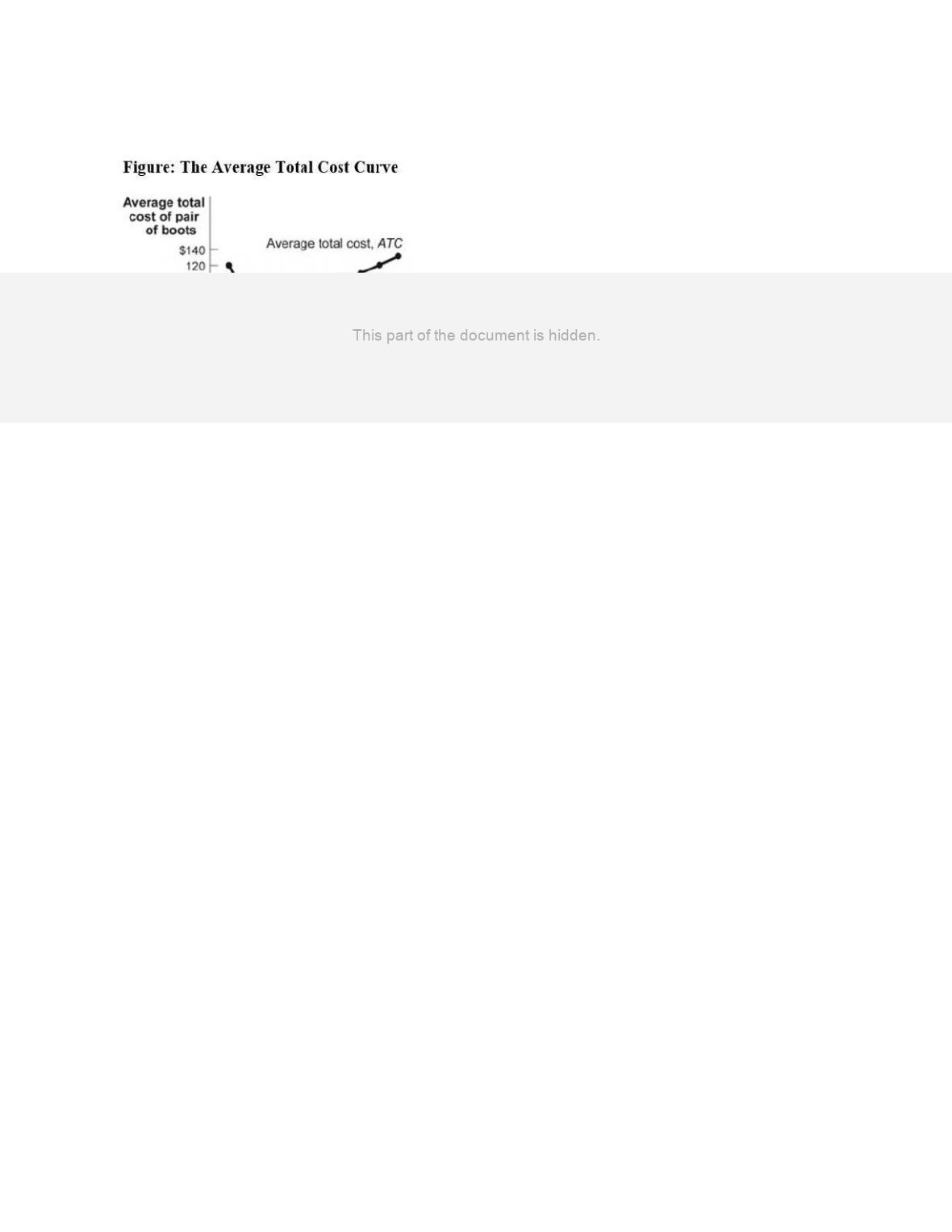
(Figure: The Average Total Cost Curve) Use Figure: The Average Total Cost Curve.
The total cost of producing three pairs of boots is approximately:
A)
$24.
B)
$72.
C)
$75.
D)
$216.
123.
(Figure: The Average Total Cost Curve) Use Figure: The Average Total Cost Curve.
The total cost of producing five pairs of boots is approximately:
A)
$408.
B)
$82.
C)
$108.
D)
$17.
124.
(Figure: The Average Total Cost Curve) Use Figure: The Average Total Cost Curve.
The total cost of producing 10 pairs of boots is approximately:
A)
$13.
B)
$54.
C)
$131.
D)
$1,308.
125.
Average total cost is:
A)
the change in cost divided by the change in output.
B)
total cost divided by output.
C)
the change in output divided by the change in costs.
D)
total cost times output.
Page 30
126.
Total cost divided by the quantity of output produced is:
A)
average total cost.
B)
average fixed cost.
C)
average product.
D)
marginal cost.
127.
Average variable cost is:
A)
variable cost per unit multiplied by output.
B)
total variable cost divided by output.
C)
the difference between average total cost and total variable cost.
D)
the difference between total cost and total variable cost.
128.
Average variable cost is the ratio of:
A)
total cost to marginal cost.
B)
total cost to the amount of variable input.
C)
variable cost to the quantity of output.
D)
marginal cost to the quantity of output.
129.
A business produces 10 pairs of eyeglasses. It incurs $30 in average variable cost and $5
in average fixed cost. The average total cost of producing 10 pairs of eyeglasses is:
A)
$30.
B)
$35.
C)
$50.
D)
$300.
130.
A business produces 10 pairs of eyeglasses. It incurs $35 in average total cost and $5 in
average fixed cost. The average variable cost of producing 10 pairs of eyeglasses is:
A)
$30.
B)
$35.
C)
$50.
D)
$300.
131.
A business produces 10 pairs of eyeglasses. It incurs $30 in average variable cost and $5
in average fixed cost. The total cost of producing 10 pairs of eyeglasses is:
A)
$35.
B)
$50.
C)
$300.
D)
$350.
Page 31
132.
A business produces 10 pairs of eyeglasses. It incurs $30 in average variable cost and
$35 in average total cost. The total fixed cost of producing 10 pairs of eyeglasses is:
A)
$3.
B)
$35.
C)
$50.
D)
$300.
133.
Average total cost is:
A)
the change in variable cost divided by the change in quantity.
B)
total cost divided by quantity.
C)
the change in quantity divided by the change in labor costs.
D)
total cost times quantity.
134.
Average variable cost is:
A)
variable cost per unit multiplied by quantity.
B)
total variable cost divided by quantity.
C)
the difference between average total cost and total cost.
D)
the difference between total cost and total fixed cost.
135.
Average total cost is the ratio of _____ cost to _____.
A)
total; marginal cost
B)
total; quantity of output
C)
total; amount of variable input
D)
marginal; amount of variable input
136.
Total cost divided by the quantity of output produced is:
A)
always increasing.
B)
always decreasing.
C)
average total cost.
D)
marginal cost.
137.
Average variable cost is the ratio of:
A)
total cost to the marginal cost.
B)
variable inputs to fixed inputs.
C)
variable cost to the quantity of output.
D)
fixed costs to variable cost.

Page 32
138.
Variable cost divided by the quantity of output produced is _____ cost.
A)
marginal
B)
average total
C)
average fixed
D)
average variable
139.
Tankao makes earbuds for mobile devices. When Tankao produces 20 sets of earbuds,
its average variable cost is $5 per set and its average total cost is $8 per set. Tankao’s:
A)
marginal cost is less than $3 per set.
B)
marginal cost is $3 per set.
C)
average fixed cost is $3 per set.
D)
marginal cost is equal to its average fixed cost.
140.
Tankao makes Bluetooth headphones for mobile devices. When 50 Bluetooth
headphones are produced in the short run, the average variable cost is $30. Fixed costs
are greater than zero. Therefore, Tankao’s average _____ cost is _____.
A)
total; $30.
B)
total; greater than $30.
C)
total; less than $30.
D)
fixed; $30.
141.
Austin’s total fixed cost is $3,600 a month for making 100,000 cupcakes at his cupcake
bakery. Austin employs 20 workers and pays each worker $600 a month. If labor is his
only variable cost, what is Austin’s total cost per month for making 100,000 cupcakes?
A)
$3,600
B)
$1,200
C)
$15,600
D)
$12,000
142.
When marginal cost is rising:
A)
average variable cost must be rising.
B)
average total cost must be rising.
C)
average variable cost and average total cost must be falling.
D)
both average variable cost and average total cost may be rising or falling.

Page 33
143.
When Aishe’s Bar-B-Que produces 10 pork sandwiches, the total cost is $5. When 11
pork sandwiches are produced, the total cost rises to $6. From this we know that the
marginal cost of the eleventh pork sandwich:
A)
is equal to the average cost of 11 pork sandwiches.
B)
is greater than the average cost of 11 pork sandwiches.
C)
is less than the average cost of 11 pork sandwiches.
D)
can’t be calculated without more information.
144.
Suppose the marginal cost curve in the short run first decreases and then increases. If
marginal cost is decreasing, _____ must be _____ and _____ must be _____.
A)
marginal product; increasing; average fixed cost; zero
B)
average variable cost; decreasing; average fixed cost; increasing
C)
average total cost; increasing; marginal cost; decreasing
D)
marginal product; increasing; average variable cost; decreasing
145.
Suppose the marginal cost curve in the short run first decreases and then increases. If
marginal cost is increasing, _____ must be _____.
A)
marginal product; increasing
B)
average variable cost; increasing
C)
average total cost; increasing
D)
marginal product; decreasing
146.
At the current level of output, Becca Furniture’s marginal cost curve is above the
average total cost curve. This means Becca Furniture’s average total cost curve:
A)
must be rising.
B)
must be flat.
C)
must be falling.
D)
may be rising, falling, or flat depending on other things.
147.
The marginal cost curve intersects the average variable cost curve at:
A)
its lowest point.
B)
its maximum.
C)
its end point.
D)
no point; the curves don’t intersect.
148.
When marginal cost is BELOW average variable cost, average variable cost must be:
A)
at its minimum.
B)
at its maximum.
C)
falling.
D)
rising.
Page 34
149.
When marginal cost is ABOVE average variable cost, average variable cost must be:
A)
at its minimum.
B)
at its maximum.
C)
falling.
D)
rising.
150.
If marginal cost is GREATER than average total cost:
A)
average total cost is increasing.
B)
average total cost is decreasing.
C)
average total cost is unchanged.
D)
marginal cost is decreasing.
151.
In general, if marginal cost is EQUAL to average total cost:
A)
average total cost is increasing.
B)
average total cost is at its maximum.
C)
average total cost is at its minimum.
D)
marginal cost is decreasing.
152.
If an increase in output results in a DECREASE in average total cost, the corresponding
marginal cost is:
A)
less than average total cost.
B)
greater than average total cost.
C)
equal to average total cost.
D)
negative.
153.
When a caterer produces 30 catered meals, its marginal cost and average variable cost
each equal $10. Therefore, assuming normally shaped cost curves, at 29 meals its
marginal cost is _____ $10 and its average variable cost is _____ $10.
A)
greater than; less than
B)
less than; greater than
C)
greater than; greater than
D)
equal to; equal to
154.
When marginal cost is BELOW average variable cost, average variable cost must be:
A)
above average total cost.
B)
below average fixed cost.
C)
falling.
D)
rising.
Page 35
155.
When marginal cost is ABOVE average variable cost, average variable cost must be:
A)
at its minimum.
B)
at its maximum.
C)
greater than average total cost.
D)
rising.
156.
If marginal cost is GREATER than average total cost, then average total cost is:
A)
at its maximum.
B)
at its minimum.
C)
rising.
D)
falling.
157.
If marginal cost is LESS than average total cost, then _____ cost is _____.
A)
average total; increasing
B)
average total; decreasing
C)
marginal; necessarily increasing
D)
marginal; necessarily decreasing
158.
Suppose Cyd knows the average total cost of producing 9 scones is $5, while the
average total cost of producing 10 scones is $5.20. What is the marginal cost of the tenth
scone?
A)
$7.00
B)
$5.20
C)
$0.20
D)
$5.00
Use the following to answer question 159:

Page 36
159.
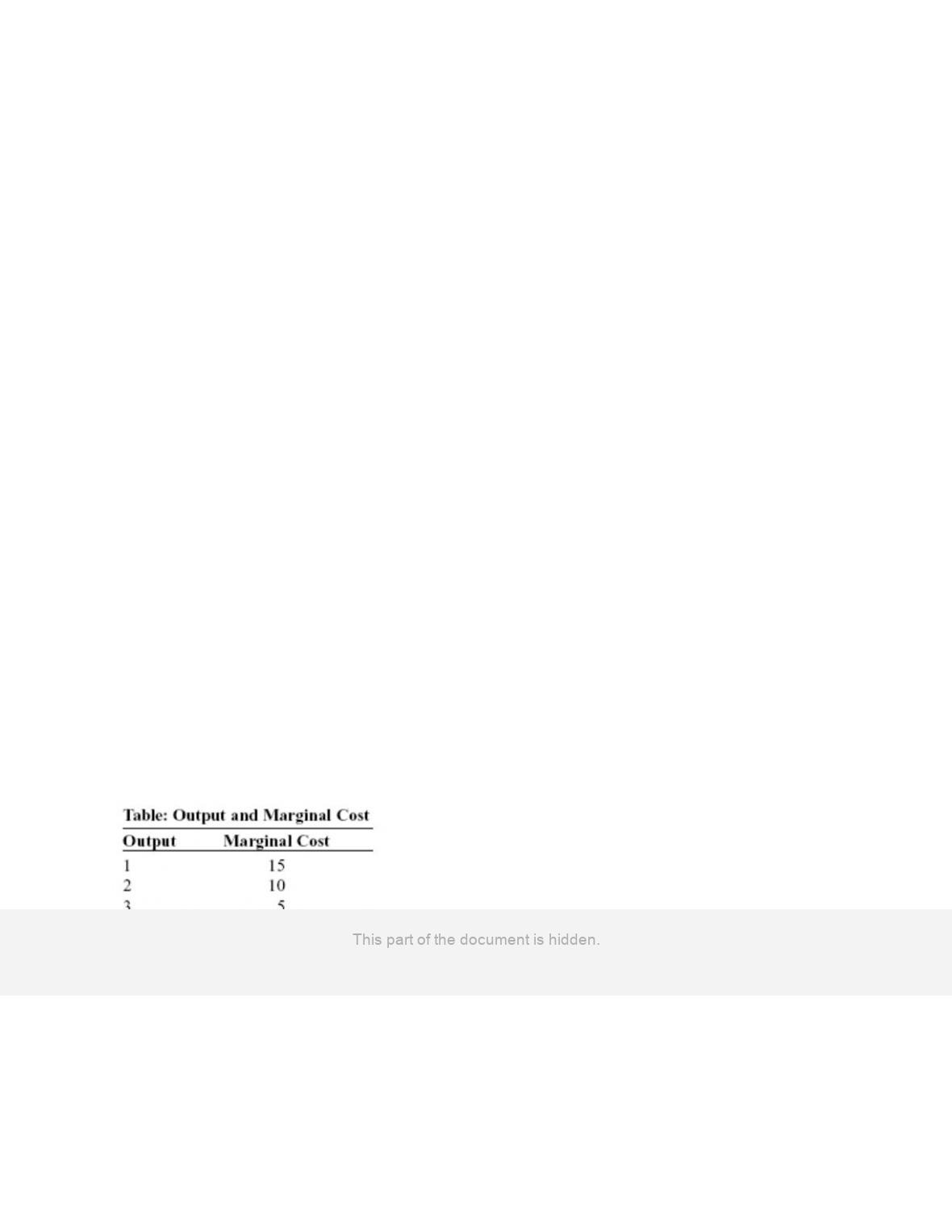
(Table: Output and Marginal Cost) Use Table: Output and Marginal Cost. After
graduation, you achieve your dream of opening an art shop that specializes in selling
mud statues. How many statues should you produce to minimize your average variable
costs?
A)
two
B)
three
C)
four
D)
five
160.
Kaile Cakes produces 10 cakes per day. The marginal cost of the tenth cake is $24, and
average total cost of 10 cakes is $6. The average total cost of 9 cakes is:
A)
$4.
B)
$5.
C)
$6.
D)
$8.
161.
Cindy operates Birds-R-Us, a small store manufacturing and selling 100 bird feeders per
month. Cindy’s monthly total fixed costs are $500, and her monthly total variable costs
are $2,500. If for some reason Cindy’s fixed cost fell to $400, then her _____ costs
would _____.
A)
average fixed; increase
B)
average total; decrease
C)
marginal; decrease
D)
average variable; decrease
162.
In the short run, as output gets larger:
A)
fixed cost gets smaller.
B)
the average variable cost curve gets closer to the average total cost curve.
C)
marginal cost gets smaller.
D)
average total cost decreases after the point of diminishing returns.
Page 37
Use the following to answer questions 163-167:
163.
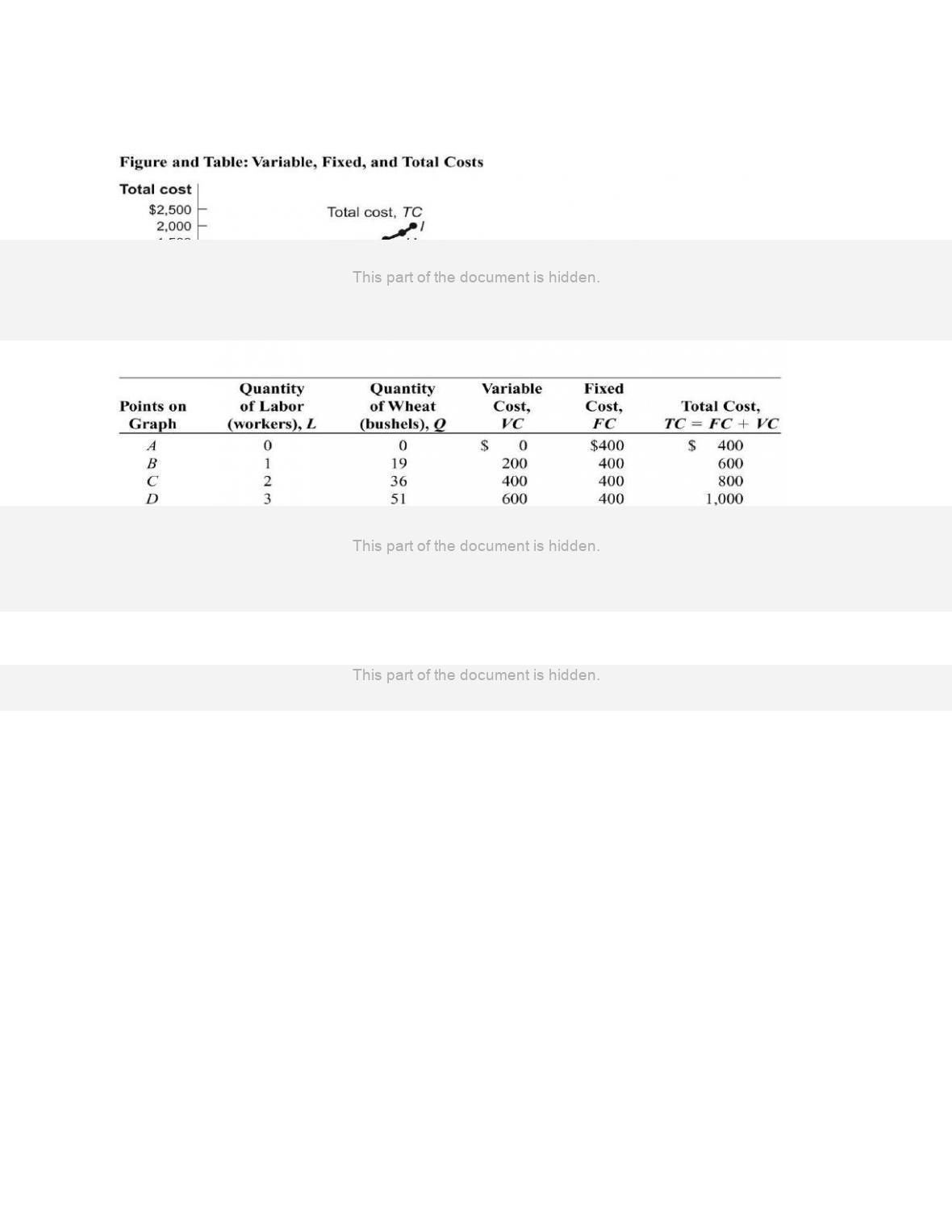
(Figure and Table: Variable, Fixed, and Total Costs) Use Figure and Table: Variable,
Fixed, and Total Costs. The marginal cost of increasing production from 19 to 36
bushels of wheat is:
A)
$23.53.
B)
$11.76.
C)
$22.22.
D)
$11.11.
164.
(Figure and Table: Variable, Fixed, and Total Costs) Use Figure and Table: Variable,
Fixed, and Total Costs. The marginal cost of increasing production from 51 to 64
bushels of wheat is:
A)
$16.00.
B)
$15.38.
C)
$12.50.
D)
$18.75.
Page 38
165.
(Figure and Table: Variable, Fixed, and Total Costs) Use Figure and Table: Variable,
Fixed, and Total Costs. The marginal cost of increasing production from 84 to 91
bushels of wheat is:
A)
$13.00.
B)
$19.78.
C)
$22.22.
D)
$28.57.
166.
(Figure and Table: Variable, Fixed, and Total Costs) Use Figure and Table: Variable,
Fixed, and Total Costs. When 51 bushels of wheat is produced, the average fixed cost is
_____, average variable cost is _____, and average total cost is _____.
A)
$7.84; $11.76; $19.60
B)
$133.33; $200.00; $333.33
C)
$400.00; $600.00; $1,000.00
D)
$5.33; $13.33; $18.67
167.
(Figure and Table: Variable, Fixed, and Total Costs) Use Figure and Table: Variable,
Fixed, and Total Costs. When 96 bushels of wheat is produced, the average fixed cost is
_____, average variable cost is _____, and average total cost is _____.
A)
$7.84; $11.76; $19.60
B)
$133.33; $200.00; $333.33
C)
$4.17; $16.67; $20.83
D)
$5.33; $13.33; $18.67
Use the following to answer questions 168-171:
Page 39
168.
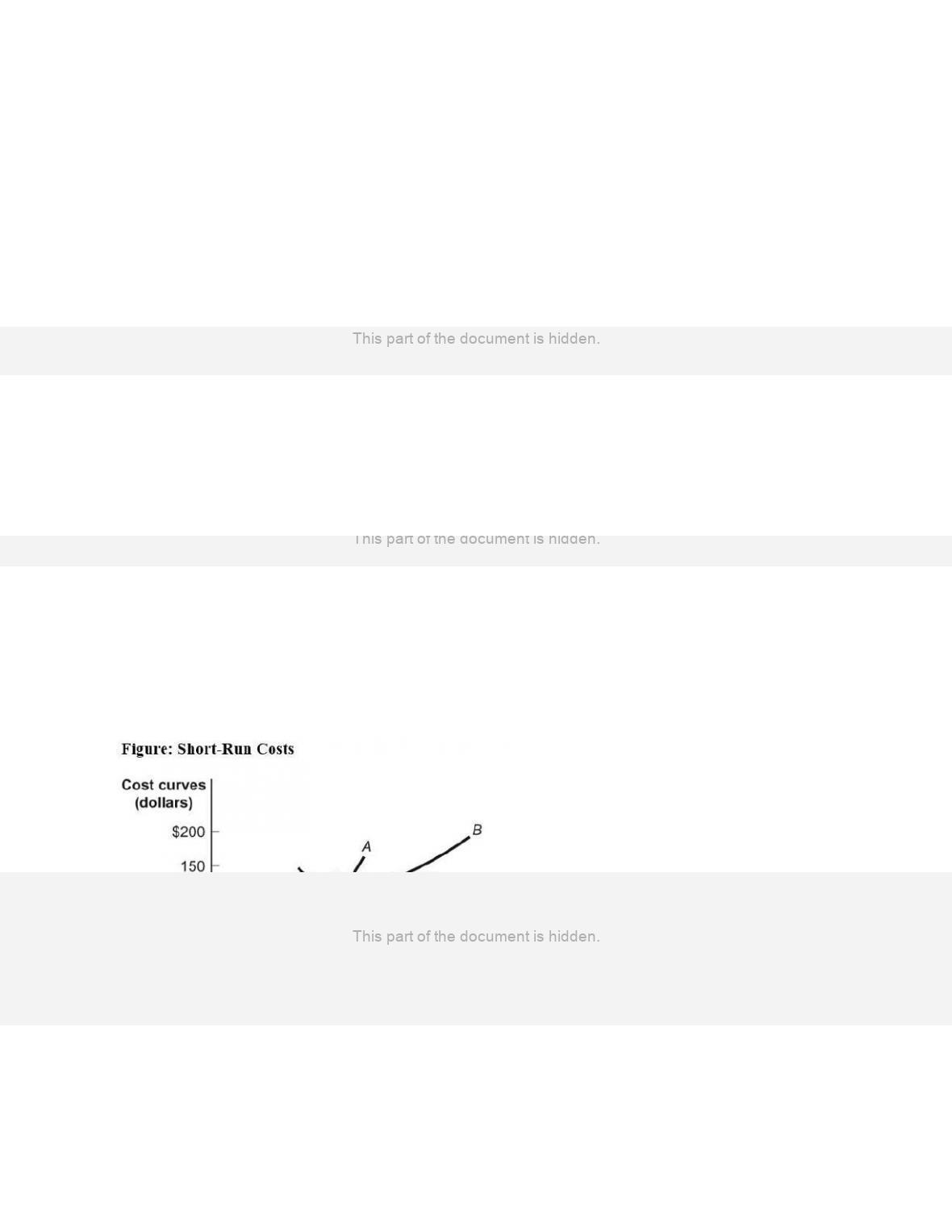
(Figure: Short-Run Costs) Use Figure: Short-Run Costs. A is the _____ cost curve.
A)
average total
B)
average variable
C)
marginal
D)
total
169.
(Figure: Short-Run Costs) Use Figure: Short-Run Costs. B is the _____ cost curve.
A)
average total
B)
average variable
C)
marginal
D)
total
170.
(Figure: Short-Run Costs) Use Figure: Short-Run Costs. C is the _____ cost curve.
A)
average total
B)
total
C)
marginal
D)
average variable
171.
(Figure: Short-Run Costs) Use Figure: Short-Run Costs. The vertical difference between
curve B and curve C at any quantity of output is _____ cost.
A)
marginal
B)
fixed
C)
average fixed
D)
average variable
Use the following to answer questions 172-179:
Page 40
172.
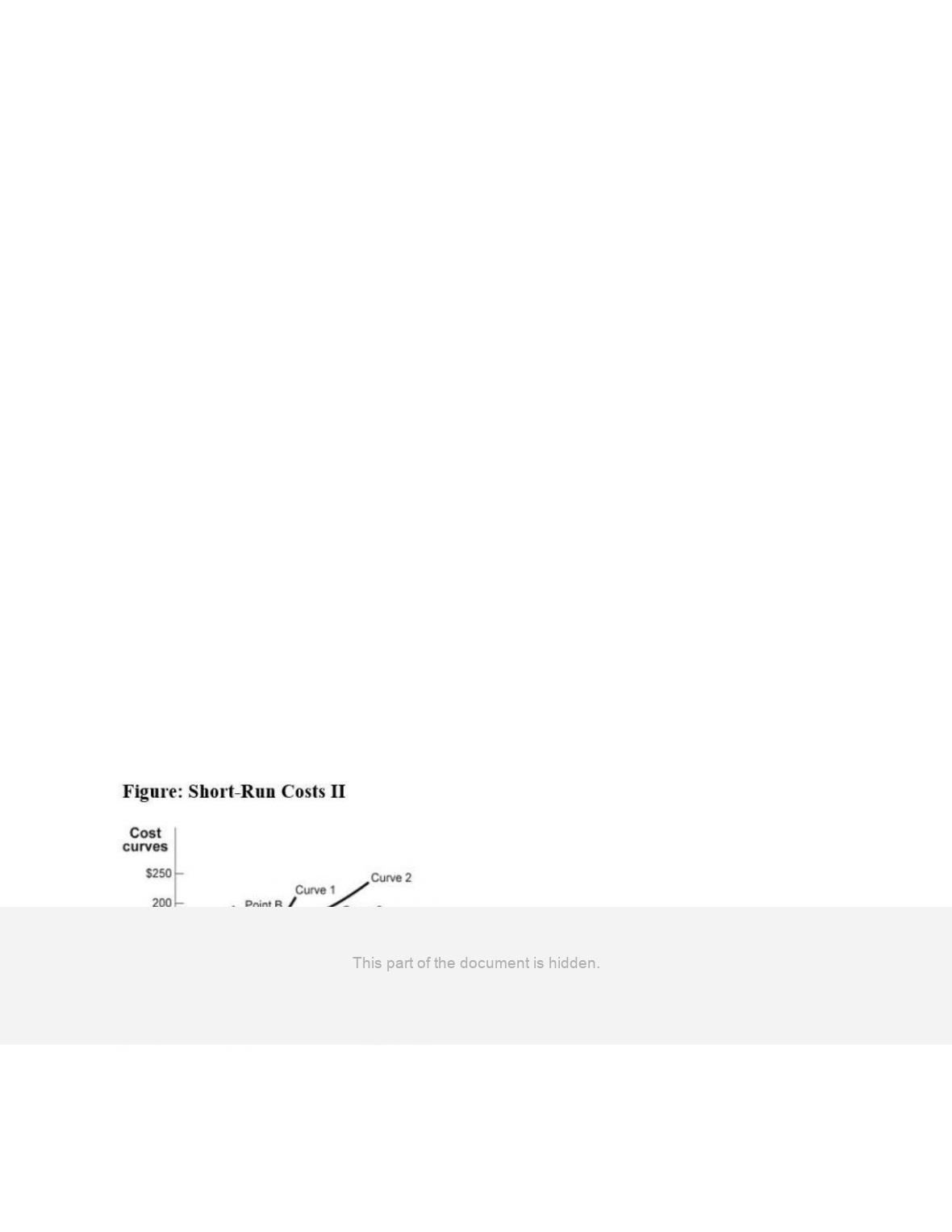
(Figure: Short-Run Costs II) Use Figure: Short-Run Costs II. Curve 1 is the _____ cost
curve.
A)
average total
B)
average variable
C)
marginal
D)
total
173.
(Figure: Short-Run Costs II) Use Figure: Short-Run Costs II. Curve 2 is the _____ cost
curve.
A)
average total
B)
average variable
C)
marginal
D)
total
174.
(Figure: Short-Run Costs II) Use Figure: Short-Run Costs II. Curve 3 is the _____ cost
curve.
A)
average total
B)
total
C)
marginal
D)
average variable
175.
(Figure: Short-Run Costs II) Use Figure: Short-Run Costs II. Curve 1 crosses the
average variable cost curve at:
A)
3 units of output.
B)
approximately 5.3 units of output.
C)
the minimum value of curve 2.
D)
the level of output at which diminishing marginal returns begin.
176.
(Figure: Short-Run Costs II) Use Figure: Short-Run Costs II. Curve 1 crosses the
average total cost curve at:
A)
the minimum value of curve 2.
B)
approximately 4.3 units of output.
C)
approximately 2.8 units of output.
D)
point A.