Page 57
218.
If the marginal utility of hot dogs exceeds the marginal utility of french fries, then the
consumer should necessarily adjust their consumption toward eating more hot dogs and
fewer french fries.
A)
True
B)
False
219.
If the price of pecan rolls is $2, the price of a gyro is $6, and the marginal utility of the
last pecan roll consumed is 12, then the marginal utility of the last gyro consumed for a
consumer purchasing the optimal consumption bundle of pecan rolls and gyros is 36.
A)
True
B)
False
220.
Suppose Sirach knows that the price of doughnuts is $3 and the price of cupcakes is $4.
He also knows that the next doughnut he consumes will increase his total utility by 6
utils and the next cupcake will increase his total utility by 10 utils. Assuming he has
enough money to buy either, Sirach should buy a doughnut next.
A)
True
B)
False
221.
At the optimal consumption bundle, the marginal utility derived from the last unit of
each good purchased is always the same.
A)
True
B)
False
222.
The optimal consumption rule implies that, if Pascal is maximizing his utility by
spending all of his income on concert tickets and cab rides, with prices equal to PTickets
and PRides, respectively, then it must be the case that MUTickets/MURides = PTickets/PRides.
A)
True
B)
False
223.
For most goods, the income effect has no significant effect on individual consumption.
A)
True
B)
False
224.
If the substitution effect and the income effect of a price change move in opposite
directions for a particular good, then the good must be an inferior good.
A)
True
B)
False
Page 58
225.
When the price of Spam (an inferior good) decreased, Dale bought more Spam. For
Dale, the income and substitution effects moved in the same direction.
A)
True
B)
False
226.
For a Giffin good, the income effect works in the opposite direction from the
substitution effect, and the income effect is larger than the substitution effect.
A)
True
B)
False
227.
Many people have severe food allergies, such that even one bite of the wrong food
might send them to the emergency room. Consider a person with a severe allergy to
nuts. Describe their total utility function from eating nuts.
228.
Explain the difference between the total utility and marginal utility of eating pizza.
229.
You have an economics test tomorrow and you think that you might need to stay up all
night to study for it. Your professor argues against pulling this all-nighter because he
thinks there is a point where more studying (and less sleeping) can actually do more
harm than good. Using the concepts of total and marginal utility, explain your
professor’s position.
230.
James spends his daily income of $50 on protein shakes (PS) and energy bars (EB).
Protein shakes are priced at $5 each, and energy bars are priced at $4 each. Provide the
equation for his budget constraint. If he spends half of his income on each item, how
many units of each will he consume?
231.
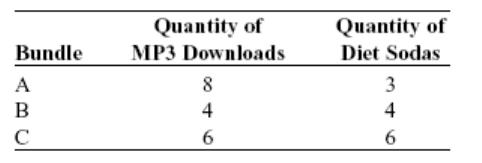
(Table: MP3 Music Downloads) Use Table: MP3 Music Downloads. Jen spends her
daily income of $28 on MP3 music downloads and diet sodas. One MP3 music
download costs $2, and one diet soda costs $4. The table provided shows three
consumption bundles. Identify the bundle that is unaffordable, the one that lies on her
budget line, and the one that is affordable but does not use all of her income.
Page 59
232.
Ladan has $500 each semester to spend on textbooks and sandwiches. Textbooks are
$100 each and sandwiches are $5 each. Assume that diminishing marginal utility applies
to both goods. She has purchased 3 textbooks this semester and 40 sandwiches. She tells
you that her marginal utility from the next textbook is about 100 utils and the marginal
utility from the next sandwich is about 15 utils. Has Ladan successfully maximized her
utility this semester? Should she adjust her spending next semester?
233.
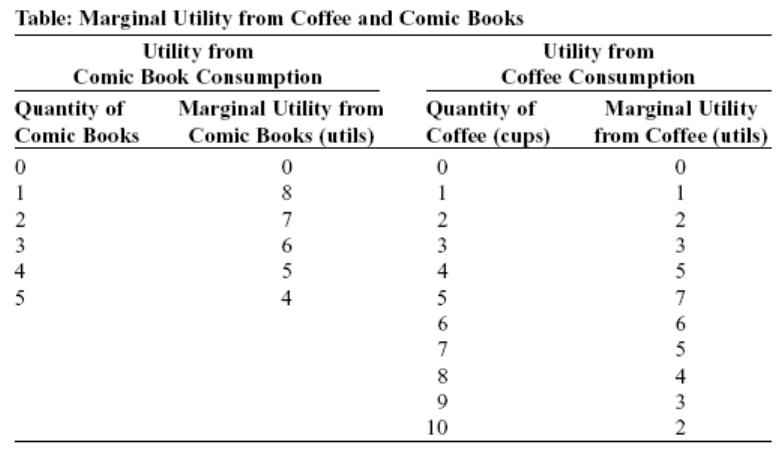
(Table: Marginal Utility from Coffee and Comic Books) Use Table: Marginal Utility
from Coffee and Comic Books. Your eccentric professor has a daily budget of $40, and
he spends it entirely on coffee and comic books. The table shows the marginal utility he
receives from consuming different quantities of coffee and comic books. Each comic
book is priced at $8, and each cup of coffee is priced at $4. To maximize his total utility,
how many cups of coffee should he buy, and how many comic books should he buy?
How many utils of total utility will he enjoy?
234.
The rising price of gasoline has caused your parents to use public transportation, rather
than drive to work. They have also decided to cancel a cross-country trip for a family
reunion. Are there substitution and income effects here? Explain.
235.
Two consumers, Eric and Eli, have the same preferences for good X, a normal good.
The only difference is that for Eli there would be no income effect if the price of good X
changed; the two would experience the same substitution effects, though. In other
words, for Eric, there would be both income and substitution effects for a price change,
but Eli would only experience substitution effects. What does this tell you about Eric’s
and Eli’s demand for good X? Explain.
Page 60
236.
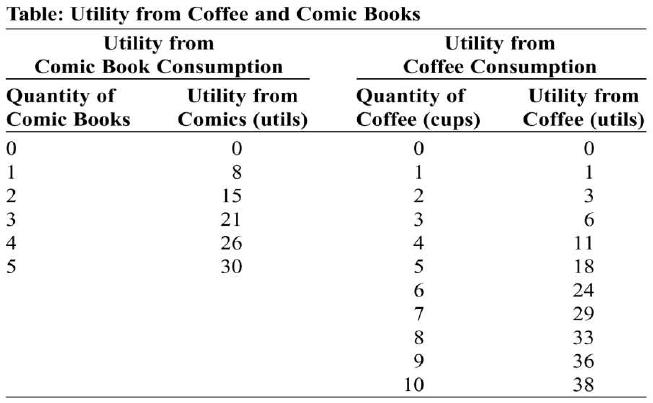
(Table: Utility from Coffee and Comic Books) Use Table: Utility from Coffee and
Comic Books. Your eccentric professor has a daily budget of $40, and he spends it
entirely on coffee and comic books. Each comic book is priced at $8 and each cup of
coffee is priced at $4. To maximize his utility, how many cups of coffee and how many
comic books should he buy? How many total utils will he enjoy?
237.
In the standard models in economics, consumers maximize utility because they are:
A)
rational.
B)
demand-constrained.
C)
inferior.
D)
comfortable.
238.
The satisfaction that a consumer gets from the consumption of a bundle of goods and
services is:
A)
utility.
B)
rationalization.
C)
budget constraints.
D)
income.
Page 61
Use the following to answer questions 239-241:
239.
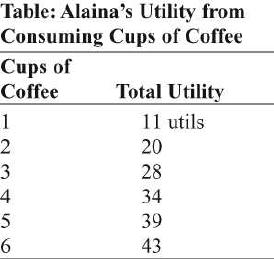
(Table: Alaina’s Utility from Consuming Cups of Coffee) Use Table: Alaina’s Utility
from Consuming Cups of Coffee. Given the information in the table, Alaina’s total
utility from drinking coffee:
A)
decreases as she consumes additional coffee.
B)
increases at a decreasing rate as she consumes more coffee.
C)
stays constant as she consumes more coffee.
D)
equals 0 utils.
240.
(Table: Alaina’s Utility from Consuming Cups of Coffee) Use Table: Alaina’s Utility
from Consuming Cups of Coffee. Alaina’s marginal utility from consuming her sixth
cup of coffee is _____ utils.
A)
43
B)
82
C)
4
D)
0
241.
(Table: Alaina’s Utility from Consuming Cups of Coffee) Use Table: Alaina’s Utility
from Consuming Cups of Coffee. Diminishing marginal utility is:
A)
not present in Alaina’s consumption of coffee since her total utility keeps
increasing.
B)
present in Alaina’s consumption of coffee since her total utility increases at a
decreasing rate with each cup consumed.
C)
equal to 0 utils.
D)
not present since Alaina exhibits increasing marginal utility.
Page 62
242.
If marginal utility is diminishing, the marginal utility curve is _____ sloping since each
additional unit of the good consumed yields _____ satisfaction than the unit that
preceded it.
A)
downward ; less
B)
upward; more
C)
downward; more
D)
upward; less
243.
George has a weekly income (I) of $50, which he uses to purchase doughnuts (D) and
coffee (C). If the price of a doughnut is $1 and the price of coffee is $2.50, his budget
constraint can be expressed as:
A)
D 50 + 2.50C.
B)
D 50 – 25C.
C)
D 50 – 0.25C.
D)
D 50 – 2.50C.
244.
George has a weekly income (I) of $50, which he uses to purchase doughnuts (D) and
coffee (C). If the price of a doughnut is $1 and the price of coffee is $2.50, which
consumption bundle lies BEYOND George’s budget constraint?
A)
10C and 25D
B)
15C and 15D
C)
5C and 10D
D)
5C and 5D
245.
George has a weekly income (I) of $50, which he uses to purchase doughnuts (D) and
coffee (C). The price of a doughnut is $1 and the price of coffee is $2.50. Suppose
George’s income increases to $100 and the prices of both doughnuts and coffee remain
unchanged. Given this income change, one would expect George’s budget line to:
A)
shift to the right.
B)
shift to the left.
C)
rotate around the coffee axis point.
D)
not be affected.
246.
George has a weekly income (I) of $50, which he uses to purchase doughnuts (D) and
coffee (C). The price of a doughnut is $1 and the price of coffee is $2.50. Suppose
George’s income drops to $25 and the prices of doughnuts and coffee each fall to
one-half their initial prices. One would expect George’s budget line to:
A)
shift to the right.
B)
shift to the left.
C)
rotate around one of the axes, but we cannot tell which one.
D)
stay the same.
Page 63
247.
Tonya’s budget constraint for gallons of gasoline (G) and shirts (S) each month can be
expressed by the equation G = 100 – 2S, where G is the number of gallons of gasoline
she buys and S is the total number of shirts she buys. Assume that she spends her entire
budget each month. If the price of shirts is $10, the price of gasoline is _____ per gallon,
and the total amount of income spent on both shirts and gasoline each month is _____.
A)
$5; $500
B)
$2; $100
C)
$1; $500
D)
$2; $1,000
248.
Tonya’s budget constraint for gallons of gasoline (G) and shirts (S) each month can be
expressed by the equation G = 100 – 2S, where G is the number of gallons of gasoline
she buys and S is the total number of shirts she buys. Assume that she spends her entire
budget each month. If the price of shirts is $10, which consumption bundle is NOT
feasible for Tonya?
A)
45 shirts and 100 gallons of gasoline
B)
50 shirts and 0 gallons of gasoline
C)
0 shirts and 100 gallons of gasoline
D)
10 shirts and 5 gallons of gasoline
249.
Tonya’s budget constraint for gallons of gasoline (G) and shirts (S) each month can be
expressed by the equation G = 100 – 2S, where G is the number of gallons of gasoline
she buys and S is the total number of shirts she buys. Assume that she spends her entire
budget each month. If the price of shirts is $10, which consumption bundle lies INSIDE
Tonya’s budget line?
A)
45 shirts and 100 gallons of gasoline
B)
50 shirts and 0 gallons of gasoline
C)
0 shirts and 100 gallons of gasoline
D)
10 shirts and 5 gallons of gasoline
250.
Consumption bundles that Mei CANNOT afford because the bundles cost more than her
income are _____ the budget line.
A)
within
B)
beyond
C)
on
D)
at the corner of
Page 64
251.
The consumption bundles that Mei CAN afford but that do not use up her entire income
lie _____ the budget line.
A)
within
B)
beyond
C)
on
D)
at the corner of
252.
Jie consumes three heads of broccoli and six bowls of rice each week, using up her
weekly budget for these two items. The price of a head of broccoli is $2, and the price of
rice is $4 per bowl. Jie’s marginal utility from the last head of broccoli consumed is 4
utils, and her marginal utility from her last bowl of rice is 8 utils. If Jie wants to
maximize her utility, she should:
A)
increase her broccoli consumption and decrease her rice consumption.
B)
increase her rice consumption and decrease her broccoli consumption.
C)
not change her consumption of either broccoli or rice.
D)
stop consuming both goods.
253.
Sam always tries to maximize his utility in his consumption of popcorn and soft drinks.
Both of these goods are subject to diminishing marginal utility. Suppose the prices of
these goods, along with Sam’s budget (and spending) for these items, stay the same, but
Sam decides to decrease his consumption of popcorn. Holding everything else constant,
this means that Sam must _____ his consumption of soft drinks, and his marginal utility
per dollar spent on popcorn will be _____ than it used to be.
A)
increase; greater
B)
decrease; greater
C)
increase; less
D)
decrease; less
254.
When a consumer maximizes utility, the marginal utility from the last dollar spent on all
goods and services in the consumption bundle must be the same. This is referred to as:
A)
the law of demand.
B)
the optimal consumption rule.
C)
the budget constraint.
D)
consumption possibilities.
Page 65
255.
A consumer is attempting to maximize utility in her consumption of goods A and B. If
her income and the price of good A do not change but the marginal utility of good B is
constant and the price of good B decreases, this will _____ utility per dollar spent on
good B.
A)
decrease the marginal
B)
not affect the marginal
C)
decrease the total
D)
increase the marginal
256.
A decrease in the price of a good, holding income and the prices of all other goods
constant, is associated with:
A)
a positive substitution effect since consumers increase their consumption of the
good as the marginal utility per dollar of the good increases.
B)
a negative substitution effect since consumers decrease their consumption of the
good as the marginal utility per dollar spent of the good decreases.
C)
the consumer purchasing fewer of all goods in the consumption bundle.
D)
a shift inward of the budget line.
257.
Consuming more of a good that has become cheaper in place of a good that has become
relatively more expensive is the:
A)
income effect.
B)
substitution effect.
C)
budget constraint.
D)
inferior effect.
258.
The income effect will play a greater role in a consumer’s spending if the good:
A)
accounts for a substantial share of the consumer’s spending.
B)
accounts for a small share of the consumer’s spending.
C)
is not subject to a budget constraint.
D)
is not something the consumer needs.
259.
Housing is a normal good that tends to take up a substantial share of a consumer’s
spending. An increase in the price of housing will result in:
A)
both an income and substitution effect to decrease the quantity demanded of
housing.
B)
both an income and substitution effect to increase the quantity demanded of
housing.
C)
the income effect of increasing the quantity demanded of housing and the
substitution effect of decreasing the quantity demanded of housing.
D)
the income effect of decreasing the quantity demanded of housing and the
substitution effect of increasing the quantity demanded of housing.
Page 66
260.
If the price of a good changes so that the income effect and the substitution effect
reinforce one another, this means the good is:
A)
inferior.
B)
always on the budget line.
C)
normal.
D)
not likely to be bought.
Use the following to answer questions 261-264:
261.
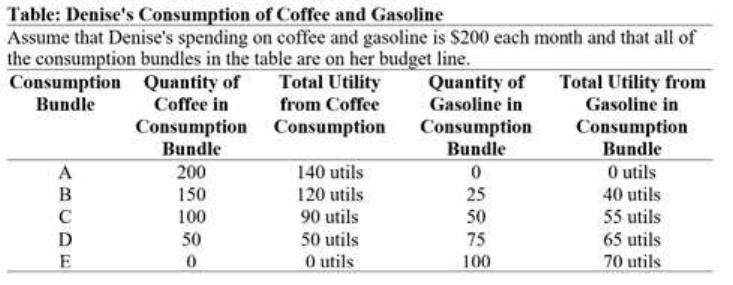
(Table: Denise’s Consumption of Coffee and Gasoline) Use Table: Denise’s
Consumption of Coffee and Gasoline. Given the information provided, the price of each
cup of coffee is _____ and the price of each gallon of gasoline is _____.
A)
$2; $2
B)
$3; $6
C)
$1; $2
D)
$3; $3
262.
(Table: Denise’s Consumption of Coffee and Gasoline) Use Table: Denise’s
Consumption of Coffee and Gasoline. Denise will maximize her utility by consuming
bundle:
A)
A.
B)
B.
C)
C.
D)
D.
Page 67
263.
(Table: Denise’s Consumption of Coffee and Gasoline) Use Table: Denise’s
Consumption of Coffee and Gasoline. When Denise maximizes her utility, her marginal
utility per dollar spent on gallons of gasoline equals _____ utils per dollar.
A)
0.6
B)
0.8
C)
0.5
D)
1.6
264.
(Table: Denise’s Consumption of Coffee and Gasoline) Use Table: Denise’s
Consumption of Coffee and Gasoline. Suppose Denise initially chooses consumption
bundle A. She can increase her total utility by:
A)
consuming more gasoline and less coffee.
B)
consuming more coffee and less gasoline.
C)
not consuming more coffee or gasoline.
D)
consuming more coffee and more gasoline.
Answer Key
Page 69
45.
A
46.
C
47.
D
48.
D
49.
A
50.
A
51.
A
52.
A
53.
A
54.
C
55.
D
56.
B
57.
C
58.
B
59.
B
60.
C
61.
C
62.
D
63.
A
64.
A
65.
A
66.
A
67.
C
68.
B
69.
D
70.
D
71.
B
72.
C
73.
C
74.
B
75.
C
76.
A
77.
A
78.
B
79.
B
80.
B
81.
A
82.
D
83.
A
84.
A
85.
C
86.
D
87.
B
88.
C
89.
A
90.
A
Page 70
91.
B
92.
D
93.
C
94.
C
95.
B
96.
D
97.
C
98.
D
99.
B
100.
A
101.
B
102.
B
103.
D
104.
C
105.
C
106.
B
107.
C
108.
C
109.
C
110.
A
111.
C
112.
B
113.
A
114.
D
115.
A
116.
C
117.
B
118.
B
119.
C
120.
B
121.
B
122.
C
123.
D
124.
B
125.
A
126.
B
127.
B
128.
A
129.
A
130.
B
131.
C
132.
C
133.
B
134.
B
135.
B
136.
A
Page 71
137.
B
138.
B
139.
B
140.
B
141.
B
142.
C
143.
A
144.
B
145.
D
146.
A
147.
A
148.
C
149.
C
150.
C
151.
A
152.
D
153.
C
154.
B
155.
D
156.
C
157.
D
158.
D
159.
A
160.
C
161.
B
162.
C
163.
B
164.
D
165.
C
166.
A
167.
A
168.
B
169.
C
170.
D
171.
C
172.
C
173.
C
174.
A
175.
D
176.
D
177.
A
178.
C
179.
D
180.
D
181.
C
182.
B
Page 72
183.
A
184.
C
185.
B
186.
B
187.
C
188.
C
189.
C
190.
C
191.
C
192.
D
193.
C
194.
D
195.
A
196.
B
197.
B
198.
A
199.
C
200.
A
201.
C
202.
A
203.
C
204.
B
205.
A
206.
B
207.
B
208.
B
209.
A
210.
B
211.
A
212.
B
213.
B
214.
A
215.
B
216.
B
217.
B
218.
B
219.
A
220.
B
221.
B
222.
A
223.
A
224.
A
225.
B
226.
A
227.
If even one bite of nuts sends this person to the hospital, their utility function must be
negative for all quantities of nuts consumed. Furthermore, each additional bite puts this
Page 73
person in more trouble; therefore, their utility must be increasingly negative as nut
consumption rises.
228.
229.
230.
231.
232.
233.
234.
235.
236.
237.
A
238.
A
239.
B
240.
C
241.
B
242.
A
243.
D
244.
B
245.
A
246.
D
247.
A
248.
A
249.
D
250.
B
251.
A
252.
C
253.
A
254.
B
255.
D
256.
A
257.
B
258.
A
259.
A
260.
C
261.
C
262.
B
263.
B
264.
A