Page 41
168.
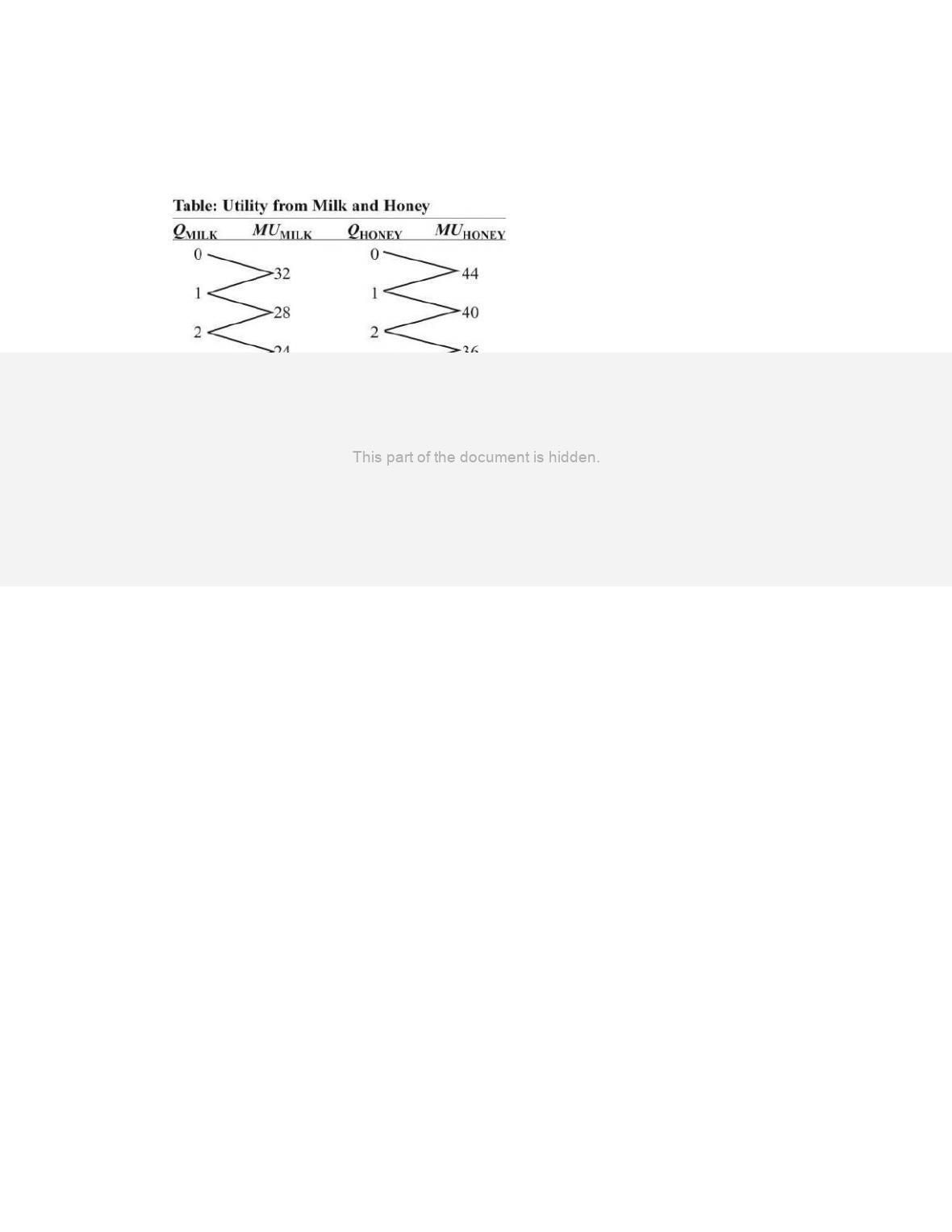
(Table: Utility from Milk and Honey) Use Table: Utility from Milk and Honey. The
price of milk is $2, and the price of honey is $4. If Max’s income is $16, he buys _____
bottle(s) of milk and _____ jar(s) of honey.
A)
1; 1
B)
4; 2
C)
5; 4
D)
6; 0
Page 42
169.
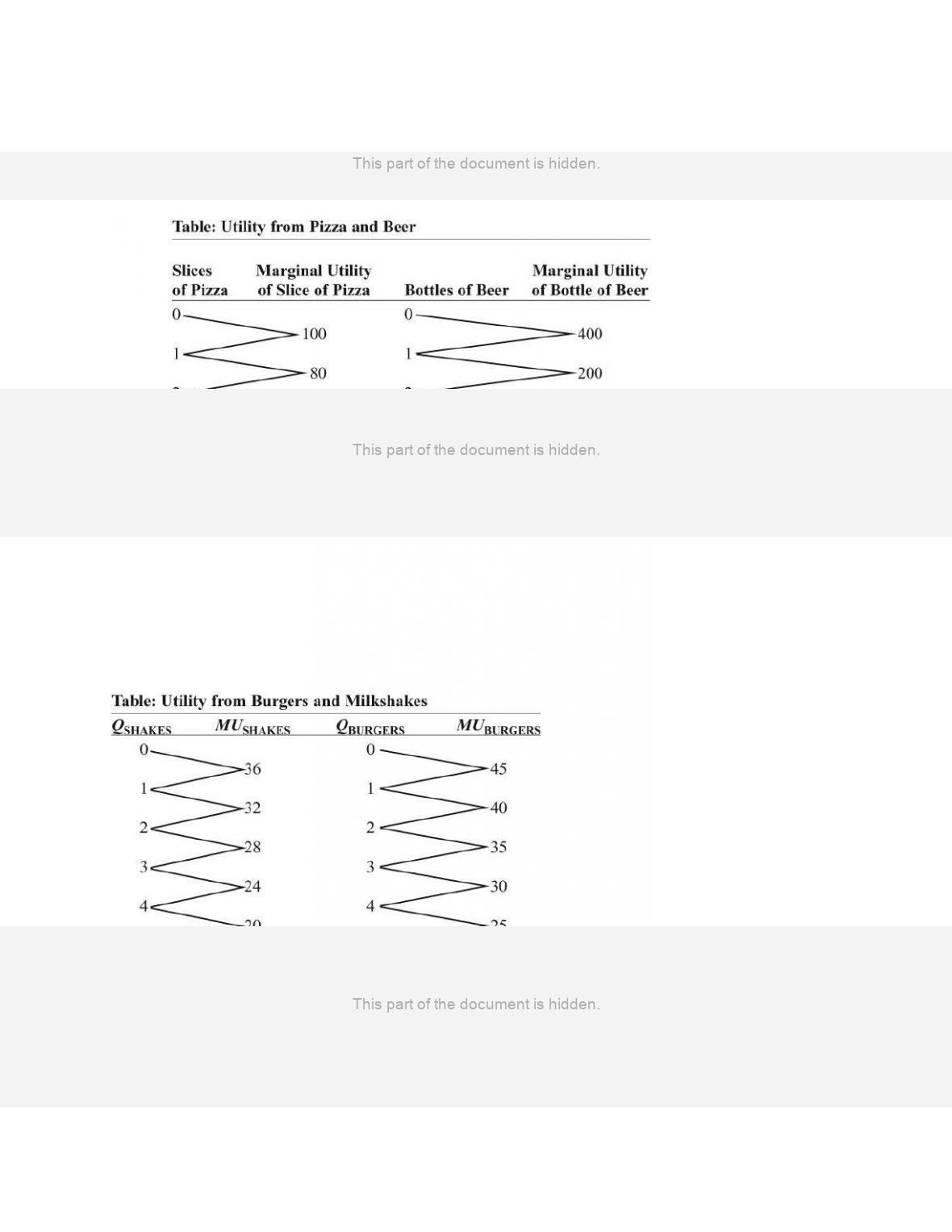
(Table: Utility from Pizza and Beer) Use Table: Utility from Pizza and Beer. At
All-Sports Bar, a bottle of beer costs $4, and a slice of pizza costs $2. Denard has $10 to
spend on beer and pizza. To maximize his utility, Denard will consume _____ slice(s) of
pizza and _____ bottle(s) of beer.
A)
5; 0
B)
3; 1
C)
1; 2
D)
4; 3
Use the following to answer questions 170-171:

Page 43
170.
(Table: Utility from Burgers and Milkshakes) Use Table: Utility from Burgers and
Milkshakes. David’s marginal utilities for milkshakes and burgers are given in the table.
The price of milkshakes is $2, and the price of burgers is $5. If David’s income is $22,
to maximize his utility, he buys _____ shake(s) and _____ burger(s).
A)
1; 1
B)
6; 0
C)
5; 1
D)
6; 2
171.
(Table: Utility from Burgers and Milkshakes) Use Table: Utility from Burgers and
Milkshakes. David’s marginal utilities for milkshakes and burgers are given in the table.
The price of milkshakes is $2, and the price of burgers is $5. If David’s income is $10,
to maximize his utility, he buys _____ shake(s) and _____ burger(s).
A)
1; 1
B)
0; 2
C)
5; 0
D)
2; 1
Page 44
172.
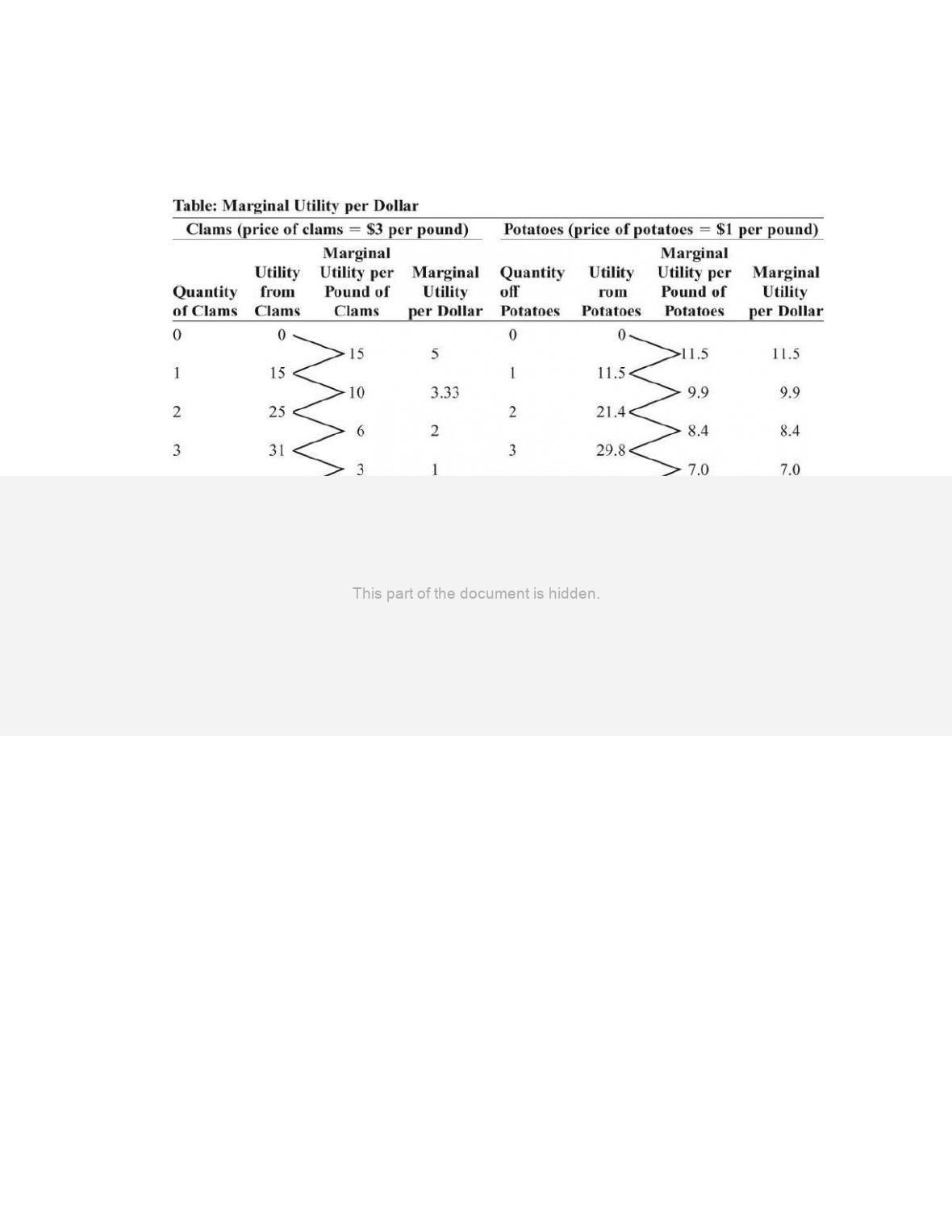
(Table: Marginal Utility per Dollar) Use Table: Marginal Utility per Dollar. If Damian
has $9 to spend on potatoes and clams, then the utility-maximizing combination is
_____ pound(s) of clams and _____ pound(s) of potatoes.
A)
0; 9
B)
2; 2
C)
1; 6
D)
2; 3
Page 45
173.
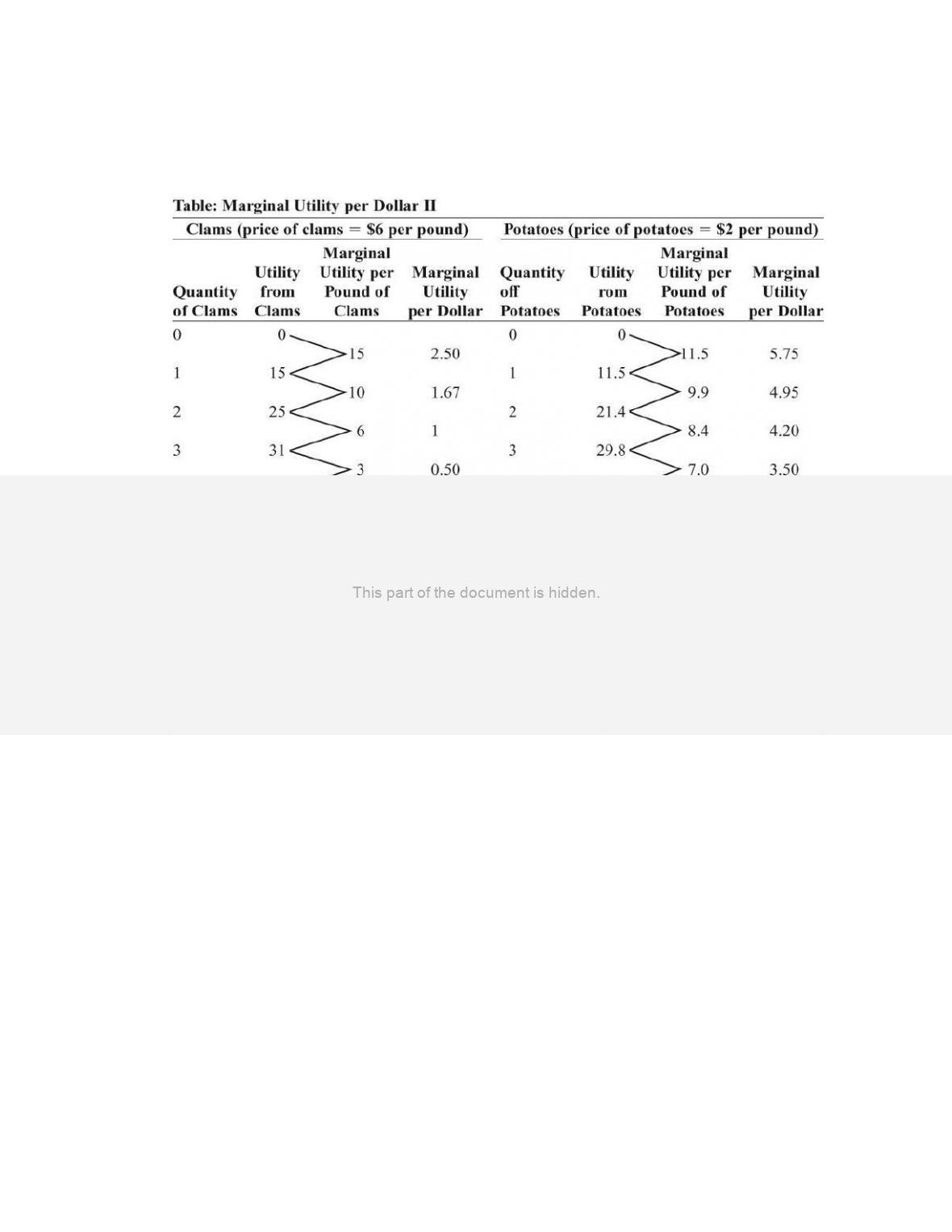
(Table: Marginal Utility per Dollar II) Use Table: Marginal Utility per Dollar II. If
Manuel has $18 to spend on potatoes and clams, then the utility-maximizing
combination is _____ pound(s) of clams and _____ pound(s) of potatoes.
A)
5; 3
B)
4; 6
C)
1; 6
D)
3; 9
Page 46
174.
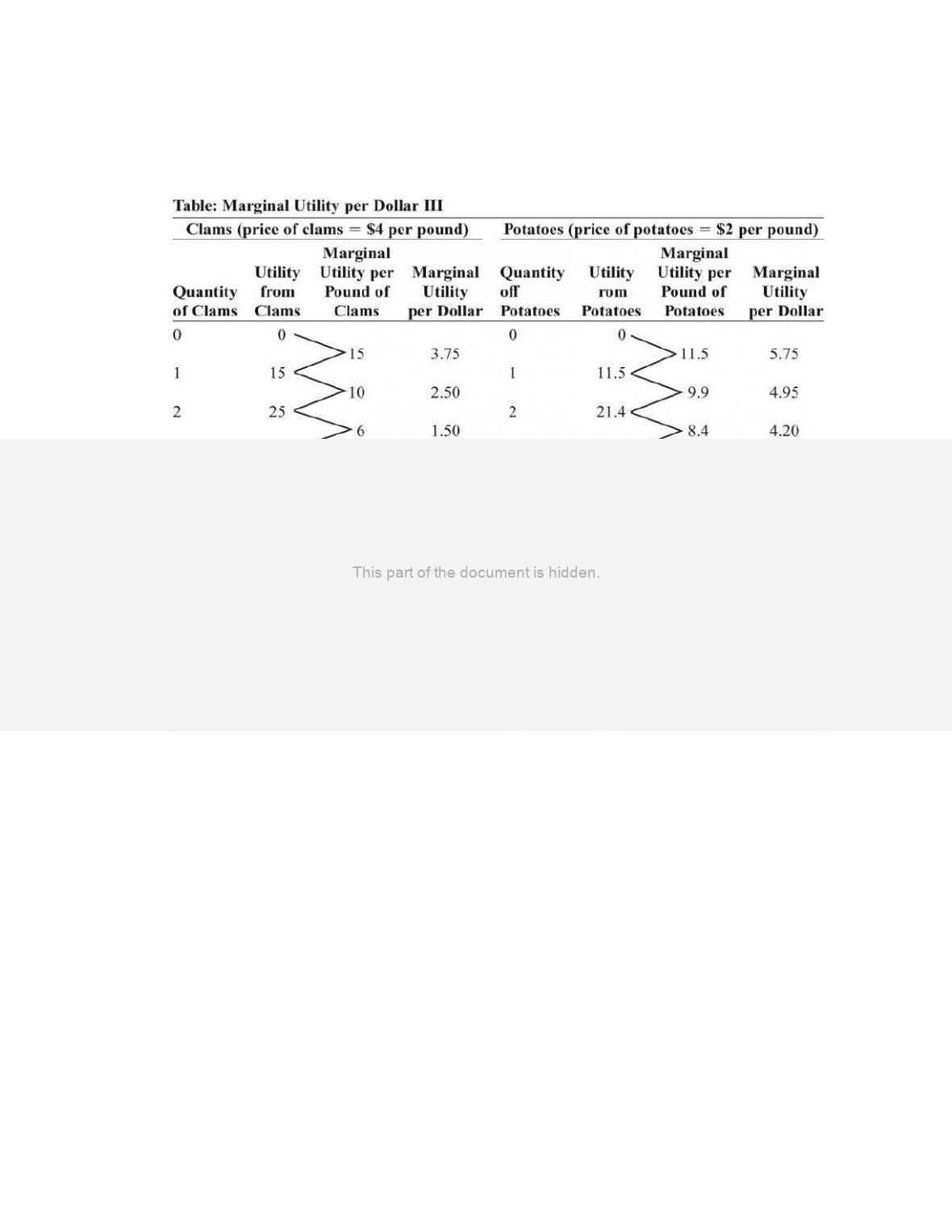
(Table: Marginal Utility per Dollar III) Use Table: Marginal Utility per Dollar III. If
Liyun has $20 to spend on potatoes and clams, then the utility-maximizing combination
is _____ pound(s) of clams and _____ pound(s) of potatoes.
A)
2; 6
B)
3; 4
C)
1; 8
D)
3; 9
Page 47
175.
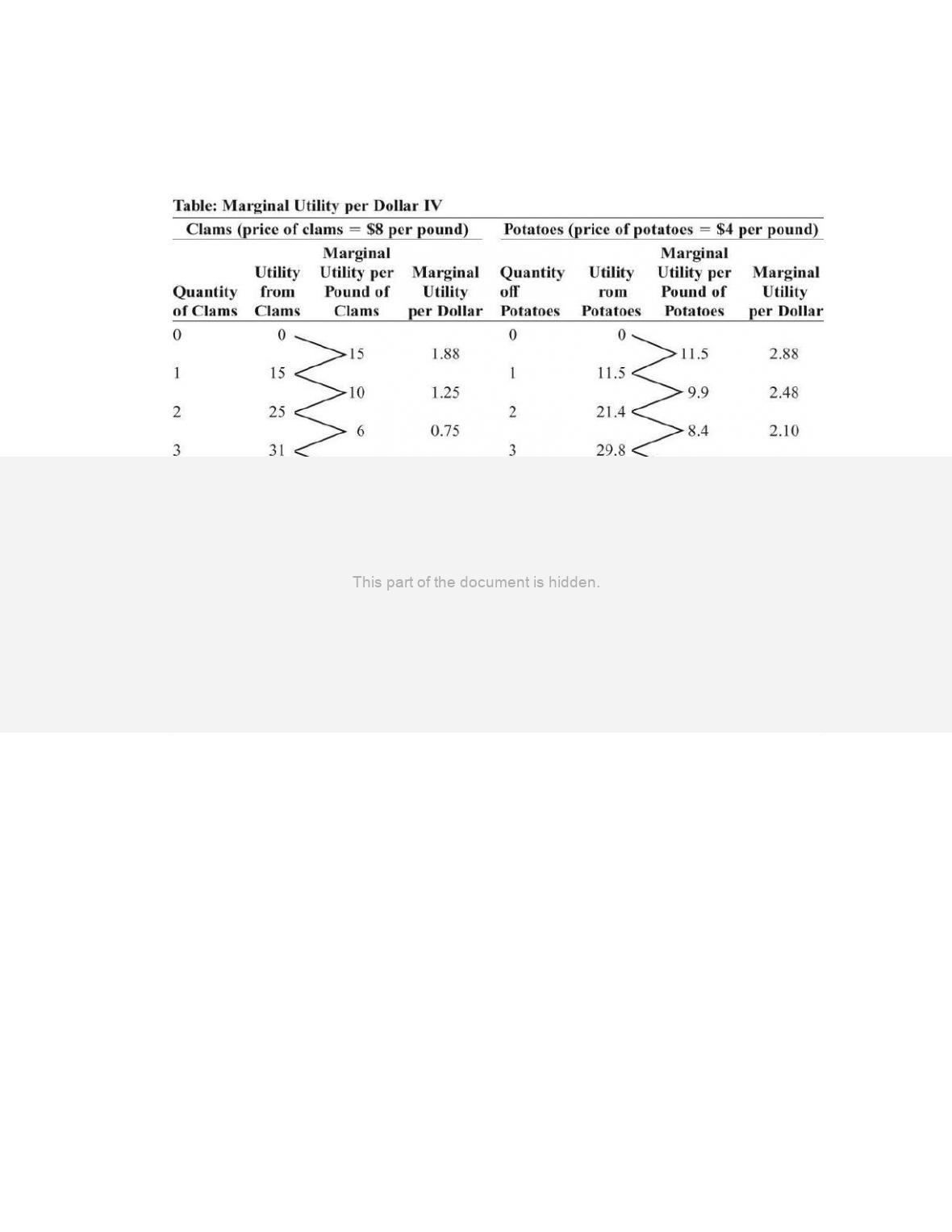
(Table: Marginal Utility per Dollar IV) Use Table: Marginal Utility per Dollar IV. If
Ashyra has $40 to spend on potatoes and clams, then the utility-maximizing
combination is _____ pound(s) of clams and _____ pound(s) of potatoes.
A)
3; 4
B)
2; 5
C)
1; 8
D)
2; 6
Page 48
Use the following to answer questions 176-183:
176.
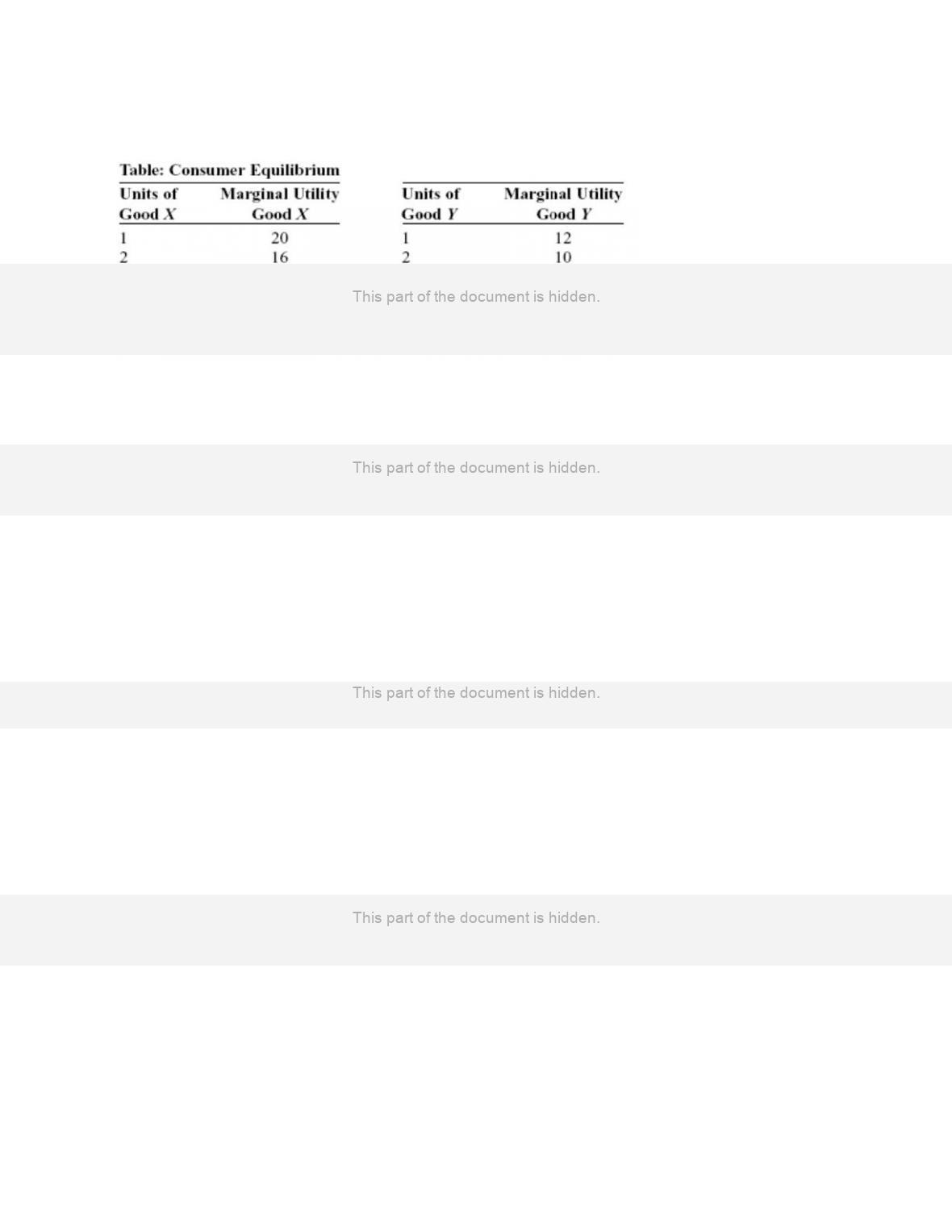
(Table: Consumer Equilibrium) Use Table: Consumer Equilibrium. Assume that the
price of both goods is $1 per unit, that you consume three units of good X and three
units of good Y, and that you are spending all of your income. To maximize utility,
assuming that the goods are divisible, you would want to consume _____ of X and
_____ of Y.
A)
less; less
B)
more; more
C)
less; more
D)
more; less
177.
(Table: Consumer Equilibrium) Use Table: Consumer Equilibrium. Assume that the
price of both goods is $1 per unit, that you consume four units of good X and two units
of good Y, and that you are spending all of your income. To maximize utility, assuming
that the goods are divisible, you would consume _____ of X and _____ of Y.
A)
less; more
B)
more; more
C)
less; less
D)
more; less
178.
(Table: Consumer Equilibrium) Use Table: Consumer Equilibrium. Assume that the
price of good X is $2 per unit and the price of good Y is $1 per unit, that you consume
three units of good X and three units of good Y, and that you are spending all of your
income. To maximize utility, assuming that the goods are divisible, you would consume
_____ of X and _____ of Y.
A)
less; less
B)
more; more
C)
less; more
D)
more; less

Page 49
179.
(Table: Consumer Equilibrium) Use Table: Consumer Equilibrium. Assume that the
price of good X is $1 per unit and the price of good Y is $2 per unit, that you consume 4
units of good X and 2 units of good Y, and that you are spending all of your income. To
maximize utility, assuming that the goods are divisible, you would consume _____ of X
and _____ of Y.
A)
less; less
B)
more; more
C)
less; more
D)
more; less
180.
(Table: Consumer Equilibrium) Use Table: Consumer Equilibrium. Assume that goods
X and Y both cost $1 per unit and you have $4 to spend on both goods. To maximize
utility, you would consume _____ unit(s) of X and _____ unit(s) of Y.
A)
0; 4
B)
1; 3
C)
2; 2
D)
3; 1
181.
(Table: Consumer Equilibrium) Use Table: Consumer Equilibrium. Assume that goods
X and Y both cost $1 per unit and you have $7 to spend on both goods. To maximize
utility, you would consume _____ units of X and _____ units of Y.
A)
2; 5
B)
3; 4
C)
4; 3
D)
5; 2
182.
(Table: Consumer Equilibrium) Use Table: Consumer Equilibrium. Assume that the
price of good X is $5 per unit, that the price of good Y is $1 per unit, and that you have
$10 to spend on both goods. To maximize utility, you would consume _____ unit(s) of
X and _____ unit(s) of Y.
A)
0; 1
B)
1; 5
C)
4; 6
D)
5; 5
Page 50
183.
(Table: Consumer Equilibrium) Use Table: Consumer Equilibrium. Assume that the
price of good X is $2 per unit, that the price of good Y is $1 per unit, and that you have
$10 to spend on both goods. To maximize utility, you would consume _____ units of X
and _____ units of Y.
A)
3; 4
B)
2; 3
C)
2; 6
D)
5; 0
184.
Choices that maximize total utility generally produce demand curves that are:
A)
horizontal.
B)
upward sloping.
C)
downward sloping.
D)
straight lines.
185.
If the price of coffee cups falls and the consumer decides to buy more coffee cups solely
because they are less expensive, this describes the:
A)
income effect.
B)
substitution effect.
C)
consumer surplus effect.
D)
marginal-maximizing rule.
186.
The substitution effect of a price change is described by the statement that:
A)
when the price of canning jars falls, consumers have more real income with the
same nominal income and will buy more canning jars.
B)
when the price of canning jars falls, consumers will substitute these lower-priced
canning jars for higher-priced goods.
C)
the substitution effect is the change in the number of canning jars purchased when
the price of spatulas changes.
D)
the substitution effect shows how a change in income will affect the quantity of a
good purchased.
187.
According to the substitution effect, which statement BEST describes why a decrease in
the price of LED light bulbs leads to an increase in the quantity of LED light bulbs
demanded?
A)
Buyers have more real income.
B)
Buyers always purchase fewer substitute goods for LED light bulbs.
C)
Buyers tend to purchase more of the now less expensive LED light bulbs.
D)
Buyers tend to purchase more complementary goods to LED light bulbs.
Page 51
188.
The substitution effect always entails a change in consumption in the _____ direction as
(of) the change in _____.
A)
same; marginal utility
B)
same; price
C)
opposite; price
D)
opposite; the budget
189.
According to the substitution effect, a decrease in the price of a product leads to an
increase in the quantity of the product demanded because buyers:
A)
have more real income.
B)
purchase fewer substitute goods.
C)
purchase more of the now less expensive good.
D)
purchase more complementary goods.
190.
The substitution effect always involves a change in consumption in the _____ direction
as (to) the _____ change.
A)
same; budget
B)
same; price
C)
opposite; price
D)
opposite; budget
191.
If, because of a price change, both the income and substitution effects are strong for a
normal good, this segment of the demand curve must be:
A)
unit-elastic.
B)
vertical.
C)
relatively price-elastic.
D)
horizontal.
192.
A Giffin good is one in which the _____ curve is _____ sloping.
A)
supply; downward
B)
demand; downward
C)
supply; upward
D)
demand; upward

Page 52
193.
Jane is a utility-maximizing consumer who is spending her entire budget on the optimal
quantity of wallets and eyeglasses. The price of wallets falls. Jane will _____ her
consumption of wallets if wallets are a(n) _____ good and (because) the income effect
_____ the substitution effect.
A)
decrease; inferior; is weaker than
B)
increase; inferior; is stronger than
C)
increase; normal; reinforces
D)
decrease; normal; reinforces
194.
Which statement BEST describes the income effect of a price increase?
A)
The price of bacon increases, so Michelle buys more sausage.
B)
The price of corn chips increases, so Michelle buys potato chips.
C)
The tuition at the public university increases, so Michelle attends a community
college.
D)
Michelle’s apartment rent increases, so she cancels her subscription to a monthly
magazine.
195.
The demand curve for a normal good will always slope downward because:
A)
the substitution effect and the income effect reinforce each other, and the
substitution effect always displays an inverse relation between price and quantity
demanded.
B)
the substitution effect and the income effect reinforce each other, and the income
effect always displays an inverse relation between price and quantity demanded.
C)
even though the substitution effect and the income effect move in opposite
directions, the substitution effect dominates, and it always displays an inverse
relation between price and quantity demanded.
D)
even though the substitution effect and the income effect move in opposite
directions, the income effect dominates, and it always displays an inverse relation
between price and quantity demanded.
196.
For most goods, demand curves slope downward because:
A)
marginal utility rises as quantity demanded increases.
B)
the substitution effect constitutes almost the entire effect of a price change, and this
effect always causes quantity demanded and price to be inversely related.
C)
the income effect constitutes almost the entire effect of a price change, and this
effect always causes quantity demanded and price to be inversely related.
D)
the income and substitution effects work in opposite directions.
Page 53
197.
The income effect of a price change is the effect on consumption changes as a result of a
change in:
A)
income when all prices change in the same proportion.
B)
purchasing power caused by a change in the price of the good.
C)
income caused by a change in the price of labor.
D)
income sufficient to offset the effect of a price change.
198.
The income effects of a change in price are most important for goods that:
A)
take up a substantial share of a consumer’s spending.
B)
are very inexpensive.
C)
are imported.
D)
are normal.
199.
Which statement is FALSE?
A)
A Giffin good must be an inferior good.
B)
A Giffin good must be such that the income effect and the substitution effect move
in opposite directions, and the income effect outweighs the substitution effect.
C)
A Giffin good must be such that the substitution effect outweighs the income effect
for an inferior good.
D)
A Giffin good must have an upward-sloping demand curve.
200.
Assume that, as the price of cauliflower falls, the income effect causes consumers to buy
fewer heads of cauliflower. We can conclude that cauliflower is:
A)
an inferior good.
B)
nasty tasting.
C)
a normal good.
D)
expensive.
201.
The income effect can refer to a change in:
A)
income because of a change in business investment.
B)
money or nominal income because of a change in wages.
C)
the quantity demanded of a good because of an implicit change in the buyer’s
income caused by a change in the price of a good or service.
D)
the quantity demanded of a good because of a change in the buyer’s preferences.
Page 54
202.
Which statement is FALSE?
A)
The income effect of normal goods counters the substitution effect, so the demand
curve slopes upward.
B)
The income effect and the substitution effect reinforce each other when the price of
a normal good changes.
C)
The income effect represents the decrease in quantity demanded caused by the
implicit change in income due to a fall in the price of an inferior good but not of a
normal good.
D)
The substitution effect reflects the change in quantity demanded solely because of a
change in the relative price of a good.
203.
When the price of an inferior good falls, the substitution effect contributes to a(n) _____
in the quantity demanded, and the income effect _____ the substitution effect.
A)
decrease; reinforces
B)
increase; reinforces
C)
increase; opposes
D)
decrease; opposes
Use the following to answer questions 204-205:
204.
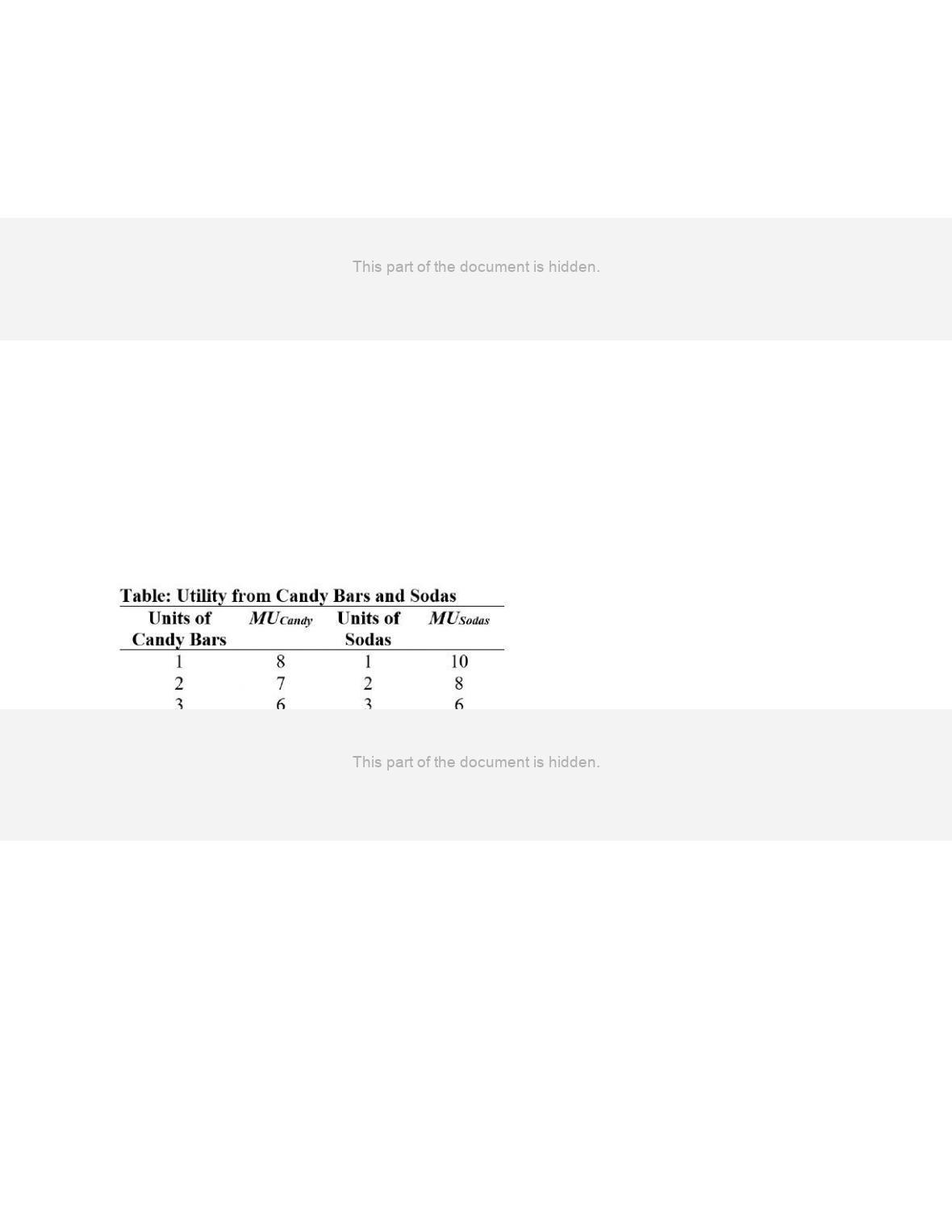
(Table: Utility from Candy Bars and Sodas) Use Table: Utility from Candy Bars and
Sodas. If Stan consumes two candy bars and two sodas, his total utility will be _____
utils.
A)
15
B)
33
C)
18
D)
78
Page 55
205.
(Table: Utility from Candy Bars and Sodas) Use Table: Utility from Candy Bars and
Sodas. Stan’s daily income is $11, the price of a candy bar is $2, and the price of a soda
is $1. Given this budget constraint, Stan will receive the MOST utils from consuming
_____ candy bar(s) and _____ sodas.
A)
3; 5
B)
1; 4
C)
5; 6
D)
2; 7
206.
The assumption that a rational consumer seeks to maximize his or her utility implies that
utility is measurable according to some objective scale.
A)
True
B)
False
207.
Gehrig’s utility from the consumption of mangoes is measured by the level of
satisfaction he gets from only the first mango he buys and eats.
A)
True
B)
False
208.
The marginal utility of a good is used to describe any good (such as a mushroom brush
or a shrimp deveiner) that has only limited usefulness.
A)
True
B)
False
209.
If Joe drinks iced tea while he is mowing his yard, he will probably derive a lower
marginal utility from his sixth glass of iced tea than from his first glass.
A)
True
B)
False
210.
Mary, an avid gardener, plans to spend 8 hours working in her garden. It takes her 45
minutes to prune a bush and 30 minutes to fertilize a tree. If she prunes eight bushes, she
will still have enough time to fertilize six trees.
A)
True
B)
False
211.
A person’s consumption possibilities include all points on their budget line as well as all
points below the budget line.
A)
True
B)
False

212.
The optimal consumption bundle is the combination of goods that lies above the budget
constraint.
A)
True
B)
False
213.
Professor Makrung spends his entire weekly income of $700 on economics books (E)
and coffee (C). The price of an economics book (PE) is $50, and the price of a cup of
coffee (PC) is $2. If the professor buys 10 economics books and 50 cups of coffee per
week, he finds that MUE = 75 and MUC = 3. This implies that a consumption bundle
consisting of 10 economics books and 50 cups of coffee per week maximizes the
professor’s utility.
A)
True
B)
False
214.
Mikaela is buying a new motorcycle. She has narrowed her choices to a BMW Classic
Montauk or a Honda Valkyrie Rune. She likes the Honda exactly twice as much, but it
costs about 40% more. If both bikes are in her budget, she should buy the Honda.
A)
True
B)
False
215.
If the price of laundry detergent equals the price of dishwashing powder, then a
utility-maximizing consumer will always buy equal amounts of laundry detergent and
dishwashing powder.
A)
True
B)
False
216.
At Frankie’s Buy-the-Slice Pizza, Bill eats three slices of pizza and then realizes that he
enjoyed the second slice more than the third. Even though the price per slice is just $1,
the utility-maximizing decision is to quit eating now since Bill has reached diminishing
marginal utility.
A)
True
B)
False
217.
At Frankie’s Buy-the-Slice Pizza, Brian eats eight slices of pizza. He says that, because
pizza is $2 per slice, the utility-maximizing decision is to eat until your marginal utility
per dollar is zero. Brian’s explanation is correct.
A)
True
B)
False