Page 21
85.
(Figure: Budget Lines for Oranges and Apples) Use Figure: Budget Lines for Oranges
and Apples. For some time, Antonio has had $5 per month to spend on oranges and
apples. The price of an orange is $0.50 and the price of an apple is $0.25. Which chart
shows what will happen to his budget line if his income decreases to $2.50?
A)
A
B)
B
C)
C
D)
D
86.
(Figure: Budget Lines for Oranges and Apples) Use Figure: Budget Lines for Oranges
and Apples. For some time, Antonio has had $5 per month to spend on oranges and
apples. The price of an orange is $0.50 and the price of an apple is $0.25. Which chart
shows what will happen to his budget line if the price of an orange falls to $0.25?
A)
A
B)
B
C)
C
D)
D
87.
(Figure: Budget Lines for Oranges and Apples) Use Figure: Budget Lines for Oranges
and Apples. For some time, Antonio has $5 per month to spend on oranges and apples.
The price of an orange is $0.50 and the price of an apple is $0.25. Which chart shows
what will happen to his budget line if the price of an apple rises to $0.50?
A)
A
B)
B
C)
C
D)
D
88.
(Figure: Budget Lines for Oranges and Apples) Use Figure: Budget Lines for Oranges
and Apples. For some time, Antonio has had $5 per month to spend on oranges and
apples. The price of an orange is $0.50 and the price of an apple is $0.25. Which chart
shows what will happen to his budget line if the price of an orange rises to $1.00 and the
price of an apple rises to $0.50?
A)
A
B)
B
C)
C
D)
D
Page 22
89.
(Figure: Budget Lines for Oranges and Apples) Use Figure: Budget Lines for Oranges
and Apples. For some time, Antonio has had $5 per month to spend on oranges and
apples. The price of an orange is $0.50 and the price of an apple is $0.25. Which chart
shows what will happen to his budget line if the prices of the two goods fall by 20%?
A)
A
B)
B
C)
C
D)
D
90.
Adam has a monthly income of $20 that can be spent on books (B) and pencils (P). The
price of a book is $5 and the price of a pencil is $0.50. The equation for Adam’s daily
budget constraint can be written as:
A)
5(B) + 0.50(P) 20.
B)
0.50(B) + 5(P) 20.
C)
20(B) + 0.50(P) 5.
D)
0.50(B) + 20(P) 5.
91.
Adam has a monthly income of $20 that can be spent on books (B) and pencils (P). The
price of a book is $5 and the price of a pencil is $0.50. Which bundle of books and
pencils is NOT affordable for Adam?
A)
4 books and no pencils
B)
2 books and 30 pencils
C)
1 book and 20 pencils
D)
2 books and 20 pencils
92.
Adam has a monthly income of $20 that can be spent on books (B) and pencils (P). The
price of a book is $5 and the price of a pencil is $0.50. Which bundle of books and
pencils is affordable for Adam, but does not use all of his income?
A)
1 book and 30 pencils
B)
no books and 40 pencils
C)
2 books and 20 pencils
D)
1 book and 22 pencils
93.
Adam has a monthly income of $20 that can be spent on books (B) and pencils (P). The
price of a book is $5 and the price of a pencil is $0.50. Which bundle of books and
pencils lies ON Adam’s budget line?
A)
3 books and 5 pencils
B)
1 book and 40 pencils
C)
2 books and 20 pencils
D)
no books and 20 pencils
Page 23
94.
The price of popcorn is $0.50 per box and the price of peanuts is $0.25 per bag. You
have $10 to spend on both goods. The maximum number of boxes of popcorn that you
can purchase is:
A)
5.
B)
10.
C)
20.
D)
40.
95.
The price of popcorn is $0.50 per box and the price of peanuts is $0.25 per bag. You
have $5 to spend on both goods. The maximum number of boxes of popcorn that you
can purchase is:
A)
5.
B)
10.
C)
20.
D)
40.
96.
The price of popcorn is $0.50 per box and the price of peanuts is $0.25 per bag. You
have $10 to spend on both goods. The maximum number of bags of peanuts that you
can purchase is:
A)
5.
B)
10.
C)
20.
D)
40.
97.
The price of popcorn is $0.50 per box and the price of peanuts is $0.25 per bag. You
have $5 to spend on both goods. The maximum number of bags of peanuts that you can
purchase is:
A)
5.
B)
10.
C)
20.
D)
40.
98.
The price of popcorn is $0.50 per box and the price of peanuts is $0.25 per bag. You
have $10 to spend. You decide to purchase 8 bags of peanuts. The maximum number of
boxes of popcorn that you can purchase is:
A)
4.
B)
8.
C)
10.
D)
16.
Page 24
99.
The price of popcorn is $0.50 per box and the price of peanuts is $0.25 per bag. You
have $10 to spend. You decide to purchase 20 bags of peanuts. The maximum number
of boxes of popcorn that you can purchase is:
A)
8.
B)
10.
C)
12.
D)
16.
100.
The price of popcorn is $0.50 per box and the price of peanuts is $0.25 per bag. You
have $5 to spend. You decide to purchase 8 boxes of popcorn. The maximum number of
bags of peanuts that you can purchase is:
A)
4.
B)
8.
C)
10.
D)
12.
101.
The price of popcorn is $0.50 per box and the price of peanuts is $0.25 per bag. You
have $5 to spend. You decide to purchase 6 boxes of popcorn. The maximum number of
bags of peanuts that you can purchase is:
A)
4.
B)
8.
C)
10.
D)
12.
102.
For Domingo, the optimum consumption bundle is the one that _____ his _____, given
his budget constraint.
A)
minimizes; utility
B)
maximizes; utility
C)
maximizes; opportunity cost
D)
minimizes; opportunity cost
Page 25
Use the following to answer questions 103-108:
103.
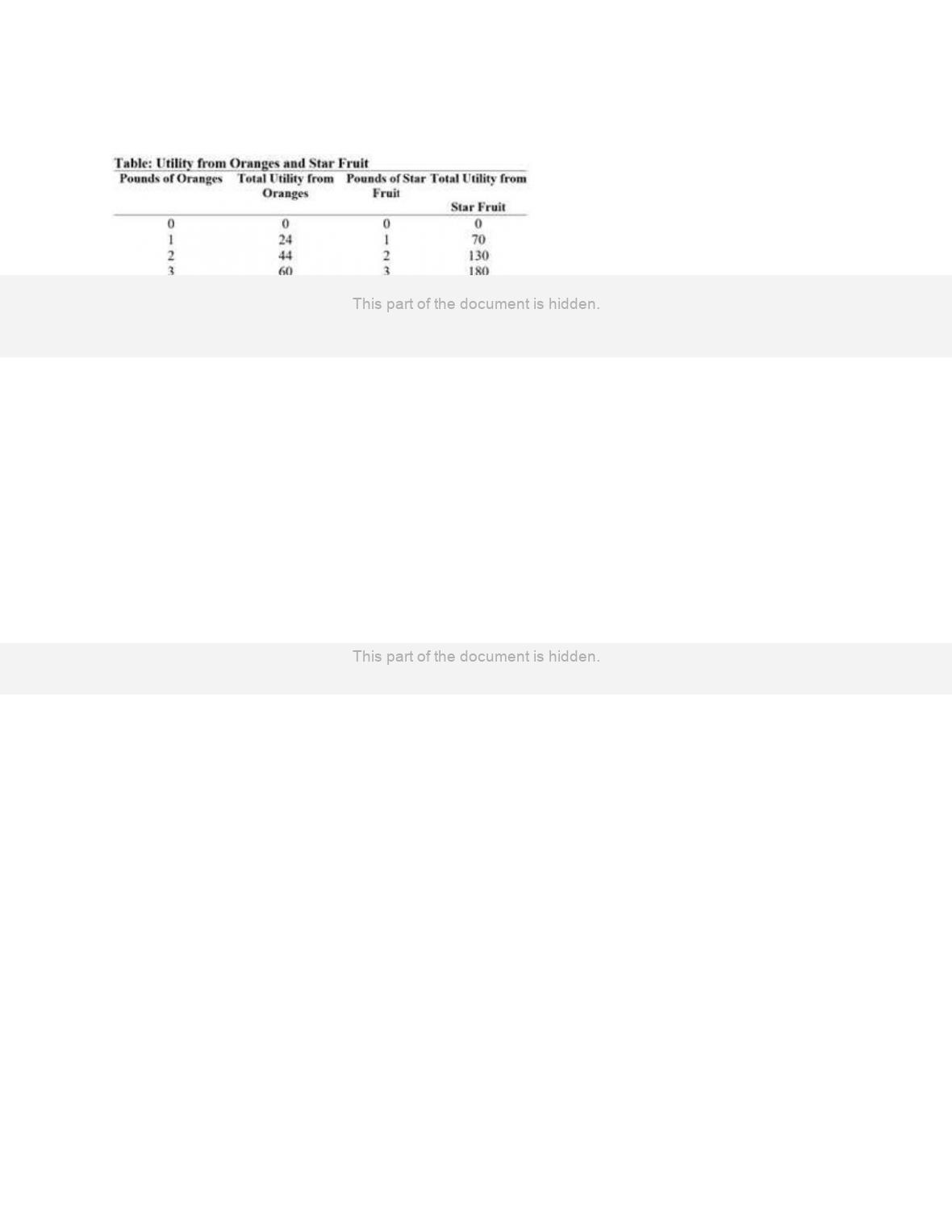
(Table: Utility from Oranges and Star Fruit) Use Table: Utility from Oranges and Star
Fruit. Oranges cost $2 per pound and star fruit costs $5 per pound. Calvin has $26 to
spend. If Calvin spends all of his money on oranges, how many pounds of oranges can
he buy?
A)
6
B)
7
C)
9
D)
13
104.
(Table: Utility from Oranges and Star Fruit) Use Table: Utility from Oranges and Star
Fruit. Oranges cost $2 per pound and star fruit costs $5 per pound. Calvin has $26 to
spend. If Calvin spends all of his money on star fruit and if he can buy only whole
pounds of it, how many pounds of star fruit can he buy?
A)
7
B)
6
C)
5
D)
4
105.
(Table: Utility from Oranges and Star Fruit) Use Table: Utility from Oranges and Star
Fruit. Oranges cost $2 per pound and star fruit costs $5 per pound. Calvin has $26 to
spend. If Calvin buys 2 pounds of star fruit, how many pounds of oranges can he buy?
A)
6
B)
7
C)
8
D)
9
Page 26
106.
(Table: Utility from Oranges and Star Fruit) Use Table: Utility from Oranges and Star
Fruit. Oranges cost $2 per pound and star fruit costs $5 per pound. Calvin has $26 to
spend. If Calvin buys 4 pounds of star fruit, how many pounds of oranges can he buy?
A)
2
B)
3
C)
4
D)
7
107.
(Table: Utility from Oranges and Star Fruit) Use Table: Utility from Oranges and Star
Fruit. Oranges cost $2 per pound and star fruit costs $5 per pound. Calvin has $26 to
spend. If Calvin buys 4 pounds of star fruit and 3 pounds of oranges, how much is his
total utility?
A)
72
B)
180
C)
280
D)
364
108.
(Table: Utility from Oranges and Star Fruit) Use Table: Utility from Oranges and Star
Fruit. Oranges cost $2 per pound and star fruit costs $5 per pound. The table shows
Calvin’s total utility from eating various amounts of oranges and star fruits. If Calvin has
$26, he should eat _____ oranges and _____ pounds of star fruit, and he will have
_____ left over.
A)
0; 5; $1
B)
8; 2; no money
C)
3; 4; no money
D)
4; 5; no money
Use the following to answer questions 109-116:
Page 27
109.
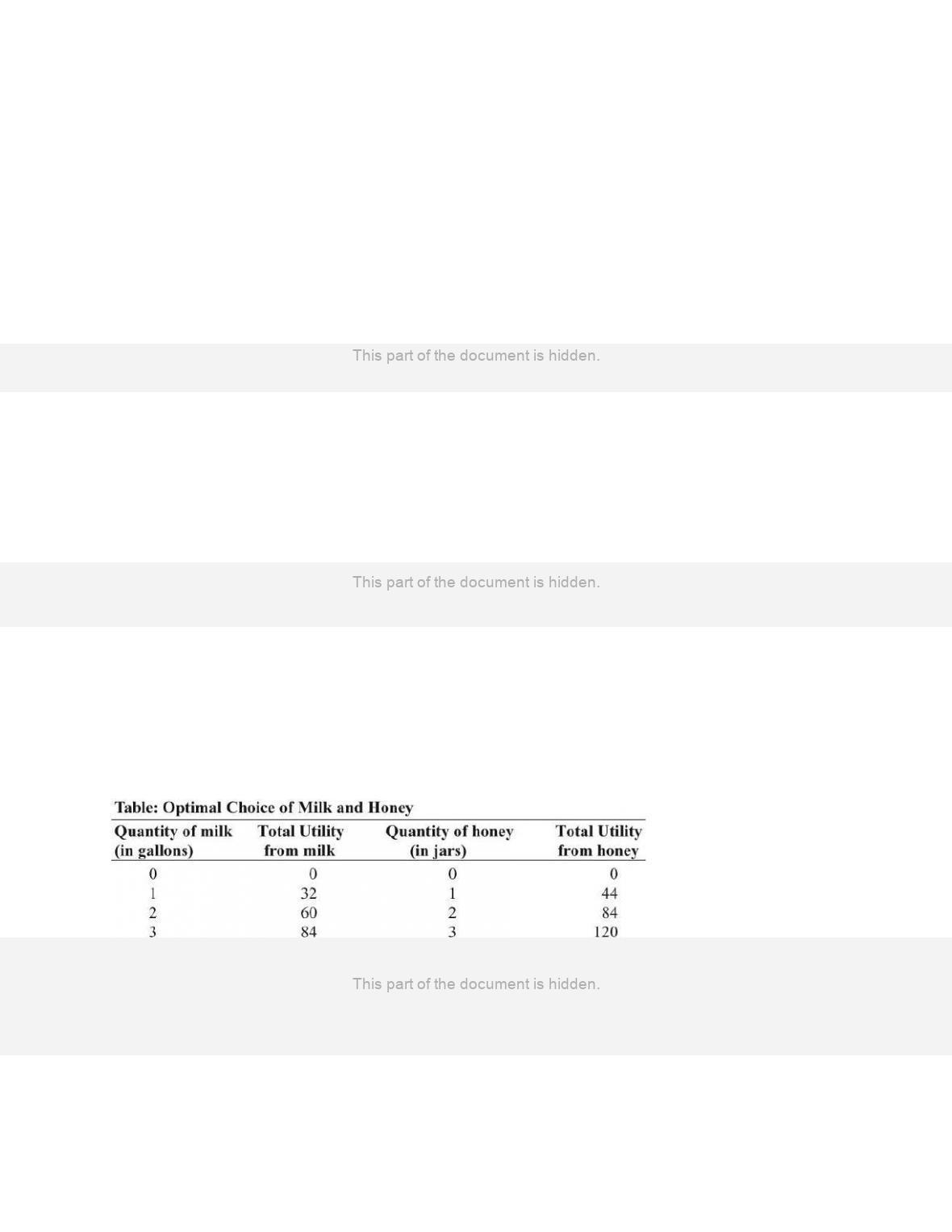
(Table: Optimal Choice of Milk and Honey) Use Table: Optimal Choice of Milk and
Honey. The price of milk is $2 per gallon, and the price of honey is $4 per jar. Hal’s
income is $16. If he spends all of his income on milk, the most he can buy is _____
gallons, and his total utility will be _____.
A)
4; 104
B)
6; 12
C)
8; 144
D)
8; 4
110.
(Table: Optimal Choice of Milk and Honey) Use Table: Optimal Choice of Milk and
Honey. The price of milk is $2 per gallon, and the price of honey is $4 per jar. Hal’s
income is $16. If he spends all of his income on honey, the most he can buy is _____
jars, and his total utility will be _____.
A)
4; 152
B)
4; 22
C)
6; 204
D)
8; 240
111.
(Table: Optimal Choice of Milk and Honey) Use Table: Optimal Choice of Milk and
Honey. The price of milk is $2 per gallon, and the price of honey is $4 per jar. Hal’s
income is $16. Assuming that Hal spends all of his income on honey and milk, if he
buys 3 jars of honey, he can buy _____ gallons of milk.
A)
4
B)
3
C)
2
D)
1
112.
(Table: Optimal Choice of Milk and Honey) Use Table: Optimal Choice of Milk and
Honey. The price of milk is $2 per gallon, and the price of honey is $4 per jar. Hal’s
income is $16. If he buys 3 jars of honey and 2 gallons of milk, his total utility will be:
A)
7,200.
B)
180.
C)
120.
D)
60.
Page 28
113.
(Table: Optimal Choice of Milk and Honey) Use Table: Optimal Choice of Milk and
Honey. The price of milk is $2 per gallon, and the price of honey is $4 per jar. Hal’s
income is $16. Assuming that Hal spends all of his income on honey and milk, if he
buys 2 jars of honey, he can buy _____ gallons of milk.
A)
4
B)
3
C)
2
D)
1
114.
(Table: Optimal Choice of Milk and Honey) Use Table: Optimal Choice of Milk and
Honey. The price of milk is $2 per gallon, and the price of honey is $4 per jar. Hal’s
income is $16. If he buys 2 jars of honey and 4 gallons of milk, his total utility will be:
A)
8.
B)
84.
C)
104.
D)
188.
115.
(Table: Optimal Choice of Milk and Honey) Use Table: Optimal Choice of Milk and
Honey. The price of milk is $2 per gallon, and the price of honey is $4 per jar. Hal’s
income is $16. Assuming that Hal spends all of his income on honey and milk, if he
buys 1 jar of honey, he can buy _____ gallons of milk, and his total utility will be
_____.
A)
6; 176
B)
6; 132
C)
3; 44
D)
2; 60
116.
(Table: Optimal Choice of Milk and Honey) Use Table: Optimal Choice of Milk and
Honey. The price of milk is $2 per gallon, and the price of honey is $4 per jar. Hal’s
income is $16. Assuming that Hal spends all of his income on honey and milk, the
combination of milk and honey that will maximize his total utility is _____ jars of
honey and _____ gallons of milk.
A)
8; 8
B)
3; 2
C)
2; 4
D)
1; 6
Page 29
117.
Which statement is TRUE?
A)
A budget constraint limits what a poor consumer can spend, but there is no similar
constraint on rich people.
B)
Utility maximization requires seeking the most utility from a given budget.
C)
In consumer choice theory, we assume all goods and services are inferior.
D)
The slope of the budget constraint depends on how much of each good is
consumed.
118.
Emilio finds a new job that doubles his income. He adjusts his consumption. From this,
we know that, for every normal good Emilio now buys, his:
A)
marginal utility per dollar will be greater than before his income increase.
B)
marginal utility per dollar will be smaller than before his income increase.
C)
marginal utility per dollar will stay the same as before his income increase.
D)
total utility will be smaller than before his income increase .
119.
You go to an all-you-can-eat buffet. If you maximize utility, the marginal utility of the
last bite that you eat will be:
A)
equal to the price of the buffet.
B)
as high as possible.
C)
0.
D)
dependent on how much you like the buffet.
120.
How much utility is gained by spending an additional dollar on coffee pots?
A)
the average utility of coffee pots divided by the price of coffee pots
B)
MUPots /PPots
C)
TUPots /PPots
D)
MUCoffee /PCoffee
121.
Which value BEST describes the amount of utility that is gained by spending an
additional dollar on yogurt?
A)
the average utility of yogurt divided by the price of the yogurt tub
B)
the marginal utility of one tub of yogurt divided by the price of the yogurt tub
C)
the total utility of a tub of yogurt divided by the price of the yogurt tub
D)
the value equal to the price of a related good
Page 30
Use the following to answer questions 122-128:
122.
(Table: Marginal Utility per Dollar of M&Ms) Use Table: Marginal Utility per Dollar of
M&Ms. The price of M&Ms is $2 per bag. The marginal utility per dollar of the first
bag of M&Ms is:
A)
12.
B)
6.
C)
3.
D)
2.
123.
(Table: Marginal Utility per Dollar of M&Ms) Use Table: Marginal Utility per Dollar of
M&Ms. The price of M&Ms is $2 per bag. The marginal utility per dollar of the second
bag of M&Ms is:
A)
16.
B)
10.
C)
5.
D)
2.
124.
(Table: Marginal Utility per Dollar of M&Ms) Use Table: Marginal Utility per Dollar of
M&Ms. The price of M&Ms is $2 per bag. The marginal utility per dollar of the third
bag of M&Ms is:
A)
1.
B)
1.5.
C)
3.
D)
13.

Page 31
125.
(Table: Marginal Utility per Dollar of M&Ms) Use Table: Marginal Utility per Dollar of
M&Ms. The price of M&Ms is $2 per bag. The marginal utility per dollar of the fourth
bag of M&Ms is:
A)
1.
B)
2.
C)
7.5.
D)
15.
126.
(Table: Marginal Utility per Dollar of M&Ms) Use Table: Marginal Utility per Dollar of
M&Ms. The price of M&Ms is $2 per bag. The marginal utility per dollar of the fifth
bag of M&Ms is:
A)
0.
B)
0.5.
C)
1.
D)
8.
127.
(Table: Marginal Utility per Dollar of M&Ms) Use Table: Marginal Utility per Dollar of
M&Ms. The price of M&Ms is $2 per bag. If the price of M&Ms increases to $3 per
bag, the marginal utility per dollar for each bag of M&Ms will:
A)
increase.
B)
decrease.
C)
remain constant.
D)
fluctuate randomly.
128.
(Table: Marginal Utility per Dollar of M&Ms) Use Table: Marginal Utility per Dollar of
M&Ms. The price of M&Ms is $2 per bag. If the price of M&Ms decreases to $1 per
bag, the marginal utility per dollar for each bag of M&Ms will:
A)
increase.
B)
decrease.
C)
remain constant.
D)
fluctuate randomly.
129.
Jenny believes that spending one hour studying for economics will increase her grade by
20 points. Studying for a second hour will increase her grade by 10 points. She also
believes that studying for an hour for history will increase her grade by 15 points, but
spending a second hour will increase her grade by only 5 points. Jenny has two hours to
study. If Jenny wants to maximize the sum total of her scores, what should she do?
A)
study 1 hour for economics and 1 hour for history
B)
study 2 hours for economics and not study for history
C)
not study for economics and study 2 hours for history
D)
study 1 hour for economics and not study for history
Page 32
130.
Assume that Maia spends all of her income on halvah (H) and pomegranates (P) and is
purchasing the optimal consumption bundle. If MUH/MUP = 3 and the price of halvah is
$12, then the price of pomegranates must be:
A)
$36.
B)
$4.
C)
$12.
D)
$3.
131.
Brad spends all of his income on cameras and coffee. He is purchasing the consumption
bundle that maximizes his utility given his budget constraint. At the optimal
consumption bundle, which statement is CORRECT?
A)
If cameras cost more than coffee, then the marginal utility of cameras is less than
that of coffee.
B)
If cameras cost less than coffee, then the marginal utility of cameras is more than
that of coffee.
C)
If cameras cost the same as coffee, then the marginal utility of cameras is equal to
that of coffee.
D)
The prices of cameras and coffee and their marginal utilities are unrelated.
132.
Suzy knows she has maximized her utility because she is on her budget constraint and:
A)
her consumption of cameras equals her consumption of coffee.
B)
what she spends on cameras equals what she spends on coffee.
C)
MUCameras/PCameras = MUCoffee/PCoffee.
D)
MUCameras = MUCoffee.
133.
Sasha buys a cold soda and a slice of pizza. The marginal utility from a soda is 40, and
the price of the soda is $1. The marginal utility from a slice of pizza is 80. Assume
Sasha is successfully maximizing his utility. If this is the case, we know the price of a
slice of pizza must be:
A)
$20.
B)
$2.
C)
$1.
D)
$0.50.
Page 33
134.
Benny spends all of his money buying wine and cheese. Diminishing marginal utility
applies to both goods. The marginal utility of the last bottle of wine he bought is 60, and
the marginal utility of the last block of cheese he bought is 30. The price of wine is $3,
and the price of cheese is $2. Benny:
A)
is buying wine and cheese in the utility-maximizing amounts.
B)
should buy more wine and less cheese.
C)
should buy more cheese and less wine.
D)
is spending too much money on wine and cheese.
135.
Suppose Ivy buys only two things, books and coffee, and receives the same satisfaction
from the last book bought as she did from the last coffee bought. Books cost twice as
much as coffee, and she has spent all of her money. Diminishing marginal utility applies
to both goods. If she is trying to maximize her utility, Ivy:
A)
should buy more books and less coffee.
B)
should buy more coffee and fewer books.
C)
should buy more coffee and more books.
D)
is currently making the optimal choice.
136.
Melika spends all of her income on magazines and carry-out lunches. The price of a
magazine is $5, and the price of a carry-out lunch is $7. At the current consumption
bundle, the marginal utility of magazines is 10, and the marginal utility of carry-out
lunches is 21. Assuming that diminishing marginal utility applies to both goods, to
maximize utility given her income, Melika should:
A)
consume more carry-out lunches and fewer magazines.
B)
consume more magazines and fewer carry-out lunches.
C)
continue to consume the current bundle.
D)
consume equal amounts of magazines and carry-out lunches.
137.
Joseph is consuming three units of pizza and two units of soda. The price of pizza is $5
and the price of soda is $1. If he is consuming the optimal consumption bundle and his
marginal utility of the third unit of pizza is 50, his marginal utility of the second soda is:
A)
50.
B)
10.
C)
5.
D)
impossible to determine unless you know Joseph’s income.
Page 34
138.
Juan spends all of his income on packs of baseball cards and boxes of candy. At his
current consumption bundle, the marginal utility of baseball card packs is 20 and the
marginal utility of candy boxes is 10. Assuming that diminishing marginal utility
applies to both goods, if the price of baseball card packs is $10 and the price of candy
boxes is $2, Juan should:
A)
consume more baseball card packs and fewer candy boxes.
B)
consume more candy boxes and fewer baseball card packs.
C)
continue to consume the current bundle.
D)
consume equal numbers of baseball card packs and candy boxes.
139.
At the optimal consumption bundle:
A)
the marginal utility of all goods consumed is equal.
B)
the marginal utility per dollar spent is equalized across all goods consumed.
C)
the price of all goods consumed is equal.
D)
total utility from all goods consumed is equal.
140.
Diego spends all of his income on milkshakes and french fries. At his current
consumption levels, the marginal utility of one milkshake and the marginal utility of one
order of french fries are equal. According to the optimal consumption rule, Diego:
A)
is maximizing his utility.
B)
is maximizing his utility only if one milkshake and one order of french fries have
the same price.
C)
should buy more milkshakes and fewer fries if a milkshake costs more than an
order of fries.
D)
will maximize his utility by specializing in consumption and buying either
milkshakes or fries but not both.
141.
Assume that diminishing marginal utility applies to both coffee and football tickets and
that the consumer is spending all of her income. If a consumer purchases a combination
of coffee and football tickets such that MUCoffee/ /PCoffee = 20 and MUFootball tickets/
/PFootball tickets = 10, to maximize utility, the consumer should buy _____ coffee and
_____ football tickets.
A)
less; more
B)
more; fewer
C)
more; more
D)
less; fewer
Page 35
142.
Assume that diminishing marginal utility applies to both dish soap and floor wax and
that Minh is spending all of her income. If Minh purchases a combination of dish soap
and floor wax such that MUDish soap/ /PDish soap = 50 and MUFloor wax/ /PFloor wax = 30, to
maximize utility, Minh should buy _____ soap and _____ floor wax.
A)
less; less
B)
more; more
C)
more; less
D)
less; more
143.
Assume that diminishing marginal utility applies to both ballet slippers and tutus and
that Natasha is spending all of her income. If Natasha purchases a combination of ballet
slippers and tutus such that MUSlippers/ /PSlippers = 20 and MUTutus/ /PTutus = 5, to maximize
utility, Natasha should buy _____ slippers and _____ tutus.
A)
more; fewer
B)
fewer; more
C)
more; more
D)
fewer; fewer
144.
Assume that diminishing marginal utility applies to both textbooks and concert tickets
and that Sun is spending all of his income. If Sun purchases a combination of textbooks
and concert tickets such that MUTextbooks/PTextbooks = 100 and MUTickets/ /PTickets = 80, to
maximize utility, Sun should buy _____ textbooks and _____ tickets.
A)
fewer; fewer
B)
more; fewer
C)
fewer; more
D)
more; more
145.
If, for Adam, the marginal utility of ties is greater than the marginal utility of shirts, to
maximize utility, Adam should:
A)
buy more ties and fewer shirts.
B)
buy more shirts and fewer ties.
C)
buy the same number of each.
D)
determine the price of ties and the price of shirts before he decides how many of
each to buy.
146.
If a consumer derives more utility by spending an additional $1 on good X, rather than
on good Y:
A)
MUx/Px > MUy/Py.
B)
MUx/Px = MUy/Py.
C)
MUx/Px < MUy/Py.
D)
Px/MUx > Py/MUy.
147.
Sally devotes all of her income to the consumption of apples and Reese’s Peanut Butter
Cups. At her current level of consumption, the marginal utility of an apple is 6 and the
marginal utility of a Reese’s Peanut Butter Cup is 8. Assume that diminishing marginal
utility applies to both apples and Reese’s Peanut Butter Cups. Suppose the price of an
apple is $0.20 and the price of a Reese’s Peanut Butter Cup is $0.25. To maximize her
total utility, assuming that the goods are divisible, she would:
A)
consume more Reese’s Peanut Butter Cups and fewer apples.
B)
consume less of both goods.
C)
consume more apples and fewer Reese’s Peanut Butter Cups.
D)
There is not enough information to justify a change in her current level of
consumption.
148.
Sally devotes all of her income to the consumption of apples and Reese’s Peanut Butter
Cups. At her current level of consumption, the marginal utility of an apple is 6 and the
marginal utility of a Reese’s Peanut Butter Cup is 8. Assume that diminishing marginal
utility applies to both apples and Reese’s Peanut Butter Cups. Suppose the price of an
apple is $0.10, while the price of a Reese’s Peanut Butter Cup is $0.25. To maximize her
total utility, assuming that the goods are divisible, she would:
A)
consume more Reese’s Peanut Butter Cups and fewer apples.
B)
consume less of both goods.
C)
consume more apples and fewer Reese’s Peanut Butter Cups.
D)
There is not enough information to justify a change in her current level of
consumption.
149.
Assume that Siri is consuming the utility-maximizing quantities of pork and chicken.
We can conclude that:
A)
the price of pork equals the price of chicken.
B)
the marginal utility of pork equals the marginal utility of chicken.
C)
the ratio of the marginal utility to price is the same for pork as it is for chicken.
D)
Siri is consuming the same amount of pork and chicken.
150.
Smedley, a careful utility maximizer, consumes peanut butter and ice cream. Assume
that both peanut butter and ice cream are normal goods. Right after he achieves the
utility-maximizing level of consumption of the two goods, the price of ice cream
increases. To adjust to this event, he consumes _____ peanut butter and _____ ice
cream.
A)
more; more
B)
less; less
C)
more; less
D)
less; more
Page 37
151.
Smedley, a careful utility maximizer, consumes peanut butter and broccoli. Assume that
both peanut butter and broccoli are normal goods. Right after he achieves the
utility-maximizing level of consumption of the two goods, the price of broccoli
increases. To adjust to this event, he consumes _____ peanut butter and _____ broccoli.
A)
more; less
B)
less; less
C)
more; more
D)
less; more
152.
Jill, a careful utility maximizer, consumes peanut butter and ice cream. Assume that
both peanut butter and ice cream are normal goods. Right after she achieves the
utility-maximizing level of consumption of the two goods, the price of peanut butter
increases. After she adjusts to this event, the marginal utility of peanut butter goes
_____ and that of ice cream goes _____.
A)
up; up
B)
down; down
C)
down; up
D)
up; down
153.
Kawamura, a careful utility maximizer, consumes peanut butter and ice cream. Assume
that both peanut butter and ice cream are normal goods and that diminishing marginal
utility applies to both goods. Right after he achieves the utility-maximizing level of
consumption of the two goods, the price of peanut butter falls. After he adjusts to this
event, the marginal utility of peanut butter goes _____ and that of ice cream goes _____.
A)
up; up
B)
down; down
C)
down; up
D)
up; down
154.
Marge has spent her entire budget on milk and cookies. The last glass of milk provided
Marge with 10 additional utils, and the last cookie provided her with 25 additional utils.
The price of a cookie is twice the price of a glass of milk. Assuming that diminishing
marginal utility applies to both goods, Marge should consume _____ milk and _____
cookies.
A)
more; fewer
B)
less; more
C)
more; more
D)
less; fewer
Page 38
155.
Nancy is consuming her optimal consumption bundle of burritos and margaritas. The
marginal utility of her last burrito was 75 utils, and each burrito costs $3. Her marginal
utility of her last margarita was 100 utils. What is the price of a margarita?
A)
$1
B)
$2
C)
$3
D)
$4
156.
The optimal consumption rule for all goods requires the:
A)
marginal utility of all goods consumed divided by their respective prices to be
equal to the budget constraint.
B)
marginal utility of all goods consumed to exceed the total utility of all goods.
C)
marginal utility of all goods consumed divided by their respective prices to be
equal.
D)
prices of all goods to be equal.
157.
Faced with two goods to buy, diamonds and silver, a utility-maximizing individual will
buy according to which rule?
A)
The price of diamonds equals the price of silver.
B)
The marginal utility of diamonds equals the marginal utility of silver.
C)
The price of diamonds divided by the marginal utility of silver equals the price of
silver divided by the marginal utility of diamonds.
D)
The marginal utility of diamonds divided by the price of diamonds equals the
marginal utility of silver divided by the price of silver.
158.
Tori devotes all of her income to the consumption of peanut butter and jelly. She has
just discovered that at her current level of consumption the marginal utility of a jar of
peanut butter is 5 and the marginal utility of a jar of jelly is 7. Which statement is
TRUE?
A)
To maximize her total utility, Tori should consume more of both goods.
B)
To maximize her total utility, Tori should consume less of both goods.
C)
To maximize her total utility, Tori should consume more peanut butter and less
jelly.
D)
There is not enough information provided to justify a change in Tori’s level of
consumption.
Page 39
159.
Antonio derives more utility from spending an additional dollar on boots than on gloves.
We can assume that:
A)
the marginal utility per dollar spent on boots is greater than the marginal utility per
dollar spent on gloves.
B)
the marginal utility per dollar spent on boots is equal to the marginal utility per
dollar spent on gloves.
C)
the marginal utility per dollar spent on boots is less than the marginal utility per
dollar spent on gloves.
D)
boots cost less than gloves.
160.
If Paloma is consuming the utility-maximizing quantities of pizza and soda pop:
A)
the price of pizza equals the price of soda pop.
B)
the marginal utility of pizza is equal to the marginal utility of soda pop.
C)
the ratio of the marginal utility to price is the same for pizza as it is for soda pop.
D)
the total utility of pizza is equal to the total utility of soda pop.
161.
Steven consumes staples and paper clips. He is maximizing his utility in consumption of
both goods. The price of staples falls. After the change in price, Steven should consume
_____ staples and _____ paper clips.
A)
more; more
B)
more; fewer
C)
fewer; fewer
D)
fewer; more
162.
Steven consumes staples and paper clips. He is maximizing his utility in consumption of
both goods. The price of staples rises. After the change in price, Steven should consume
_____ staples and _____ paper clips.
A)
more; fewer
B)
more; more
C)
fewer; more
D)
fewer; fewer
163.
Steven consumes staples and paper clips. He is maximizing his utility in consumption of
both goods. The price of paper clips rises. Assuming that diminishing marginal utility
applies to both goods, as Steven adjusts to this event, the marginal utility of staples will
_____, and the marginal utility of paper clips will _____.
A)
rise; fall
B)
fall; rise
C)
rise; rise
D)
fall; fall
Page 40
164.
Steven consumes staples and paper clips. He is maximizing his utility in consumption of
both goods. The price of staples falls. Assuming that diminishing marginal utility
applies to both goods, as Steven adjusts to this event, the marginal utility of staples will
_____, and the marginal utility of paper clips will _____.
A)
rise; fall
B)
rise; rise
C)
fall; fall
D)
fall; rise
165.
John consumes pizza and pasta, both normal goods. He is maximizing his utility in
consumption of both goods. The price of pasta rises. Assuming that diminishing
marginal utility applies to both goods, as John adjusts to this event, the marginal utility
of pizza will _____, and the marginal utility of pasta will _____.
A)
rise; rise
B)
fall; fall
C)
fall; rise
D)
rise; fall
166.
Wolfgang really likes both rutabagas and broccoli. The price of each good is $0.60 per
pound and Wolfgang is maximizing utility. At the point of maximal utility, the marginal
utility of:
A)
rutabagas and broccoli is the same.
B)
rutabagas is greater than the marginal utility of broccoli.
C)
broccoli is greater than the marginal utility of rutabagas.
D)
both goods is zero.
167.
Wolfgang really likes both rutabagas and broccoli. Suppose the price of each good is
$0.60 per pound and Wolfgang is maximizing utility, consuming 5 pounds of rutabagas
and 0.5 pound of broccoli per month. At the point of maximal utility, the marginal
utility of:
A)
the two goods is the same.
B)
rutabagas is greater than that of broccoli.
C)
broccoli is greater than that of rutabagas.
D)
both goods is zero.