Page 1
Name: __________________________ Date: _____________
1.
The relation between an individual’s consumption bundle and her satisfaction is called a
_____ function.
A)
demand
B)
production
C)
consumption
D)
utility
2.
To say that you can’t have too much of a good thing means that, for any good that you
enjoy (for example, pizza):
A)
higher consumption will always lead to higher utility.
B)
higher consumption will cause utility to decrease at an increasing rate.
C)
higher consumption will increase utility, but only up to a point; after that, utility
will start to decrease.
D)
it is valid to measure utility in utils.
3.
Economists identify the satisfaction a person derives from the consumption of goods
and services as:
A)
happiness.
B)
usefulness.
C)
utility.
D)
pleasure.
4.
The utility of a good is determined by how much _____ a particular consumer obtains
from it.
A)
satisfaction
B)
usefulness
C)
cost
D)
need fulfillment
5.
Economists describe the satisfaction consumers receive from consuming goods and
services as:
A)
utility.
B)
income effects.
C)
budget constraints.
D)
substitution effects.
Page 2
6.
Utility is the:
A)
difference between a firm’s total revenue and its total economic cost.
B)
good not adequately provided by a free market and usually provided by the
government.
C)
satisfaction consumers derive from their consumption of goods and services.
D)
lowest price that buyers are willing to pay for a given quantity of a good.
7.
For economists, the satisfaction an individual derives from the consumption of goods
and services is BEST described as:
A)
happiness.
B)
usefulness.
C)
utility.
D)
opportunity cost.
8.
In economics, the ability of pumpkin pie to satisfy a want is referred to as its:
A)
utility.
B)
usefulness.
C)
worthiness.
D)
necessity.
9.
Utility is MOST closely related to:
A)
usefulness.
B)
satisfaction.
C)
requirement.
D)
necessity.
10.
How much _____ Susan obtains from eating green beans is a measure of the utility of
green beans for her.
A)
efficiency
B)
usefulness
C)
cost
D)
satisfaction
11.
Which good is MOST likely to display increasing marginal utility over some range?
A)
chicken during the 1920s, when it was considered a luxury good
B)
paint, because you need enough to paint at least one entire room
C)
lobsters, which are so expensive that you must eat two to get your money’s worth
D)
peanut butter and jelly sandwiches
Page 3
12.
The marginal utility of coffee consumption for Steve is the change in _____ generated
by consuming an additional cup of coffee.
A)
total utility
B)
total consumption
C)
total demand
D)
price
13.
Xavier notices that the marginal utility of working with a tutor seems to fall with each
hour the tutor helps him study. If Xavier keeps the tutor until his grade actually begins
to fall, his marginal utility for the last hour of tutoring will be:
A)
negative.
B)
positive, but rising more slowly.
C)
0.
D)
immeasurable.
14.
On a sparsely populated island, an additional minute of high-speed Internet service
would have a _____ marginal utility than in New York City, while in New York City,
quiet evenings would carry a _____ marginal utility than on a deserted island.
A)
lower; higher
B)
higher; lower
C)
lower; lower
D)
higher; higher
15.
Suppose bad weather and pollution dramatically reduce the supply of crawfish in
Louisiana next year. This would MOST likely lead to _____ in the marginal utility of
crawfish consumption.
A)
an increase
B)
a decrease
C)
no change
D)
substitution and income effects
16.
An individual gets 5 units of utility from one slice of pizza and 9 units of utility from
two slices of pizza. The principle of diminishing marginal utility implies that the total
utility from three slices of pizza will be _____ units of utility.
A)
exactly 12
B)
less than 13
C)
less than 9
D)
more than 14

Page 4
17.
Which statement BEST describes the principle of diminishing marginal utility? As an
individual consumes more of a good:
A)
the total utility obtained will eventually fall.
B)
the total utility obtained will eventually become negative.
C)
the addition to total utility obtained from the nth unit of the good will be less than
that obtained from the immediately preceding unit of the good.
D)
the marginal utility will eventually become negative.
18.
The principle of diminishing marginal utility means that, when Sarah eats pizza, her
satisfaction from the second slice of pizza is probably _____ that from the first.
A)
greater than
B)
equal to
C)
less than
D)
not comparable to
19.
The amount by which total utility changes when an additional unit of a good is
consumed is called _____ utility.
A)
average
B)
additional
C)
maximum
D)
marginal
20.
The amount by which an additional unit of a good or service changes a consumer’s total
satisfaction, all other things unchanged, is _____ utility.
A)
marginal
B)
maximum
C)
average
D)
expected
21.
Assume that the marginal utilities for the first three units of a good consumed are 200,
150, and 125, respectively. The total utility for the first unit is:
A)
125.
B)
150.
C)
200.
D)
350.
Page 5
22.
Assume that the marginal utilities for the first three units of a good consumed are 200,
150, and 125, respectively. The total utility when two units are consumed is:
A)
150.
B)
200.
C)
350.
D)
475.
Use the following to answer questions 23-29:
23.
(Table: The Utility of Pecan Rolls) Use Table: The Utility of Pecan Rolls. The marginal
utility for the second roll is:
A)
35.
B)
15.
C)
10.
D)
5.
24.
(Table: The Utility of Pecan Rolls) Use Table: The Utility of Pecan Rolls. The marginal
utility for the fifth roll is:
A)
15.
B)
10.
C)
5.
D)
0.
25.
(Table: The Utility of Pecan Rolls) Use Table: The Utility of Pecan Rolls. The marginal
utility for the sixth roll is:
A)
–5.
B)
0.
C)
5.
D)
–10.
26.
(Table: The Utility of Pecan Rolls) Use Table: The Utility of Pecan Rolls. Total utility is
maximized at the _____ roll.
A)
first
B)
second
C)
fourth
D)
sixth
Page 6
27.
(Table: The Utility of Pecan Rolls) Use Table: The Utility of Pecan Rolls. Marginal
utility is 0 for the _____ roll.
A)
first
B)
second
C)
third
D)
fifth
28.
(Table: The Utility of Pecan Rolls) Use Table: The Utility of Pecan Rolls. Marginal
utility becomes negative for the _____ roll.
A)
first
B)
second
C)
fifth
D)
sixth
29.
(Table: The Utility of Pecan Rolls) Use Table: The Utility of Pecan Rolls. Marginal
utility begins to diminish with the _____ roll.
A)
second
B)
third
C)
fifth
D)
sixth
30.
At the quantity where total utility is maximized, marginal utility is:
A)
rising.
B)
at its average value.
C)
at a maximum.
D)
zero.
31.
The law of diminishing marginal utility indicates that the slope of the marginal utility
curve is generally:
A)
negative.
B)
vertical.
C)
horizontal.
D)
positive.

Page 7
32.
The principle of diminishing marginal utility:
A)
refers to the tendency of total utility to increase until an individual’s budget is no
longer constrained.
B)
refers to the tendency of marginal utility to decline as the amount of consumption
of a good or service increases.
C)
indicates that, if a good is inferior, less of it will be purchased when income falls.
D)
assumes all goods are normal.
33.
Which statement is TRUE if the principle of diminishing marginal utility applies?
A)
When a customer at the Pie Palace continues to eat more pie, each additional piece
of pie gives the same marginal utility.
B)
When a customer at the Pie Palace continues to eat more pie, each additional piece
of pie gives less marginal utility.
C)
When a customer at the Pie Palace continues to eat more pie, each additional piece
of pie lowers total utility.
D)
The total utility of pie is at a maximum, while the marginal utility of pie is still
increasing.
34.
If total utility is rising as more salsa is consumed, we can definitely say that marginal
utility is:
A)
falling.
B)
constant.
C)
rising.
D)
greater than zero.
35.
Freddy has eaten three corn dogs at the county fair, and if he eats another, he will get
sick on the roller coaster. Knowing this, and ignoring any impact that price might have
on his decision, we can say that, for the fourth corn dog, the:
A)
total utility is less than zero.
B)
marginal utility is less than zero.
C)
total utility curve is still increasing.
D)
marginal utility curve is still increasing.
Page 8
Use the following to answer questions 36-37:
36.
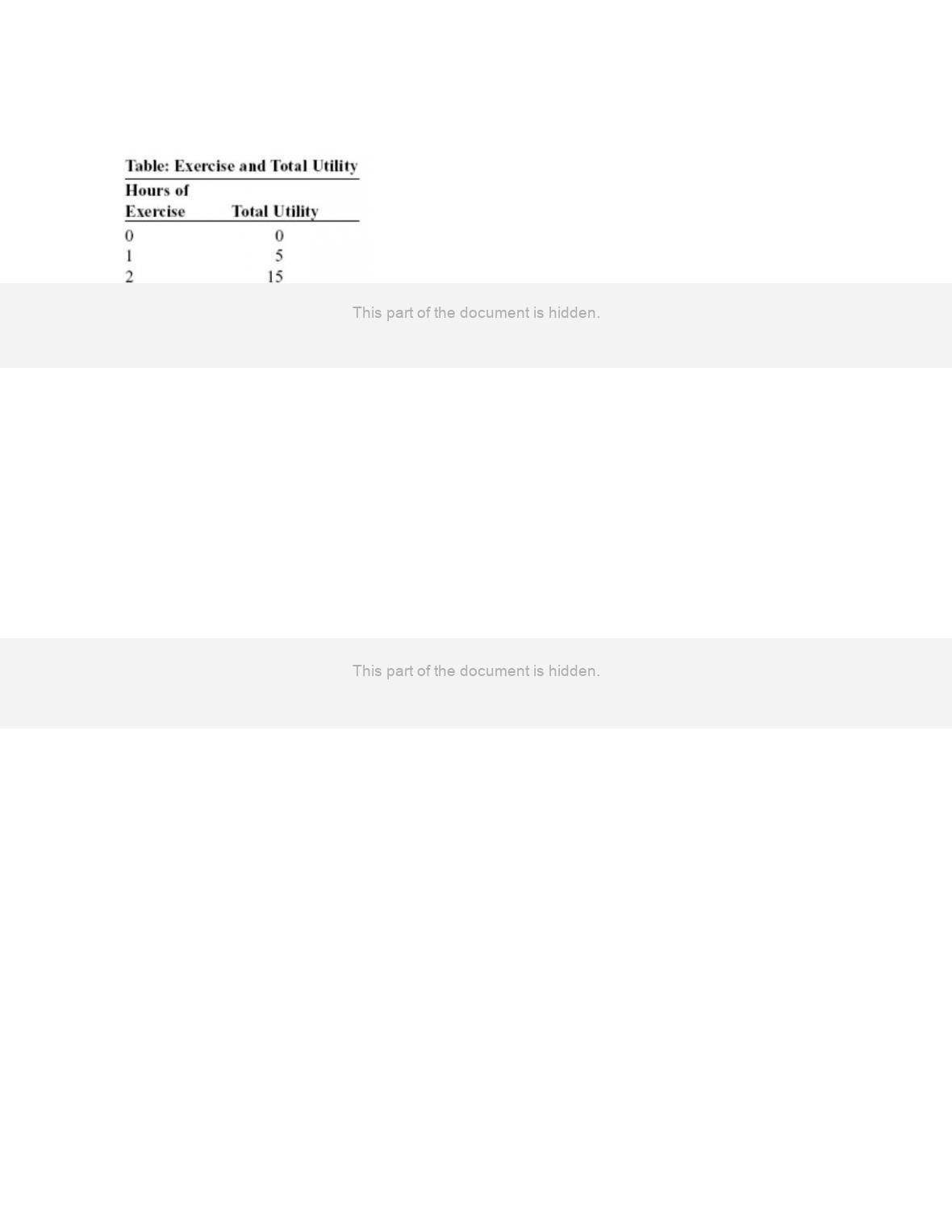
(Table: Exercise and Total Utility) Use Table: Exercise and Total Utility. Marginal
utility:
A)
initially decreases but eventually increases as more exercise is consumed.
B)
always decreases as more exercise is consumed.
C)
initially increases but eventually decreases as more exercise is consumed.
D)
initially increases but eventually stays constant as more exercise is consumed.
37.
(Table: Exercise and Total Utility) Use Table: Exercise and Total Utility. The principle
of diminishing marginal utility is seen:
A)
nowhere, as marginal utility is always increasing.
B)
immediately, from the first hour and beyond.
C)
between the third and fourth hours.
D)
after the second hour of exercise.
38.
When an individual continues to eat more turkey, if the principle of diminishing
marginal utility applies, each additional serving yields:
A)
more marginal utility.
B)
less marginal utility.
C)
the same amount of marginal utility.
D)
less total utility.
39.
If total utility is at a maximum, marginal utility is:
A)
rising.
B)
at its average value.
C)
at a maximum.
D)
zero.
Page 9
40.
The amount by which total utility rises when an additional slice of pie is consumed is
called:
A)
average utility.
B)
the law of diminishing returns.
C)
incremental utility.
D)
marginal utility.
41.
As you consume more turkey relative to mashed potatoes, the _____ of turkey
eventually decreases.
A)
price
B)
usefulness
C)
marginal utility
D)
demand
42.
The amount by which total utility _____ when an additional unit of a good is consumed
is _____.
A)
changes; average utility
B)
increases; the income effect
C)
decreases; maximum utility
D)
changes; marginal utility
Use the following to answer questions 43-48:
43.
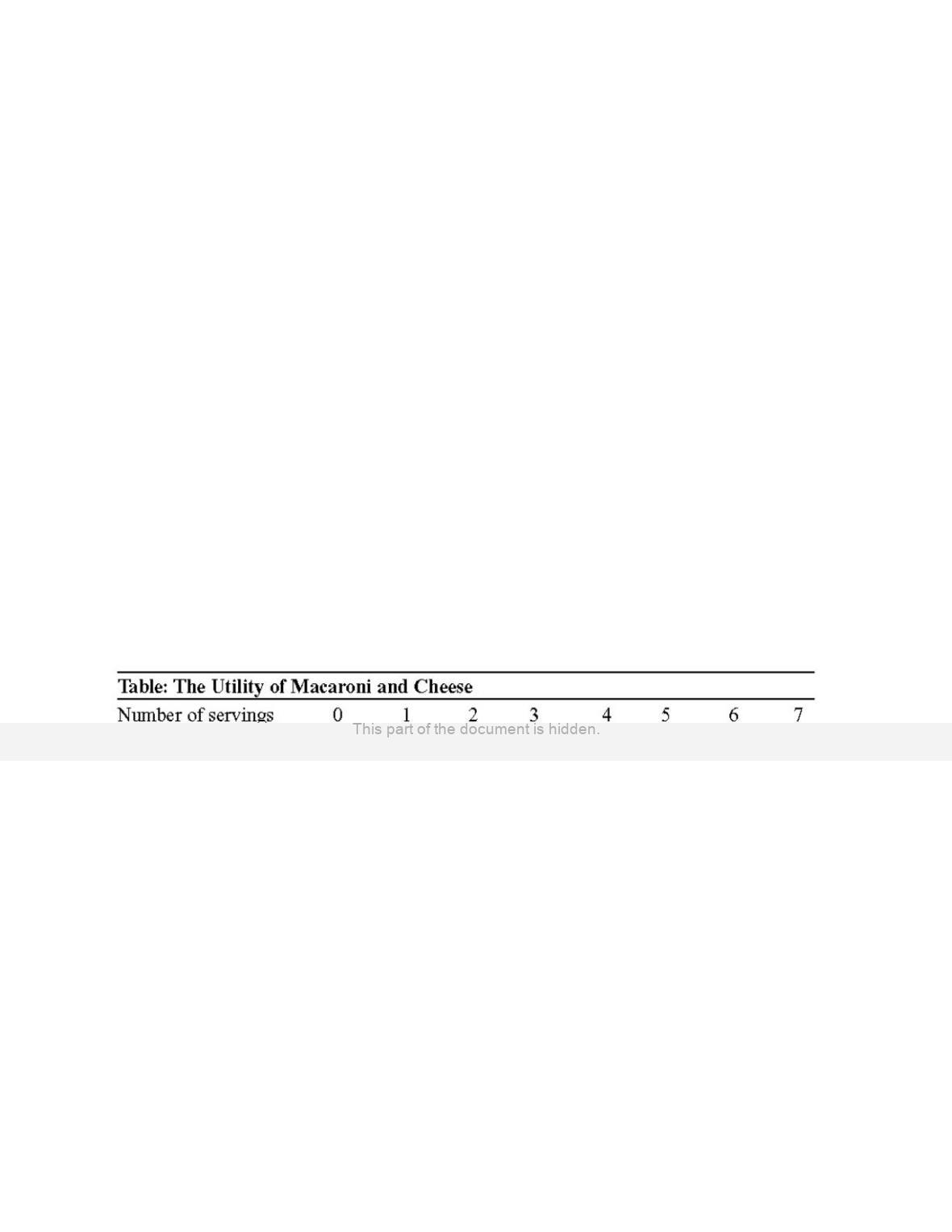
(Table: The Utility of Macaroni and Cheese) Use Table: The Utility of Macaroni and
Cheese. Carmen loves eating macaroni and cheese on Thanksgiving. The marginal
utility she derives from the second serving she eats is _____ units.
A)
35
B)
15
C)
10
D)
5

Page 10
44.
(Table: The Utility of Macaroni and Cheese) Use Table: The Utility of Macaroni and
Cheese. Carmen loves eating macaroni and cheese on Thanksgiving. The marginal
utility she derives from the fifth serving she eats is _____ units.
A)
15
B)
10
C)
5
D)
0
45.
(Table: The Utility of Macaroni and Cheese) Use Table: The Utility of Macaroni and
Cheese. Carmen loves eating macaroni and cheese on Thanksgiving. The marginal
utility she derives from the sixth serving she eats is _____ units.
A)
–25
B)
0
C)
25
D)
–15
46.
(Table: The Utility of Macaroni and Cheese) Use Table: The Utility of Macaroni and
Cheese. Carmen loves eating macaroni and cheese on Thanksgiving. Carmen’s total
utility is maximized after she eats the _____ serving.
A)
first
B)
second
C)
forth
D)
sixth
47.
(Table: The Utility of Macaroni and Cheese) Use Table: The Utility of Macaroni and
Cheese. Carmen loves eating macaroni and cheese on Thanksgiving. Carmen’s marginal
utility from eating macaroni and cheese is 0 for the _____ serving.
A)
first
B)
second
C)
third
D)
fifth
48.
(Table: The Utility of Macaroni and Cheese) Use Table: The Utility of Macaroni and
Cheese. Carmen loves eating macaroni and cheese on Thanksgiving. Carmen’s marginal
utility from eating macaroni becomes negative at the _____ serving.
A)
first
B)
second
C)
fifth
D)
sixth
Page 11
49.
The marginal utility of eating sweet potatoes is the:
A)
change in total utility from consuming an additional serving.
B)
total utility divided by the number of servings consumed.
C)
change in total utility divided by the number of servings consumed.
D)
total utility divided by the change in the number of servings consumed.
50.
Assuming that diminishing marginal utility applies to both pomegranates and bananas, if
Vanessa buys more pomegranates and fewer bananas, the _____ utility of pomegranates
will _____, and the _____ utility of bananas will _____.
A)
marginal; fall; marginal; rise
B)
marginal; rise; marginal; fall
C)
total; fall; marginal; rise
D)
marginal; rise; total; rise
51.
Assuming that diminishing marginal utility applies to both goods, if a consumer buys
more plastic bins and fewer door hooks, the _____ utility of plastic bins will _____, and
the _____ utility of door hooks will _____.
A)
marginal; fall; marginal; rise
B)
marginal; fall; marginal; fall
C)
total; fall; marginal; rise
D)
marginal; rise; total; rise
52.
Abdul spends all of his income on food (F) and shelter (S). His budget line is given by
the equation 5F + 20S = 100. Which consumption bundle is part of his consumption
possibilities?
A)
8 units of F and 3 units of S
B)
14 units of F and 2 units of S
C)
0 units of F and 6 units of S
D)
20 units of F and 15 units of S
Page 12
Use the following to answer questions 53-57:
53.
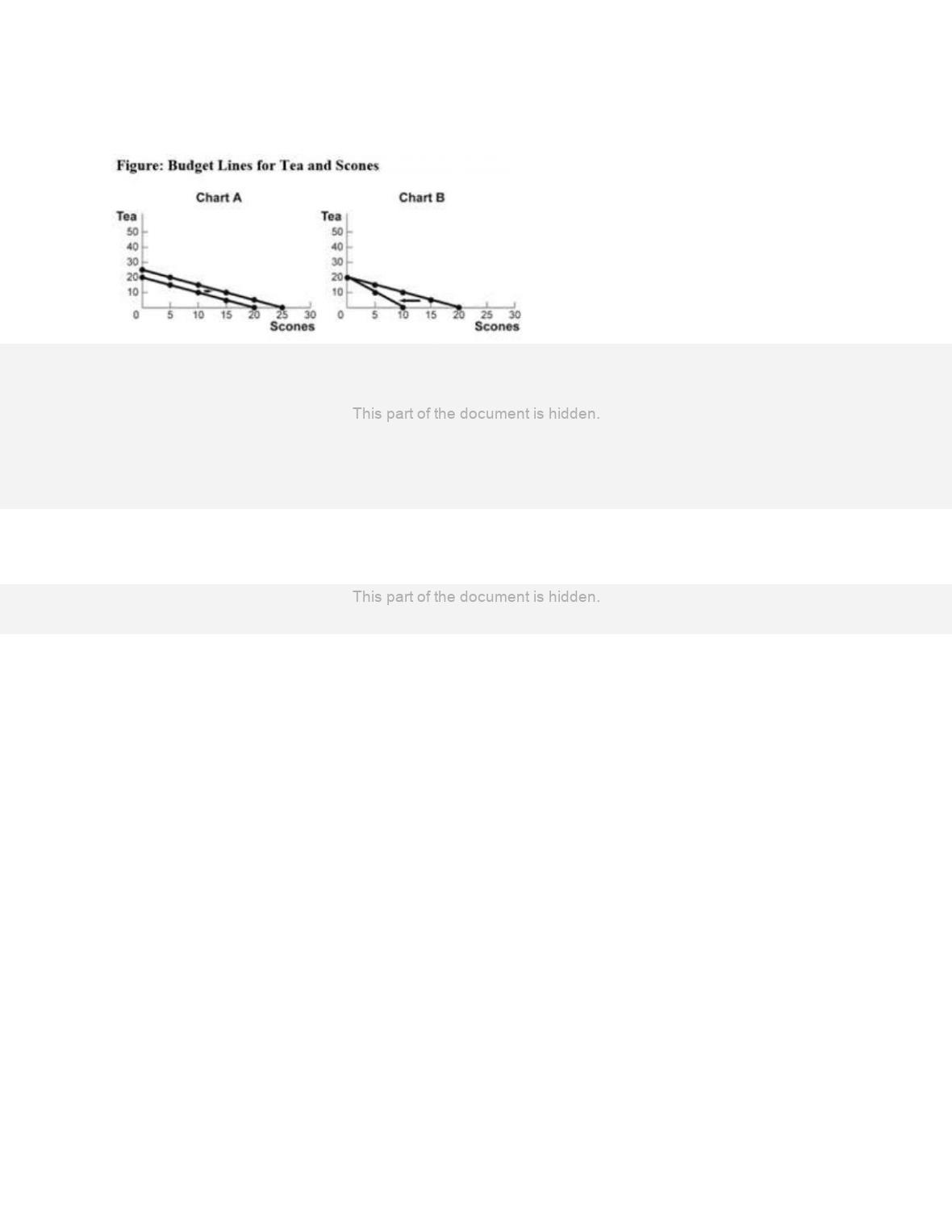
(Figure: Budget Lines for Tea and Scones) Use Figure: Budget Lines for Tea and
Scones. For months now, Agnes has had $20 per month to spend on tea and scones. The
price of each cup of tea and each scone is $1. Which chart shows what will happen to
her budget line if her income increases to $25?
A)
A
B)
B
C)
C
D)
D
54.
(Figure: Budget Lines for Tea and Scones) Use Figure: Budget Lines for Tea and
Scones. For months now, Agnes has had $20 per month to spend on tea and scones. The
price of each cup of tea and each scone has been $1. Which chart shows what will
happen to her budget line if her income decreases to $10?
A)
A
B)
B
C)
C
D)
D
Page 13
55.
(Figure: Budget Lines for Tea and Scones) Use Figure: Budget Lines for Tea and
Scones. For months now, Agnes has had $20 per month to spend on tea and scones. The
price of each cup of tea and each scone has been $1. Which chart shows what will
happen to her budget line if the price of a cup of tea falls to $0.50?
A)
A
B)
B
C)
C
D)
D
56.
(Figure: Budget Lines for Tea and Scones) Use Figure: Budget Lines for Tea and
Scones. For months now, Agnes has had $20 per month to spend on tea and scones. The
price of each cup of tea and each scone has been $1. Which chart shows what will
happen to her budget line if the price of a scone rises to $2?
A)
A
B)
B
C)
C
D)
D
57.
(Figure: Budget Lines for Tea and Scones) Use Figure: Budget Lines for Tea and
Scones. For months now, Agnes has had $20 per month to spend on tea and scones. The
price of each cup of tea and each scone has been $1. Which chart shows what will
happen to her budget line if the price of both a cup of tea and a scone increase to $2?
A)
A
B)
B
C)
C
D)
D
58.
Faruq spends all of his income on tacos and milkshakes. His income is $100, the price
of tacos is $10, and the price of milkshakes is $2. Put tacos on the horizontal axis and
milkshakes on the vertical axis. The horizontal intercept for Faruq’s budget line is _____
tacos.
A)
50
B)
10
C)
5
D)
100
Page 14
59.
Faruq spends all of his income on tacos and milkshakes. His income is $100, the price
of tacos is $10, and the price of milkshakes is $2. Put tacos on the horizontal axis and
milkshakes on the vertical axis. The slope of Faruq’s budget line is equal to:
A)
–1/5.
B)
–5.
C)
1/5.
D)
5.
60.
Faruq spends all of his income on tacos and milkshakes. His income is $100, the price
of tacos is $10, and the price of milkshakes is $2. Put tacos on the horizontal axis and
milkshakes on the vertical axis. If Faruq spends all of his income, the opportunity cost
of one taco equals _____ milkshakes.
A)
2
B)
10
C)
5
D)
1/5
61.
Faruq spends all of his income on tacos and milkshakes. His income is $100, the price
of tacos is $10, and the price of milkshakes is $2. If Faruq purchases 10 milkshakes, he
can purchase _____ tacos.
A)
10
B)
50
C)
8
D)
18
62.
Faruq spends all of his income on tacos and milkshakes. His income is $100, the price
of tacos is $10, and the price of milkshakes is $2. If Faruq spends all of his income, the
opportunity cost of one milkshake is equal to _____ tacos.
A)
2
B)
10
C)
5
D)
1/5
63.
Chuck spends all of his income on tacos and milkshakes. His income is $100, the price
of tacos is $10, and the price of milkshakes is $2. If the price of each good doubles and
Chuck’s income doubles:
A)
Chuck’s budget line will be unaffected.
B)
Chuck’s budget line will shift out.
C)
Chuck’s budget line will shift in.
D)
Chuck will be able to buy more of both goods.
Page 15
64.
Chuck spends all of his income on tacos and milkshakes. His income is $100, the price
of tacos is $10, and the price of milkshakes is $2. Put tacos on the horizontal axis and
milkshakes on the vertical axis. The vertical intercept for Chuck’s budget line is _____
milkshakes.
A)
50
B)
10
C)
5
D)
100
65.
Joe’s budget line reflects the _____ available to Joe if he spends _____ of his income.
A)
consumption bundles; all
B)
consumption bundles; part
C)
utility; all
D)
utility; part
Use the following to answer questions 66-71:

Page 16
66.
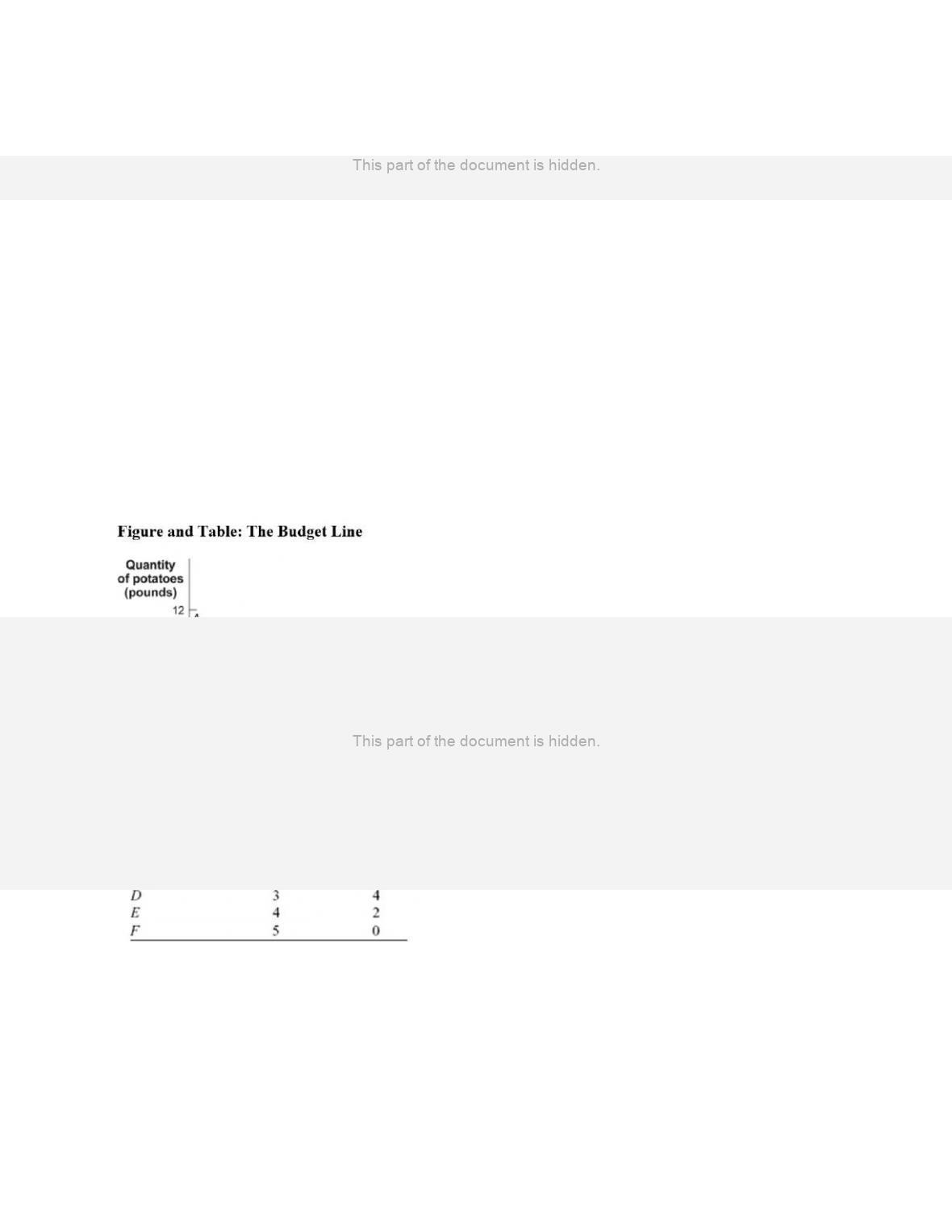
(Figure and Table: The Budget Line) Use Figure and Table: The Budget Line. A(n)
_____ in the price of clams would rotate the budget line, changing the intercept on the
_____ axis and moving it _____ the origin.
A)
increase; horizontal; toward
B)
decrease; horizontal; toward
C)
increase; vertical; toward
D)
decrease; vertical; away from
67.
(Figure and Table: The Budget Line) Use Figure and Table: The Budget Line. A(n)
_____ in the price of potatoes would rotate the budget line, changing the intercept on the
_____ axis and moving it _____ the origin.
A)
increase; horizontal; away from
B)
decrease; horizontal; toward
C)
increase; vertical; toward
D)
decrease; vertical; toward
68.
(Figure and Table: The Budget Line) Use Figure and Table: The Budget Line. A(n)
_____ in the price of clams would rotate the budget line, changing the intercept on the
_____ axis and moving it _____ the origin.
A)
increase; horizontal; away from
B)
decrease; horizontal; away from
C)
increase; vertical; toward
D)
decrease; vertical; away from
69.
(Figure and Table: The Budget Line) Use Figure and Table: The Budget Line. A(n)
_____ in the price of potatoes would rotate the budget line, changing the intercept on the
_____ axis and moving it _____ the origin.
A)
increase; horizontal; away from
B)
decrease; horizontal; toward
C)
increase; vertical; away from
D)
decrease; vertical; away from
70.
(Figure and Table: The Budget Line) Use Figure and Table: The Budget Line. An
increase in income would:
A)
rotate the budget line, changing the intercept on the horizontal axis.
B)
shift the budget line to the left.
C)
rotate the budget line, changing the intercept on the vertical axis.
D)
shift the budget line to the right.
Page 17
71.
(Figure and Table: The Budget Line) Use Figure and Table: The Budget Line. A
decrease in income would:
A)
rotate the budget line, changing the intercept on the horizontal axis.
B)
shift the budget line to the left.
C)
rotate the budget line, changing the intercept on the vertical axis.
D)
shift the budget line to the right.
72.
A consumer’s spending is restricted because of:
A)
marginal utility.
B)
total utility.
C)
his or her budget constraint.
D)
utility maximization.
73.
Whatever the time period in question, Molly’s spending will be _____ by her _____.
A)
unlimited; marginal utility
B)
limited; marginal utility
C)
limited; budget
D)
unlimited; budget
74.
(Scenario: Tom’s Budget Constraint) Use Scenario: Tom’s Budget Constraint. The
combination of _____ music downloads and _____ movies lies ON Tom’s budget line.
Scenario: Tom’s Budget Constraint
Tom is trying to decide how to allocate his $50 budget for music downloads and online
movie streaming when the price of a music download is $1 and the price of a movie is
$5.
A)
50; 10
B)
50; 0
C)
0; 5
D)
100; 5
Page 18
75.
(Scenario: Tom’s Budget Constraint) Use Scenario: Tom’s Budget Constraint. The
combination of _____ music downloads and _____ movies lies INSIDE Tom’s budget
line (meaning Tom can afford this combination, but he will not be spending the entire
$50).
Scenario: Tom’s Budget Constraint
Tom is trying to decide how to allocate his $50 budget for music downloads and online
movie streaming when the price of a music download is $1 and the price of a movie is
$5.
A)
50; 10
B)
50; 0
C)
0; 5
D)
100; 5
76.
(Scenario: Tom’s Budget Constraint) Use Scenario: Tom’s Budget Constraint. The
combination of _____ music downloads and _____ movies lies OUTSIDE Tom’s budget
line (meaning Tom cannot afford this combination).
Scenario: Tom’s Budget Constraint
Tom is trying to decide how to allocate his $50 budget for music downloads and online
movie streaming when the price of a music download is $1 and the price of a movie is
$5.
A)
50; 10
B)
50; 0
C)
0; 5
D)
20; 5
77.
(Scenario: Tom’s Budget Constraint) Use Scenario: Tom’s Budget Constraint. If we
place music downloads on the horizontal axis and movies on the vertical axis, the
vertical intercept of Tom’s budget line is:
Scenario: Tom’s Budget Constraint
Tom is trying to decide how to allocate his $50 budget for music downloads and online
movie streaming when the price of a music download is $1 and the price of a movie is
$5.
A)
10.
B)
50.
C)
2.
D)
1/2.
Page 19
78.
(Scenario: Tom’s Budget Constraint) Use Scenario: Tom’s Budget Constraint. If we
place music downloads on the horizontal axis and movies on the vertical axis, the
horizontal intercept of Tom’s budget line is:
Scenario: Tom’s Budget Constraint
Tom is trying to decide how to allocate his $50 budget for music downloads and online
movie streaming when the price of a music download is $1 and the price of a movie is
$5.
A)
100.
B)
50.
C)
10.
D)
1/2.
79.
(Scenario: Tom’s Budget Constraint) Use Scenario: Tom’s Budget Constraint. If we
place music downloads on the horizontal axis and movies on the vertical axis, the slope
of Tom’s budget line is:
Scenario: Tom’s Budget Constraint
Tom is trying to decide how to allocate his $50 budget for music downloads and online
movie streaming when the price of a music download is $1 and the price of a movie is
$5.
A)
–10.
B)
–1/5.
C)
–2.
D)
–1/2.
80.
The slope of a budget line for a consumer buying two goods is equal to the _____ of the
price of the good on the _____ axis divided by the price of the good on the _____ axis.
A)
positive; vertical; horizontal
B)
negative; horizontal; vertical
C)
positive; horizontal; vertical
D)
negative; vertical; horizontal
81.
A line representing all possible combinations of two commodities that a consumer can
purchase at a particular time, given the market prices of the commodities and the
consumer’s income, is a(n):
A)
budget line.
B)
consumption line.
C)
income consumption curve.
D)
indifference curve.
Page 20
82.
An increase in a consumer’s income will NOT:
A)
shift the budget line away from the origin.
B)
increase the horizontal intercept.
C)
increase the vertical intercept.
D)
change the slope of the budget line.
83.
A decrease in a consumer’s income will NOT:
A)
shift the budget line away from the origin.
B)
decrease the horizontal intercept.
C)
decrease the vertical intercept.
D)
reduce the individual’s consumption possibilities.
Use the following to answer questions 84-89:
84.
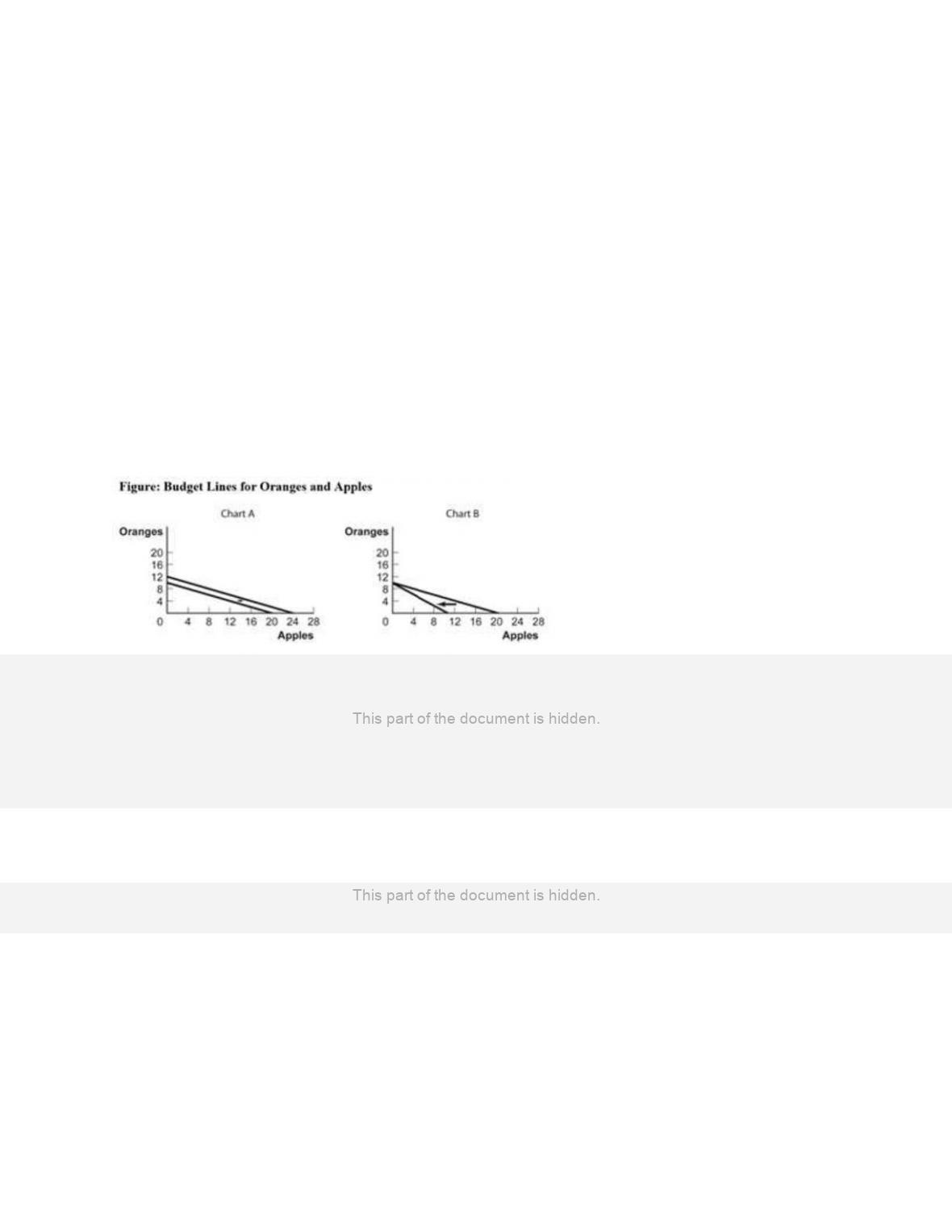
(Figure: Budget Lines for Oranges and Apples) Use Figure: Budget Lines for Oranges
and Apples. For some time, Antonio has had $5 per month to spend on oranges and
apples. The price of an orange is $0.50 and the price of an apple is $0.25. Which chart
shows what will happen to his budget line if his income increases to $6?
A)
A
B)
B
C)
C
D)
D