Page 33
167.
A trade-off involves weighing costs and benefits.
A)
True
B)
False
168.
Using marginal analysis to decide whether to consume an additional slice of pizza
requires making a comparison of the benefits and costs associated with the consumption
of an additional slice of pizza.
A)
True
B)
False
169.
Economists make predictions about individual behavior based on the assumption that
people exploit opportunities to make themselves better off. The fact that different
individuals make different choices when confronted with the same situation implies that
this assumption is often violated.
A)
True
B)
False
170.
The principle that people will exploit opportunities to do what is best for others is the
basis of all predictions by economists about individual behavior.
A)
True
B)
False
171.
When people in Brazil engage in trade with people in Germany, all citizens in both
nations are necessarily made better off.
A)
True
B)
False
172.
As long as individuals know that they can find the goods and services they want in the
market, they are willing to forgo being self-sufficient and are willing to specialize.
A)
True
B)
False
173.
Trade theoretically allows people to get more of what they want.
A)
True
B)
False
Page 34
174.
In equilibrium, there will be no further opportunities for gains from trade.
A)
True
B)
False
175.
An economic situation is in equilibrium when no individual would be better off taking a
different action.
A)
True
B)
False
176.
An economy is efficient if one person can be made better off by reallocating resources
without making anyone else worse off.
A)
True
B)
False
177.
Equity is the same as efficiency.
A)
True
B)
False
178.
If an economy’s resources are used efficiently, then it is guaranteed that the economy
will also achieve equity.
A)
True
B)
False
179.
Handicapped-designated parking spaces are an example of the market economy
achieving efficiency.
A)
True
B)
False
180.
The fact that individuals in a market economy act so as to make themselves better off is
a major reason a market equilibrium is usually efficient.
A)
True
B)
False
181.
According to standard economic theory, markets usually lead to efficiency.
A)
True
B)
False
Page 35
182.
Market failure occurs when the pursuit of self-interest leads to bad results for society.
A)
True
B)
False
183.
Because one person’s spending is another person’s income, if one group in the economy
spends more, the incomes of other groups will increase.
A)
True
B)
False
184.
Because one person’s spending is another person’s income, if one group in the economy
spends more, they increase their share of income and decrease the incomes of other
groups.
A)
True
B)
False
185.
Some products, like tobacco, are taxed. Why would the government interfere in a
market that if left untaxed would probably move to equilibrium on its own?
186.
Many college freshmen describe themselves as pre-med, but a very small percentage of
these freshmen will ever attend medical school. After the first course in biology or
chemistry, many decide to major in something other than the natural sciences. Which of
the twelve principles is at work here?
187.
A college student stays up late writing a history paper and as a result sleeps through her
morning economics class. What is the cost of sleeping through the class?
188.
A college student waits in line for hours to purchase a ticket to the Rose Bowl, but an
attorney does not. Rather than spend hours in line, he purchases a much more expensive
ticket through a ticket broker. Why?
189.
A two-year-old child is eating raisins one at a time from a large box. Even though the
child doesn’t understand formal economic theory, he knows when to stop eating because
he is full. Describe how this child has already mastered marginal analysis.
Page 36
190.
An apartment complex included a fixed price of water in the monthly rent. One day, the
city decided to attach a water meter to each individual apartment and charge the tenant
for actual water usage. As a result, water usage in the apartment complex went way
down. Explain this situation using a principle of economics.
191.
You and your roommate are taking the same economics class. When it comes to doing
homework assignments, your roommate draws beautifully precise graphs, while you are
an extremely fast typist. Therefore, you and your roommate work on the assignments
together. Which of the twelve principles is at work here?
192.
At most airports, there are multiple security guards ready to screen passengers and their
luggage through the X-ray and metal detector checkpoints. The length of the wait for
each line is about the same. Why?
193.
The most efficient way to dispose of industrial waste is to dump it in a nearby river or
parcel of land. Why is this illegal?
194.
When Hurricane Katrina devastated the Gulf coast, the businesses in the area, even
those not physically damaged by the storm, had losses. Explain how this illustrates the
principle that “one person’s spending is another person’s income.”
195.
By early 2008, the U.S. economy was in a significant downturn. The unemployment rate
began to increase, and home prices began to fall. Congress passed a stimulus package
that gave tax rebates to virtually every person who paid taxes in 2007. Which of the
twelve principles is described by this package?
196.
When someone says resources are scarce, this suggests that:
A)
lower-income individuals must be especially careful about the choices they make.
B)
choices must be made to utilize resources in the best manner possible.
C)
additional resources could be found if there were additional funds allocated to the
effort.
D)
we have enough resources to meet all of our needs and wants.
Page 37
197.
One day, Martha wakes up and in frustration yells, “Decisions, decisions, decisions!
Why do I have to make decisions about everything?” Martha’s frustrations stem from
the fact that:
A)
like all economic beings, she faces constraints and cannot have everything she
wants.
B)
she doesn’t realize she can have everything she wants.
C)
she is the only one who faces constraints in life.
D)
she really doesn’t want anything.
198.
Katherine has a physics exam tomorrow. However, a free lecture by one of her favorite
authors is taking place this evening. Katherine decides to attend the lecture instead of
studying for her exam. Katherine’s opportunity cost of attending the lecture is:
A)
the time spent listening to the lecture.
B)
not relevant since no money is involved.
C)
the transportation and time cost of getting to the lecture itself plus the reduction in
her physics exam grade as a result of not studying tonight.
D)
the time spent getting to the lecture.
199.
Mr. Freezee operates a fleet of ice cream trucks that drive around neighborhoods selling
ice cream. He is trying to decide whether he should buy another ice cream truck to add
to his fleet. He determines that one more truck will add $750 to his revenue but that the
truck will also increase his costs by $1,000. Based on marginal analysis, Mr. Freezee
decides:
A)
that he should not purchase the truck since the costs outweigh the benefits.
B)
that he should purchase the truck since the benefits outweigh the costs.
C)
that he should purchase the truck since his profits will rise by $250.
D)
to purchase several trucks with the same costs and benefits.
200.
Julie is getting ready for final exams. She has three exams during the first three days of
the exam period. To prepare, she has outlined a schedule that includes reviewing for her
first exam on one day, her next exam on the following day, and her third exam on the
third day. On each day, she has also allocated some time when she can watch TV or
basically do nothing. Which statement BEST explains why Julie provides some time for
leisure?
A)
Julie is not that smart and cannot study that long.
B)
Julie is slacking off and will most likely fail all of her finals.
C)
Julie realizes that there are benefits to leisure time that outweigh the costs of
constant studying.
D)
Julie does not understand the importance of studying.
Page 38
201.
A popular train station has free parking for commuters who take the train. This often
results in many people being unable to find a parking spot and missing their train. To
solve this problem, all commuters should be:
A)
given a parking pass along with their ticket.
B)
required to pay for parking.
C)
barred from parking at the station.
D)
exempt from parking lot fees.
202.
Beth promises to do Alice’s taxes, and in exchange, Alice will set up several
spreadsheets for Beth’s household budget. This trade will MOST likely:
A)
be beneficial to both individuals.
B)
hurt both individuals.
C)
help Beth but hurt Alice.
D)
help Alice but hurt Beth.
203.
Overall, trade between China and the United States will:
A)
benefit the United States more than China.
B)
benefit China more than the United States.
C)
benefit both countries.
D)
hurt both countries.
204.
When a market is in equilibrium:
A)
a person could do better if he or she did something different.
B)
people have exploited all opportunities to make themselves better off.
C)
the government has wrongly interfered in this market.
D)
markets are not working efficiently.
205.
If an economy is efficient:
A)
all goods are produced at their maximum quantity.
B)
all opportunities to make people better off without making other people worse off
have been taken.
C)
more resources have been used to produce specific consumer goods than producer
goods.
D)
prices are the lowest they can possibly be.
Page 39
206.
The provision of disabled-parking passes to those with disabilities often requires that
more than enough spaces be available for those with disabilities. As a result, many of
these spaces are vacant quite often when they could be used by able-bodied individuals.
Such a situation illustrates the:
A)
trade-off between efficiency and equity.
B)
trade-off between efficiency and specialization.
C)
ability of markets to provide efficient and equitable outcomes.
D)
power of the market to provide for equilibrium outcomes.
207.
The existence of government intervention often suggests that:
A)
markets may not be able to provide for efficient results all of the time.
B)
individual actions have no side effects.
C)
an equitable outcome will necessarily be achieved through this intervention.
D)
markets can efficiently manage the allocation of goods.
208.
Suppose small business owners decide to spend less. How will this affect an economy?
A)
It will have no impact since this group makes up a small portion of any economy.
B)
It will decrease the level of income of other people since one person’s spending is
someone else’s income.
C)
It will cause prices for many goods to increase.
D)
It will increase the level of income in the economy since other groups will spend
more.
209.
People who live in large cities decide to spend less in their day-to-day activities. This
will MOST likely lead to:
A)
less income for other people
B)
more income for other people.
C)
no impact on other people.
D)
inflation.
210.
Too little spending in an economy often leads to:
A)
a recession.
B)
inflation.
C)
equilibrium.
D)
efficiency.
Answer Key
Page 41
45.
C
46.
C
47.
C
48.
A
49.
C
50.
C
51.
A
52.
C
53.
B
54.
D
55.
D
56.
C
57.
A
58.
D
59.
D
60.
B
61.
C
62.
C
63.
B
64.
A
65.
B
66.
A
67.
B
68.
C
69.
B
70.
A
71.
C
72.
B
73.
A
74.
D
75.
C
76.
B
77.
A
78.
B
79.
A
80.
A
81.
A
82.
A
83.
B
84.
B
85.
A
86.
C
87.
C
88.
D
89.
C
90.
D
Page 42
91.
B
92.
B
93.
D
94.
C
95.
B
96.
B
97.
B
98.
C
99.
A
100.
A
101.
D
102.
C
103.
A
104.
B
105.
B
106.
B
107.
A
108.
A
109.
D
110.
C
111.
C
112.
D
113.
C
114.
C
115.
B
116.
D
117.
D
118.
C
119.
D
120.
A
121.
C
122.
A
123.
C
124.
C
125.
B
126.
A
127.
C
128.
B
129.
A
130.
A
131.
A
132.
B
133.
C
134.
D
135.
A
136.
C
Page 43
137.
C
138.
C
139.
C
140.
B
141.
C
142.
D
143.
B
144.
C
145.
B
146.
D
147.
A
148.
A
149.
B
150.
D
151.
D
152.
D
153.
D
154.
B
155.
C
156.
D
157.
C
158.
B
159.
C
160.
D
161.
C
162.
C
163.
B
164.
A
165.
A
166.
B
167.
A
168.
A
169.
B
170.
B
171.
B
172.
A
173.
A
174.
A
175.
A
176.
B
177.
B
178.
B
179.
B
180.
A
181.
A
182.
A
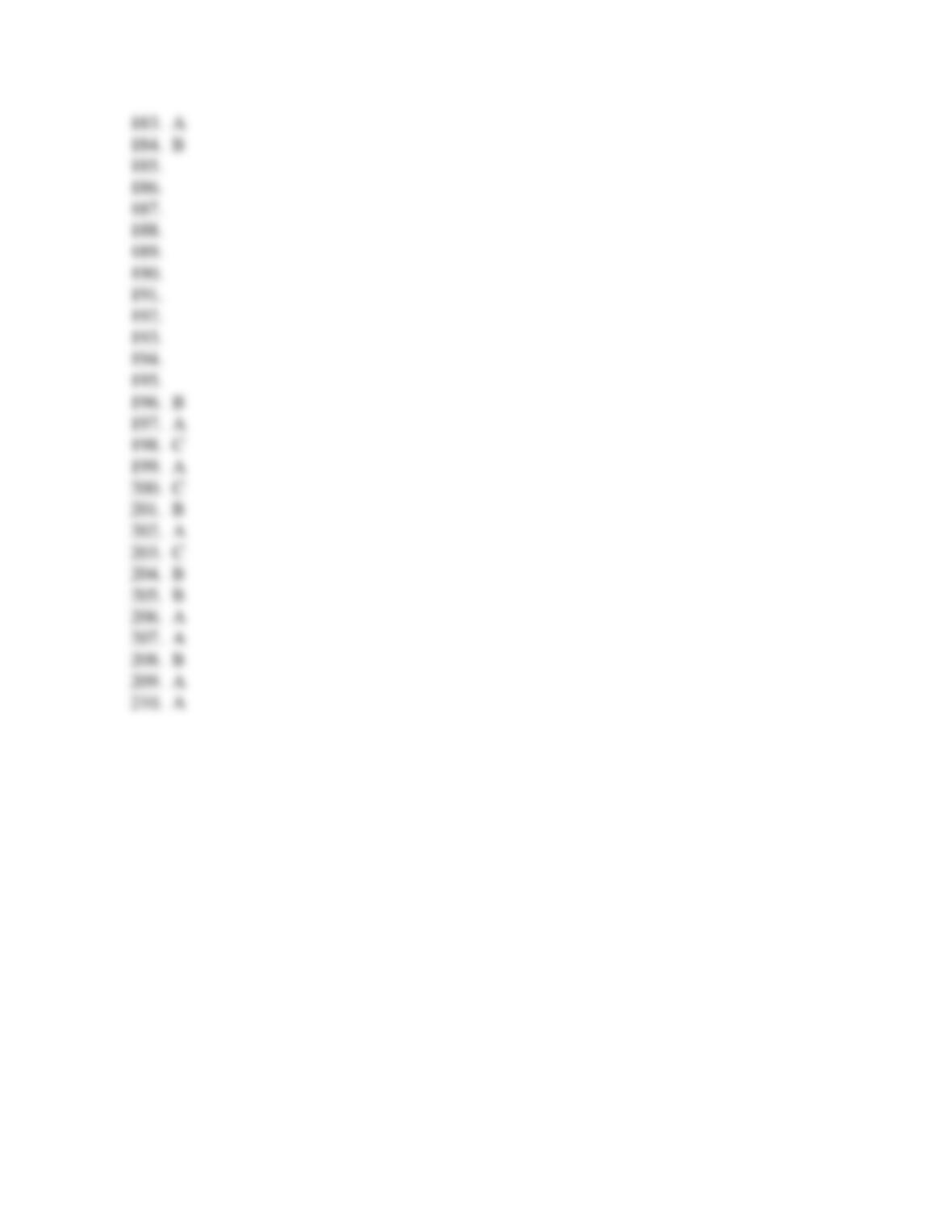
Page 44
183.
A
184.
B
185.
186.
187.
188.
189.
190.
191.
192.
193.
194.
195.
196.
B
197.
A
198.
C
199.
A
200.
C
201.
B
202.
A
203.
C
204.
B
205.
B
206.
A
207.
A
208.
B
209.
A
210.
A