Page 41
161.
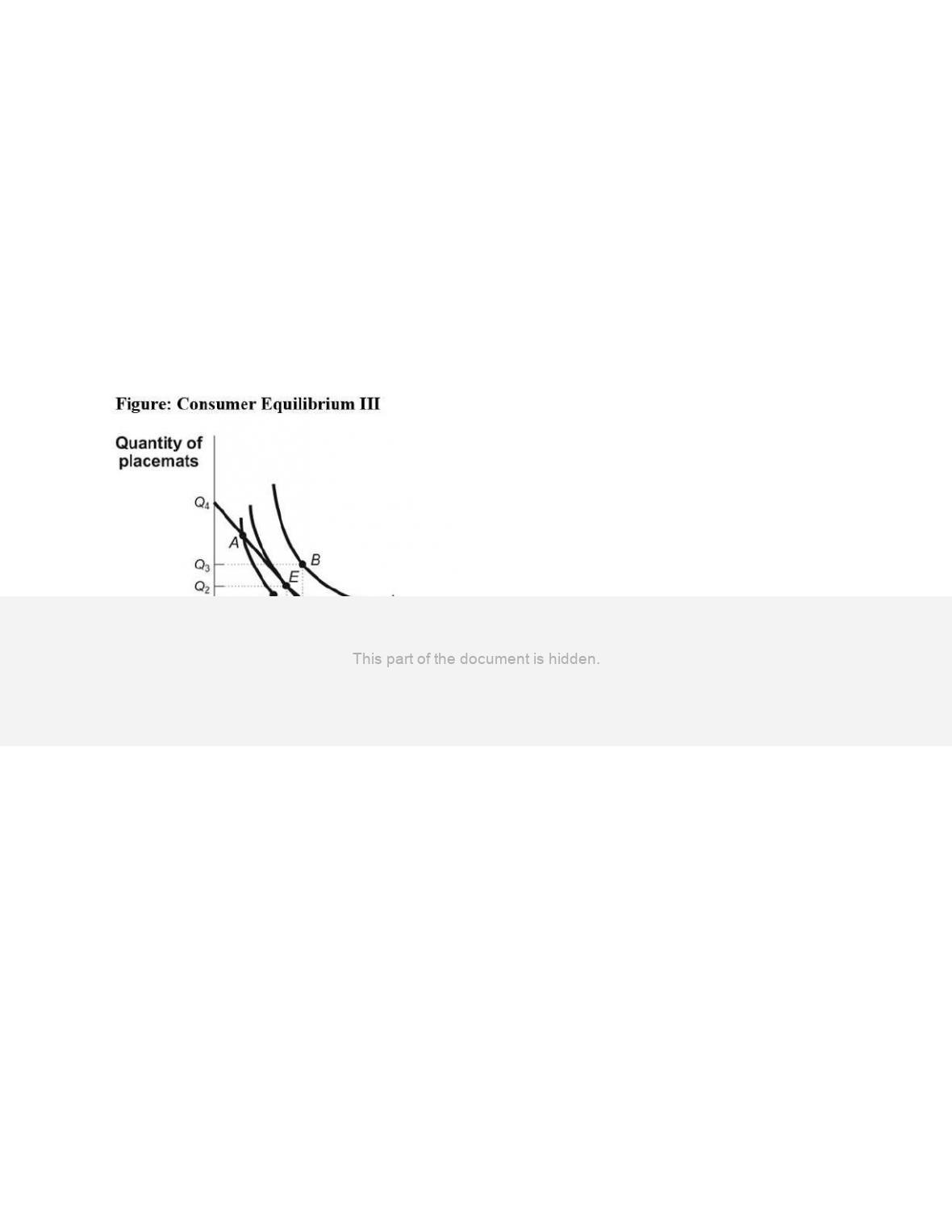
(Figure: Consumer Equilibrium II) Use Figure Consumer Equilibrium II. Ashyra
consumes at point G. Ashyra would be able to realize more total utility by choosing
point _____, all other things held equal.
A)
J
B)
K
C)
I
D)
H
162.
(Figure: Consumer Equilibrium II) Use Figure Consumer Equilibrium II. Ashyra
consumes at point I. Ashyra could gain more utility by choosing point _____, all other
things held equal.
A)
J
B)
G
C)
K
D)
The consumer doesn’t have enough income to gain more utility.
163.
(Figure: Consumer Equilibrium II) Use Figure Consumer Equilibrium II. Ashyra would
maximize her utility at point _____ with the consumption of _____ olive oil and _____
dish soap.
A)
J; S; P
B)
I; S; P
C)
J; N; F
D)
I; N; M
164.
(Figure: Consumer Equilibrium II) Use Figure Consumer Equilibrium II. Which of the
following statements is TRUE?
A)
Point I is the point of utility maximization.
B)
At the point of utility maximization, the rate at which Ashyra is willing to
exchange one good for another is less than the rate at which the goods can be
exchanged in the market.
C)
At point I, Py. = Px.
D)
At point I, Ashyra has some income left for saving.
Page 42
165.
(Figure: Consumer Equilibrium II) Use Figure Consumer Equilibrium II. Which of the
following is TRUE?
A)
To increase utility beyond that received at point I requires an increase in the price
of olive oil.
B)
Point J could be attained with an increase in Ashyra’s income.
C)
An increase in the prices of olive oil and dish soap would allow Ashyra to attain
point J.
D)
To increase utility beyond that received at point I requires an increase in the price
of dish soap.
Use the following to answer questions 166-174:
166.
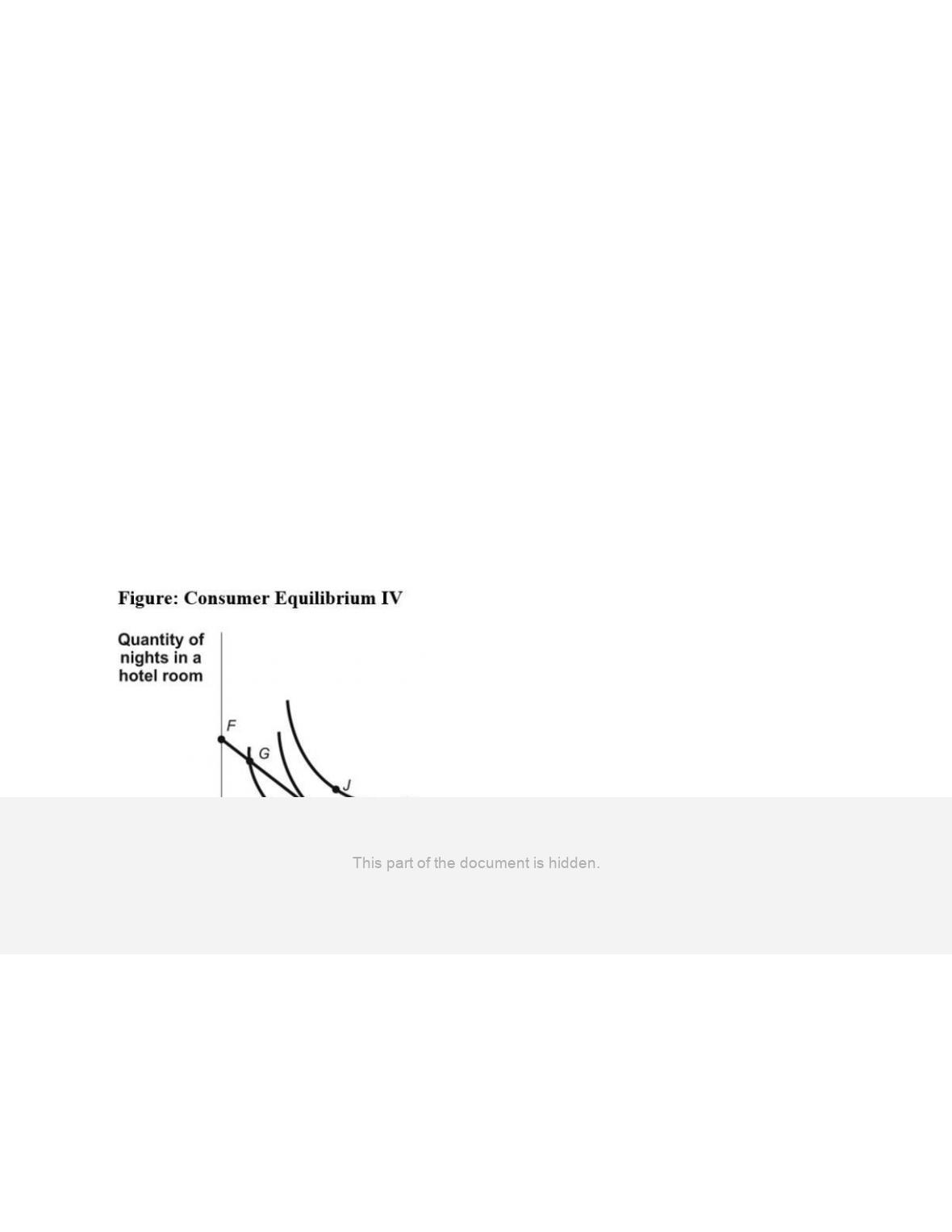
(Figure: Consumer Equilibrium III) Use Figure Consumer Equilibrium III. The highest
level of total utility attainable is associated with point _____ on _____.
A)
C; I3
B)
E; I2
C)
A; I2
D)
B; I1
167.
(Figure: Consumer Equilibrium III) Use Figure Consumer Equilibrium III. The lowest
level of total utility at which Ivan still spends all of his income is associated with point
_____ on _____.
A)
A; I3
B)
C; I3
C)
E; I2
D)
B; I1
Page 43
168.
(Figure: Consumer Equilibrium III) Use Figure Consumer Equilibrium III. A level of
total utility NOT attainable is at point:
A)
A.
B)
F.
C)
E.
D)
B.
169.
(Figure: Consumer Equilibrium III) Use Figure Consumer Equilibrium III. Which of the
following statements is TRUE?
A)
Q4 indicates the price of placemats.
B)
Q8 indicates the price of tamales.
C)
Points A and E represent the same level of total utility.
D)
Kurt is better off at point E than at point A.
170.
(Figure: Consumer Equilibrium III) Use Figure Consumer Equilibrium III. Kurt
consumes at point A. Other things held equal, Kurt would be able to realize more total
utility by choosing point:
A)
E.
B)
B.
C)
C.
D)
F.
171.
(Figure: Consumer Equilibrium III) Use Figure Consumer Equilibrium III. Kurt
consumes at point C. If income remains unchanged, Kurt could gain more utility by
choosing point:
A)
B.
B)
A.
C)
F.
D)
E.
172.
(Figure: Consumer Equilibrium III) Use Figure Consumer Equilibrium III. Kurt would
maximize his utility at point _____ with the consumption of _____.
A)
B; Q6 and Q3
B)
E; Q1 and Q7
C)
F; Q5 and Q4
D)
E; Q5 and Q2
Page 44
173.
(Figure: Consumer Equilibrium III) Use Figure Consumer Equilibrium III. Given the
figure, which of the following statements is TRUE?
A)
At the point of utility maximization, the rate at which Kurt is willing to exchange
one good for another is less than the rate at which the goods can be exchanged in
the market.
B)
An increase in the prices of tamales and placemats would allow Kurt to attain point
B.
C)
At point E, Px = Py.
D)
Point E is the point of utility maximization under current budget constraints.
174.
(Figure: Consumer Equilibrium III) Use Figure Consumer Equilibrium III. Given the
figure, which of the following is TRUE?
A)
Point C is preferable to point E.
B)
At point E, Px = Py
C)
Point B could be attained with an increase in the consumer’s income.
D)
To increase utility beyond that received at point E requires a change in the
preferences of the consumer.
Use the following to answer questions 175-184:
Page 45
175.
(Figure: Consumer Equilibrium IV) Use Figure Consumer Equilibrium IV. The highest
level of utility shown in the figure is associated with indifference curve:
A)
X.
B)
Y.
C)
Z.
D)
Y or Z.
176.
(Figure: Consumer Equilibrium IV) Use Figure Consumer Equilibrium IV. The lowest
level of utility shown in the figure is associated with indifference curve:
A)
X.
B)
Y.
C)
Z.
D)
X or Y.
177.
(Figure: Consumer Equilibrium IV) Use Figure Consumer Equilibrium IV. The highest
level of utility is at point:
A)
G.
B)
H.
C)
I.
D)
J.
178.
(Figure: Consumer Equilibrium IV) Use Figure Consumer Equilibrium IV. The highest
attainable level of utility, given budget constraint FL, is at point:
A)
G.
B)
H.
C)
I.
D)
J.
179.
(Figure: Consumer Equilibrium IV) Use Figure Consumer Equilibrium IV. An
unattainable level of utility, given budget constraint FL, is at point:
A)
G.
B)
H.
C)
I.
D)
J.
Page 46
180.
(Figure: Consumer Equilibrium IV) Use Figure Consumer Equilibrium IV. Assume that
you are consuming the combination of goods at point G. Given the budget constraint
FL, utility:
A)
can be increased by consuming more train tickets and fewer nights in a hotel room.
B)
can be increased by consuming fewer train tickets and more nights in a hotel room.
C)
can be increased by consuming more of both goods.
D)
cannot be increased.
181.
(Figure: Consumer Equilibrium IV) Use Figure Consumer Equilibrium IV. Assume that
you are consuming the combination of goods at point K. Given the budget constraint FL,
utility:
A)
can be increased by consuming more nights in a hotel room and fewer train tickets.
B)
can be increased by consuming fewer nights in a hotel room and more train tickets.
C)
can be increased by consuming more of both goods.
D)
cannot be increased.
182.
(Figure: Consumer Equilibrium IV) Use Figure Consumer Equilibrium IV. Assume that
you are consuming the combination of goods at point I. Given the budget constraint FL,
utility:
A)
cannot be increased.
B)
can be increased by consuming more nights in a hotel room and fewer train tickets.
C)
can be increased by consuming fewer nights in a hotel room and more train tickets.
D)
can be increased by consuming more of both goods.
183.
(Figure: Consumer Equilibrium IV) Use Figure Consumer Equilibrium IV. Assume that
you are consuming the combination of goods at point G. Given the budget constraint
FL, utility can be increased by moving to point:
A)
H.
B)
I.
C)
J.
D)
K.
184.
(Figure: Consumer Equilibrium IV) Use Figure Consumer Equilibrium IV. Assume that
you are consuming the combination of goods at point K. Given the budget constraint FL,
utility can be increased by moving to point:
A)
F.
B)
G.
C)
H.
D)
I.
Page 47
185.
One point on an indifference curve drawn between mangoes and vegetable broth is the
consumption bundle consisting of five mangoes and three boxes of vegetable broth. This
means that Sharri is indifferent between five mangoes and three boxes of vegetable
broth.
A)
True
B)
False
186.
As an individual moves down his or her indifference curve, total utility remains
constant.
A)
True
B)
False
187.
Suppose Joe derives 327 utils from consuming 1 dozen crab cakes and 11 pairs of socks.
If he also derives 327 utils from 2 dozen crab cakes and 5 pairs of socks, Joe is
indifferent between those combinations of crab cakes and socks.
A)
True
B)
False
188.
The following bundles can all be on the same indifference curve. Bundle A: 4
enchiladas, 1 burrito; bundle B: 3 enchiladas, 3 burritos; bundle C: 2 enchiladas, 2
burritos.
A)
True
B)
False
189.
Maria derives 288 utils from buying 2 pairs of hiking boots and 4 saws. She gets 313
utils from buying 1 pair of hiking boots and 7 saws. Maria is indifferent between these
two combinations of hiking boots and saws.
A)
True
B)
False
190.
Janella consumes only bananas and passion fruit. It is not possible for Janella’s
indifference curves to cross one another at any point.
A)
True
B)
False
191.
The assumption that the farther from the origin an indifference curve is, the higher the
level of utility it indicates implies that more is better.
A)
True
B)
False
Page 48
192.
Because of diminishing marginal utility, indifference curves are convex to the origin.
A)
True
B)
False
193.
Diminishing marginal utility occurs with increasing total utility.
A)
True
B)
False
194.
Shirley knows her marginal rate of substitution of mangoes for bananas is equal to 3.
The price of bananas is $0.50 and the price of mangoes is $1.00. Shirley should buy
more mangoes.
A)
True
B)
False
195.
At the video store, Lucian narrows his selection to either a $2 videocassette of The Evil
Dead or a $4 DVD of Finding Nemo. Lucian finally flips a coin to decide which movie
to rent. This must mean that Lucian’s marginal rate of substitution of The Evil Dead for
Finding Nemo is 0.5.
A)
True
B)
False
196.
Henry and Anne have identical incomes. Both buy only sardines and ice cream. Since
they face the same prices for the two goods, their optimal consumption bundles must be
identical.
A)
True
B)
False
197.
Mr. Coiner is always willing to exchange two nickels for a dime, no matter how many
nickels and dimes he has. This implies that nickels and dimes are ordinary goods for Mr.
Coiner.
A)
True
B)
False
Page 49
198.
Pooh spends all of his income on honey and maple syrup. Because he views honey and
maple syrup as perfect substitutes, he is willing to substitute honey for maple syrup at
the constant rate of 1 teaspoon of honey to 2 teaspoons of maple syrup. If the price of
honey in terms of maple syrup is 2.2, Pooh’s optimal consumption bundle will consist
entirely of maple syrup.
A)
True
B)
False
199.
Ms. Stardoe gets utility from coffee and cream, but only if they are consumed in the
precise ratio of 8 ounces of coffee to 2 ounces of cream. This implies that coffee and
cream are ordinary goods for Ms. Stardoe.
A)
True
B)
False
200.
If Ian’s indifference curve between guitars and Cadillacs is shaped like a right angle,
then he considers the two goods perfect complements.
A)
True
B)
False
201.
Miguel eats only burgers with onion rings. Miguel’s indifference curve between burgers
and onion rings must be a straight line.
A)
True
B)
False
202.
When we graphically isolate the substitution effect of a change in the price of one good,
utility is held constant.
A)
True
B)
False
203.
A Giffen good is an inferior good for which the income effect dominates the substitution
effect.
A)
True
B)
False
204.
How is a utility function different from an indifference curve?
205.
Patrick enjoys consuming chocolate but really detests broccoli. Describe the shape of
Patrick’s indifference curves for these two goods and explain your reasoning.
Page 50
206.
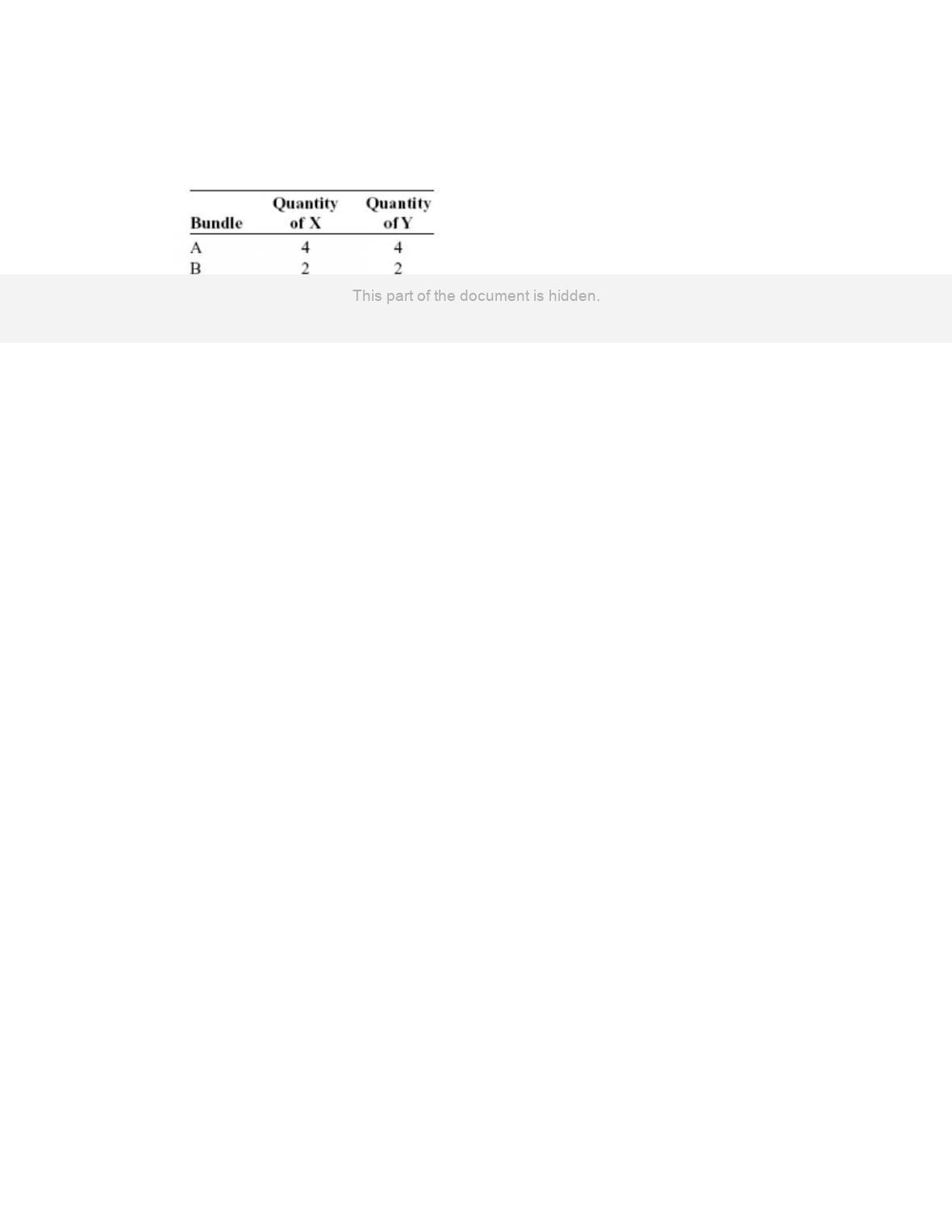
Consider the following bundles of two ordinary goods, X and Y. Can you rank them
from the one that provides the most utility to the least? Explain your reasoning.
207.
Explain why an individual’s indifference curves cannot intersect. Use an example to
explain.
208.
Jaime enjoys both iced tea and hot dogs. Explain why Jaime’s indifference curves for
these two goods must slope downward.
209.
Explain the concept of the marginal rate of substitution. Provide an intuitive rather than
mathematical reason it is believed to be diminishing as a consumer moves down an
indifference curve.
210.
Mallory consumes a bundle of candy and cookies, spending all of her income. The price
of candy is $1 and the price of a cookie is $0.50. At her current bundle, the marginal
utility of the next bar of candy she could purchase is 12 utils and the marginal utility of
the next cookie she could purchase is 6 utils. Should Mallory consume more cookies or
more candy, or should she leave her consumption unchanged?
211.
Michaela consumes a bundle of candy and cookies, spending all of her income. The
price of candy is $1 and the price of a cookie is $0.50. At her current bundle, the
marginal utility of the next bar of candy she could purchase is 16 utils and the marginal
utility of the next cookie she could purchase is 7 utils. Should Michaela consume more
cookies or more candy? Or should she leave her consumption unchanged?
212.
Jennifer has $10 to spend on tomatoes and cheese. The price of a pound of tomatoes is
$2 and the price of a pound of cheese is $4. She has found her utility-maximizing
bundle at 2 pounds of tomatoes and 1.5 pounds of cheese. Suppose Jennifer’s income
falls to $8 and the price of tomatoes falls to $1. The price of cheese remains the same.
Jennifer is considering a bundle of no tomatoes and 2 units of cheese. What is your
advice?
Page 51
213.
Kelli likes to bake cookies and doesn’t care whether she uses corn oil or safflower oil in
her recipes. To her, they provide the same function and the same taste. What do Kelli’s
indifference curves look like for corn oil and safflower oil? What is her tangency
condition when it comes to finding the utility-maximizing bundle?
Use the following to answer questions 214-216:
214.
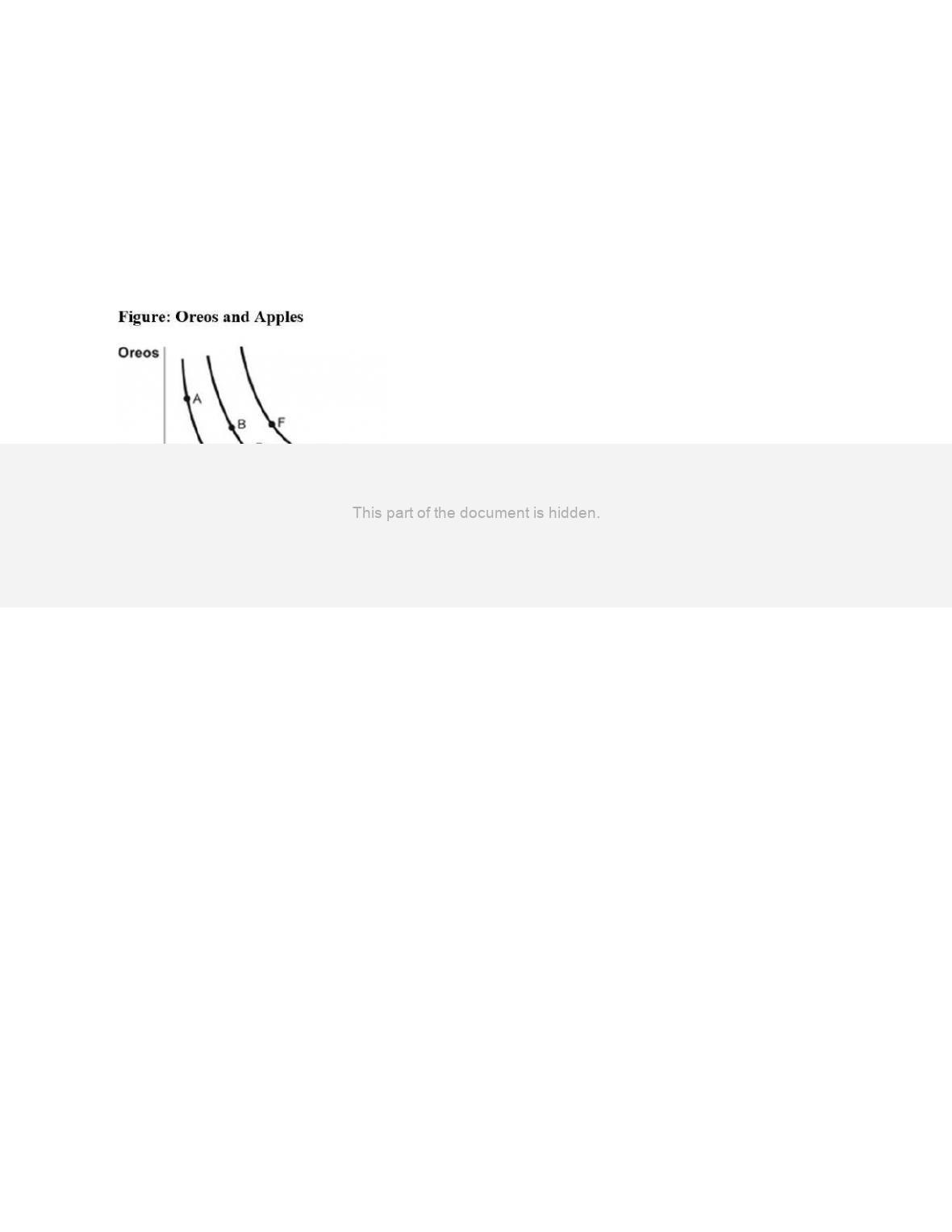
(Figure: Oreos and Apples) Use Figure Oreos and Apples, which provides an
indifference curve map for Diego. The consumption bundle that provides the highest
level of utility is bundle:
A)
A or C.
B)
B or D.
C)
E or F.
D)
A or B.
215.
(Figure: Oreos and Apples) Use Figure Oreos and Apples, which provides an
indifference curve map for Diego. Diego prefers:
A)
E to F.
B)
F to E.
C)
A to E.
D)
D to C.
Page 52
216.
(Figure: Oreos and Apples) Use Figure Oreos and Apples, which provides an
indifference curve map for Diego. As Diego moves along an indifference curve from
point F to point E, he buys _____ Oreos to obtain _____ apples.
A)
fewer; more
B)
more; more
C)
the same number of; more
D)
no; more
217.
An indifference curve map illustrates _____ levels of utility, while each indifference
curve in the map indicates consumption bundles that yield _____ level of utility for an
individual.
A)
different; the same
B)
the same; a different
C)
the same; the same
D)
different; a different
218.
To find her optimal consumption bundle, Vanessa would have to:
A)
calculate the numerical value of the utility she receives from each specific
consumption bundle.
B)
rank-order consumption bundles based on the level of utility she receives from
each one.
C)
calculate her budget for each consumption bundle and identify the substitution and
income effects of each bundle.
D)
choose her bundles in an irrational manner.
219.
When an individual’s consumption of an additional unit of a good generates a smaller
increase in total utility than the previous unit consumed, then this person’s indifference
curve will be:
A)
a straight line.
B)
convex, or bowed toward the origin.
C)
concave, or bowed away from the origin.
D)
a right angle.
220.
The assumption that more is preferred to less explains why indifference curves:
A)
that lie closer to the origin represent higher levels of utility.
B)
that lie farther from the origin represent higher levels of utility.
C)
cross frequently.
D)
slope upward and away from the origin.