Name:
Class:
Date:
Chapter 05 Test D
Copyright Cengage Learning. Powered by Cognero.
Page 1
Syllogistic Form 1D
Given the following syllogistic form:
All P are M.
No S are M.
All S are P.
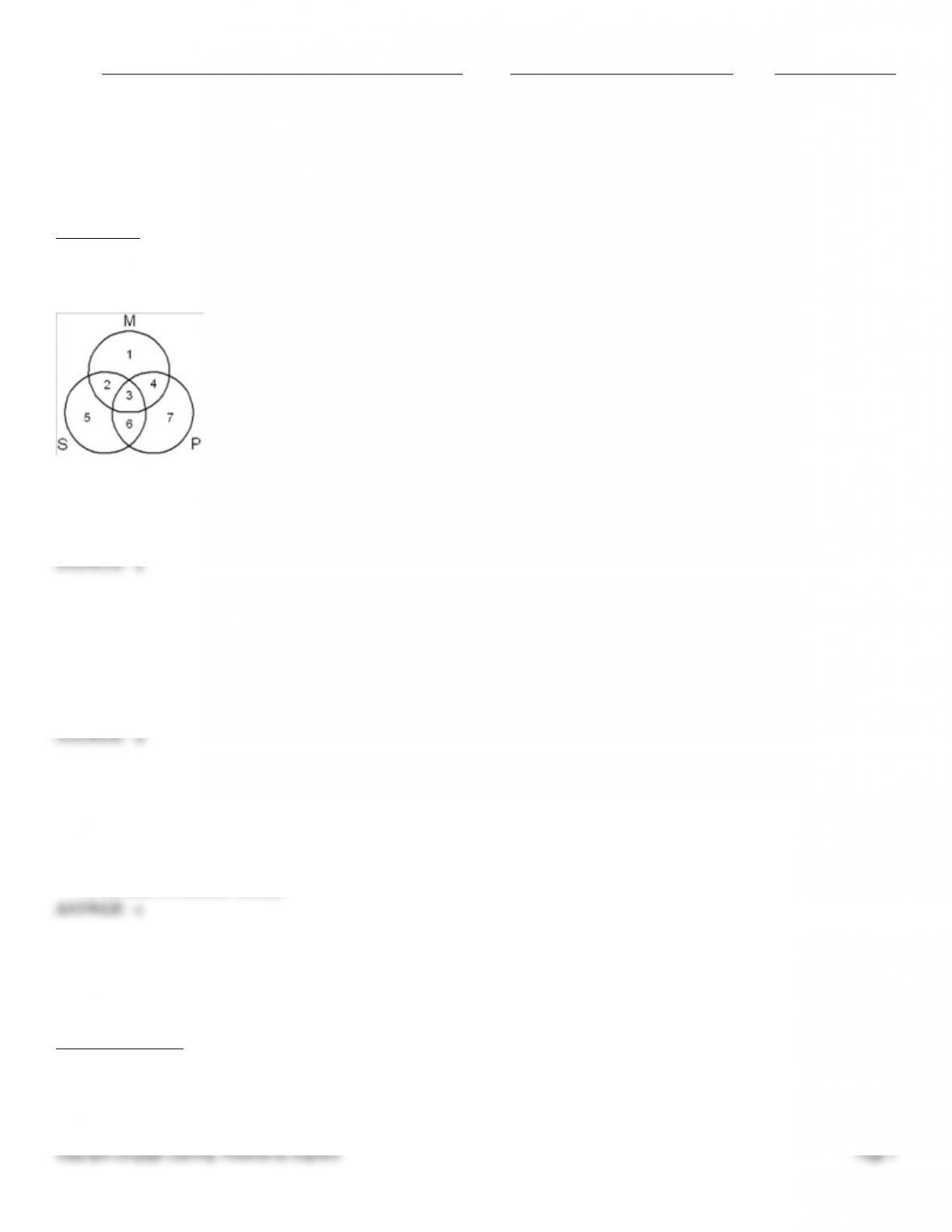
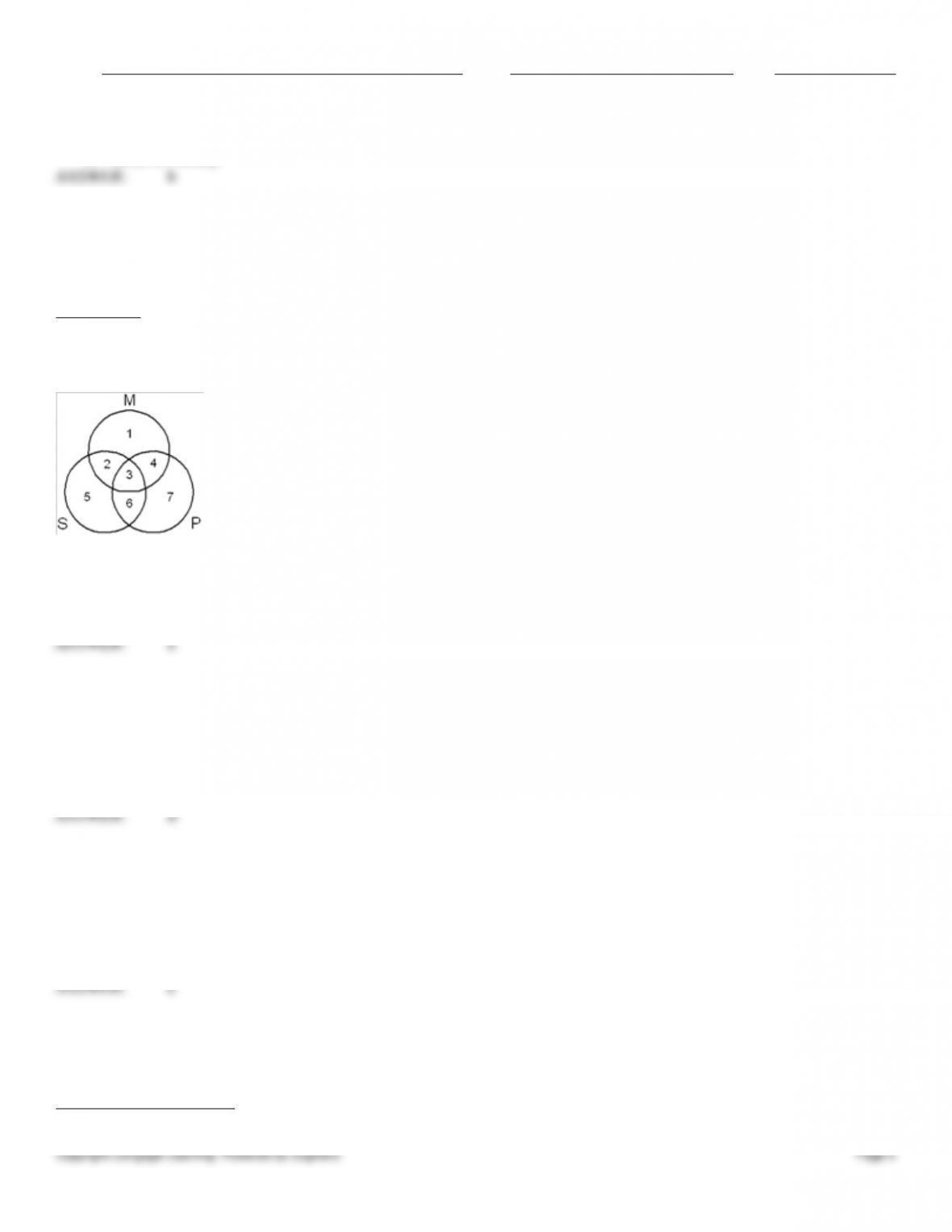
1. For Syllogistic Form 1D, after filling in the Venn diagram,
a. Areas 2, 3, 6, and 7 are shaded, and there are no other marks.
b. Areas 3, 4, 5, and 6 are shaded.
c. Areas 2 and 3 are shaded, and there is an X in area 4.
d. Areas 2, 3, 5, 6, and 7 are shaded.
e. Areas 2, 3, 6, and 7 are shaded, and there is an X in area 5.
2. For Syllogistic Form 1D, the mood and figure is:
a. AIA–2.
b. AOA–3.
c. EAE–2.
d. AEA–2.
e. AEA–3.
3. For Syllogistic Form 1D, the answer from the Boolean standpoint is:
a. Valid, no fallacy.
b. Invalid, illicit minor.
c. Invalid, drawing an affirmative conclusion from a negative premise.
d. Invalid, undistributed middle.
e. Invalid, existential fallacy.
Syllogistic Form 2D
Given the following syllogistic form:
Some M are not P.
Some S are M.
Some S are not P.
Name:
Class:
Date:
Chapter 05 Test D
Copyright Cengage Learning. Powered by Cognero.
Page 2
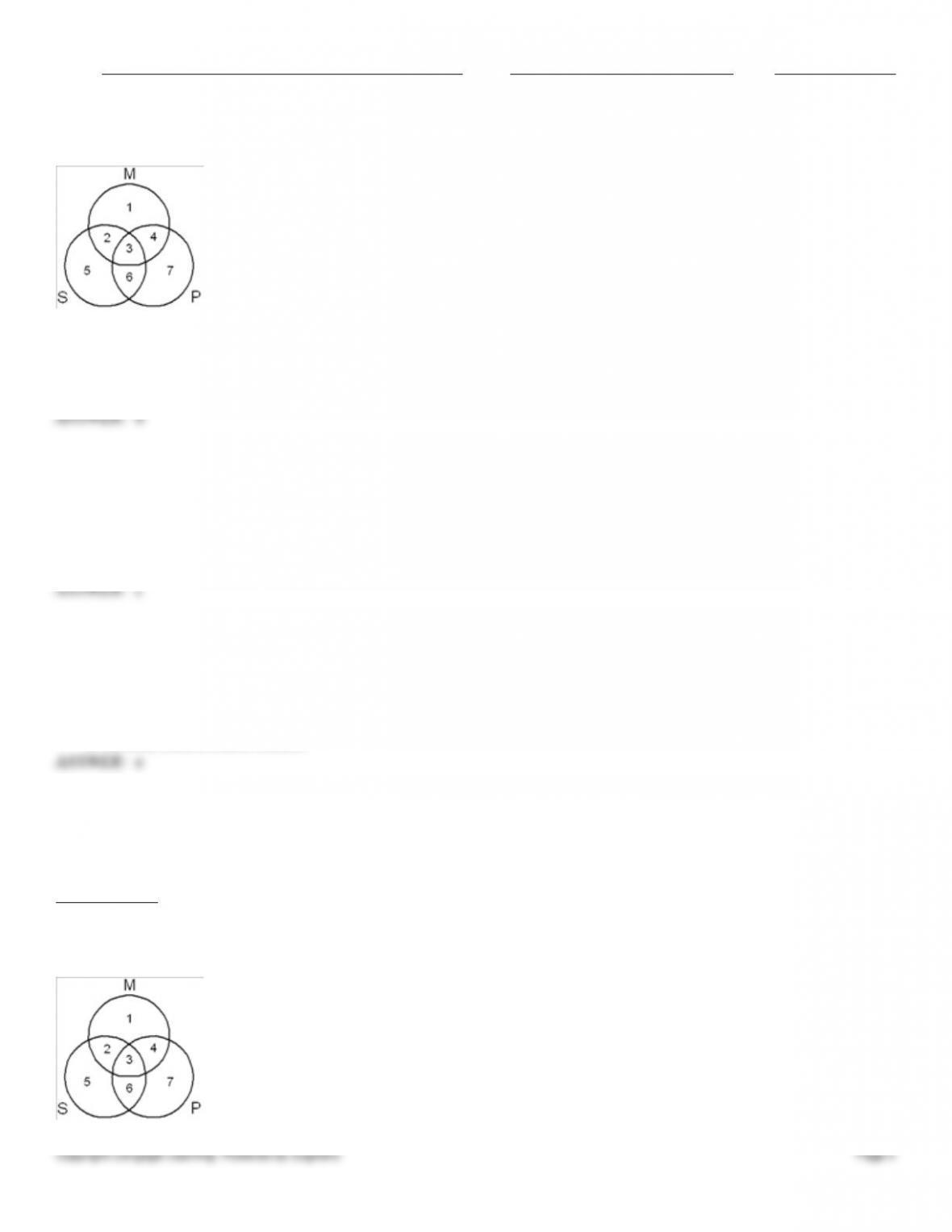
4. For Syllogistic Form 2D, after filling in the Venn diagram,
a. There is an X on the line between areas 1 and 4 and between areas 2 and 3.
b. There is an X on the line between areas 1 and 2 and between areas 2 and 3.
c. There is an X in area 1 and in area 3.
d. There is an X on the line between areas 1 and 2 and in area 3.
e. There is an X on the line between areas 1 and 4 and between areas 2 and 5.
5. For Syllogistic Form 2D, the mood and figure is:
a. IOI–1.
b. OEO–1.
c. OIO–1.
d. IOI–4.
e. OIO–4.
6. For Syllogistic Form 2D, the answer from the Boolean standpoint is:
a. Valid, no fallacy.
b. Invalid, illicit minor.
c. invalid, drawing a negative conclusion from affirmative premises.
d. Invalid, illicit major.
e. Invalid, undistributed middle.
Syllogistic Form 3D
Given the following syllogistic form:
All M are P.
Some M are S.
Some S are P.
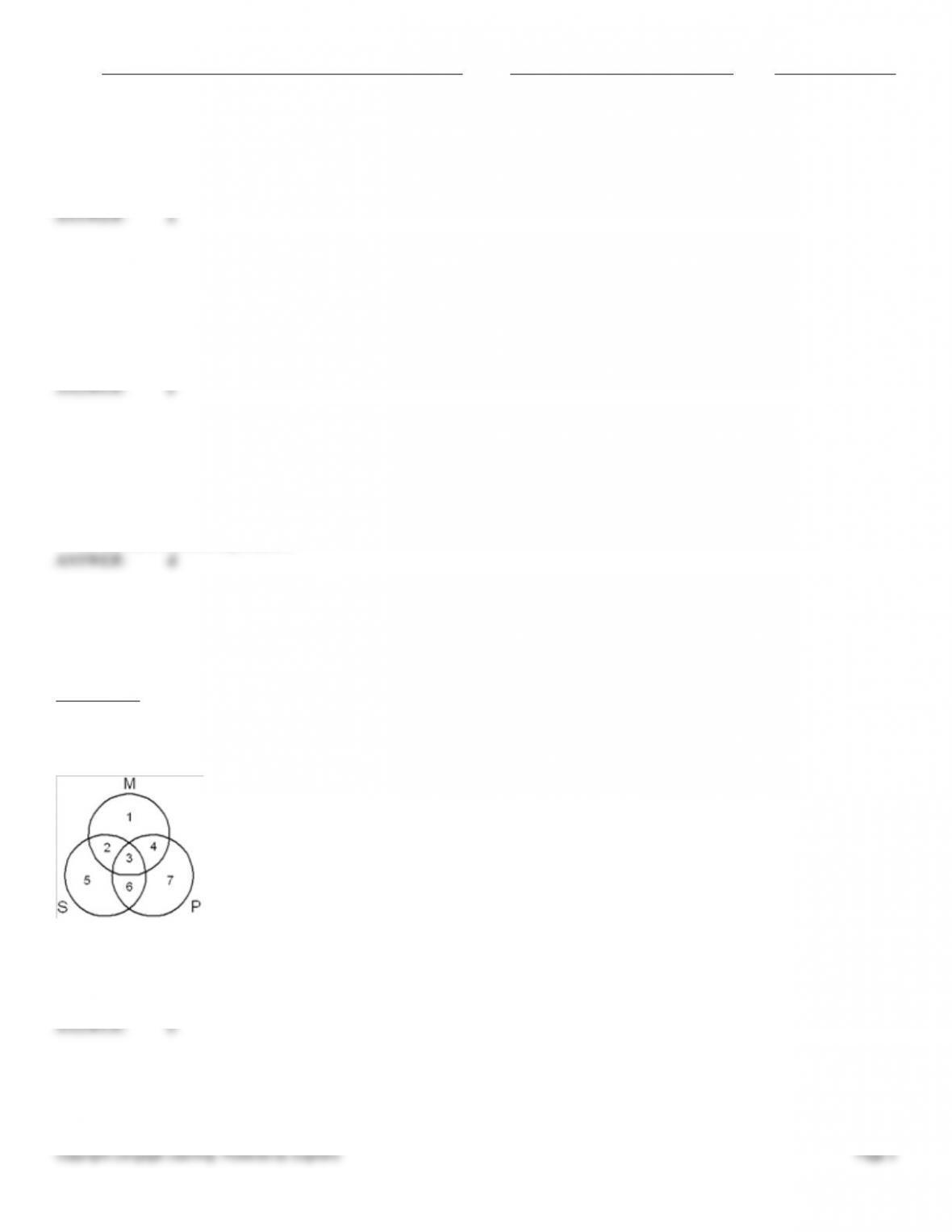
7. For Syllogistic Form 3D, after filling in the Venn diagram,
a. Areas 1 and 2 are shaded, and there is an X in area 3.
Name:
Class:
Date:
Chapter 05 Test D
Copyright Cengage Learning. Powered by Cognero.
Page 3
b. Areas 3 and 4 are shaded, and there is an X in area 2.
c. Areas 1 and 2 are shaded, and there is an X on the line between areas 3 and 4.
d. Areas 1 and 4 are shaded, and there is an X in area 3.
e. Areas 1 and 2 are shaded, and there is an X in area 4.
8. For Syllogistic Form 3D, the mood and figure is:
a. AII–4.
b. AOO–4.
c. AII–2.
d. AEE–3.
e. AII–3.
9. For Syllogistic Form 3D, the answer from the Boolean standpoint is:
a. Invalid, undistributed middle.
b. Invalid, illicit minor.
c. Invalid, drawing an affirmative conclusion from a negative premise.
d. Valid, no fallacy.
e. Invalid, exclusive premises.
Syllogistic Form 4D
Given the following syllogistic form:
All M are P.
No M are S.
No S are P.
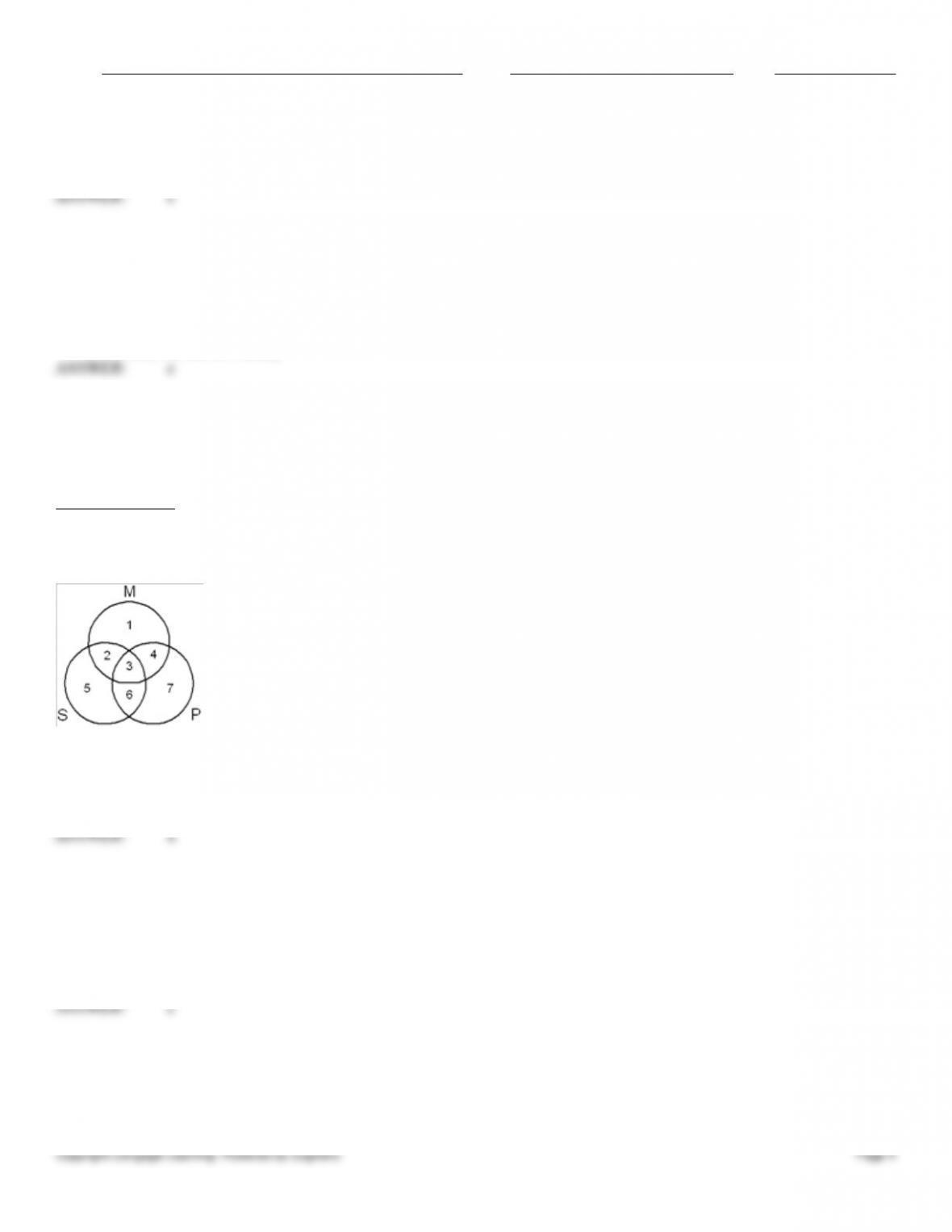
10. For Syllogistic Form 4D, after filling in the Venn diagram,
a. Areas 1, 2, and 4 are shaded, and there are no other marks.
b. Areas 1, 2, and 3 are shaded, and there are no other marks.
c. Areas 1, 3, and 4 are shaded.
d. Areas 1, 2, and 3 are shaded, and there is an X in area 4.
e. Areas 2 and 3, and 4 are shaded.
11. For Syllogistic Form 4D, the mood and figure is:
a. EAA–3.
b. AII–2.
Name:
Class:
Date:
Chapter 05 Test D
Copyright Cengage Learning. Powered by Cognero.
Page 4
c. AEE–3.
d. AOO–3.
e. AEE–2.
12. For Syllogistic Form 4D, the answer from the Boolean standpoint is:
a. Invalid, drawing a negative conclusion from affirmative premises.
b. Invalid, illicit minor.
c. Invalid, illicit major.
d. Valid, no fallacy.
e. Invalid, existential fallacy.
Syllogistic Form 5D
Given the following syllogistic form:
No M are P.
All S are M.
Some S are not P.
13. For Syllogistic Form 5D, after filling in the Venn diagram,
a. Areas 3, 4, 5 and 6 are shaded, and there are no other marks.
b. Areas 3 and 4 are shaded, and there is an X on the line between areas 2 and 5.
c. Areas 1, 2, and 3 are shaded.
d. Areas 3, 4, 5, and 6 are shaded, and there is an X in area 2.
e. Areas 3, 4, 5, and 6 are shaded, and there is an X in area 6.
14. For Syllogistic Form 5D, the mood and figure is:
a. EAI–1.
b. AEI–4.
c. AEO–1.
d. EAO–4.
e. EAO–1.
15. For Syllogistic Form 5D, the answer from the Boolean standpoint is:
a. Invalid, undistributed middle.
b. Invalid, existential fallacy.
c. Invalid, illicit major.
Name:
Class:
Date:
Chapter 05 Test D
Copyright Cengage Learning. Powered by Cognero.
Page 5
d. Invalid, exclusive premises.
e. Valid, no fallacy.
Syllogistic Form 6D
Given the following syllogistic form:
All P are M.
All M are S.
All S are P.
16. For Syllogistic Form 6D, after filling in the Venn diagram,
a. Areas 1, 4, 6, and 7 are shaded, and there are no other marks.
b. Areas 2, 3, and 4 are shaded, and there are no other marks.
c. Areas 2, 3, 4, and 6 are shaded.
d. Areas 1, 4, 6, and 7 are shaded, and there is an X in area 3.
e. Areas 1, 2, 4, 5, 6, and 7 are shaded.
17. For Syllogistic Form 6D, the mood and figure is:
a. AAA–1.
b. III–1.
c. EEE–4.
d. AAA–4.
e. AEA–4.
18. For Syllogistic Form 6D, the answer from the Boolean standpoint is:
a. Invalid, illicit major.
b. Valid, no fallacy.
c. Invalid, existential fallacy.
d. Invalid, exclusive premises.
e. Invalid, illicit minor.
19. Given the following syllogism:
No pigs are bears.
All bears are animals.
Some animals are not pigs.
Name:
Class:
Date:
Chapter 05 Test D
Copyright Cengage Learning. Powered by Cognero.
Page 6
This syllogism is:
a. Valid from the Aristotelian standpoint because animals exist.
b. Invalid from the Aristotelian standpoint.
c. Valid from the Aristotelian standpoint because bears exist.
d. Valid from the Boolean standpoint.
e. Valid from the Aristotelian standpoint because pigs exist.
20. Given the following syllogism:
No unicorns are mules.
All unicorns are animals.
Some animals are not mules.
This syllogism:
a. Is valid from both the Boolean and Aristotelian standpoints.
b. Is valid from the Boolean standpoint only.
c. Commits the existential fallacy from the Boolean standpoint only.
d. Commits the existential fallacy from both standpoints.
e. Commits the existential fallacy from the Aristotelian standpoint only.
Syllogism 1D
Given the following syllogism:
All unrewarding occupations are unsatisfying jobs, because no meaningless employments are satisfying jobs and all
meaningful employments are rewarding occupations.
21. After reducing the number of terms in Syllogism 1D, the conclusion is:
a. All meaningful employments are satisfying jobs.
b. All satisfying jobs are rewarding occupations.
c. All satisfying jobs are meaningful employments.
d. All meaningful employments are rewarding occupations.
e. All rewarding occupations are satisfying jobs.
22. For Syllogism 1D, the major premise is:
a. All satisfying jobs are rewarding occupations.
b. No meaningful employments are unrewarding occupations.
c. All meaningful employments are rewarding occupations.
d. All satisfying jobs are meaningful employments.
e. All rewarding occupations are meaningful employments.
23. For Syllogism 1D, the minor premise is:
a. All satisfying jobs are meaningful employments.
b. All satisfying jobs are rewarding occupations.
c. No meaningful employments are unrewarding occupations.
d. No satisfying jobs are meaningless employments.
Name:
Class:
Date:
Chapter 05 Test D
Copyright Cengage Learning. Powered by Cognero.
Page 7
e. All meaningful employments are rewarding occupations.
Syllogism 2D
Given the following syllogism:
Some low class characters are not people with money, so some people without money are not honest souls, since no
dishonest souls are high class characters.
24. After reducing the number of terms in Syllogism 2D, the conclusion is:
a. Some people without money are not high class characters.
b. All dishonest souls are low class characters.
c. Some people with money are not honest souls.
d. All high class characters are honest souls.
e. Some people without money are not honest souls.
25. For Syllogism 2D, the major premise is:
a. Some people without money are not honest souls.
b. Some people without money are not high class characters.
c. All dishonest souls are low class characters.
d. All high class characters are honest souls.
e. No low class characters are honest souls.
26. For Syllogism 2D, the minor premise is:
a. Some people without money are not honest souls.
b. Some high class characters are not people without money.
c. Some people without money are not high class characters.
d. No high class characters are dishonest souls.
e. All high class characters are honest souls.
Syllogism 3D
Given the following syllogism:
Edward gets angry whenever customers complain. Thus, Edward must have been angry yesterday, because customers
were complaining yesterday.
27. After translating Syllogism 3D into standard form, the conclusion is:
a. All times Edward gets angry are times customers complain.
b. All times identical to yesterday are times Edward gets angry.
c. All times customers complain are times Edward gets angry.
d. All persons identical to Edward are persons who got angry yesterday.
e. All times identical to yesterday are times customers complain.
28. For Syllogism 3D, the major premise is:
a. All times Edward gets angry are times customers complain.
b. All times identical to yesterday are times customers complain.
Name:
Class:
Date:
Chapter 05 Test D
Copyright Cengage Learning. Powered by Cognero.
Page 8
c. All times customers complain are times Edward gets angry.
d. All persons identical to Edward are persons who get angry when customers complain.
e. All times identical to yesterday are times Edward gets angry.
29. For Syllogism 3D, the minor premise is:
a. All times Edward gets angry are times customers complain.
b. All times customers complain are times identical to yesterday.
c. All times identical to yesterday are times Edward gets angry.
d. All times customers complain are times Edward gets angry.
e. All times identical to yesterday are times customers complain.
Syllogism 4D
Given the following syllogism:
A few Hondas are not on sale, because the cars with green tags are not on sale and a few Hondas have green tags.
30. After translating Syllogism 4D into standard form, the conclusion is:
a. Some cars that are on sale are not Hondas.
b. Some Hondas are cars with green tags.
c. All cars with green tags are cars that are not on sale.
d. Some Hondas are not cars that are on sale.
e. No cars with green tags are cars on sale.
31. For Syllogism 4D, the major premise is:
a. No cars with green tags are cars on sale.
b. All cars with green tags are not cars that are on sale.
c. All cars with green tags are cars that are not on sale.
d. Some Hondas are not cars that are on sale.
e. Some Hondas are cars with green tags.
32. For Syllogism 4D, the minor premise is:
a. Some Hondas are not cars that are on sale.
b. Some Hondas are cars with green tags.
c. No cars with green tags are cars on sale.
d. Some Hondas are not cars with green tags.
e. All cars with green tags are cars that are not on sale.
33. Given the following enthymeme:
Schools cannot discriminate if they receive federal financing, and Hamilton College receives federal financing.
The statement needed to convert the enthymeme into a valid syllogism is:
a. Not all schools receive federal financing. (Premise)
b. Some colleges other than Hamilton College discriminate. (Conclusion)
c. Hamilton College can discriminate. (Conclusion)

Name:
Class:
Date:
Chapter 05 Test D
Copyright Cengage Learning. Powered by Cognero.
Page 9
d. Hamilton College cannot discriminate. (Premise)
e. Hamilton College cannot discriminate. (Conclusion)
34. Given the following enthymeme:
Nuclear power does not cause global warming, so it must be good.
The statement needed to convert the enthymeme into a valid syllogism is:
a. Nuclear power is less efficient than hydroelectric power. (Premise)
b. Nuclear power produces a great deal of radioactive waste. (Premise)
c. Any kind of power that does not cause global warming is good. (Premise)
d. Nuclear power is good. (Conclusion)
e. Global warming can possibly be corrected through nuclear power. (Conclusion)
35. Given the following enthymeme:
Street gangs are a top priority for the FBI because they’re involved in organized crime.
The statement needed to convert the enthymeme into a valid syllogism is:
a. Street gangs have been involved in organized crime for years. (Premise)
b. Organized crime includes theft, murder, extortion, and prostitution. (Conclusion)
c. The FBI will never succeed in eradicating street gangs. (Conclusion)
d. Groups involved in organized crime are a top priority for the FBI. (Premise)
e. Any gang that deals in street drugs is involved in organized crime. (Premise)
Sorites 1D
Given the following sorites:
Some S are R.
No B are S.
All R are H.
All M are B.
Some H are not M.
36. For Sorites 1D, the correct standard form is:
a. All M are B.
No B are S.
Some S are R.
All R are H.
Some H are not M.
b. All R are H.
Some H are not M.
All M are B.
No B are S.
Some S are R.
c. All R are H.
Some S are R.
No B are S.
Name:
Class:
Date:
Chapter 05 Test D
Copyright Cengage Learning. Powered by Cognero.
Page 10
All M are B.
Some H are not M.
d. All R are H.
Some S are R.
All M are B.
No B are S.
Some H are not M.
e. No B are S.
All M are B.
Some S are R.
All R are H.
Some H are not M.
37. For Sorites 1D, the first intermediate conclusion is:
a. Some S are H.
b. Some R are not S.
c. All M are S.
d. No M are S.
e. Some R are not M.
38. For Sorites 1D, the second intermediate conclusion is:
a. Some S are H.
b. No M are B.
c. Some R are not B.
d. No M are S.
e. Some R are not M.
39. For Sorites 1D, the correct answer is:
a. Invalid.
b. Sound.
c. Valid.
d. Unsound.
e. Cogent.
40. Given the following sorites:
Some G are A.
No G are K.
All N are K.
All F are N.
No F are A.
This sorites is:
a. Invalid because one of the middle terms is undistributed.

Name:
Class:
Date:
Chapter 05 Test D
Copyright Cengage Learning. Powered by Cognero.
Page 11
b. Invalid because a term is distributed in the conclusion but not in the premise.
c. Invalid because the conclusion in negative but three premises are affirmative.
d. Valid because no rules are broken.
e. Valid because a negative premise requires a negative conclusion.