
Name:
Class:
Date:
chapter 3
Copyright Cengage Learning. Powered by Cognero.
Page 1
Indicate whether the statement is true or false.
1. Cause-related marketing is a marketing relationship based on a straight donation.
a. True
b. False
2. Morals are rules people develop as a result of cultural values and norms.
a. True
b. False
3. An ethical decision is solely based on the number of people who are benefitted by the decision.
a. True
b. False
4. Unlike rule utilitarianism, act utilitarianism is accurate in predicting the future outcomes of an action.
a. True
b. False
5. Sustainability is a popular theory in cause-related marketing.
a. True
b. False
6. Behavioral norms are standards of proper or acceptable behavior.
a. True
b. False
7. Conventional morality is the most basic level of ethical development.
a. True
b. False
8. Business gift giving is considered as the most unacceptable business practice in China.
a. True
b. False
9. The utilitarian theory is a belief in time-and-place ethics, that is, ethical truths depend on the individuals and groups
holding them.
a. True
b. False
10. The pyramid of corporate social responsibility portrays philanthropic performance as the foundation for the other
responsibilities.
a. True
b. False

Name:
Class:
Date:
chapter 3
Copyright Cengage Learning. Powered by Cognero.
Page 2
11. A virtue is a character trait valued as being good.
a. True
b. False
12. The local community is not a stakeholder of an organization.
a. True
b. False
13. Postconventional morality represents the morality of the mature adult.
a. True
b. False
14. Preconventional morality moves from an egocentric viewpoint toward the expectations of society.
a. True
b. False
15. Ethical beliefs vary widely from culture to culture.
a. True
b. False
Indicate the answer choice that best completes the statement or answers the question.
16. Lena is the CEO of a multinational corporation. When her subordinates fail to meet one of her expectations, she
promptly fires them. While doing so, she does not think about how beneficial that employee has been to her business over
the years. In this scenario, which of the following levels of ethical development is best illustrated?
a. Preconventional morality
b. Conventional morality
c. Postconventional morality
d. Act utilitarianism
17. Unlike the deontological theory, the utilitarian ethical theory:
a. is not necessarily concerned with the welfare of others.
b. upholds that an individual’s duty is considered ethically correct
c. determines choices that are socially beneficial and ethically correct
d. is free from inherent flaws that are present in all ethical theories
18. Which of the following companies is an advocate of sustainability?
a. Poldoid Inc., a manufacturer of plastic products, uses biodegradable plastics to reduce the generation of hazardous
wastes.
b. Harlose Brothers, an ice cream manufacturer, offers discounts on its ice creams during summer
c. Magnira Inc., a textile company, uses cost-effective strategies to generate higher profits
d. Laelle Corp.’s management believes that its employees are the most important and valuable resource of the
company.

Name:
Class:
Date:
chapter 3
Copyright Cengage Learning. Powered by Cognero.
Page 3
19. Coolers, a soft drink company, decides to launch a new brand of soft drink for children. It is not concerned with how
popular the drink will get with the customers in the long run. It is happy that the National Food & Beverage Council has
approved the quality of product and that the proceedings of the launch are legitimate. This shows that the company is at
the_____ level of ethical development.
a. preconventional morality
b. conventional morality
c. most basic
d. egocentric
20. Good Reads is a children’s bookstore. Every fortnight, the store collects old school textbooks and used stationery from
its regular customers and donates them to a nonprofit organization that helps educate underprivileged children in the city.
For this donation, customers get a special discount on books. This partnership is an example of _____.
a. diversity marketing
b. flanking marketing
c. cause-related marketing
d. green marketing
21. Karma is a professional landscaping company. For landscapes, it uses eco-friendly products such as synthetic turf and
drought-resistant plants that help save water and energy. The methods adopted by the company are inexpensive as well.
Which of the following concepts is illustrated in this scenario?
a. Relationship marketing
b. Effect-related marketing
c. Cause-related marketing
d. Green marketing
22. Under the Foreign Corrupt Practices Act (FCPA), _____.
a. U.S. corporations are prohibited to involve in international business dealings
b. U.S. corporations are prohibited to make illegal payments to foreign governments
c. prosecutions against bribery have significantly declined
d. several U.S. businesses are offered significant advantages
23. Quasio Foods Inc. is a large food manufacturing corporation that earns more profits than its competitors. The company
uses only organically grown grains and fruits. It also promotes organic farming and helps nonprofit agencies who focus on
food and nutrition causes. The company has now decided to launch a campaign to promote healthy eating habits among
the youth. In this scenario, Quasio Foods is most likely to have adopted the concept of _____.
a. divestment
b. consumerism
c. opportunism
d. sustainability
24. In the context of corporate social responsibility, which of the following statements is true of the stakeholder theory?
a. It states that companies should only focus on increasing shareholder wealth
b. It states that social responsibility is best carried out by government agencies.
c. It states that a company is expected to be a good citizen in its community
d. It states that employees and not the top management should be involved in corporate social responsibility.

Name:
Class:
Date:
chapter 3
Copyright Cengage Learning. Powered by Cognero.
Page 4
25. Ronald Systems Inc. has developed a line of appliances that run on solar energy and cause no harm to the
environment. Which of the following concepts is illustrated in this scenario?
a. Divestment
b. Opportunism
c. Green marketing
d. Cause-related marketing
26. In the context of ethical theories, which of the following statements is true of rule utilitarianism?
a. Ethical truths depend on the individuals and groups holding them.
b. Decisions must benefit the most people but through the fairest and most just means available.
c. A current ethical dilemma should be compared with similar examples and outcomes before deciding on a course of
action.
d. Intuition and personal feelings should guide decision making in case of dilemmas.
27. Louis is a responsible citizen of his country. While driving, he always wears his seat belt in order to avoid a fine. He
avoids driving under the influence of alcohol and abides by traffic regulations. Louis displays _____.
a. casuist relativism
b. act utilitarianism
c. rule utilitarianism
d. moral relativism
28. Which of the following is one of the four major components of the pyramid of corporate social responsibility?
a. Opportunism
b. Self-dealing
c. Creativity
d. Philanthropy
29. In the context of the utilitarian ethical theory, to a utilitarian:
a. intuition and personal feelings will guide decision making in cases of dilemmas
b. similar predicted solutions can be compared to determine the most beneficial choice.
c. a law can be broken to uphold individual duty to society
d. the truth of a moral judgment is relative to the judging person or group.
30. Which of the following statements is true of cause-related marketing?
a. It is the cooperative efforts of a for-profit firm and a nonprofit organization for mutual benefit
b. It is a marketing relationship based on a straight donation
c. It occurs when government agencies and nonprofit agencies launch social campaigns
d. It seldom helps companies increase the sale of their products
31. Antony sees a little boy stealing an apple from a vendor and follows him. He discovers that the boy had stolen the
apple to feed his two younger sisters who looked famished. A policeman passing by sees him observing the children and
asks if the children had stolen anything. Although Antony knows it would be wrong to lie, he replies in the negative. The
scenario best exemplifies an instance of _____.
a. act utilitarianism
b. rule utilitarianism
c. moral universalism
d. moral absolutism

Name:
Class:
Date:
chapter 3
Copyright Cengage Learning. Powered by Cognero.
Page 5
32. Jennifer, a surgeon, is faced with the option of saving one person’s life or refusing to treat him and saving the lives of
five other patients who need organ transplants. Jennifer believes that it would be wrong to let someone die without
treatment in the hope of saving others. In this scenario, she displays _____.
a. moral relativism
b. act utilitarianism
c. rule utilitarianism
d. moral nihilism
33. Mark is the sales manager of a reputed firm. Over his tenure, he has witnessed numerous ethical misconducts. In this
case, he will observe lessethical misconduct when:
a. his coworkers have a strong ethical culture
b. a code of ethics is absent in his firm.
c. organizational rules are absent in his firm.
d. the top managers of his firm have little control over organizational culture.
34. Robin, a police sergeant, believes that bribing is illegal. He does not accept bribes irrespective of the amount of
money. Robin displays _____.
a. act utilitarianism
b. rule utilitarianism
c. ethical relativism
d. moral relativism
35. Leon strictly follows the law. He never breaks traffic signals even when he is late for work. In addition, he keeps all
his promises even when it becomes tough to fulfill them. Leon is most likely a(n) _____.
a. introvert
b. deontologist
c. extrovert
d. diplomat
36. According to the levels of ethical development, at the preconventional morality level, people:
a. focus on the long-term results of their actions.
b. tend to have an egocentric orientation
c. tend to focus on adhering to social norms and laws
d. focus on being loyal to an organization.
37. Hallie has a tendency to be egocentric. She follows the rules of her company mainly to avoid punishment and to gain
respect. When making decisions, she always focuses on what immediate benefits she will gain from an alternative. Which
of the following levels of ethical development is illustrated by Hallie?
a. Preconventional morality
b. Postconventional morality
c. Conventional morality
d. Ethnocentric morality
38. A code of ethics:
a. should exclude guidelines for day-to-day activities

Name:
Class:
Date:
chapter 3
Copyright Cengage Learning. Powered by Cognero.
Page 6
b. should be limited to a list of do’s and don’ts.
c. should be in written form to avoid confusion
d. should be kept confidential from a firm’s employees.
39. In the context of ethical decision making, the greater the degree of agreement among managerial peers that an action is
harmful, _____.
a. the more likely that marketers will recognize a problem as unethical
b. the lesser the likelihood that the action will result in a harmful outcome
c. the fewer the individuals in the organization are likely to get affected by the action
d. the fewer the number of persons affected by the negative outcome
40. _____ is a business’s concern for the long-range welfare of both the company and its relationship to the society within
which it operates.
a. Preconventional morality
b. Moral relativism
c. Corporate self-dealing
d. Corporate social responsibility
41. In the context of ethical behavior, morals:
a. are universal and seldom vary.
b. set absolute standards for good and bad that are enforced by the law.
c. may reflect the laws and regulations that affect social and economic behavior.
d. set absolute standards for good and bad that are enforced by the law.
42. In which of the following situations are marketers most likely to recognize a practice as unethical?
a. If the practice has very few benefits
b. If the practice is widely used throughout an organization
c. If the practice does not have any immediate consequences
d. If the practice is very likely to result in a harmful outcome
43. Allan speaks out against those who litter on roads because he believes that society expects cleanliness from people.
This illustrates _____.
a. preconventional morality
b. social control
c. moral relativism
d. conventional morality
44. Jane, a school teacher, does not appreciate dishonesty and teaches her students to refrain from lying when it is not
required. However, she lies to the police in order to avoid her favorite student from being arrested for robbery. In this
case, Jane is a _____.
a. rule utilitarian
b. existentialist
c. moral relativist
d. deontologist
45. Who among the following is most likely to disapprove of unethical practices more strongly than others?

Name:
Class:
Date:
chapter 3
Copyright Cengage Learning. Powered by Cognero.
Page 7
a. Rebecca, who has noticed that most of her colleagues often use office supplies for personal use
b. Jason, an editor, who has noticed that all his managers agree that it is okay to plagiarize content to a small extent
c. Sarah, a manager, whose organization does not provide guidelines on ethical behavior
d. David, who has noticed for the first time a colleague misrepresenting data in a report
46. Mark is a friend of Ryan, who has been accused of attempt to murder. Even though Mark knows that Ryan is guilty,
he lies when the police interrogates him. Mark believes that his behavior will benefit his family and him, and hence he is
not concerned about the legality of his behavior. In the context of ethical theories, Mark displays _____.
a. act utilitarianism
b. rule utilitarianism
c. casuist relativism
d. moral absolutism
47. Penguin Energy Systems is a manufacturer of solar heating panels for residential complexes across the city. It serves
as an environment-friendly establishment that aids sustainable development through optimum usage and minimum
wastage of the planet’s natural resources. Which of the following concepts is illustrated in this scenario?
a. Divestment
b. Opportunism
c. Green marketing
d. Cause-related marketing
48. Matthew is an active social worker in his city. He fights for animal rights and has been a part of protests against child
labor and animal cruelty. He believes that every living being has a right to be happy and to fight against all forms of
suffering. He even breaks the law to attain his goals. In the context of ethical theories, Matthew displays _____.
a. rule utilitarianism
b. act utilitarianism
c. ethnocentric views
d. moral absolutism
49. A secret and anonymous group of civilians assassinated a corrupt politician of the government. They did not care so
much about the legal consequences of their actions as they hoped for a better life for their people. In this scenario, the
civilians display _____.
a. rule utilitarianism
b. act utilitarianism
c. moral universalism
d. moral absolutism
50. A person who follows the deontological theory:
a. chooses the alternative that adheres to laws and standards set by government without considering his or her
obligations toward society.
b. adopts the approach that is necessarily concerned with the welfare of others
c. chooses an alternative based on a comparison of his current ethical dilemma with examples of similar ethical
dilemmas.
d. follows his or her obligations to another individual or society because upholding one’s duty is what is considered
ethically correct.

Name:
Class:
Date:
chapter 3
Copyright Cengage Learning. Powered by Cognero.
Page 8
51. Micheal is a corporate lawyer who does not defend the guilty. He does not tamper with evidence during a trial. He
makes sure his clients are honest with him. Micheal ensures that every move he makes in his investigation is in
accordance with the law. He displays _____.
a. rule utilitarianism
b. act utilitarianism
c. ethnocentric views
d. moral relativism
52. Which of the following statements is true about the pyramid of corporate social responsibility?
a. It states that philanthropy should be the most important function of a corporation.
b. It states that ethical responsibilities of a corporation provide the basis for other responsibilities.
c. It states that if a company does not make a profit, then the other responsibilities are moot.
d. It states that social responsibility efforts should be focused on the external and not the internal stakeholders of a
corporation.
53. In the context of ethics in other countries, which of the following statements is true?
a. Corruption seldom occurs in international business dealings.
b. Usage of illegal payments is accepted and expected in various countries
c. Ethical beliefs widely vary from culture to culture.
d. Prosecutions under the Foreign Corrupt Practices Act have significantly declined.
54. The _____ states that people should adhere to their obligations and duties when analyzing an ethical dilemma.
a. deontological theory
b. moral relativism theory
c. casuist ethical theory
d. utilitarian ethical theory
55. Ethereality is a home and garden store that serves as the perfect go-to place for eco-friendly home products,
sustainable wood products, and non-toxic plants and seeds. With every purchase, customers are awarded points, which are
redeemable for a donation toward philanthropic organizations that aid afforestation and reforestation. This alliance is an
example of _____.
a. diversity marketing
b. flanking marketing
c. cause-related marketing
d. traditional marketing
56. Which of the following is a similarity between the deontological theory and moral relativism?
a. Both theories are concerned with the welfare of others
b. Both theories may lead to actions that are not ethically correct.
c. Both theories are free from flaws.
d. Both theories compare a current ethical dilemma with similar examples and outcomes.
57. A business firm is collaborating with a nonprofit organization in an initiative to provide public relations training to
working professionals throughout a country. Twenty percent of the fee that the working professionals would pay is given
to the nonprofit organization. The money is then used by the nonprofit organization to fund the training program. This
scenario illustrates _____.

Name:
Class:
Date:
chapter 3
Copyright Cengage Learning. Powered by Cognero.
Page 9
a. relationship marketing
b. effect-related marketing
c. cause-related marketing
d. green marketing
58. Which of the following is a similarity between act utilitarianism and rule utilitarianism?
a. Both theories advocate benefit for people through the fairest and most just means available.
b. Both theories compare a current ethical dilemma with similar examples.
c. Both theories have flaws associated with predicting the future
d. Both theories are beliefs based on time-and-place ethics.
59. According to the three levels of ethical development, which of the following statements is true of conventional
morality?
a. It is the most basic level of ethical development
b. A person at this level performs unethical and manipulative actions.
c. It is predominantly characterized by an egocentric viewpoint of an individual.
d. A person at this level is concerned how an action will be viewed by others
60. Which of the following is a disadvantage of cause-related marketing?
a. It does not increase the sale of products
b. It can lead to consumer cause fatigue
c. It results in immediate losses for a company because of its focus on a cause
d. It requires corporations to use anti-competitive measures
61. The _____ compares a current ethical dilemma with examples of similar ethical dilemmas and their outcomes.
a. deontological theory
b. moral relativism theory
c. casuist ethical theory
d. utilitarian ethical theory
62. Adam is the Managing Director of a tire manufacturing company. When it comes to taking decisions that affect the
company’s profits, he analyzes whether a particular step is profitable and legal. He also analyzes whether it is right in the
long run. In this scenario, which of the following levels of ethical development is best illustrated?
a. Preconventional morality
b. Conventional morality
c. Postconventional morality
d. Ethnocentric morality
63. Which of the following statements is true of corporate social responsibility?
a. The primary responsibility of social welfare rests with governments and not business firms
b. The free market, not companies, should decide what is best for the world
c. Businesses have resources, so businesses should be given the chance to solve social problems
d. Businesses never perpetrate social problems as the primary objective of businesses is making profits
64. The stakeholder theory of corporate social responsibility:
a. considers the management of an organization as one of the stakeholders.

Name:
Class:
Date:
chapter 3
Copyright Cengage Learning. Powered by Cognero.
Page 10
b. excludes customers and government agencies from the list of stakeholders
c. does not consider the owners of an organization as the stakeholders
d. pays attention to the unaffected stakeholder in every aspect of a firm’s operation.
65. In the context of the utilitarian ethical theory, uncertainty in predicting the future can lead to:
a. indulging in illegal behaviors
b. boosting the image of an organization among the public.
c. protecting the welfare of people.
d. making the utilitarian look unethical as time passes.
66. In the context of the determinants of a civil society, _____ involves the voluntary acceptance of standards established
by nongovernmental entities.
a. self-regulation
b. media
c. cause marketing
d. green marketing
67. Jordon is a sales manager. He operates at the postconventional level of morality while making ethical decisions. In this
case, which of the following statements is true?
a. He is concerned about how he sees and judges himself in the long run
b. He is concerned about how people will view his decisions.
c. He is calculating and self-centered while making decisions and looks for immediate benefits.
d. He makes decisions that are not beneficial for most people
68. In which of the following situations are marketers most likely to recognize a practice as unethical?
a. If the practice has very few benefits
b. If the practice is widely used throughout an organization
c. If the practice does not have any immediate consequences
d. If the practice is very likely to result in a harmful outcome
69. In the context of ethical theories, which of the following statements is true of moral relativism?
a. An act that is legally wrong is always ethically wrong.
b. It does not believe in absolute rules such as laws
c. Moral relativists believe that the choice that yields the greatest benefit to the most people is ethically correct.
d. It is a belief based on rules and individual obligations.
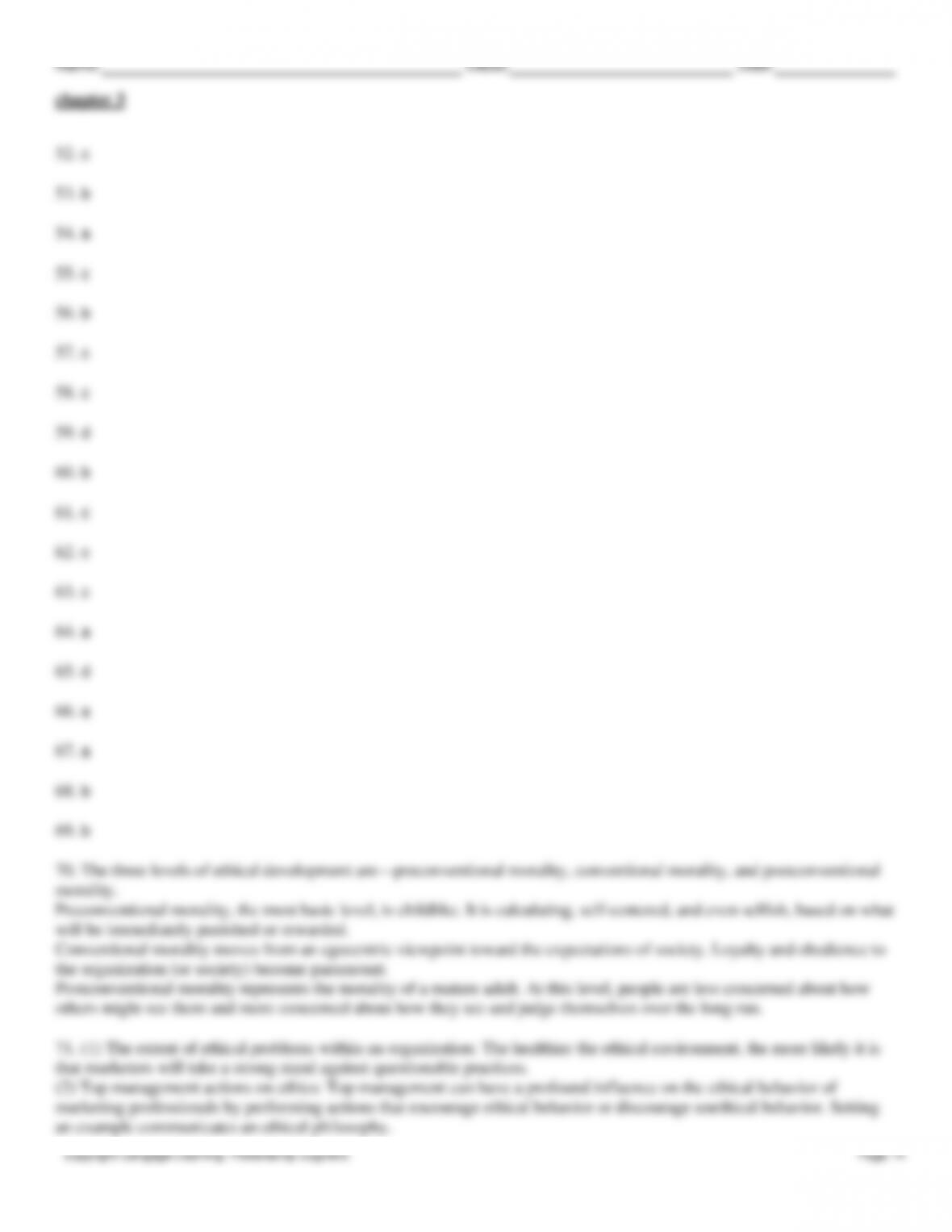
70. List and describe the three levels of ethical development.
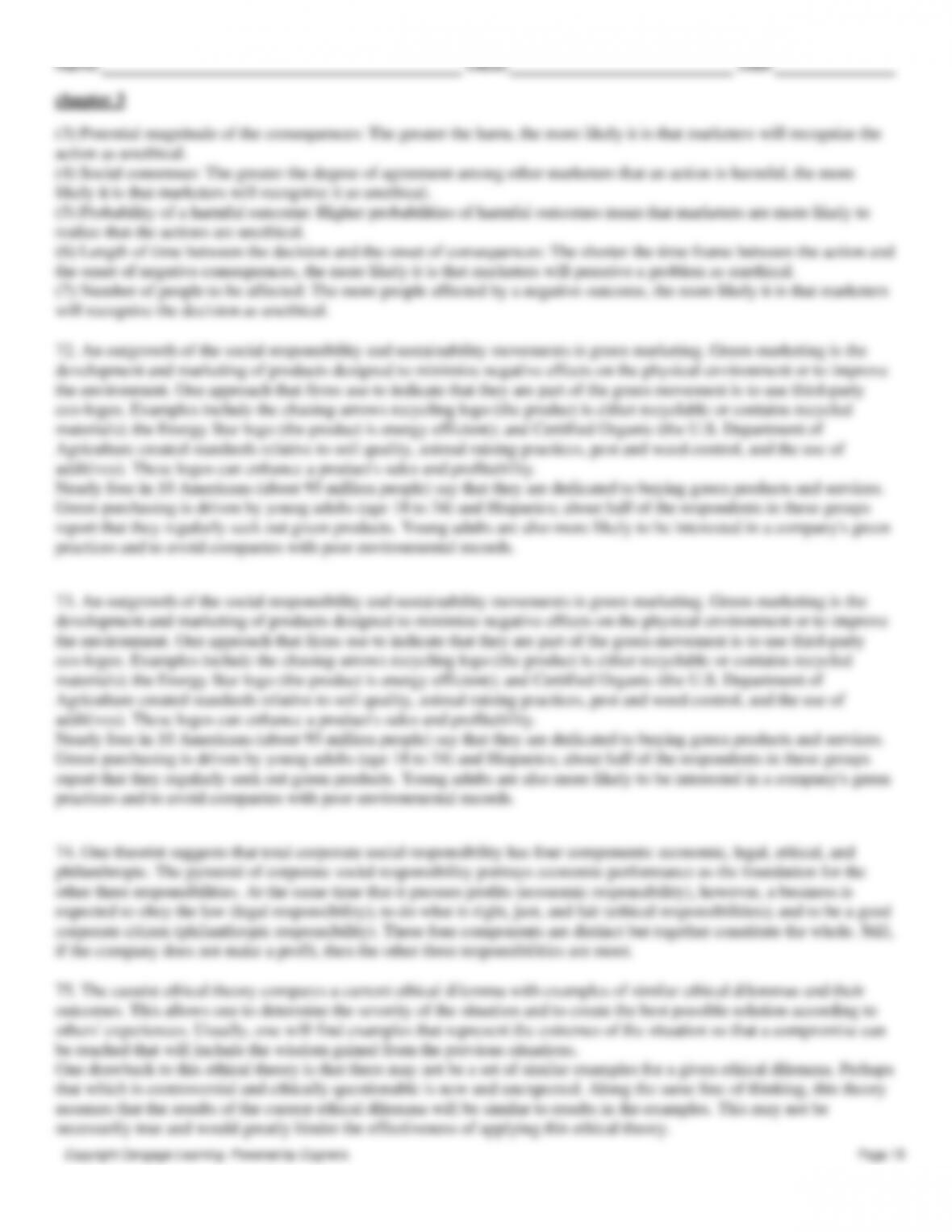
71. Briefly explain the factors that tend to influence ethical decision making and judgments.
72. Explain green marketing and outline its impact.
73. Explain green marketing and outline its impact.
74. Define the pyramid of corporate social responsibility and list its components.

Name:
Class:
Date:
chapter 3
Copyright Cengage Learning. Powered by Cognero.
Page 11
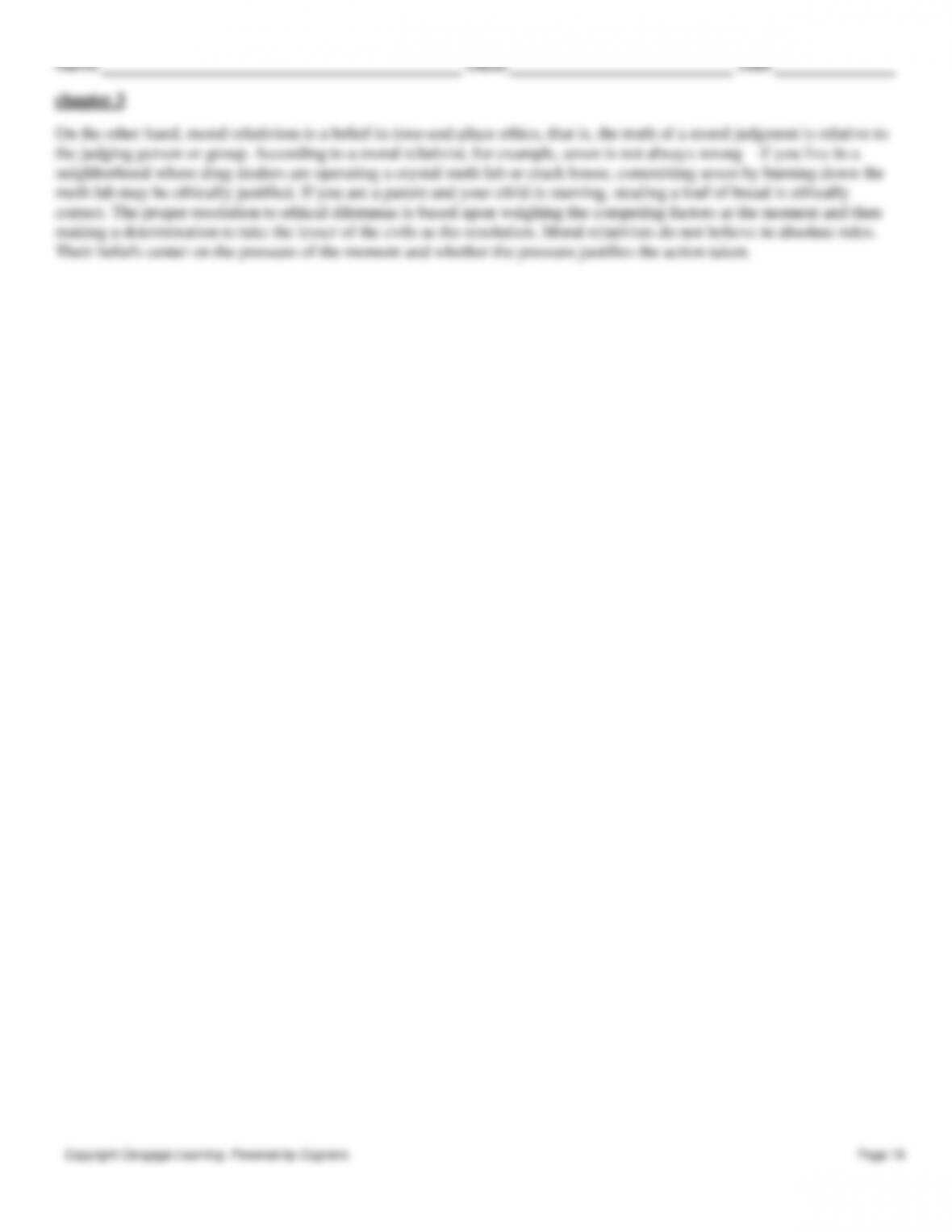
75. Differentiate between the casuist ethical theory and moral relativism.

Name:
Class:
Date:
chapter 3
Copyright Cengage Learning. Powered by Cognero.
Page 12
Answer Key
1. False
2. True

Name:
Class:
Date:
chapter 3
Copyright Cengage Learning. Powered by Cognero.
Page 13
Name:
Class:
Date:
chapter 3
Copyright Cengage Learning. Powered by Cognero.
Page 14
Name:
Class:
Date:
chapter 3
Copyright Cengage Learning. Powered by Cognero.
Page 15
Name:
Class:
Date:
chapter 3
Copyright Cengage Learning. Powered by Cognero.
Page 16