
Name:
Class:
Date:
Chapter 14: Consumption to Satisfaction
Copyright Cengage Learning. Powered by Cognero.
Page 1
1. Equity theory proposes that consumers are satisfied with their own level of inputs and outcomes in an exchange and
make no effort to compare them with that of another party.
a.
True
b.
False
ANSWER:
False
2. Service quality sometimes is seen as determined by the difference between consumer expectations of different service
aspects and the actual service that is delivered.
a.
True
b.
False
ANSWER:
True
3. The basic disconfirmation model proposes that consumers enter into a consumption experience without predetermined
expectations.
a.
True
b.
False
ANSWER:
False
4. Packrats hang onto a relatively manageable number of cherished mementos from the past that bring a great deal of
value through nostalgia or personal memories.
a.
True
b.
False
ANSWER:
False
5. In the context of disposing of consumer refuse, recycling cuts down on garbage while providing raw materials for other
new products.
a.
True
b.
False
ANSWER:
True
6. Hope is the level of a particular benefit that will lead to a valued end state.
a.
True
b.
False
ANSWER:
False
7. Delight, disgust, surprise, exhilaration, and even anger are some of the pre-consumption reactions.
a.
True
b.
False
ANSWER:
False
8. The confirmatory bias works in conjunction with self-perception theory.
a.
True
b.
False
ANSWER:
True
9. Expectations about what a consumer thinks will actually occur during an experience are also known as normative

Name:
Class:
Date:
Chapter 14: Consumption to Satisfaction
Copyright Cengage Learning. Powered by Cognero.
Page 2
expectations.
a.
True
b.
False
ANSWER:
False
10. Expectations can affect performance perceptions.
a.
True
b.
False
ANSWER:
True
11. From a regulatory focus viewpoint, equitable expectations can be called prevention-based expectations.
a.
True
b.
False
ANSWER:
True
12. Expectations are pre-consumption beliefs concerning what will occur during an exchange and/or consumption of a
product.
a.
True
b.
False
ANSWER:
True
13. Attribution theory focuses on explaining why a certain event has occurred.
a.
True
b.
False
ANSWER:
True
14. Managers believe that initiatives that increase customer satisfaction always improve top-line performance.
a.
True
b.
False
ANSWER:
False
15. Durable goods are goods that are consumed over extremely short periods of time.
a.
True
b.
False
ANSWER:
False
16. With low involvement, high expectations will be associated directly with increased dissatisfaction and low
expectations will be associated directly with increased satisfaction.
a.
True
b.
False
ANSWER:
False
17. Confirmatory bias is present when consumers receive recommendations from the marketer, and return policies are
lenient.
a.
True

Name:
Class:
Date:
Chapter 14: Consumption to Satisfaction
Copyright Cengage Learning. Powered by Cognero.
Page 3
b.
False
ANSWER:
True
18. Satisfaction as an emotion is extremely strong and creates relatively strong behavioral reactions.
a.
True
b.
False
ANSWER:
False
19. If performance perceptions are more positive than what was expected, neutral disconfirmation occurs.
a.
True
b.
False
ANSWER:
False
20. A refrigerator is an example of a durable good.
a.
True
b.
False
ANSWER:
True
21. Consumer satisfaction is a pre-consumption phenomenon.
a.
True
b.
False
ANSWER:
False
22. Analysis of typical consumer responses to a direct, global measure scale indicates that the data are right skewed.
a.
True
b.
False
ANSWER:
False
23. Top-line performance is a business term referring to sales growth, sales being at the top of an earnings statement.
a.
True
b.
False
ANSWER:
True
24. In terms of regulatory focus theory, ideal expectations could be referred to as promotion-based expectations.
a.
True
b.
False
ANSWER:
True
25. Positive disconfirmation leads to consumer dissatisfaction by disconfirming the positive expectations associated with
the product under consideration.
a.
True
b.
False
ANSWER:
False
26. An inequitable exchange can occur when a consumer believes that he or she has been taken advantage of by a

Name:
Class:
Date:
Chapter 14: Consumption to Satisfaction
Copyright Cengage Learning. Powered by Cognero.
Page 4
company or when another customer has been treated more favorably.
a.
True
b.
False
ANSWER:
True
27. Consumption frequency refers to the number of consumers consuming the same product or service in a given
geographic location.
a.
True
b.
False
ANSWER:
False
28. Emotions influence consumer behavior only after the consumption of a product or service.
a.
True
b.
False
ANSWER:
False
29. Negative disconfirmation leads to consumer satisfaction by disconfirming negative expectations associated with a
product.
a.
True
b.
False
ANSWER:
False
30. The locus element of the attribution theory involves judgments of whether the outcome was controllable or not.
a.
True
b.
False
ANSWER:
False
31. Equitable expectations are expectations of what a consumer thinks should happen given past experiences with a
product or service.
a.
True
b.
False
ANSWER:
False
32. A consumer with low satisfaction exhibits much more noticeable and persistent behavior than does an angry
consumer.
a.
True
b.
False
ANSWER:
False
33. Consumers who frame expectations based on what ought to happen show a greater tendency toward being satisfied
relative to consumers who experience anticipatory hope.
a.
True
b.
False
ANSWER:
False
34. Nondurable goods are consumed over a long duration.

Name:
Class:
Date:
Chapter 14: Consumption to Satisfaction
Copyright Cengage Learning. Powered by Cognero.
Page 5
a.
True
b.
False
ANSWER:
False
35. Services and experiences are usually classified as durable by default.
a.
True
b.
False
ANSWER:
False
36. Patty buys a product from a spa that is labelled “facelift in a bottle.” She pays $69.95 for the product and takes it home
anticipating that using the product will make her look young. Based on the information provided, which of the following
emotions best reflects Patty’s expectation from the product?
a.
Pride
b.
Hope
c.
Confusion
d.
Surprise
ANSWER:
b
37. Denise expects her incentive to be more than her co-workers as she has achieved more sales than her colleagues. In
this scenario, Denise’s expectation is an example of a(n) _____.
a.
equitable expectation
b.
mediated expectation
c.
ideal expectation
d.
normative expectation
ANSWER:
a
38. Soft drinks and facial tissues are examples of _____.
a.
public goods
b.
nondurable goods
c.
luxury goods
d.
enduring goods
ANSWER:
b
39. In the context of consumer satisfaction, _____ is the level of a particular benefit that will lead to a valued end state.
a.
a packrat
b.
bias
c.
a desire
d.
hope
ANSWER:
c
40. Identify an accurate statement about customer satisfaction.
a.
It creates strong behavioral motivations.
b.
It is a pre-consumption phenomenon.
c.
It results from a cognitive appraisal.

Name:
Class:
Date:
Chapter 14: Consumption to Satisfaction
Copyright Cengage Learning. Powered by Cognero.
Page 6
d.
It is an outcome of cognitive dissonance.
ANSWER:
c
41. Which of the following is a fundamental emotion evoked by negative, anticipatory appraisals that signal uncertainty
about a negative outcome?
a.
Tolerance
b.
Fear
c.
Envy
d.
Detachment
ANSWER:
b
42. _____ are what a consumer really wants to happen during an experience if everything was perfect.
a.
Equitable expectations
b.
Ideal expectations
c.
Predictive expectations
d.
Normative expectations
ANSWER:
b
43. The overall goodness or badness of a service provided is referred to as _____.
a.
service input
b.
service gateway
c.
service guarantee
d.
service quality
ANSWER:
d
44. A consumer is more likely to experience true dissonance following a purchase when:
a.
the decision is easy to reverse.
b.
the product includes a warranty.
c.
the consumer has low self-confidence.
d.
the degree of confirmatory bias is low.
ANSWER:
c
45. Which of the following is true of customer expectations?
a.
They are post-consumption beliefs concerned with what will occur during an exchange.
b.
With high involvement, consumers’ expectations are based on their ability to think objectively.
c.
With low involvement, low expectation is associated with increased dissatisfaction.
d.
They are related to thoughts and evaluation of the experience of consumption of a product.
ANSWER:
c
46. Which of the following theories is related to post-consumption reactions of consumers?
a.
Utility theory
b.
Motivation-need theory
c.
Self-determination theory
d.
Equity theory

Name:
Class:
Date:
Chapter 14: Consumption to Satisfaction
Copyright Cengage Learning. Powered by Cognero.
Page 7
ANSWER:
d
47. Which of the following is a difference between durable and nondurable goods?
a.
Unlike durable goods, nondurable goods are expensive.
b.
Unlike durable goods, nondurable goods are long-lasting.
c.
Unlike durable goods, nondurable goods do not pose major problems if they do not perform well.
d.
Unlike durable goods, nondurable goods do not include consumptions such as services and experiences.
ANSWER:
c
48. Darrell has a negative perception about plasma televisions and thinks that they are less energy-efficient. His son buys
a plasma television for its superior picture quality. However, Darrell tries to find faults with the plasma television due to
his preconceived notion. In this scenario, which of the following phenomena does Darrell demonstrate?
a.
Confirmatory bias
b.
Positive disconfirmation
c.
Interactional fairness
d.
Authenticity paradox
ANSWER:
a
49. Which of the following elements in the attribution theory refers to the likelihood that an event will occur again in the
future?
a.
Locus
b.
Stability
c.
Control
d.
Bias
ANSWER:
b
50. Identify a true statement about consumer dissatisfaction.
a.
It can lead to specific emotions like delight.
b.
It is a negative consumption outcome.
c.
It results in positive disconfirmation.
d.
It is an effect of low involvement and high expectation.
ANSWER:
b
51. Identify a true statement about attribution theory.
a.
It states that consumers are motivated to act in accordance with their attitudes and behaviors.
b.
It proposes that people compare their own level of inputs and outcomes to those of another party in an
exchange.
c.
It proposes that consumers look for the cause of particular consumption experiences when arriving at
satisfaction judgments.
d.
It proposes that consumers use expectations as a benchmark against which performance perceptions are
judged.
ANSWER:
c
52. In consumer behavior, _____ is the tendency for expectations to guide performance perceptions.
a.
confirmatory bias

Name:
Class:
Date:
Chapter 14: Consumption to Satisfaction
Copyright Cengage Learning. Powered by Cognero.
Page 8
b.
negative disconfirmation
c.
cognitive dissonance
d.
consumption frequency
ANSWER:
a
53. Prior to the 1930s, diamond engagement rings did not enjoy much significance in the United States. However,
following persistent promotions by diamond companies—such as associating diamonds as symbols of the “forever”
element of marriage—diamond engagement rings have now become almost a cultural requirement. In this case, which of
the following phenomena can be attributed to the cultural significance gained by diamond engagement rings?
a.
Cognitive dissonance
b.
Meaning transference
c.
Positive disconfirmation
d.
Confirmatory bias
ANSWER:
b
54. Confirmatory bias is particularly present when:
a.
return policies are strict.
b.
consumers receive recommendations from the marketer.
c.
expectations are high.
d.
consumer expectations are in line with consumption experience.
ANSWER:
b
55. An amusement park was recently inaugurated in a city. All the customers who visited the park during the first few
days were sent a feedback form via email to rate their overall satisfaction. The customers were provided four answer
options to choose from in the feedback form: completely dissatisfied, dissatisfied, satisfied, or completely satisfied. This
scale is an example of a(n) _____.
a.
attribute-specific measure
b.
disconfirmation measure
c.
unstructured measure
d.
direct measure
ANSWER:
d
56. Which of the following theories consists of the three elements of locus, control, and stability?
a.
Attribution theory
b.
The disconfirmation theory
c.
Equity theory
d.
The balance theory
ANSWER:
a
57. Gwen waits tables at a coffee shop. While the coffee shop is always crowded, on one particular rainy day, there were
very few customers. Although the coffee shop is popular in the locality, Gwen blames her manager for not advertising the
shop. She attributes the lack of advertisement to the fewer customers on that day. In this scenario, which element of the
attribution theory does Gwen associate with the cause for fewer customers on a rainy day?
a.
Locus
b.
Bias

Name:
Class:
Date:
Chapter 14: Consumption to Satisfaction
Copyright Cengage Learning. Powered by Cognero.
Page 9
c.
Uniformity
d.
Stability
ANSWER:
a
58. Services and experiences are usually classified as _____ by default.
a.
durable
b.
nondurable
c.
permanent
d.
constant
ANSWER:
b
59. _____ are the cognitive component of anticipation.
a.
Consequences
b.
Disconfirmations
c.
Expectations
d.
Opportunities
ANSWER:
c
60. Edorta is a popular and expensive brand of watches since 1920. Although several fake Edorta watches are sold in the
market, an original Edorta watch can be identified from its dial, which is made of platinum. In this case, the platinum dial
of Edorta watches marks its _____.
a.
sensitivity
b.
efficacy
c.
potency
d.
authenticity
ANSWER:
d
61. According to the expectancy/disconfirmation theory, when performance perceptions are more beneficial than what
was expected, _____ occurs.
a.
positive disconfirmation
b.
negative disconfirmation
c.
negative expectation
d.
positive expectation
ANSWER:
a
62. Which of the following is true of consumer satisfaction?
a.
It is often the result of cognitive dissonance.
b.
It results from affective rather than cognitive processes.
c.
It is a post-consumption phenomenon.
d.
It creates strong behavioral motivations.
ANSWER:
c
63. When Eleanor went to Letty’s department store, she noticed that the price that rang up when she was billing was much
higher than the price advertised on the shelf. This was the third time she experienced such a price difference at the store.
While she did not stop frequenting Letty’s as it was closest to her house, she started becoming wary and looking out for a

Name:
Class:
Date:
Chapter 14: Consumption to Satisfaction
Copyright Cengage Learning. Powered by Cognero.
Page 10
price difference in the bill each time she shopped there. In this scenario, which of the following elements in the attribution
theory corresponds best with Eleanor’s wariness?
a.
Locus
b.
Balance
c.
Control
d.
Stability
ANSWER:
d
64. Kate is a 45-year-old kindergarten teacher. She is single and likes to spend most of her salary on shopping. Which of
the following, if true, would make Kate a packrat?
a.
Kate experiences cognitive dissonance after most of her purchases.
b.
Kate easily gets bored of new things and gets rid of them at the first opportunity.
c.
Kate goes overboard with her philanthropic activities and tends to give away her possessions in charities.
d.
Kate develops an emotional bond with her possessions and is unable to discard them.
ANSWER:
d
65. Which of the following disposal alternatives cuts down on garbage while providing raw materials for other new
products?
a.
Recycling
b.
Trashing
c.
Reselling
d.
Trading
ANSWER:
a
66. Which of the following is a fundamental emotion evoked by positive, anticipatory appraisals that signal uncertainty
about a positive outcome?
a.
Surprise
b.
Pride
c.
Hope
d.
Confusion
ANSWER:
c
67. Unlike nondurable goods, durable goods are:
a.
consumed quickly.
b.
consumed more frequently.
c.
bought at a higher cost.
d.
easily perishable.
ANSWER:
c
68. Jane purchases a new laptop. She believes that the laptop’s battery will be long-lasting and that it is worth the price she
paid. In this case, Jane’s belief is a reflection of her _____ of the event.
a.
confirmation
b.
expectation
c.
dissension
d.
apprehension

Name:
Class:
Date:
Chapter 14: Consumption to Satisfaction
Copyright Cengage Learning. Powered by Cognero.
Page 11
ANSWER:
b
69. Which of the following is true of a consumption experience?
a.
It has the potential to produce a utilitarian value.
b.
It guarantees customer satisfaction and product durability.
c.
It is the number of times a consumer buys a product.
d.
It is positive when a product is less authentic.
ANSWER:
a
70. The process through which cultural ideals or values are transferred to products and then to consumers is known as
_____.
a.
consumption frequency
b.
cognitive transference
c.
meaning transference
d.
distributive fairness
ANSWER:
c
71. Automobiles and furniture are examples of _____.
a.
durable goods
b.
convenience goods
c.
perishable goods
d.
public goods
ANSWER:
a
72. Which of the following is an example of a durable good?
a.
A dining table
b.
A coffee mug
c.
A facial cream
d.
A seed stock
ANSWER:
a
73. Pre-consumption beliefs concerning what will occur during an exchange and/or consumption of a product are known
as _____.
a.
premeditations
b.
perceptions
c.
confirmations
d.
expectations
ANSWER:
d
74. Which of the following affects consumption outcomes prior to consumption?
a.
Satisfaction
b.
Evaluation
c.
Experience
d.
Anticipation

Name:
Class:
Date:
Chapter 14: Consumption to Satisfaction
Copyright Cengage Learning. Powered by Cognero.
Page 12
ANSWER:
d
75. Goods that are typically inexpensive and consumed quickly are known as _____.
a.
durable goods
b.
nondurable goods
c.
enduring goods
d.
sustainable goods
ANSWER:
b
76. Which of the following reflects the expectations a consumer forms regarding what he or she thinks should or ought to
happen given the level of work that he or she has put into the experience?
a.
Predictive Expectations
b.
Normative Expectations
c.
Ideal Expectations
d.
Equitable Expectations
ANSWER:
d
77. Which of the following elements in the attribution theory refers to the judgments of who is responsible for an event?
a.
Locus
b.
Bias
c.
Stability
d.
Control
ANSWER:
a
78. According to the expectancy/disconfirmation theory, when performance perceptions exactly match what was
expected, then _____ occurs.
a.
cognitive dissonance
b.
confirmatory bias
c.
confirmation
d.
dissatisfaction
ANSWER:
c
79. Which of the following is an example of a nondurable good?
a.
An air conditioner
b.
A bottle of water
c.
A dining table
d.
A box of gold
ANSWER:
b
80. Which of the following defines consumption?
a.
It is the number of times a product or service is consumed in a given time period.
b.
It is the process that converts time, goods, ideas, or services into value for customers.
c.
It is the tendency for expectations to guide performance perceptions.
d.
It is the degree to which something seems genuine and part of history.
Name:
Class:
Date:
Chapter 14: Consumption to Satisfaction
Copyright Cengage Learning. Powered by Cognero.
Page 13
ANSWER:
b
81. Anaya decides to purchase a convertible from Jupiter Cars and tells her friend, James, about it. James cautions Anaya
because his experience with Jupiter Cars had been unpleasant. Anaya still places an order with Jupiter Cars because the
offer was appealing. However, Anaya is worried about the quality of the convertible and Jupiter Cars’ customer service. In
this case, which of the following types of expectation does Anaya demonstrate?
a.
Predictive expectation
b.
Ideal expectation
c.
Equitable expectation
d.
Normative expectation
ANSWER:
d
82. Which of the following is true of cognitive dissonance?
a.
It occurs when customers’ thoughts are consistent with preconceived notions.
b.
It occurs with unimportant decisions that are easy to reverse.
c.
It occurs when consumers have high self-confidence.
d.
It occurs when customers make a decision that involves risk.
ANSWER:
d
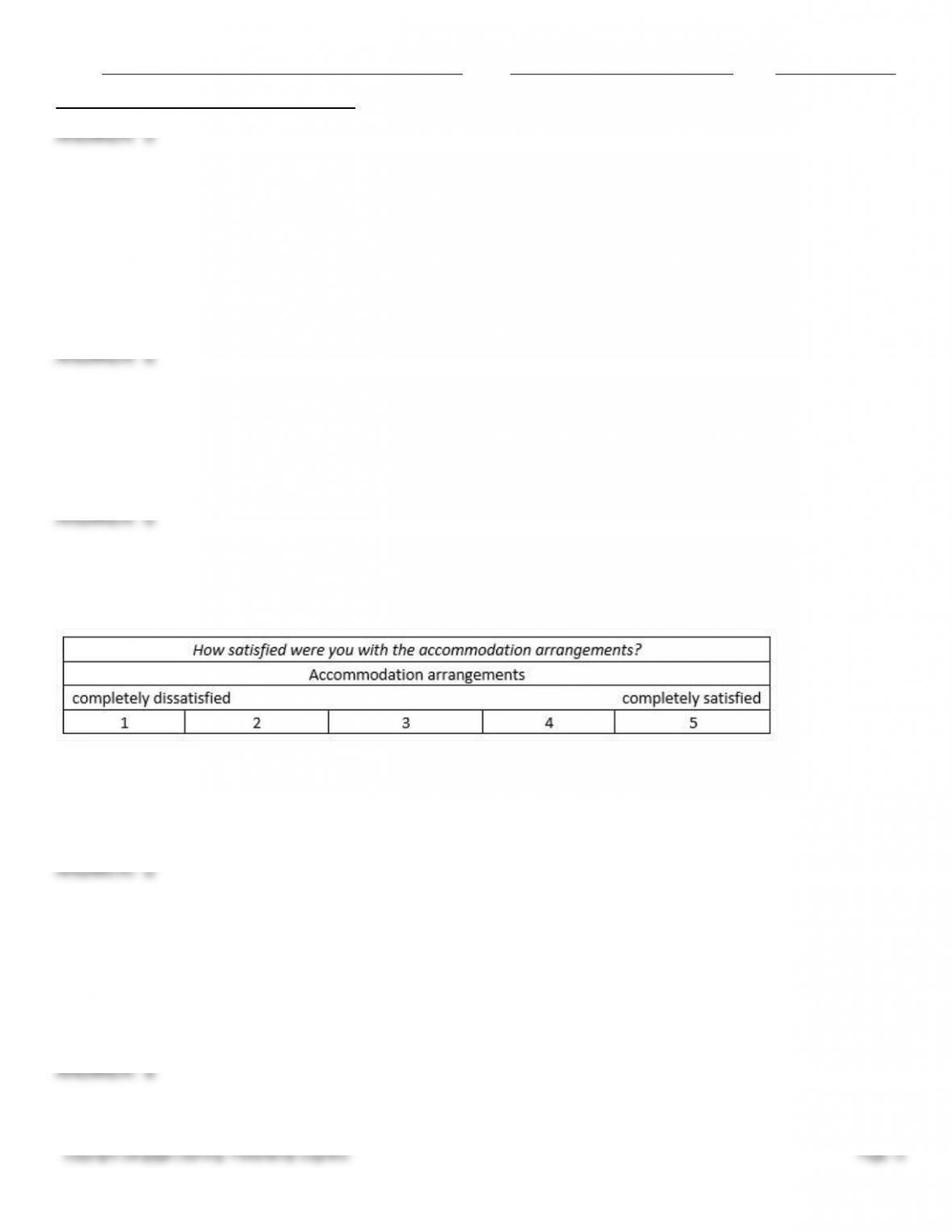
83. Leroy’s Travels LLC contacts Renata, a market researcher, to assess consumer satisfaction with the travel services
provided by the firm. To conduct the research, Renata collects feedback from customers by distributing questionnaires
that consist of ten questions. Each question has to be rated on a scale of 1 to 5, 1 being completely dissatisfied and 5 being
completely satisfied. One question from the questionnaire is as follows:
The measurement approach used by Renata is an example of a(n) _____.
a.
direct measure
b.
disconfirmation measure
c.
comprehensive measure
d.
attribute-specific measure
ANSWER:
d
84. Edward plans to buy a used car and contacts his friend who owns a used car dealership. Edward anticipates that his
friend will offer him the best deal and hence, does not consider other options. In this scenario, Edward’s anticipation is an
example of a(n) _____.
a.
predictive expectation
b.
mediated expectation
c.
equitable expectation
d.
normative expectation
ANSWER:
a
85. Goods that are typically expensive and consumed over long periods of time are known as _____.
a.
degradable goods

Name:
Class:
Date:
Chapter 14: Consumption to Satisfaction
Copyright Cengage Learning. Powered by Cognero.
Page 14
b.
convenience goods
c.
perishable goods
d.
durable goods
ANSWER:
d
86. _____ states that consumers are motivated to act in accordance with their attitudes and behaviors.
a.
Attribution theory
b.
Self-perception theory
c.
Equity theory
d.
Social-cognitive theory
ANSWER:
b
87. Cathy plans to buy a washing machine and visits a physical store to explore the different models. She is happy with
the information she gets at the store and decides to buy a particular washing machine after seeing a demonstration of the
product. Since her shopping experience was perfect, Cathy expects that the product is the best choice and will function
well. She is happy that she will now have more personal time. In this scenario, which type of expectation does Cathy
demonstrate?
a.
Negative expectations
b.
Normative expectations
c.
Ideal expectations
d.
Equitable expectations
ANSWER:
c
88. Consumer satisfaction is important because:
a.
it is an effect of confirmatory bias.
b.
it creates strong behavioral motivations.
c.
it is a pre-consumption phenomenon.
d.
it correlates with repeat purchases.
ANSWER:
d
89. Dina requests a new landline telephone connection. However, on the day the connection was to be set up, torrential
rains damage the telephone lines. Dina got the telephone connection after several weeks. She understands that the delay
was not the fault of the telephone company. Which of the following elements in the attribution theory corresponds best
with Dina’s realization?
a.
Locus
b.
Bias
c.
Stability
d.
Control
ANSWER:
d
90. The way a consumer judges the outcomes of an exchange is known as _____.
a.
retributive fairness
b.
procedural fairness
c.
restorative fairness
d.
distributive fairness
Name:
Class:
Date:
Chapter 14: Consumption to Satisfaction
ANSWER:
Answers will vary. A consumer is more likely to experience true dissonance following a purchase when the
ANSWER:
d
91. Define consumer satisfaction. How does it differ from other important consumer behavior concepts?
ANSWER:
Answers will vary. Consumer satisfaction is a mild, positive emotional state resulting from a favorable
appraisal of a consumption outcome. Several points distinguish consumer satisfaction from other important
consumer behavior concepts:1. Consumer satisfaction is a post-consumption phenomenon because it is a
reaction to an outcome.2. Like other emotions, satisfaction results from a cognitive appraisal. Some refer to
this appraisal as the satisfaction judgment.3. Satisfaction as an emotion is a relatively mild emotion and does
not create strong behavioral motivations.
92. List out some possible post-consumption reactions other than satisfaction. Why is it important to assess these reactions
of consumers?
ANSWER:
Answers will vary. Some possible post-consumption reactions are:1. Delight2. Disgust3. Surprise4.
Exhilaration5. AngerThese particular emotions are often much more strongly linked to behavior because
although they are also emotional reactions to appraisals, they are often much stronger. For example, an angry
consumer exhibits much more noticeable and persistent behavior than does a consumer with low satisfaction.
93. Define expectations. Describe the four types of consumer expectations.
ANSWER:
Answers will vary. Expectations are pre-consumption beliefs of what will occur during an exchange and/or
consumption of a product. Consumer expectations have two components: the probability that something will
occur and an evaluation of that potential occurrence. Consumers bring different types of expectations into a
consumption situation:1. Predictive expectations—expectations that form about what a consumer thinks will
actually occur during an experience.2. Normative expectations—expectations of what a consumer thinks
should happen given past experiences with a product or service.3. Ideal expectations—expectations about
what a consumer really wants to happen during an experience if everything was ideal.4. Equitable
expectations—expectations that a consumer forms regarding what he or she thinks should happen given the
level of work that he or she has put into the experience.
94. Define attribution theory. Explain how the three elements in the attribution theory help in explaining consumer
satisfaction.
ANSWER:
Answers will vary. Attribution theory focuses on explaining why a certain event has occurred. This theory
proposes that consumers look for the cause of particular consumption experiences when arriving at
satisfaction judgments. There are three key elements to the attribution theory approach: locus, control, and
stability.1. Locus: It involves the judgments of who is responsible for an event. A self-ascribed event occurs
when a consumer blames himself or herself for a bad event. If an event is attributed to a product or company,
an external attribution is made. This type of attribution of blame toward a marketing entity increases
consumer dissatisfaction.2. Control: It refers the extent to which an outcome was controllable or not. If the
consumer feels the marketer could control the outcome, dissatisfaction is more likely.3. Stability: It refers to
the likelihood that an event will occur again in the future. If the consumer believes that a bad outcome is
likely to happen again, he or she will be dissatisfied.
95. Differentiate durable and nondurable goods with examples.
ANSWER:
Answers will vary. Durable goods are typically relatively expensive goods consumed over long periods of
time. Dishwashers, furniture, automobiles, and many electronics like personal computers represent durable
goods. Durable goods that do not perform well cause consumers major problems. Nondurable goods are
typically inexpensive and consumed quickly. Soft drinks, pencils, and Kleenex are nondurable goods.
Nondurable goods that do not perform well do not present major problems for consumers.
Name:
Class:
Date:
Chapter 14: Consumption to Satisfaction