
Name:
Class:
Date:
chapter 10
Copyright Cengage Learning. Powered by Cognero.
Page 1
Indicate whether the statement is true or false.
1. Extreme competitiveness, impatience, aggressiveness, and devotion to work are included in Type B behavior pattern.
a. True
b. False
2. Organizations that want to challenge their employees and stay competitive can easily be stress-free.
a. True
b. False
3. Locus of control refers to an individual’s belief that he or she can successfully accomplish a specific task or outcome.
a. True
b. False
4. Self-management is NOT a component of emotional intelligence.
a. True
b. False
5. Low Machs are particularly good in jobs that require bargaining skills or that involve substantial rewards for winning.
a. True
b. False
6. The last step in getting organized is to empty your head.
a. True
b. False
7. The three options in getting things done are doing it, delegating it, or deferring it.
a. True
b. False
8. Teresa is highly imaginative and an artistically sensitive individual who displays a high degree of creativity. According
to the Big Five personality factors, these qualities describe her openness to experience.
a. True
b. False
9. People with an internal locus of control are easier to motivate because they believe the rewards are the result of their
behavior.
a. True
b. False
10. Two important approaches to enhancing self-awareness are soliciting feedback from others using self-assessments.
a. True
b. False

Name:
Class:
Date:
chapter 10
Copyright Cengage Learning. Powered by Cognero.
Page 2
11. A halo blinds the perceiver to other attributes that should be used in generating a more complete assessment.
a. True
b. False
12. The ability to connect to others, build positive relationships, respond to the emotions of others, and influence others is
referred to as relationship management.
a. True
b. False
13. An internal attribution says something about the situation has caused the person’s behavior.
a. True
b. False
14. An emotion can be thought of as a mental state that arises spontaneously within a person based on interaction with the
environment rather than through conscious effort and is often accompanied by physiological changes or sensations.
a. True
b. False
15. A positive attitude toward one’s job is called cognitive attitude.
a. True
b. False
16. A survey of 75 members of the Stanford Graduate School of Business’s Advisory Council revealed that by far the most
important capability for managers to develop is self-confidence.
a. True
b. False
17. The link between satisfaction and performance, according to research, is generally small and is affected by other
factors.
a. True
b. False
18. Organizing the selected data into patterns for interpretation and response is the last step in the perception process.
a. True
b. False
19. Social awareness is the ability to connect to others, build positive relationships, respond to the emotions of others, and
influence others.
a. True
b. False
Indicate the answer choice that best completes the statement or answers the question.
20. The first step toward better time management is to:
a. decide the first action.

Name:
Class:
Date:
chapter 10
Copyright Cengage Learning. Powered by Cognero.
Page 3
b. empty your head.
c. delegate as necessary.
d. defer some things to be done later.
e. get organized.
21. __________ refers to a positive attitude toward one’s job.
a. Organizational citizenship
b. Job satisfaction
c. Cognitive dissonance
d. Organizational commitment
e. Job involvement
22. A high degree of __________ means you can accurately assess your own strengths and limitations and have a healthy
sense of self-confidence.
a. self-management
b. social cohesiveness
c. social awareness
d. relationship management
e. self-awareness
23. Blaming the teacher for a poor grade on an exam and taking credit for good grades could be an example of which of
the following?
a. Perceptual distortion
b. Closure activity
c. Self-serving bias
d. Stereotyping
e. Perceptual grouping
24. Traits of __________ seem to be particularly important in today’s collaborative organizations.
a. likability
b. agreeableness
c. friendliness
d. openness
e. sociability
25. In what stage of the perception process are individuals likely to put things into patterns?
a. Selecting
b. Projecting
c. Organizing
d. Sensing
e. Reasoning
26. Rachel is described by her colleagues as pragmatic, super-competitive, and more likely to persuade than be persuaded.
She fits which of the following personality categories most closely?
a. High Mach
b. Low Mach
c. High feeling

Name:
Class:
Date:
chapter 10
Copyright Cengage Learning. Powered by Cognero.
Page 4
d. Low feeling
e. Moderate thinking
27. Which of the following describes the last step in the perception process?
a. Observing information
b. Screening the information
c. Selecting what to process
d. Organizing the selected data into patterns
e. Transmitting the observed information
28. __________-type people, according to Jung, would rather work with known facts and hard data and prefer routine and
order in gathering information.
a. Feeling
b. Gut-feel
c. Intuitive
d. Sensation
e. Affective
29. Type A behavior is characterized by all of these, EXCEPT:
a. impatience.
b. devotion to work.
c. aggressiveness.
d. relaxed lifestyle.
e. extreme competitiveness.
30. Josh evaluates Kandi’s performance and gives her an “outstanding” based on his knowledge that she came to work
every day earlier than anyone else and therefore she is extremely hardworking. Josh is making which of the following
errors in perceptual judgment?
a. Perceptual defense
b. Projection
c. Stereotyping
d. The halo effect
e. Figure-ground
31. Frank regretfully missed an important deadline at work. His boss, George, thinks to himself, “Frank missed that
deadline because he is lazy; I really need to crack down on him more.” This is an example of which of the following kinds
of attribution?
a. External attribution
b. Internal attribution
c. Horizontal attribution
d. Vertical attribution
e. Skewed attribution
32. People with an external locus of control are:
a. more achievement oriented.
b. better able to handle complex information and problem solving.
c. more independent.

Name:
Class:
Date:
chapter 10
Copyright Cengage Learning. Powered by Cognero.
Page 5
d. easier to motivate.
e. easier to manage.
33. All of the following are tactics for promoting stronger organizational commitment, EXCEPT:
a. maintaining a secretive culture.
b. being honest and trustworthy in business dealings.
c. giving employees a say in decisions.
d. treating employees fairly.
e. offering employees rewards that they value.
34. Maliah bases her judgments on impersonal analysis. To resolve problems at work, she uses reason and logic rather
than personal values or emotional aspects of the situation. In gathering information, Maliah prefers routine and order.
Based on this information, Maliah ranks highly in which of the following Myers-Briggs categories?
a. Judging-Perceiving
b. Intuitive-Thinking
c. Sensation-Thinking
d. Sensation-Feeling
e. Intuitive-Feeling
35. If Ben is tense, nervous, depressed, and insecure, he would tend to be rated as low on which of the following factors?
a. Agreeableness
b. Conscientiousness
c. Emotional stability
d. Openness to experience
e. Extroversion
36. Jason has been unemployed for three months. When his wife asked him why he was not looking for a job, Jason
responded, “If I am lucky, I will get my old job back.” Jason would be considered as having a(n):
a. external locus of control.
b. high conscientiousness.
c. sensation and intuition type personality.
d. internal locus of control.
e. high Mach attitude.
37. An individual’s strong belief that he or she can successfully accomplish a specific task or outcome is referred to as:
a. locus of control.
b. self-confidence.
c. self-efficacy.
d. perceptual selectivity.
e. cognitive dissonance.
38. Research shows that __________ are predisposed to being pragmatic, capable of lying to achieve personal goals, more
likely to win in win-lose situations, and more likely to persuade than be persuaded.
a. high introverted individuals
b. high authoritarians
c. high Machs
d. low extroverted individuals

Name:
Class:
Date:
chapter 10
Copyright Cengage Learning. Powered by Cognero.
Page 6
e. low Machs
39. Seeking positions of power and responsibility, Chandra has rapidly moved up the ranks within her organization.
Colleagues describe her as someone with a tremendous amount of energy and a powerful force for leadership within the
organization. Based on this description, Chandra has which of the following types of personality?
a. Type A
b. Type B
c. Type C
d. Type X
e. Type Y
40. Jay is a trusting and forgiving individual who gets along with others because of being good-natured and cooperative.
This describes which of the following Big Five personality factors?
a. Agreeableness
b. Conscientiousness
c. Emotional stability
d. Openness to experience
e. Extroversion
Enter the appropriate word(s) to complete the statement.
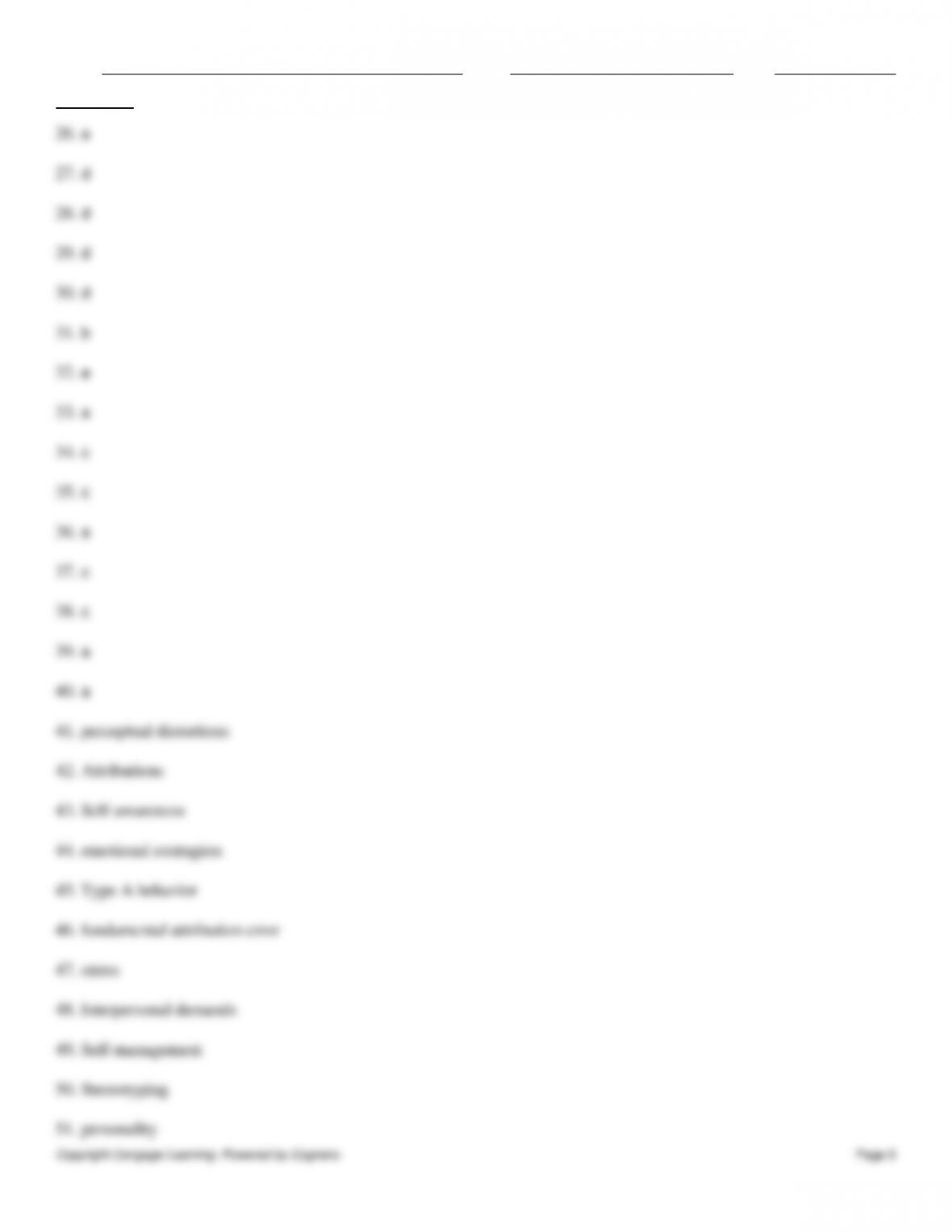
41. Errors in perceptual judgment that arise from inaccuracies in any part of the perception process are called
__________.
42. ___________ are judgments about what caused a person’s behavior—something about the person or something about
the situation.
43. ___________ means being conscious of the internal aspects of one’s nature, such as personality traits, beliefs,
emotions, attitudes, and perceptions, and appreciating how your patterns affect other people.
44. When managers who express positive emotions such as happiness, enthusiasm, and appreciation trigger positive
emotions in employees, this is known as ___________.
45. ___________ is behavior pattern characterized by extreme competitiveness, impatience, aggressiveness, and devotion
to work.
46. The tendency to underestimate the influence of external factors on another’s behavior and to overestimate the
influence of internal factors is called the ___________.
47. A physiological and emotional response to stimuli that place physical or psychological demands on an individual is
called ___________.
48. ___________ are stressors associated with relationships in the organization.
49. ___________ is the ability to engage in self-regulating thoughts and behavior to accomplish all your tasks and handle
difficult or challenging situations.
50. ___________ is the tendency to assign an individual to a group or broad category and then attribute generalizations
about the group to the individual.

Name:
Class:
Date:
chapter 10
Copyright Cengage Learning. Powered by Cognero.
Page 7
51. An individual’s ___________ is the set of characteristics that underlie a relatively stable pattern of behavior in
response to ideas, objects, or people in the environment.
52. ___________ is the degree to which a person is able to get along with others by being good-natured, likable,
cooperative, forgiving, understanding, and trusting.
53. Uncertainty about what behaviors are expected of a person in a particular role is referred to as ___________.
54. The process people use to make sense of the environment by selecting, organizing, and interpreting information from
the environment is referred to as ___________.
55. The ___________ occurs when the perceiver develops an overall impression of a person or situation based on one
attribute, either favorable or unfavorable.
56. ___________ are stressors arising from the tasks required of a person holding a particular job.
57. The tendency to place the primary responsibility for one’s success or failure either within oneself (internally) or on
outside forces (externally) is called the ___________.
58. ___________ is the belief that power and status differences should exist within the organization.
59. Loyalty to and heavy involvement in one’s organization is called ___________.
60. A positive feeling about one’s job is called ___________.
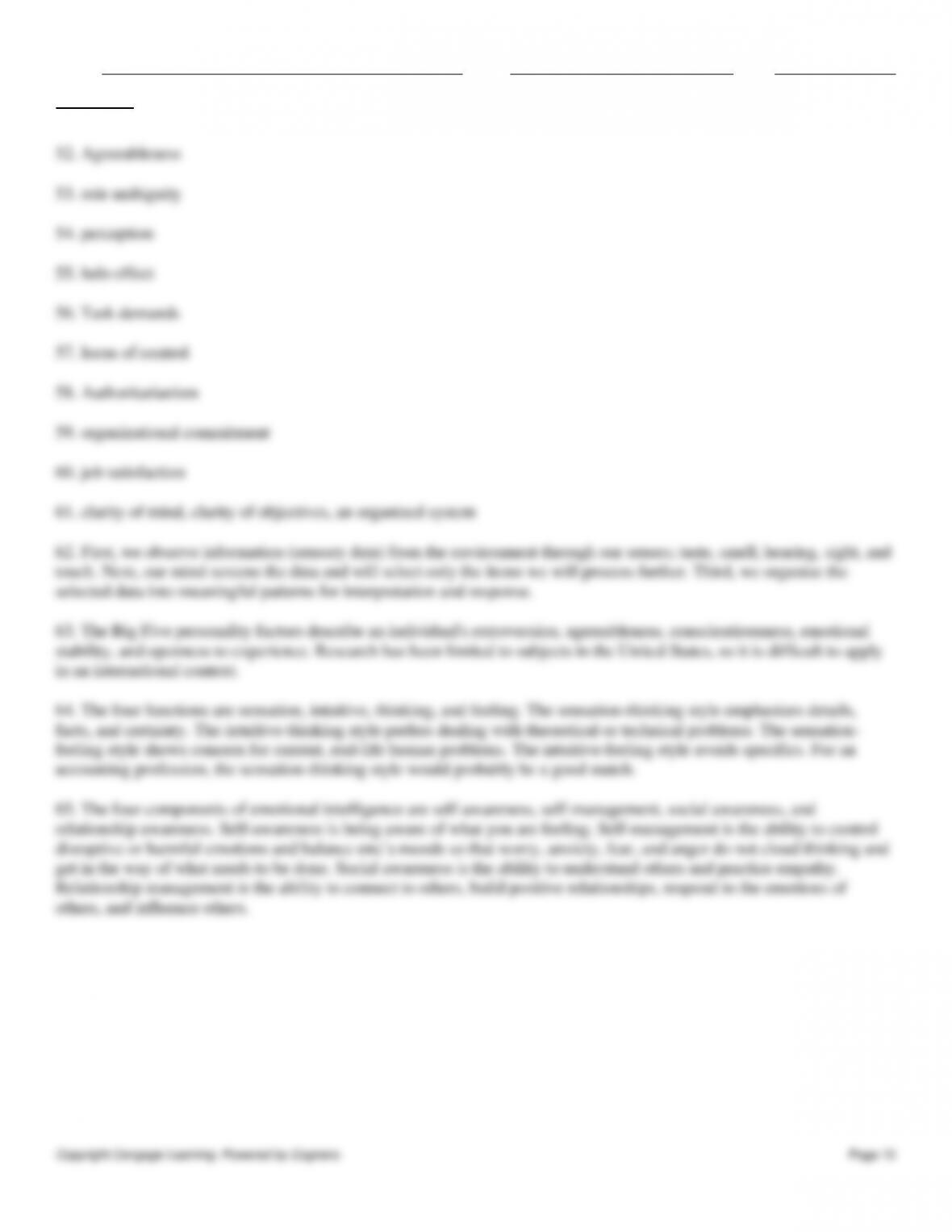
61. Name the three basic principles for managing commitments effectively.
62. Briefly describe the perception process.
63. Explain the Big Five personality factors. Are these applicable in an international context?
64. Describe Carl Jung’s four functions related to gathering and evaluating information for problem solving and decision
making. Which problem solving style would be appropriate for an accounting profession? Why?
65. What are the four components of emotional intelligence? Explain.

Name:
Class:
Date:
chapter 10
Copyright Cengage Learning. Powered by Cognero.
Page 8
Answer Key
1. False
2. False
Name:
Class:
Date:
chapter 10
Copyright Cengage Learning. Powered by Cognero.
Page 9
Name:
Class:
Date:
chapter 10
Copyright Cengage Learning. Powered by Cognero.
Page 10