
Name:
Class:
Date:
chapter 22
Copyright Cengage Learning. Powered by Cognero.
Page 12
95. The number of days, on average, that a company holds inventory
96. The management of current assets and current liabilities
97. The number of days, on average, that a firm extends credit to its customers
98. Accounts receivable used as collateral for a loan
99. The time required to convert paid-for inventory and accounts receivable into cash
100. The number of days, on average, that a business takes to pay its accounts payable
Match the term with its definition. Some terms may not be used.
a. Accounting return on investment technique
b. Capital budgeting analysis
c. Discounted cash flow techniques
d. Internal rate of return
e. Net present value
f. Payback period technique
g. Working capital cycle
h. Working capital management
101. An analytical method that helps managers make decisions about long-term investments
102. A capital budgeting technique that compares expected average annual after-tax profits to the average book value of
an investment
103. The daily flow of resources through a firm’s working capital accounts
104. The present value of expected future cash flows less the initial investment outlay
105. A capital budgeting technique that measures the amount of time it will take to recover the initial cash outlay of an
investment
106. The rate of return a firm expects to earn on a project
107. Capital budgeting techniques that compare the present value of future cash flow with the cost of the initial
investment
108. Dana produces fine chocolates for her retail shop which is open 6 days a week. The sales are $156,000 annually with
a cost of goods sold of 45% of sales and inventory of 5%. Calculate the days in inventory and indicate any concerns for
the shop considering the national average is 15 days.
109. Assume that the cost of certain equipment a business is considering purchasing is $100,000. The equipment will be
depreciated over five years, at which point the salvage value is expected to be $8,000. Anticipated after-tax profits (losses)
are as follows:
Year After-Tax Profits/Losses
1 ($10,000)

Name:
Class:
Date:
chapter 22
Copyright Cengage Learning. Powered by Cognero.
Page 13
2 20,000
3 25,000
4 35,000
5 20,000
Compute the accounting return on investment technique showing the formulas and computations.
110. Compare the two investment proposals below, using the payback period technique. The projected cost of each
investment proposal is $100,000.
Project A Project B
Year (Cash flow) (Cash flow)
1 $25,000 $25,000
2 20,000 20,000
3 10,000 40,000
4 10,000 30,000
5 – 10,000
111. After identifying the stages of the accounts receivables life cycle, discuss areas that are of concern in the process.
112. Shelly is a photographer who sells her original copyrighted photographs to regional and national magazines for
illustrations of written articles. She has noticed a slowdown in payment and needs suggestions as to what she can do to
decrease her average collection period.
113. After discussing three techniques for making capital budgeting decisions, which one(s) incorporate the time value of
money?
114. Discuss the importance of working capital management and how it relates to the working-capital cycle of a small
business.
115. What are key issues in managing accounts payable?
116. Jane has started a gift basket company that specializes in regional products. Several corporations use her baskets for
the holidays, to welcome new employees, and for their sales staff to use as gifts for corporate clients. Because she noticed
her average collection period from last quarter to this quarter had doubled to 60 days, she then realized the company’s
days in inventory has increased from 30 to 40 days and the days in payables dropped from 35 to 30 days. After
calculating each quarter’s cash conversion periods, what do the changes indicate?
117. Ralph has always enjoyed fireworks and has set up a booth between June 4th through July 4th. Additional inventory
is scheduled to be sent throughout the month. Ralph is now wondering if he has ordered too much. List three reasons that
could have motivated Ralph in his inventory buying.
118. Discuss cash flow characteristics of firms that have a cash culture in relation to the recession.
119. After defining capital budgeting, give examples of the types of capital budgeting decisions a small business owner
would make.
120. Calculate the annual interest rate associated with each of the following terms:
a. 2/5, net 30
b. 2/10, net 20
c. 3/15, net 30.

Name:
Class:
Date:
chapter 22
Copyright Cengage Learning. Powered by Cognero.
Page 14
121. Many small business owners do not use discounted cash flow techniques. What are the reasons why they do not?

Name:
Class:
Date:
chapter 22
Copyright Cengage Learning. Powered by Cognero.
Page 15
Answer Key
1. False
2. False

Name:
Class:
Date:
chapter 22
Copyright Cengage Learning. Powered by Cognero.
Page 16

Name:
Class:
Date:
chapter 22
Copyright Cengage Learning. Powered by Cognero.
Page 17

Name:
Class:
Date:
chapter 22
Copyright Cengage Learning. Powered by Cognero.
Page 18
Name:
Class:
Date:
chapter 22
Copyright Cengage Learning. Powered by Cognero.
Page 19
103. g
104. e
105. f
106. d
107. c
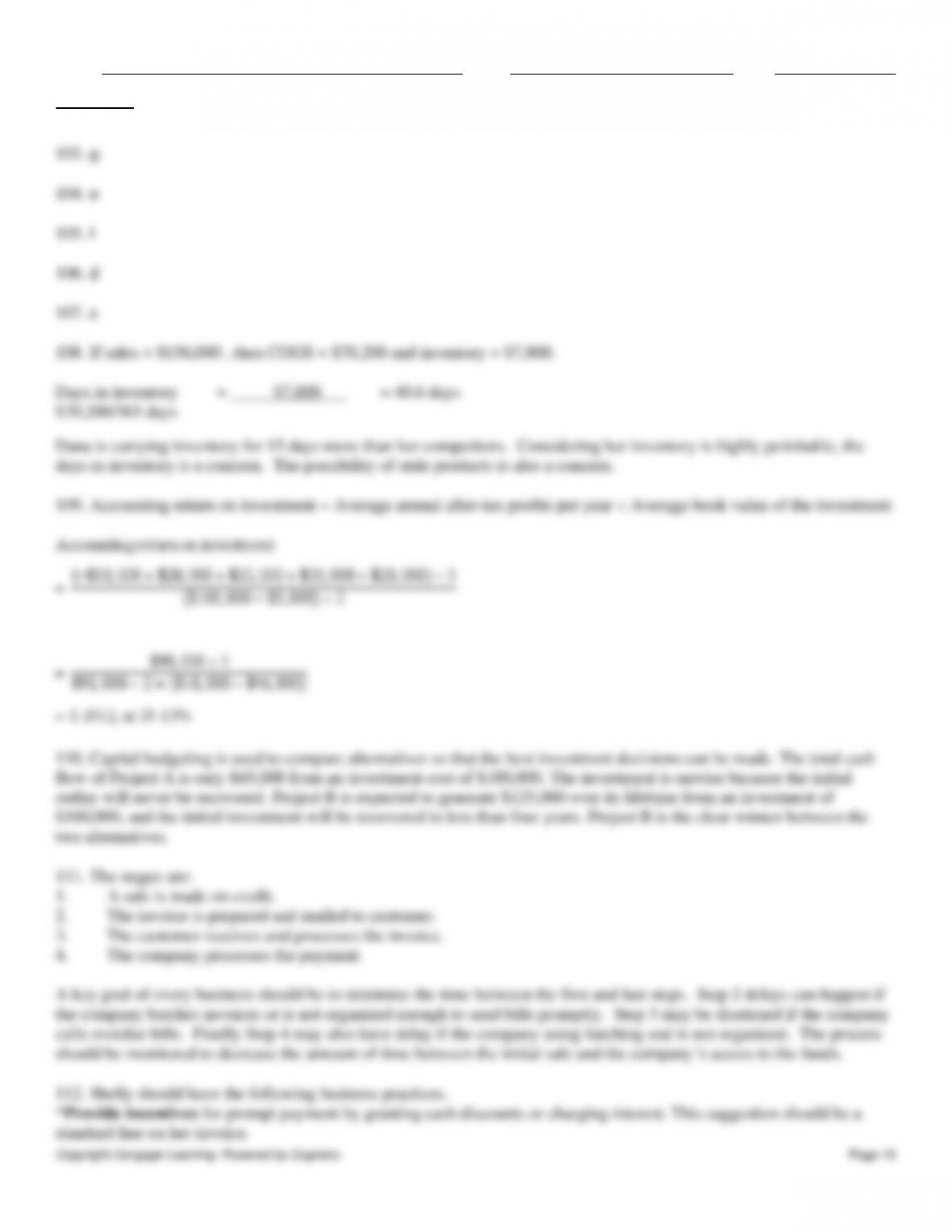
108. If sales = $156,000 , then COGS = $70,200 and inventory = $7,800.
Days in inventory = $7,800 = 40.6 days
$70,200/365 days
Dana is carrying inventory for 15 days more than her competitors. Considering her inventory is highly perishable, the
days in inventory is a concern. The possibility of stale products is also a concern.
109. Accounting return on investment = Average annual after-tax profits per year ÷ Average book value of the investment
110. Capital budgeting is used to compare alternatives so that the best investment decisions can be made. The total cash
flow of Project A is only $65,000 from an investment cost of $100,000. The investment is unwise because the initial
outlay will never be recovered. Project B is expected to generate $125,000 over its lifetime from an investment of
$100,000, and the initial investment will be recovered in less than four years. Project B is the clear winner between the
two alternatives.
111. The stages are:
1. A sale is made on credit.
2. The invoice is prepared and mailed to customer.
3. The customer receives and processes the invoice.
4. The company processes the payment.
A key goal of every business should be to minimize the time between the first and last steps. Step 2 delays can happen if
the company batches invoices or is not organized enough to send bills promptly. Step 3 may be shortened if the company
calls overdue bills. Finally Step 4 may also have delay if the company using batching and is not organized. The process
should be monitored to decrease the amount of time between the initial sale and the company’s access to the funds.
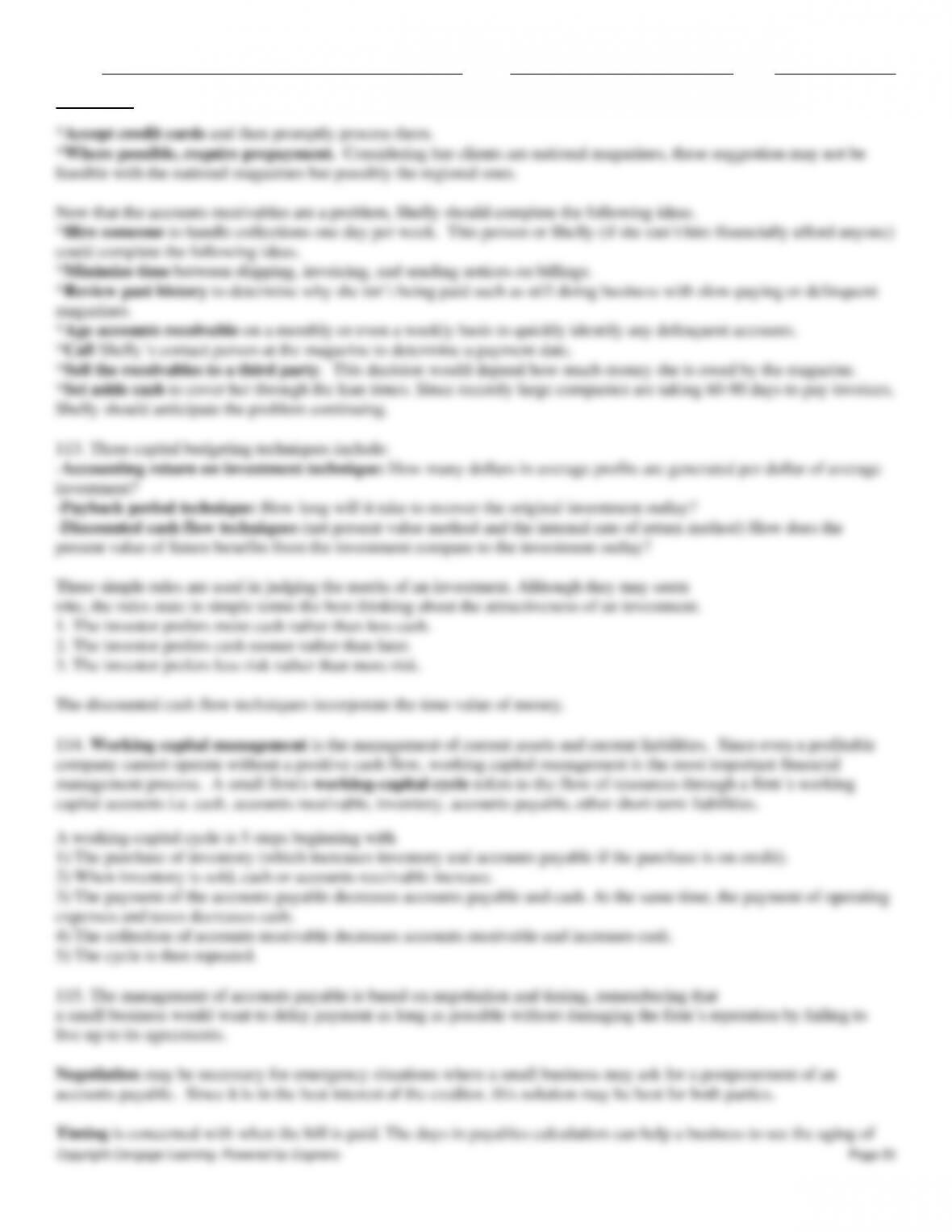
112. Shelly should have the following business practices.
*Provide incentives for prompt payment by granting cash discounts or charging interest. This suggestion should be a
standard line on her invoice.
Name:
Class:
Date:
chapter 22
Copyright Cengage Learning. Powered by Cognero.
Page 20
Name:
Class:
Date:
chapter 22
Name:
Class:
Date:
chapter 22
Copyright Cengage Learning. Powered by Cognero.
Page 22