
Name:
Class:
Date:
chapter 21
Copyright Cengage Learning. Powered by Cognero.
Page 13
103. The use of a random, representative portion of products to determine the acceptability of an entire lot
104. An all-encompassing management approach to providing high-quality products or services
Match the term with its definition. Some terms may not be used.
a. ABC method
b. Associative forecasting
c. Cooperative purchasing organization
d. Cycle counting
e. Demand management strategies
f. Economic order quantity
g. Just-in-time inventory system
h. Perpetual inventory system
i. Physical inventory system
j. Poka-yoke
k. Statistical inventory control
l. Two-bin inventory system
105. Operational strategies used to stimulate customer demand when it is normally low
106. A system of classifying items in inventory by relative value
107. A method of reducing inventory carrying costs by making or buying what is needed just as it is needed
108. A method of controlling inventory that uses a targeted service level, allowing statistical determination of the
appropriate amount of inventory to carry
109. An index that determines the quantity to purchase in order to minimize total inventory costs
110. A method for counting different segments of the physical inventory at different times during the year
111. A method of inventory conrol based on the use of two containers for each item in inventory, one to meet current
demand and the other to meet future demand
112. A method that provides for periodic counting of items in inventory
113. Forecasting that considers a variety of variables to determine expected sales
114. A method for keeping a running record of inventory
115. An organization in which small businesses combine their demand for products or services in order to negotiate as a
group with suppliers
Match the term with its definition. Some terms may not be used.
a. Continuous manufacturing
b. Flexible manufacturing systems
c. Job shops
d. Lean production
e. Make-or–buy decisions
f. Operations

Name:
Class:
Date:
chapter 21
Copyright Cengage Learning. Powered by Cognero.
Page 14
g. Outsourcing
h. Poka-yoke
i. Project manufacturing
j. Repetitive manufacturing
k. Supply Chain Operations Reference model
l. Synchronous manufacturing
116. An approach that recognizes the interdependence of assets and activities and manages them to optimize the entire
firm’s performance
117. A form of manufacturing with output that more closely resembles a product stream than individual products
118. An approach that emphasizes efficiency through elimination of waste
119. Manufacturing operatoins that usually involve computer-controlled equipment that can turn out products in smaller
or more flexible quantities
120. Manufacturing operations used to create unique but similar products
121. Manufacturing operations designed for short production runs of small quantities of items
122. Manufacturing operations designed for long production runs of high-volume, standardized products
123. Contracting with a third party to take on and manage one or more of a firm’s functions
124. A choice that companies must make when they have the option of making or buying component parts for products
they produce
125. The processes used to create and deliver a product or service
126. A list of critical factors that provides a helpful starting place when assessing a supplier’s performance
127. Edith is the operations manager at a small company that imports English leather-goods for resale. In a recent
meeting with the CEO, the decision was made that the small company would concentrate purchases with one supplier.
What are reasons that this decision could have been made?
128. Wallie’s Western Wear is a retailer of western style clothing that produces all of its own products. Wallie and
Wanda, the owners, want to incorporate a system to solve quality problems and understand they need to start with their
customers. What suggestions would be helpful for this process?
129. Holly is a business consultant who assists new companies in writing business plans. What type of manufacturing
operation would Holly’s business be considered and what are important characteristics for operational success?
130. How can supplier performance be measured when selecting a new supplier? Discuss the SCOR model followed by
other suggestions for good relations.
131. Christie and Kevin are starting a produce farm raising organic vegetables. Kevin plans to sell the produce wholesale
to a local restaurant and Christie is going to start a cooking school spotlighting the produce. Complete the following table

Name:
Class:
Date:
chapter 21
Copyright Cengage Learning. Powered by Cognero.
Page 15
detailing the inputs and outputs between the product business versus the service business. What are the similarities?
Product:
Wholesale Restaurant Sales Operation Services:
Organic Food Cooking School
Input
Processes
Output
132. Tonya owns TT’s T-shirts, a sports clothing production company that produces embroidered shirts that are
monogrammed. She has identified a constraint with her monogramming machine in that the work flow slows
considerably due to the shirts not being fed into the machine properly and the machine taking a certain amount of
time. How could this problem be addressed?
133. After defining operations management, discuss operational factors that will impact a firm’s performance.
134. Discuss quality tools and techniques that can be used to improve quality. Specifically describe the difference
between inspection vs. poka-yoke as a quality assurance method. How do these methods relate to Ishikawa’s “The Basic
Seven” and statistical methods of quality control?
135. Discuss the objectives of inventory management.
136. After describing common inventory record-keeping systems, what are guidelines for their use?
137. After describing the ABC Inventory Classification System, give examples of each category for a food item common
to a restaurant.
138. Discuss principles of lean production, specifically the ways that the Toyota Production System uses to eliminate
waste.
139. According to The American Society for Quality, what features are necessary for TQM?

Name:
Class:
Date:
chapter 21
Copyright Cengage Learning. Powered by Cognero.
Page 16
Answer Key
1. False
2. False

Name:
Class:
Date:
chapter 21
Copyright Cengage Learning. Powered by Cognero.
Page 17
Name:
Class:
Date:
chapter 21
Copyright Cengage Learning. Powered by Cognero.
Page 18
Name:
Class:
Date:
chapter 21
Copyright Cengage Learning. Powered by Cognero.
Page 19
Name:
Class:
Date:
chapter 21
Copyright Cengage Learning. Powered by Cognero.
Page 20
103. a
104. k
105. e
106. a
107. g
108. k
109. f
110. d
111. l
112. i
113. b
114. h
115. c
116. l
117. a
118. d
119. b
120. i
121. c
122. j
123. g
124. e
125. f
126. k
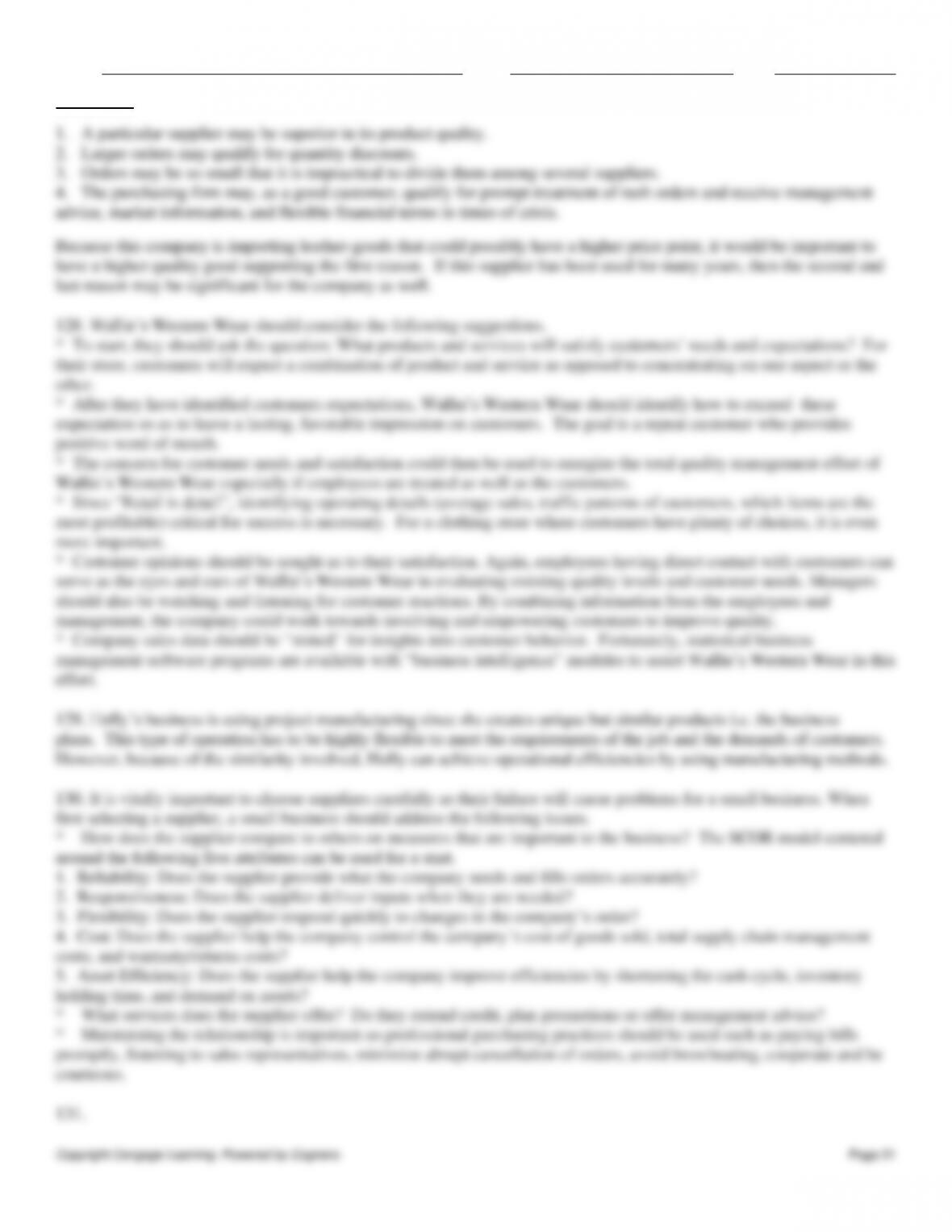
127. Four reasons are typically why a small business chooses to use only one vendor.
Name:
Class:
Date:
chapter 21
Copyright Cengage Learning. Powered by Cognero.
Page 21
Name:
Class:
Date:
chapter 21
Copyright Cengage Learning. Powered by Cognero.
Page 22
Name:
Class:
Date:
chapter 21
Copyright Cengage Learning. Powered by Cognero.
Page 23
Name:
Class:
Date:
chapter 21
Copyright Cengage Learning. Powered by Cognero.
Page 24