Principles of Finance, 6e
Besley/Brigham
Chapter 07
Cengage Learning Testing, Powered by Cognero
Page 21
Subtractions (uses of cash):
Increase in accounts receivable
(50)
Increase in inventories
(35)
Decrease in accounts payable
(20)
Net Cash Flows from Operations
($85)
Cash Flows Associated with Financing Activities
Decrease in marketable securities
$25
Increase in notes payable
30
Net Cash Flows from Financing
$55
Net reduction in Cash
($30)
POINTS:
1
DIFFICULTY:
Moderate
ACCREDITING STANDARDS:
Blooms Taxonomy-1 – Analyzing
Business Program-3 – Analytic
DISC-FIN-07 – Finance Function
Time Estimate-b – 10 min.
TOPICS:
Change in Cash Flows
43. Cannon Company has enjoyed a rapid increase in sales in recent years, following a decision to sell on credit.
However, the firm has noticed a recent increase in its collection period. Last year, total sales were $1 million, and
$250,000 of these sales were on credit. During the year, the accounts receivable account averaged $41,664. It is expected
that sales will increase in the forthcoming year by 50 percent, and, while credit sales should continue to be the same
proportion of total sales, it is expected that the days sales outstanding will also increase by 50 percent. If the resulting
increase in accounts receivable must be financed by external funds, how much external funding will Cannon need?
a.
$41,664
b.
$52,086
c.
$47,359
d.
$106,471
e.
$93,750
ANSWER:
b
RATIONALE:
DSO = ($41,664/$250,000)/360 = 60 days. New A/R = (($250,000)(1.5)/(360))(60)(1.5) =
$93,750. Hence, increase in receivables = $93,750 − $41,664 = $52,086.
POINTS:
1
DIFFICULTY:
Moderate
ACCREDITING STANDARDS:
Blooms Taxonomy-1 – Analyzing
Business Program-3 – Analytic
DISC-FIN-07 – Finance Function
Time Estimate-b – 10 min.
TOPICS:
Receivables Increase
44. The Meryl Corporation’s common stock currently is selling at $100 per share, which represents a P/E ratio of 10. If the
firm has 100 shares of common stock outstanding, a return on equity of 20 percent, and a debt ratio of 60 percent, what is
its return on total assets (ROA)?
a.
8.0%
Principles of Finance, 6e
Besley/Brigham
Chapter 07
Cengage Learning Testing, Powered by Cognero
Page 22
b.
10.0%
c.
12.0%
d.
16.7%
e.
20.0%
ANSWER:
a
RATIONALE:
P/E = 10 = $100/EPS EPS = $100/10 = $10. Earnings = NI = $10(100 shares) = $1,000.
ROE = NI/Equity = $1,000/Equity = 20% Equity = $1,000/0.20 = $5,000. Debt ratio =
60%, so Equity ratio = 40% = Equity/TA TA = Equity/0.40 = $5,000/0.40 = $12,500. ROA
= NI/TA = $1,000/$12,500 = 0.08 = 8%.
POINTS:
1
DIFFICULTY:
Moderate
ACCREDITING STANDARDS:
Blooms Taxonomy-1 – Analyzing
Business Program-3 – Analytic
DISC-FIN-07 – Finance Function
Time Estimate-b – 10 min.
TOPICS:
ROA
45. A fire has destroyed a large percentage of the financial records of the Carter Company. You have the task of piecing
together information in order to release a financial report. You have found the return on equity to be 18 percent. If sales
were $4 million, the debt ratio was 0.40, and total liabilities were $2 million, what was the return on assets (ROA)?
a.
10.8%
b.
0.8%
c.
1.25%
d.
12.6%
e.
Insufficient information.
ANSWER:
a
RATIONALE:
Debt ratio = 0.40, so Equity = 1 − 0.40 = 0.60 = 60% of Total assets. ROE = NI/Equity =
NI/[0.6(TA)] = 18%. NI = 0.6(18%)TA = 10.8%(TA). ROA = NI/TA = [10.8%(TA)]/TA =
10.8%.
POINTS:
1
DIFFICULTY:
Moderate
ACCREDITING STANDARDS:
Blooms Taxonomy-1 – Analyzing
Business Program-3 – Analytic
DISC-FIN-07 – Finance Function
Time Estimate-b – 10 min.
TOPICS:
ROA
46. Selzer Inc. sells all its merchandise on credit. It has a profit margin of 4 percent, days sales outstanding equal to 60
days, receivables of $150,000, total assets of $3 million, and a debt ratio of 0.64. What is the firm’s return on equity
(ROE)?
a.
7.1%
b.
33.3%
c.
3.3%
d.
71.0%
Principles of Finance, 6e
Besley/Brigham
Chapter 07
e.
8.1%
ANSWER:
c
RATIONALE:
(Sales per day)(DSO)
= A/R
(Sales/360)(60)
= $150,000
Sales
= $900,000.
Profit margin = Net profit after tax/Sales. Net profit = 0.04($900,000) = $36,000. Debt
ratio = 0.64 = Total debt/$3,000,000. Total debt = $1,920,000. Total equity = $3,000,000
− $1,920,000 = $1,080,000. ROE = $36,000/$1,080,000 = 3.3%.
POINTS:
1
DIFFICULTY:
Moderate
ACCREDITING STANDARDS:
Blooms Taxonomy-1 – Analyzing
Business Program-3 – Analytic
DISC-FIN-07 – Finance Function
Time Estimate-b – 10 min.
TOPICS:
ROE
47. A firm has total assets of $1,000,000 and a debt ratio of 30 percent. Currently, it has sales of $2,500,000, total fixed
costs of $1,000,000, and EBIT of $50,000. If the firm’s before-tax cost of debt is 10 percent and the firm’s tax rate is 40
percent, what is the firm’s ROE?
a.
1.7%
b.
2.5%
c.
6.0%
d.
8.3%
e.
9.8%
ANSWER:
a
RATIONALE:
Total debt = $300,000. Total equity = $1,000,000 − $300,000 = $700,000. Net income =
[$50,000 − (0.10)($300,000)]0.60 = $12,000. ROE = $12,000/$700,000 = 1.7%.
POINTS:
1
DIFFICULTY:
Moderate
ACCREDITING STANDARDS:
Blooms Taxonomy-1 – Analyzing
Business Program-3 – Analytic
DISC-FIN-07 – Finance Function
Time Estimate-b – 10 min.
TOPICS:
ROE
48. A firm has a debt ratio of 40 percent. Currently, it has interest expense of $500,000 on $5,000,000 of total debt
outstanding, and a tax rate of 40 percent. If the firm’s ROA is 6 percent, by how many percentage points is the firm’s ROE
greater than its ROA?
a.
0.0%
b.
4.0%
c.
5.8%
d.
7.4%
e.
10.0%
ANSWER:
b
Principles of Finance, 6e
Besley/Brigham
Chapter 07
TOPICS:
Rate of Interest
cost of goods sold is 75% of sales?
e.
18.7%
ANSWER:
d
RATIONALE:
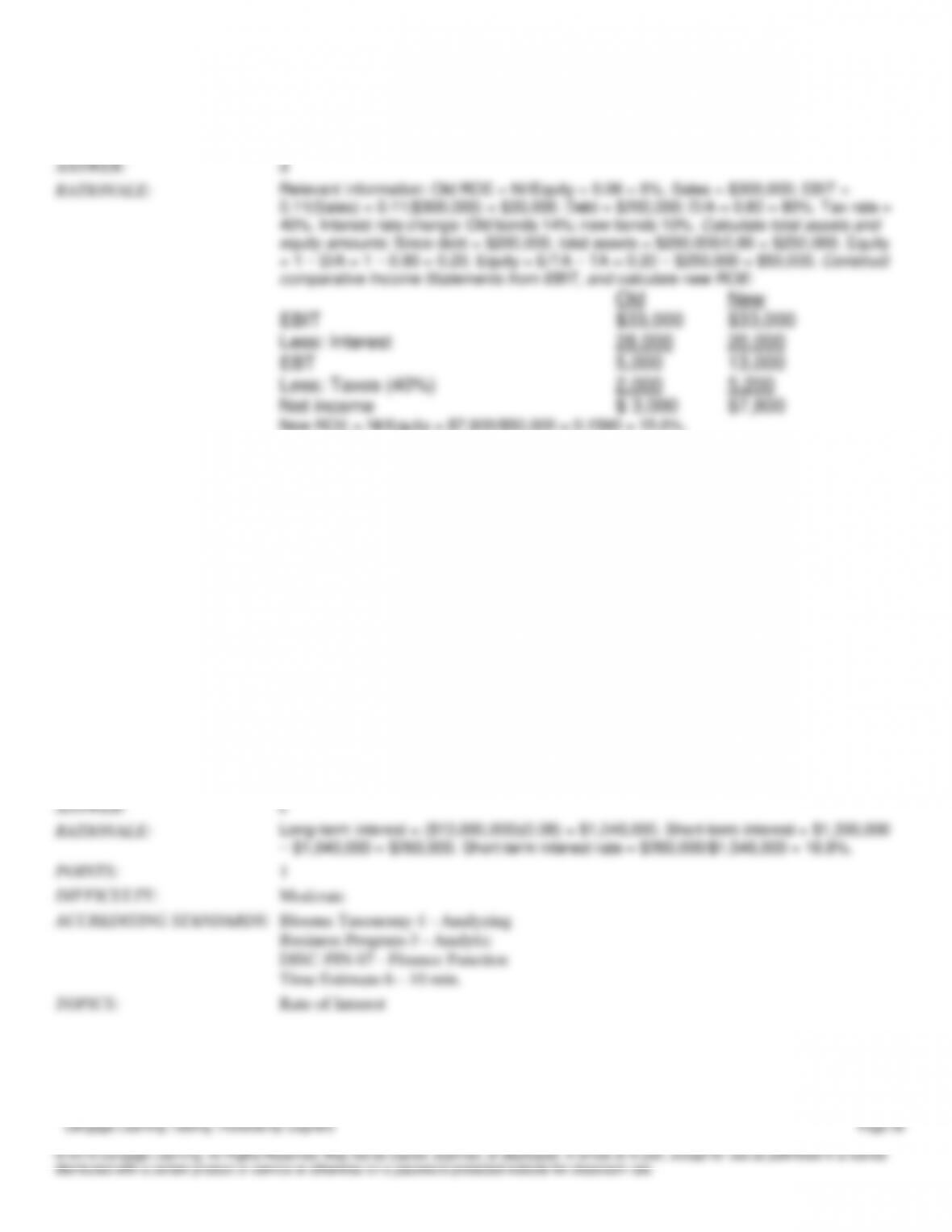
Relevant information: Old ROE = NI/Equity = 0.06 = 6%. Sales = $300,000; EBIT =
0.11(Sales) = 0.11($300,000) = $33,000. Debt = $200,000; D/A = 0.80 = 80%. Tax rate =
40%. Interest rate change: Old bonds 14%; new bonds 10%. Calculate total assets and
equity amounts: Since debt = $200,000, total assets = $200,000/0.80 = $250,000. Equity
= 1 − D/A = 1 − 0.80 = 0.20. Equity = E/TA × TA = 0.20 × $250,000 = $50,000. Construct
comparative Income Statements from EBIT, and calculate new ROE:
Old
New
EBIT
$33,000
$33,000
Less: Interest
28,000
20,000
EBT
5,000
13,000
Less: Taxes (40%)
2,000
5,200
Net income
$ 3,000
$7,800
New ROE = NI/Equity = $7,800/$50,000 = 0.1560 = 15.6%.
POINTS:
1
DIFFICULTY:
Moderate
ACCREDITING STANDARDS:
Blooms Taxonomy-1 – Analyzing
Business Program-3 – Analytic
DISC-FIN-07 – Finance Function
Time Estimate-b – 10 min.
TOPICS:
ROE
Refinancing
53. A firm has notes payable of $1,546,000, long-term debt of $13,000,000, and total interest expense of $1,300,000. If
the firm pays 8 percent interest on its long-term debt, what rate of interest does it pay on its notes payable?
a.
8.2%
b.
13.1%
c.
16.8%
d.
18.0%
e.
15.3%
ANSWER:
c
RATIONALE:
Long-term interest = ($13,000,000)(0.08) = $1,040,000. Short-term interest = $1,300,000
− $1,040,000 = $260,000. Short-term interest rate = $260,000/$1,546,000 = 16.8%.
POINTS:
1
DIFFICULTY:
Moderate
ACCREDITING STANDARDS:
Blooms Taxonomy-1 – Analyzing
Business Program-3 – Analytic
DISC-FIN-07 – Finance Function
Time Estimate-b – 10 min.
Principles of Finance, 6e
Besley/Brigham
Chapter 07
Cengage Learning Testing, Powered by Cognero
Page 27
a.
$960,000
b.
$720,000
c.
$1,620,000
d.
$120,000
e.
$540,000
ANSWER:
a
RATIONALE:
Current liabilities: (0.2)($1,000,000) = $200,000. Current assets: CA/$200,000 = 3.0; CA
= $600,000. Inventory: ($600,000 − I)/$200,000 = 2.4; I = $120,000. Sales:
(0.75)S/$120,000 = 6; S = $720,000/0.75 = $960,000.
POINTS:
1
DIFFICULTY:
Moderate
ACCREDITING STANDARDS:
Blooms Taxonomy-1 – Analyzing
Business Program-3 – Analytic
DISC-FIN-07 – Finance Function
Time Estimate-b – 10 min.
TOPICS:
Sales Volume
55. Given the following information, calculate the market price per share of WAM Inc.
Earnings after interest and taxes
= $200,000
Earnings per share
= $2.00
Stockholders’ equity
= $2,000,000
Market/Book ratio
= 0.20
a.
$20.00
b.
$8.00
c.
$4.00
d.
$2.00
e.
$1.00
ANSWER:
c
RATIONALE:
Number of shares = $200,000/$2.00 = 100,000. Book value per share =
$2,000,000/100,000 = $20. Market value = 0.2(Book value) = 0.2($20) = $4.00 per share.
POINTS:
1
DIFFICULTY:
Moderate
ACCREDITING STANDARDS:
Blooms Taxonomy-1 – Analyzing
Business Program-3 – Analytic
DISC-FIN-07 – Finance Function
Time Estimate-b – 10 min.
TOPICS:
Market Price Per Share
56. On its December 31st balance sheet, LCG Company reported gross fixed assets of $6,500,000 and net fixed assets of
$5,000,000. Depreciation for the year was $500,000. Net fixed assets a year earlier on December 31st, had been
$4,700,000. What figure for “Cash Flows Associated with Long-Term Investments (Fixed Assets)” should LCG report on
its Statement of Cash Flows for the current year?
a.
$500,000
b.
$600,000
Principles of Finance, 6e
Besley/Brigham
Chapter 07
d.
2.67
e.
3.45
ANSWER:
d
= 2
S/$10,000
= 2
c.
$700,000
d.
$800,000
e.
$900,000
ANSWER:
d
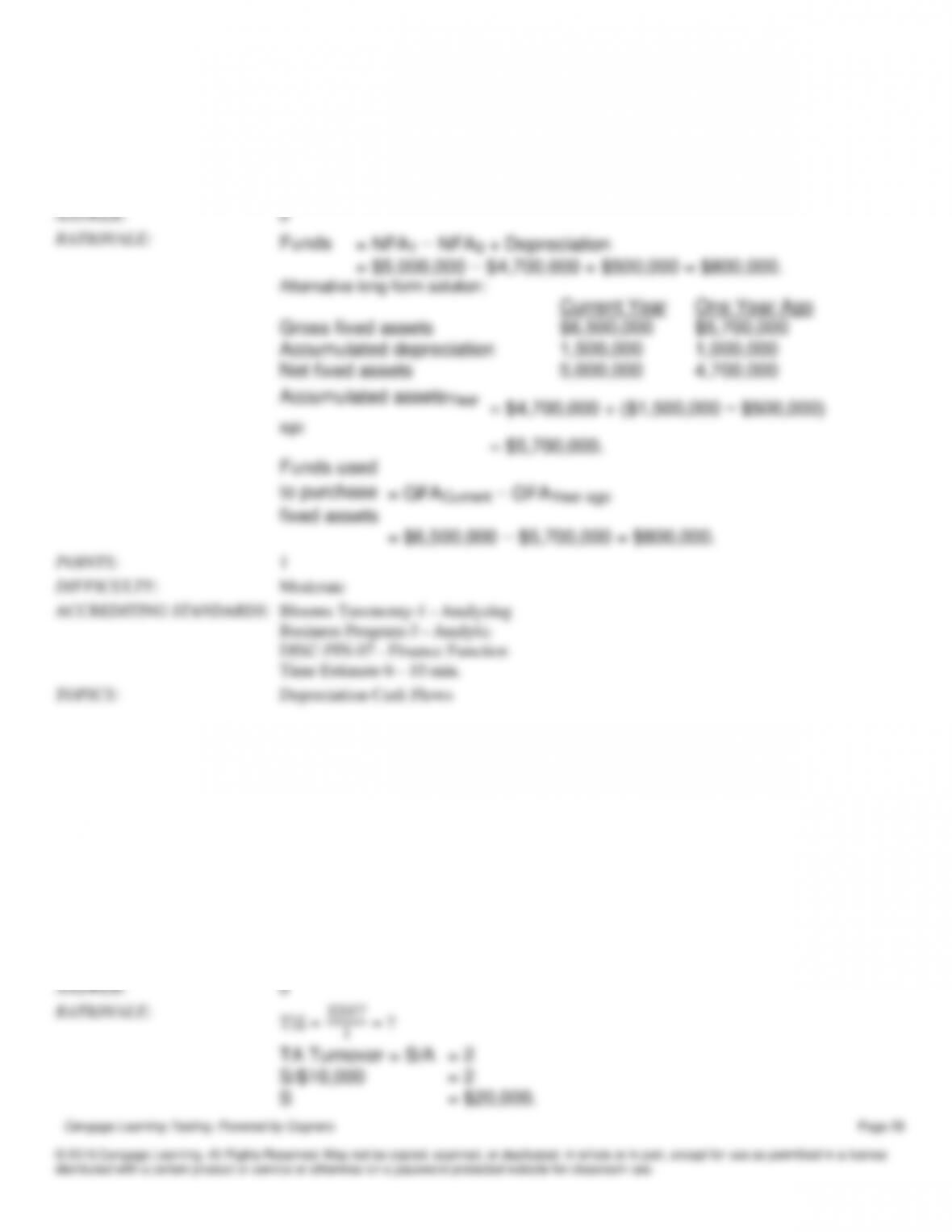
RATIONALE:
Funds
= NFA1 − NFA0 + Depreciation
= $5,000,000 − $4,700,000 + $500,000 = $800,000.
Alternative long-form solution:
Current Year
One Year Ago
Gross fixed assets
$6,500,000
$5,700,000
Accumulated depreciation
1,500,000
1,000,000
Net fixed assets
5,000,000
4,700,000
Accumulated assetsYear
ago
= $4,700,000 + ($1,500,000 − $500,000)
= $5,700,000.
Funds used
to purchase
= GFACurrent − GFAYear ago
fixed assets
= $6,500,000 − $5,700,000 = $800,000.
POINTS:
1
DIFFICULTY:
Moderate
ACCREDITING STANDARDS:
Blooms Taxonomy-1 – Analyzing
Business Program-3 – Analytic
DISC-FIN-07 – Finance Function
Time Estimate-b – 10 min.
TOPICS:
Depreciation Cash Flows
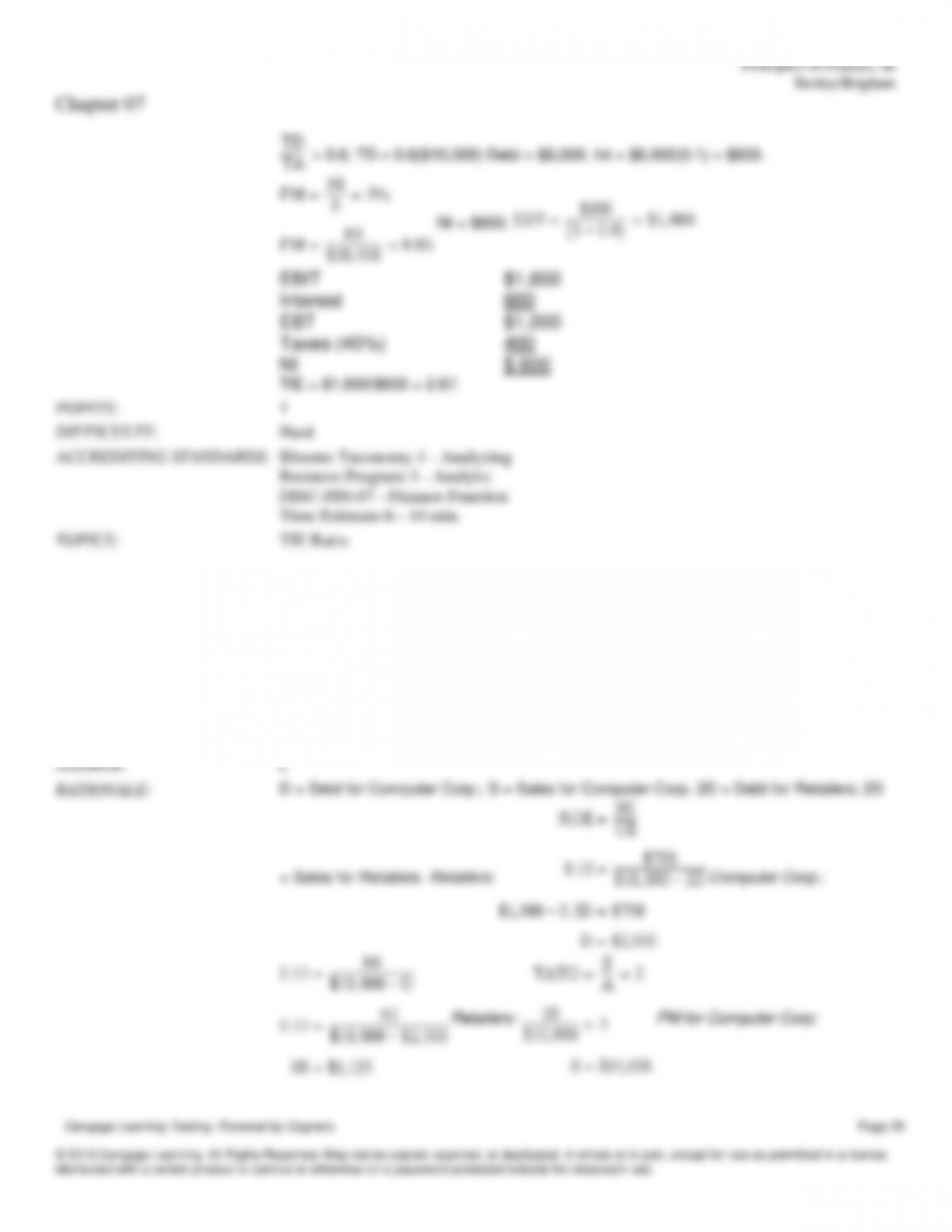
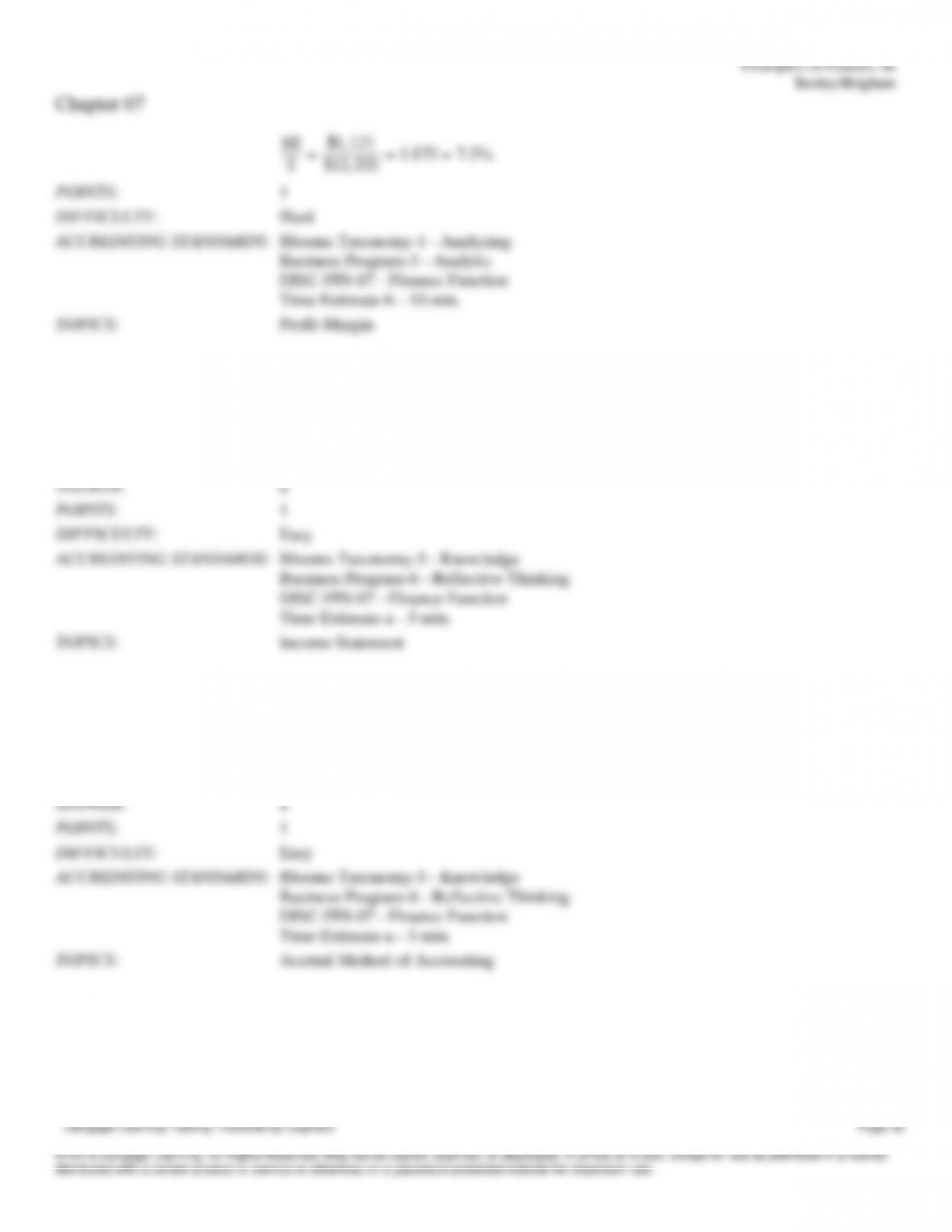
57. Lombardi Trucking Company has the following data:
Assets: $10,000
Profit margin: 3.0%
Debt ratio: 60.0%
Interest rate: 10.0%
Tax rate: 40%
Total asset turnover: 2.0
What is Lombardi’s TIE ratio?
a.
0.95
b.
1.75
c.
2.10
Principles of Finance, 6e
Besley/Brigham
Chapter 07
Cengage Learning Testing, Powered by Cognero
Page 31
d.
statement of retained earnings
ANSWER:
b
POINTS:
1
DIFFICULTY:
Easy
ACCREDITING STANDARDS:
Blooms Taxonomy-5 – Knowledge
Business Program-6 – Reflective Thinking
DISC-FIN-07 – Finance Function
Time Estimate-a – 5 min.
TOPICS:
Balance Sheet
62. ____ is a residual that represents the amount that stockholders would receive if all of the firm’s assets could be sold at
their book values and all of their liabilities could be paid at their book values.
a.
Net worth
b.
Retained earnings
c.
Paid-in-capital
d.
Total assets
ANSWER:
a
POINTS:
1
DIFFICULTY:
Easy
ACCREDITING STANDARDS:
Blooms Taxonomy-5 – Knowledge
Business Program-6 – Reflective Thinking
DISC-FIN-07 – Finance Function
Time Estimate-a – 5 min.
TOPICS:
Common Stockholders’ Equity
63. In the event of a firm’s liquidation, the order in which claimholders are paid off is
a.
debtholders, common stockholders, preferred stockholders
b.
common stockholders, preferred stockholders, debtholders
c.
debtholders, preferred stockholders, common stockholders
d.
common stockholders, debtholders, preferred stockholders
ANSWER:
c
POINTS:
1
DIFFICULTY:
Easy
ACCREDITING STANDARDS:
Blooms Taxonomy-5 – Knowledge
Business Program-6 – Reflective Thinking
DISC-FIN-07 – Finance Function
Time Estimate-a – 5 min.
TOPICS:
Residual Claim
64. From management’s standpoint, financial statement analysis is useful
a.
both as a way to anticipate future conditions and, more important, as a starting point for planning actions.
b.
as a way to anticipate future conditions, but not for current planning.
c.
for planning activities, but not as a way to anticipate future conditions.
Principles of Finance, 6e
Besley/Brigham
Chapter 07
Cengage Learning Testing, Powered by Cognero
Page 32
© 2015 Cengage Learning. All Rights Reserved. May not be copied, scanned, or duplicated, in whole or in part, except for use as permitted in a license
d.
For meeting government requirements, but not for anticipating future conditions or planning actions.
ANSWER:
a
POINTS:
1
DIFFICULTY:
Easy
ACCREDITING STANDARDS:
Blooms Taxonomy-5 – Knowledge
Business Program-6 – Reflective Thinking
DISC-FIN-07 – Finance Function
Time Estimate-a – 5 min.
TOPICS:
Financial Statement Analysis
65. The ____ is a statement reporting the effects of a firm’s operating, investing, and financing activities on cash flows
over an accounting period.
a.
income statement
b.
balance sheet
c.
statement of cash flows
d.
statement of retained earnings
ANSWER:
c
POINTS:
1
DIFFICULTY:
Easy
ACCREDITING STANDARDS:
Blooms Taxonomy-5 – Knowledge
Business Program-6 – Reflective Thinking
DISC-FIN-07 – Finance Function
Time Estimate-a – 5 min.
TOPICS:
Statement of Cash Flows
66. Bender Corporation had sales of $250,000 last year. They had operating costs of $100,000, an interest expense of
$15,000, and had an average tax 32%. Assuming Bender wants to have a 60% payout ratio and has 1,000 shares
outstanding, what is Bender’s expected dividend per share?
a.
$235.00
b.
$102.00
c.
$91.80
d.
$55.08
ANSWER:
d
RATIONALE:
First determine net income and then dividends. Net income = ($250,000 − $100,000 −
$15,000)*(1 − .32) = $91,800 Dividend = $91,800*0.60 = $55,080 Dividend per share =
$55,080/1,000 = $55.08
POINTS:
1
DIFFICULTY:
Moderate
ACCREDITING STANDARDS:
Blooms Taxonomy-1 – Analyzing
Business Program-3 – Analytic
DISC-FIN-07 – Finance Function
Time Estimate-b – 10 min.
TOPICS:
Net Income
Principles of Finance, 6e
Besley/Brigham
Chapter 07
Cengage Learning Testing, Powered by Cognero
Page 33
67. The ____ provides a good indication of the firm’s ability to meet its current obligations.
a.
debt ratio
b.
profit margin
c.
days sales outstanding
d.
quick ratio
e.
return on equity
ANSWER:
d
POINTS:
1
DIFFICULTY:
Easy
ACCREDITING STANDARDS:
Blooms Taxonomy-5 – Knowledge
Business Program-6 – Reflective Thinking
DISC-FIN-07 – Finance Function
Time Estimate-a – 5 min.
TOPICS:
Quick Ratio
68. The income statement measures the flow of funds into (i.e. revenue) and out of (i.e. expenses) the firm over a certain
time period. It is always based on accounting data.
a.
True
b.
False
ANSWER:
False
POINTS:
1
DIFFICULTY:
Easy
ACCREDITING STANDARDS:
Blooms Taxonomy-5 – Knowledge
Business Program-6 – Reflective Thinking
DISC-FIN-07 – Finance Function
Time Estimate-a – 5 min.
TOPICS:
Income Statement
69. The balance sheet is a financial statement measuring the flow of funds into and out of various accounts over time
while the income statement measures the progress of the firm at a point in time.
a.
True
b.
False
ANSWER:
False
POINTS:
1
DIFFICULTY:
Easy
ACCREDITING STANDARDS:
Blooms Taxonomy-5 – Knowledge
Business Program-6 – Reflective Thinking
DISC-FIN-07 – Finance Function
Time Estimate-a – 5 min.
TOPICS:
Financial Statements
70. On the balance sheet, total assets must always equal total liabilities. The amount remaining is what is used to finance
the firm and includes equity and long-term debt.
a.
True
Principles of Finance, 6e
Besley/Brigham
Chapter 07
Cengage Learning Testing, Powered by Cognero
Page 34
© 2015 Cengage Learning. All Rights Reserved. May not be copied, scanned, or duplicated, in whole or in part, except for use as permitted in a license
b.
False
ANSWER:
False
POINTS:
1
DIFFICULTY:
Easy
ACCREDITING STANDARDS:
Blooms Taxonomy-5 – Knowledge
Business Program-6 – Reflective Thinking
DISC-FIN-07 – Finance Function
Time Estimate-a – 5 min.
TOPICS:
Balance Sheet
71. An increase in an asset account is a source of cash, whereas an increase in a liability account is a use of cash.
a.
True
b.
False
ANSWER:
False
POINTS:
1
DIFFICULTY:
Easy
ACCREDITING STANDARDS:
Blooms Taxonomy-5 – Knowledge
Business Program-6 – Reflective Thinking
DISC-FIN-07 – Finance Function
Time Estimate-a – 5 min.
TOPICS:
Sources and Uses of Cash
72. Depreciation, as shown on the income statement, is regarded as a use of cash because it is an expense.
a.
True
b.
False
ANSWER:
False
POINTS:
1
DIFFICULTY:
Easy
ACCREDITING STANDARDS:
Blooms Taxonomy-5 – Knowledge
Business Program-6 – Reflective Thinking
DISC-FIN-07 – Finance Function
Time Estimate-a – 5 min.
TOPICS:
Sources and Uses of Cash
73. If a firm borrows money from a bank or reduces its level of inventory, these are both examples of sources of funds.
a.
True
b.
False
ANSWER:
False
POINTS:
1
DIFFICULTY:
Easy
ACCREDITING STANDARDS:
Blooms Taxonomy-5 – Knowledge
Business Program-6 – Reflective Thinking
DISC-FIN-07 – Finance Function
Time Estimate-a – 5 min.