Principles of Finance, 6e
Besley/Brigham
Chapter 10
Cengage Learning Testing, Powered by Cognero
Page 21
© 2015 Cengage Learning. All Rights Reserved. May not be copied, scanned, or duplicated, in whole or in part, except for use as permitted in a license
RATIONALE:
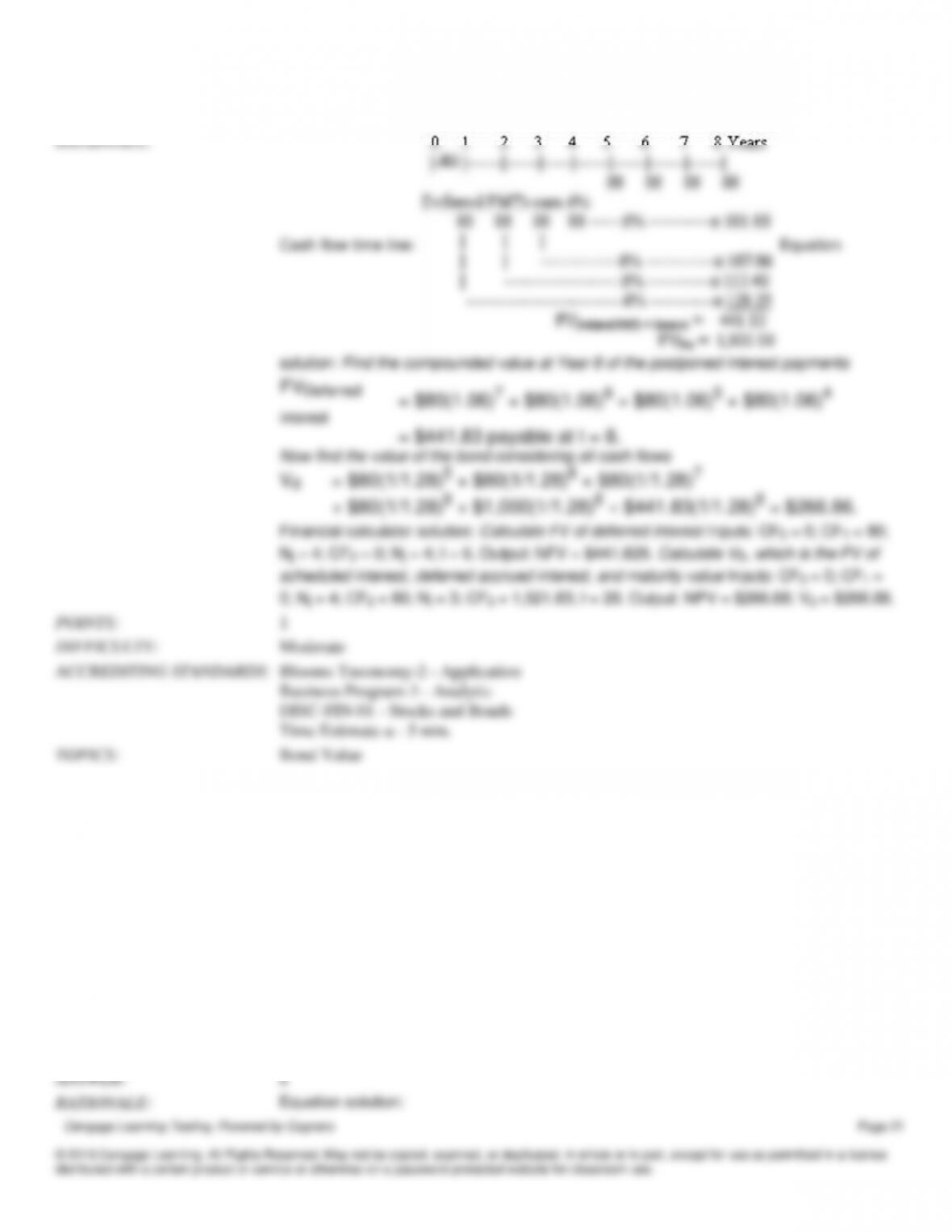
Cash flow time line: Equation
solution: Find the compounded value at Year 8 of the postponed interest payments
FVDeferred
interest
= $80(1.06)7 + $80(1.06)6 + $80(1.06)5 + $80(1.06)4
= $441.83 payable at t = 8.
Now find the value of the bond considering all cash flows
Vd
= $80(1/1.28)5 + $80(1/1.28)6 + $80(1/1.28)7
+ $80(1/1.28)8 + $1,000(1/1.28)8 + $441.83(1/1.28)8 = $266.86.
Financial calculator solution: Calculate FV of deferred interest Inputs: CF0 = 0; CF1 = 80;
Nj = 4; CF2 = 0; Nj = 4; I = 6. Output: NFV = $441.828. Calculate VB, which is the PV of
scheduled interest, deferred accrued interest, and maturity value Inputs: CF0 = 0; CF1 =
0; Nj = 4; CF2 = 80; Nj = 3; CF3 = 1,521.83; I = 28. Output: NPV = $266.88; Vd = $266.88.
POINTS:
1
DIFFICULTY:
Moderate
ACCREDITING STANDARDS:
Blooms Taxonomy-2 – Application
Business Program-3 – Analytic
DISC-FIN-01 – Stocks and Bonds
Time Estimate-a – 5 min.
TOPICS:
Bond Value
39. Marie Snell recently inherited some bonds (face value $100,000) from her father, and soon thereafter she became
engaged to Sam Spade, a University of Florida marketing graduate. Sam wants Marie to cash in the bonds so the two of
them can use the money to “live like royalty” for two years in Monte Carlo. The 2 percent annual coupon bonds mature on
January 1, 2030, and it is now January 1, 2010. Interest on these bonds is paid annually on December 31 of each year, and
new annual coupon bonds with similar risk and maturity are currently yielding 12 percent. If Marie sells her bonds now
and puts the proceeds into an account which pays 10 percent compounded annually, what would be the largest equal
annual amounts she could withdraw for two years, beginning today (i.e., two payments, the first payment today and the
second payment one year from today)?
a.
$13,255
b.
$29,708
c.
$12,654
d.
$25,305
e.
$14,580
ANSWER:
a
RATIONALE:
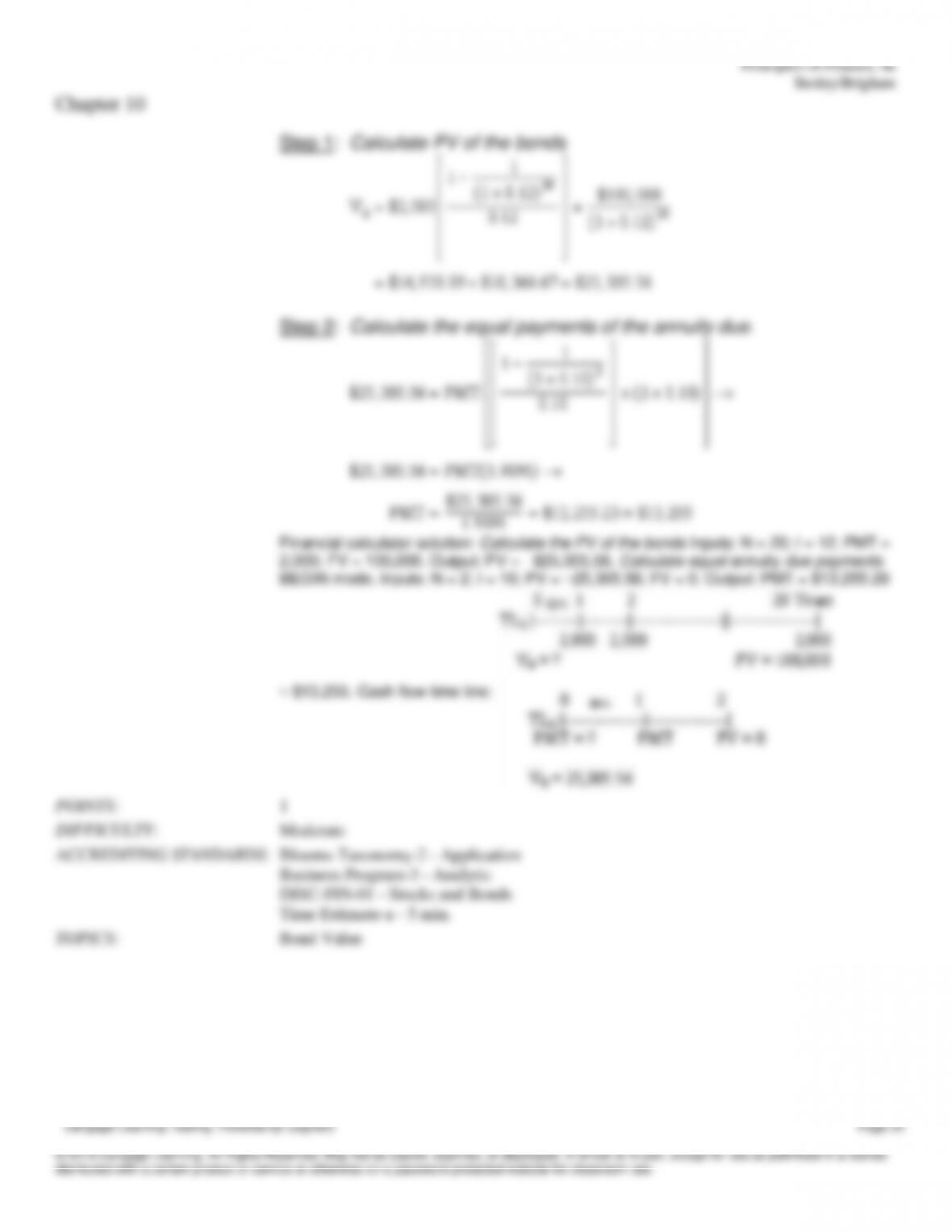
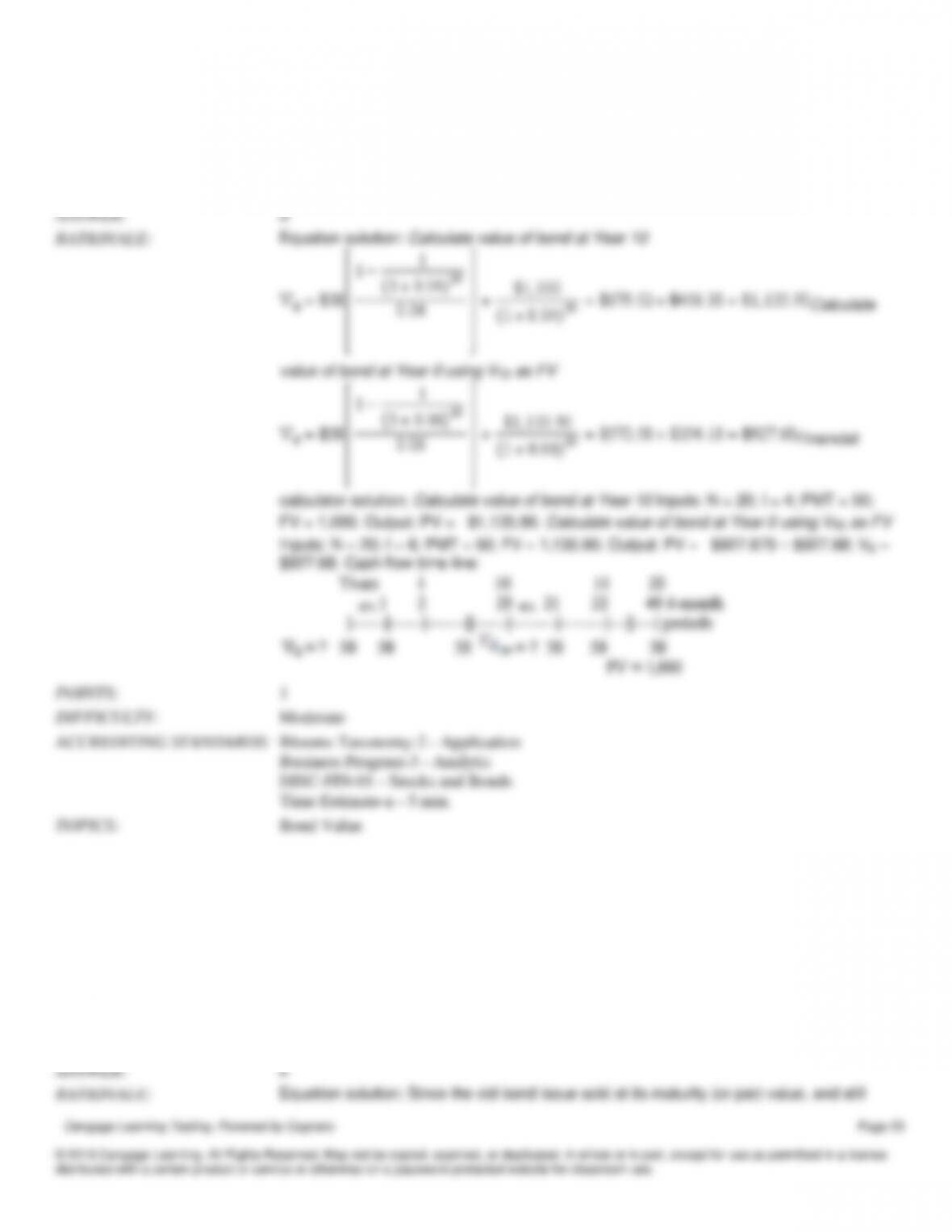
Equation solution:
Principles of Finance, 6e
Besley/Brigham
Chapter 10
TOPICS:
Bond Value
a.
2,400
b.
2,596
c.
3,000
d.
5,000
e.
4,275
RATIONALE:
c.
$737.50
d.
$927.68
e.
$856.91
ANSWER:
d
RATIONALE:
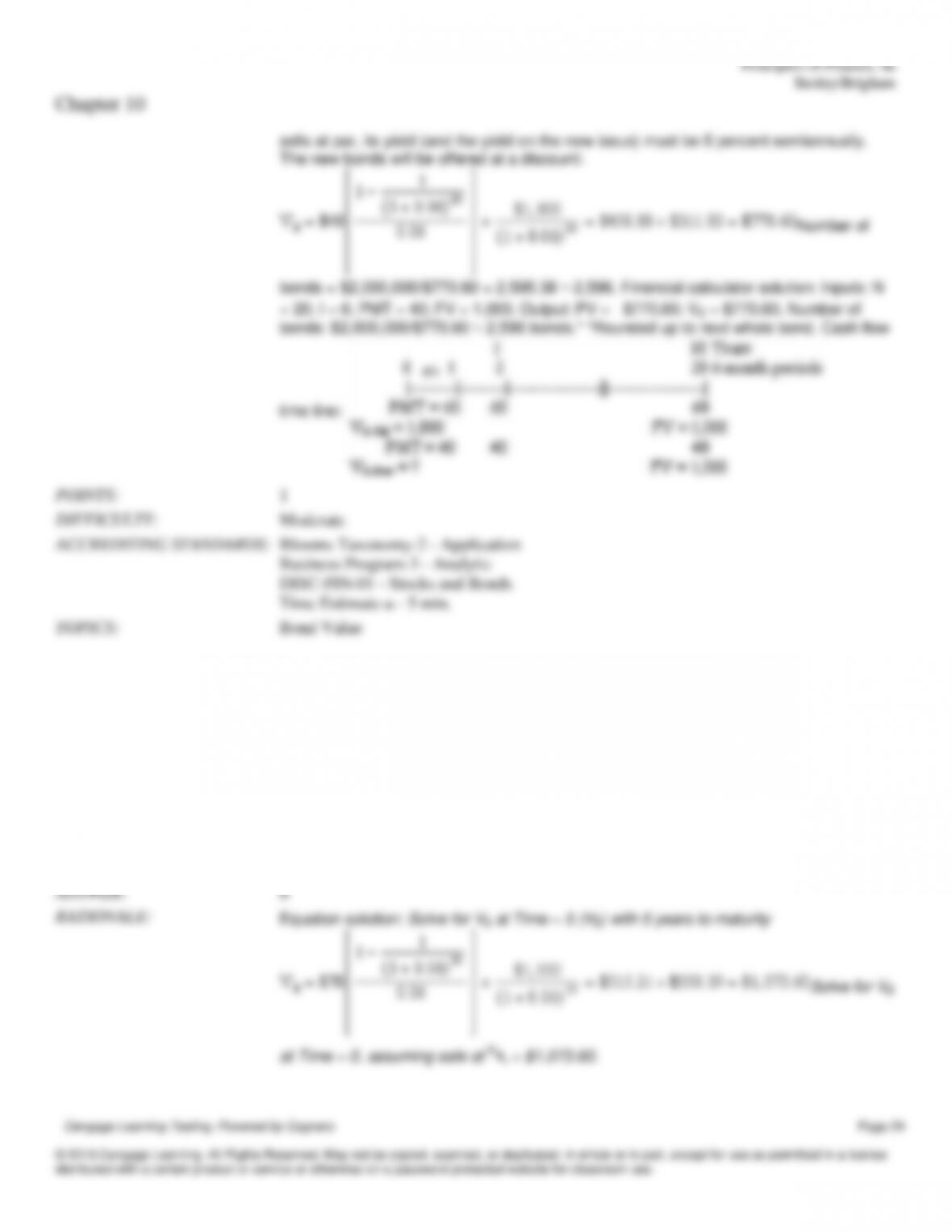
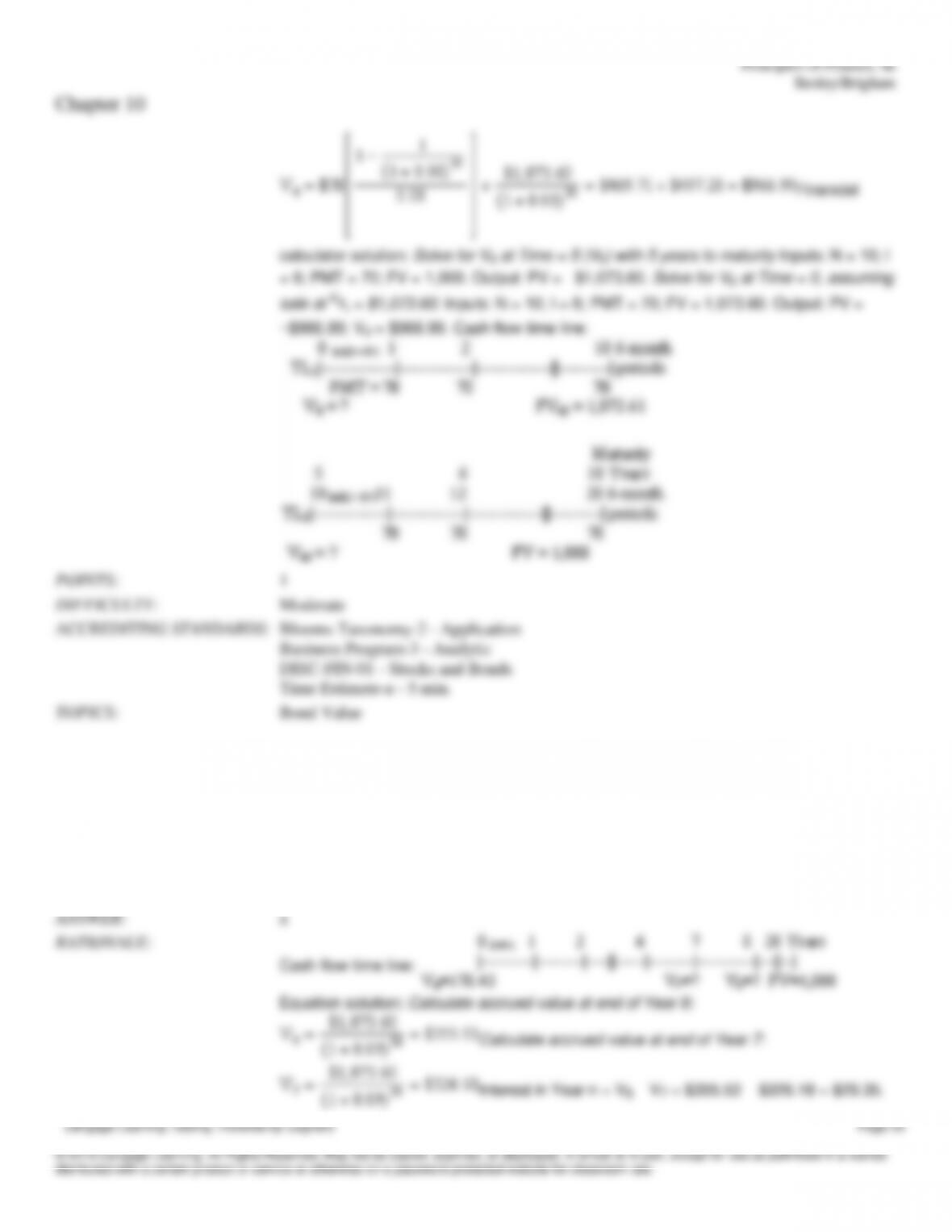
Equation solution: Calculate value of bond at Year 10
Calculate
value of bond at Year 0 using V10 as FV
Financial
calculator solution: Calculate value of bond at Year 10 Inputs: N = 20; I = 4; PMT = 50;
FV = 1,000. Output: PV = −$1,135.90. Calculate value of bond at Year 0 using V10 as FV
Inputs: N = 20; I = 6; PMT = 50; FV = 1,135.90. Output: PV = −$927.675 ≈ $927.68; Vd =
$927.68. Cash flow time line:
POINTS:
1
DIFFICULTY:
Moderate
ACCREDITING STANDARDS:
Blooms Taxonomy-2 – Application
Business Program-3 – Analytic
DISC-FIN-01 – Stocks and Bonds
Principles of Finance, 6e
Besley/Brigham
Chapter 10
Time Estimate-a – 5 min.
TOPICS:
Value of a Perpetuity
interest does this bond pay each year?
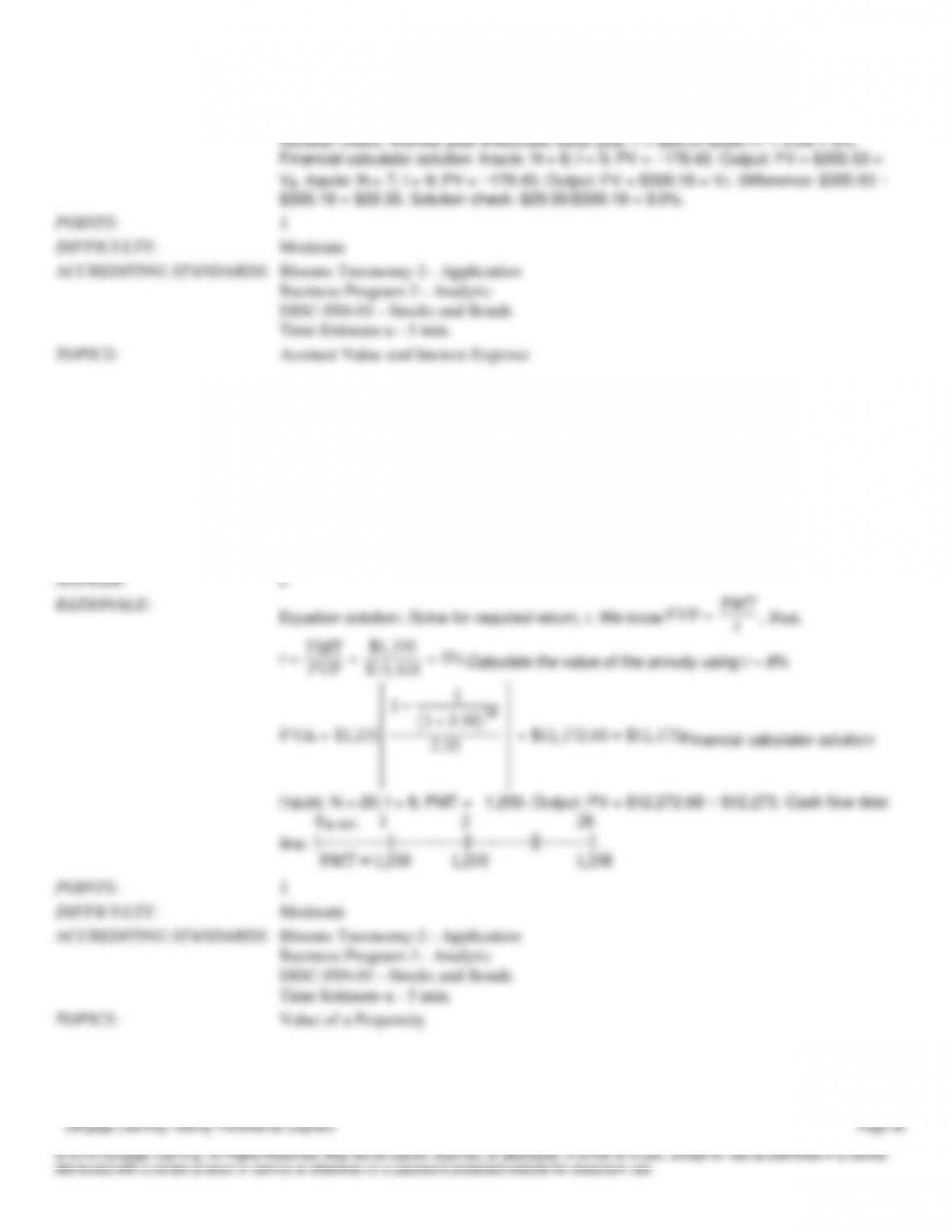
Solution check: Interest year 8/Accrued value year 7 = $29.37/$326.17 = 0.09 = 9%.
Financial calculator solution: Inputs: N = 8; I = 9; PV = −178.43. Output: FV = $355.53 =
V8. Inputs: N = 7; I = 9; PV = −178.43. Output: FV = $326.18 = V7. Difference: $355.53 −
$326.18 = $29.35. Solution check: $29.35/$326.18 = 9.0%.
POINTS:
1
DIFFICULTY:
Moderate
ACCREDITING STANDARDS:
Blooms Taxonomy-2 – Application
Business Program-3 – Analytic
DISC-FIN-01 – Stocks and Bonds
Time Estimate-a – 5 min.
TOPICS:
Accrued Value and Interest Expense
44. You are willing to pay $15,625 to purchase a perpetuity which will pay you and your heirs $1,250 each year, forever.
If your required rate of return does not change, how much would you be willing to pay if this were a 20-year, annual
payment, ordinary annuity instead of a perpetuity?
a.
$10,342
b.
$11,931
c.
$12,273
d.
$13,922
e.
$17,157
ANSWER:
c
RATIONALE:
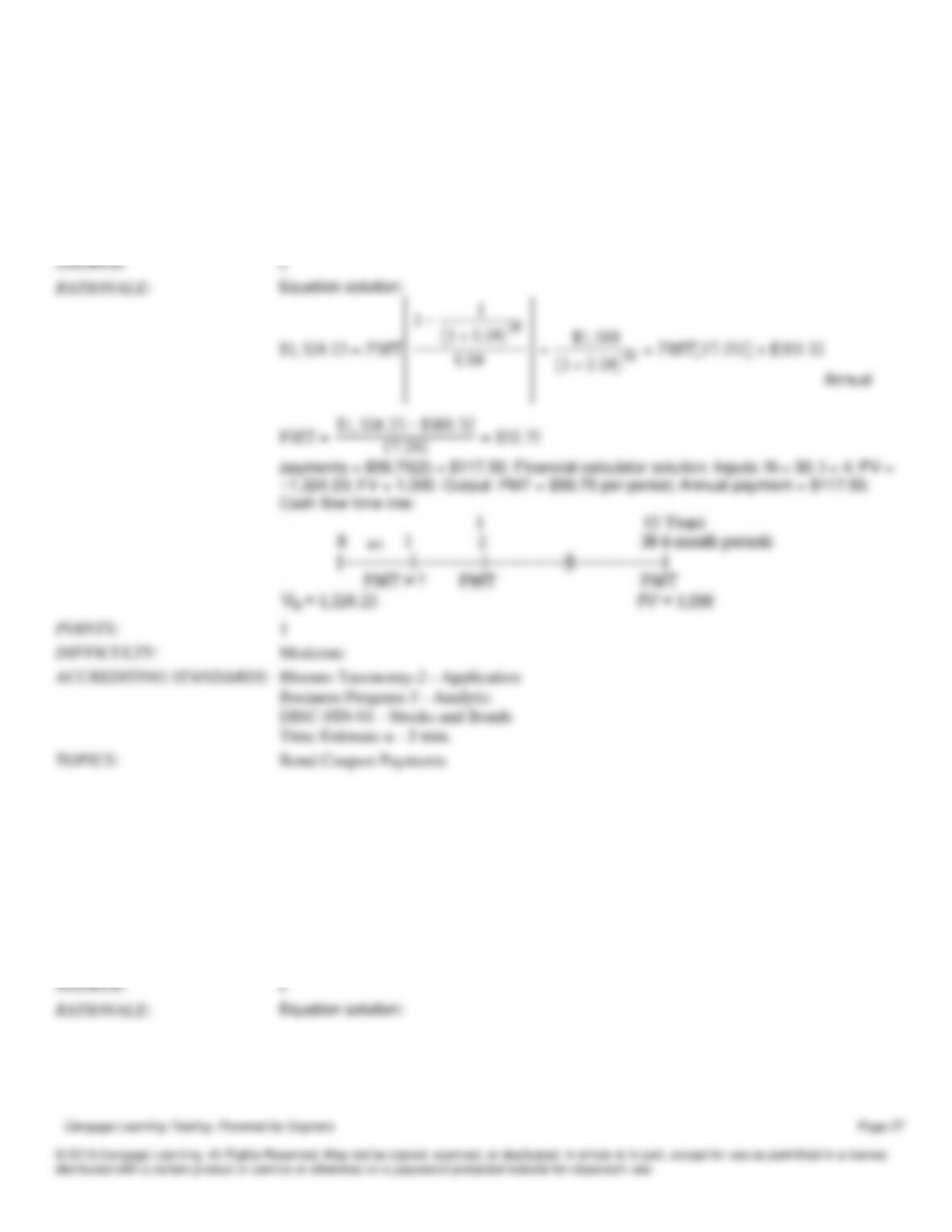
Equation solution: Solve for required return, r. We know , thus,
Calculate the value of the annuity using r = 8%
Financial calculator solution:
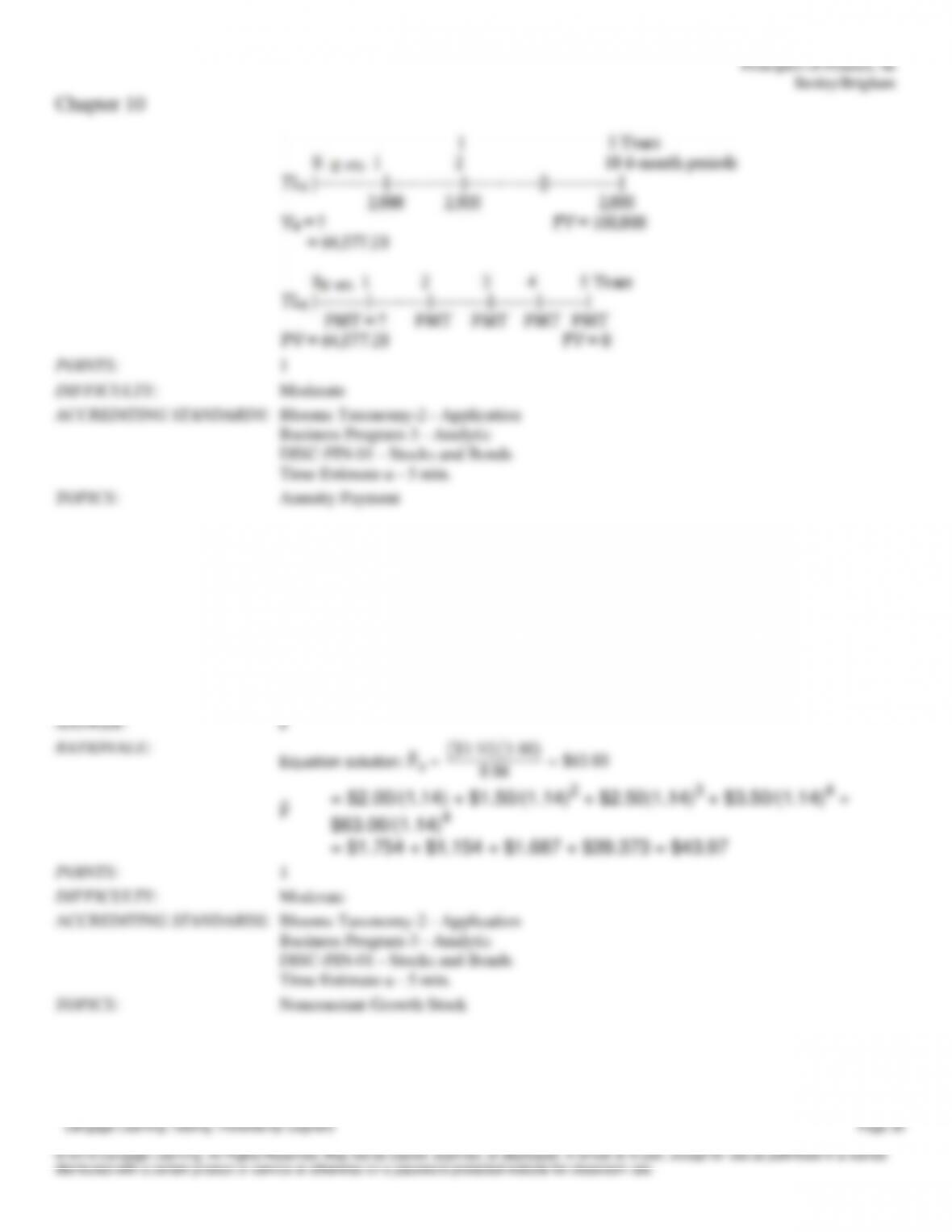
Inputs: N = 20; I = 8; PMT = −1,250. Output: PV = $12,272.68 ≈ $12,273. Cash flow time
line:
POINTS:
1
DIFFICULTY:
Moderate
ACCREDITING STANDARDS:
Blooms Taxonomy-2 – Application
Business Program-3 – Analytic
Principles of Finance, 6e
Besley/Brigham
Chapter 10
c.
4%
d.
2%
e.
0%
ANSWER:
c
RATIONALE:
a.
$64.81
b.
$56.37
c.
$117.50
d.
$132.19
e.
$126.48
ANSWER:
c
RATIONALE:
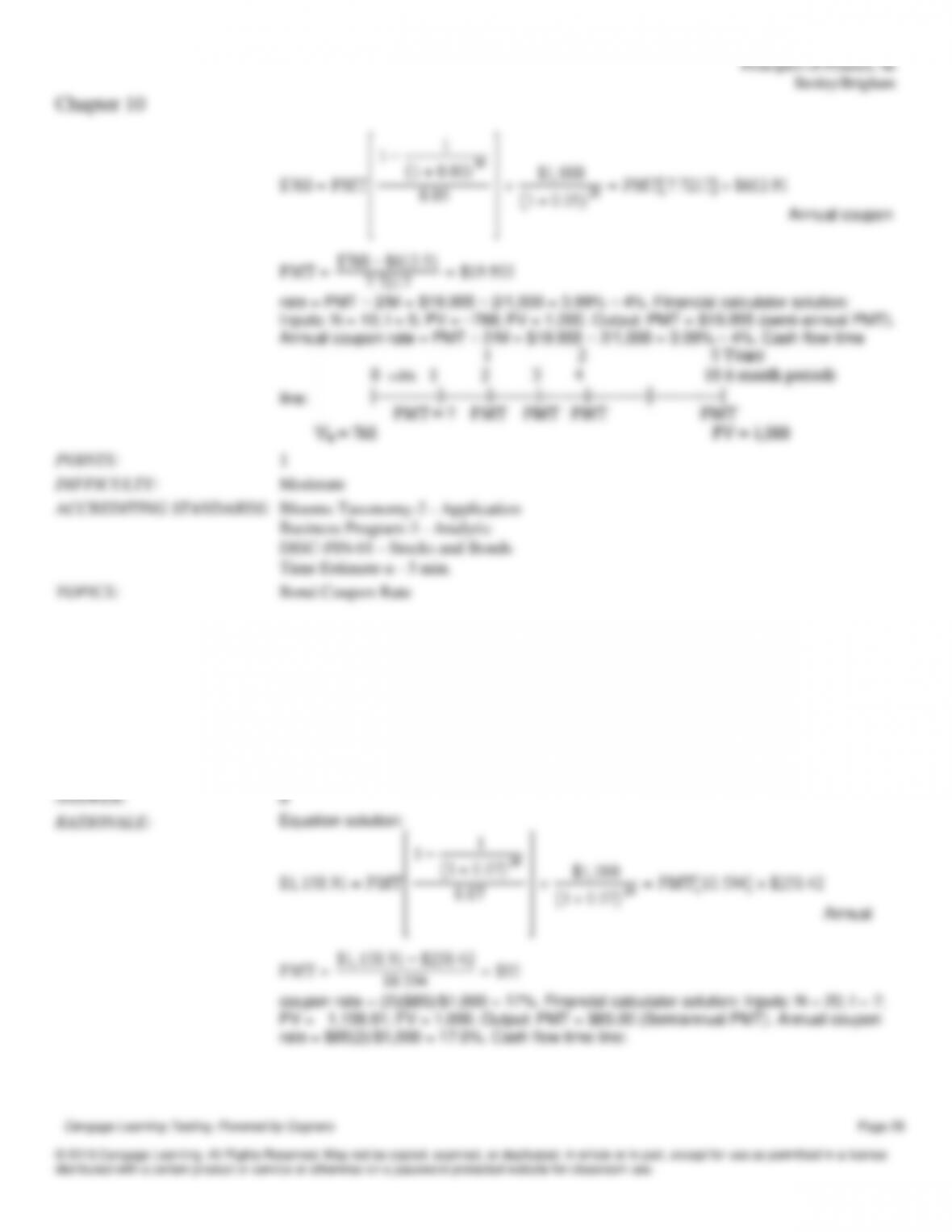
Equation solution:
Annual
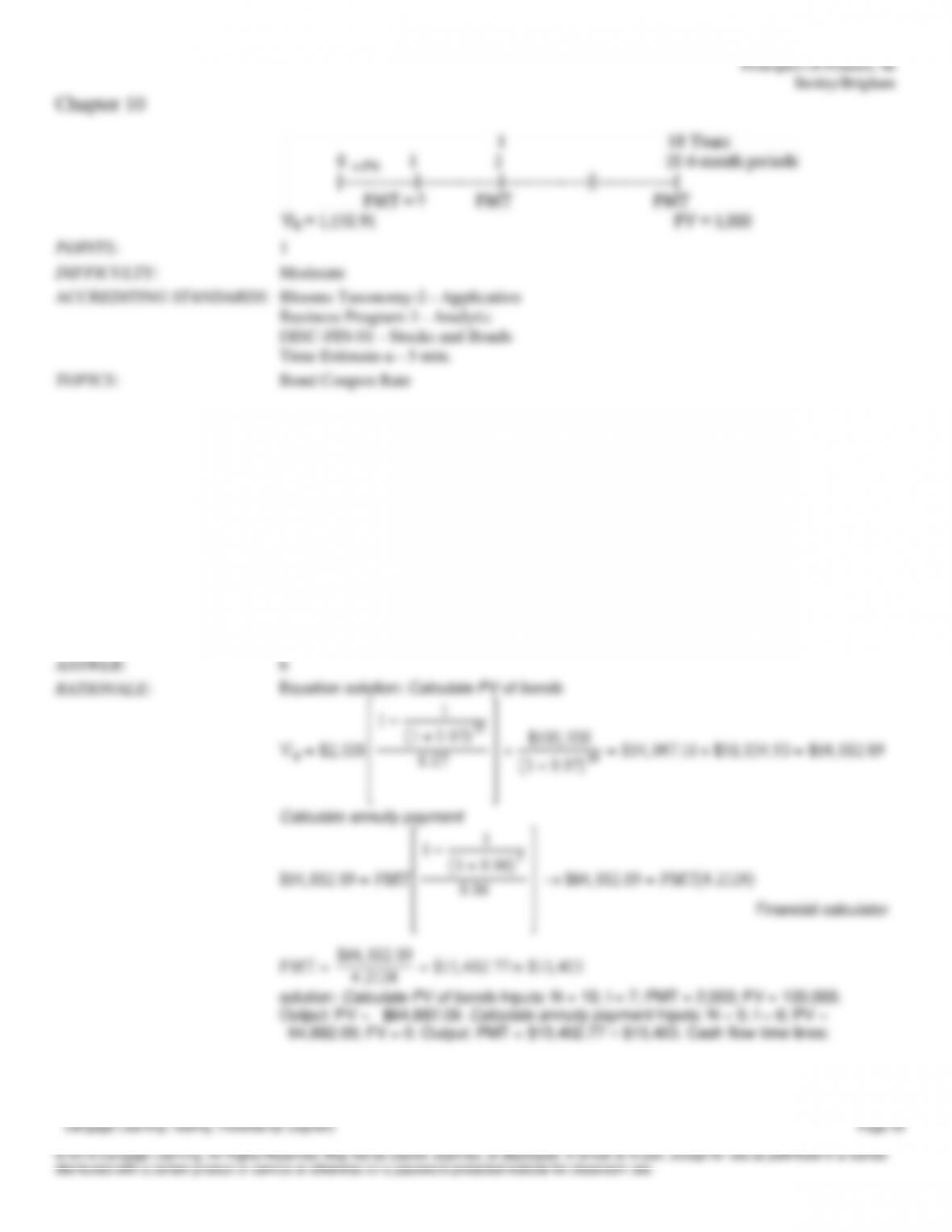
payments = $58.75(2) = $117.50. Financial calculator solution: Inputs: N = 30; I = 4; PV =
−1,324.23; FV = 1,000. Output: PMT = $58.75 per period; Annual payment = $117.50.
Cash flow time line:
POINTS:
1
DIFFICULTY:
Moderate
ACCREDITING STANDARDS:
Blooms Taxonomy-2 – Application
Business Program-3 – Analytic
DISC-FIN-01 – Stocks and Bonds
Time Estimate-a – 5 min.
TOPICS:
Bond Coupon Payments
46. Cold Boxes Ltd. has 100 bonds outstanding (maturity value = $1,000). The required rate of return on these bonds is
currently 10 percent, and interest is paid semiannually. The bonds mature in 5 years, and their current market value is
$768 per bond. What is the annual coupon interest rate?
a.
8%
b.
6%
Principles of Finance, 6e
Besley/Brigham
Chapter 10
percent. What should be the present price per share of Eastern common stock?
a.
$19.26
b.
$31.87
c.
$30.30
d.
$20.83
e.
$19.95
ANSWER:
d
RATIONALE:
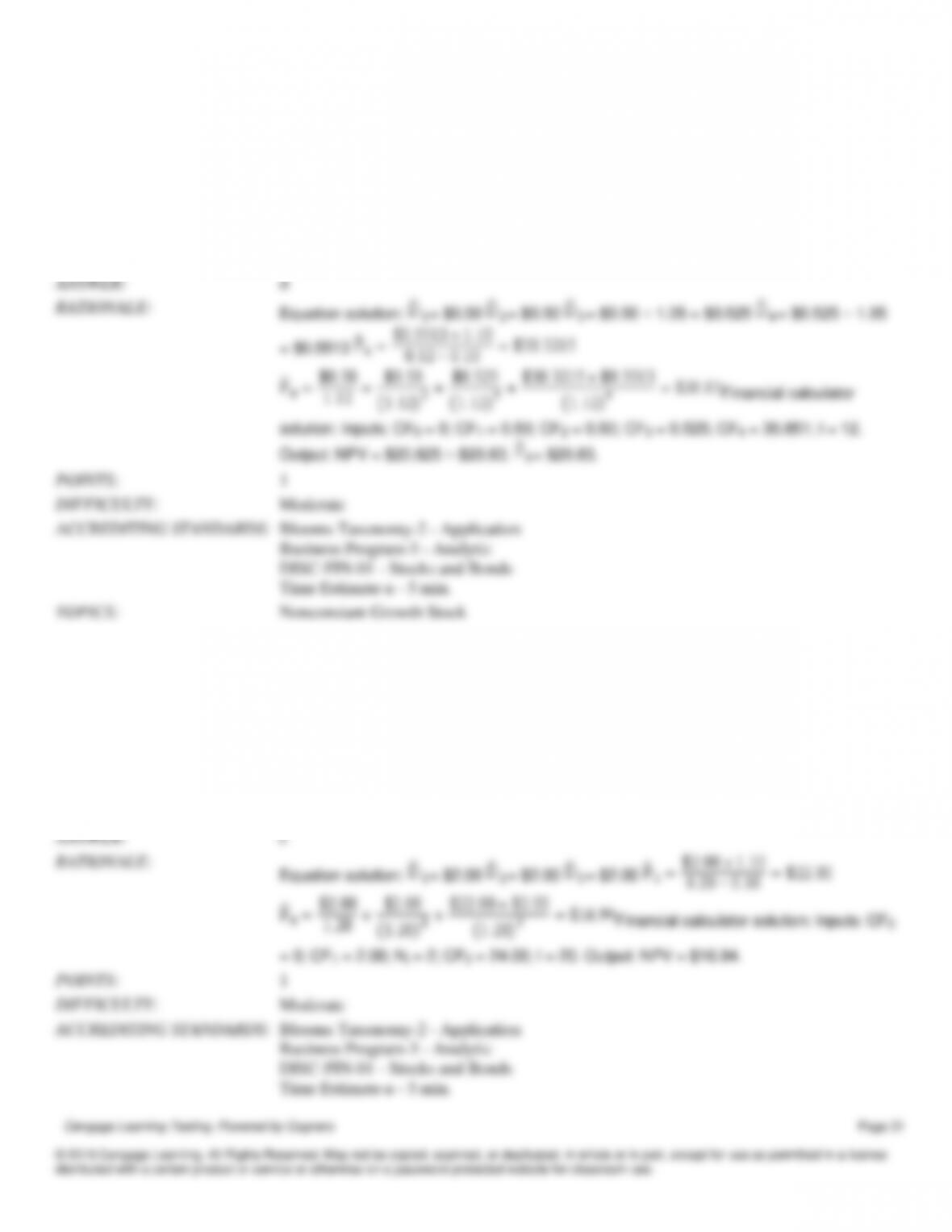
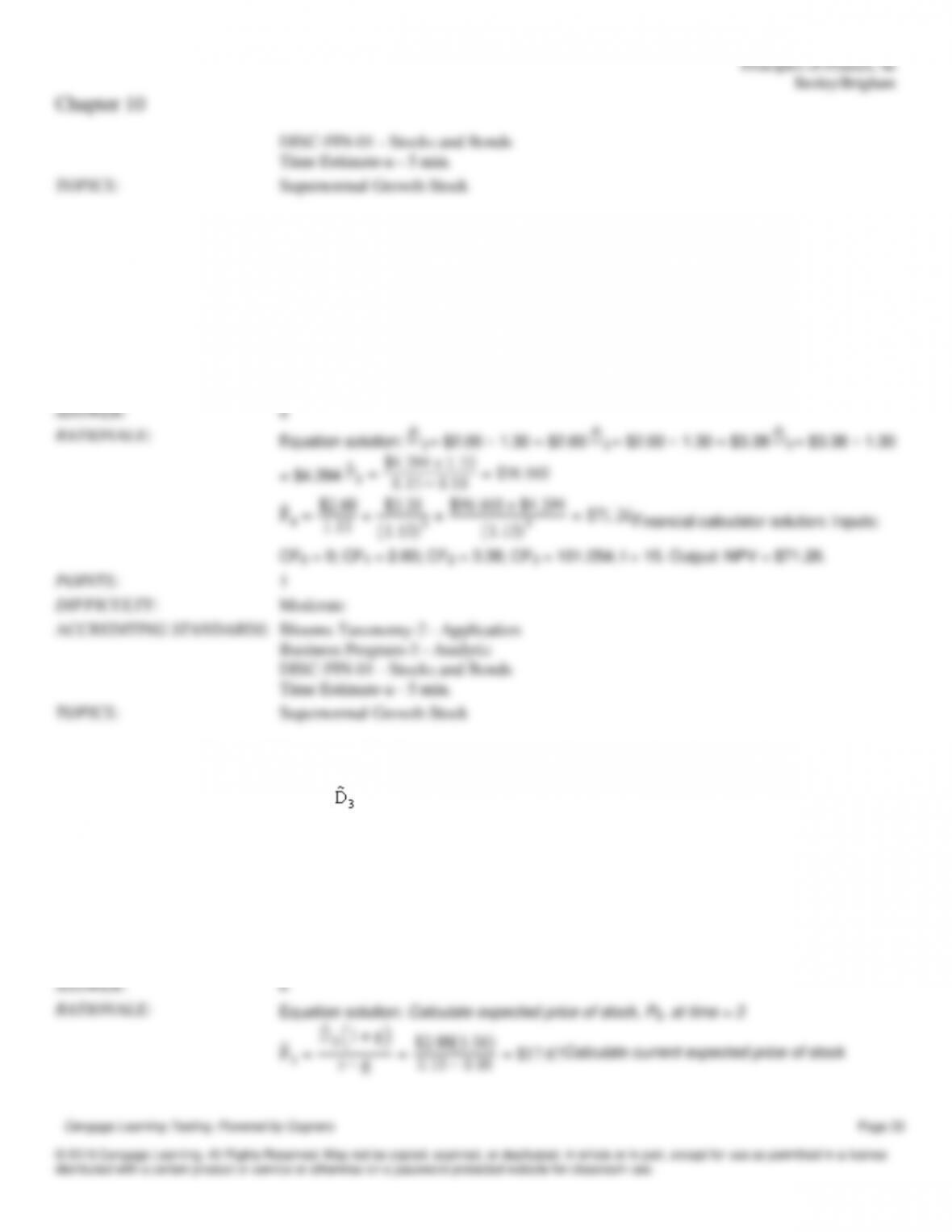
Equation solution: = $0.50 = $0.50 = $0.50 × 1.05 = $0.525 = $0.525 × 1.05
= $0.5513
Financial calculator
solution: Inputs: CF0 = 0; CF1 = 0.50; CF2 = 0.50; CF3 = 0.525; CF4 = 30.851; I = 12.
Output: NPV = $20.825 ≈ $20.83. = $20.83.
POINTS:
1
DIFFICULTY:
Moderate
ACCREDITING STANDARDS:
Blooms Taxonomy-2 – Application
Business Program-3 – Analytic
DISC-FIN-01 – Stocks and Bonds
Time Estimate-a – 5 min.
TOPICS:
Nonconstant Growth Stock
51. Due to unfavorable economic conditions, EFB Company’s earnings and dividends are expected to remain unchanged
for the next 3 years. After 3 years, dividends are expected to grow at a 10 percent annual rate forever. The last dividend
was $2.00, and the required rate of return is 20 percent. What should be the current market value of EFB stock?
a.
$13.46
b.
$14.51
c.
$15.22
d.
$16.03
e.
$16.94
ANSWER:
e
RATIONALE:
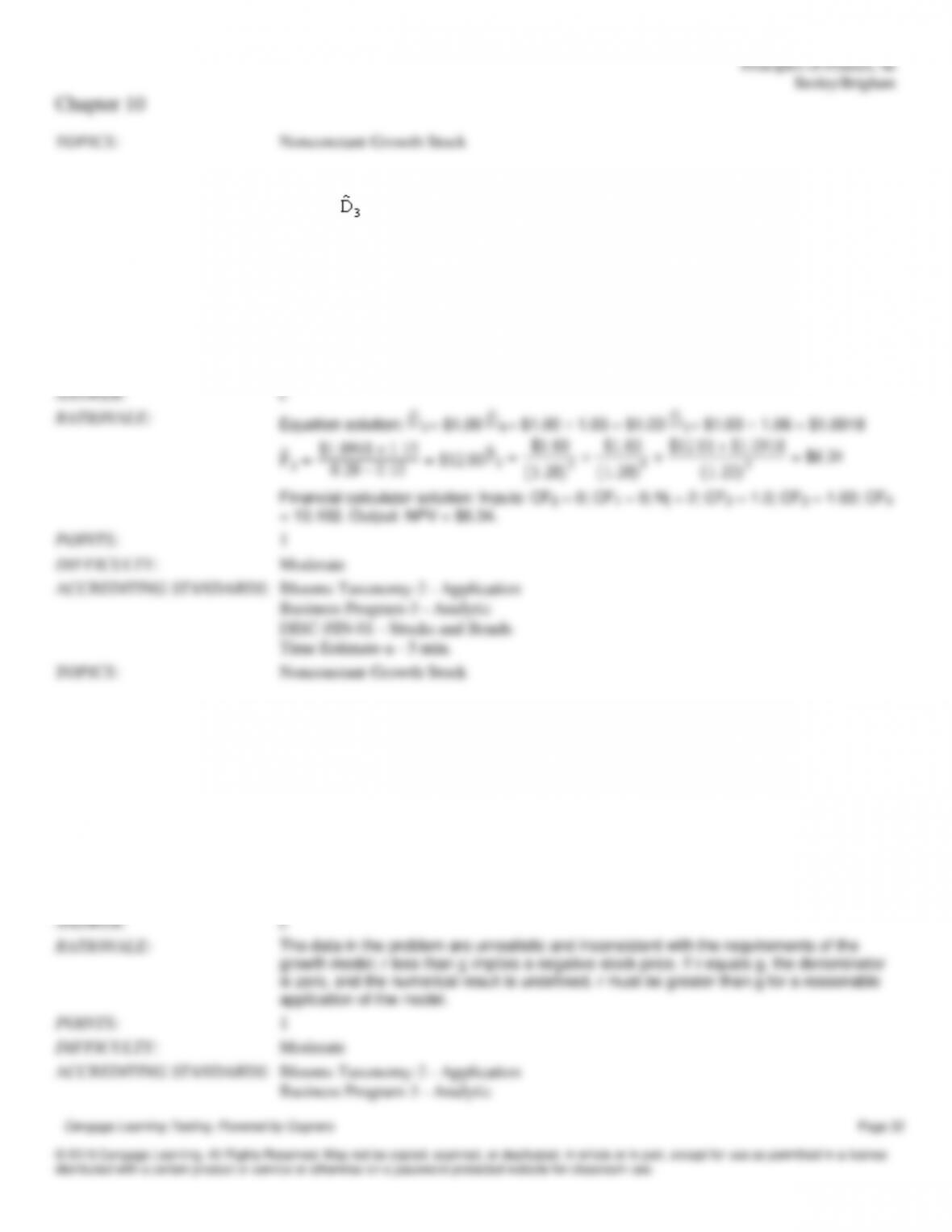
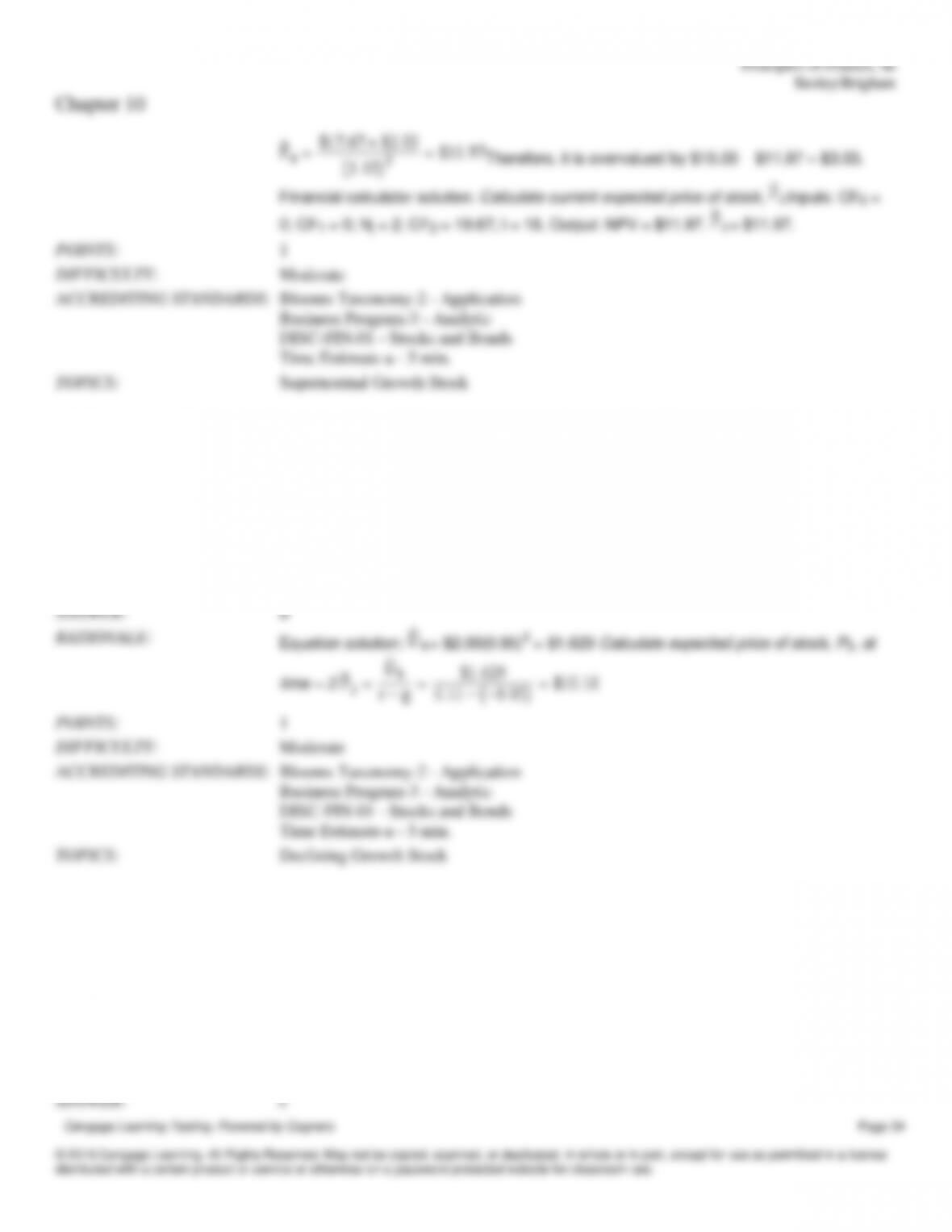
Equation solution: = $2.00 = $2.00 = $2.00
Financial calculator solution: Inputs: CF0
= 0; CF1 = 2.00; Nj = 2; CF2 = 24.00; I = 20. Output: NPV = $16.94.
POINTS:
1
DIFFICULTY:
Moderate
ACCREDITING STANDARDS:
Blooms Taxonomy-2 – Application
Business Program-3 – Analytic
DISC-FIN-01 – Stocks and Bonds
Principles of Finance, 6e
Besley/Brigham
Chapter 10
Blooms Taxonomy-2 – Application
percent and its last dividend, D0, was $2 per share, what should be the current price per share?
a.
$32.66
b.
$47.83
c.
$53.64
d.
$38.47
e.
$42.49
ANSWER:
d
RATIONALE:
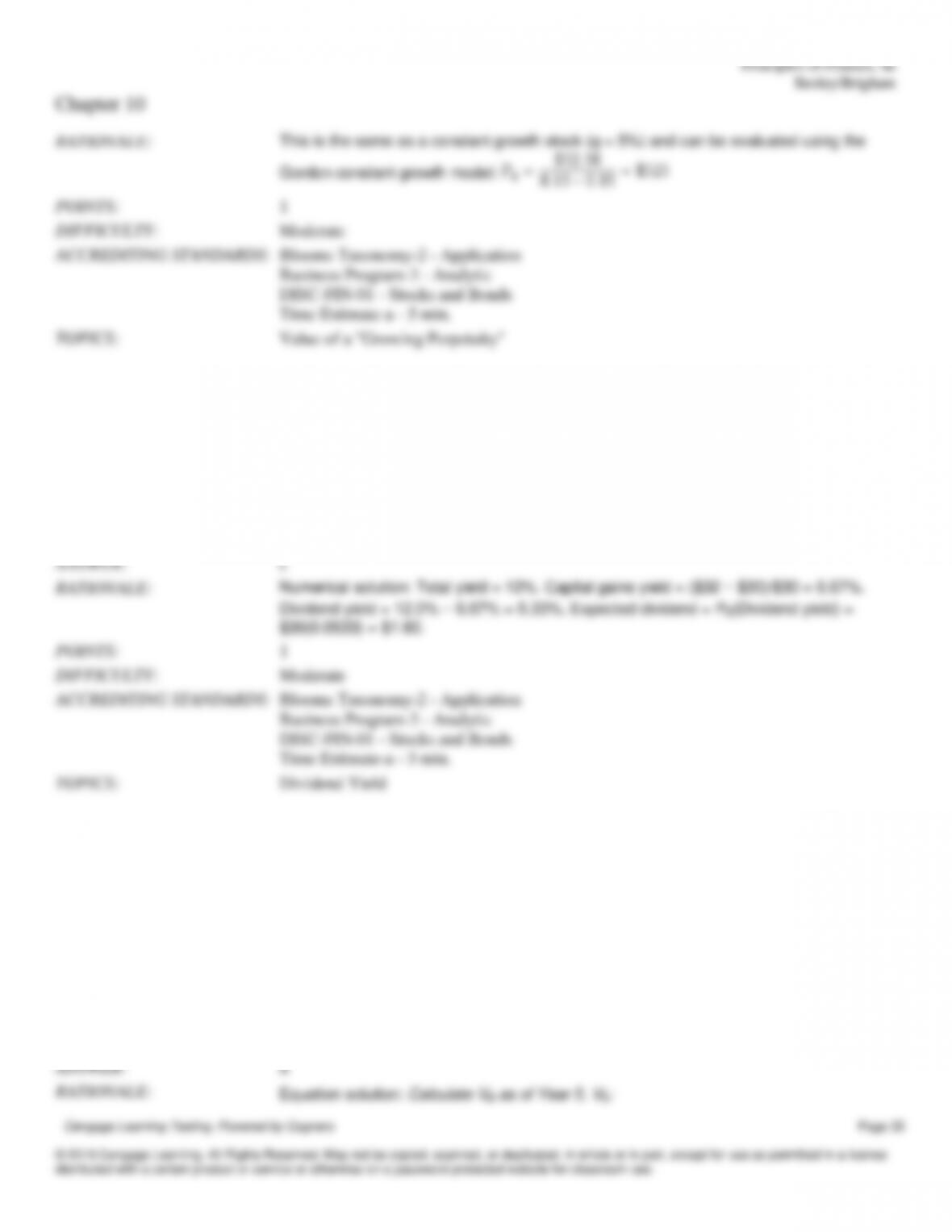
Equation solution: = $2.00 × 0.95 = $1.90 = $1.90 × 0.95 = $1.805 = $1.805
= $1.805
Financial
calculator solution: Inputs: CF0 = 0; CF1 = 1.90; CF2 = 1.805; Nj = 2; CF4 = 49.63; I = 10.
Output: NPV = $38.47.
POINTS:
1
DIFFICULTY:
Hard
ACCREDITING STANDARDS:
Blooms Taxonomy-2 – Application
Business Program-3 – Analytic
DISC-FIN-01 – Stocks and Bonds
Time Estimate-b – 10 min.
TOPICS:
Nonconstant Growth Stock
63. Club Auto Parts’ last dividend, D0, was $0.50, and the company expects to experience no growth for the next 2 years.
However, Club will grow at an annual rate of 5 percent in the third and fourth years, and, beginning with the fifth year, it
should attain a 10 percent growth rate which it will sustain thereafter. Club has a required rate of return of 12 percent.
What should be the price per share of Club stock at the beginning of the third year, ?
a.
$19.98
b.
$25.06
c.
$31.21
d.
$19.48
e.
$27.55
ANSWER:
b
RATIONALE:
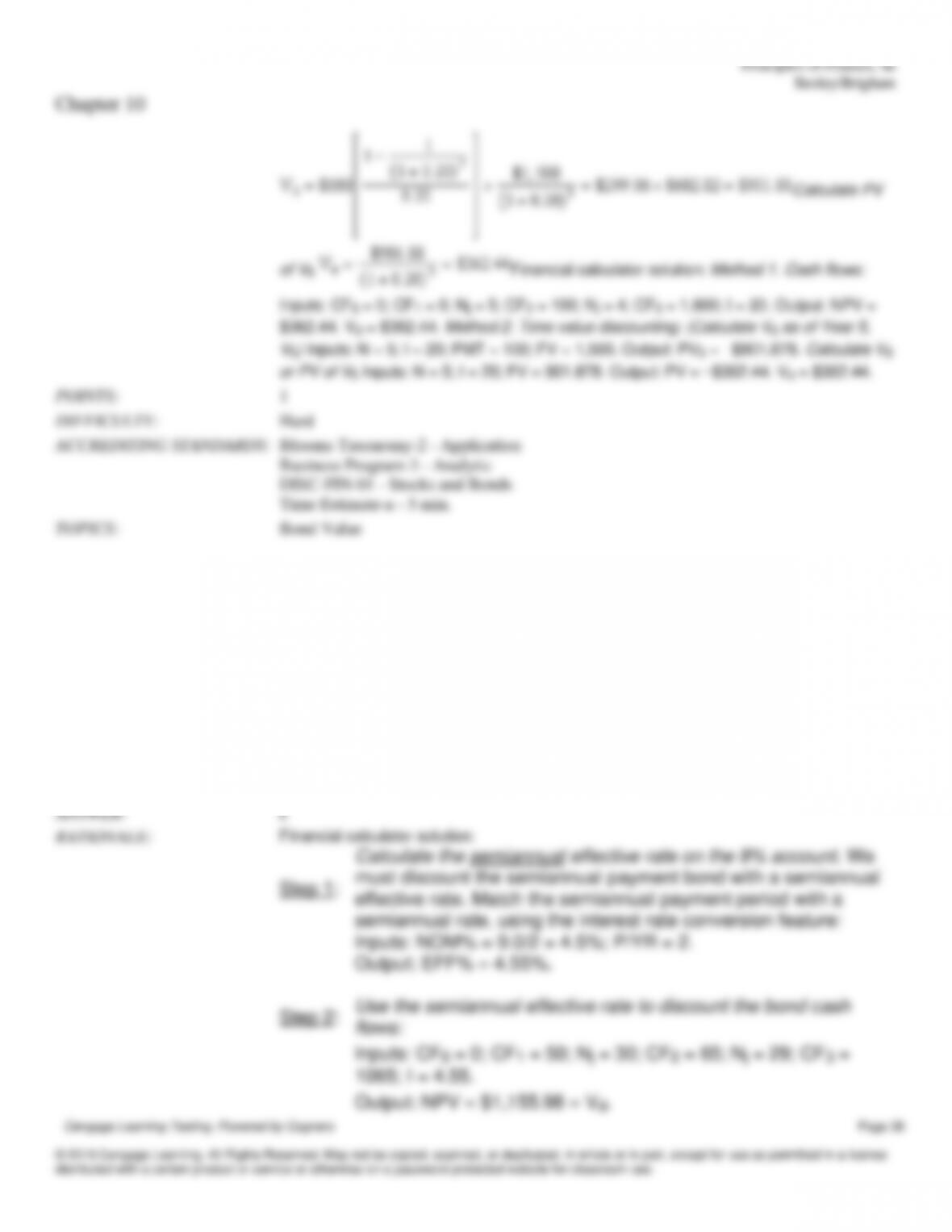
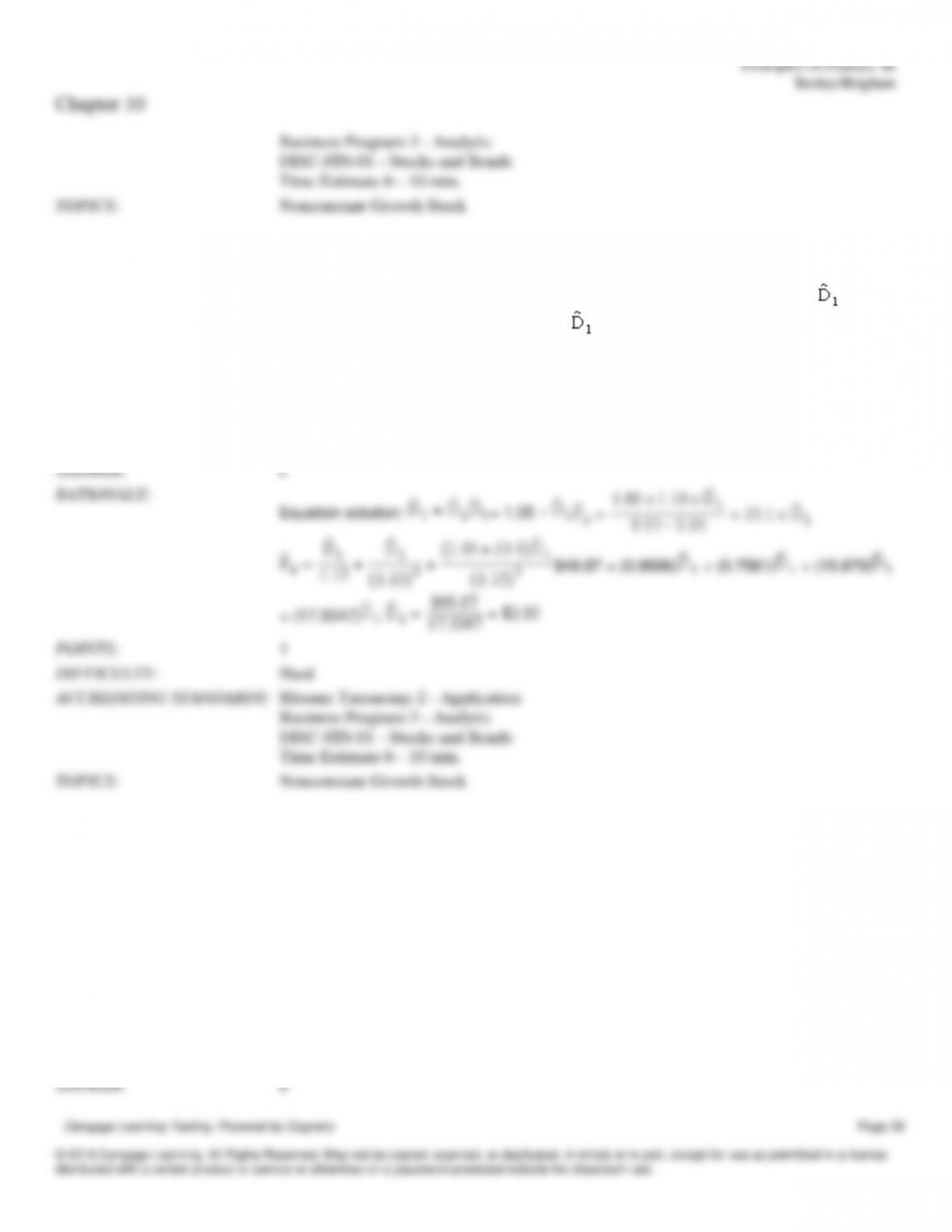
Equation solution: = $0.50 × 1.05 = $0.525 = $0.525 × 1.05 = $0.551
Financial
calculator solution: Calculate the PV of the stock’s expected cash flows as of time = 2,
thus, CF0 = 0; CF1 = 0.525, which is ; CF2 = 30.851, which is actually . Inputs:
CF0 = 0; CF1 = 0.525; CF2 = 30.851; I = 12. Output: NPV = $25.06. = $25.06.
POINTS:
1
DIFFICULTY:
Hard
Principles of Finance, 6e
Besley/Brigham
Chapter 10
Cengage Learning Testing, Powered by Cognero
Page 40
© 2015 Cengage Learning. All Rights Reserved. May not be copied, scanned, or duplicated, in whole or in part, except for use as permitted in a license
RATIONALE:
Equation solution: Short way
Total number of
tickets = $101,852.21/$10.00 = 10,185.22 ≈ 10,186.* *Rounded up to next whole ticket
Note: Short way works only if bond yield = investment rate. Financial calculator solution:
Long way Inputs: N = 20; I = 8; FV = 1,000,000. Output: PMT = −$21,852.21. Add coupon
interest and reserve payment together Annual PMTTotal = $80,000 + $21,852.21 =
$101,852.21. Total number of tickets = $101,852.21/$10.00 = 10,185.22 ≈ 10,186.*
*Rounded up to next whole ticket. Short way Inputs: N = 20; I = 8; PV = 1,000,000; FV =
0. Output: PMT = −$101,852.21. Total number of tickets = $101,852.21/$10.00 ≈ 10,186.*
*Rounded up to next whole ticket. Cash flow time line: (In thousands)
POINTS:
1
DIFFICULTY:
Hard
ACCREDITING STANDARDS:
Blooms Taxonomy-2 – Application
Business Program-3 – Analytic
DISC-FIN-01 – Stocks and Bonds
Time Estimate-b – 10 min.
TOPICS:
Loan Amortization
66. Tony’s Pizzeria plans to issue bonds with a par value of $1,000 and 10 years to maturity. These bonds will pay $45
interest every 6 months. Current market conditions are such that the bonds will be sold to net $937.79. What is the YTM
of the issue as a broker would quote it to an investor?
a.
11%
b.
10%
c.
9%
d.
8%
e.
7%
ANSWER:
b
RATIONALE:
Financial calculator solution: Inputs: N = 20; PV = −937.79; PMT = 45; FV = 1,000.
Output: I = 5.0% per period. rd = YTM = 5.0% × 2 periods = 10%.
POINTS:
1
DIFFICULTY:
Easy