
Name:
Class:
Date:
Chapter 15: Thermoforming
Copyright Cengage Learning. Powered by Cognero.
Page 1
1. A disadvantage of straight vacuum forming is that ____.
a.
high pressures must force the plastics into the mold
b.
formed pieces usually must be trimmed
c.
equipment is costly
d.
processing time is long
ANSWER:
b
2. The main difference between straight vacuum forming and drape forming is that drape forming ____.
a.
is less costly
b.
uses higher pressures
c.
uses a female mold
d.
uses a male mold
ANSWER:
d
3. In what kind of thermoforming is a heated sheet trapped and formed between male and female dies?
a.
matched-mold forming
b.
vacuum forming
c.
drape forming
d.
mechanical forming
ANSWER:
a
4. Which process is most suited to developing a deep thermoformed product?
a.
matched-mold forming
b.
vacuum forming
c.
pressure-bubble plug-assist vacuum forming
d.
mechanical forming
ANSWER:
c
5. A disadvantage of plug-assist vacuum forming is that ____.
a.
it has a long cooling cycle
b.
close temperature control is needed
c.
equipment is costly
d.
processing time is long
ANSWER:
d
6. A process called solid phase pressure forming (SPPF) is most similar to ____.
a.
drape forming
b.
matched-mold forming
c.
plug-assist forming
d.
straight vacuum forming
ANSWER:
c
7. Complex parts with recesses can be formed with ____.
a.
drape forming

Name:
Class:
Date:
Chapter 15: Thermoforming
Copyright Cengage Learning. Powered by Cognero.
Page 2
b.
matched-mold forming
c.
plug-assist forming
d.
straight vacuum forming
ANSWER:
c
8. Complex parts with recesses can be formed with ____.
a.
drape forming
b.
matched-mold forming
c.
plug-assist forming
d.
vacuum snap-back forming
ANSWER:
d
9. Flaws or marks left on the finished product from the mold are called ____.
a.
markoff
b.
thinning
c.
extrusions
d.
stretch marks
ANSWER:
a
10. A possible remedy for markoff in the production process is to ____.
a.
increase chilling time
b.
add vacuum holes
c.
check the vacuum system
d.
clean the mold
ANSWER:
d
11. Skylight panels and aircraft canopies are made by ____.
a.
twin sheet thermoforming
b.
air-slip forming
c.
mechanical forming
d.
free forming
ANSWER:
d
12. Ductwork, pallets, and plastics cases are formed by ____.
a.
twin sheet thermoforming
b.
air-slip forming
c.
mechanical forming
d.
free forming
ANSWER:
a
13. Air-slip forming is similar to ____ with the exception of the method used for creating the stretch bubble.
a.
twin sheet thermoforming
b.
mechanical forming
c.
snap-back forming
Name:
Class:
Date:
Chapter 15: Thermoforming
Copyright Cengage Learning. Powered by Cognero.
Page 3
d.
free forming
ANSWER:
c
14. In____, air pressures of over 2.7 MPa may be used to blow a hot plastics sheet through the silhouette of a female
mold.
a.
snap-back forming
b.
twin sheet thermoforming
c.
free forming
d.
mechanical forming
ANSWER:
c
15. Which method is used to make thin-wall hollow products?
a.
snap-back forming
b.
free forming
c.
mechanical forming
d.
twin sheet thermoforming
ANSWER:
d
16. In ____, no vacuum or air pressure is used to form the part. Only the force of bending, stretching, or holding the hot
sheet is used.
a.
vacuum forming
b.
free forming
c.
mechanical forming
d.
drape forming
ANSWER:
c
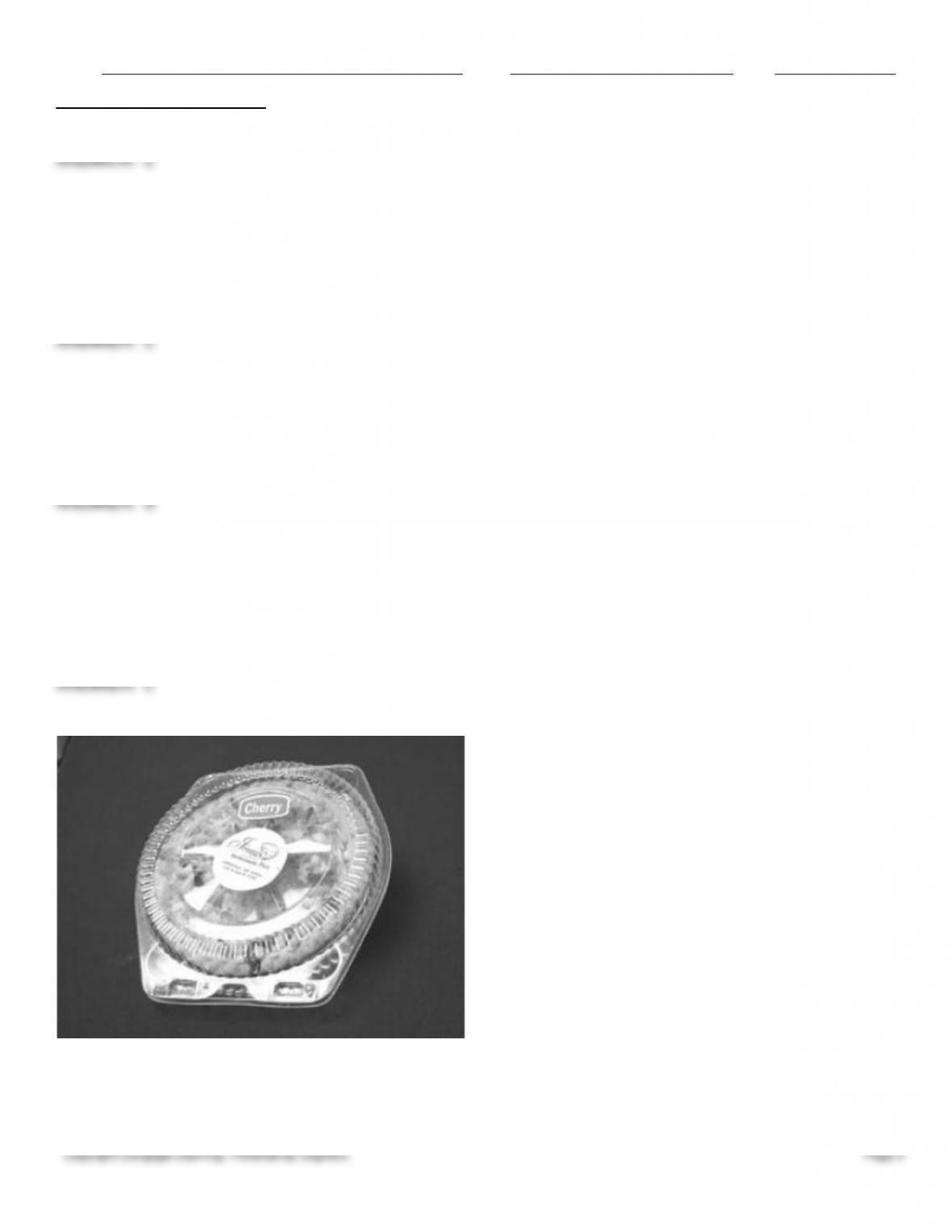
17. This image shows an example of a product made by ____.
a.
vacuum forming
b.
free forming
c.
mechanical forming
d.
drape forming

Name:
Class:
Date:
Chapter 15: Thermoforming
Copyright Cengage Learning. Powered by Cognero.
Page 4
ANSWER:
a
18. In ____, the sheet is heated and then stretched by air pressure, which allows deep drawing and the formation of
complex parts.
a.
vacuum forming
b.
free forming
c.
mechanical forming
d.
pressure-bubble vacuum snap-back forming
ANSWER:
d
19. This process is like straight vacuum forming except air pressure and a vacuum assist may be used to force the hot
plastics into a female mold.
a.
free forming
b.
trapped-sheet contact-heat pressure forming
c.
mechanical forming
d.
pressure-bubble vacuum snap-back forming
ANSWER:
b
20. This image shows an acrylic bubble-formed side window for a helicopter. What is most likely to have formed this
product?
a.
free forming
b.
trapped-sheet contact-heat pressure forming
c.
mechanical forming
d.
pressure-bubble vacuum snap-back forming
ANSWER:
a