52) Modigliani and Associates has forecasted the following payoffs from a project:
Outcome
Probability of
Outcome
Assumptions
$
0
20%
pessimistic
$
3,500
60%
moderately successful
$
6,000
20%
optimistic
What is the expected value of the outcomes?
A) $0
B) $3,300
C) $3,700
D) Cannot be determined. Depends upon which prediction is correct.
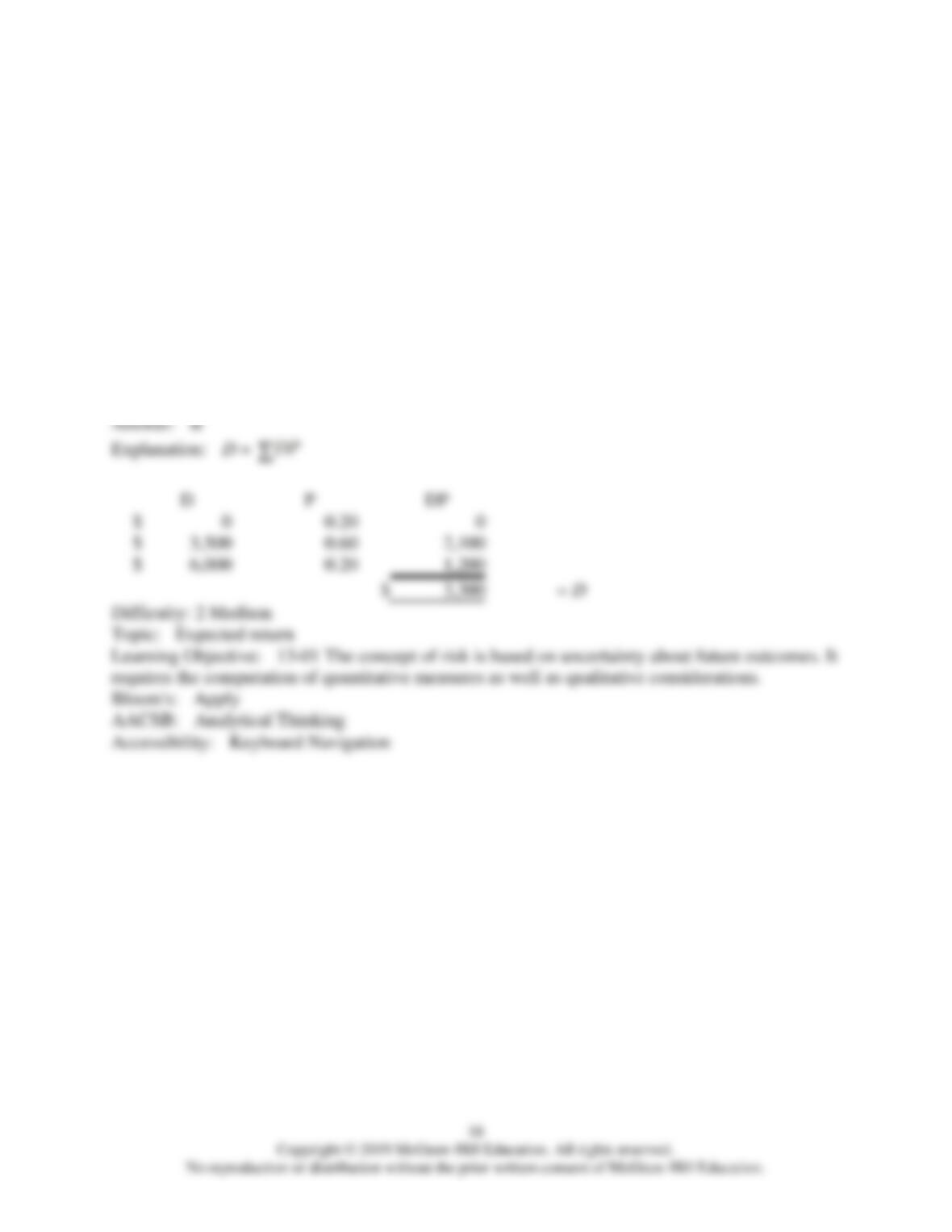
D
P
DP
$
0
0.20
0
$
3,500
0.60
2,100
$
6,000
0.20
1,200
$
3,300
= D
Difficulty: 2 Medium
Topic: Expected return
Learning Objective: 13-01 The concept of risk is based on uncertainty about future outcomes. It
requires the computation of quantitative measures as well as qualitative considerations.
Bloom’s: Apply
AACSB: Analytical Thinking
Accessibility: Keyboard Navigation

53) Buchanan Corp. forecasts the following payoffs from a project:
Outcome
Probability of
Outcome
Assumptions
$
2,000
40%
pessimistic
$
4,000
60%
moderately successful
$
6,000
30%
optimistic
What is the expected value of the outcomes?
A) $5,000
B) $4,000
C) $5,300
D) The forecast is incorrect and must be modified before finding the expected value.
54) The coefficient of variation (V) can be defined as the
A) expected value multiplied by the standard deviation.
B) standard deviation divided by the mean (expected value).
C) mean (expected value) divided by the standard deviation.
D) standard deviation squared, divided by the expected value.
55) If three investment alternatives all have some degree of risk and different expected returns,
which of the following measures could best be used to rank the risk levels of the projects?
A) The coefficient of correlation
B) The coefficient of variation
C) The standard deviation of returns
D) The net present value
56) In determining the appropriate discount rate for an individual project, the financial manager
will be most influenced by the
A) expected value.
B) internal rate of return.
C) standard deviation.
D) coefficient of variation.
57) Which of the following is a characteristic of beta?
A) Beta measures only the volatility of returns on an individual bond relative to a bond market
index.
B) A beta of 1.0 has zero risk.
C) A beta of less than 1.0 has less risk than the market.
D) A beta is always equal to 1.0.
58) A project’s coefficient of variation is 0.55. The project has a positive coefficient of
correlation of 0.20. The expected value is $1,200. What is the standard deviation?
A) $400
B) $220
C) $660
D) $1,200

59) Which investment has the least amount of risk?
A) Standard deviation = $450, expected return = $4,500
B) Standard deviation = $600, expected return = $400
C) Standard deviation = $500, expected return = $800
D) Standard deviation = $400, expected return = $5,000
60) A project’s cash flows have a beta of 1.2, a standard deviation of $340, and a coefficient of
variation of 0.40. What is the expected cash flow?
A) $850
B) $167
C) $2,400
D) $500
61) Which investment has the least amount of risk?
A) Coefficient of variation = 8%, expected return = $800
B) Coefficient of variation = 8%, standard deviation = $200
C) Standard deviation = $300, expected return = $5,000
D) Standard deviation = $100, expected return = $80

62) Risk may be integrated into capital budgeting decisions by
A) adjusting the standard deviation of possible outcomes.
B) determining the expected value.
C) adjusting the discount rate.
D) adjusting the time horizon.
63) The firm’s highest risk-adjusted discount should be applied to
A) the repair of old machinery.
B) a new product in a related field.
C) a new product in a foreign market.
D) the purchase of new equipment.

64) Using the risk-adjusted discount rate approach, projects with high coefficients of variation
will have ________ net present values than projects with low coefficients of variation and
similar cash flows.
A) somewhat higher
B) substantially higher
C) lower
D) either somewhat higher or substantially higher
65) Using the risk-adjusted discount rate approach, the firm’s weighted average cost of capital is
applied to projects with
A) no risk.
B) low risk.
C) normal risk.
D) high risk.

66) In order to evaluate risk, management may also set qualitative risk classes. Rank these four
projects from least risky to most risky, all other things being equal.
1. Completely new market in United States.
2. Completely new market in South America.
3. Addition to normal product line.
4. Repair to old machinery.
A) 4, 3, 1, 2
B) 1, 2, 3, 4
C) 3, 4, 1, 2
D) 4, 3, 2, 1
67) Place the following investment decisions in order from the lowest risk to the highest risk:
(a) purchase of replacement machinery
(b) new product in a foreign market
(c) new product in the local market
(d) repair of existing machinery
A) b, c, a, d
B) d, a, b, c
C) d, b, a, c
D) d, a, c, b

68) A “what if” simulation using a computer helps to
A) reduce the risk associated with a particular investment.
B) determine the effects of changes in certain variables.
C) increase the accuracy of the inputs.
D) make data entry more complicated.
69) Simulation models allow the planner to
A) reduce the standard deviations of projects.
B) plan ahead for all possible changes in each variable.
C) deal with the uncertainty of investment risk.
D) test possible changes in each variable and deal with the uncertainty in forecasting outcomes.
70) Which of the following is a common approach in dealing with uncertainty?
A) A Monte Carlo simulation
B) An internal rate of return
C) The net present value
D) Beta

71) A Monte Carlo simulation model uses
A) random variables as inputs.
B) a point estimate.
C) the cost of capital.
D) portfolio risk.
72) A tool that helps to organize the decision process by presenting a graphical comparison of
investment choices is called a
A) module hierarchy diagram.
B) “what if” simulation.
C) decision tree.
D) None of these options are correct.
73) Which ways can a decision tree be presented to help lay out the sequence of decisions that
can be made?
A) Tabular
B) Graphical
C) A and B
D) None of these options are correct.

74) The “portfolio effect” in capital budgeting refers to
A) the relationship of stocks to bonds.
B) the degree of correlation between various investments.
C) the coefficient of variation.
D) the risk-adjusted discount rate.
75) An example of negative correlation may exist between the
A) forest products and housing industries.
B) jewelry and discount furniture industries.
C) steel and aluminum industries.
D) oil and auto industries.
76) A correlation coefficient of zero indicates
A) the projects have the same expected value.
B) there is no correlation and no risk reduction when the projects are combined.
C) there is no correlation, but there is some risk reduction when the projects are combined.
D) the projects have the same standard deviation.

77) In order to reduce risk in a firm, the firm would seek to enter a business that
A) has a high positive correlation with its present business.
B) has a zero correlation with its present business.
C) has a high negative correlation with its present business.
D) has a high negative variation with its present business.
78) The lower the coefficient of correlation, the greater the
A) risk when projects are combined.
B) risk reduction when projects are combined.
C) return when projects are combined.
D) standard deviation when projects are combined.
79) The coefficient of correlation
A) takes on values anywhere from 0 to +1.
B) takes on values anywhere from −1 to 0.
C) takes on values anywhere from −1 to +1.
D) takes on values of 0 or larger.

80) Portfolio risk is evaluated differently than individual project risk. In evaluating portfolio risk,
we
A) need to consider the impact of a given project on the overall risk of the firm.
B) recognize that a risky investment may create a portfolio with less risk.
C) need to consider how the returns of the projects in the portfolio are correlated.
D) all of these options are true.
81) Projects that are negatively correlated
A) reduce the standard deviation of returns for the firm.
B) increase the possible losses of the firm.
C) are generally in the same industry.
D) none of these options are correct.
82) A correlation coefficient of ________ provides no risk reduction.
A) 0
B) −1
C) +1
D) +0.5
83) A correlation coefficient of ________ provides the greatest risk reduction.
A) 0
B) −1
C) +1
D) +0.5
84) Projects that are totally uncorrelated provide
A) no risk reduction.
B) some risk reduction.
C) extreme risk reduction.
D) risk has nothing to do with correlation.
85) A correlation coefficient of ________ provides the greatest possible risk reduction to the
firm.
A) −2
B) −1
C) 0
D) +1

86) A project that carries a normal amount of risk and does not affect the risk exposure of the
firm should be discounted back at the
A) coefficient of variation.
B) beta.
C) risk-free rate.
D) firm’s weighted average cost of capital.
87) The “efficient frontier” indicates
A) alternatives with neutral combinations of risk and return.
B) alternatives with the highest returns.
C) alternatives with the best combination of risk and return.
D) alternatives with no risk.
88) All of the following are methods of evaluating the risk of a project EXCEPT
A) The net present value profile
B) A Monte Carlo simulation
C) Decision trees
D) The coefficient of variation

89) When considering the efficient frontier, financial managers should adhere to all of the
following guidelines EXCEPT
A) Select the projects on the leftmost and uppermost sector of the possible projects.
B) Prefer the project on the far right side of the efficient frontier because it offers the highest
return.
C) Maximize return for a given level of risk.
D) Minimize risk for a given level of return.
90) Which of the following combinations of investments would provide the firm with the highest
negative correlation?
A) Fabric firm and retail firm
B) Telecommunications firm and Internet firm
C) Soft drink manufacturer and health care firm
D) Airline company and gasoline manufacturer