Chapter 20 Test Bank
Multiple Choice Questions
1. Government regulatory bodies
A. include the FDA and USDA
B. have increased consumer satisfaction with counterfeit goods
C. ensure the safety of counterfeit consumer goods
D. require manufacturers of branded goods to reimburse consumers who find they have gotten a counterfeit version
E. All of these choices are correct.
2. Which of the following statements is false regarding marketing practices?
A. Marketing practices are sometimes controversial.
B. Regulating marketing activities requires a higher level of understanding of consumer behavior than does
managing marketing programs.
C. There are many issues where the appropriate ethical action for marketers is not clear-cut.
D. Society has declared that some marketing actions are clearly inappropriate.
E. There are laws and regulations that prohibit or require specific marketing actions.
3. The regulation of marketing activities aimed at children focuses primarily on which of the following?
A. product safety
B. advertising
C. promotion
D. privacy protection
E. All of these choices are correct.
4. One basis for the concern over marketing to children is based on
A. attribution theory.
B. Piaget’s stages of cognitive development.
C. the multiattribute model of cognitive development.
D. dissonance theory.
E. mental development theory.
5. The food industry has responded to concerns regarding children’s health by
A. providing healthier meal options for kids.
B. removing diet sodas and replacing them with diet and other healthier drinks on menus.
C. committing to advertising healthy dietary choices to children under 12.
D. providing healthier meal options for kids. and removing diet sodas and replacing them with diet and other
healthier drinks on menus.
E. All of these choices are correct.
20-3
Copyright © 2019 McGraw-Hill Education. All rights reserved. No reproduction or distribution without the prior written consent
of McGraw-Hill Education.
AACSB: Analytical Thinking
Accessibility: Keyboard Navigation
Blooms: Remember
Difficulty: Moderate
Gradable: automatic
Learning Objective: 20-01 Explain the two major concerns in marketing to children that CARU deals with.
Topic: Marketing Regulation and Consumer Behavior
6. According to Piaget’s stages of cognitive development, children lack the ability to fully process and understand
information, including marketing messages, until around age
A. 5.
B. 8.
C. 10.
D. 12.
E. 15.
7. What is the oldest age of a child that most regulation attempts to protect with respect to marketing practices?
A. 2
B. 5
C. 8
D. 10
E. 12
8. Conor is 15 years old. Which of the following statements is true regarding him and other children his age?
A. He most likely still lacks the ability to fully process and understand information, including marketing messages.
B. Most marketing programs aimed at him deliberately attempt to exploit him.
C. He most likely has the ability to fully process and understand information, including marketing messages.
D. While he has the ability to process information, he does not yet have the ability to understand the information.
E. Most regulation regarding marketing to children includes him.
9. Which of the following is the American advertising industry’s primary self-regulatory body?
A. Federal Trade Commission
B. National Advertising Division of the Council of Better Business Bureaus
C. Food and Drug Administration
D. Congress
E. media
10. Which of the following is a special unit of the National Advertising Division of the Council of Better Business
Bureaus that specifically reviews advertising aimed at children?
A. Children’s Advertising Review Unit (CARU)
B. National Advertising Review Board (NARB)
C. National Children’s Advertising Division (NCAD)
D. National Children’s Advertising Review Board (NCARB)
E. Federal Trade Commission (FTC)
20-5
Copyright © 2019 McGraw-Hill Education. All rights reserved. No reproduction or distribution without the prior written consent
of McGraw-Hill Education.
AACSB: Analytical Thinking
Accessibility: Keyboard Navigation
Blooms: Remember
Difficulty: Moderate
Gradable: automatic
Learning Objective: 20-01 Explain the two major concerns in marketing to children that CARU deals with.
Topic: Concerns about the Ability of Children to Comprehend Commercial Messages
11. Margaret wants to complain about an advertisement targeting children that she saw on a program her children
were watching. Which self-regulatory organization should she contact?
A. Children’s Advertising Review Unit (CARU)
B. National Advertising Review Board (NARB)
C. National Children’s Advertising Division (NCAD)
D. National Children’s Advertising Review Board (NCARB)
E. Federal Trade Commission (FTC)
12. How many of the CARU’s general guiding principles relate to a child’s ability to comprehend commercial
messages?
A. one
B. four
C. five
D. six
E. All of these choices are correct.
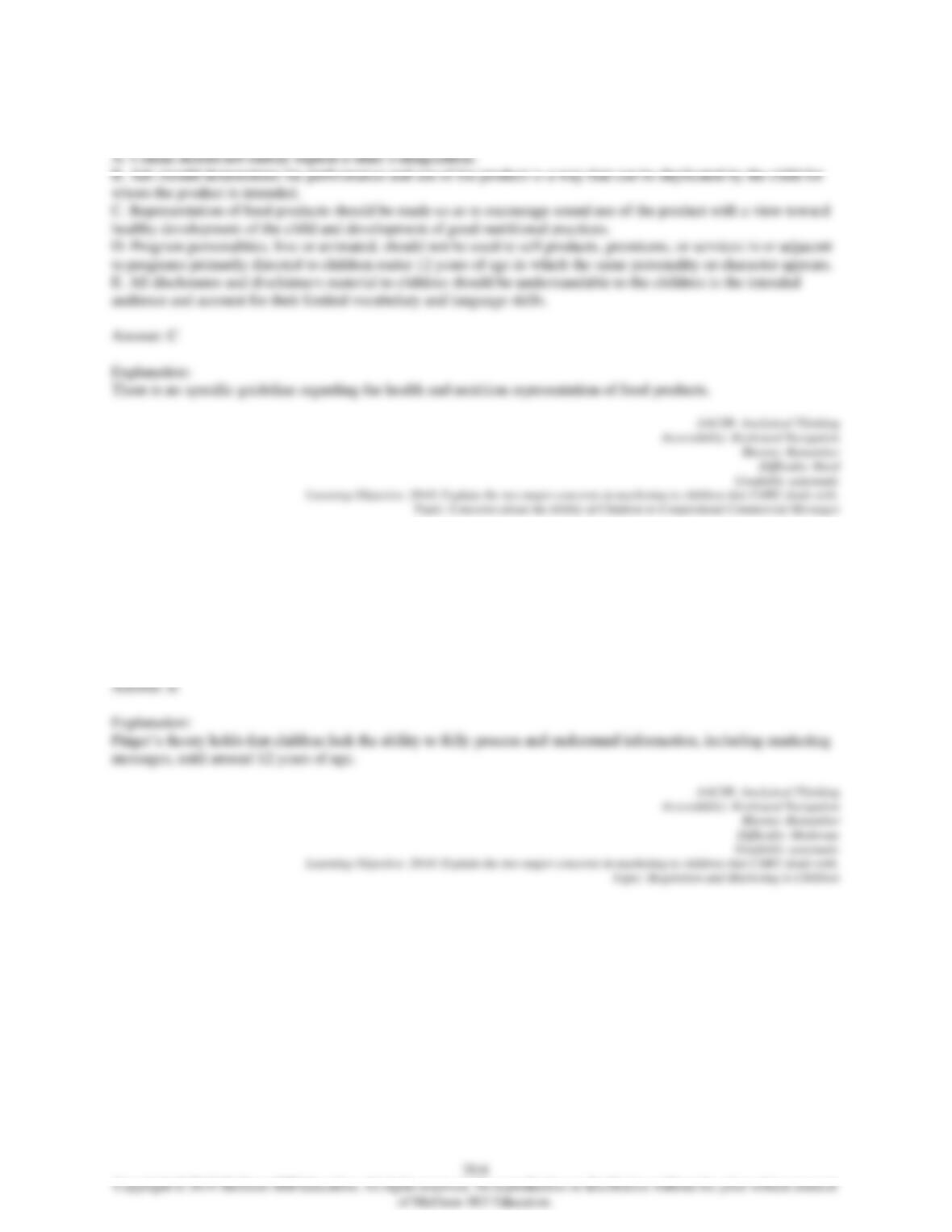
13. Which of the following is not an information-processing related guideline of the CARU?
14. Piaget’s theory of cognitive development holds that
A. children must be taught how to be consumers.
B. marketing stimuli play a critical role in child socialization.
C. intellectual capabilities can continue to expand throughout the lifecycle.
D. intellectual capabilities continue to expand until late middle age.
E. None of these choices are correct.
15. When Rose Art Industries changed its packaging due to concerns that size of the product relative to the size of
the child shown on the package picture could lead a child to believe that the Super Lite toy was larger than it was,
this is related to
A. CARU’s guidelines linked to possible information-processing deficits of children
B. CARU’s guidelines linked to concerns about the health/safety/value effects of commercial messages on children.
C. COPPA’s guidelines regarding processing deficits of children.
D. All of these choices are correct.
E. None of these choices are correct.
16. CARU and others are interested in the impact that the __________ of children’s advertising has, as well as the
ability of children to process advertising messages.
A. content
B. quantity
C. quality
D. tone
E. All of these choices are correct.
17. What is the concern regarding the limited ability of children to comprehend advertising messages?
A. Do children understand the selling intend of commercials?
B. Can children understand specific aspects of commercials?
C. Do children like commercials?
D. Do children understand the selling intend of commercials? and Can children understand specific aspects of
commercials?
E. Do children understand the selling intend of commercials?, Can children understand specific aspects of
commercials?, and Do children like commercials?
18. Cathy was babysitting her two nieces on a Saturday morning, and they were watching cartoons together. She
noticed that every time a commercial pod came on, there was a little jingle telling the kids that “after these
messages, we’ll be right back.” This is an example of
A. a discriminator.
B. a warning.
C. a separator.
D. a primer.
E. corrective advertising.
19. “Part of a nutritious breakfast,” “Each sold separately,” and “Batteries not included” are examples of
A. disclaimers.
B. primers.
C. warning labels.
D. deception.
E. corrective advertising.
20. Which of the following is a major area of concern regarding the large amount of time children devote to
watching television?
A. The impact of commercial messages on children’s values.
B. The impact of commercial messages on children’s health and safety.
C. The impact of commercial messages on children’s education.
D. The impact of commercial messages on children’s values and the impact of commercial messages on children’s
health and safety.
E. The impact of commercial messages on children’s values, the impact of commercial messages on children’s health
and safety, and the impact of commercial messages on children’s education.
21. How many of CARU’s basic principles focus on the concern regarding the impact of commercial messages on
children’s values and their health and safety?
A. one
B. two
C. three
D. four
E. five
22. Which of the following CARU principles addresses the impact of commercial messages on children’s values and
their health and safety?
A. Although there are many influences that affect a child’s personal and social development, it remains the prime
responsibility of the parents to provide guidance for children. Advertisers should contribute to this parent-child
relationship in a constructive manner.
B. Advertisers are encouraged to capitalize on the potential of advertising to serve an educational role and influence
positive personal qualities and behaviors in children.
C. Advertisers should avoid social stereotyping and appeals to prejudice, and are encouraged to incorporate minority
and other groups in ads and to present positive role models whenever possible.
D. Products and content which are inappropriate for children should not be advertised or promoted directly to them.
E. All of these choices are correct.
23. Which of the following statements regarding marketing and children’s health and safety is false?
A. Ensuring that advertisements portray only safe uses of products is sometimes difficult, and it is a controversial
area.
B. Even ads clearly not targeting children can have potentially harmful consequences.
C. In many instances, children and teenagers are exposed to advertising directed at adults.
D. Advertising of health-related products, particularly snack foods and cereals, is controversial.
E. Advertising sugared products such as presweetened breakfast cereals does increase their consumption.
24. Cindy is bothered about the amount of advertising her 10 year old daughter sees for cosmetics and designer
clothes that she feels are too suggestive in nature. Which is Cindy’s major area of concern regarding advertising to
children?
A. the impact of commercial messages on children’s values
B. the impact of commercial messages on children’s health and safety
C. the impact of commercial messages on the economy
D. the impact of commercial messages on her children’s cognitive development
E. the impact of commercial messages on her budget
25. Hale noticed in a commercial that his children were watching that children riding bikes were shown not wearing
a helmet. He always makes his children wear helmets while riding their bikes, but he’s concerned about other
children seeing this ad and thinking it’s ok to not wear one. What is Hale’s major area of concern regarding
advertising to children?
A. the impact of commercial messages on children’s values
B. the impact of commercial messages on children’s health and safety
C. the impact of commercial messages on the economy
D. the impact of commercial messages on children’s cognitive development
E. the impact of commercial messages on family’s budgets
26. Advertising is frequently criticized for fostering which type of values in children?
A. overly materialistic
B. self-focused
C. short-term
D. overly materialistic and self-focused
E. overly materialistic, self-focused, and short-term
27. Estimates of the number of TV ads that children are exposed to per year range from
A. 1,000 to 5,000.
B. 8,500 to 15,000.
C. 18,000 to 40,000.
D. 48,000 to 60,000.
E. 73,000 to 100,000.
20-13
Copyright © 2019 McGraw-Hill Education. All rights reserved. No reproduction or distribution without the prior written consent
of McGraw-Hill Education.
AACSB: Analytical Thinking
Accessibility: Keyboard Navigation
Blooms: Remember
Difficulty: Hard
Gradable: automatic
Learning Objective: 20-01 Explain the two major concerns in marketing to children that CARU deals with.
Topic: Concerns about the Effects of the Content of Commercial Messages on Children
28. CARU reviews thousands of ads every year and has __________ success rate in resolving issues related to
children’s advertising.
A. a 10 percent
B. a 25 percent
C. a 50 percent
D. an 80 percent
E. over a 95 percent
29. Which of the following is a marketing activity targeted at children that is considered controversial?
A. violent entertainment products
B. kids’ clubs
C. mobile marketing
D. commercialization in schools
E. All of these choices are correct.
30. Which of the following is referred to as the “Third Screen”?
A. television
B. computer
C. video games
D. mobile device
E. movie theater
31. Ringtones, mobile games, and text-in contests are various types of promotional efforts regarding which
controversial marketing activity aimed at children?
A. violent entertainment products
B. kids’ clubs
C. mobile marketing
D. commercialization of schools
E. online marketing
32. A soft drink manufacturer is running a promotion in which consumers text message from their cell phone a code
that they can find under the bottle cap. Consumers entering can win various prizes. This is an example of which type
of marketing activity aimed at children that is considered controversial?
A. violent entertainment products
B. kids’ clubs
C. mobile marketing
D. commercialization in schools
E. online marketing
20-15
Copyright © 2019 McGraw-Hill Education. All rights reserved. No reproduction or distribution without the prior written consent
of McGraw-Hill Education.
AACSB: Analytical Thinking
Accessibility: Keyboard Navigation
Blooms: Understand
Difficulty: Moderate
Gradable: automatic
Learning Objective: 20-02 Describe the various marketing activities aimed at children that are controversial.
Topic: Controversial Marketing Activities Aimed at Children
33. If consumers call a specific number, they can access games on their cell phones. The games usually involve a
branded product or an event, such as the release of a movie. This is an example of which type of marketing activity
aimed at children that is considered controversial?
A. violent entertainment products
B. kids’ clubs
C. mobile marketing
D. commercialization in schools
E. online marketing
34. Scott participated in a promotion that allowed him to download a ringtone for his cell phone that played the Stars
Wars theme song. This is an example of which type of marketing activity aimed at children that is considered
controversial?
A. violent entertainment products
B. kids’ clubs
C. mobile marketing
D. commercialization in schools
E. online marketing
35. Which of the following is a classification of commercialization of schools?
A. in-school ads
B. ads in classrooms
C. corporate-sponsored educational materials and programs
D. corporate-sponsored contests and incentive programs
E. All of these choices are correct.
36. Which of the following is not a classification of commercialization of schools?
A. in-school ads
B. ads in classrooms
C. corporate-sponsored educational materials and programs
D. corporate-sponsored contests and incentive programs
E. mobile games
37. Ads in such places as school buses, scoreboards, bulletin boards, as well as coupons and free samples represent
which of the following?
A. in-school ads
B. ads in classrooms
C. corporate-sponsored educational materials and programs
D. corporate-sponsored contests and incentive programs
E. mobile games
20-17
Copyright © 2019 McGraw-Hill Education. All rights reserved. No reproduction or distribution without the prior written consent
of McGraw-Hill Education.
AACSB: Analytical Thinking
Accessibility: Keyboard Navigation
Blooms: Remember
Difficulty: Moderate
Gradable: automatic
Learning Objective: 20-02 Describe the various marketing activities aimed at children that are controversial.
Topic: Controversial Marketing Activities Aimed at Children
38. At Marci’s school, there are logos for McDonald’s, Coca-Cola, and Sprint around the football stadium’s
scoreboard. She was also given pencils that had Gap written on them and a notebook with the Nike swoosh. These
are examples of
A. in-school ads.
B. ads in classrooms.
C. corporate-sponsored educational materials and programs.
D. corporate-sponsored contests and incentive programs.
E. mobile games.
39. Channel One is an example of
A. in-school ads.
B. ads in classrooms.
C. corporate-sponsored educational materials and programs.
D. corporate-sponsored contests and incentive programs.
E. mobile games.
40. Corporate-sponsored educational materials and programs are also called
A. propaganda programs (PPs).
B. biased educational materials (BEMs).
C. sponsored educational materials (SEMs).
D. commercial educational materials (CEMs).
E. marketing educational materials (MEMs).
41. Which of the following are teaching materials provided by corporations, usually for free, and come in various
forms including posters, activity sheets, and multimedia teaching aids?
A. in-school ads
B. ads in classrooms
C. corporate-sponsored educational materials and programs
D. corporate-sponsored contests and incentive programs
E. mobile games
42. Marilyn is a recent college graduate teaching junior high school science. She has several courses she has to
prepare, so she was very pleased when Alcoa Corporation provided her with a teaching unit on recycling. This
teaching unit is an example of
A. in-school ads.
B. ads in classrooms.
C. corporate-sponsored educational materials and programs.
D. corporate-sponsored contests and incentive programs.
E. mobile games.
20-19
Copyright © 2019 McGraw-Hill Education. All rights reserved. No reproduction or distribution without the prior written consent
of McGraw-Hill Education.
AACSB: Analytical Thinking
Accessibility: Keyboard Navigation
Blooms: Understand
Difficulty: Easy
Gradable: automatic
Learning Objective: 20-02 Describe the various marketing activities aimed at children that are controversial.
Topic: Controversial Marketing Activities Aimed at Children
43. The fourth grade class at Westview Elementary School won $10,000 for their school‘s music program because
they entered a contest sponsored by Oscar Mayer bologna in which they sang the famous jingle for that brand (i.e.,
“my bologna has a first name, it‘s O-S-C-A-R….”) and won it for their state. This is an example of
A. in-school ads.
B. ads in classrooms.
C. corporate-sponsored educational materials and programs.
D. corporate-sponsored contests and incentive programs.
E. mobile games.
44. What is a major concern that has emerged regarding online marketing and children?
A. invading children’s privacy
B. exploitation of children through manipulative sales techniques
C. inappropriate pop-up ads
D. invading children’s privacy and exploitation of children through manipulative sales techniques
E. invading children’s privacy, exploitation of children through manipulative sales techniques, and inappropriate
pop-up ads
45. James is 12 years old and likes to play games on the Internet, and several of these games can be found on
marketers’ websites that feature characters related to their brands. Some sites require that he gives information such
as his name and address, and his mother is very concerned about this. Which major concern regarding online
marketing and children does this highlight?
A. invading children’s privacy
B. exploitation of children through manipulative sales techniques
C. inappropriate pop-up ads
D. inappropriate site content
E. child pornography
46. Customized games which are placed on a company’s website and prominently feature or integrate the company’s
brands and products as part of the game itself are known as
A. brand games.
B. adver-games.
C. promo-games.
D. interactive games.
E. convergent games.
47. Which of these provisions is not included in The Rule under COPPA?
A. privacy policy
B. parental notice
C. parental consent
D. confidentiality
E. All of these choices are included.