116) Though it started first as a limousine service and became a ridesharing service, Uber
recently redefined its business with the addition of Uber Rush and UberEats, and now considers
itself to be in which of these?
A) The restaurant business
B) The digital or physical mail business
C) The logistics business
D) The transportation business
E) The warehousing business
117) Statements of an accomplishment of a task to be achieved, often by a specific time are
referred to as
A) plans.
B) procedures.
C) strategies.
D) core values.
E) goals.
118) Objectives refer to
A) the means by which a marketing goal is to be achieved, usually characterized by a specified
target market and a marketing program designed to reach it.
B) criteria or standards used in evaluating proposed solutions to a marketing problem.
C) statements of an accomplishment of a task to be achieved, often by a specific time.
D) a road map for the marketing activities of an organization for a specified future time period,
such as one year or five years.
E) the detailed day-to-day operational decisions essential to the overall success of marketing
strategies.
119) ________ convert an organization’s mission and business into long- and short-term
performance targets.
A) Plans
B) Tactics
C) Strategies
D) Goals
E) Visions
120) Regarding goals and objectives, which of the following statements would be most accurate?
A) Objectives convert an organization’s mission and business into long- and short-term
performance targets.
B) Goals and objectives are actually the detailed day-to-day activities necessary to implement a
marketing program.
C) A company’s goals and objectives are often worthy in intent, but unrealistic in practice
because they are never accomplished during the specified time period.
D) Goal-setting only applies to business firms; nonprofit organizations typically do not set goals
because they don’t earn a profit.
E) The terms goal and objective should not be used interchangeably. Goals are philosophical
while objectives are performance-based.
121) Most firms seek to maximize their long-run ________, achieving as high a financial return
on their investments as possible.
A) quality
B) market share
C) employee welfare
D) social responsibility
E) profits
122) A new company projects that its sales will exceed its expenses within the first year of
operation. This is an example of which type of goal?
A) Dollar sales revenue
B) Profit
C) Market share
D) Unit sales
E) Quality
123) Seeking to obtain as high a financial return on their investments (ROI) as possible, firms
will often set ________ goals.
A) sales
B) quality
C) market share
D) profit
E) employee welfare
124) Sometimes maximizing sales will come at the expense of ________, so it is necessary to
ensure that the latter remains at acceptable levels.
A) advertisements
B) sales force
C) profits
D) sustainability efforts
E) customer satisfaction
125) Steep markdowns at a retail store for end-of-year sales are likely to help with which goal,
rather than a profit one?
A) Social responsibility
B) Sales
C) Market share
D) Customer satisfaction
E) Survival
126) GM’s original first-year ________ goal for the Volt was 10,000 units, although the product
was well into its second year before reaching that level.
A) profit
B) market share
C) sales
D) customer satisfaction
E) survival
127) Market share refers to
A) the ratio of the profit of the firm to the total profits of all firms in the industry, excluding the
firm itself.
B) the ratio of the profit of the firm to the total profits of all firms in the industry, including the
firm itself.
C) the ratio of sales revenue of the firm to the total sales revenue of all firms in the industry,
excluding the firm itself.
D) the ratio of sales revenue of the firm to the total sales revenue of all firms in the industry,
including the firm itself.
E) the ratio of the profits of all firms in an industry to the profits of the firm.
128) The ratio of sales revenue of the firm to the total sales revenue of all firms in the industry,
including the firm itself, is referred to as
A) a sales proportionality.
B) a marketing metric.
C) an industry potential.
D) a contribution margin.
E) a market share.
129) Market share is the ratio of sales revenue of the firm to the total sales revenue of all
________, including the firm itself.
A) firms in the industry
B) firms in the competitive set
C) firms in the WTO
D) product groupings
E) domestic firms in a country
130) If Dr. Pepper Snapple plans to grow its proportion of the flavors segment of the carbonated
soft drink industry to 45 percent, it has set ________ goal.
A) a sales proportionality
B) a company sales
C) an industry potential
D) a contribution margin
E) a market share
131) A firm may have a goal to offer its customers the highest ________, as Medtronic does with
its implantable medical devices that meet its customers’ critical performance expectations.
A) innovation
B) quality
C) service
D) value
E) warranty
132) Pharmavite LLC recently recalled several lots of Nature Made vitamin products due to
possible salmonella or staphylococcus contamination. It should have adopted a more rigorous
________ goal.
A) profit
B) sales revenue
C) customer satisfaction
D) employee welfare
E) quality
133) Toyota had some difficulty recovering from a recall crisis several years ago when it was
forced to recall about 6 million vehicles due to a variety of problems, most notably one with the
accelerator pedal. To “polish” its brand, it implemented stricter ________ goals to improve the
safety and reliability of its vehicles.
A) profit
B) sales revenue
C) customer satisfaction
D) quality
E) employee welfare
134) Motorola, a pioneer firm in the mobile communications space, invented a program known
as Six Sigma, which sets as a goal no more than one defect in one million parts manufactured.
This is an example of ________ goal.
A) a profit
B) a sales revenue
C) a quality
D) a market share
E) an employee welfare
135) Customers’ perceptions are of vital importance to an organization. Customer ________ can
be measured with surveys or by the number of customer complaints an organization receives.
A) satisfaction
B) welfare
C) lifetime benefit
D) value
E) responsibility
136) The top consumer complaint about bananas is how soon they start getting brown spots.
Dole, a multinational agricultural company, most likely set ________ goal when it recently
began adding stickers to bananas to promote the use of overripe bananas in the Yonanas machine
(Dole owns 30 percent of the firm) to make a creamy, guilt-free dessert.
A) a profit
B) a market share
C) an employee welfare
D) a customer satisfaction
E) a social responsibility
137) Suppose L. L. Bean, a catalog retailer, has set a goal to reduce merchandise returns by 20
percent for the holiday season. The firm would most likely have set ________ goal.
A) a profit
B) a customer satisfaction
C) a market share
D) an employee welfare
E) a social responsibility
138) Lands’ End, an American apparel and outerwear firm, ships each order within 48 hours and
its guarantee is said to be the best in the world, as exemplified by its tagline “Guaranteed
Period.” These marketing actions by Lands’ End most likely reflect its ________ goals.
A) profit
B) market share
C) employee welfare
D) social responsibility
E) customer satisfaction
139) When a firm recognizes the critical importance of its employees by attempting to provide
good conditions and opportunities, it sets an employee ________ goal.
A) satisfaction
B) responsibility
C) compensation
D) core value
E) welfare
140) Howard Schultz, the founder of the American coffee chain Starbucks, provides health care
for all employees who work over 20 hours per week. He says, “The companies that are doing the
right thing by covering their employees [with health care coverage] are paying for the companies
who don’t do the right thing.” This is an example of one of Starbucks’ ________ goals.
A) profit
B) market share
C) employee welfare
D) customer satisfaction
E) sales
141) Some universities provide retirement benefits by matching the percentage an employee pays
into a retirement account up to a certain percentage. This encourages a larger percentage of
employees to participate in retirement planning. This is an example of ________ goal.
A) a satisfaction
B) a sales revenue
C) a market share
D) a quality
E) an employee welfare
142) Businesses sometimes pursue ________ goal to balance the conflicting goals of
stakeholders to promote their overall welfare, even at the expense of profits.
A) a customer satisfaction
B) a shareholder
C) a profit minimization
D) a social responsibility
E) an employee welfare
143) American Express, the credit card and travel organization, has a long history of working for
the good of all in its New York community. In 1885, it engaged its employees to help raise
money to build the pedestal of the Statue of Liberty. Today, it has a program to help restore,
preserve, and revitalize historic sites in New York City. These actions by American Express are
partial fulfillment of the ________ the firm has established for itself as a corporate citizen.
A) unit sales goals
B) market share goals
C) sales revenue goals
D) customer satisfaction goals
E) social responsibility goals
144) Hasbro is a more than $4 billion global toy company that prides itself on donating to
organizations that help children, since this group and their parents comprise the target market for
its business. This is an example of a
A) unit sales goal.
B) market share goal.
C) social responsibility goal.
D) sales revenue goal.
E) customer satisfaction goal.
145) The organizational foundation sets the ________ of organizations, the organization
direction sets the ________, and organizational strategies are concerned with the ________.
A) when; why; what
B) why; what; how
C) what; how; why
D) what; where; how
E) how; where; what
146) Organizational strategies vary in two ways, depending on
A) the strategy’s level in the organization and the offerings it provides to its customers.
B) the corporate level and the SBU level in the organization.
C) whether an offering is a tangible product or a service.
D) whether management plans to develop mission statements or core values.
E) the organizational culture and its core values.
147) A marketing plan refers to
A) the long-term decisions made to implement the marketing program and the monitoring of
those decisions.
B) a technique that marketing managers use to quantify performance measures and growth
targets to analyze their firm’s strategic business units (SBUs) as though they were a collection of
separate investments.
C) a road map for the marketing activities of an organization for a specified future time period,
such as one year or five years.
D) the detailed day-to-day operational decisions essential to the overall success of marketing
strategies.
E) a road map for the entire organization for a specified future period of time, such as one year or
five years.
148) A road map for the marketing activities of an organization for a specified future time
period, such as one year or five years, is referred to as a
A) business plan.
B) marketing objective.
C) marketing plan.
D) marketing strategy.
E) marketing program.
149) A marketing plan is developed during which phase of the strategic marketing process?
A) Implementation
B) Control
C) Development
D) Planning
E) Evaluation
150) A(n) ________ is the visual computer display of the essential information related to
achieving a marketing objective.
A) marketing metric
B) output report
C) marketing dashboard
D) information monitor
E) data interface
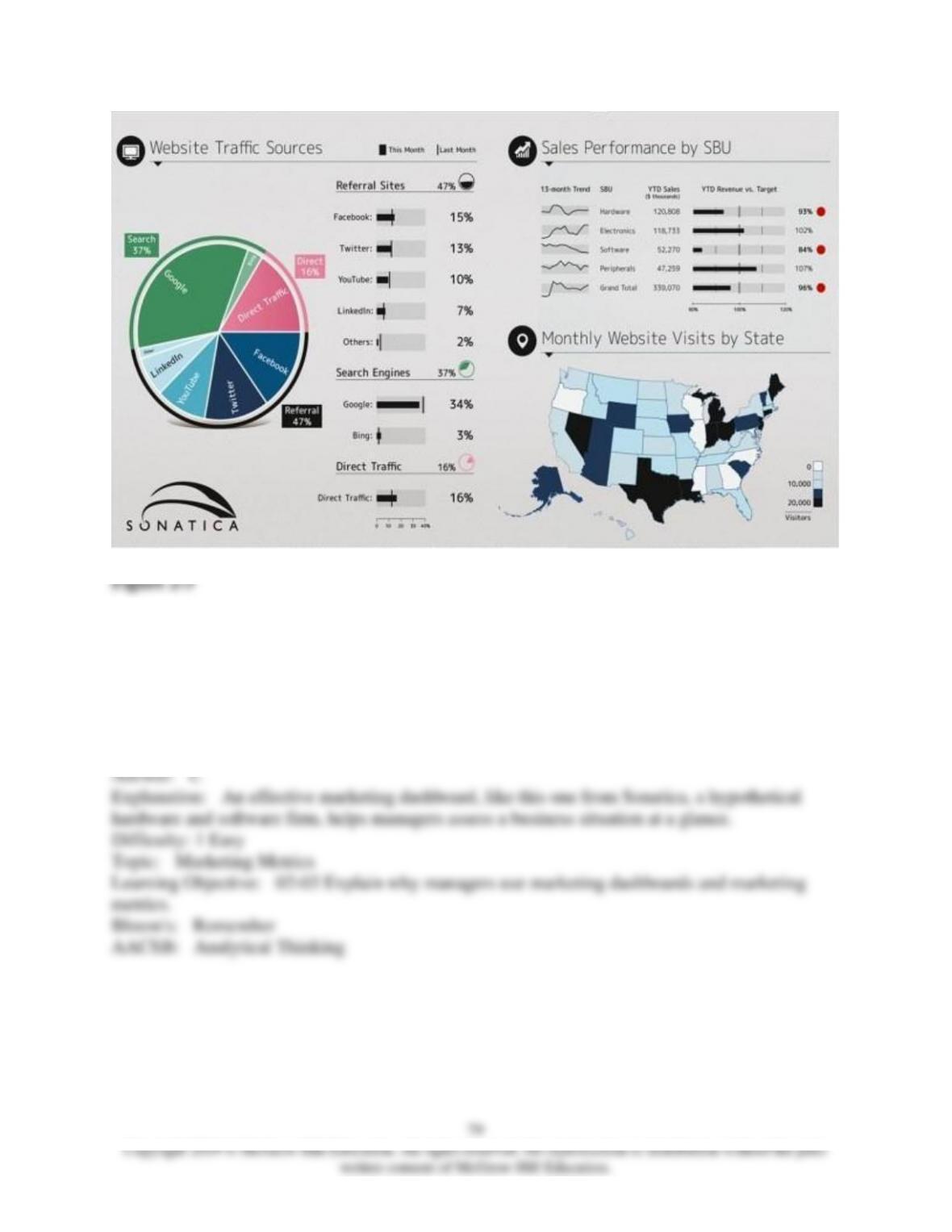
151) According to Figure 2-3 above, the image shown is an example of a(n)
A) marketing gauge.
B) output report.
C) marketing dashboard.
D) information monitor.
E) data interface.
152) A marketing dashboard refers to
A) a “report card” prepared by the marketing department regarding its performance in terms of
environmental and social responsibility.
B) the display of information found on a car’s dashboard.
C) an “app” that uses a car navigation device metaphorically to indicate the specific direction in
which a company wishes to grow based on its annual marketing plan.
D) information about an organization’s marketing metrics presented orally so marketers can
quickly spot deviations from plans and take corrective actions.
E) the visual computer display of the essential information related to achieving a marketing
objective.
153) With a marketing dashboard, a marketing manager may get information in the form of any
of these except which?
A) The time frame for which the data are presented
B) A graph
C) A table
D) A printed report
E) A map