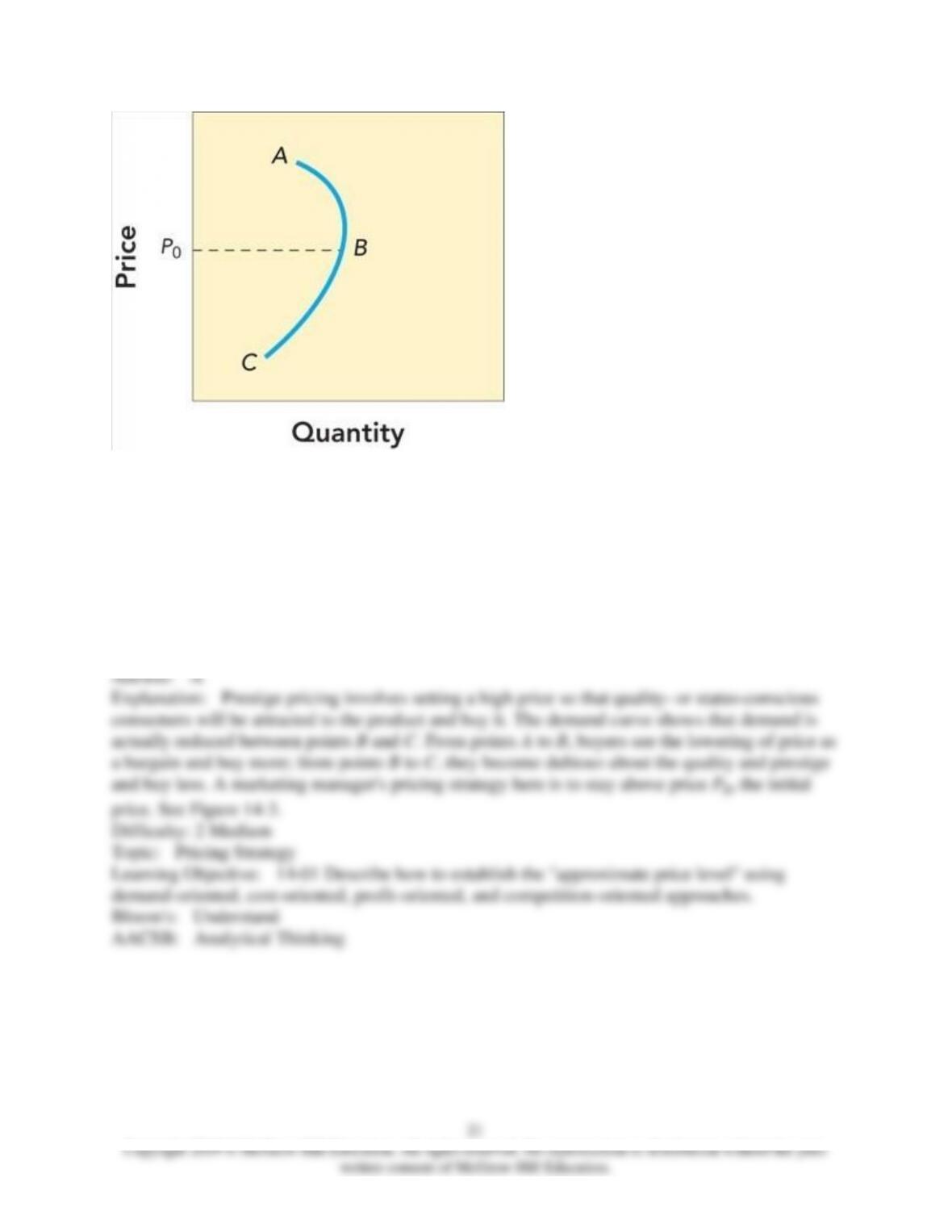
Figure 14-3
37) Figure 14-3 above shows a demand curve depicting which pricing approach?
A) prestige pricing
B) skimming pricing
C) penetration pricing
D) price lining
E) reflexive pricing
38) The movement from point A to point B in Figure 14-3 above shows
A) skimming demand.
B) penetration demand.
C) that buyers see the product as a bargain and buy more.
D) that buyers become dubious about the quality and prestige and buy less.
E) a downturn in the economy.
39) The movement from point B to point C in Figure 14-3 above shows
A) skimming demand.
B) penetration demand.
C) that buyers see the product as a bargain and buy more.
D) that buyers become dubious about the quality and prestige and buy less.
E) a downturn in the economy.
40) Talbots sells women’s clothes. A long-sleeved scoop neck T-shirt with the Talbots label costs
$45. By comparison, you can buy a T-shirt for $5 at a Family Dollar Store, but it won’t have the
prestigious Talbots label or quality. What kind of demand-oriented approach to pricing does
Talbots use?
A) experience curve pricing
B) skimming pricing
C) demand-backward pricing
D) prestige pricing
E) flexible pricing
41) You can buy a General Electric dishwasher for $399 or you can buy a similar Bosch brand
dishwasher for $989. Since Bosch uses its pricing strategy to project a high-quality product
image, it is most likely using ________ pricing.
A) bundle
B) standard markup
C) prestige
D) penetration
E) cost plus fixed-fee
42) A Patek Philippe Sky Moon Tourbillon men’s wristwatch is among the most expensive in the
world, costing more than $1.5 million. This is an example of a ________ strategy.
A) penetration pricing
B) target pricing
C) bundle pricing
D) loss-leader pricing
E) prestige pricing
43) When the Swiss watchmaker TAG Heuer quadruped the average price of its watches, its
sales volume jumped sevenfold. The likely cause of this volume increase is that
A) the watch market is highly conservative.
B) economies of scale in production would be substantial.
C) retailers are not willing to carry new brands of watches in this category.
D) once the initial price is set, it is nearly impossible to lower the price without alienating early
buyers.
E) the watch category frequently uses prestige pricing, wherein lower prices may result in lower
sales.
44) Price lining is considered to be a ________ approach to pricing.
A) cost-oriented
B) demand-oriented
C) profit-oriented
D) competition-oriented
E) service-oriented
45) Setting the price of a line of products at a number of different specific price points is referred
to as
A) odd-even pricing.
B) bundle pricing.
C) cost-plus pricing.
D) price lining.
E) prestige pricing.
46) Price lining refers to
A) charging different prices to different buyers for goods of like grade and quality.
B) setting a low initial price on a new product to appeal immediately to the mass market.
C) setting a market price for a product or product class based on a subjective feel for the
competitors’ price or market price as the benchmark.
D) setting prices a few dollars or cents under an even number.
E) setting the price of a line of products at a number of different specific pricing points.
47) When using a price lining strategy, a marketer will
A) set the price of a line of products at a number of different specific pricing points.
B) set the price slightly higher than necessary to protect against losses resulting from adverse
environmental forces.
C) adjust the price of a product so it is “in line” with the price of its largest competitor.
D) set a low initial price on a new product to appeal immediately to the mass market.
E) set a market price for a product or product class based on a subjective feel for the competitors’
price or market price as the benchmark.
48) If demand for a class of products is elastic at a number of price points but is inelastic
between these price points, which pricing approach should be chosen?
A) product-line pricing
B) skimming pricing
C) penetration pricing
D) price lining
E) odd-even pricing
49) Which of the following statements regarding price lining is most accurate?
A) In order for price lining to be effective, there should be at least five specified price points.
B) Price lining assumes that demand is inelastic at each price point but elastic between price
points.
C) Price lining assumes that demand is elastic at each price point but inelastic between price
points.
D) Price lining is the preferred pricing strategy for governmental contracts.
E) Price lining is the same as above-, at-, or below-market pricing.
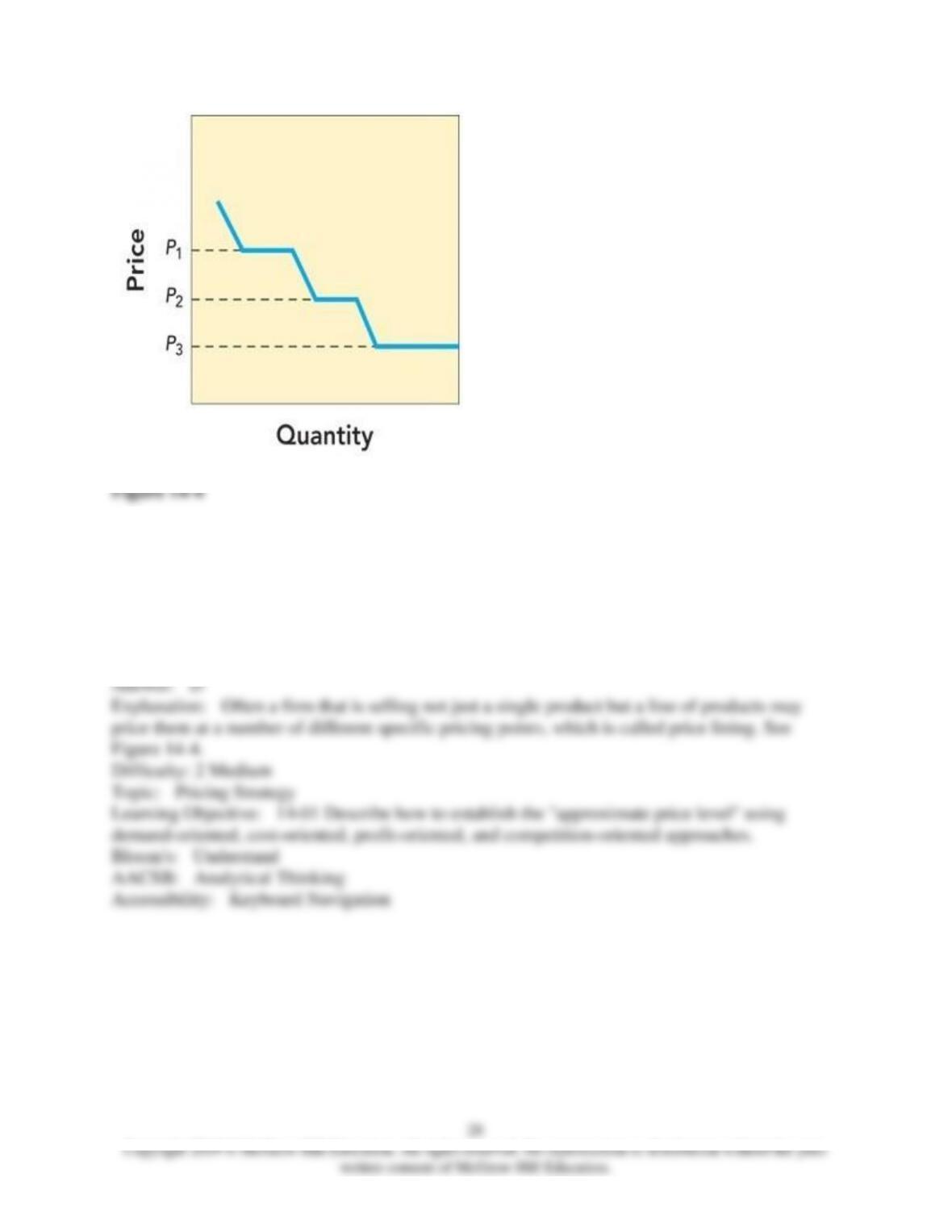
50) Figure 14-4 above illustrates which type of pricing approach?
A) skimming
B) penetration
C) cost-plus
D) price lining
E) prestige
51) A retailer purchased a gross (144) of silk shells each costing exactly $17. Although the only
difference between the shells was color, when they were put on the floor, the primary colors
were marked $25, the pastel colors were marked $28, and the black and white shells were
marked $30. These prices were set most likely because
A) retailers using a price lining strategy will occasionally mark up items based on color, style,
and expected consumer demand.
B) fewer people buy black and white shells, so the retailer has to charge a higher price to break
even.
C) the retailer is using prestige pricing; black and white shells are more elegant.
D) the primary colors were priced using a penetration strategy, the pastels were priced using a
skimming strategy, and the black and white shells were priced using prestige pricing.
E) price lining is essentially the same as above-, at-, or below-market pricing.
52) Odd-even pricing is considered to be a ________ approach to pricing.
A) cost-oriented
B) profit-oriented
C) demand-oriented
D) competition-oriented
E) service-oriented
53) Odd-even pricing refers to
A) setting prices one way for product lines and another way for individual brands.
B) setting prices of luxury items at even price points and setting the price of necessities at odd
price points.
C) setting prices a few dollars or cents under an odd number.
D) adding a fixed percentage to the cost of all items in a specific product class.
E) setting prices a few dollars or cents under an even number.
54) Setting prices a few dollars or cents under an even number is referred to as
A) odd-even pricing.
B) prestige pricing.
C) price lining.
D) above-, at-, or below-market pricing.
E) every day fair pricing.
55) Odd-even pricing is based on
A) a retailers’ ranges of prices.
B) the wholesalers’ markups.
C) a manufacturer’s costs.
D) competitors’ price assumptions.
E) customers’ perceptions of price.
56) Which of the following statements regarding odd-even pricing is most accurate?
A) Odd-even pricing is designed to give the consumer a better set of pricing alternatives.
B) Odd-even pricing can be used in conjunction with a skimming pricing strategy, but should not
be used with a penetration pricing strategy.
C) Odd-even pricing does not work if the product is health care-related.
D) Overuse of odd-ending prices tends to mute its effect on demand.
E) Odd-ending prices are best used with large ticket items; it loses its effectiveness with
moderate- to low-ticket items.
57) The prices for all furniture sold at American Furniture Warehouse end in $9.99, such as
$599.99, $899.99, etc. American Furniture Warehouse uses
A) odd-even pricing.
B) dynamic pricing.
C) price lining.
D) bundle pricing.
E) product-line pricing.
58) Target pricing is considered to be a ________ approach to pricing.
A) cost-oriented
B) profit-oriented
C) demand-oriented
D) competition-oriented
E) service-oriented
59) Target pricing refers to
A) a method of selecting specific prices wholesalers and retailers are willing to pay based upon
the elasticity of each given item.
B) a method of charging different prices to maximize revenue for a set amount of capacity at any
given time.
C) the practice of simultaneously increasing product and service benefits while maintaining or
decreasing price.
D) a method of estimating the price that ultimate consumers would be willing to pay for a
product, then working backward through markups taken by retailers and wholesalers to
determine what price to charge wholesalers.
E) a method of estimating the price that ultimate consumers would be willing to pay for a
product, then determining how much wholesalers wish to charge its customers, deliberately
adjusting the composition and features of the product to achieve the price to consumers.
60) The pricing approach that results in the manufacturer deliberately adjusting the composition
and features of the product to achieve the desired price for consumers is referred to as
A) cost-benefit pricing.
B) cost-plus percentage-of-cost pricing.
C) target pricing.
D) cost-plus fixed-fee pricing.
E) product feature pricing.
61) The pricing approach that estimates the price that ultimate consumers would be willing to
pay for a product; works backward through markups taken by retailers and wholesalers to
determine what price to charge wholesalers is referred to as
A) cost-benefit pricing.
B) cost-plus percentage-of-cost pricing.
C) target pricing.
D) cost-plus fixed-fee pricing.
E) product feature pricing.
62) Which of the following pricing techniques is most sensitive to customers’ responses to price?
A) cost-plus percentage-of-cost pricing
B) target pricing
C) experience curve pricing
D) cost-plus fixed-fee pricing
E) standard markup pricing
63) The Swedish manufacturer of Asko dishwashers concluded that consumers would be willing
to pay approximately $989 for a dishwasher that was quieter than any other dishwasher on the
market. Based on this price, Asko determined the margins that would have to be given to
wholesalers and retailers to arrive at the $989 retail price. Asko used
A) prestige pricing.
B) price lining.
C) cost-plus pricing.
D) target pricing.
E) customary pricing.
64) Bundle pricing is considered to be a ________ pricing practice.
A) demand-oriented
B) cost-oriented
C) profit-oriented
D) competition-oriented
E) product line-oriented
65) Which of the following is a demand-oriented approach to pricing?
A) customary pricing
B) target profit pricing
C) standard markup pricing
D) bundle pricing
E) service-oriented pricing
66) Marketing two or more products in a single package price is referred to as
A) package pricing.
B) loss-leader pricing.
C) bundle pricing.
D) tie-in pricing.
E) multi-product pricing.
67) Bundle pricing refers to
A) an extra amount of “free goods” awarded sellers in the channel of distribution for promoting a
product.
B) marketing two or more products in a single package price.
C) using BOGOs—requiring customers to “buy one to get one free” as a strategy to increase
sales and profits.
D) setting the price of a line of products at two specific pricing points.
E) the practice of charging two or more prices depending upon the outlet carrying the product.
68) Which one of the following statements regarding bundle pricing is most accurate?
A) Bundle pricing is intended to benefit the consumer, not the seller.
B) Bundle pricing is really “bundle packaging” since the price charged is for two or more of the
same products that are shrink-wrapped together.
C) Bundle pricing is often associated with a skimming strategy.
D) Bundle pricing often provides a lower total cost to buyers and lower marketing costs to
sellers.
E) Bundle pricing is based on the idea that consumers value the individual items more than they
value the group contained in the package.
69) If you were to buy one peach tree and one apple tree from the Stark Bros. fruit trees and
landscaping catalog in two separate orders, you would pay a total of $109.99. However, if you
order the peach and apple tree together in the same order, you pay only $89.99 each. When
purchasing the two trees together, what pricing strategy does Stark Bros. employ?
A) product-line pricing
B) prestige pricing
C) price lining
D) discount pricing
E) bundle pricing
70) When Dell sells various laptops, it also pre-installs Microsoft Office and other software that
customers order at a discount before a laptop is shipped. This is an example of
A) price lining.
B) product-line pricing.
C) bundle pricing.
D) customary pricing.
E) prestige pricing.
71) A box of Cascade dishwasher detergent shrink-wrapped with a bottle of Jet Dry is sold for
$1.50 less than the regular price of the products sold separately. This is an example of ________
pricing.
A) penetration
B) prestige
C) bundle
D) odd-even
E) standard markup
72) Delta Air Lines offers vacation packages that include airfare, car rental, and lodging. Delta
Air is using a(n) ________ pricing strategy.
A) penetration
B) prestige
C) bundle
D) odd-even
E) standard markup
73) Yield management is considered to be a ________ approach to pricing.
A) demand-oriented
B) cost-oriented
C) profit-oriented
D) competition-oriented
E) service-oriented