Real Estate Finance & Investments, 16e (Brueggeman)
Chapter 9 Income-Producing Properties: Leases, Rents, and the Market for Space
1) Analysis of effective rents tends to be superior to analysis of total rents over the life of a lease.
2) The existing stock of space cannot be adjusted in the short run, but can be increased or
decreased in the long run.
3) To attract anchor tenants, property owners tend to charge them lower rents. They make-up for
the lower rents by charging the anchor tenant higher CAM charges.
4) Overage rent is rent that exceeds expenses.
5) The term “percentage rent” refers to rent paid as a percent of space leased.
6) A gross lease is one in which the tenant only pays rent, and the owner of the property pays the
operating expenses and provides all services.
7) The term “usable area” is typically synonymous with “leasable area,” in a building with
multiple tenants.
8) The use of a CPI index in a lease contract shifts risk to the tenant.
9) Expense stops protect the lessee from unexpected changes in market rents.
10) A gross lease is riskier for the lessor than a net lease.
11) In projecting cash flows for an office property, net operating income is the income after
deduction of mortgage payments.
12) Free rent is a concession that a building owner may offer.
13) CPI adjustments are used to adjust rents by all or part of the increase in the Consumer Price
Index.
14) Condominium complexes are considered to be nonresidential properties.
15) The great majority of businesses lease the space they occupy rather than purchasing it
outright.
16)
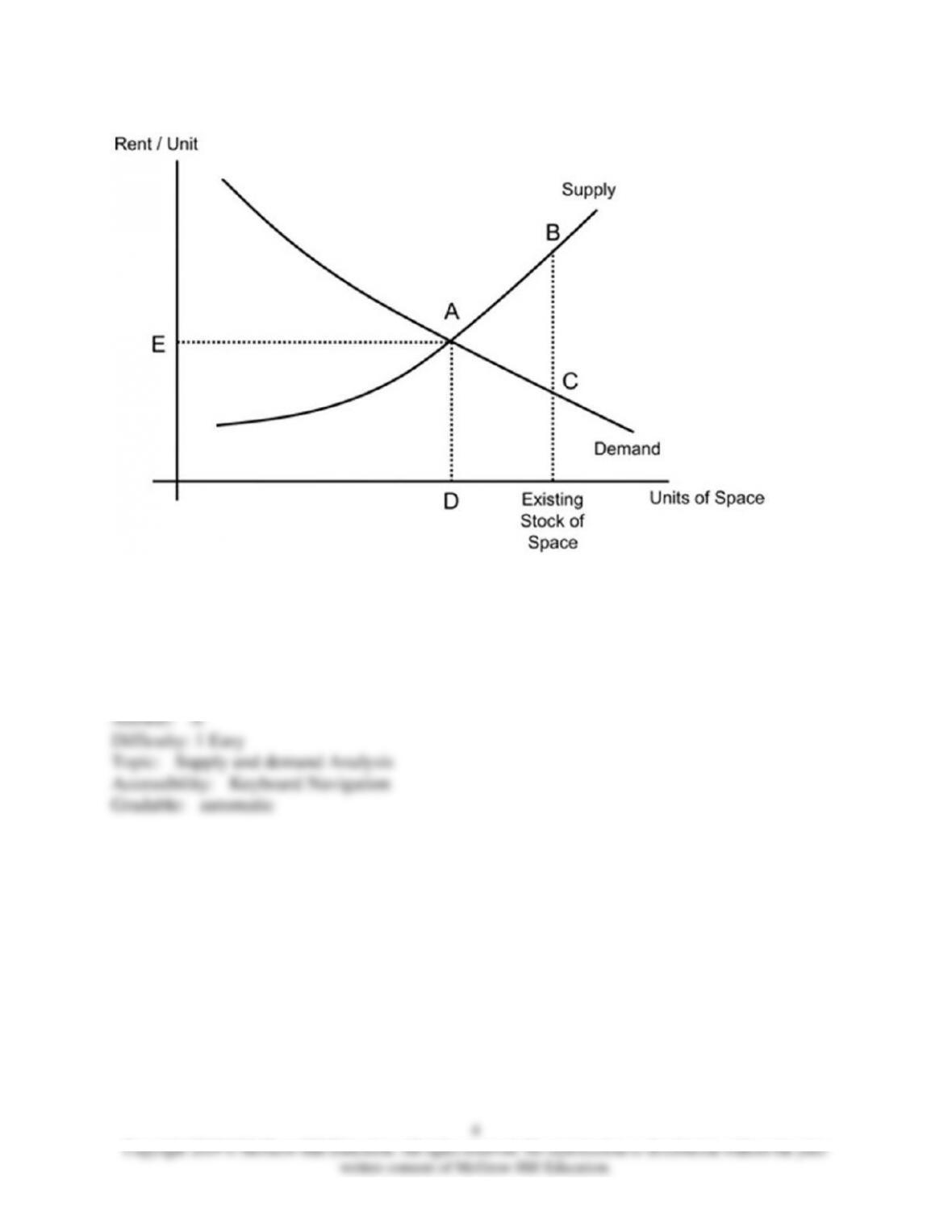
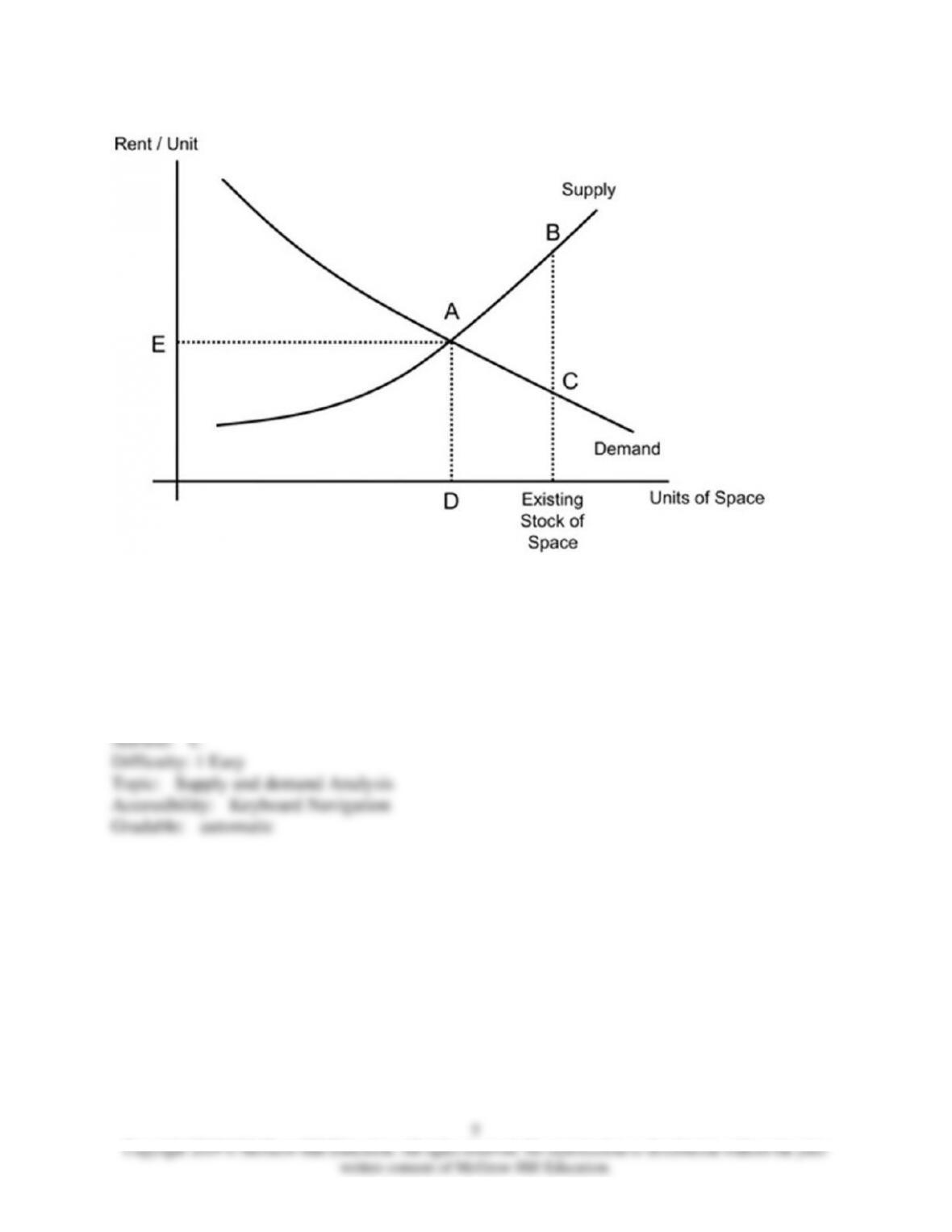
Consider the figure above. Point D represents:
A) Equilibrium occupancy
B) Market rent
C) Vacancy
D) Shortage
17)
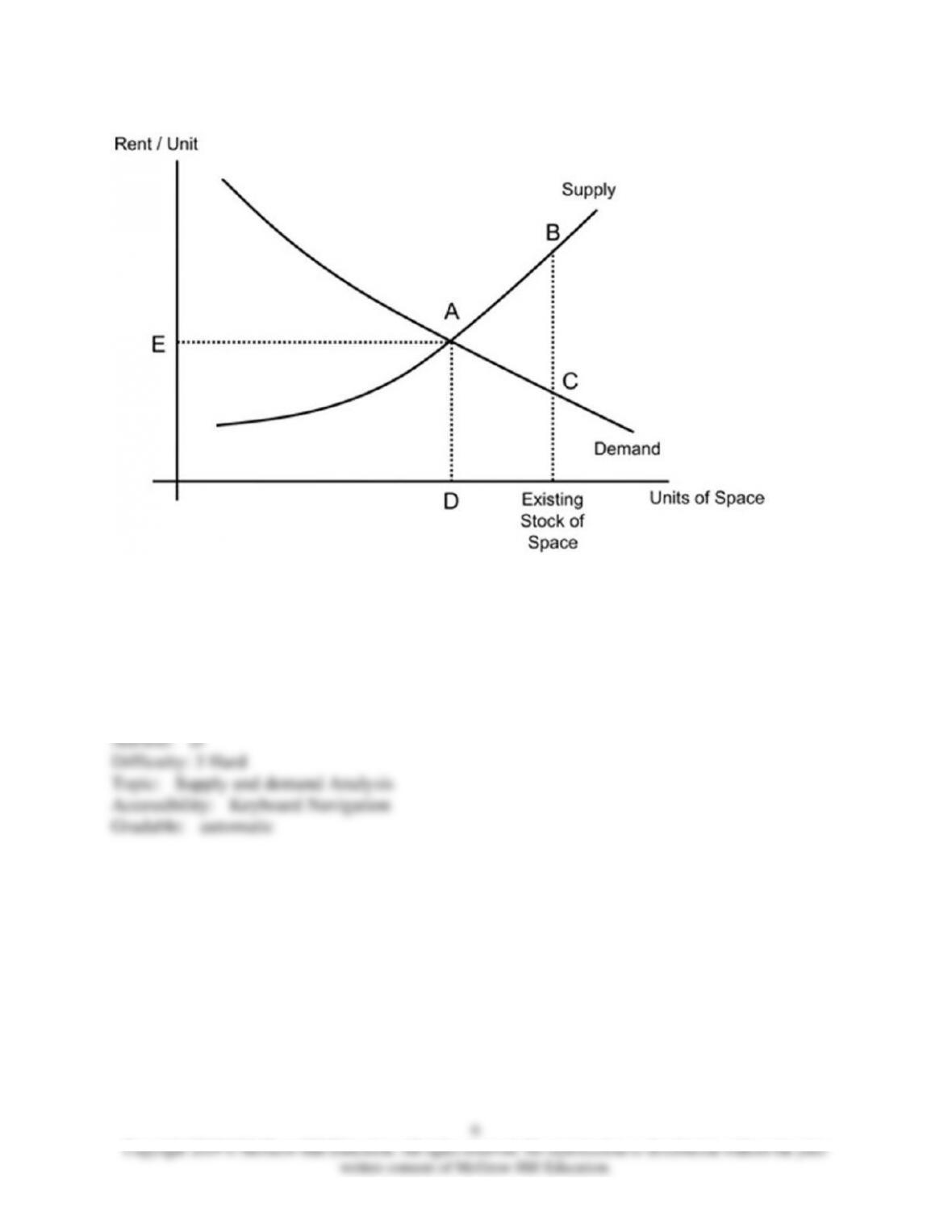
Consider the figure above. The difference between the existing stock of space and Point D
represents:
A) Equilibrium occupancy
B) Market rent
C) Vacancy
D) Shortage
18)
Consider the figure above. If the demand for units increases, what would happen in equilibrium,
holding everything else constant?
A) Market rent would decrease; equilibrium occupancy would decrease
B) Market rent would decrease; equilibrium occupancy would increase
C) Market rent would increase; equilibrium occupancy would decrease
D) Market rent would increase; equilibrium occupancy would increase
19) For which of the following reasons would a business prefer to own space rather than lease it?
A) The business demands specialized or unique facilities
B) Owning allows the business to develop skills in operating, maintaining, and repairing real
estate and the associated facilities
C) Owning reduces operating flexibility
D) The capital commitments with owning are lower than the capital commitments associated
with leasing
20) A building owner charges net rent of $20 in the first year, $21 in the second year, and $22 in
the third year. Using a 10 percent discount rate, what is the effective rent over the three years?
A) $20.00
B) $20.94
C) $21.73
D) $52.07
21) A building owner charges net rent of $20 in the first year, $21 in the second year, and $22 in
the third year, but is providing six months of free rent in the first year as a concession. Using a
10 percent discount rate, what is the effective rent over the three years?
A) $17.28
B) $18.94
C) $20.94
D) $42.98
22) Which of the following is NOT considered to be an office or retail property?
A) Single-tenant – build to suit
B) Regional shopping center
C) Warehouse
D) Community center
23) The difference between the existing stock of space and the equilibrium occupancy is known
as:
A) Supply
B) Demand
C) Equilibrium
D) Vacancy
24) The dollar amount by which total rent exceeds base rent under a percentage lease for retail is
referred to as:
A) Overage rent
B) Excess rent
C) Percentage rent
D) Marginal rent
25) The supply of space is:
A) Inelastic in both the short run and the long run
B) Elastic in both the short run and the long run
C) Relatively inelastic in the short run, and highly elastic in the long run
D) Relatively elastic in the short run, and highly inelastic in the long run
26) Expenses for a 1,000 square foot office space are $6.00 per square foot. The lease specifies
an expense stop of $5.40. What is the total expense paid by the landlord?
A) $5,400
B) $6,000
C) $600
D) $0
27) A 1,500 square foot office space is leased at $12.00 square foot. The space is vacant one
month out of the year. Office expenses are $6.50 per square foot and an expense stop is set at
$6.00 per square foot. What is the annual net operating income?
A) $7,500
B) $6,750
C) $15,750
D) $8,250
28) A clause which requires a tenant in retail space to achieve a certain level of sales or the lease
will be terminated is referred to as a:
A) Change clause
B) Termination clause
C) Option clause
D) Santa clause
29) A clause in a non-anchor tenant’s lease requiring the presence of an anchor tenant is referred
to as a:
A) Non-compete clause
B) Co-tenancy clause
C) Joint tenancy clause
D) Anchor clause
30) Income after deducting loss of rents due to vacancy and nonpayment of rents, as well as any
concessions, is referred to as:
A) Potential gross income
B) Effective gross income
C) Net operating income
D) Before-tax cash flow
31) A 1,000 square foot office space is leased at $15.00 per square foot during the first year with
$2.00 step-up provisions each of the following years. The lease is gross with an expense stop set
at $6.65 per square foot, and yearly expenses per square foot are as follows: $6.00, $6.65, and
$7.05. The lease provides for two months of free rent at the end of the lease term. If the lease
term is three years and the discount rate is 10%, what is the effective rent per square foot?
A) $9.38
B) $9.50
C) $10.22
D) $10.46
32) Which of the following does the term “anchor tenant” usually refer to?
A) Someone who leases space
B) The largest tenant in an office building
C) A department store in a mall
D) The tenant who pays the highest rent in a mall
33) Which of the following describes the function of an expense stop in a lease?
A) Expenses are stopped from increasing
B) Expenses above the stop are paid by the owner
C) Expenses above the stop are paid by the tenant
D) Expenses below the stop are paid for by the tenant
34) Which of the following is TRUE for a net lease?
A) All expenses are paid by the owner
B) All expenses are paid by the tenant
C) All expenses are paid by the lender
D) All expenses are paid by the investor
35) Which of the following tends to lower effective rents?
A) Percentage rent
B) Step up provisions
C) Concessions
D) CPI adjustment
36) Which of the following does the term “in-line tenants” refer to?
A) Smaller stores in a mall that are not anchor tenants
B) Tenants whose sales are in line with estimates
C) Tenants who pay their rents on a timely basis
D) All stores located inside the mall, including anchors
37) Which of the following is FALSE regarding cap rates?
A) Excess supply tends to drive cap rates up
B) Rising interest rates generally tend to lower cap rates
C) Excess demand and falling interest rates result in lower cap rates
D) Excess demand leads to lower cap rates
38) Which of the following leads to rent premiums?
A) Apartments on the periphery of a site; higher floors with no elevators
B) Second or third levels in multi-level malls
C) Middle floors in an office building
D) Apartments on higher floors with elevators
39) The price a potential tenant must pay to lease a specific type of real estate under the current
economic conditions is:
A) Percentage rent
B) Market rent
C) Effective rent
D) Base rent
40) Which of the following would be considered as expense pass throughs in a lease?
A) Electricity
B) Landscaping fees
C) Security costs
D) Property taxes
41) A manufacturing business is contracting to lease a large, open building and is seeking to add
partition walls and a large air conditioning unit in order to accommodate its specific needs. What
type of lease is the building owner likely to want to agree to?
A) Gross lease
B) Modified lease with direct pass throughs
C) Single net lease
D) Triple net lease