
Real Estate Finance & Investments, 16e (Brueggeman)
Chapter 13 Risk Analysis
1) Partitioning the internal rate of return is useful because it helps the investor to determine how
much of the return is from annual operating cash flow and how much is from the projected resale
cash flow.
2) In general, investors are assumed to be risk seekers who must be compensated more for the
higher risk of some investments.
3) Financial risk increases as the amount of debt increases.
4) Real estate that is not leveraged is not affected by interest rate risk.
5) Real estate is generally dramatically affected by inflation risk.

6) Use of leverage always increases the amount of business risk.
7) The range of returns (highest to lowest) is the most common risk measure.
8) The term “due diligence” refers to conducting an investigation before buying a property.
9) Land can be viewed as having an “option” to develop the land.
10) Percentage rent is common in office building leases.

11) The term “financial risk” refers to the probability of interest rates changing.
12) In general, real estate is usually considered more risky than bonds but less risky than stocks.
13) A property with a higher standard deviation and a higher return is preferable to a property
with a lower standard deviation and a lower return.
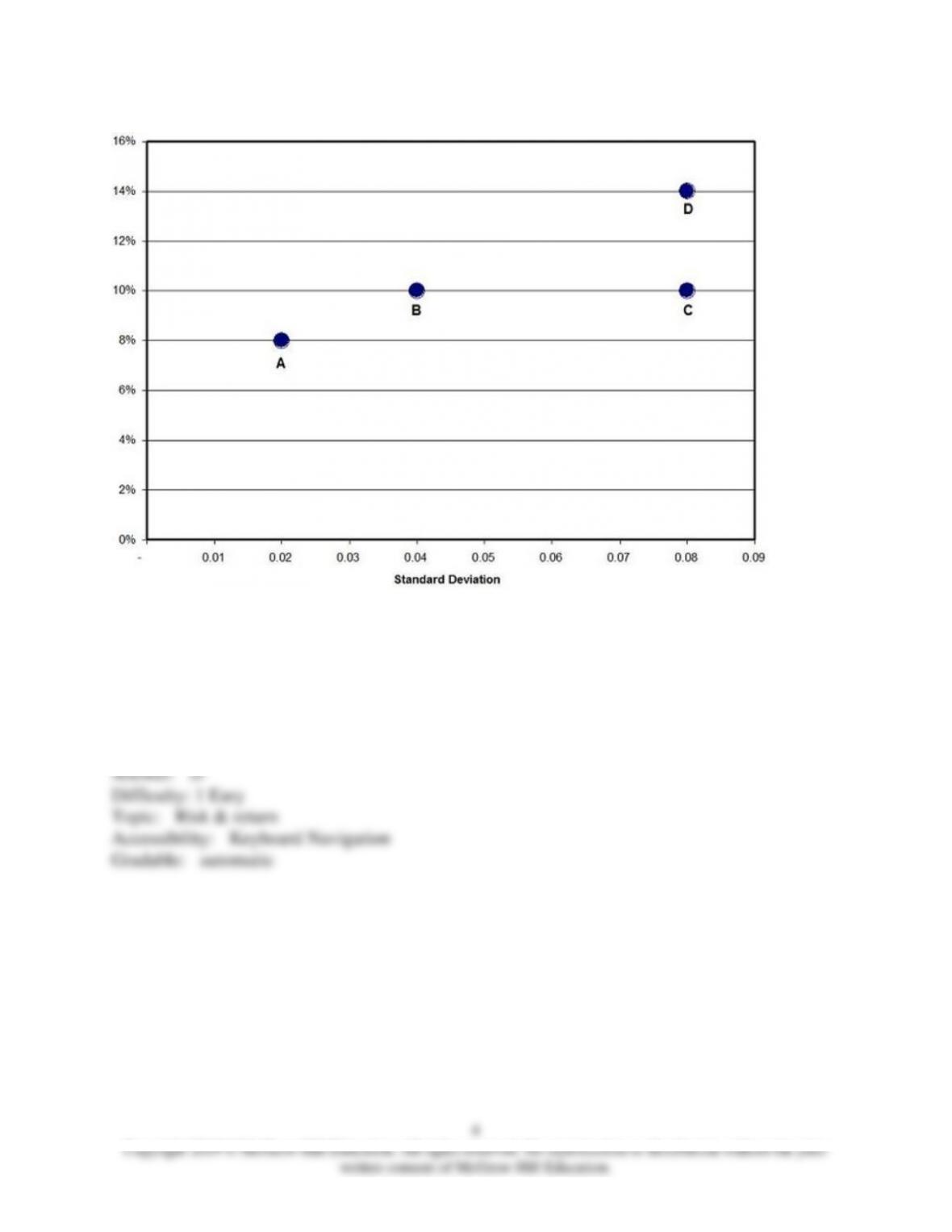
14)
Consider risk-return characteristics of Investments A-D, given above. Which of the following
statements is TRUE?
A) Investment C is preferred to Investment D
B) Investment D is preferred over all other investments
C) Investment A is preferred to Investment B
D) Investment B is preferred to Investment C

15) Consider two investments:
Investment 1 has a 50% chance of producing a return of zero and a 50% chance of producing a
return of 40%
Investment 2 has a 50% chance of producing a return of 10% and a 50% chance of producing a
return of 30%
Which of the following statements regarding the investments is TRUE?
A) Investment 1 is riskier than Investment 2
B) Investment 2 is riskier than Investment 1
C) Investment 1 and Investment 2 have the same amount of risk
D) Investment 1 is a better investment because it has the potential to produce the highest returns
16) Which of the following is NOT a component of lease rollover risk?
A) Commissions paid to a leasing agent to find a new tenant
B) Costs of tenant improvements demanded by new tenants
C) Liquidity risk
D) Reduced revenues from vacancy until a new tenant is found

17) Consider an investment in which a developer plans to begin construction, of a building that
will cost $1,000,000, in one year if, at that point, rent levels make construction feasible. There is
a 50 percent chance that NOI will be $160,000 and a 50 percent chance that NOI will be
$80,000. Using the traditional approach, which is similar to the “highest and best use” approach,
what will the land value of the property be at the completion of the construction, assuming a cap
rate of 10 percent (12 percent discount rate and an NOI growth rate of 2 percent)?
A) $120,000
B) $200,000
C) $300,000
D) $833,333
18) Consider an investment in which a developer plans to begin construction, of a building that
will cost $1,000,000, in one year if, at that point, rent levels make construction feasible. There is
a 50 percent chance that NOI will be $160,000 and a 50 percent chance that NOI will be
$80,000. Assuming a cap rate of 10 percent (12 percent discount rate and an NOI growth rate of
2 percent) what would the land value be at the completion of the construction, under the real
options approach?
A) $120,000
B) $200,000
C) $300,000
D) $833,333

19) Risk due to potential tax law changes is referred to as:
A) Business risk
B) Financial risk
C) Legislative risk
D) Tax risk
20) When an investor performs an investigation while considering acquisition of a property, this
is referred to as:
A) Investigation
B) Risk analysis
C) Due diligence
D) Acquisition analysis
21) Which of the following refers to the risk real estate investors face stemming from changes in
general economic conditions?
A) Financial risk
B) Liquidity risk
C) Environmental risk
D) Business risk

22) Which of the following BEST describes the process of “partitioning the IRR”?
A) Dividing the IRR into income and appreciation components
B) Using the IRR as a discount rate and determining how much of the present value comes from
income and resale
C) Dividing the IRR into before-tax and after-tax IRRs
D) Determining how much of the IRR comes from each property in a portfolio
23) When sales exceed a breakpoint sales volume in a retail lease with percentage rent, the
additional rent is referred to as:
A) Retail rent
B) Participation rent
C) Overage rent
D) Sales rent
24) Which of the following may be used as a market leasing assumption (including a renewal
probability) in an analysis related to a lease renewal?
A) Market rent paid after the existing lease ends
B) Vacancy after the existing lease ends.
C) Leasing commissions paid after the existing lease ends
D) All of the above

25) If the renewal probability for a lease is assumed to be 60% and the number of months vacant
would be 12 months if the lease is not renewed, what is the expected vacancy at the end of the
lease?
A) 4.8 months
B) 7.2 months
C) 9.0 months
D) 12.0 months
26) Which of the following best describes the approach to valuing land as a “real option”?
A) The land value reflects the fact that the developer can wait to decide whether to construct a
building on the site
B) The seller provides the investor with an option to purchase the land at a specific price before a
certain date
C) The land is valued at its most probable use
D) The seller has an option to repurchase the land from the buyer before construction takes place
27) Which of the following is an example of a “real option” in an investment decision?
A) Valuation of vacant land
B) Valuation of projects with phases of development
C) Valuation of a building that can be renovated
D) All of the above

28) An investor is analyzing the risk of a possible investment by producing three different
scenarios. Under a pessimistic scenario, the property would produce a BTIRRp of 8%; a most-
likely scenario would produce a BTIRRp of 12%; and an optimistic scenario would produce a
BTIRRp of 16%. The investor assigns the pessimistic scenario a 25% chance of occurring, the
most-likely case a 60% chance of occurring, and the optimistic scenario a 15% chance of
occurring. What is the standard deviation of the returns?
A) 0.062%
B) 1.248%
C) 2.498%
D) 2.904%
29) Which of the following increases with use of leverage in a business?
A) Financial risk
B) Liquidity risk
C) Environmental risk
D) Inflation risk
30) Which of the following would be most suitable for use in analyzing the best-case, worst-
case, and most-likely outcomes for potential investment opportunity?
A) Risk analysis
B) Financial analysis
C) Sensitivity analysis
D) Cost analysis

31) A property owner may incur some downtime due to the expiration of a lease that has not
been renewed. The time period that occurs before the owner can contract with a new tenant is
referred to as:
A) Absentia turnover
B) Market turnover
C) Lease turnover
D) Vacancy turnover