
Real Estate Finance & Investments, 16e (Brueggeman)
Chapter 10 Valuation of Income Properties: Appraisal and the Market for Capital
1) The sales comparison approach to appraisal is preferred because it is the only objective
appraisal approach.
2) When using the gross income multiplier technique in conjunction with the income approach to
valuation, potential gross income is preferred to effective gross income.
3) One advantage of the gross income multiplier technique is that it is most suitable for
properties in which operating expenses vary widely across the properties being surveyed.
4) The rationale for using the cost approach to appraisal is that any informed buyer would not
pay more for a property than what it would cost to buy the land and build the structure.

5) When conducting an appraisal, only one of three approaches should be selected to determine
the property value.
6) In the cost approach to valuation, land value can be estimated by comparing sales of vacant
land that are similar to the subject land.
7) In the income approach to valuation, replacement cost is reduced by costs such as those that
are associated with curing deterioration of the property and the economic loss of value from
incurable factors due to change in design or layout efficiency.
8) A building has 12 foot ceilings that cause the electric bill to be $1,200 higher per year than a
conventional ceiling height. Depreciation caused by the ceilings can be estimated by calculating
the present value of the $1,200 per year over the remaining economic life of building.
9) A gross income multiplier can be calculated by dividing the gross income by the sales price.

10) An overall capitalization rate can be calculated by dividing the net operating income by the
property value.
11) The capitalization rate is equal to the discount rate minus any expected annual growth in
income and property value.
12) A property is purchased for $350,000. Based on an annual growth rate of 3%, the resale
value at the end of year 10 would be $456,671.
13) The capitalization rate for a leased fee estate should always be lower than the capitalization
rate for a fee simple estate.
14) The equity value can be estimated by subtracting debt service from net operating income and
dividing this amount by the equity dividend rate.

15) The market method or direct sales comparison method of estimating site value is not the
most reliable method available.
16) Appraisers use bracketing in order to estimate the upper and lower range of value.
17) Return on investment and change in net operating income are essential factors for cost
analysis.
18) The capitalization rate of a newly constructed apartment building will be more than that of a
relatively old apartment building, which is comparable in all other aspects.
19) The assumption that a knowledgeable buyer would not pay more for property than what
other buyers have recently paid for comparable properties, provides the rationale for the sales
comparison approach.
20) The discount rate establishes the minimum return that an investor is willing to accept when
evaluating the potential purchase of an income-producing property.
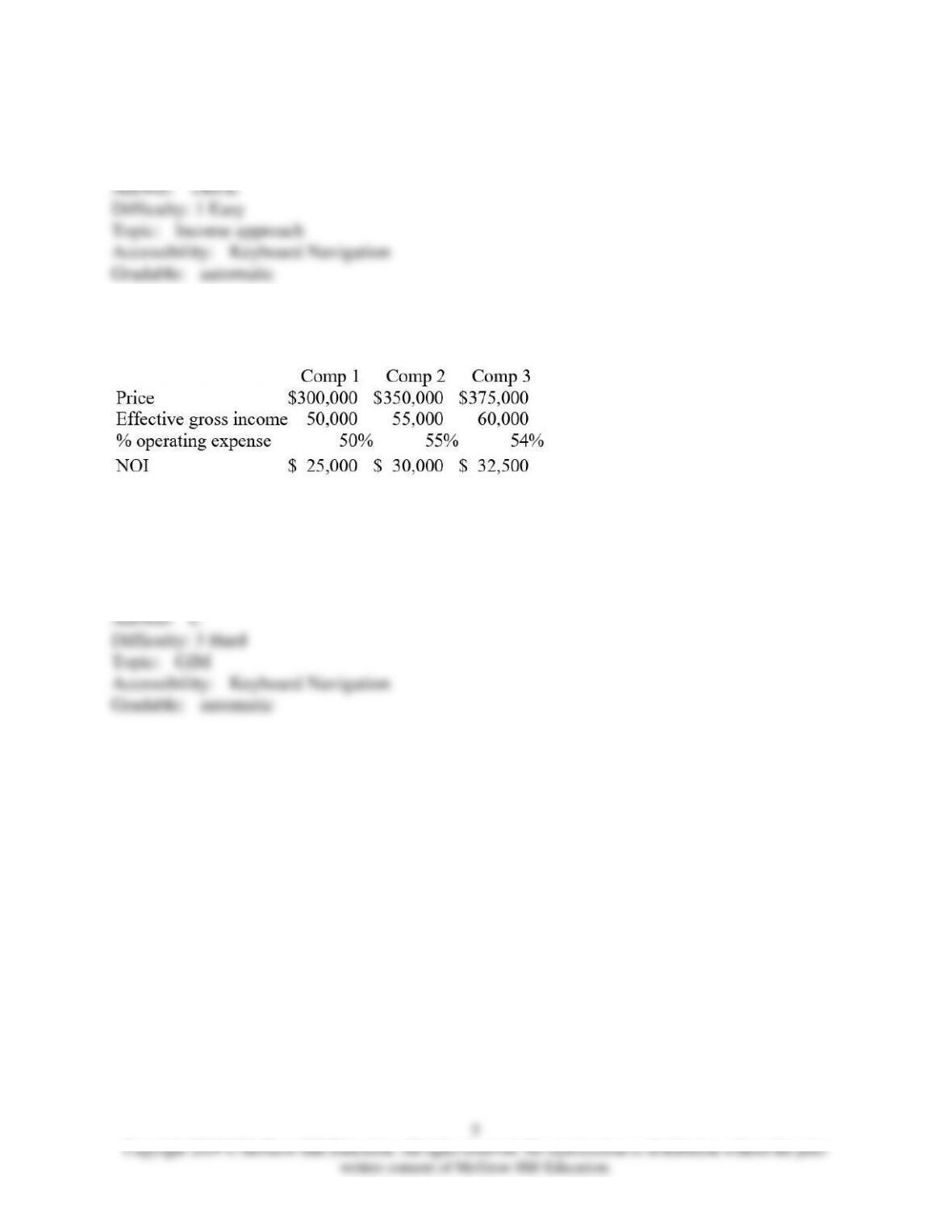
21) Consider the table. Assume that the subject property has effective gross income of $53,000
and a NOI of $27,500. What value would a GIM approach yield (rounded to the nearest $100)?
A) $322,600
B) $325,600
C) $328,600
D) $330,000
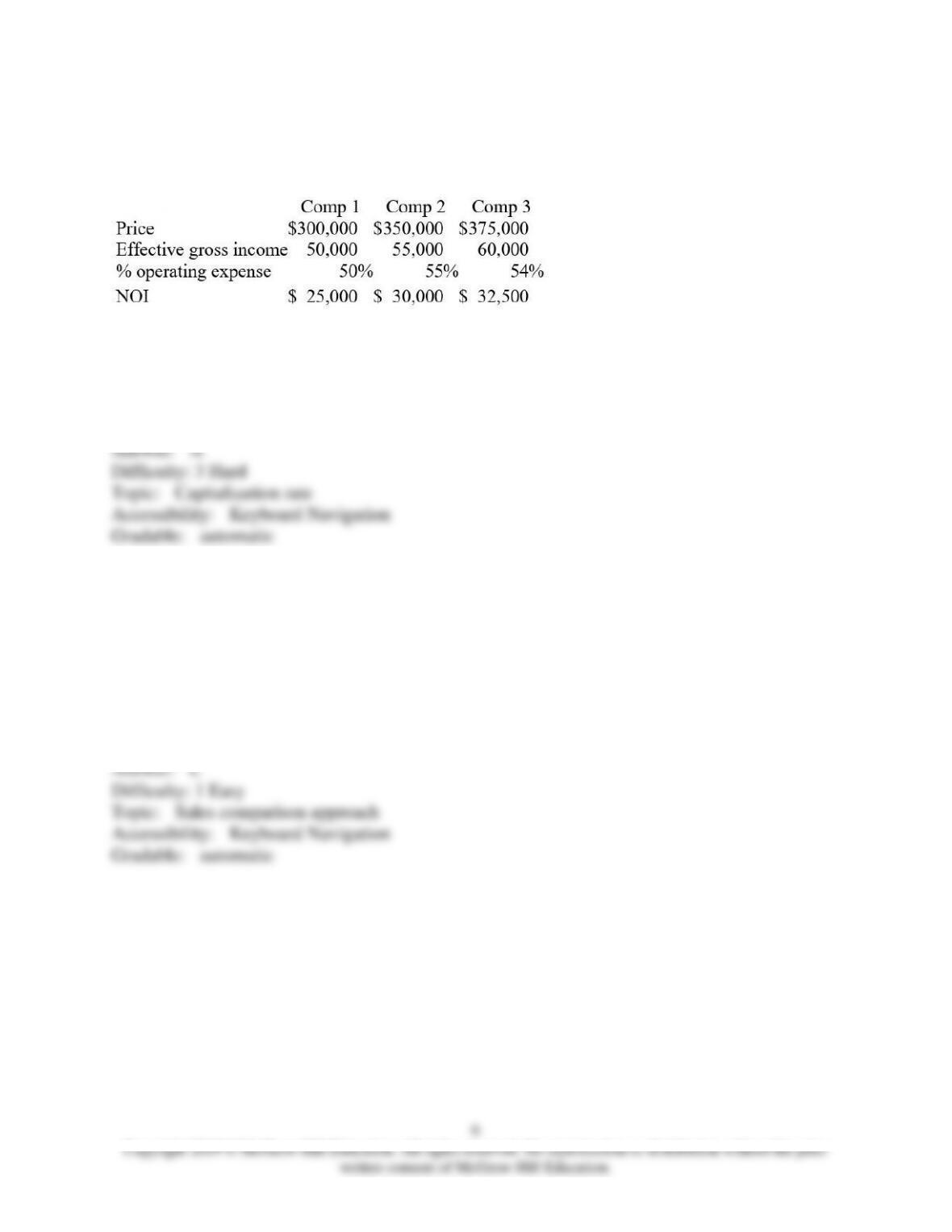
22) Consider the table. Assume that the subject property has effective gross income of $53,000
and a NOI of $27,500. What value would a cap rate approach yield (rounded to the nearest
$100)?
A) $322,600
B) $325,600
C) $328,600
D) $330,000
23) Which of the following statements regarding the sales comparison approach to appraisal is
TRUE?
A) As a “rule of thumb” transactions involving foreclosures should be discounted by 10 percent
B) The comparable buildings’ characteristics are more important than the comparable properties’
location for performing the sales comparison
C) The comparable sales must involve transactions between unrelated individuals
D) The only factors important for comparable analysis are property size, building size, age of the
building, and the condition of building

24) Which of the following techniques is NOT associated with the income approach to
valuation?
A) Capitalization rate
B) Discounted present value
C) Factor discounting rates
D) Gross income multiplier
25) Consider a building with a very long economic life. Assume at the end of year 6, NOI will be
$80,000 and is expected to grow at a rate of 2 percent per year. Your company’s required rate of
return is 12 percent. As part of your analysis, you must calculate the reversion value (REV) at
the end of year 5, which would be:
A) $571,429
B) $666,667
C) $800,000
D) $4,000,000
26) Consider a property with NOI of $72,000 and a debt coverage ratio of 1.2 applied to first
year NOI. What would be the estimated monthly mortgage payment?
A) $5,000
B) $7,200
C) $60,000
D) $86,400

27) Consider the table for an income property that is under evaluation for purchase with a
$455,000 loan. Using the principles of mortgage equity capitalization, what is the estimated total
property value (rounded to the nearest $100)?
Year 1
Year 2
Year 3
NOI
$
72,000
$
74,880
$
77,875
DS
60,000
60,000
60,000
Cash flow
$
12,000
$
14,880
$
17,875
Resale in year 3
900,000
Less mortgage balance
−435,000
Total cash flow
$
12,000
$
14,880
$
482,875
Present value of cash flow @ 15%
$
10,435
$
11,251
$
317,498
A) $317,500
B) $482,900
C) $772,500
D) $794,200

28) Consider the table for an income property that is under evaluation for purchase with a
$455,000 loan. What would be the equity dividend rate?
Year 1
Year 2
Year 3
NOI
$
72,000
$
74,880
$
77,875
DS
60,000
60,000
60,000
Cash flow
$
12,000
$
14,880
$
17,875
Resale in year 3
900,000
Less mortgage balance
−435,000
Total cash flow
$
12,000
$
14,880
$
482,875
Present value of cash flow @ 15%
$
10,435
$
11,251
$
317,498
A) 2.4 percent
B) 3.5 percent
C) $12,000
D) $317,498
29) Which of the following factors is NOT part of the definition of market value?
A) Payment is made in terms of cash in U.S. dollars or a comparable financial arrangement
B) The property has been on the open market for less than a year
C) Buyer and seller are typically motivated
D) Price is not affected by special or creative financing

30) Regarding the value of a property, an appraisal:
A) Calculates value
B) Confirms value
C) Estimates value
D) Determines value
31) Which of the following steps normally would be used in the cost approach to value?
A) Estimate net operating income of the property
B) Multiply accrued depreciation by the assessed cost
C) Add actual construction costs to the land value
D) Subtract accrued depreciation from the replacement cost
32) Which of the following choices represents the main categories of depreciation?
A) Physical, external, functional
B) Physical, economic, locational
C) External, structural, financial
D) Economic, physical, external

33) A comparable property has a feature that is superior to the subject property. What adjustment
would be made in the sales comparison approach to value?
A) Value of the feature would be subtracted from the sales price of the comparable property
B) Value of the feature would be added to the sales price of the comparable property
C) Value of the feature would be subtracted from the value of the subject property
D) Value of the feature would be added to the value of the subject property
34) Given the following sales adjustment grid, what adjustment would be made for size?
Characteristic
Subject
1
2
3
4
Sales price
116,000
120,000
124,000
126,000
Square feet
1,800
1,700
1,900
1,900
1,900
Exterior
Alum
Brick
Alum
Alum
Brick
Age
16
20
20
18
20
A) $23.65 psf.
B) $45.82 psf.
C) $65.74 psf.
D) $38.26 psf.
35) Which of the following expenses would NOT be included in an operating statement used to
calculate net operating income in the income approach to value?
A) Reserves for replacement
B) Maintenance
C) Real estate taxes
D) Capital additions
36) A property is sold for $200,000. Typical financing terms are an 85% loan with a 10% interest
rate over 15 years. If the before-tax cash flow is $2,000, what is the overall capitalization rate?
A) 10.96%
B) 11.96%
C) 19.13%
D) 9.96%
37) A property produces a first-year net operating income of $24,000. Because of the long
economic life of the building, the income is considered as a perpetuity that will grow by 2.5%
per year. Using a discount rate of 9.5%, the property value is estimated at:
A) $276,968
B) $252,632
C) $200,000
D) $342,857
38) A property is leased for $24,000 per year although market rents are currently $27,500 per
year and are expected to increase by 2% per year. The property is expected to be sold at the end
of year 10 based on a 10% terminal cap rate applied to the eleventh year NOI. The current lease
on the property will expire at the end of year 10 so the property can be leased in the eleventh
year at market rates. What is the value of the leased fee estate based on an 11.5% discount rate?
A) $362,489
B) $298,325
C) $251,298
D) $271,486

39) The discount rate is a rate that a typical investor would normally require as a(n) ________
return over investment holding period.
A) Maximum
B) Risk free
C) Expected
D) Historical
40) Total possible income less any vacancy is ________.
A) Effective gross income
B) Potential gross income
C) Net operating income
D) Gross income multiplier
41) Which of the following is TRUE concerning the capitalization rate?
A) It is an IRR
B) It explicitly considers projected future income and changes in property value over time
C) It expresses relationships between income and property value at a specific point in time
D) It is the rate of return that investors expect to earn on all capital invested

42) Capitalization rates will differ from yield rates when the income is expected to ________
over time.
A) Stay the same
B) Increase
C) Decrease
D) Both B and C.
43) Which is of the following is NOT normally considered when conducting an appraisal using
the cost approach?
A) Functional obsolescence
B) Effective age
C) Capitalization rate
D) Replacement cost
44) Which lease has the LOWEST effective rent?
Lease
Year 1
Year 2
Year 3
Year 4
Year 5
A
10
11
12
13
14
B
0
13
14
15
16
C
0
0
20
20
22
D
15
14
13
12
11
A) Lease A
B) Lease B
C) Lease C
D) Lease D

45) Which of the following income capitalization techniques is based on the principle that buyers
will not pay more for a property than the present value (PV) of all future Net Operating Incomes
(NOI)?
A) Direct capitalization method
B) Effective gross income method
C) Potential gross income method
D) Discounted cash flow method
46) The difference between the total property value (accounting for rents and cash flows) and the
cost of constructing an improvement on a given site is:
A) Residual land value
B) Highest and best use value
C) Land value differential
D) Excess land value
47) The principle that an informed purchaser would not spend more for a piece of real estate than
the cost to purchase the land and the cost to construct a structure, provides the rationale for
which of these valuation methods?
A) Sales comparison approach
B) Income approach
C) Cost approach
D) Direct capitalization approach