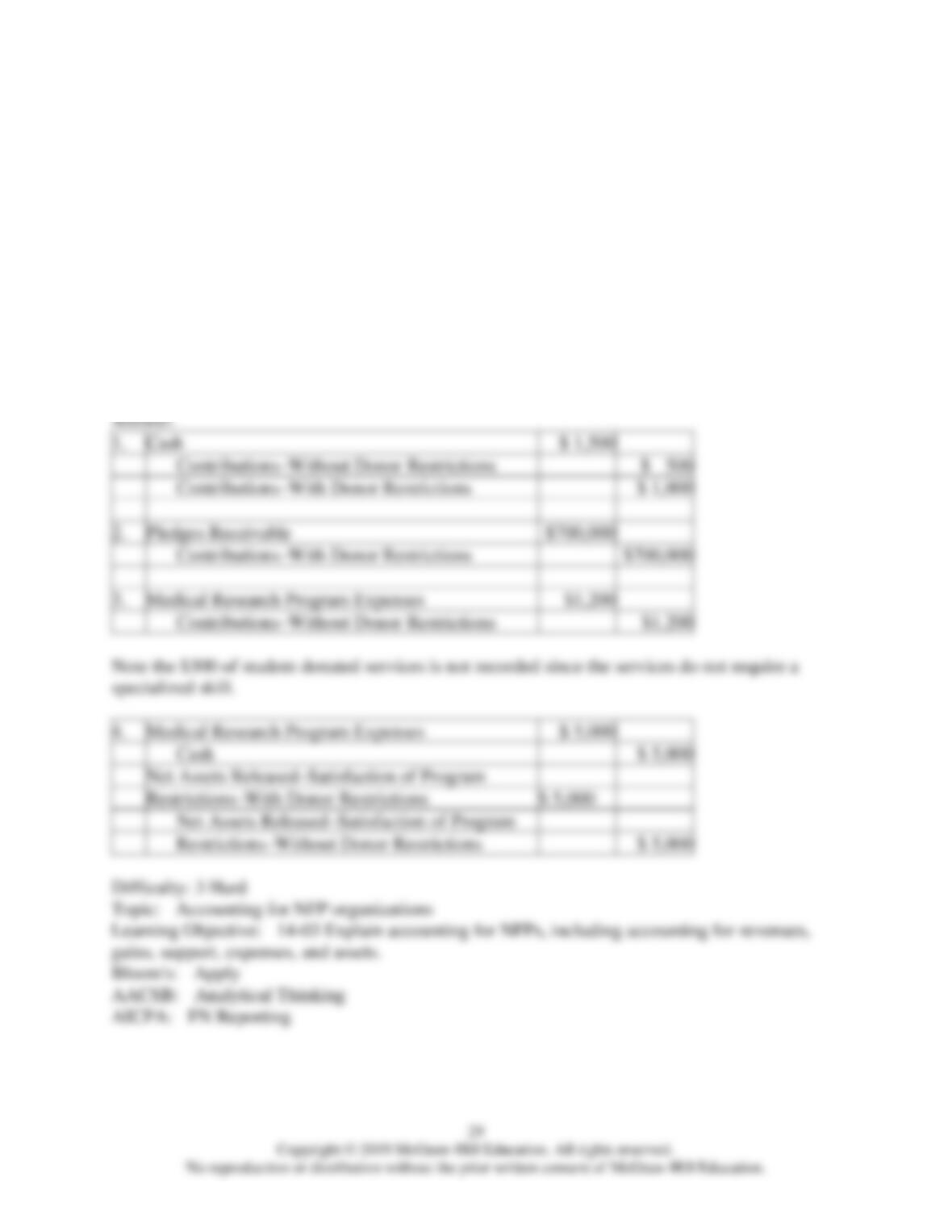
69) Record the journal entry that would be made by a nongovernmental, not-for-profit
organization involved in medical research. (If no entry is required for a transaction/event,
select “No Journal Entry Required” in the first account field.)
1. The entity received $1,500 in cash contributions. Of that amount, $1,000 is to be used for
medical research.
2. The entity received pledges of $700,000 for its endowment fund. All pledges will be collected
next year.
3. The entity received donated services of $1,200 from medical researchers who helped with the
entity’s on-going drug development research. It also received $300 in donated services from
students, who helped clean the research facilities.
4. The entity paid medical research operating expenses of $5,000 that were related to restricted net
assets it had received in prior years.
70) Explain the purpose of FASB ASC 958-720-45 on joint-cost accounting as it relates to
reporting fund-raising and program expenses of a not-for-profit organization. How is this standard
applied?
71) Distinguish not-for-profit organizations from entities in the government and commercial
sectors of the U.S. economy.
72) Distinguish between “support” and “revenues from exchange transactions.”
73) If the program services expenses category includes both directly related costs and indirect
costs allocated to it, why is it necessary to have a separate category of “supporting services
expenses”?
74) Would a not-for-profit library that receives the majority of its resources from a specific tax
levy on local citizens remitted to the city follow the same financial reporting principles as would a
library that operates without a dedicated tax and instead relies on contributions from individuals
and grants from foundations and governments? Explain.
75) Explain when donated materials should be recognized as a contribution and as an expense by a
nongovernmental not-for-profit organization.
76) Explain the accounting for contributions received by a financial intermediary under the FASB
Codification.

34
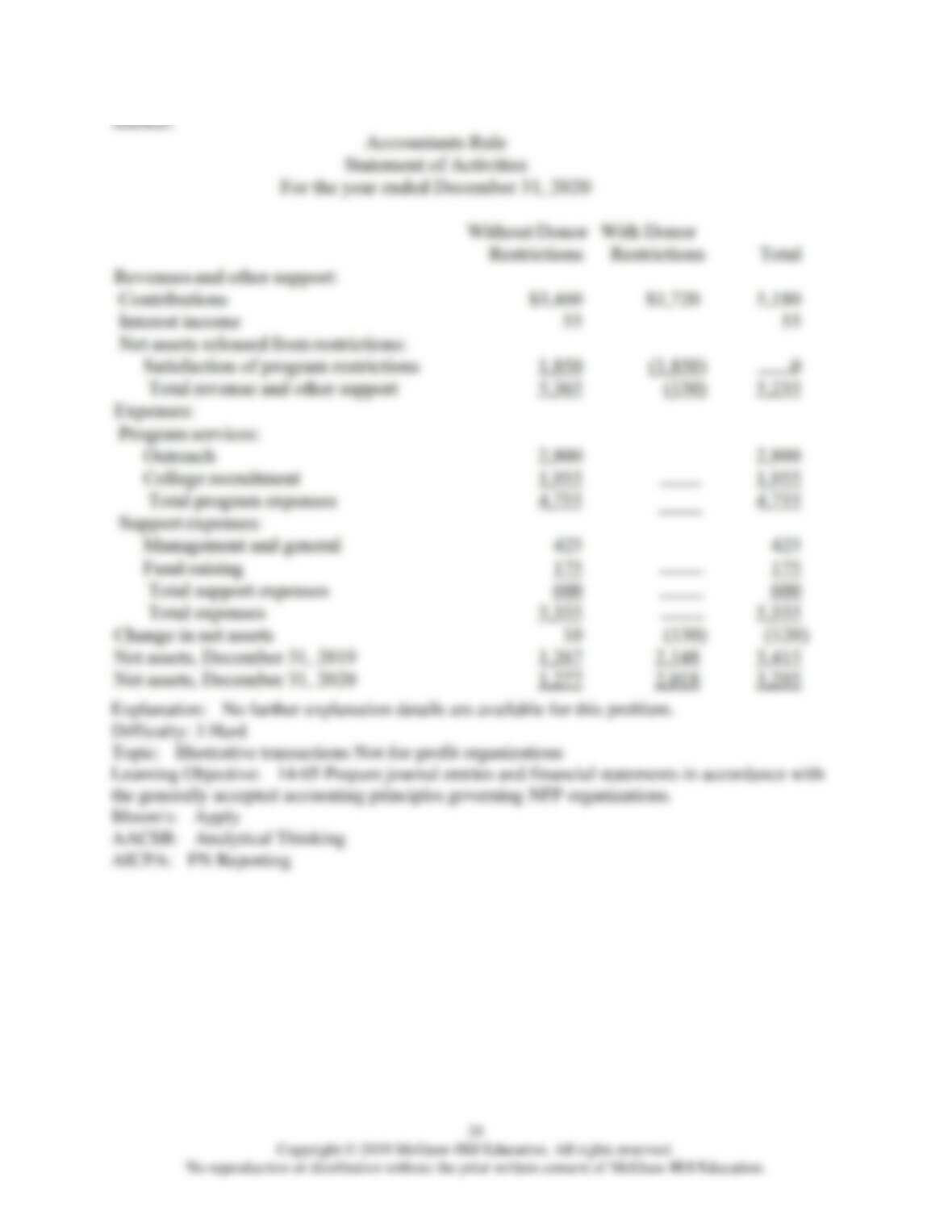
77) The not-for-profit organization Accountants Rule has a mission to promote the accounting
profession in the local community. It is heavily supported by local accounting firms and businesses
seeking to increase the number of individuals entering the profession. Following is the pre-closing
trial balance for the organization.
Debit
Credit
Cash and cash equivalents
$
985
Investments
$
2,605
Pledges receivable
$
830
Allowance for uncollectible pledges
$
35
Accounts payable and accrued liabilities
$
1,090
Net assets without donor restrictions
$
1,267
Net assets with donor restrictions
$
2,148
Contributions—without donor restrictions
$
3,460
Contributions—with donor restrictions
$
1,720
Interest income—without donor restrictions
$
55
Net assets released—satisfaction of program
restriction—without donor restrictions
$
1,850
Net assets released—satisfaction of program
restriction—with donor restrictions
$
1,850
Outreach expenses
$
2,800
College recruitment expenses
$
1,955
Management and general expenses
$
425
Fund-raising expenses
$
175
Total
$
11,625
$
11,625
Prepare a statement of activities for the organization for the year ended December 31, 2020.
(Negative amounts should be indicated by a minus sign.)
35
Copyright © 2019 McGraw-Hill Education. All rights reserved.
No reproduction or distribution without the prior written consent of McGraw-Hill Education.
Answer:
Explanation: No further explanation details are available for this problem.
Difficulty: 3 Hard
Topic: Illustrative transactions Not-for-profit organizations
Learning Objective: 14-05 Prepare journal entries and financial statements in accordance with
the generally accepted accounting principles governing NFP organizations.
Bloom’s: Apply
AACSB: Analytical Thinking
AICPA: FN Reporting