35) Which of the following is a measure of the extent to which the government’s business-type
activities are self-supporting?
A) Unrestricted net position/total revenues.
B) Business-type activities revenues/business-type activities expenses.
C) Total net position (governmental activities and business-type activities) less total net position at
the beginning of the year divided by total beginning net position.
D) Total revenues/total expenses.
36) A measure of whether the government lived within its means in the measurement year, or was
required to use prior year resources to fund a portion of current year costs, or shifted the funding of
some current year costs to future periods, is:
A) Business-type activities revenues/business-type activities expenses.
B) Unrestricted net position/total revenues.
C) Net revenues/total expenses.
D) Total net position (governmental activities and business-type activities) less total net position at
the beginning of the year divided by beginning net position.
37) A measure of the adequacy of the amount of the government’s total unrestricted net position or
deficit at the measurement date is:
A) Unrestricted net position/total revenues.
B) Business-type activities revenues/business-type activities expenses.
C) Total net position (governmental activities and business-type activities) less total net position at
the beginning of the year divided by beginning net position.
D) Net revenues/total expenses.
38) Which of the following is one of the most important reasons for evaluating a government’s
financial performance?
A) Determine if property taxes and other revenue sources should be increased.
B) Assign responsibility for success or failure of the government to certain parties.
C) Determine whether the government is accomplishing its mission.
D) Have an early warning of impending financial difficulty for a diverse set of decision makers.
39) Which of the following terms best describes a government’s ongoing ability and willingness to
meet its financial obligations and service commitments as they become due?
A) Financial condition.
B) Fiscal capacity.
C) Economic condition.
D) Financial position.
40) Political culture, such as attitudes towards taxes, is an example in the ICMA’s Financial Trend
Monitoring Systems of:
A) Environmental factors.
B) Organizational factors.
C) Financial factors.
D) Management practices and legislative policies.
41) Which of the following statements about credit analysts’ models is true?
A) Credit analysts focus primarily on demographic statistics and management’s long-term
investment strategies.
B) Credit analysts have access to the same set of information that internal managers use.
C) Credit analysts are concerned with assessing a government’s ability to pay interest and principal
on debt when due.
D) Credit analysts rarely use comprehensive annual financial reports.
42) For which of the following is a low or decreasing value of the item associated with a stronger
financial condition of a government entity?
A) Unfunded pension liability.
B) Property values.
C) Home ownership.
D) Employment rate.
43) Which ratio or concept describes the extent to which the government has lived within its means
for the year?
A) Debt to assets.
B) Interperiod equity.
C) Current ratio.
D) Revenue dispersion.
44) Which of the following financial capability indicators is a measure of a government’s capacity
to issue bonded debt?
A) Revenue dispersion.
B) Property taxes per capita.
C) Bonded debt per capita.
D) Available legal debt limit.
45) Which of the following governments would have publicly accessible information available
through the Electronic Municipal Market Access (EMMA)?
A) A city that had issued revenue bonds.
B) A county that has entered into a capital lease.
C) All state and local governments over 25,000 in population.
D) Those state and local governments who have issued debt subject to Securities and Exchange
Commission (SEC) oversight.
46) An investor could find all but one of the following pieces of information through the Electronic
Municipal Market Access (EMMA). Which of the following is not available on EMMA?
A) Credit rating for the debt issuance.
B) Comprehensive Annual Financial Report.
C) Interest rate and size of the debt issuance.
D) Credit report on the government issuing the debt.
47) Three major rating agencies (Fitch, Moody’s, and Standard and Poor‘s) for governments have
each developed quantitative tools for assessing credit risk. Which of the following general factors
is used by all three rating agencies in assessing credit risk?
A) Economy.
B) Budgetary flexibility.
C) Revenue dispersion.
D) Geographic location.
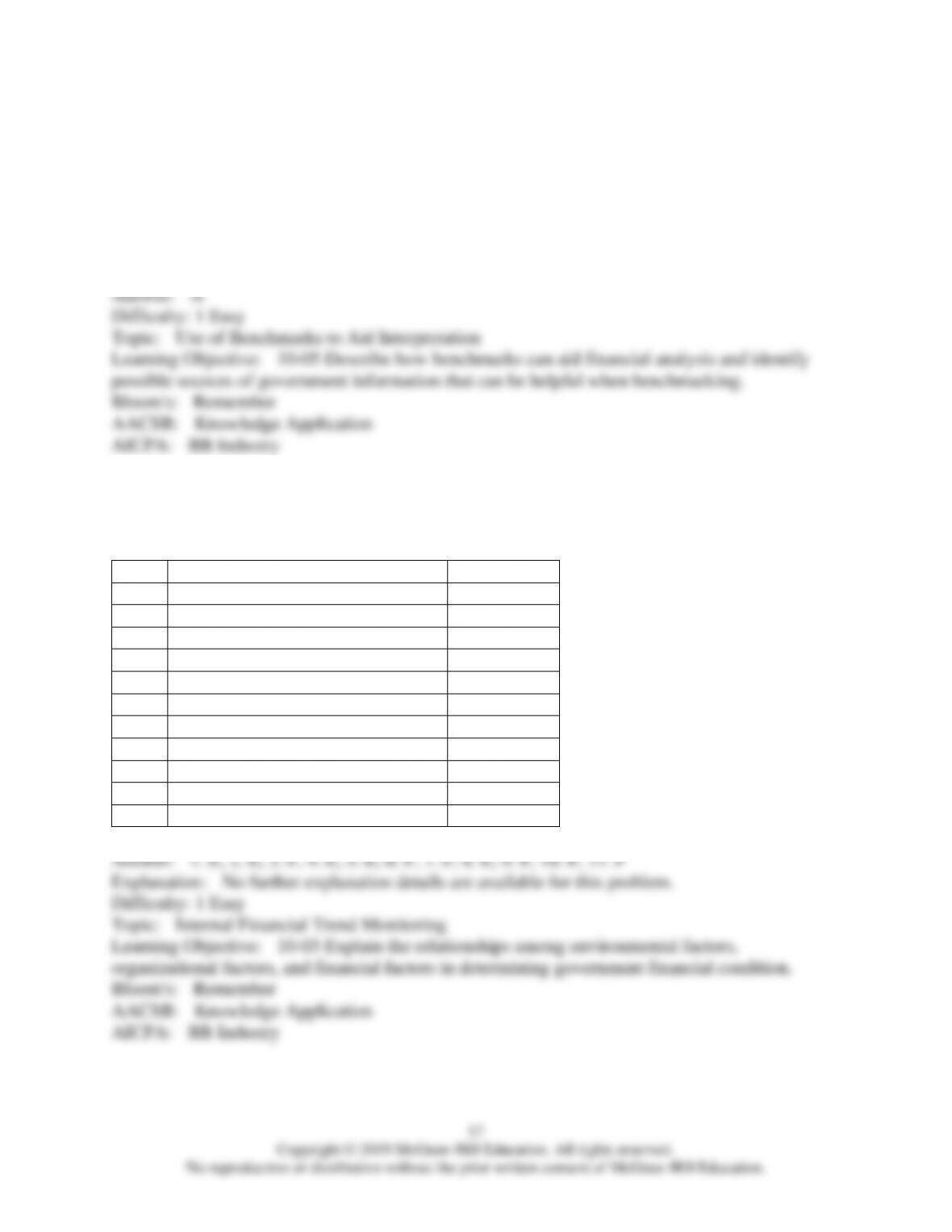
48)
Identify the following factors that affect financial condition as environmental factors (E) or
financial factors (F).
Factor
E or F
1.
Community needs and resources
________
2.
Disaster risk
________
3.
Revenues
________
4.
Intergovernmental constraints
________
5.
External economic conditions
________
6.
Expenditures
________
7.
Debt structure
________
8.
Political culture
________
9.
Unfunded liabilities
________
10.
Condition of capital plant
________
11.
Operating position
________