
40-101
Copyright © 2018 McGraw-Hill Education. All rights reserved. No reproduction or distribution without the prior
written consent of McGraw-Hill Education.
and trade add to a nations output.
Test Bank: II
Topic:
The Economic Basis for Trade
190. In a two-nation, two-good world, if both nations have identical production
possibilities curves with constant costs, then one nation would have
191. The principle of comparative advantage indicates that mutually beneficial
international trade can take place only when
192. In a two-nation world, comparative advantage in the production of a particular
product means that one nation can produce

40-102
Copyright © 2018 McGraw-Hill Education. All rights reserved. No reproduction or distribution without the prior
written consent of McGraw-Hill Education.
D. more of the product than the other nation.
193. In a two-nation, two-good world, which of the following statements is true?
194. In a two-nation, two-good world, if country A has the comparative advantage in
producing good X over country B, then country A

40-103
Copyright © 2018 McGraw-Hill Education. All rights reserved. No reproduction or distribution without the prior
written consent of McGraw-Hill Education.
and trade add to a nations output.
Test Bank: II
Topic : The Economic Basis for Trade
195. The benefits to trading nations based on comparative advantage accrue from
196. The principal concept behind comparative advantage is that a nation should
197. Specialization and trade based on comparative advantage allow nations to attain the
following results, except

198. The domestic opportunity cost of producing a television in the United States is 20
bushels of wheat. In Korea, the domestic opportunity cost of producing a television is 10
bushels of wheat. In this case,
199. The domestic opportunity cost of producing 100 barrels of chemicals in Germany is
one ton of steel. In France, the domestic opportunity cost of producing 100 barrels of
chemicals is two tons of steel. In this case,

40-105
Copyright © 2018 McGraw-Hill Education. All rights reserved. No reproduction or distribution without the prior
written consent of McGraw-Hill Education.
and trade add to a nations output.
Test Bank: II
Topic : The Economic Basis for Trade
200. Nation A pays lower wages to workers than Nation B. Nation A also uses fewer
capital goods per worker than Nation B. This suggests that gains from trade are likely to
result if
201. Employing all its available resources, Nation Alpha can produce either 800 units of
chemicals or 1,600 units of clothing. Nation Beta can produce either 200 units of chemicals
or 800 units of clothing.

40-106
202. The production possibilities for country X are either 6,000 bushels of soybeans or
10,000 bushels of wheat. The production possibilities for country Y are either 2,000
bushels of soybeans or 4,000 bushels of wheat. Which of the following is true?
203. If countries A and B produce only either rubber bands or paper clips, their maximum
outputs are shown in the accompanying production possibilities schedules.
Country
Rubber
Bands
Paper Clips
A
40
80
B
10
40
In country A the opportunity cost of 1 paper clip is
204. In Germany, one worker can produce either one cuckoo clock or one beer mug. In

40-107
Taiwan, one worker can produce either two cuckoo clocks or three beer mugs. Who has the
comparative advantage in each good?
205.
Machines
Wine
France
3
1
Germany
1
1
The accompanying table shows the output (either machines or wine) that each unit of input
in France and Germany can produce. We see that
206.
Machines
Wine
France
3
1

40-108
Germany
1
1
The accompanying table shows the output (either machines or wine) that each unit of input
in France and Germany can produce. We see that
207.
Wine
Machines
Brazil
30
10
Poland
10
10
The accompanying table gives maximum-output alternatives for Brazil and Poland. It can
be seen that if the two nations open up trade with each other, then
208.

Meat Per
Worker Per
Day
Houses Per
Worker Per
Day
A
40
80
B
10
40
The accompanying table shows labor-productivity figures in two countries facing constant
costs. It can be deduced that
209.
Meat Per
Worker Per
Day
Houses Per
Worker Per
Day
A
40
80
B
10
40
The accompanying table shows labor-productivity figures in two countries facing constant
costs. It can be deduced that

40-110
Copyright © 2018 McGraw-Hill Education. All rights reserved. No reproduction or distribution without the prior
written consent of McGraw-Hill Education.
and trade add to a nations output.
Test Bank: II
Topic:
The Economic Basis for Trade
210.
Wheat
(Bushels)
Rice
(Bushels)
India
10
10
Canada
40
20
The accompanying productivity table shows how many bushels of either wheat or rice can
be produced in India and Canada with 1 unit of input. To achieve gains from specialization
and trade,
211. Nation Alpha has a comparative advantage in product X, and nation Beta has a
comparative advantage in product Y. Trade in the two products will only benefit the two
nations if
40-111
Copyright © 2018 McGraw-Hill Education. All rights reserved. No reproduction or distribution without the prior
written consent of McGraw-Hill Education.
Test Bank: II
Topic : The Economic Basis for Trade
212.
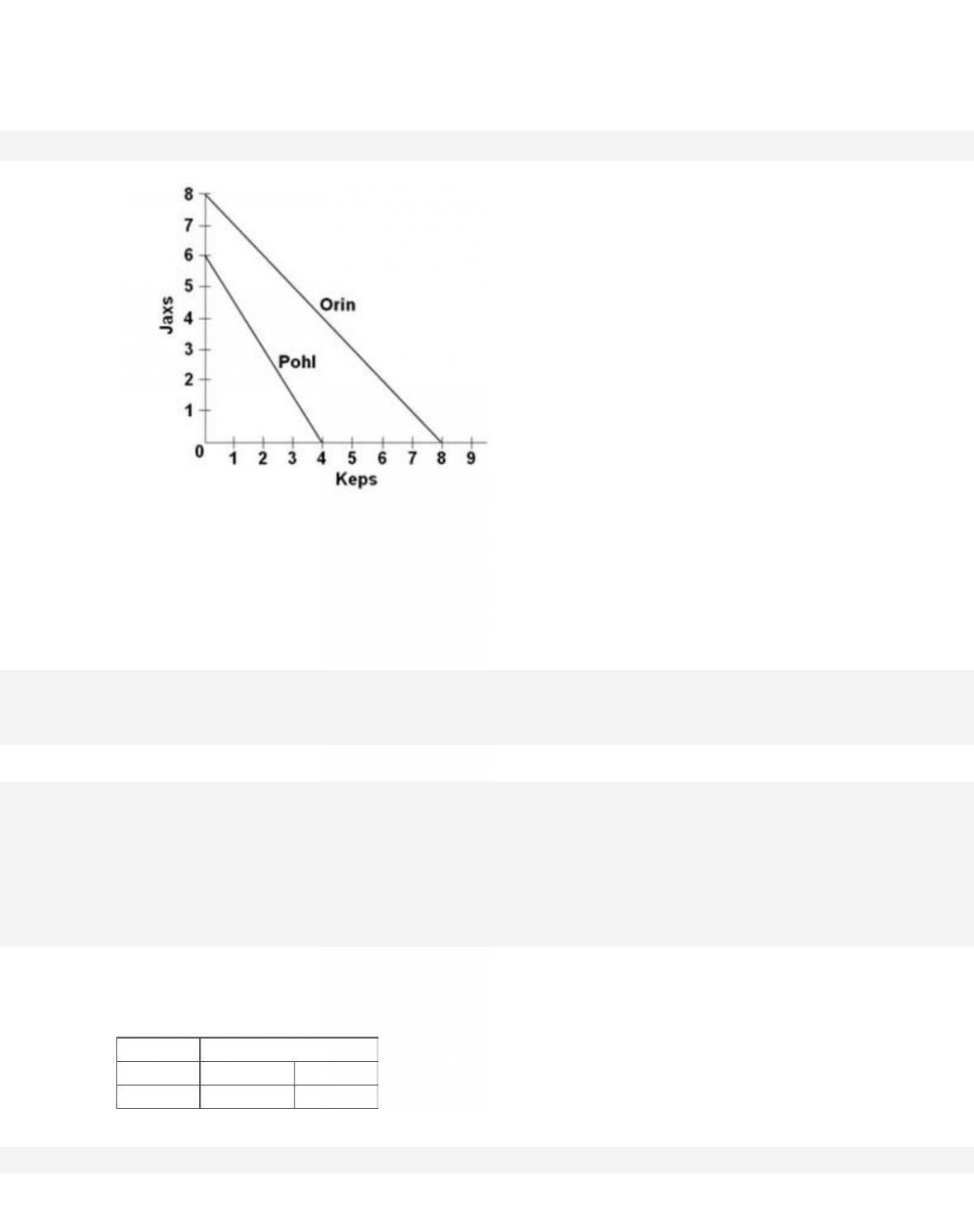
The graph shows the production possibilities curves for two hypothetical nations, Orin and
Pohl, which each make two hypothetical products, jaxs and keps. Which of the following
statements is correct?
213. If Nations Quirk and Turk only produce aluminum or oil, the accompanying table
shows the maximum output of each nation.
Output (Units)
Nations
Aluminum
Oil
Quirk
20
40
Turk
30
90
Which one of the following terms of trade is most likely to produce mutually beneficial
exchange between the two nations?
214.
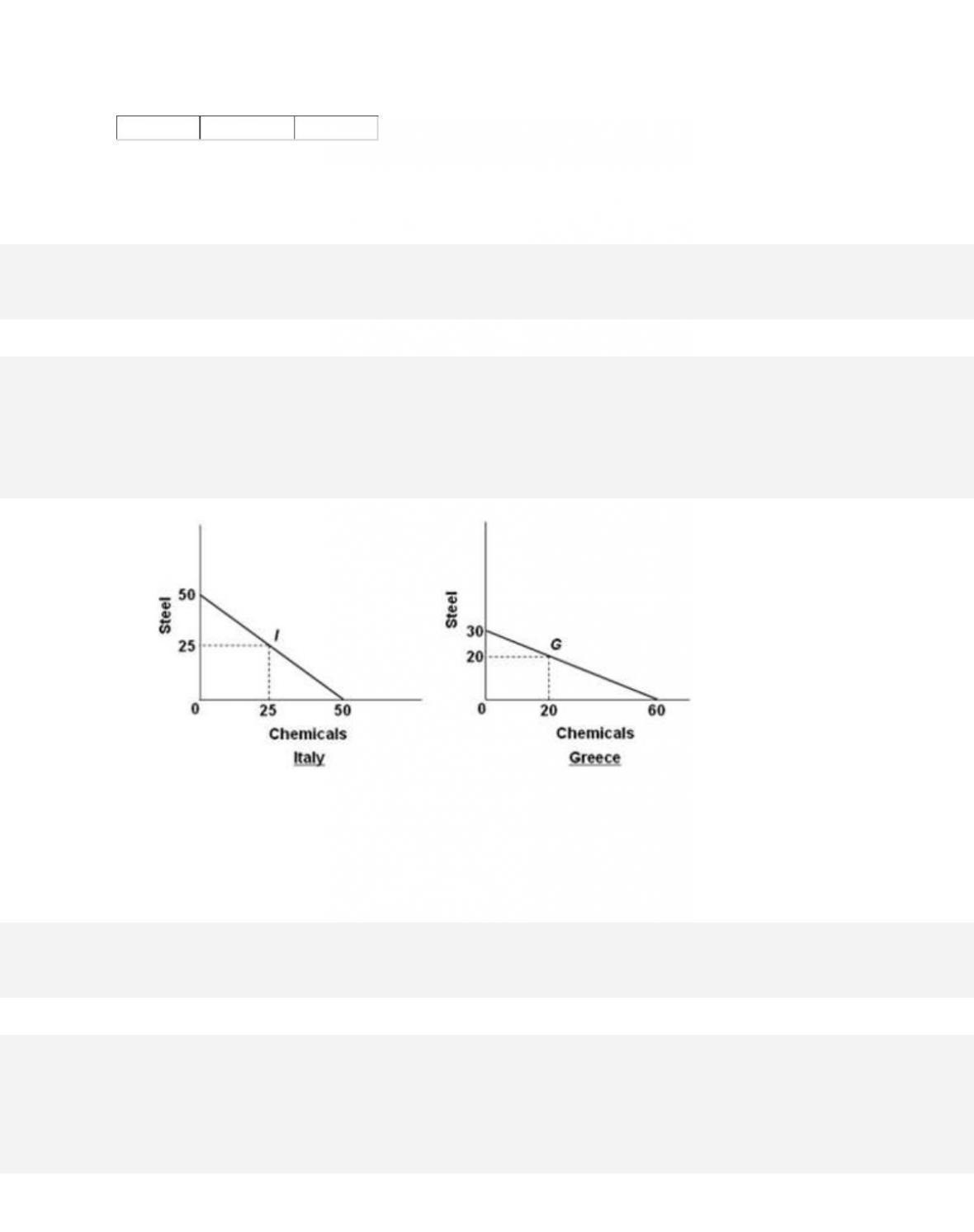
Suppose the world economy is composed of just two countries: Italy and Greece. Each can
produce steel or chemicals, but at different levels of economic efficiency. The production
possibilities curves for the two countries are shown in the graphs. It can be deduced that
40-113
Copyright © 2018 McGraw-Hill Education. All rights reserved. No reproduction or distribution without the prior
written consent of McGraw-Hill Education.
and trade add to a nations output.
Test Bank: II
Topic:
The Economic Basis for Trade
Type: Graph
215.
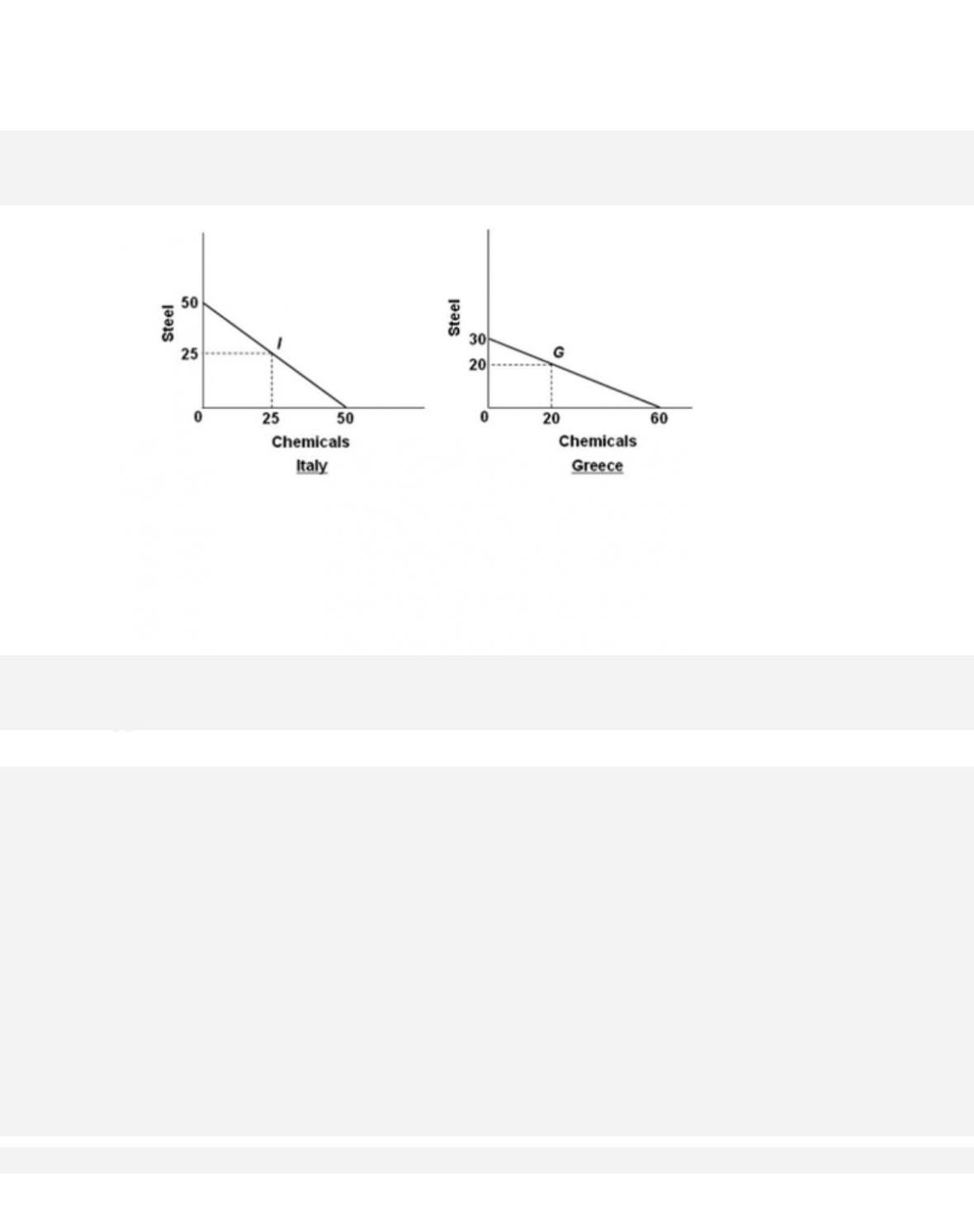
Suppose the world economy is composed of just two countries: Italy and Greece. Each can
produce steel or chemicals, but at different levels of economic efficiency. The production
possibilities curves for the two countries are shown in the graphs. If Italy and Greece
open up trade with each other, which of the following terms of trade is mutually beneficial?
40-114
216.
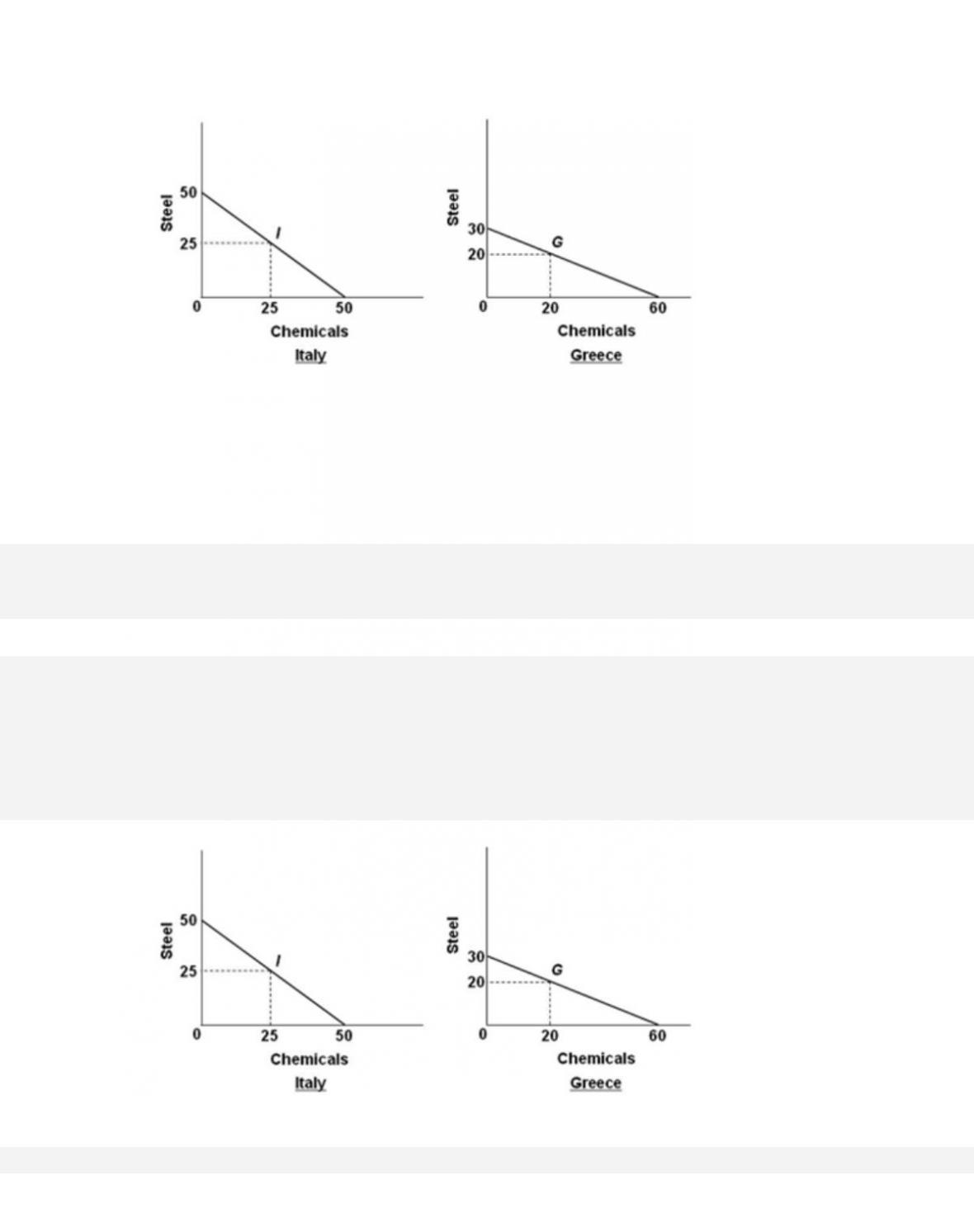
Suppose the world economy is composed of just two countries: Italy and Greece. Each can
produce steel or chemicals, but at different levels of economic efficiency. The production
possibilities curves for the two countries are shown in the graphs. The assumption made
about the domestic production opportunity costs in both countries is that they are
217.

Suppose the world economy is composed of just two countries: Italy and Greece. Each can
produce steel or chemicals, but at different levels of economic efficiency. The production
possibilities curves for the two countries are shown in the graphs. Assume that prior to
specialization and trade, Italy and Greece preferred points I and G on their respective
production possibilities curves. As a result of complete specialization according to
comparative advantage, the resulting gains in total output will be
218.
Wat’s Production Possibilities
Product
A
B
C
D
E
F
Rice
750
600
450
300
150
0
Corn
0
50
100
150
200
250
Xat’s Production Possibilities
Product
A
B
C
D
E
F
Rice
2,500
2,000
1,500
1,000
500
0
Corn
0
100
200
300
400
500
The hypothetical nations Wat and Xat have the production possibilities for rice and corn
given in the accompanying tables. Which of the following statements about the two nations
is correct based on the principle of comparative advantage?

40-116
Copyright © 2018 McGraw-Hill Education. All rights reserved. No reproduction or distribution without the prior
written consent of McGraw-Hill Education.
D. Xat has a comparative advantage in the production of corn.
219.
Wat’s Production Possibilities
Product
A
B
C
D
E
F
Rice
750
600
450
300
150
0
Corn
0
50
100
150
200
250
Xat’s Production Possibilities
Product
A
B
C
D
E
F
Rice
2,500
2,000
1,500
1,000
500
0
Corn
0
100
200
300
400
500
The hypothetical nations Wat and Xat have the production possibilities for rice and corn
given in the accompanying tables. The mutually beneficial terms of trade will be
220.
Wat’s Production Possibilities
Product
A
B
C
D
E
F

40-117
Rice
750
600
450
300
150
0
Corn
0
50
100
150
200
250
Xat’s Production Possibilities
Product
A
B
C
D
E
F
Rice
2,500
2,000
1,500
1,000
500
0
Corn
0
100
200
300
400
500
The hypothetical nations Wat and Xat have the production possibilities for rice and corn
given in the accompanying tables. Assume that Wat originally produced rice and corn at
combination C and that Xat originally produced combination B. If the nations now fully
specialize based on comparative advantage, the total gains from specialization and trade
are
221.
Germany Production Possibilities
(Production Alternatives)
Product
A
B
C
D
E
F
Autos
0
4
8
12
16
20
Chemicals
40
32
24
16
8
0
U.S. Production Possibilities
(Production Alternatives)
Product
A
B
C
D
E
F
Autos
0
3
6
9
12
15
Chemicals
60
48
36
24
12
0

The data in the accompanying production possibilities tables (in millions of units) suggest
that production in
222.
Germany Production Possibilities
(Production Alternatives)
Product
A
B
C
D
E
F
Autos
0
4
8
12
16
20
Chemicals
40
32
24
16
8
0
U.S. Production Possibilities
(Production Alternatives)
Product
A
B
C
D
E
F
Autos
0
3
6
9
12
15
Chemicals
60
48
36
24
12
0
Refer to the accompanying production possibilities tables. Data are in millions of units. If
Germany and the United States engage in trade, the mutually beneficial terms of trade will
be between

40-119
223.
Germany Production Possibilities
(Production Alternatives)
Product
A
B
C
D
E
F
Autos
0
4
8
12
16
20
Chemicals
40
32
24
16
8
0
U.S. Production Possibilities
(Production Alternatives)
Product
A
B
C
D
E
F
Autos
0
3
6
9
12
15
Chemicals
60
48
36
24
12
0
Refer to the accompanying production possibilities tables. Data are in millions of units.
Assume that prior to specialization and trade, Germany and the United States both choose
production possibility C. Now if each specializes according to its comparative advantage,
the resulting gains from specialization and trade will be
224.

Germany Production Possibilities
(Production Alternatives)
Product
A
B
C
D
E
F
Autos
0
4
8
12
16
20
Chemicals
40
32
24
16
8
0
U.S. Production Possibilities
(Production Alternatives)
Product
A
B
C
D
E
F
Autos
0
3
6
9
12
15
Chemicals
60
48
36
24
12
0
Refer to the accompanying production possibilities tables. Data are in millions of units.
Suppose that each nation specialized in producing the product for which it has a
comparative advantage and the terms of trade were set at 3 units of chemicals for 1 unit of
autos. In this case, Germany could obtain and consume a maximum combination of 8
million units of autos and
225. In a world with two products, wheat (W) and coffee (C), nation Alpha produces wheat
and nation Beta produces coffee. Nation Alpha prefers an exchange rate of 1W = 2C, and
nation Beta prefers an exchange rate of 1W = 1C. The exchange rate preferred by nation