Chapter 02 The Market System and the Circular Flow Answer Key
Multiple Choice Questions
1.
Which of the following is a distinguishing feature of a command system?
A.
private ownership of all capital
2.
Which of the following is a distinguishing feature of laissez-faire capitalism?
A.
public ownership of all capital
3.
Examples of command economies are
A.
the United States and Japan.
2-2
4.
Of the following countries, which one best exhibits the characteristics of a market
economy?
D.
Belarus
5.
The French term “laissez-faire” means
A.
“there is no free lunch.“
6.
An economic system
2-3
A.
requires a grouping of private markets linked to one another.
7.
The term “laissez-faire” suggests that
A.
land and other natural resources should be privately owned, but capital should be
publicly owned.
B.
land and other natural resources should be publicly owned, but capital should be
privately owned.
8.
Economic systems differ according to which two main characteristics?
C.
how goods are produced and who gets them
D.
the political system in place and the degree of scarcity facing the economy
2-4
9.
Command systems are also known as
A.
market systems.
B.
pure capitalism.
10.
A fundamental difference between the command system and laissez-faire capitalism
is that, in command systems,
C.
scarcity does not exist, whereas it does in laissez-faire capitalism.
D.
money is not used, whereas it is in laissez-faire capitalism.
11.
Which of the following is not a typical characteristic of a market system?
A.
private property
12.
Which of the following is a fundamental characteristic of the market system?
D.
government–set wages and prices
13.
Property rights are important because they
A.
ensure an equal distribution of income.
14.
Private property
A.
discourages cooperation because people don’t want to part with what they own.
B.
discourages innovation, as people are often afraid to risk losing their own property.
15.
Copyrights and trademarks are examples of
A.
capital goods.
B.
human capital.
16.
Freedom of enterprise
A.
is a characteristic that is common to most economic systems.
B.
in a market system means that entrepreneurs can obtain and use economic resources
without any legal restraint.
17.
The main mechanism that regulates the market system is
A.
self-interest.
18.
Broadly defined, competition involves
A.
private property and freedom of expression.
19.
Competition means that
A.
sellers can manipulate market price by causing product scarcities.
2-8
Copyright © 2018 McGraw-Hill Education. All rights reserved. No reproduction or distribution without the prior
written consent of McGraw-Hill Education.
AACSB: Knowledge Application
Ac c e ss i b il i ty : Keyboard Navigation
Blooms: Remember
Dif f ic u lty :
01 Easy
Learning Objective: 02–02 List the main characteristics of the market system.
Test Bank: I
To p i c :
Characteristics of the Market System
20.
The division of labor means that
A.
labor markets are geographically segmented.
21.
Specialization in production is important primarily because it
D.
allows society to have fewer capital goods.
22.
Specialization—the division of labor—enhances productivity and efficiency by
A.
allowing workers to take advantage of existing differences in their abilities and
skills.
2-9
23.
Specialization in production is economically beneficial primarily because it
A.
allows everyone to have a job that he or she likes.
24.
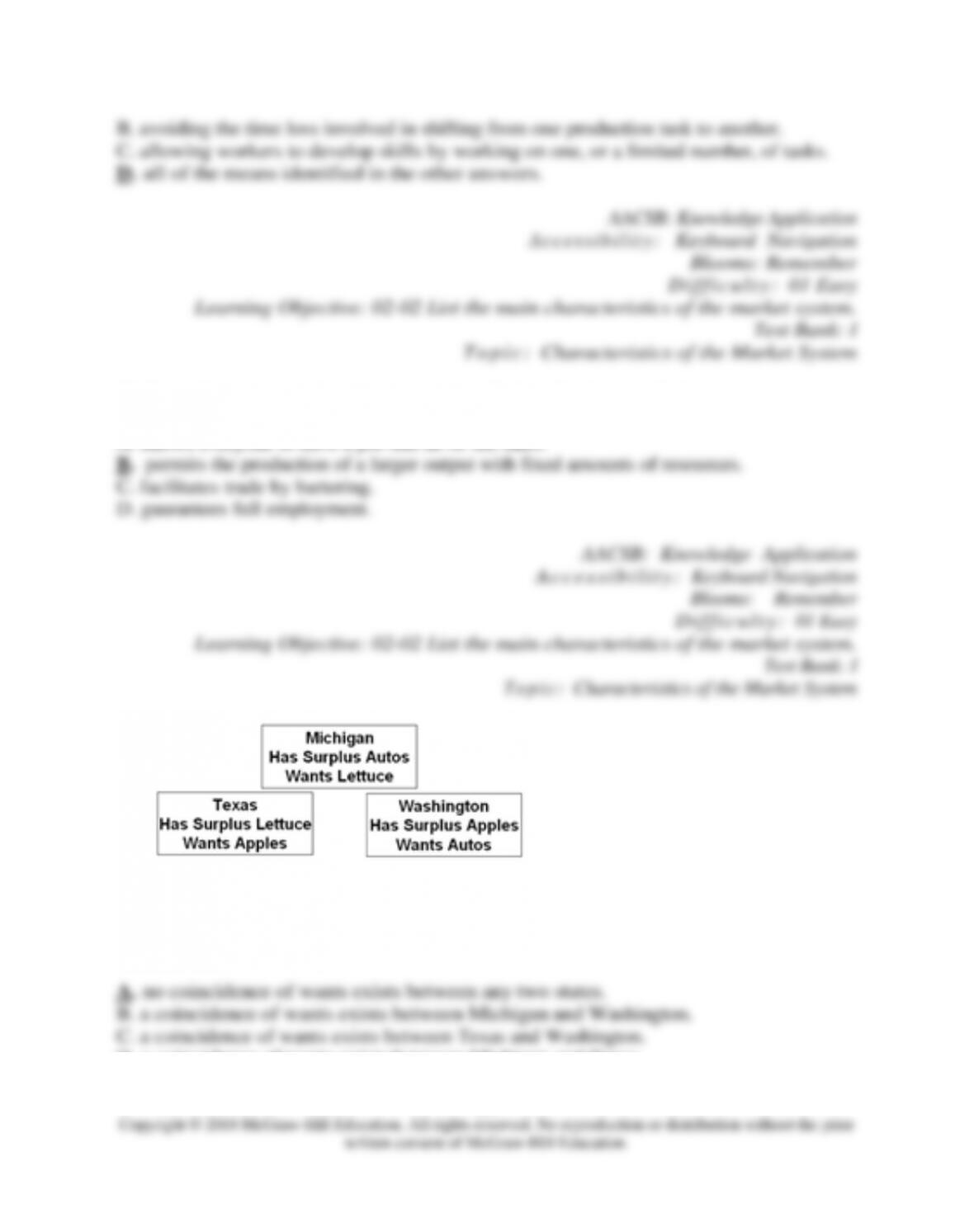
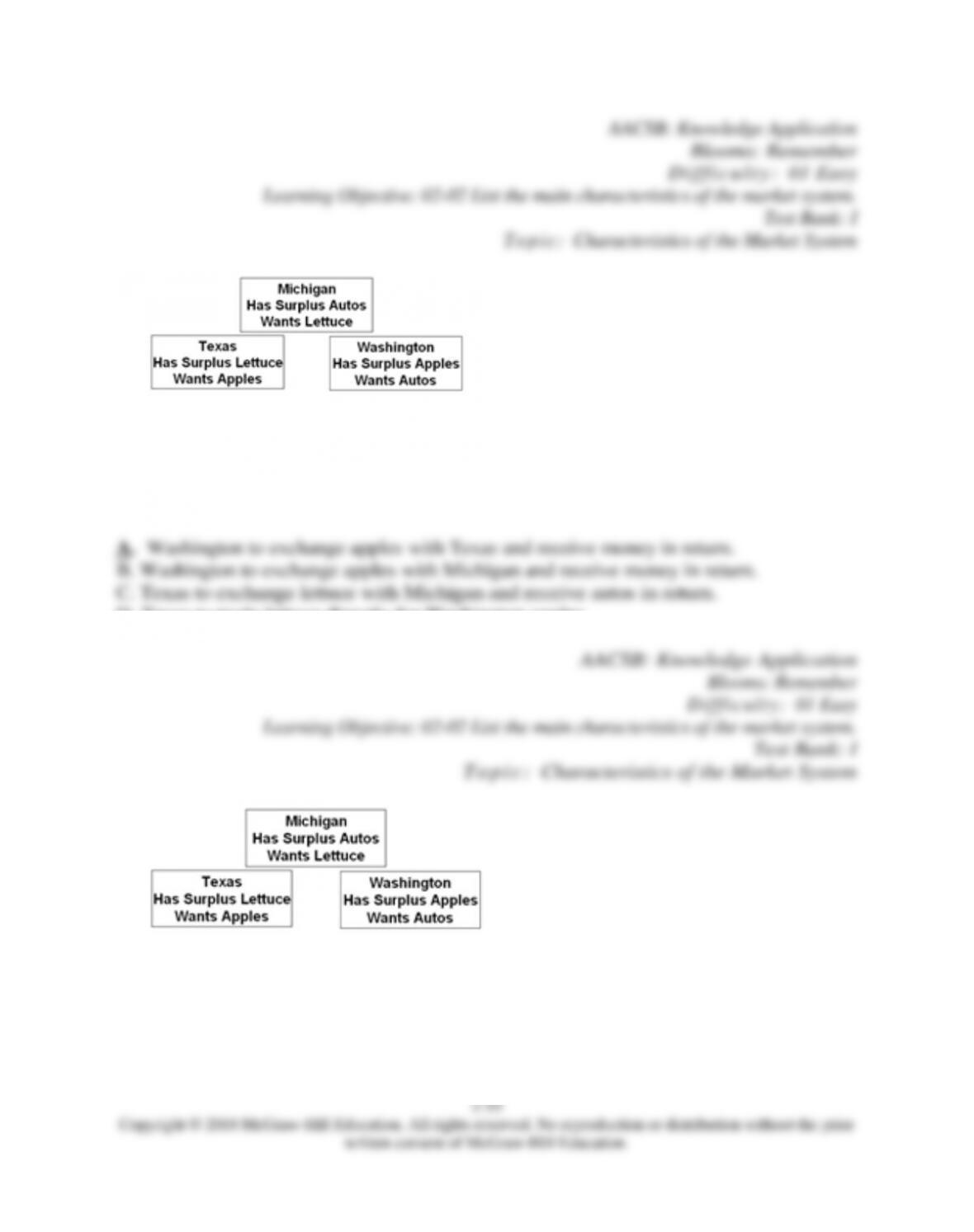
On the basis of the information, it can be said that
D.
a coincidence of wants exists between Michigan and Texas.
25.
On the basis of the information, and assuming trade occurs between the three states, we
can expect
D.
Texas to trade lettuce directly for Washington apples.
26.
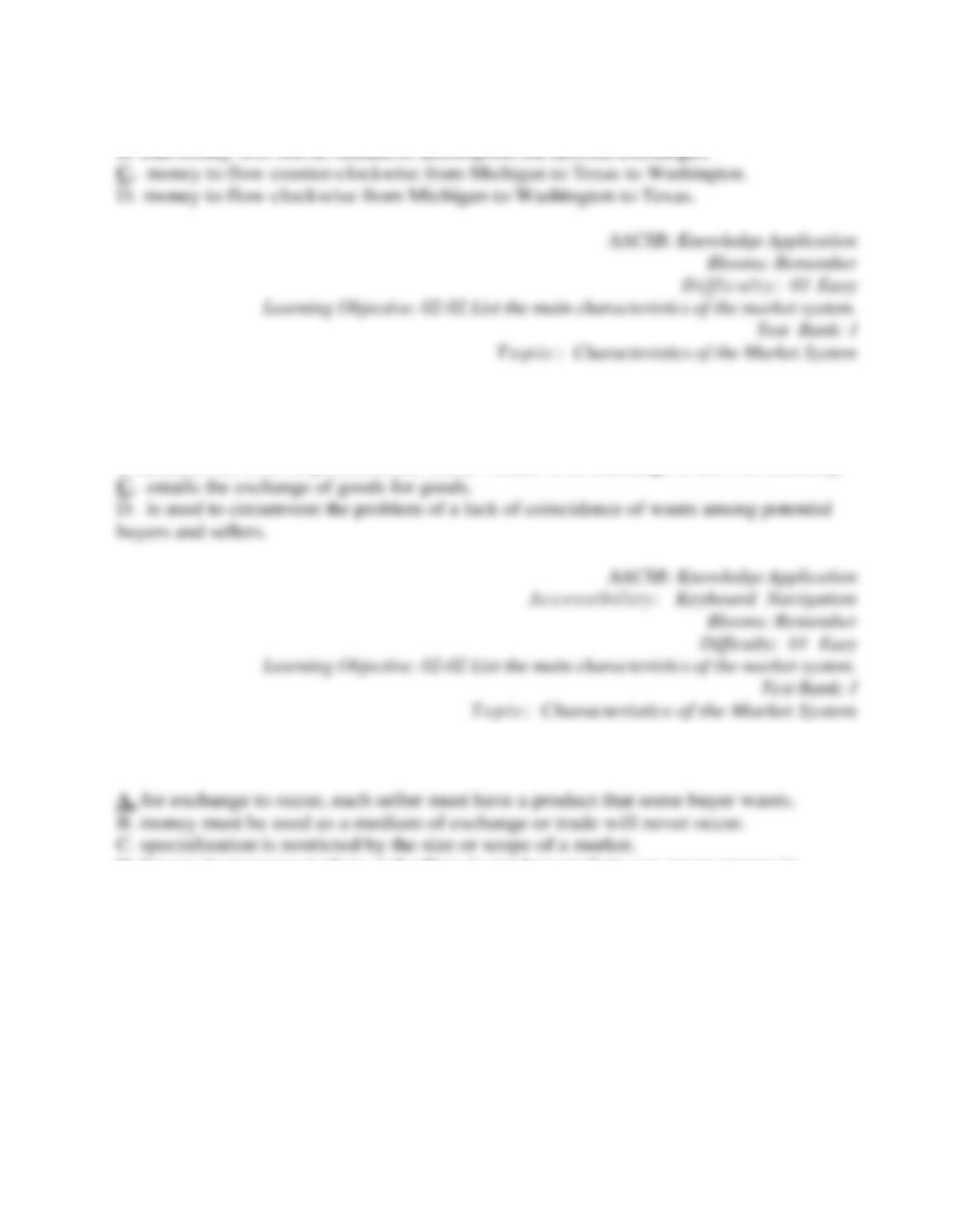
Given the information, and assuming trade occurs between the three states, we can expect
A.
that there is no means by which Michigan can obtain lettuce while specializing in the
2-11
Copyright © 2018 McGraw-Hill Education. All rights reserved. No reproduction or distribution without the prior
written consent of McGraw-Hill Education.
production of autos.
B.
that money will not be needed to accomplish the desired exchanges.
27.
Barter
A.
is the major means of exchange in centrally planned economies.
B.
accounts for over 30 percent of the dollar volume of all exchange in the U.S. economy.
28.
The “coincidence of wants” problem associated with barter refers to the fact that
D.
buyers in resource markets and sellers in product markets can never engage in
exchange.
AACSB: Knowledge Application
Ac c e ss i b il i ty : Keyboard Navigation
Blooms: Remember
Difficulty: 01 Easy
Learning Objective: 02–02 List the main characteristics of the market system.
Test Bank: I
To p i c :
Characteristics of the Market System
2-12
29.
The use of money contributes to economic efficiency because
A.
governmental direction of the production and distribution of output can be avoided by
using money.
30.
The presence of market failures implies that
31.
Which of the following characteristics is least unique to a market system?
A.
private ownership of property resources
B.
competition among buyers and sellers pursuing monetary returns
2-13
32.
Which of the following is one of the Five Fundamental Questions?
A.
Which products will be in scarce supply and which in excess supply?
33.
If competitive industry Z is making substantial economic profit, output will
A.
fall in industry Z and firms will likely leave the market.
34.
From society’s point of view, the economic function of profits and losses is to
2-14
A.
promote the equal distribution of real assets and wealth.
35.
In a market economy, a significant change in consumers’ desire for product X will
A.
alter the profits or losses received by suppliers of product X.
B.
cause a reallocation of scarce resources.
36.
Economic profits in an industry suggest the industry
A.
can earn more profits by increasing product price.
37.
Economic profits and losses
A.
are both considered by economists to be a part of production costs.
38.
If consumer desire for product X increases, all of the following will occur except
A.
an increase in the profits of industry X.
B.
an increase in the quantity of resources employed by industry X.
2-16
Copyright © 2018 McGraw-Hill Education. All rights reserved. No reproduction or distribution without the prior
written consent of McGraw-Hill Education.
AACSB: Knowledge Application
A c c e s s i b i l i t y :
Keyboard Navigation
Blooms: Understand
Dif f ic u lty : 02 Medium
Learning Objective: 02–03 Explain how the market system answers the five fundamental
questions of what to produce, how to produce, who obtains the output, how to adjust to change,
and how to promote progress.
Learning Objective: 02-04 Explain the operation of the invisible hand and why market
economies usually do a better job than command economies at efficiently transforming
economic resources into desirable output.
Test Bank: I
Topic: Five Fundamental Questions
T o p i c : The Invisible Hand
39.
An increase in consumer desire for strawberries is most likely to
D.
reduce the need for strawberry pickers.
40.
If competitive industry Y is incurring substantial losses, output will
A.
expand as resources move toward industry Y.
B.
contract as resources move toward industry Y.
41.
The economic function of profits and losses is to
A.
bring about a more equal distribution of income.
42.
If a competitive industry is neither expanding nor contracting, we would expect
A.
total revenue to be zero.
43.
The competitive market system
A.
encourages innovation because government provides tax breaks and subsidies to
those who develop new products or new productive techniques.
44.
In a market economy, the distribution of output will be determined primarily by
A.
consumer needs and preferences.
2-19
Copyright © 2018 McGraw-Hill Education. All rights reserved. No reproduction or distribution without the prior
written consent of McGraw-Hill Education.
45.
The most efficient combination of resources in producing a given output is the
combination that
A.
comes closest to using the same quantities of land, labor, capital, and entrepreneurial
46.
Firms are motivated to minimize production costs because
A.
it is the most environmentally friendly way to produce goods.
B.
least-cost production techniques use the smallest total quantity of resources.
47.
Answer the question using the following data, which show all available techniques
for producing 20 units of a particular commodity
Possible production
Resource
Resource prices
Techniques
#1
#2
#3
#4
#5
Land
$4
2
4
2
4
4
Labor
3
1
2
4
1
3
Capital
3
5
2
3
1
2
Entrepreneurial Ability
2
3
1
1
4
1
In view of the indicated resource prices, the economically most efficient production
technique(s) is (are) technique(s)
A. 1.
48. Answer the question using the following data, which show all available techniques for
producing 20 units of a particular commodity
Resource
Resource prices
Possible production
Techniques
#1
#2
#3
#4
#5
Land
$4
2
4
2
4
4
Labor
3
1
2
4
1
3
Capital
3
5
2
3
1
2
Entrepreneurial Ability
2
3
1
1
4
1
Assuming that the firm is motivated by self-interest and that the 20 units that can be
produced with each technique can be sold for $2 per unit, the firm will