
3-71
36. In the space below each of the following, indicate the effect [increase (+), decrease (−)] on equilibrium
price (P) and equilibrium quantity (Q) of each of these changes in demand and/or supply.
P Q
(a) Increase in demand, supply constant ________ ________
(b) Increase in supply, demand constant ________ ________
(c) Decrease in demand, supply constant ________ ________
(d) Decrease in supply, demand constant ________ ________
37. In the spaces below each of the following, indicate the [increase (+), decrease (−), or indeterminant (?)]
on equilibrium price (P) and equilibrium quantity (Q) of each of these changes in demand and/ or supply.
P Q
(a) Increase in demand, increase in supply ________ ________
(b) Increase in demand, decrease in supply ________ ________
(c) Decrease in demand, decrease in supply ________ ________
(d) Decrease in demand, increase in supply ________ ________
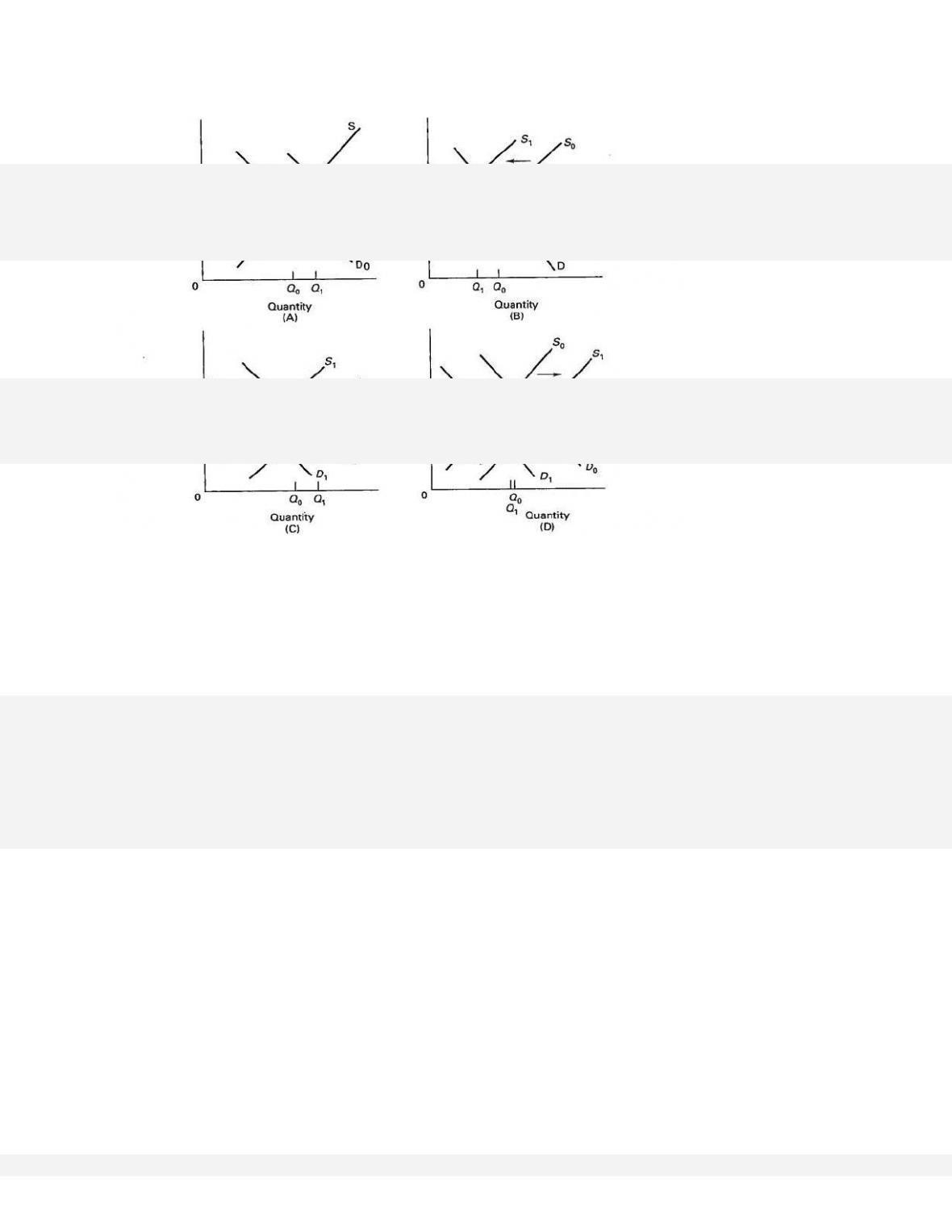
38. In each case below, indicate the effect [increase (+); decrease (−); indeterminant (ind)] upon equilibrium
price (P) and equilibrium quantity (Q) and illustrate the change graphically. Where you believe the effect
is indeterminant, two graphical illustrations may be necessary to demonstrate your point.
P Q
(a) Increase in demand, supply constant ________ ________
(b) Decrease in supply, demand constant ________ ________
(c) Decrease in demand, decrease in supply ________ ________
(d) Decrease in demand, increase in supply ________ ________
3-72
39. Given the products below and the events that affect them, indicate what happens to demand or supply, and
the equilibrium price and quantity in a competitive market. Identify the determinant of demand or supply
that causes the shift.
(a) Blue jeans. The wearing of blue jeans becomes less fashionable among consumers.
(b) Computers. Parts for making computers fall in price because of improvements in technology.
(c) Lettuce. El Nino produces heavy rains that destroy a significant portion of the lettuce crop.
(d) Chicken. Beef prices rise because severe winter weather reduces cattle herds.

3-73
40. Given the products below and the events that affect them, indicate what happens to demand or supply, and
the equilibrium price and quantity in a competitive market. Identify the determinant of demand or supply
that causes the shift.
(a) Digital cameras. There are improvements in the technology that increase the economic efficiency of
production.
(b) Automobiles. Consumer incomes rise as the economy moves out of recession.
(c) Beef. Chicken prices fall because of a decline in the cost of feeding chickens.
(d) Fast-food meals. The government imposes a significant tax on fast-food meals.
41. Given the products below and the events that affect them, indicate what happens to demand, supply,
equilibrium quantity, and equilibrium price in a competitive market. Identify the determinant of demand
and supply that causes the shifts.
(a) Calculators. More schools require students to buy and use calculators; improved productivity shortens
the time it takes to make calculators.
(b) Gasoline. Oil production declines due to a crisis in the Middle East; people take more car vacations
and drive more.
(c) New homes. The average incomes fall as the economy moves into recession; the productivity of home
construction workers and builders increases.
(d) Tobacco. The government cut its subsidy to tobacco farmers; more people quit smoking.
(a) The demand for calculators increases because of an increase in the number of buyers. The supply of

3-74
42. Given the products below and the events that affect them, indicate what happens to demand, supply,
equilibrium quantity, and equilibrium price in a competitive market. Identify the determinant of demand
and supply that causes the shifts.
(a) Home heating oil. There is a severe winter in the regions using the oil; the cost of a barrel of oil rises
for producers of home heating oil.
(b) Organic foods. People become more concerned about chemical additives in food; traditional farms are
switching to more organic methods.
(c) Film cameras. The price of digital cameras falls for consumers; there is a decline in the number of
stores selling film cameras.
(d) Bread. Many consumers adopt a low carbohydrate diet and avoid bread products; the price of flour
falls for bread producers.
(a) The demand for home heating oil increases because of an increase in the number of buyers. The
supply of home heating oil decreases because of an increase in resource prices. The equilibrium price
increases, but what happens to the equilibrium quantity is indeterminant and depends on the
43. (Consider This) Suppose a salsa manufacturers sells 1 million bottles of salsa at $4 a bottle in year 1; 2
million bottles at $5 in year 2; and 3 million bottles at $6 in year 3. Do these data show that the law of
demand does not hold? Explain.
The law of demand says that as price rises, the quantity consumed should decline assuming that all other
things remain constant. In the case of salsa, the reason that quantity consumed increases with price over
44. What is a price ceiling and what are its economic effects?
A price ceiling means that the price is not allowed to rise above the maximum price set by government. If
the price ceiling is set below the equilibrium price in a market, then there will be a shortage of the product
at the government-set price. A price ceiling interferes with the rationing function of price that serves to

3-75
45. Use data in the table below to explain the economic effects of a price ceiling at $6, at $5, and at $4.
Price
Quantity
demanded
Quantity
supplied
$7.00
4500
4500
6.00
5000
3500
5.00
5500
2500
4.00
6000
1500
46. Use economic analysis to explain why tenants in New York City who are covered by rent-controlled laws
do not want to move.
47. The city government recently implemented a price ceiling on the amount landlords can charge for rent.
Your friend then complains “This will decrease the quantity of apartments supplied.” Evaluate this
statement.
When responding to your friend you should first explain that the price ceiling will only influence the
48. What is a price floor and what are its economic effects?
A price floor means that the price is not allowed to fall below a minimum price set by government. If the
price floor is set above the equilibrium price in a market, then there will a surplus of the product. A price
49. In the debate over passing a bill providing a minimum guaranteed price for corn, a congressman argued,
“Minimum guaranteed prices always cause a disruption of the natural equilibrium of a market, ultimately
costing taxpayers money.” Evaluate this statement.
The congressman’s statement is not completely correct. If a price floor is set above the equilibrium price,

3-76
50. Use data in the following table to explain the economic effects of a price floor at $8, at $9, and at $10.
Explain the economic effects.
Price
Quantity
demanded
Quantity
supplied
$10.00
3000
7500
9.00
3500
6500
8.00
4000
5500
7.00
4500
4500
51.“Government–set prices undermine the rationing function of competitive prices.” Explain carefully in terms
of both price ceilings and price floors.
A ceiling price means that the government may hold prices at a level that is below the market equilibrium
price. Since the market equilibrium is where the quantity demanded is equal to the quantity supplied, any
3-77
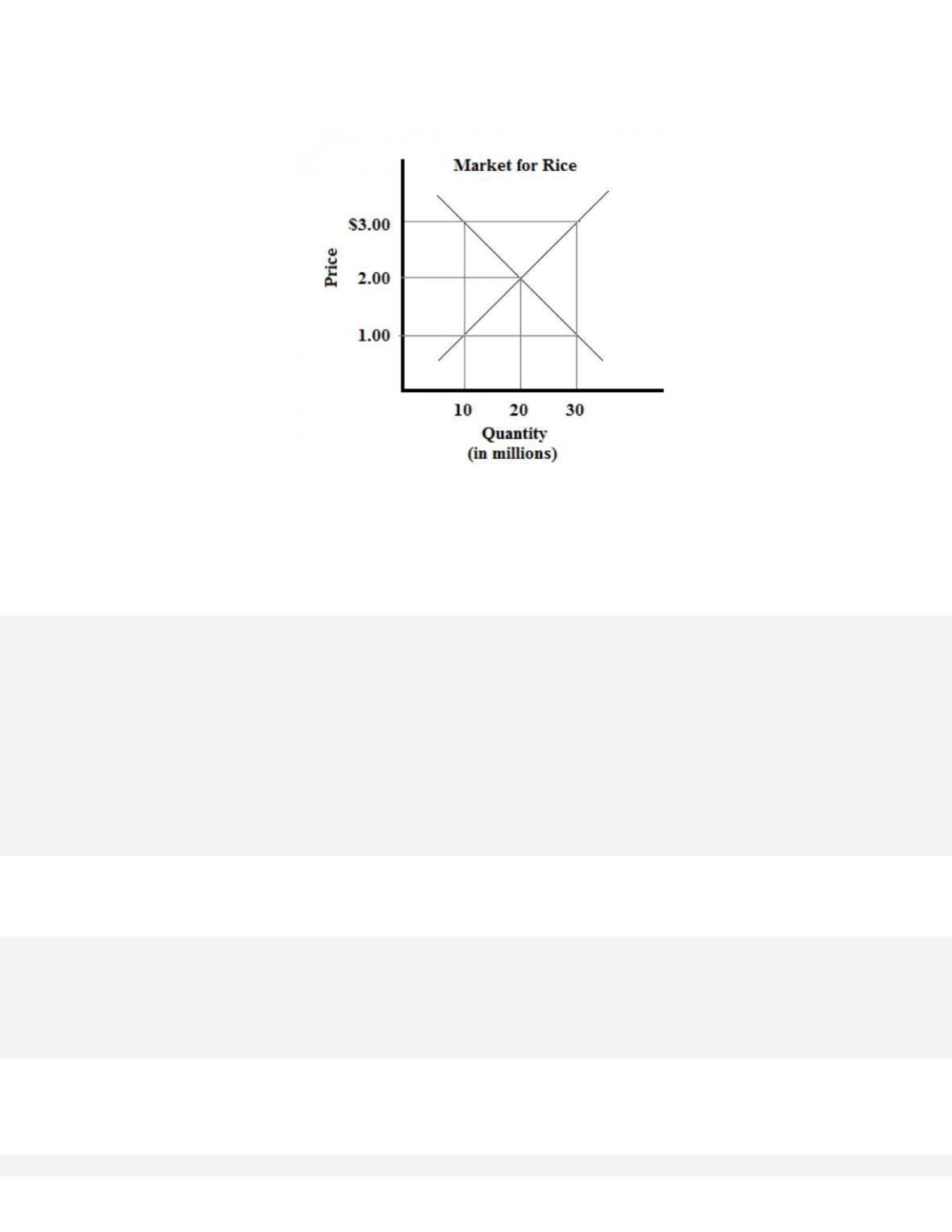
52. Answer the following questions based on the supply and demand diagram below.
(a) What is the equilibrium price and quantity in the market?
(b) Discuss the market outcome if the government were to enforce a price floor of $3.00 in the market.
(c) Discuss the market outcome if the government were to enforce a price floor of $1.00 in the market.
(d) How might the market respond to a binding price ceiling in this market?
(a) The equilibrium price for the market is $2.00 and the equilibrium quantity is 20 million bags of rice.
(b) If the government were to enforce a price floor of $3.00 a surplus will occur in the market. The quantity
53. (Last Word) Currently the federal U.S. government aims to make college more affordable by offering
federal student loans at low interest rates. Discuss the effect this has had on tuition costs.

3-78
54. (Last Word) Rather than subsidizing federal student loans for students, how might the U.S. government use
the supply of higher education to reduce the cost of attending college?

C. Appendix Questions
55. Use supply and demand analysis to explain what is most likely to happen to price and quantity in a
competitive market for a crop such as lettuce, tomatoes, or oranges, when extreme weather destroys a large
56. What are exchange rates? If a product cost 30 euros and the exchange rate was 1 euro = $1.50, then how
much would the product cost in terms of U.S. dollars?
57. What does it mean when someone says that the U.S. dollar has depreciated or the U.S. dollar has
58. What will happen to the U.S. dollar price of a euro and the quantity of euros exchanged when the demand
for the euro increases, but the supply does not change? Has the U.S. dollar appreciated or depreciated?
59. What will happen to the U.S. dollar price of a euro and the quantity of euros exchanged when the demand
for the euro decreases, but the supply does not change? Has the U.S. dollar appreciated or depreciated?
60. Use supply and demand analysis to explain what is most likely to happen to the price and quantity of corn
when there is an increase in the demand for ethanol. What other effects would such a change in the corn
market have on the price of beef, the price of farmland, and the price of corn syrup?
61. What effect will each of the following have upon the equilibrium price and equilibrium quantity of laptop
computers in a competitive market? Explain your reasoning in each case.
62. Explain how the relative magnitudes of changes in supply and demand can affect equilibrium price and
63. “If demand increases and supply decreases, then both the equilibrium price and quantity will increase.”
What conditions are necessary to make this statement true?
64. Given the products and conditions below, indicate how the events affect the demand, supply, equilibrium
price and quantity of the goods.

3-80
65. Both Economist Flores and Economist Jenkins have been monitoring the cucumber market and have noted
that the equilibrium price of cucumbers and quantity of cucumbers sold have risen over the last year.
66. How is a preset price similar to a government-imposed price ceiling or a price floor? How is a preset price
different from a government-imposed price ceiling or price floor?
67. What condition causes a secondary market to arise?
68. The hottest, new boy band, 2Hot2Handle, has just begun their U.S. tour. The supply and demand schedules
for the local 2Hot2Handle show is below, with the arena capacity fixed at 2,000 seats.
Quantity demanded
(tickets)
Price
Quantity supplied
(tickets)
1000
$60.00
2000
2000
50.00
2000
3000
40.00
2000
4000
30.00
2000
5000
20.00
2000
6000
10.00
2000
Answer the following questions.
69. Compare changes in the equilibrium price and quantity when demand increase for an upward sloping
70. Give an example of a vertical supply curve and the relationship between price and quantity.
3-81
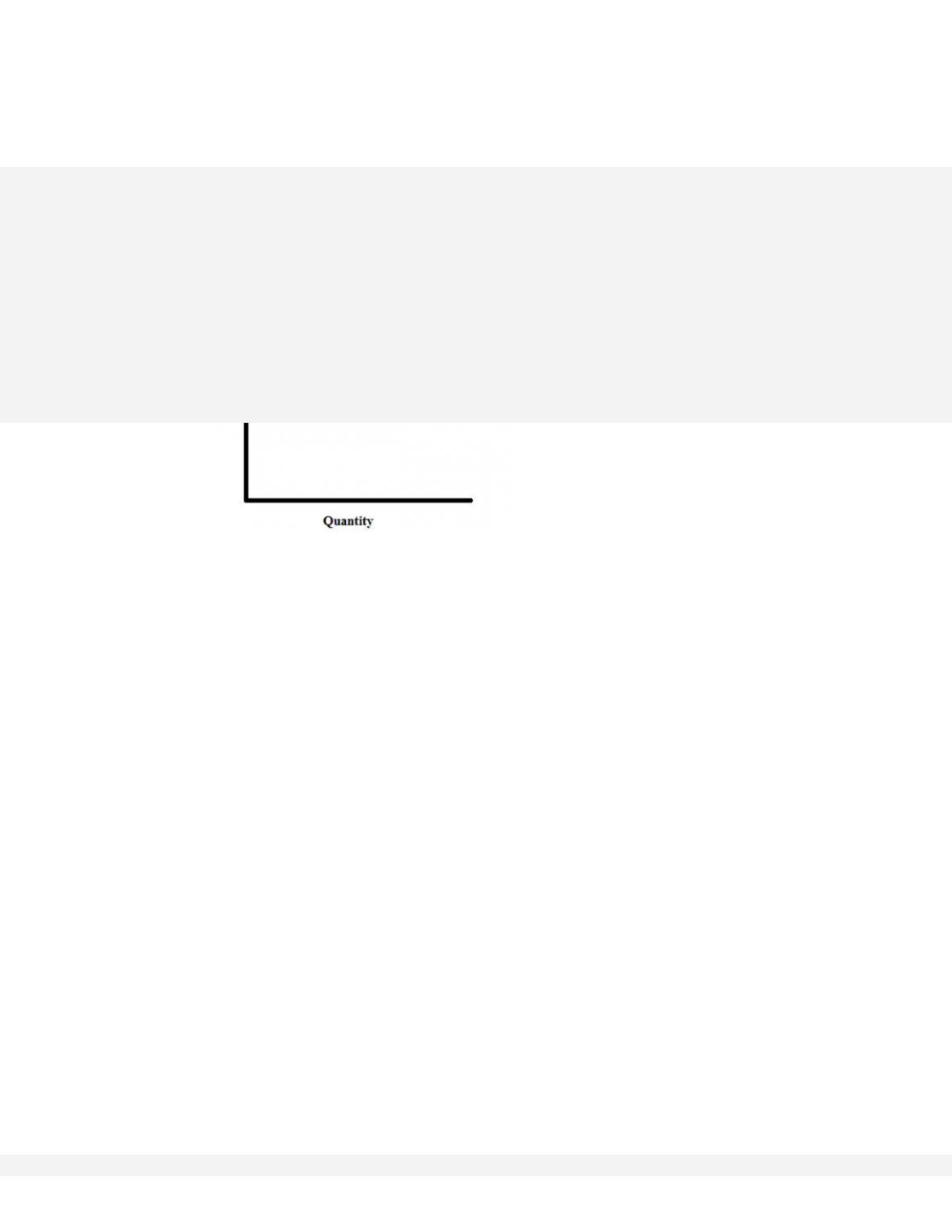
71. Use the graph provided below to answer the following questions.
(a) Draw the demand and supply curve for college football tickets at University XYZ.
(b) Suppose the football team has a significant winning streak, increasing fan’s preference to watch the

D. Answers to Appendix Questions
55. Use supply and demand analysis to explain what is most likely to happen to price and quantity in a
competitive market for a crop such as lettuce, tomatoes, or oranges, when extreme weather destroys a large
portion of the crop.
56. What are exchange rates? If a product cost 30 euros and the exchange rate was 1 euro = $1.50, then how
much would the product cost in terms of U.S. dollars?
57. What does it mean when someone says that the U.S. dollar has depreciated or the U.S. dollar has
appreciated? Give an example of each case using the euro and the U.S. dollar.
58. What will happen to the U.S. dollar price of a euro and the quantity of euros exchanged when the demand
for the euro increases, but the supply does not change? Has the U.S. dollar appreciated or depreciated?
59. What will happen to the U.S. dollar price of a euro and the quantity of euros exchanged when the demand
for the euro decreases, but the supply does not change? Has the U.S. dollar appreciated or depreciated?
60. Use supply and demand analysis to explain what is most likely to happen to the price and quantity of corn
when there is an increase in the demand for ethanol, which is produced using corn. What other effects
would such a change in the corn market have on the price of beef, the price of farmland, and the price of
corn syrup?

3-83
61. What effect will each of the following have upon the equilibrium price and equilibrium quantity of laptop
computers in a competitive market? Explain your reasoning in each case.
(a) the price decreases for wireless communications devices that consumers like to buy and attach to
laptop computers.
(b) fewer computer companies decide to produce laptop computers.
(c) new technology makes laptop computers cheaper to produce.
(d) the government imposes taxes on computer purchases.
62. Explain how the relative magnitudes of changes in supply and demand can affect equilibrium price and
quantity, if supply and demand change simultaneously.
63. “If demand increases and supply decreases, then both the equilibrium price and quantity will increase.”
64. Given the products and conditions below, indicate how the events affect the demand, supply, equilibrium
price and quantity of the goods.
(a) Videotapes. The price of DVDs and DVD players decreases. New technology makes videotapes
easier to produce. The shift in demand is greater than shift in supply.
(b) Roses. The Valentine’s Day season has just begun for the floral industry. A new pesticide decreases
the number of flowers affected by pests. The shift in supply is greater than the shift in demand.
(c) Tomatoes. FDA publicly announces that eating tomatoes and tomato-based products can significantly
reduce one’s risk of developing cancer. An unexpected freeze late in the tomato season destroys a
significant portion of this year’s crop. The shift in supply is greater than shift in demand.
(d) Healthcare. Highly publicized malpractice cases decrease consumer confidence in healthcare
providers. Malpractice insurance premiums paid by doctors increase. The shift in demand is greater
than shift in supply.

3-84
65. Both Economist Flores and Economist Jenkins have been monitoring the cucumber market and have noted
that the equilibrium price of cucumbers and quantity of cucumbers sold have risen over the last year.
Flores and Jenkins, however, disagree about why this change has occurred. Flores holds that both supply
and demand have increased and that the shift in demand has been greater than the shift in supply. Jenkins,
however, argues that while demand has increased, supply has decreased and the shift in supply is greater
than the shift in demand. Which economist offers the most feasible theory of why the equilibrium price
and quantity of cucumbers have risen?
66. How is a preset price similar to a government-imposed price ceiling or a price floor? How is a preset price
different from a government-imposed price ceiling or price floor?
67. What condition causes a secondary market to arise?

68. The hottest, new boy band, 2Hot2Handle, has just begun their U.S. tour. The supply and demand schedules
for the local 2Hot2Handle show is below, with the arena capacity fixed at 2,000 seats.
Quantity demanded
(tickets)
Price
Quantity supplied
(tickets)
1000
$60.00
2000
2000
50.00
2000
3000
40.00
2000
4000
30.00
2000
5000
20.00
2000
6000
10.00
2000
Answer the following questions.
(a) Riding on their enormous popularity, 2Hot2Handle decides to set the price of tickets of all tickets at
$60. Is the market for tickets at equilibrium? If not, calculate the size of the shortage/surplus.
(b) Hoping to gain publicity by creating long lines for tickets, 2Hot2Handle decides to lower ticket prices
to $30. Is the market for tickets at equilibrium? If not, calculate the size of the shortage/surplus.
(c) Will a price of $30 be an efficient outcome? If the price of $30 does not change, how might an
efficient outcome be reached?
69. Compare changes in the equilibrium price and quantity when demand increase for an upward sloping
supply curve and a vertical supply curve.
70. Give an example of a vertical supply curve and the relationship between price and quantity.
3-86
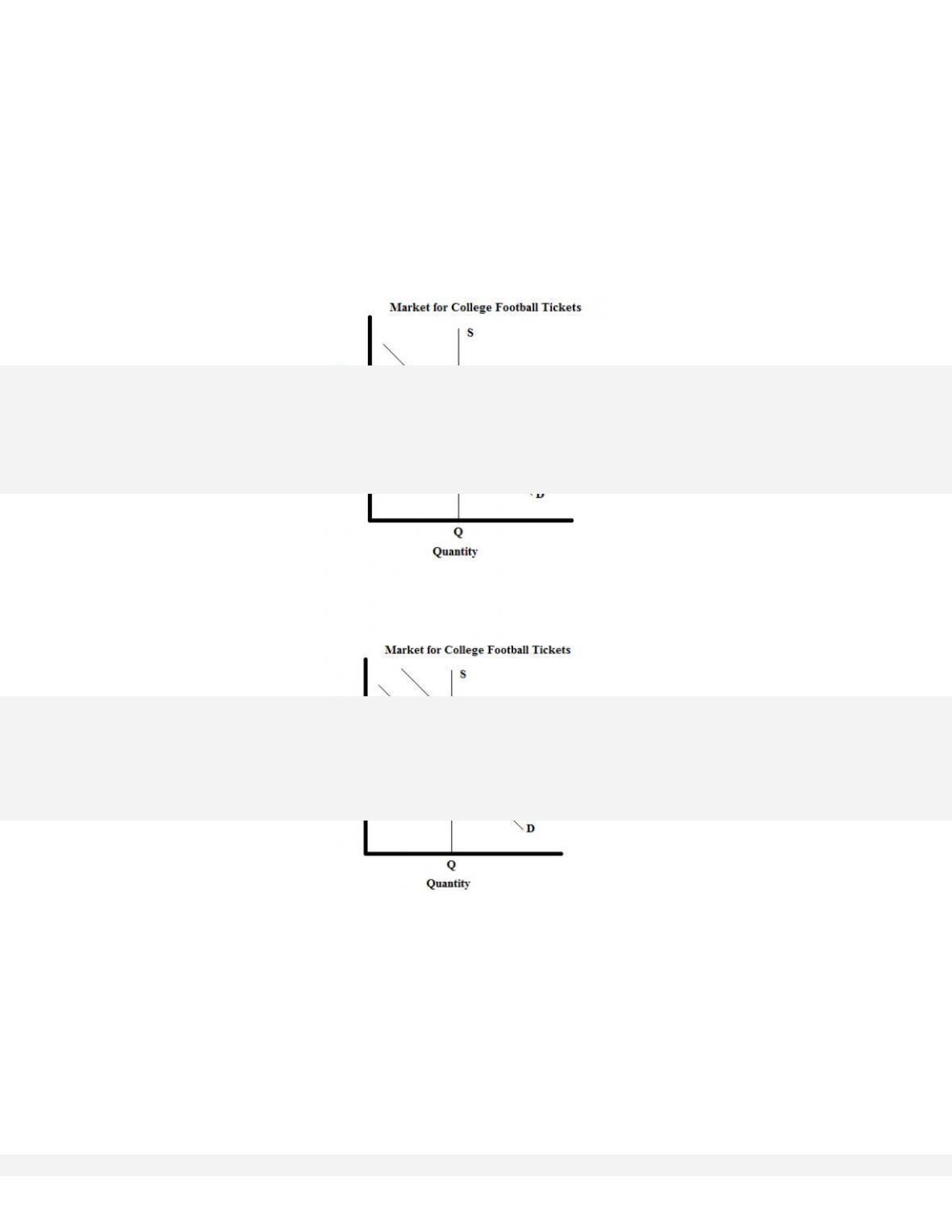
71. Use the graph provided below to answer the following questions.
(a) Draw the demand and supply curve for college football tickets at University XYZ.
(b) Suppose the football team has a significant winning streak, increasing fan’s preference to watch the
game at the stadium. Depict the change to the market. Show/Discuss changes to the equilibrium price
and quantity.
(c) Assume the University has decided to make a one-time expansion to the stadium, adding 500 seats. On
a new graph show how this will change the equilibrium price and quantity.
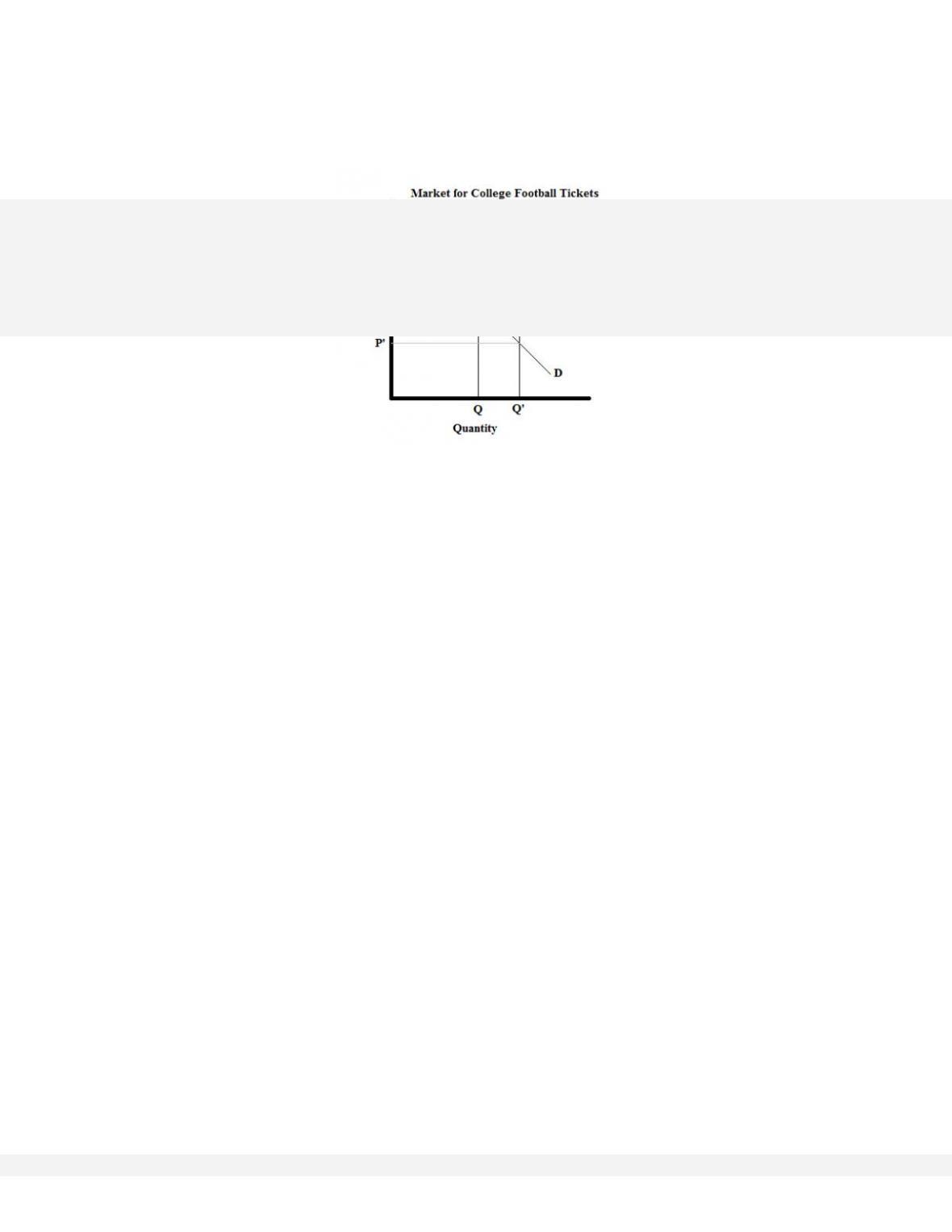
(a) See graph below
(b) See graph below. The preference to watch the football game at the stadium has increased demand for
football tickets, shifting the demand curve to the right (from D to D’). The result is an increase the
price of tickets (from P to P’), but the equilibrium quantity remains the same.
3-87
(c) See graph below. The expansion of the stadium has allowed for 500 seats. This shifts the vertical supply
curve to the right by a quantity of 500 (from S to S’). The increase in seats results in a decrease in the
price of tickets (from P to P’) and an increase in the quantity (from Q to Q’).