
15-331
23 Use the table below that shows the rate of return and R&D spending for a hypothetical firm. Assume the
interest-rate cost of funds is 8%.
Expected rate
of return (%)
R&D
(millions of $)
14
6
12
9
10
12
8
15
6
18
4
21
2
24
(a) What is the optimal amount of R&D expenditures? At this amount, what will be the marginal cost and
what will be the marginal benefit of R&D spending?
(b) Now assume that the interest-rate cost of funds rises to 12%. What will be the optimal amount of
R&D spending? For this amount of R&D spending, what will be the marginal cost and what will be
the marginal benefit (expected rate of return)?
(c) Now assume that the interest-rate cost of funds falls to 6%. What will be the optimal amount of R&D
spending? For this amount of R&D spending, what will be the marginal cost and what will be the
marginal benefit (expected rate of return)?

15-332
24. The initial values for expected returns, R&D and interest-rate cost for an energy company’s investment in
developing alternative fuels are listed in the table below. Using this information, answer the following
questions.
Expected rate
of return (%)
R&D
(millions)
Interest rate
cost of funds, %
40
$20
15
35
30
15
30
40
15
25
50
15
20
60
15
15
70
15
10
80
15
5
90
15
(a) What is the equilibrium level of return and R&D?
(b) Suppose that the energy company’s credit rating plummets after it is exposed for using unethical
accounting practices. How will this affect the expected-rate-of-return curve and interest-rate cost of
funds?
(c) Suppose the interest-rate cost of funds curve shifts upward by 10%. What will be the new equilibrium
rate of return and level of R & D investment?
(d) Suppose that the increased cost of oil has increased the demand for alternative fuels. How will this
affect the interest-rate cost of funds and expected return curves?
(e) Suppose the expected-rate-of-return curve shifts outward by 10%. What will be the new equilibrium
level of R&D and expected rate of return? (Assume the interest-rate cost of funds is 15%.)

15-333
25. Use the table below that shows the rate of return and R&D spending for a hypothetical firm. Assume the
interest-rate cost of funds is 6%.
Expected rate
of return (%)
R&D
(millions of
$)
15
0
12
10
9
20
6
30
3
40
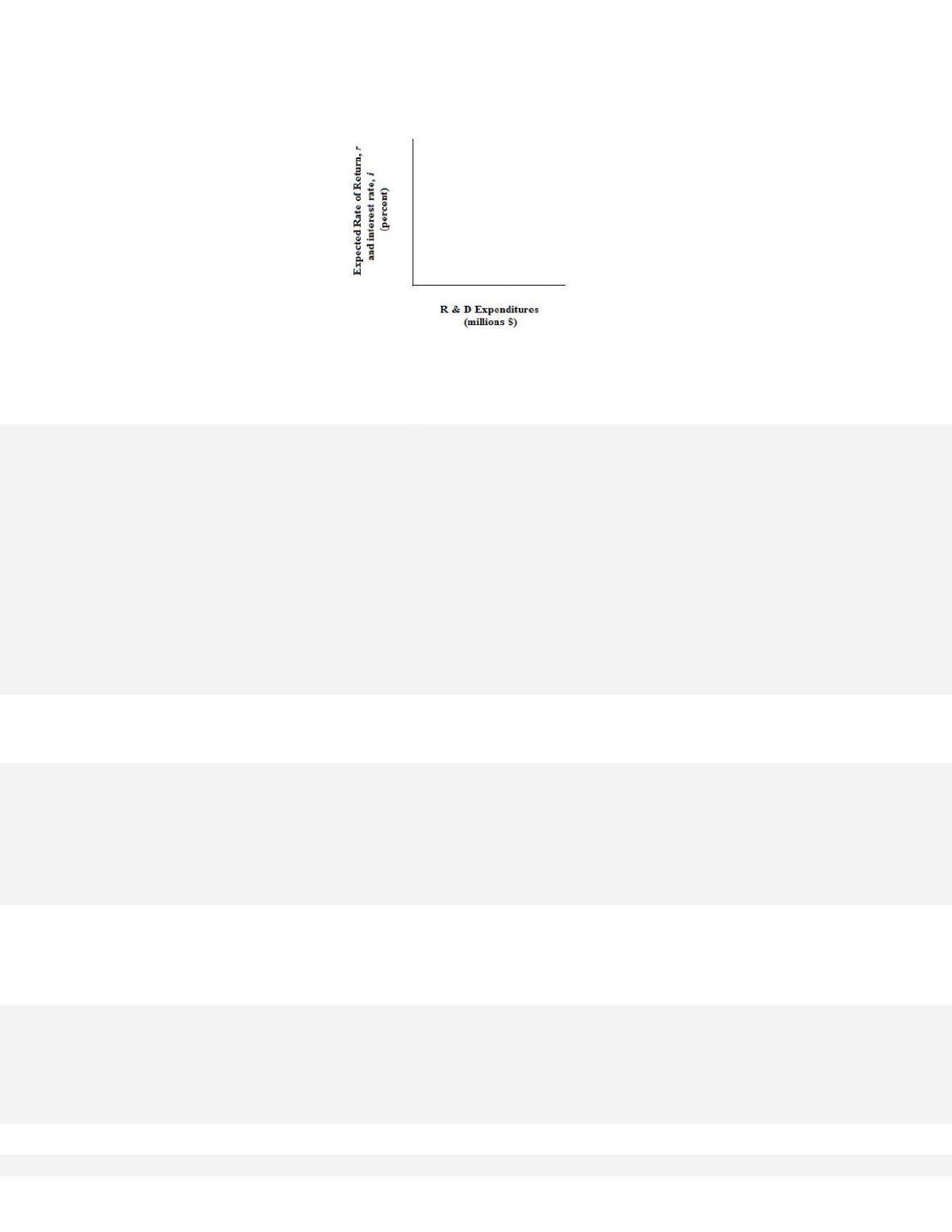
(a) Graph the marginal cost and marginal benefit curves of R&D spending in the graph below. Be sure to
label the axes. What is the optimal level of R&D spending?
(b) Now assume that the interest-rate cost of funds is 9%. Show on the graph what happens to the interest-
rate cost of funds curve. What is the optimal level of R&D spending?
15-334
26. Use the graph below to answer the following questions.
(a) Draw in a typical marginal cost and marginal benefit curve of R&D in the graph below. Suppose the
equilibrium interest rate is 5% and the R&D expenditures is 25 million.
(b) Graphically depict the effect of an increase in the interest rate from 5% to 7%. What happens to the amount
of R&D Expenditures?
27. Describe how a firm’s revenues and profits are increased through product innovation. What three other
points should be noted about these results?
28. A consumer makes purchases of an existing product A such that the marginal utility is 40 and the price is
$20. The consumer also tries a new product B and at the current level of consumption it has a marginal
utility of 72 and a price of $24. What does the utility-maximizing rule suggest that this consumer should
do?


15-336
29. The table below shows the marginal utility schedules for old product X and new product Y for a
hypothetical consumer. The price of X is $4 and the price of good Y is $2. The income of the consumer is
$20.
Product X
Product Y
Quantity
MUx
Quantity
MUy
1
32
1
28
2
28
2
24
3
24
3
20
4
20
4
16
5
16
5
12
(a) If the consumer can only buy old product X, how much will the consumer buy and what will be the
total utility per dollar spent?
(b) If the consumer buys both old product X and new product Y, how much will the consumer buy of each
to maximize utility?
(c) If the consumer purchases the utility-maximizing combination of old product X and new product Y,
total utility will be ___________.
(d) The consumer was originally limited to purchasing old product X but now can also purchase new
product Y. What is the increase in total utility from the original situation when the consumer
purchases the utility-maximizing combination of both X and Y?

30. The table below shows the marginal utility schedules for a soft drink (MUs) and an energy drink (MUe).
The price of the soft drink is $2 and the price of the energy drink is $4. The consumer’s income is $10.
Soft Drink
Energy Drink
Quantity
MUs
Quantity
MUe
1
50
1
70
2
40
2
50
3
30
3
40
4
20
4
24
5
10
5
20
(a) If the consumer can only buy the soft drink, how much will the consumer buy and what will be the
total utility?
(b) If the consumer buys both the soft drink and the energy drink, how much will the consumer buy to
maximize utility? How much will total utility change?
Suppose another company decides to enter the energy drink market and the marginal utility schedule for
that firm is listed below. Their energy drink is price at $3.
Energy Drink 2
Quantity
MUe2
1
50
2
40
3
30
4
20
5
10
(c) With the introduction of the new energy drink, what bundle will the consumer choose to maximize
utility? What will be the total level of utility?
(d) How do the results in (d) demonstrate possible benefits of diffusion for consumers?
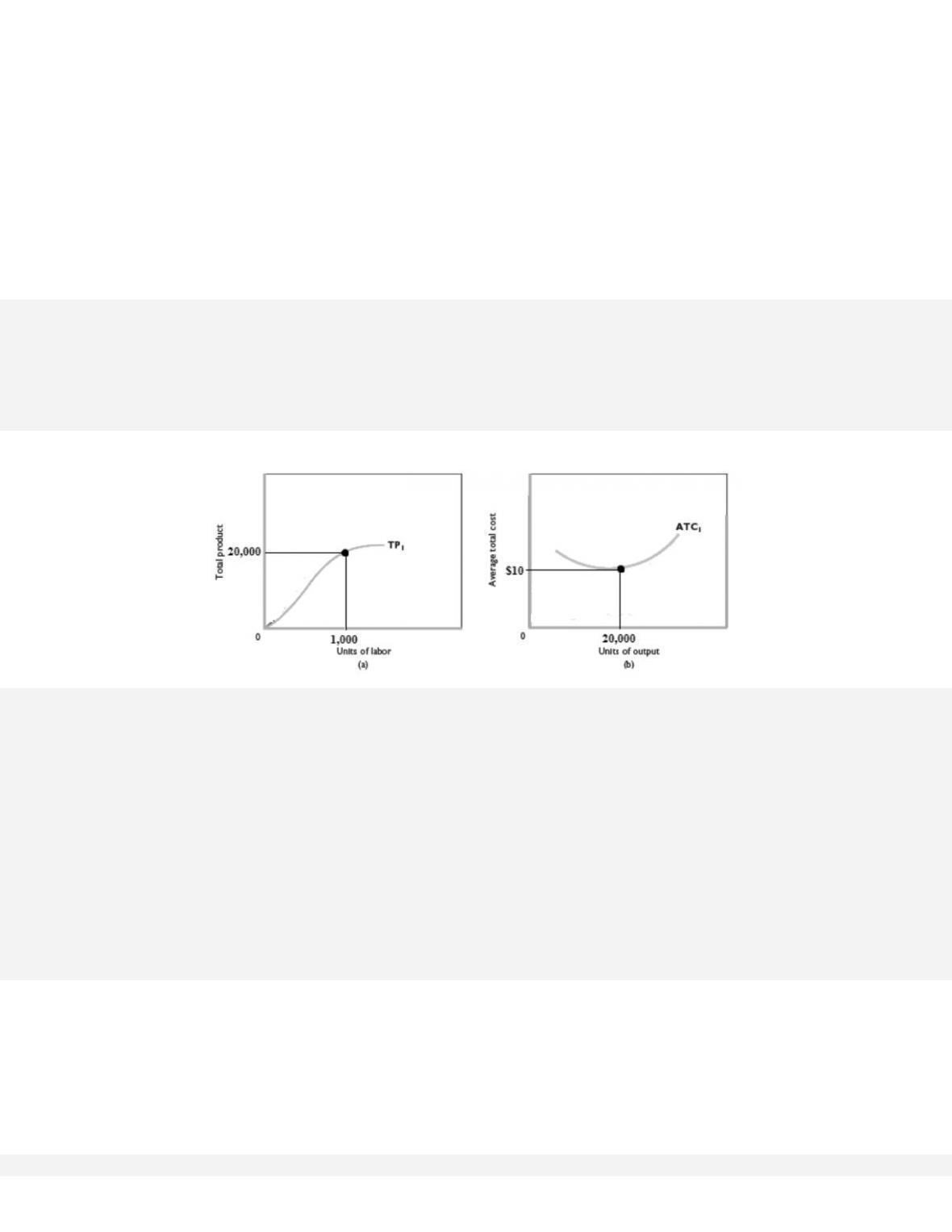
31. Explain how process innovation reduces cost and increases profits. How does this innovation affect the
firm’s total product curve and average cost curve?
15-338
32. Assume a firm faces these costs: total cost of capital = $4000; price paid for labor = $20 per labor unit; and
price paid for raw materials = $8 per raw-material unit.
(a) If the firm can produce 2000 units of output by combining its fixed capital with 200 units of labor and
500 units of raw materials, then what are the total cost and average total cost of producing the 2000
units of output?
(b) The firm now improves its production process so that it can produce 3000 units of output by
combining its fixed capital with 100 units of labor and 500 units of raw materials. What are the total
cost and average cost of producing the 3000 units of output?
(c) Based on the data, what conclusion can you draw about the effect of process innovation on economic
efficiency?
33. Suppose a new process innovation occurs. On the graphs below, show graphically the effect this innovation
has on the Total Product and Average Total Cost curves.

34. Below are two average total cost schedules for a firm. The first schedule (ATC1) shows the cost of
producing the product at five levels of output before a new innovation. The second schedule (ATC2) shows
the average total cost at the five output levels after the innovation. What was the reduction in average total
cost at each of the five levels of output as a result of the innovation?
Output
Before
ATC1
After
ATC2
10
$38
$32
20
30
22
30
28
20
40
31
23
50
38
31
(a) What was the reduction in average total cost at each of the five levels of output as a result of the
innovation?
(b) Plot the average cost curves for the schedules on the graph below.
35. What is the fast-second strategy? What are the risks to a dominant firm from using such a strategy?

36. What is the imitation problem resulting from technological advance? How might a dominant firm respond
to the threat from product innovation by a smaller firm?
37. Describe the legal protections and potential advantages of taking the lead in innovation.
38. (Consider This) What product did the Roman citizen Erasmo (c. 130 A.D.) produce and how did he maintain
his trade secret?
39. Compare pure competition, pure monopoly, monopolistic competition, and oligopoly for technological
advance in the form of new product development.
40. Compare and contrast the suitability of different market structure for fostering technological advance.

41. Explain the reasoning behind the inverted-U theory of R&D expenditures.
42. Explain the basic conclusions from inverted-U theory of R&D. What will be the optimal market structure
for technological progress? What does the evidence suggest about its validity?
43. How does technological advance enhance economic efficiency? Distinguish between its effects on
productive efficiency and allocative efficiency.
44. How might innovation create or reduce monopoly power?
45. How can innovation foster creative destruction? What are the objections to that idea?

46. (Last Word) Evaluate this statement “We should reduce federal spending on research and development
today. Those federal dollars are better spent by helping the poor.”