International Financial Management, 8e (Eun)
1) Many of the skills necessary for effective cash management are the same regardless of whether
the firm has only domestic operations or if it operates internationally.
2) The cash manager of a domestic firm should source funds internationally to obtain the lowest
borrowing cost and to place excess funds wherever the greatest return can be earned regardless of
currency.
3) A netting center necessarily implies that the MNC has a central cash manager.
4) A multilateral netting system is beneficial in reducing the number of and the expense associated
with inter-affiliate foreign exchange transactions.
5) A central cash manager has a global view of the most favorable borrowing rates and most
advantageous investment rates.
6) A centralized cash pool assists in reducing the problem of mislocated funds and in funds
mobilization.
7) A centralized cash management system with a cash pool can reduce the investment the MNC
has in precautionary cash balances, saving the firm money.
8) Efficient cash management techniques can
A) reduce the investment in cash balances and foreign exchange transaction expenses.
B) provide for maximum return from the investment of excess cash.
C) result in borrowing at lowest rate when a temporary cash shortage exists.
D) all of the options
9) Cash management refers to
A) the decision to grant credit to customers or to remain “cash and carry.”
B) the investment the firm has in transaction balances and precautionary balances.
C) a domestic firm’s investment in foreign currency.
D) none of the options
10) Precautionary cash balances
A) are necessary in case the firm has underestimated the amount of cash needed to cover
transactions.
B) are necessary to cover scheduled outflows of funds during a cash budgeting period.
C) are necessary in case the firm has underestimated the amount of cash needed to cover
transactions, and are also necessary to cover scheduled outflows of funds during a cash budgeting
period.
D) none of the options
11) Precautionary cash balances
A) represent an increasingly-important source of interest income for many MNCs.
B) are necessary in case the firm has underestimated the amount needed to cover transactions.
C) are synonymous with speculative cash balances.
D) none of the options
12) Multinational cash management
A) is really no different for an MNC than for a purely domestic firm in a closed economy.
B) concerns itself with the size of cash balances, their currency denominations, and where these
cash balances are located among the MNC’s affiliates.
C) concerns itself with the size of cash balances and their currency denominations, but not where
these cash balances are located among the MNC’s affiliates, since intra-affiliate default risk is not
an issue.
D) none of the options
13) Good cash management boils down to
A) investing excess funds at the most favorable interest rate and borrowing at the lowest rate when
there is a temporary cash shortage.
B) investing excess funds at the lowest rate and borrowing at the highest rate when there is a
temporary cash shortage.
C) hedging currency exposure with judicious use of futures, forwards, and currency option
contracts.
D) none of the options

14) ABC Trading Company of Singapore purchases spices in bulk from around the world,
packages them into consumer size quantities and sells them through sales affiliates in Hong Kong
and the Unites States. For a recent month, the following payments matrix of inter-affiliate cash
flows, stated in Singapore dollars, was forecasted.
ABC Trading Company Payments Matrix (S$000)
Disbursements by:
Singapore
Hong Kong
U.S.
Receipts by:
Singapore
80
110
Hong Kong
16
44
U.S.
22
50
Calculate, in Singapore dollars, the amount that the inter-affiliate foreign exchange transaction
will be reduced by with multilateral netting.
A) S$152,000
B) S$170,000
C) S$322,000
D) S$405,000

15) ABC Trading Company of Singapore purchases spices in bulk from around the world,
packages them into consumer size quantities and sells them through sales affiliates in Hong Kong
and the Unites States. For a recent month, the following payments matrix of inter-affiliate cash
flows, stated in Singapore dollars, was forecasted.
ABC Trading Company Payments Matrix (S$000)
Disbursements by:
Singapore
Hong Kong
U.S.
Receipts by:
Singapore
80
110
Hong Kong
16
44
U.S.
22
50
If foreign exchange transactions cost ABC 0.45 percent, what savings results from netting?
A) S$684
B) S$765
C) S$1,449
D) S$1,823
6
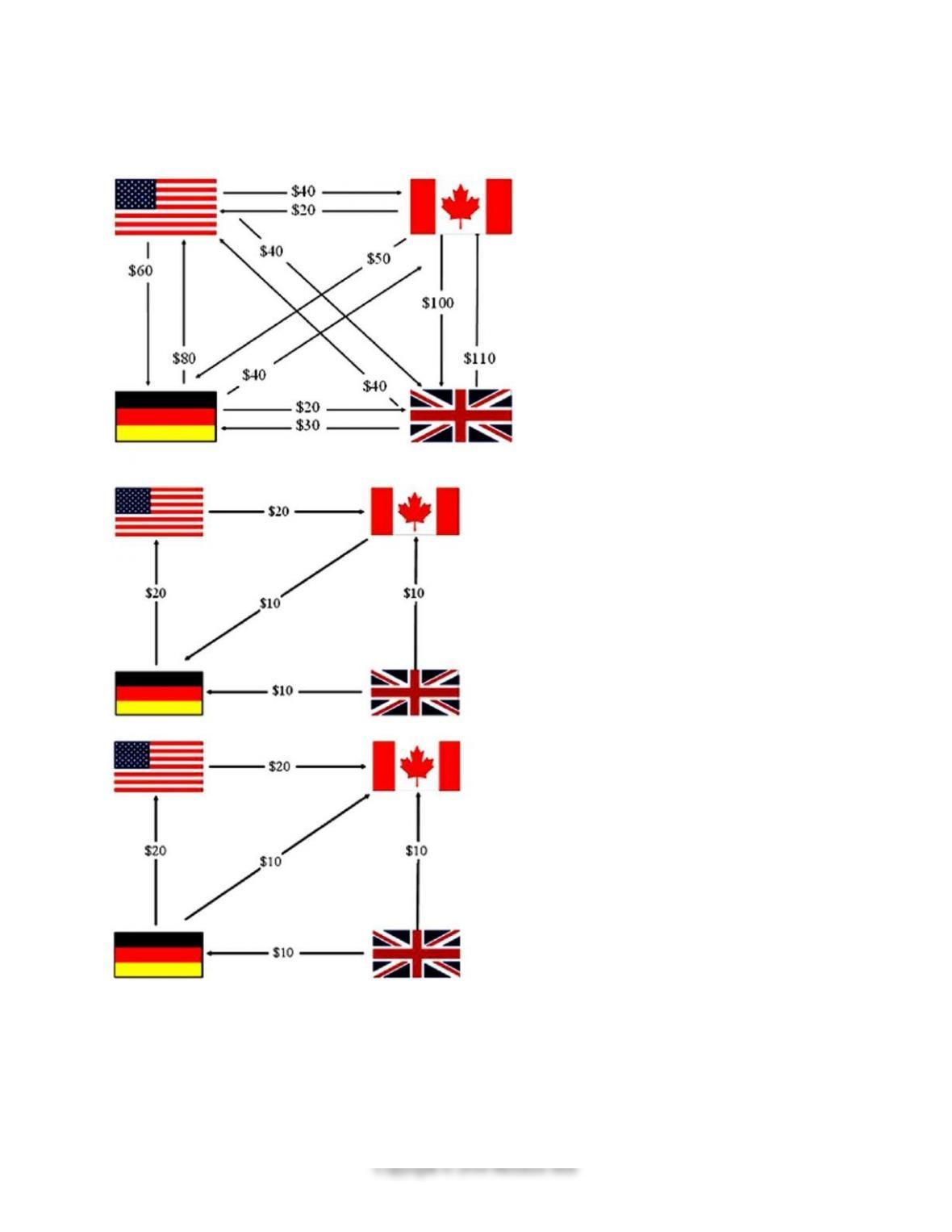
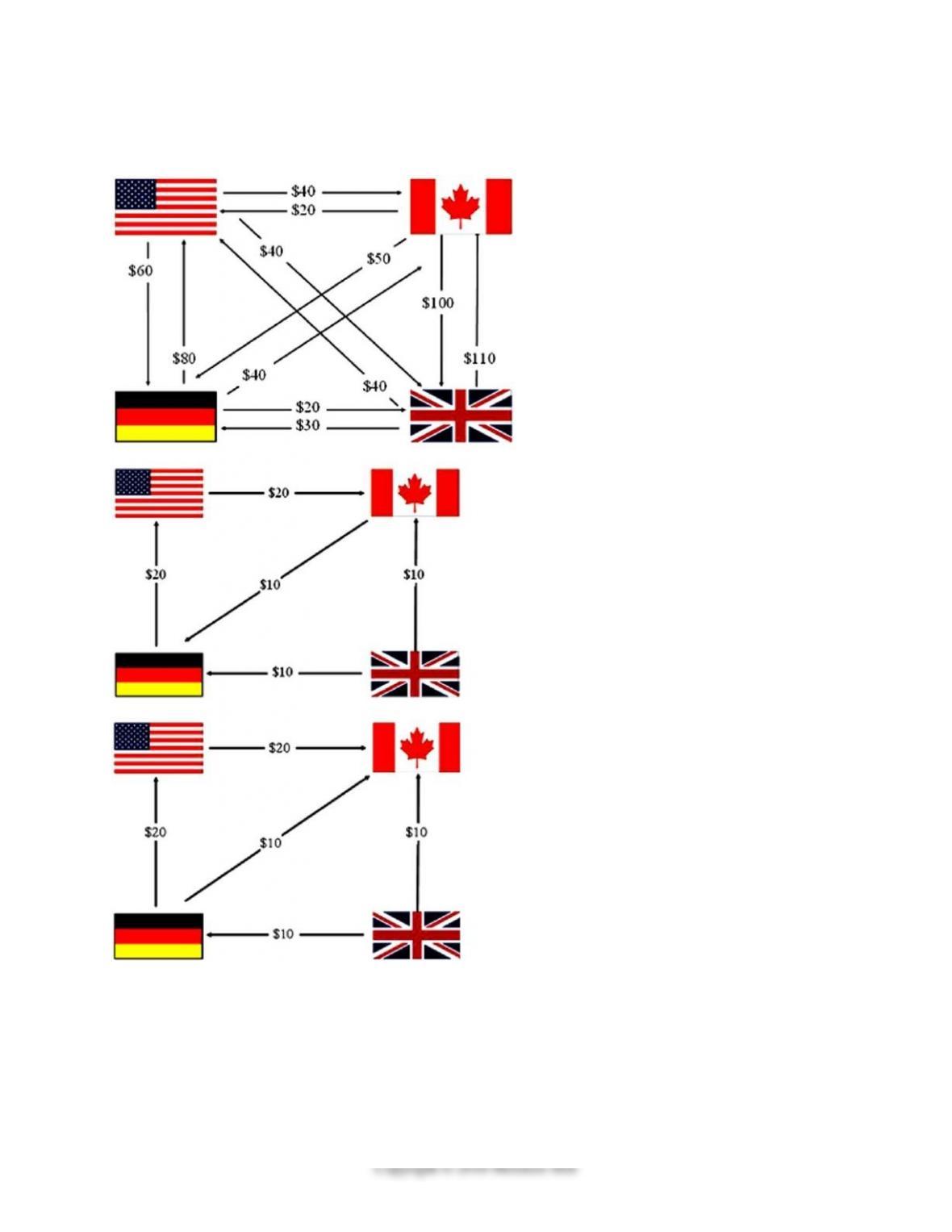
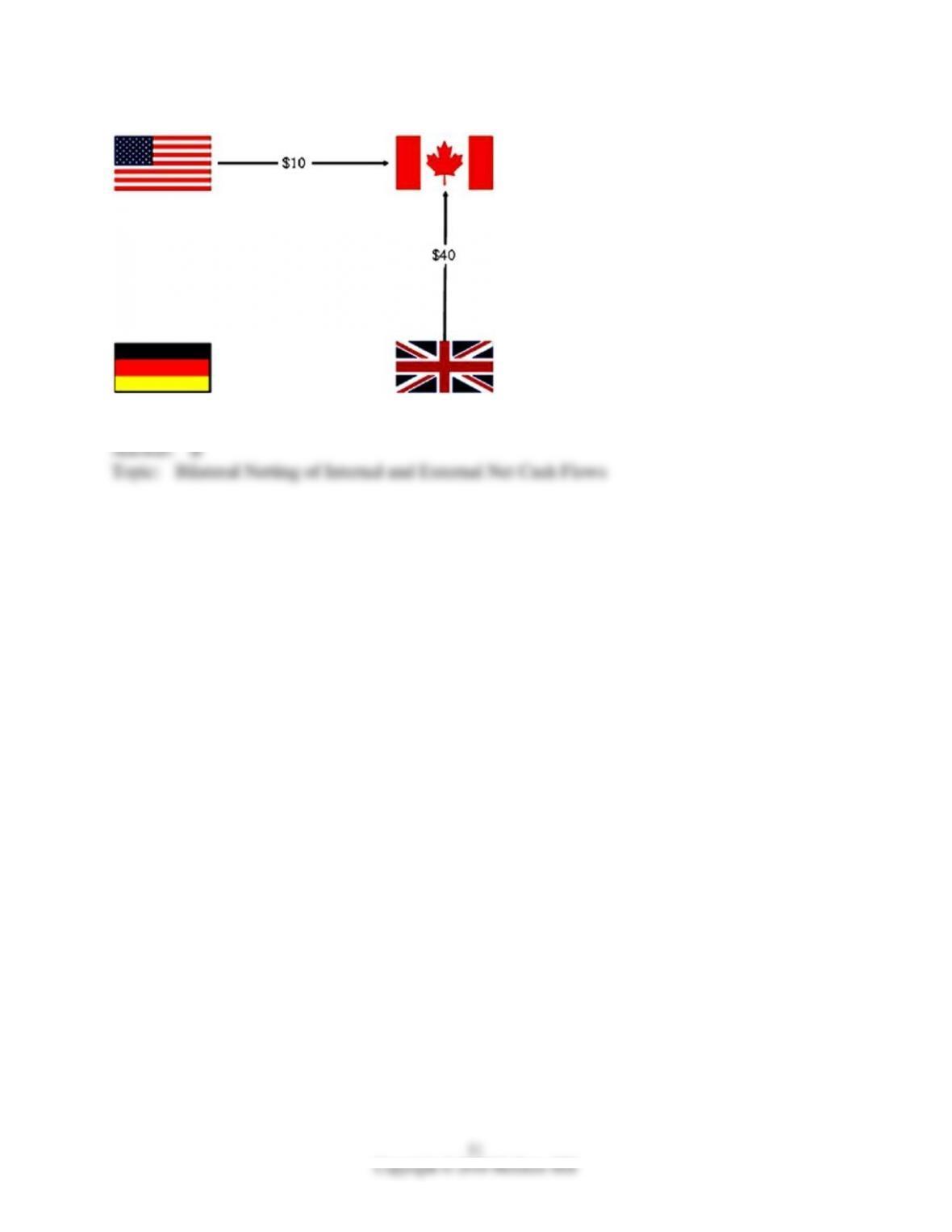
16) Consider a U.S. MNC with three subsidiaries and the following foreign exchange transactions
shown at left. Use bilateral netting to reduce the number of foreign exchange transactions by half.
A)
B)
C)
D) none of the options
8
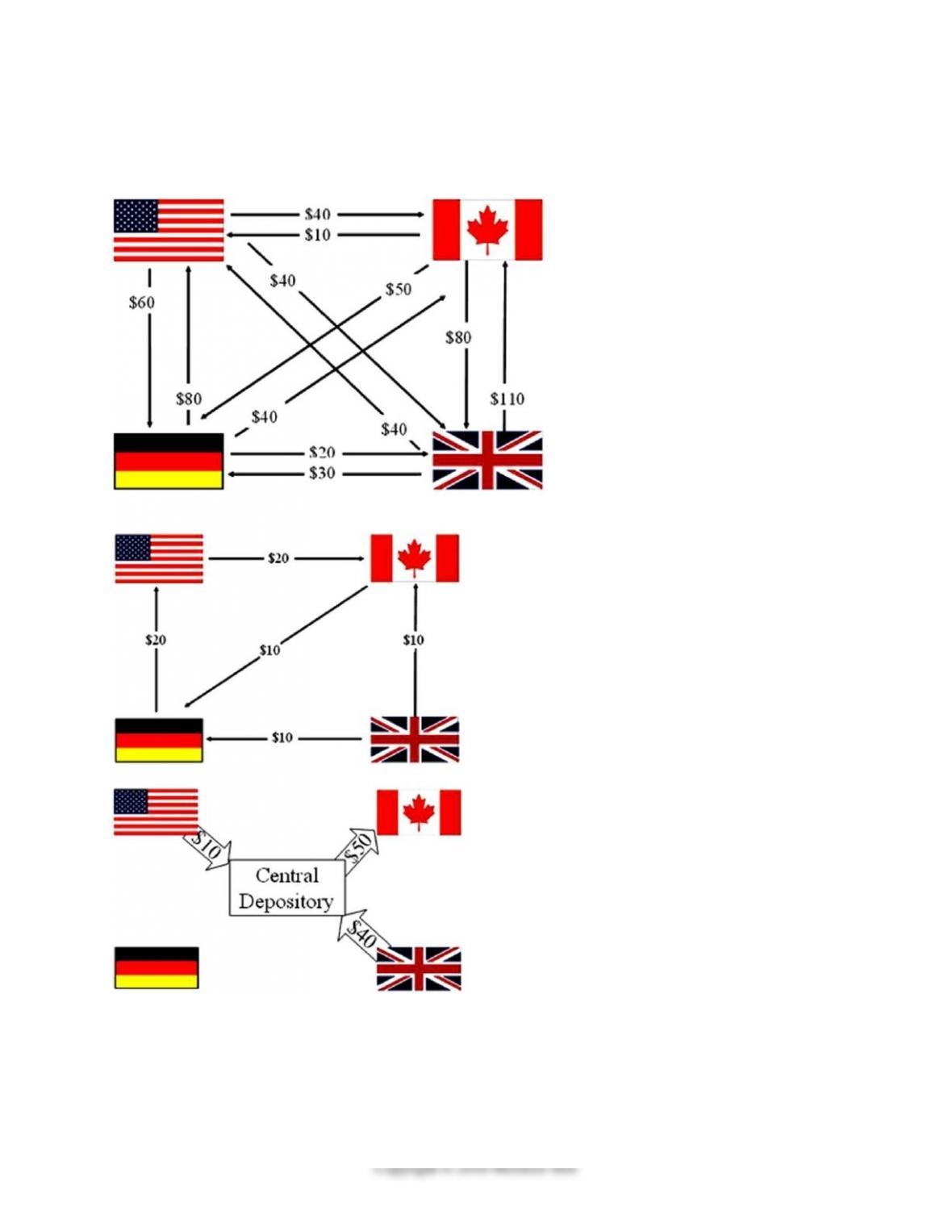
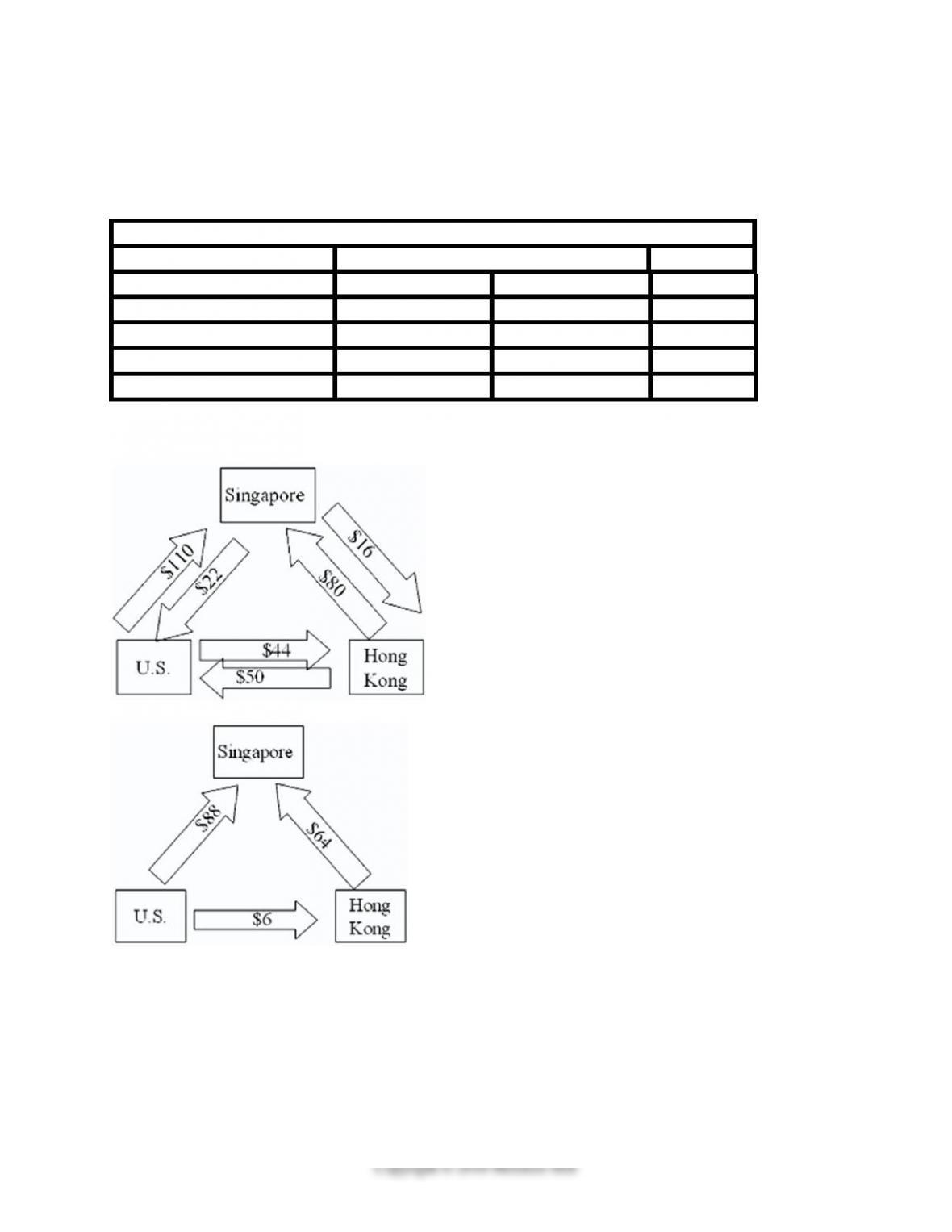
17) Consider a U.S. MNC with three subsidiaries and the following foreign exchange transactions
shown at left. Use multilateral netting to reduce the number of foreign exchange transactions.
A)
B)
C)
D) none of the options
10
18) Consider a U.S. MNC with three subsidiaries and the following foreign exchange transactions
shown at left. Use multilateral netting with a central depository to reduce the number of foreign
exchange transactions.
A)
B)
C)
D) none of the options
12
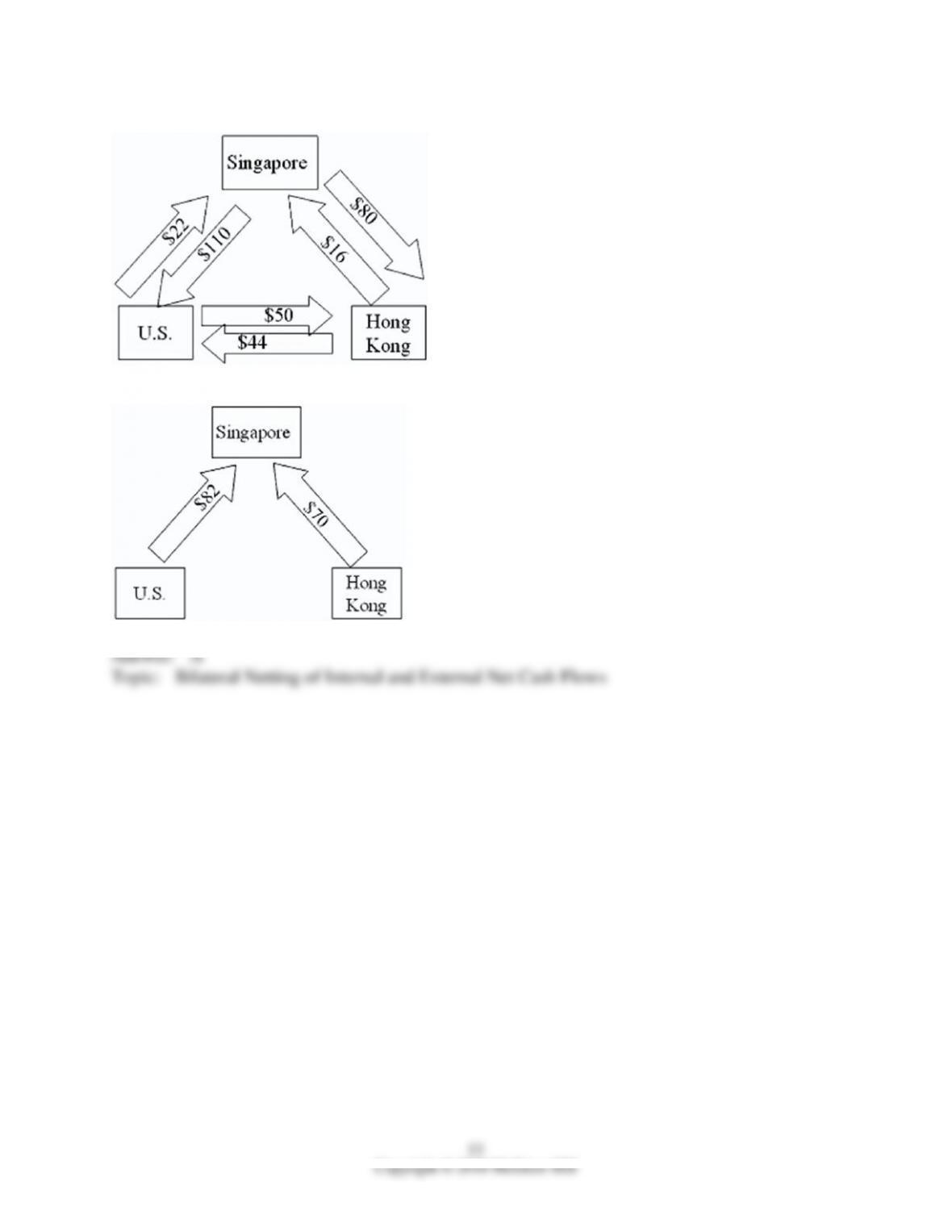
19) ABC Trading Company of Singapore purchases spices in bulk from around the world,
packages them into consumer size quantities and sells them through sales affiliates in Hong Kong
and the Unites States. For a recent month, the following payments matrix of inter-affiliate cash
flows, stated in Singapore dollars, was forecasted.
ABC Trading Company Payments Matrix (S$000)
Disbursements by:
Singapore
Hong Kong
U.S.
Receipts by:
Singapore
80
110
Hong Kong
16
44
U.S.
22
50
Which of the following is an accurate chart of their current situation?
A)
B)
C)
D)
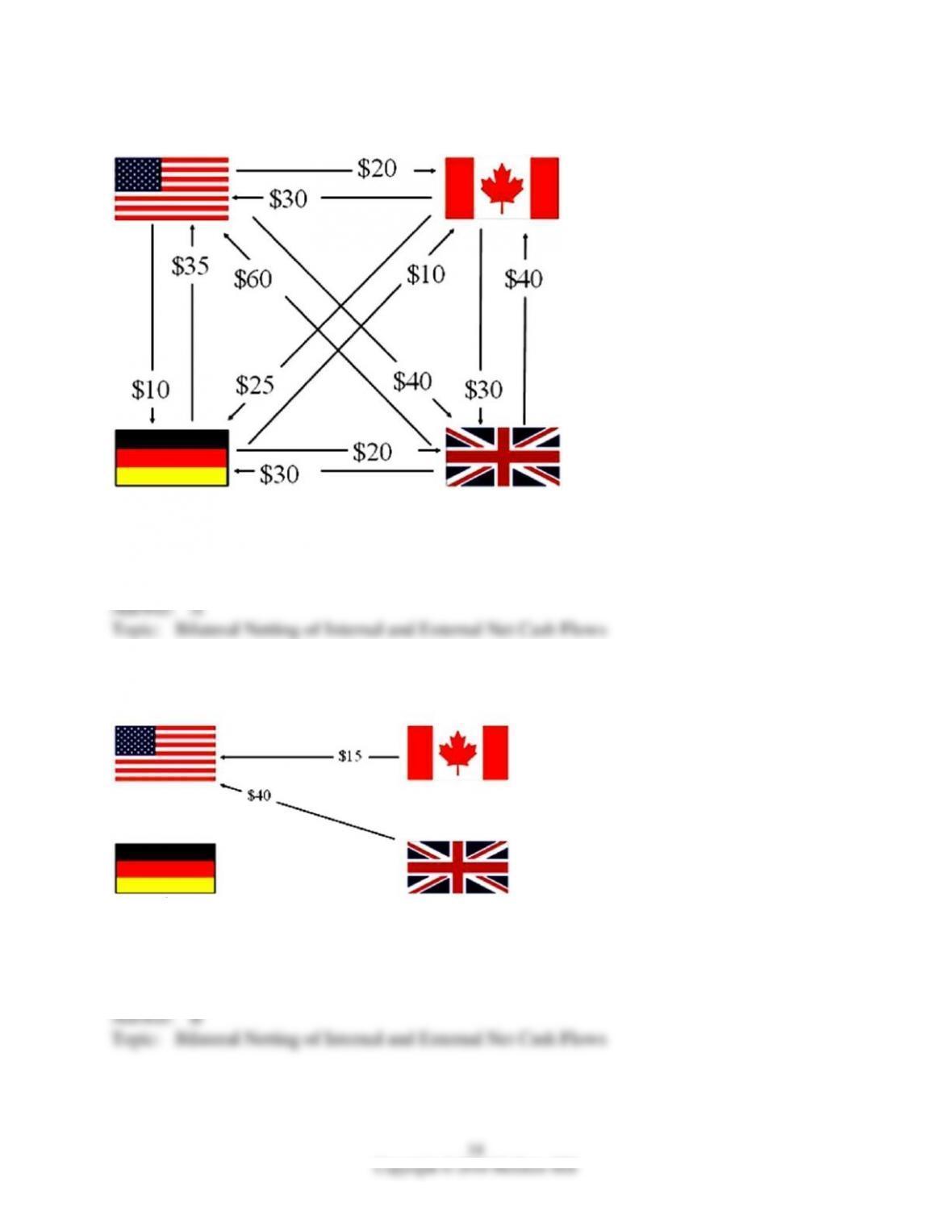
20) Find the net exposure of the U.S. MNC with the following intra-affiliate transactions shown.
A) $55
B) $65
C) $800
D) none of the options
21) Find the net exposure of the British subsidiary of the U.S. MNC with the following intra
affiliate transactions shown.
A) $40 out
B) $65 in
C) ₤20 out
D) none of the options
22) Benefits of a multilateral netting system include
A) the decrease in the expense associated with funds transfer, which in some cases can be over
$1,000 for a large international transfer of foreign exchange.
B) the reduction in the number of foreign exchange transactions and the associated cost of making
fewer but larger transactions.
C) the reduction in intra-company float, which is frequently as high as five days even for wire
transfers.
D) the benefits that accrue from the establishment of a formal information system, which serves as
the foundation for centrally managing transaction exposure and the investment of excess funds.
E) all of the options
23) With a centralized cash depository
A) there is less chance for an MNC’s funds to be denominated in the wrong currency.
B) the central cash manager has a global view of the MNC’s overall cash position.
C) there is less chance of mislocated funds.
D) all of the options
24) With a centralized cash depository
A) an MNC can facilitate fund mobilization.
B) system-wide excess cash is invested at the most advantageous rates.
C) system-wide cash shortages are borrowed at the most advantageous rates.
D) all of the options
25) Not all countries allow MNCs the freedom to net payments,
A) by limiting netting, more needless foreign exchange transactions flow through the local
banking system.
B) MNCs can avoid these restrictions by using a Centralized Cash Depository.
C) MNCs can avoid these restrictions by using wire transfers.
D) MNCs can avoid these restrictions by using a Centralized Cash Depository, as well as by using
wire transfers.
26) With regard to cash management systems in practice, studies suggest that the benefits of a
multilateral netting system include
A) the decrease in the expense associated with funds transfer, which in some cases can be over
$1,000 for a large international transfer of foreign exchange.
B) the savings in administrative time.
C) the reduction in intra company float, which is frequently as high as five days, even for wire
transfers.
D) all of the options
27) Several international banks offer multilateral netting software packages. These packages
A) calculate the net currency positions of each affiliate.
B) can integrate the netting function with foreign exchange exposure management.
C) only work on the Mac platform.
D) calculate the net currency positions of each affiliate and can integrate the netting function with
foreign exchange exposure management.
28) MNCs can reduce their exchange rate expense
A) by using bilateral netting.
B) by using a centralized cash management system.
C) by using multilateral netting.
D) all of the options
29) Which of the following statements about multilateral netting system are correct?
(i) Each affiliate nets all its inter-affiliate receipts against all its disbursements.
(ii) Each affiliate transfers or receives a balance, depending on whether it is a net payer or receiver.
(iii) The net funds to be received by the affiliates will equal the net disbursements to be made by
the affiliates.
(iv) Only two foreign exchange transactions are necessary since the affiliates’ net receipts will
always be equal to zero.
(v) Only two foreign exchange transactions are necessary since the affiliates’ net disbursements
will always be equal to zero.
A) (i) and (ii)
B) (i), (ii), and (iii)
C) (i), (ii), (iii), and (iv)
D) (i), (ii), (iii), and (v)
30) Assuming that the inter-affiliate cash flows are uncorrelated with one another, calculate the
standard deviation of the portfolio of cash held by the centralized depository for the following
affiliate members:
Expected
Standard
Affiliate
Transactions
Deviation
U.S.
$
100,000
$
40,000
Canada
$
150,000
$
60,000
Mexico
$
175,000
$
30,000
Chile
$
200,000
$
70,000
A) $34,960.33
B) $139,841.33
C) $104,880.88
D) none of the options
31) Assuming that the inter-affiliate cash flows are uncorrelated with one another, calculate the
minimum cash balance to have if the firm follows a conservative policy of having three standard
deviations of cash for precautionary purposes.
Expected
Standard
Affiliate
Transactions
Deviation
U.S.
$
100,000
$
40,000
Canada
$
150,000
$
60,000
Mexico
$
175,000
$
30,000
Chile
$
200,000
$
70,000
A) $34,960.33
B) $314,642.65
C) $104,880.88
D) none of the options
32) If French-based Affiliate A owes U.S.-based affiliate B $1,000 and Affiliate B owes Affiliate
A €2,000 when the exchange rate is $1.10 = €1.00. The net payment between A and B should be
A) €1,091 from B to A.
B) €1,091 from A to B.
C) $1,200 from B to A.
D) none of the options
33) For a recent month, the following payments matrix of inter-affiliate cash flows was forecasted:
Disbursement From:
Receipts by:
France
Britain
U.S.
France
€
500
€
800
Britain
£
300
£
400
U.S.
$
1,000
$
500
Use multilateral netting to find the net payment from the British affiliate to the U.S. affiliate.
The spot exchange rates are $1.20 = €1.00 and $1.80 = £1.00; affiliates get paid in home currency.
A) $60
B) $20
C) $0
D) none of the options
34) The U.S. IRS allows transfer prices to be set using comparable uncontrolled price method.
This method requires
A) finding the price that an unrelated willing seller would accept from an unrelated willing buyer.
B) the price at which the good is resold by the distribution affiliate is reduced by an amount
sufficient to cover overhead costs and a reasonable profit.
C) an appropriate profit is added to the cost of the manufacturing affiliate.
D) financial models and econometric techniques.
35) The U.S. IRS allows transfer prices to be set using the resale price method
A) finding the price that an unrelated willing seller would accept from an unrelated willing buyer.
B) the price at which the good is resold by the distribution affiliate is reduced by an amount
sufficient to cover overhead costs and a reasonable profit.
C) an appropriate profit is added to the cost of the manufacturing affiliate.
D) financial models and econometric techniques.
36) The U.S. IRS allows transfer prices to be set using the cost plus approach
A) finding the price that an unrelated willing seller would accept from an unrelated willing buyer.
B) the price at which the good is resold by the distribution affiliate is reduced by an amount
sufficient to cover overhead costs and a reasonable profit.
C) an appropriate profit is added to the cost of the manufacturing affiliate.
D) financial models and econometric techniques.