
International Financial Management, 8e (Eun)
1) What major dimension sets apart international finance from domestic finance?
A) Foreign exchange and political risks
B) Market imperfections
C) Expanded opportunity set
D) all of the options
2) An example of a political risk is
A) expropriation of assets.
B) adverse change in tax rules.
C) the opposition party being elected.
D) both the expropriation of assets and adverse changes in tax rules are correct.
3) Production of goods and services has become globalized to a large extent as a result of
A) natural resources being depleted in one country after another.
B) skilled labor being highly mobile.
C) multinational corporations’ efforts to source inputs and locate production anywhere where costs
are lower and profits higher.
D) common tastes worldwide for the same goods and services.
4) Recently, financial markets have become highly integrated. This development
A) allows investors to diversify their portfolios internationally.
B) allows minority investors to buy and sell stocks.
C) has increased the cost of capital for firms.
D) none of the options

5) Japan has experienced large trade surpluses. Japanese investors have responded to this by
A) liquidating their positions in stocks to buy dollar-denominated bonds.
B) investing heavily in U.S. and other foreign financial markets.
C) lobbying the U.S. government to depreciate its currency.
D) lobbying the Japanese government to allow the yen to appreciate.
6) Suppose your firm invests $100,000 in a project in Italy. At the time the exchange rate is $1.25
= €1.00. One year later the exchange rate is the same, but the Italian government has expropriated
your firm’s assets paying only €80,000 in compensation. This is an example of
A) exchange rate risk.
B) political risk.
C) market imperfections.
D) none of the options, since $100,000 = €80,000 × $1.25/€1.00.
7) Suppose you start with $100 and buy stock for £50 when the exchange rate is £1 = $2. One year
later, the stock rises to £60. You are happy with your 20 percent return on the stock, but when you
sell the stock and exchange your £60 for dollars, you only get $45 since the pound has fallen to £1
= $0.75. This loss of value is an example of
A) exchange rate risk.
B) political risk.
C) market imperfections.
D) weakness in the dollar.

8) Suppose that Great Britain is a major export market for your firm, a U.S.-based MNC. If the
British pound depreciates against the U.S. dollar,
A) your firm will be able to charge more in dollar terms while keeping pound prices stable.
B) your firm may be priced out of the U.K. market, to the extent that your dollar costs stay constant
and your pound prices will rise.
C) to protect U.K. market share, your firm may have to cut the dollar price of your goods to keep
the pound price the same.
D) your firm may be priced out of the U.K. market, to the extent that your dollar costs stay constant
and your pound prices will rise, and to protect U.K. market share, your firm may have to cut the
dollar price of your goods to keep the pound price the same.
9) Suppose Mexico is a major export market for your U.S.-based company and the Mexican peso
appreciates drastically against the U.S. dollar. This means
A) your company’s products can be priced out of the Mexican market, as the peso price of
American imports will rise following the peso’s fall.
B) your firm will be able to charge more in dollar terms while keeping peso prices stable.
C) your domestic competitors will enjoy a period of facing lessened price competition from
Mexican imports.
D) your firm will be able to charge more in dollar terms while keeping peso prices stable and your
domestic competitors will enjoy a period of facing lessened price competition from Mexican
imports.
10) Suppose Mexico is a major export market for your U.S.-based company and the Mexican peso
depreciates drastically against the U.S. dollar, as it did in December 1994. This means that
A) your company’s products can be priced out of the Mexican market, as the peso price of
American imports will rise following the peso’s fall.
B) your firm will be able to charge more in dollar terms while keeping peso prices stable.
C) your domestic competitors will enjoy a period of facing little price competition from Mexican
imports.
D) none of the options

4
11) Suppose that you are a U.S. producer of a commodity good competing with foreign producers.
Your inputs of production are priced in dollars and you sell your output in dollars. If the U.S.
currency depreciates against the currencies of our trading partners,
A) your competitive position is likely improved.
B) your competitive position is likely worsened.
C) your competitive position is unchanged.
D) none of the options
12) Undoubtedly, we are now living in a world where all the major economic
functions—consumption, production, and investment—
A) are still inherently local.
B) are still regional in nature.
C) are slowly becoming globalized.
D) are highly globalized.
13) Most governments at least try to make it difficult for people to cross their borders illegally.
This barrier to the free movement of labor is an example of
A) information asymmetry.
B) excessive transactions costs.
C) racial discrimination.
D) a market imperfection.
14) Although the world economy is much more integrated today than was the case 10 or 20 years
ago, a variety of barriers still hamper free movements of people, goods, services, and capital across
national boundaries. These barriers include
A) legal restrictions.
B) excessive transportation costs.
C) information asymmetry.
D) all of the options
15) The Japanese automobile company Honda decided to establish production facilities in Ohio,

5
mainly to
A) circumvent trade barriers.
B) reduce transportation costs.
C) reduce transactions costs.
D) all of the options
16) When individual investors become aware of overseas investment opportunities and are willing
to diversify their portfolios internationally,
A) they trade one market imperfection, information asymmetry, for another, exchange rate risk.
B) they benefit from an expanded opportunity set.
C) they should not bother to read or to understand the prospectus, since it’s probably written in a
foreign language.
D) they should invest only in dollars or euros.
17) The Nestlé Corporation, a well-known Swiss MNC, used to issue two different classes of
common stock, bearer shares and registered shares, and foreigners were allowed to hold only
A) registered shares.
B) bearer shares.
C) voting shares.
D) convertible shares.
18) Deregulated financial markets and heightened competition in financial services provided an
environment for financial innovations that resulted in the introduction of various instruments.
Examples of these innovative instruments include
A) currency futures and options, foreign stock index futures and options.
B) multicurrency bonds.
C) international mutual funds, country funds, exchange traded funds.
D) all of the options
19) Nestlé, a well-known Swiss corporation,
A) has been a paragon of virtue in its opposition to all forms of political risk.

6
B) at one time placed restrictions on foreign ownership of its stock. When it relaxed these
restrictions, the total market value of the firm fell.
C) at one time placed restrictions on foreign ownership of its stock. When it relaxed these
restrictions, there was a major transfer of wealth from foreign shareholders to domestic
shareholders.
D) none of the options
20) The goal of shareholder wealth maximization
A) is not appropriate for non-U.S. business firms.
B) means that all business decisions and investments that a firm makes are done for the purpose of
making the owners of the firm better off financially.
C) is a sub-objective the firm should attempt to achieve after the objective of customer satisfaction
is met.
D) is in conflict with the privatization process taking place in third-world countries.
21) As capital markets are becoming more integrated, the goal of shareholder wealth maximization
A) has been altered to include other goals as well.
B) has lost out to other goals, even in the U.S.
C) has been given increasing importance by managers in Europe.
D) has been shown to be a deterrent to raising funds abroad.
22) Corporate scandals at firms such as Enron, WorldCom and the Italian firm Parmalat
A) show that managers might be tempted to pursue their own private interests at the expense of
shareholders.
B) show that Italian shareholders are better at monitoring managerial behavior than U.S.
shareholders.
C) show that white-collar criminals hardly ever get punished.
D) show that socialism is a better way to go than capitalism.
23) While the corporate governance problem is not confined to the United States,
A) it can actually be a much more serious problem in other parts of the world, where the legal

protection of shareholders is weak or nonexistent.
B) it has reached its high point in the United States.
C) the U.S. legal system, with lawsuits used only as a last resort, ensured that any conflicts of
interest would soon be a thing of the past.
D) none of the options
24) The owners of a business are the
A) taxpayers.
B) workers.
C) suppliers.
D) shareholders.
25) The massive privatization that is currently taking place in developing and formerly socialist
countries
A) will eventually enhance the standard of living to these countries’ citizens.
B) depends on private investment.
C) increases the opportunity set facing these countries’ citizens.
D) all of the options
26) A firm with concentrated ownership
A) may give rise to conflicts of interest between dominant shareholders and small outside
shareholders.
B) may enjoy more accounting transparency than firms with diffuse ownership structures.
C) is a partnership, never a corporation.
D) none of the options

27) The ultimate guardians of shareholder interest in a corporation are the
A) rank and file workers.
B) senior management.
C) boards of directors.
D) all of the options
28) In countries like France and Germany,
A) managers have often made business decisions with regard to maximizing market share to the
exclusion of other goals.
B) managers have often viewed shareholders as one of the “stakeholders” of the firm, others being
employees, customers, suppliers, banks and so forth.
C) managers have often regarded the prosperity and growth of their combines, or families of
related firms, as their most critical goal.
D) managers have traditionally embraced the maximization of shareholder wealth as the only
worthy goal.
29) When corporate governance breaks down
A) shareholders are unlikely to receive fair returns on their investments.
B) managers may be tempted to enrich themselves at shareholder expense.
C) the board of directors is not doing its job.
D) all of the options
30) Privatization refers to the process of
A) having government operate businesses for the betterment of the public sector.
B) government allowing the operation of privately owned business.
C) prohibiting government operated enterprises.
D) a country divesting itself of the ownership and operation of a business venture by turning it over
to the free market system.

31) Deregulation of world financial markets
A) provided a natural environment for financial innovations, like currency futures and options.
B) has promoted competition among market participants.
C) has encouraged developing countries such as Chile, Mexico, and Korea to liberalize by
allowing foreigners to directly invest in their financial markets.
D) all of the options
32) The emergence of global financial markets is due in no small part to
A) advances in computer and telecommunications technology.
B) enforcement of the Soviet system of state ownership of resources of production.
C) government regulation and protection of infant industries.
D) none of the options
33) The common monetary policy for the euro zone is now formulated by
A) the Bundesbank in Germany.
B) the Federal Reserve Bank.
C) the World Bank.
D) the European Central Bank.
34) Since the end of World War I, the dominant global currency has been the
A) British pound.
B) Japanese yen.
C) Euro.
D) U.S. dollar.

35) Prior to World War I ending, the dominant global currency was the
A) German mark.
B) French franc.
C) Japanese yen.
D) British pound.
36) The ascendance of the dollar reflects several key factors, such as
A) the size of the U.S. population.
B) the mature and open capital markets of the U.S. economy.
C) exchange rate stability.
D) all of the options
37) The euro
A) is the common currency of Europe.
B) is divisible into 100 cents, just like the U.S. dollar.
C) may eventually have a transaction domain larger than the U.S. dollar.
D) all of the options
38) Since its inception the euro has brought about revolutionary changes in European finance. For
example,
A) by redenominating corporate bonds and stocks from several different currencies into one
common currency, the euro has precipitated the emergence of continent-wide capital markets in
Europe that are comparable to U.S. markets in depth and liquidity.
B) Swiss bank accounts are all denominated in euro.
C) the European banking sector has become much more important as a source of financing for
European firms.
D) there have actually not been any revolutionary changes.

39) In David Ricardo’s theory of comparative advantage,
A) international trade is a zero-sum game in which one trading partner’s gain comes at the expense
of another’s loss.
B) liberalization of international trade will enhance the welfare of the world’s citizens.
C) is a short-run argument, not a long-run argument.
D) has been superseded by the now-orthodox view of mercantilism.
40) Under the theory of comparative advantage, liberalization of international trade will
A) enhance the welfare of the world’s citizens.
B) create unemployment and displacement of workers permanently.
C) result in higher prices in the long run as monopolist are able to charge higher prices after
eliminating their competitors.
D) all of the options
41) Privatization is often seen as a cure for bureaucratic inefficiency and waste; some economists
estimate that privatization improves efficiency and reduces operating costs by as much as
A) 5 percent.
B) 10 percent.
C) 15 percent.
D) 20 percent.
42) The World Trade Organization, WTO,
A) has the power to enforce the rules of international trade.
B) covers agriculture and physical goods, but not services or intellectual property rights.
C) recently expelled China for human rights violations.
D) ruled that NAFTA is to be the model for world trade integration.

43) Privatization
A) has spurred a tremendous increase in cross-border investment.
B) has allowed many governments to have the funds to nationalize important industries.
C) has guaranteed that new ownership will be limited to the local citizens.
D) has generally decreased the efficiency of the enterprise.
44) The theory of comparative advantage
A) claims that economic well-being is enhanced if each country’s citizens produce only a single
product.
B) claims that economic well-being is enhanced when all countries compare commodity prices
after adjusting for exchange rate differences in order to standardize the prices charged all
countries.
C) claims that economic well-being is enhanced if each country’s citizens produce that which they
have a comparative advantage in producing relative to the citizens of other countries, and then
trade production.
D) claims that no country has an absolute advantage over another country in the production of any
good or service.
45) A multinational firm can be defined as a firm that
A) invests short-term cash inflows in more than one currency.
B) has sales affiliates in several countries.
C) is incorporated in more than one country.
D) incorporated in one country and has production and sales operations in several other countries.
46) An MNC may gain from its global presence by
A) spreading R&D expenditures and advertising costs over their global sales.
B) pooling global purchasing power over suppliers.
C) utilizing their technological and managerial know-how globally with minimum additional
costs.
D) all of the options

47) MNCs can use their global presence to
A) take advantage of underpriced labor services available in certain developing countries.
B) gain access to special R&D capabilities residing in advanced foreign counties.
C) boost profit margins and create shareholder value.
D) all of the options
48) Financial managers of MNCs should
A) learn how to manage foreign exchange and political risks using proper tools and instruments.
B) deal with (and take advantage of) market imperfections.
C) benefit from expanded investment and financing opportunities.
D) all of the options
49) A purely domestic firm that sources its products, sells its products, and raises its funds
domestically
A) can face stiff competition from a multinational corporation that can source its products in one
country, sell them in several countries, and raise its funds in a third country.
B) can be more competitive than an MNC on its home turf due to superior knowledge of the local
market.
C) can still face exchange rate risk, just like an MNC.
D) all of the options
50) MNC stands for
A) Multinational Corporation.
B) Multi-Nationalized Corporation.
C) Military National Cooperation.
D) none of the options

51) Which is growing at a faster rate, foreign direct investment by MNCs or international trade?
A) FDI by MNCs
B) International trade
C) Since they are linked, they grow at the same rate.
D) none of the options
52) A true MNC, with operations in dozens of different countries
A) must effectively manage foreign exchange risk.
B) can ignore foreign exchange risk since it is diversified.
C) will pay taxes in only its home county.
D) none of the options
53) An MNC can
A) be a factor that increases the opportunities of the citizens of less developed countries.
B) be a factor that increases the opportunity set of domestic investors.
C) increase economic efficiency.
D) all of the options
54) Today for an MNC to produce merchandise in one country on capital equipment financed by
funds raised in a number of different currencies through issuing securities to investors in many
countries, and then selling the finished product to customers in yet other countries is
A) not uncommon.
B) extremely common.
C) uncommon.
D) the norm.

55) A corporation that can source its products in one country, sell them in another country, and
raise the funds in a third country
A) is a multinational corporation.
B) is a domestic firm if all of the shareholders are from the same country.
C) enjoys a built-in hedge against exchange rate risk.
D) enjoys a built-in hedge against political risk.
56) Country A can produce 10 yards of textiles or 6 pounds of food per unit of input. Compute the
opportunity cost of producing one additional unit of food instead of textiles.
A) 1.67 pounds of food per yard of textiles
B) 1.67 yards of textiles per pound of food
C) 0.6 pounds of food per yard of textiles
D) 0.6 yards of textiles per pound of food
57) The gains from trade
A) are likely realized in the long run when workers and firms have had the time to adjust to the new
competitive environment.
B) are immediately realized in the short run, when governments drop protectionist policies.
C) are smaller than the costs of adjustment.
D) none of the options
58) Restrictions or impediments to free trade include such things as
A) import quotas.
B) import tariffs.
C) costly transportation.
D) all of the options

59) Suppose that country A is twice as good at producing widgets as country B. If the currency of
B is twice as valuable as the currency of A,
A) the comparative advantage will shift to an absolute advantage.
B) trade will be an improved outcome for both A and B.
C) the comparative advantage could be canceled out.
D) none of the options
60) Comparative advantage
A) is also known as relative efficiency.
B) can lead to trade even in the face of absolute efficiency.
C) exists when one party can produce a good or service at a lower opportunity cost than another
party.
D) all of the options
61) Country A can produce 10 yards of textiles or 6 pounds of food per unit of input. Country B
can produce 8 yards of textiles or 5 pounds of food per unit of input. Which of the following
statements is true?
A) Country A is relatively more efficient than Country B in the production of food.
B) Country B is relatively more efficient than Country A in the production of textiles.
C) Country A is relatively more efficient than Country B in the production of textiles.
D) none of the options

62) Underlying the theory of comparative advantage are assumptions regarding
A) free trade between nations.
B) that the factors of production (land, labor, capital, and entrepreneurial ability) are relatively
immobile.
C) that the factors of production (land, labor, capital, and entrepreneurial ability) are relatively
mobile.
D) free trade between nations and that the factors of production (land, labor, capital, and
entrepreneurial ability) are relatively immobile.
63) If one country is twice the size of another country and is better at making almost everything
than the benighted citizens of the smaller county,
A) the bigger county enjoys an absolute advantage.
B) the bigger county enjoys an relative advantage.
C) the bigger county enjoys an comparative advantage.
D) there is not enough information to make a determination.
64) Country A can produce 10 yards of textiles or 6 pounds of food per unit of input. Country B
can produce 8 yards of textiles or 5 pounds of food per unit of input.
A) Country A is relatively more efficient than Country B in the production of food.
B) Country B is relatively more efficient than Country A in the production of food.
C) Country A has an absolute advantage over Country B in the production of food and textiles.
D) Country B is relatively more efficient than Country A in the production of food, but Country A
has an absolute advantage over Country B in the production of food and textiles.

65) Country A can produce 10 yards of textiles or 6 pounds of food per unit of input. Country B
can produce 8 yards of textiles or 5 pounds of food per unit of input.
A) Country A is relatively more efficient than Country B in the production of textiles.
B) Country B is relatively more efficient than Country A in the production of food.
C) Country A has an absolute advantage over Country B in the production of food and textiles.
D) all of the options
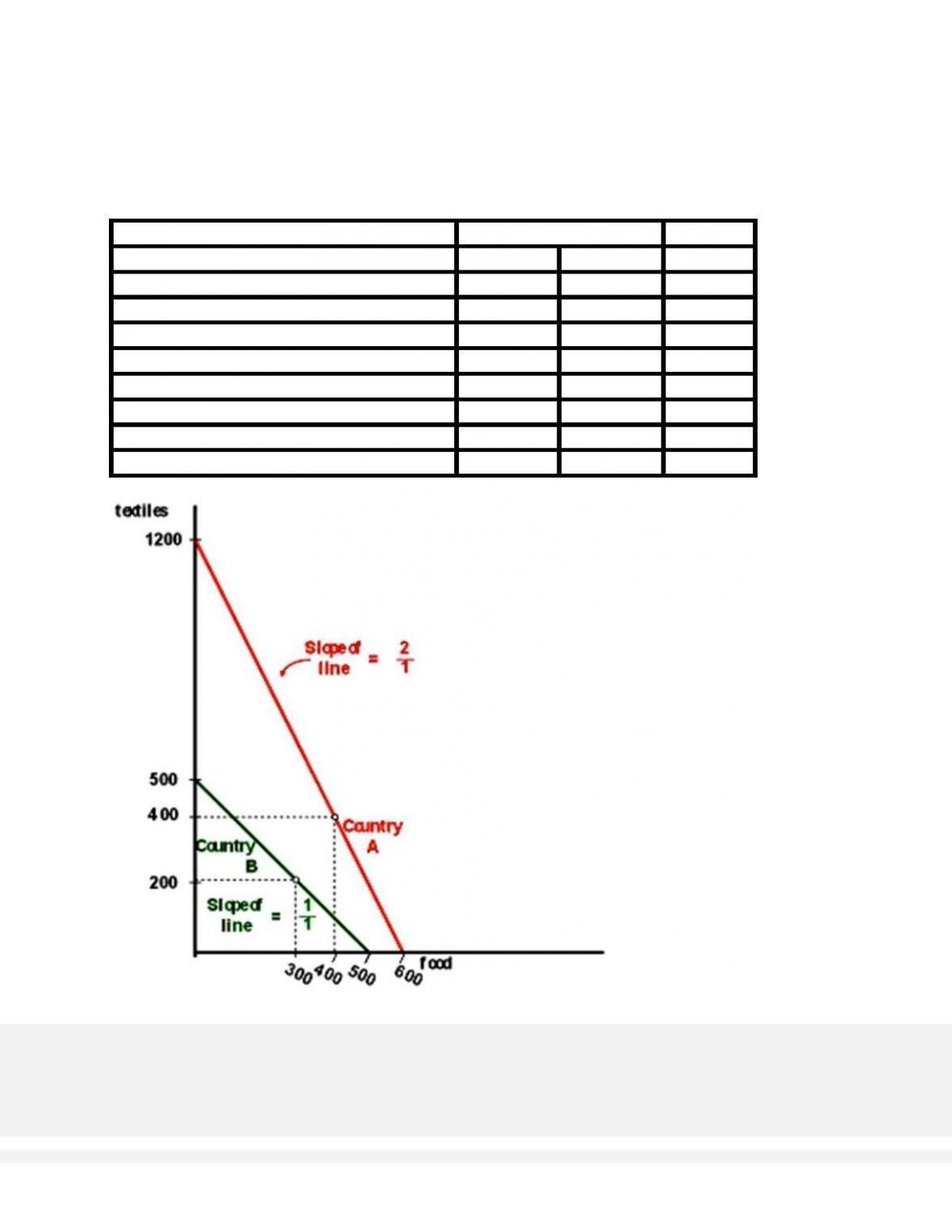
66) Consider the no-trade input/output situation presented in the following table and graph for
countries A and B. Assuming that free trade is legal; develop a scenario that will benefit the
citizens of both countries.
Input/Output without Trade
Country
A
B
Total
I. Total Potential Output
(lbs. or yard; 000,000s)
Food
600
500
1,100
Textiles
1,200
500
1,700
II. Consumption
(lbs. or yard; 000,000s)
Food
300
400
700
Textiles
200
400
600