16. The market value of shareholders’ equity cannot be negative. A negative market value in this case
would imply that the company would pay you to own the stock. The market value of shareholders’
equity can be stated as: Shareholders’ equity = Max [(TA – TL), 0]. So, if TA is $12,400, equity is
equal to $1,100, and if TA is $9,600, equity is equal to $0. We should note here that while the market
value of equity cannot be negative, the book value of shareholders’ equity can be negative.
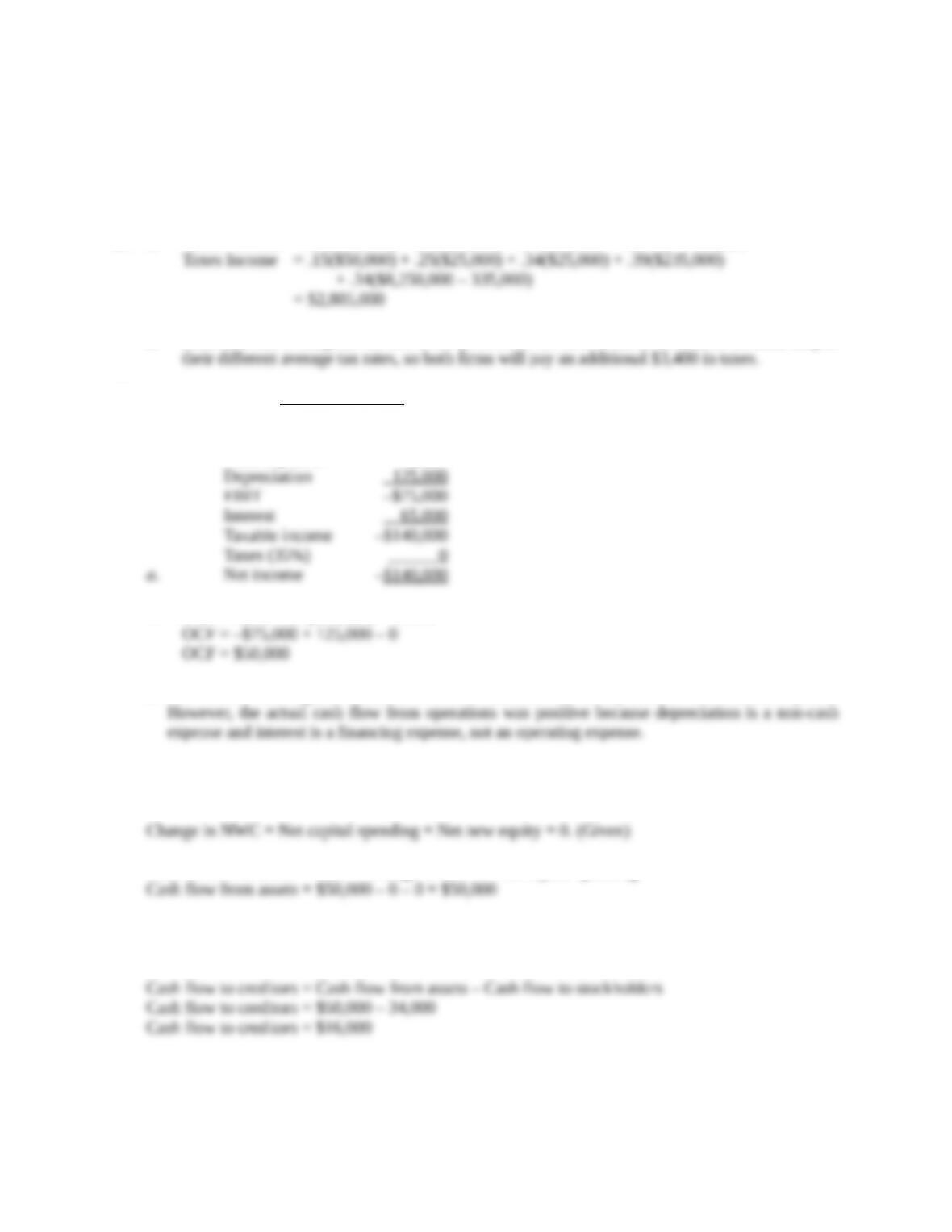
17. a. Taxes Growth = .15($50,000) + .25($25,000) + .34($82,500 – 75,000) = $16,300
b. Each firm has a marginal tax rate of 34 percent on the next $10,000 of taxable income, despite
18. Income Statement
Sales $590,000
COGS 455,000
A&S expenses 85,000
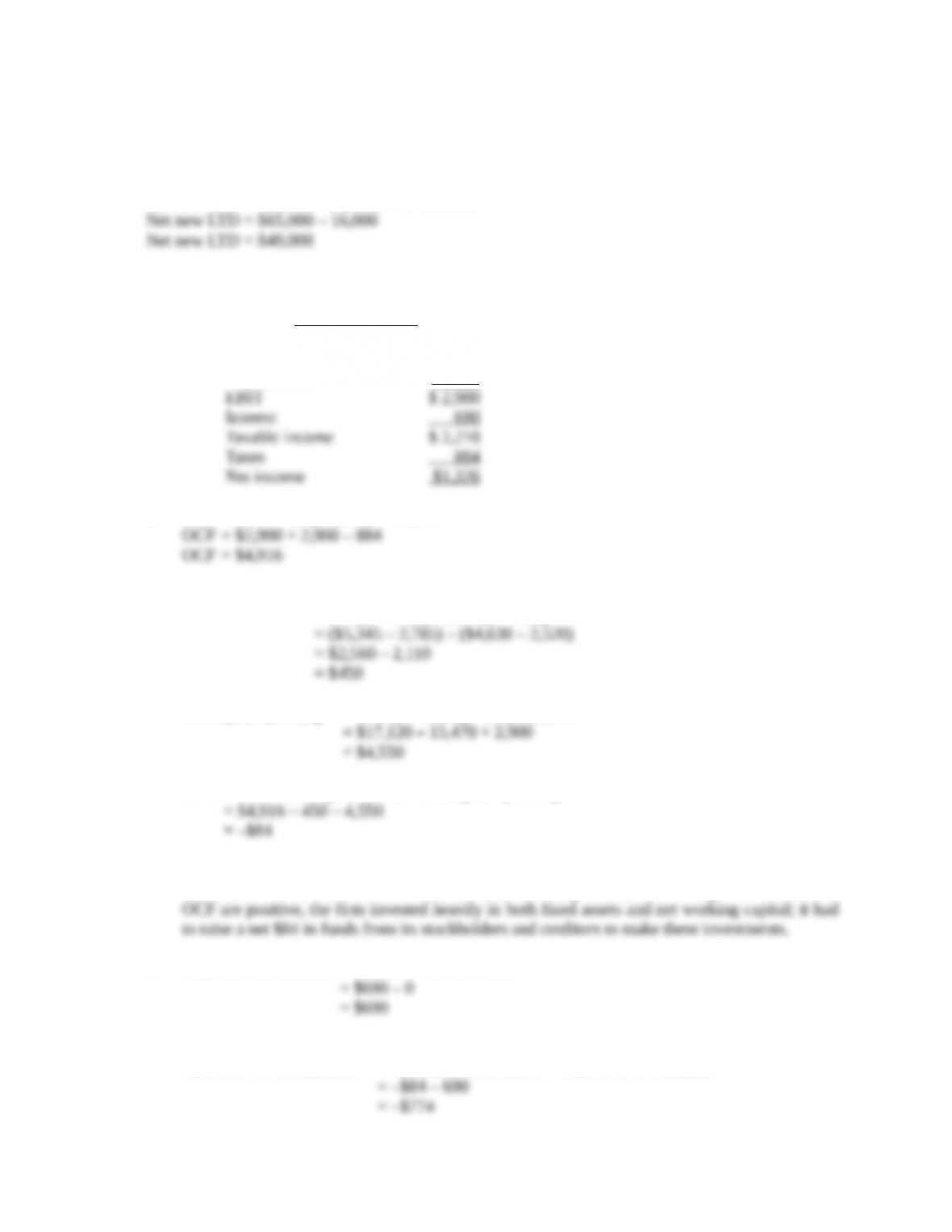
b. OCF = EBIT + Depreciation – Taxes
c. Net income was negative because of the tax deductibility of depreciation and interest expense.
19. A firm can still pay out dividends if net income is negative; it just has to be sure there is sufficient
cash flow to make the dividend payments.
Cash flow from assets = OCF – Change in NWC – Net capital spending
Cash flow to stockholders = Dividends – Net new equity
Cash flow to stockholders = $34,000 – 0 = $34,000
Cash flow to creditors is also:
Cash flow to creditors = Interest – Net new LTD
So:
Net new LTD = Interest – Cash flow to creditors
20. a. The income statement is:
Income Statement
Sales $20,300
Cost of goods sold 14,500
Depreciation 2,900
b. OCF = EBIT + Depreciation – Taxes
c. Change in NWC = NWCend – NWCbeg
= (CAend – CLend) – (CAbeg – CLbeg)
Net capital spending = NFAend – NFAbeg + Depreciation
CFA = OCF – Change in NWC – Net capital spending
The cash flow from assets can be positive or negative, since it represents whether the firm
raised funds or distributed funds on a net basis. In this problem, even though net income and
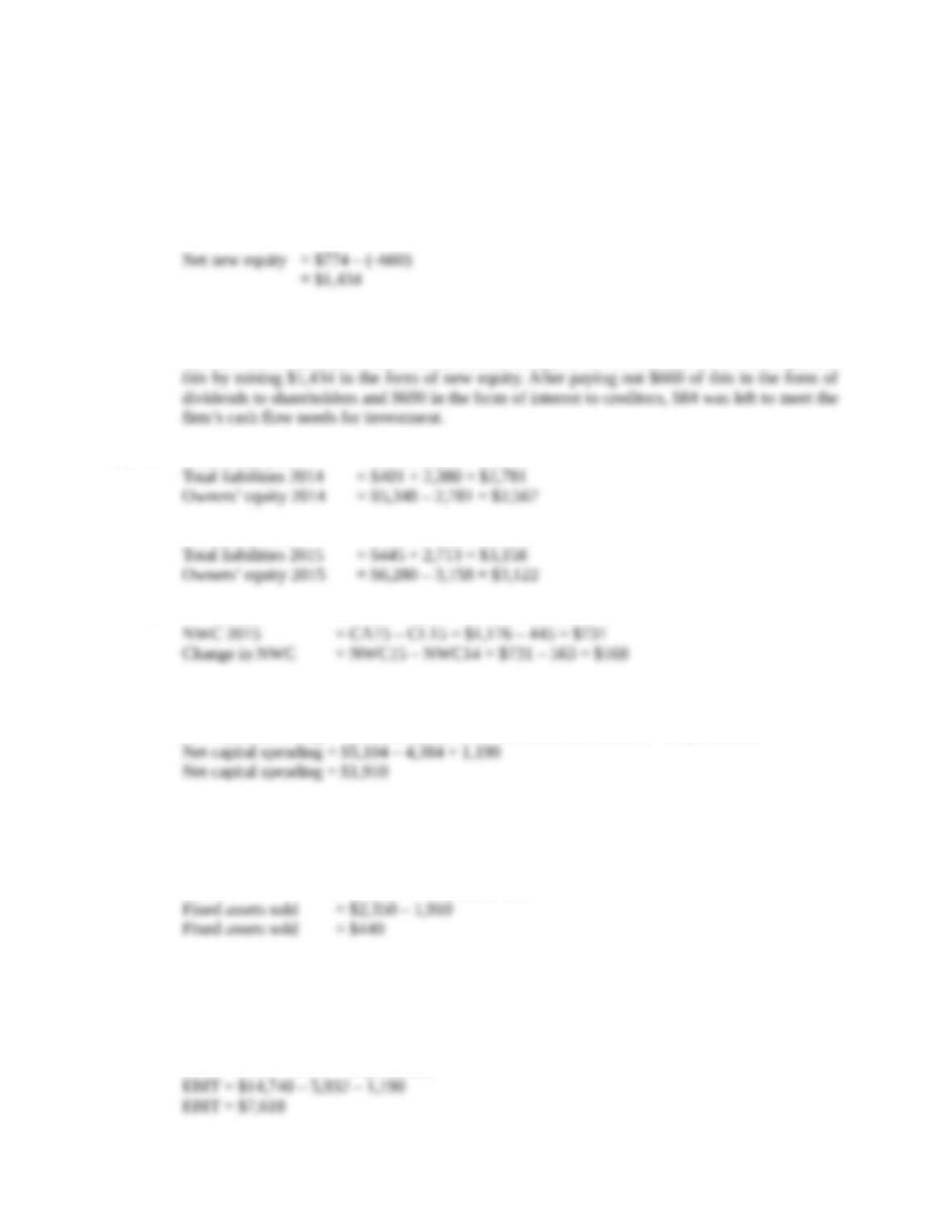
d. Cash flow to creditors = Interest – Net new LTD
Cash flow to stockholders = Cash flow from assets – Cash flow to creditors
We can also calculate the cash flow to stockholders as:
Cash flow to stockholders = Dividends – Net new equity
Solving for net new equity, we get:
The firm had positive earnings in an accounting sense (NI > 0) and had positive cash flow from
operations. The firm invested $450 in new net working capital and $4,550 in new fixed assets.
The firm had to raise $84 from its stakeholders to support this new investment. It accomplished
21. a. Total assets 2014 = $964 + 4,384 = $5,348
Total assets 2015 = $1,176 + 5,104 = $6,280
b. NWC 2014 = CA14 – CL14 = $964 – 401 = $563
c. We can calculate net capital spending as:
Net capital spending = Net fixed assets 2015 – Net fixed assets 2014 + Depreciation
So, the company had a net capital spending cash flow of $1,910. We also know that net capital
spending is:
Net capital spending = Fixed assets bought – Fixed assets sold
$1,910 = $2,350 – Fixed assets sold
To calculate the cash flow from assets, we must first calculate the operating cash flow. The
operating cash flow is calculated as follows (you can also prepare a traditional income
statement):
EBIT = Sales – Costs – Depreciation
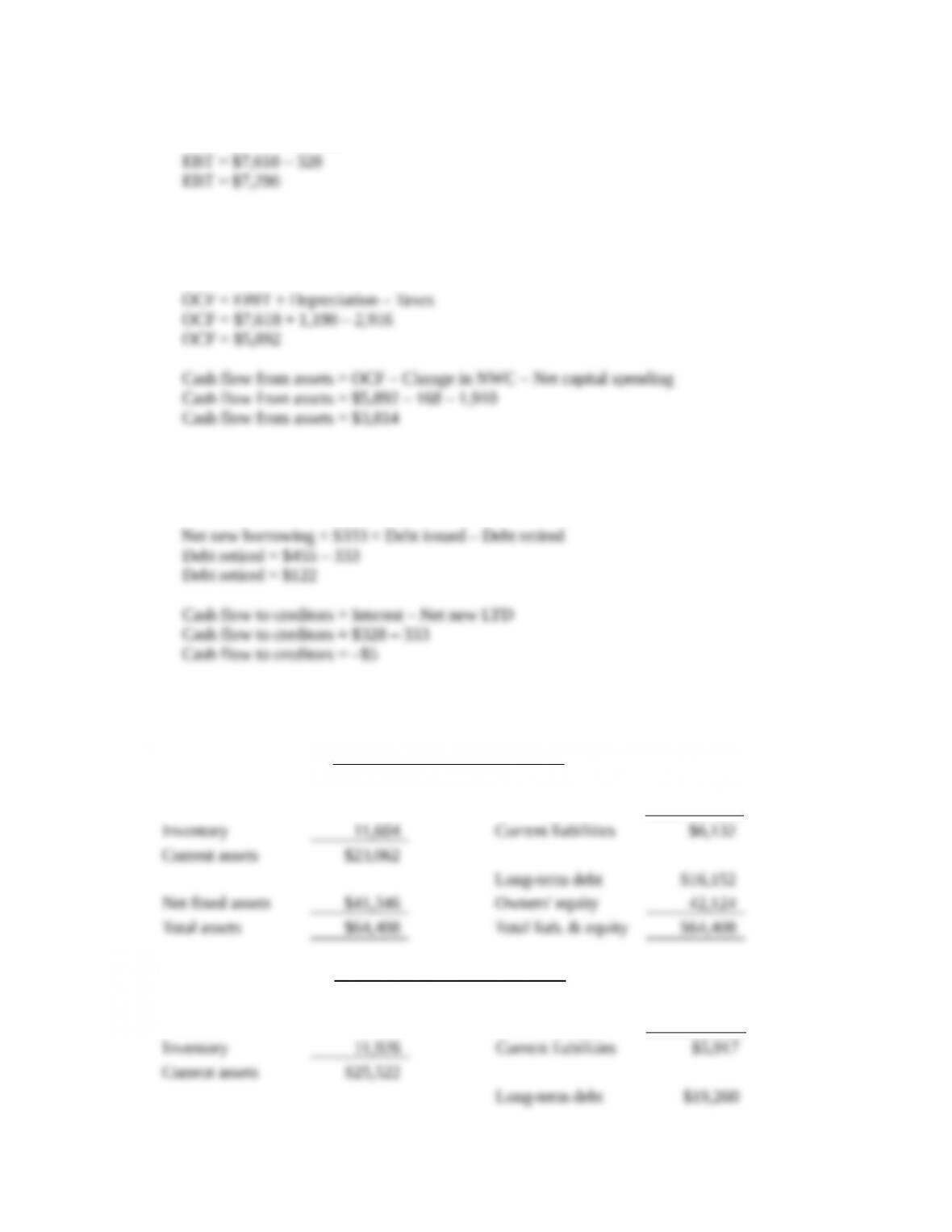
EBT = EBIT – Interest
Taxes = EBT .40
Taxes = $7,290 .40
Taxes = $2,916
d. Net new borrowing = LTD15 – LTD14
Net new borrowing = $2,713 – 2,380
Net new borrowing = $333
22.
Balance sheet as of Dec. 31, 2014
Cash $4,931 Accounts payable $5,179
Accounts receivable 6,527 Notes payable 953
Balance sheet as of Dec. 31, 2015
Cash $6,244 Accounts payable $5,022
Accounts receivable 7,352 Notes payable 895
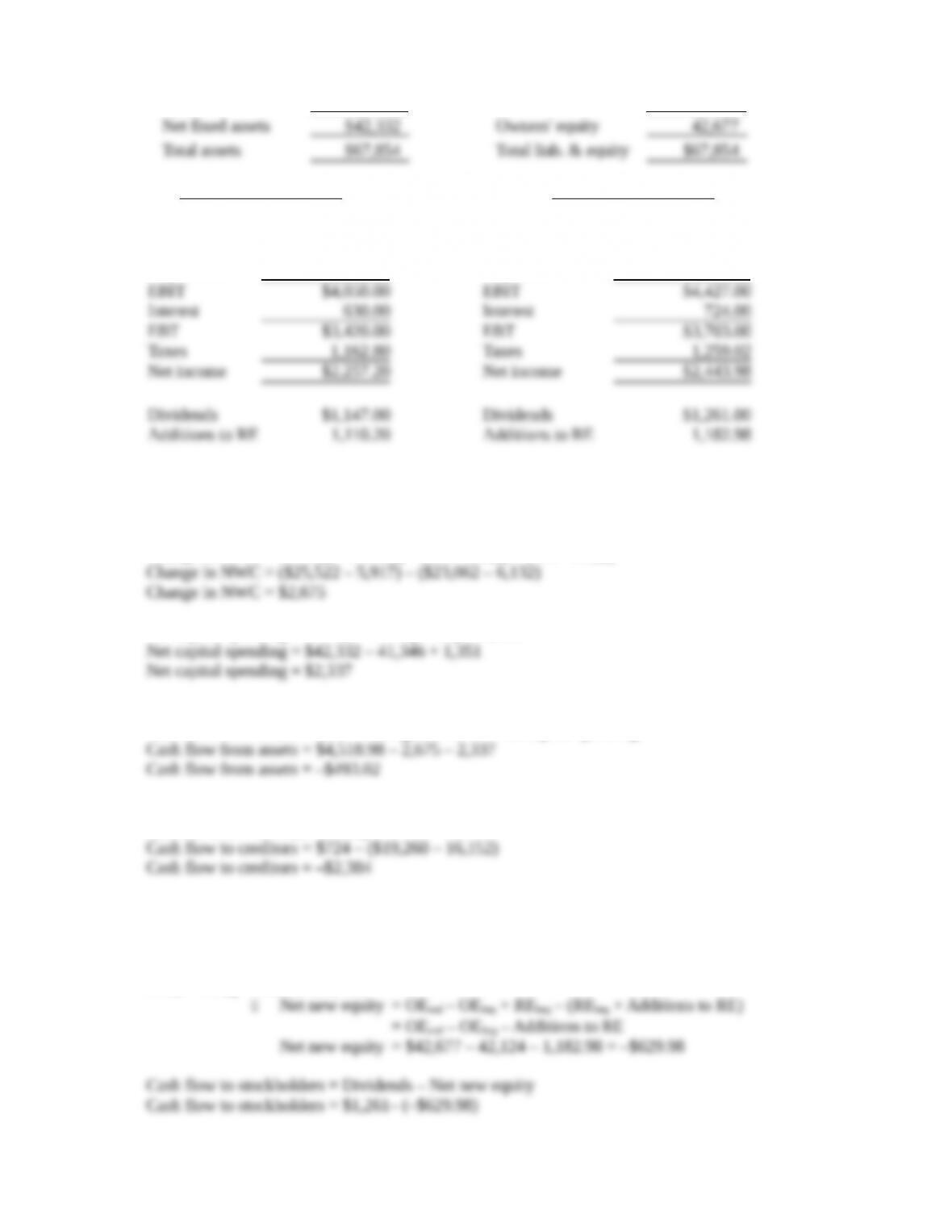
2014 Income Statement 2015 Income Statement
Sales $9,402.00 Sales $10,091.00
COGS 3,235.00 COGS 3,672.00
Other expenses 767.00 Other expenses 641.00
Depreciation 1,350.00 Depreciation 1,351.00
23. OCF = EBIT + Depreciation – Taxes
OCF = $4,427 + 1,351 – 1,259.02
OCF = $4,518.98
Change in NWC = NWCend – NWCbeg = (CA – CL)end – (CA – CL)beg
Net capital spending = NFAend – NFAbeg + Depreciation
Cash flow from assets = OCF – Change in NWC – Net capital spending
Cash flow to creditors = Interest – Net new LTD
Net new LTD = LTDend – LTDbeg
Net new equity = Common stockend – Common stockbeg
Common stock + Retained earnings = Total owners’ equity
Net new equity = (OE – RE)end – (OE – RE)beg
Net new equity = OEend – OEbeg + REbeg – REend
REend = REbeg + Additions to RE
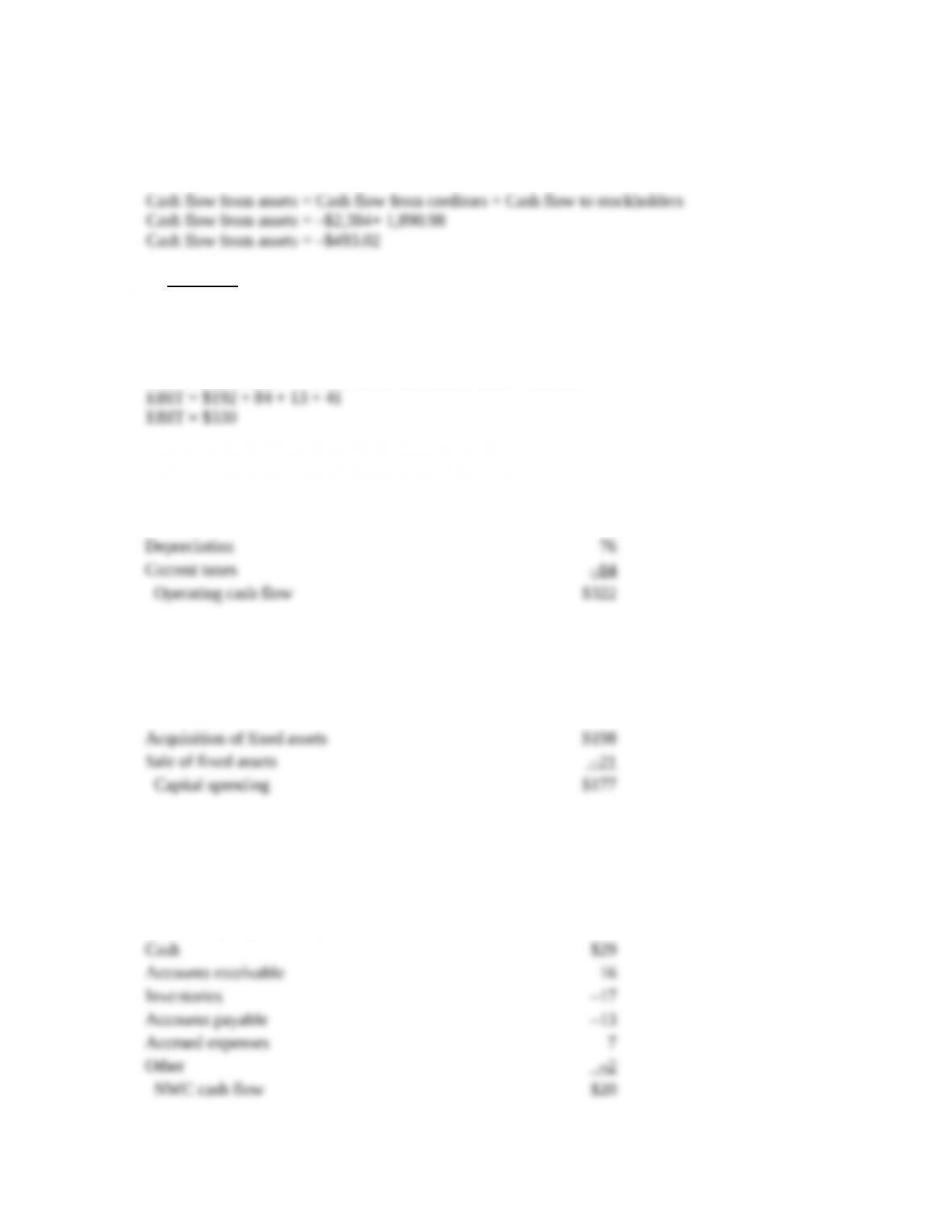
Cash flow to stockholders = $1,890.98
As a check, cash flow from assets is –$493.02
Challenge
24. We will begin by calculating the operating cash flow. First, we need the EBIT, which can be
calculated as:
EBIT = Net income + Current taxes + Deferred taxes + Interest
Now we can calculate the operating cash flow as:
Operating cash flow
Earnings before interest and taxes $330
The cash flow from assets is found in the investing activities portion of the accounting statement of
cash flows, so:
Cash flow from assets
The net working capital cash flows are all found in the operations cash flow section of the
accounting statement of cash flows. However, instead of calculating the net working capital cash
flows as the change in net working capital, we must calculate each item individually. Doing so, we
find:
Net working capital cash flow
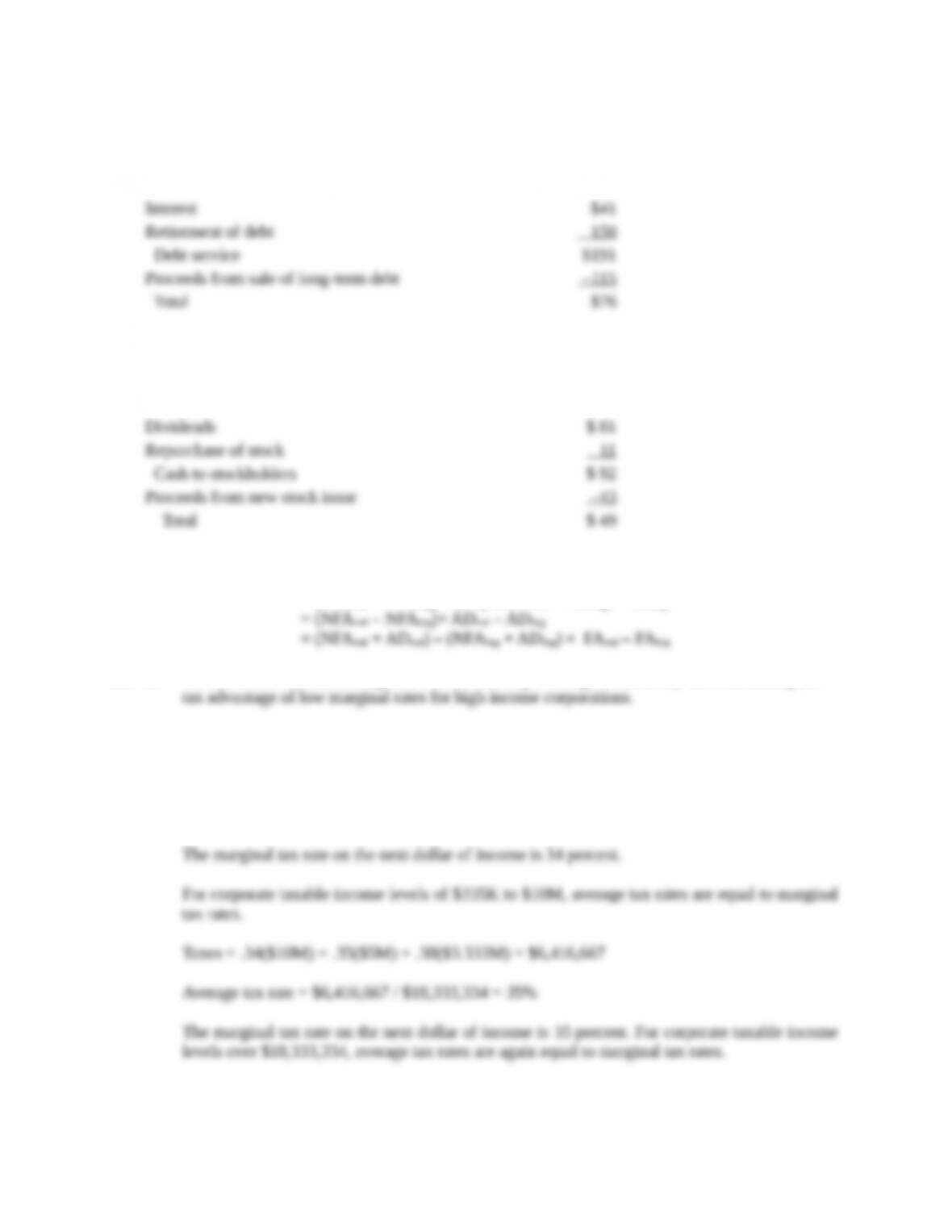
Except for the interest expense, the cash flow to creditors is found in the financing activities of the
accounting statement of cash flows. The interest expense from the income statement is given, so:
Cash flow to creditors
And we can find the cash flow to stockholders in the financing section of the accounting statement
of cash flows. The cash flow to stockholders was:
Cash flow to stockholders
25. Net capital spending = NFAend – NFAbeg + Depreciation
= (NFAend – NFAbeg) + (Depreciation + ADbeg) – ADbeg
26. a. The tax bubble causes average tax rates to catch up to marginal tax rates, thus eliminating the
b. Assuming a taxable income of $335,000, the taxes will be:
Taxes = .15($50K) + .25($25K) + .34($25K) + .39($235K) = $113.9K
Average tax rate = $113.9K / $335K = 34%
c. Taxes = .34($200K) = $68K = .15($50K) + .25($25K) + .34($25K) + X($100K);