CHAPTER 19
DIVIDENDS AND OTHER PAYOUTS
Answers to Concepts Review and Critical Thinking Questions
1. Dividend policy deals with the timing of dividend payments, not the amounts ultimately paid.
2. A stock repurchase reduces equity while leaving debt unchanged. The debt ratio rises. A firm could,
3. The chief drawback to a strict dividend policy is the variability in dividend payments. This is a
problem because investors tend to want a somewhat predictable cash flow. Also, if there is
information content to dividend announcements, then the firm may be inadvertently telling the
4. Friday, December 29 is the ex-dividend day. Remember not to count January 1 because it is a
5. No, because the money could be better invested in stocks that pay dividends in cash which benefit
6. The change in price is due to the change in dividends, not due to the change in dividend policy.
7. The stock price dropped because of an expected drop in future dividends. Since the stock price is the
8. The plan will probably have little effect on shareholder wealth. The shareholders can reinvest on
their own, and the shareholders must pay the taxes on the dividends either way. However, the
9. If these firms just went public, they probably did so because they were growing and needed the
additional capital. Growth firms typically pay very small cash dividends, if they pay a dividend at
10. It would not be irrational to find low-dividend, high-growth stocks. The trust should be indifferent
between receiving dividends or capital gains since it does not pay taxes on either one (ignoring
11. The stock price drop on the ex-dividend date should be lower. With taxes, stock prices should drop
12. With a high tax on dividends and a low tax on capital gains, investors, in general, will prefer capital
13. Knowing that share price can be expressed as the present value of expected future dividends does not
make dividend policy relevant. Under the growing perpetuity model, if overall corporate cash flows
In a more realistic context and assuming a finite holding period, the value of the shares should
represent the future stock price as well as the dividends. Any cash flow not paid as a dividend will be
14. The bird-in-the-hand argument is based upon the erroneous assumption that increased dividends
15. This argument is theoretically correct. In the real world, with transaction costs of security trading,
homemade dividends can be more expensive than dividends directly paid out by the firms. However,
16. a. Cap’s past behavior suggests a preference for capital gains, while Sarah exhibits a preference
b. Cap could show Sarah how to construct homemade dividends through the sale of stock. Of
c. Sarah may still not invest in Neotech because of the transaction costs involved in constructing
17. To minimize her tax burden, your aunt should divest herself of high dividend yield stocks and invest
18. The capital investment needs of small, growing companies are very high. Therefore, payment of
dividends could curtail their investment opportunities. Their other option is to issue stock to pay the
19. Unless there is an unsatisfied high dividend clientele, a firm cannot improve its share price by
switching policies. If the market is in equilibrium, the number of people who desire high dividend
20. This finding implies that firms use initial dividends to “signal” their potential growth and positive
Solutions to Questions and Problems
NOTE: All end-of-chapter problems were solved using a spreadsheet. Many problems require multiple
steps. Due to space and readability constraints, when these intermediate steps are included in this
solutions manual, rounding may appear to have occurred. However, the final answer for each problem is
found without rounding during any step in the problem.
Basic
1. The aftertax dividend is the pretax dividend times one minus the tax rate, so:
2. a. The shares outstanding increases by 10 percent, so:
New shares issued = 4,000
Since the par value of the new shares is $1, the capital surplus per share is $38. The total capital
surplus is therefore:
b. The shares outstanding increases by 25 percent, so:
Since the par value of the new shares is $1, the capital surplus per share is $38. The total capital
surplus is therefore:
3. a. To find the new shares outstanding, we multiply the current shares outstanding times the ratio
of new shares to old shares, so:
The equity accounts are unchanged except that the par value of the stock is changed by the ratio
of new shares to old shares, so the new par value is:
b. To find the new shares outstanding, we multiply the current shares outstanding times the ratio
of new shares to old shares, so:
The equity accounts are unchanged except that the par value of the stock is changed by the ratio
of new shares to old shares, so the new par value is:
4. To find the new stock price, we multiply the current stock price by the ratio of old shares to new
shares, so:
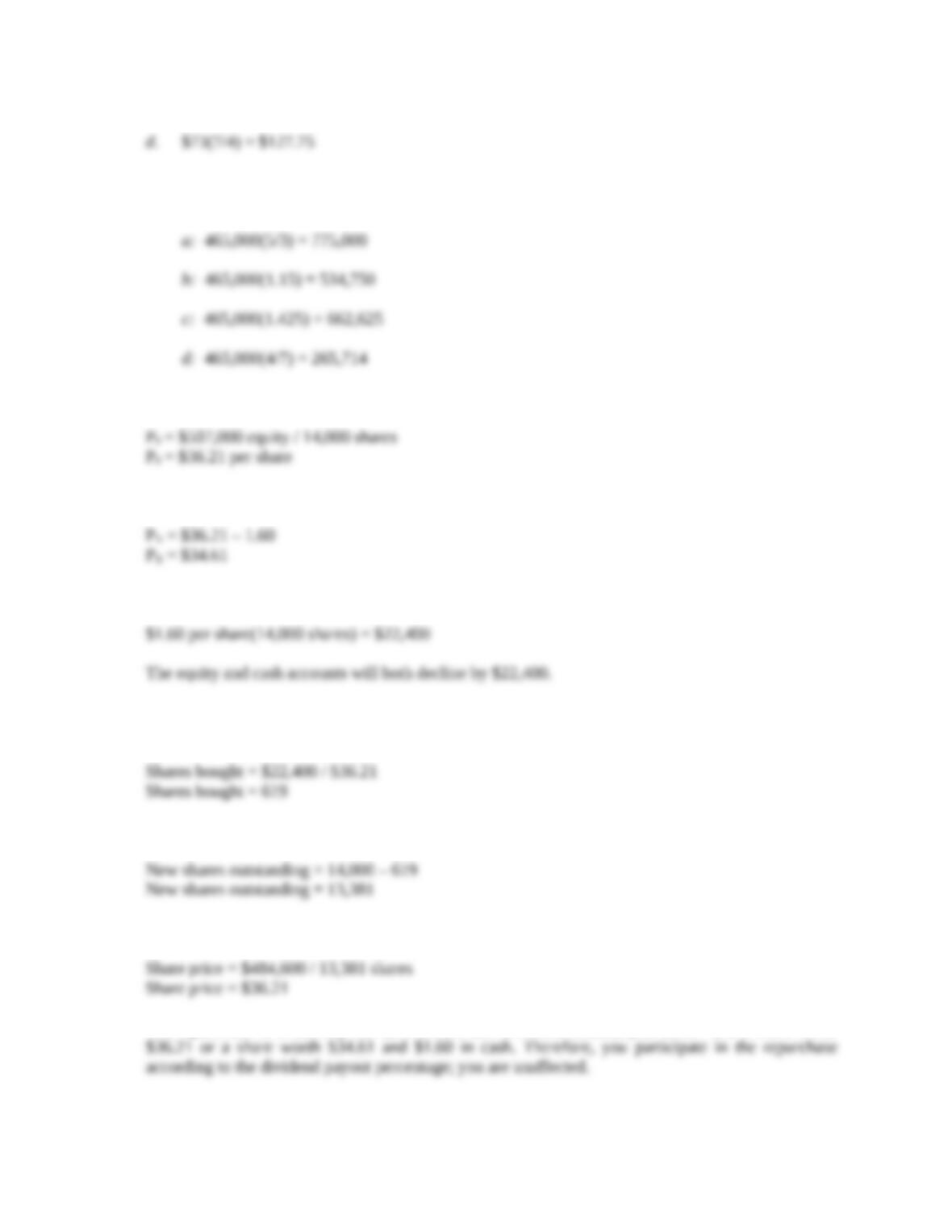
To find the new shares outstanding, we multiply the current shares outstanding times the ratio of new
shares to old shares, so:
5. The stock price is the total market value of equity divided by the shares outstanding, so:
Ignoring tax effects, the stock price will drop by the amount of the dividend, so:
The total dividends paid will be:
6. Repurchasing the shares will reduce shareholders’ equity by $22,400. The shares repurchased will be
the total purchase amount divided by the stock price, so:
And the new shares outstanding will be:
After repurchase, the new stock price is:
The repurchase is effectively the same as the cash dividend because you either hold a share worth
7. The stock price is the total market value of equity divided by the shares outstanding, so:
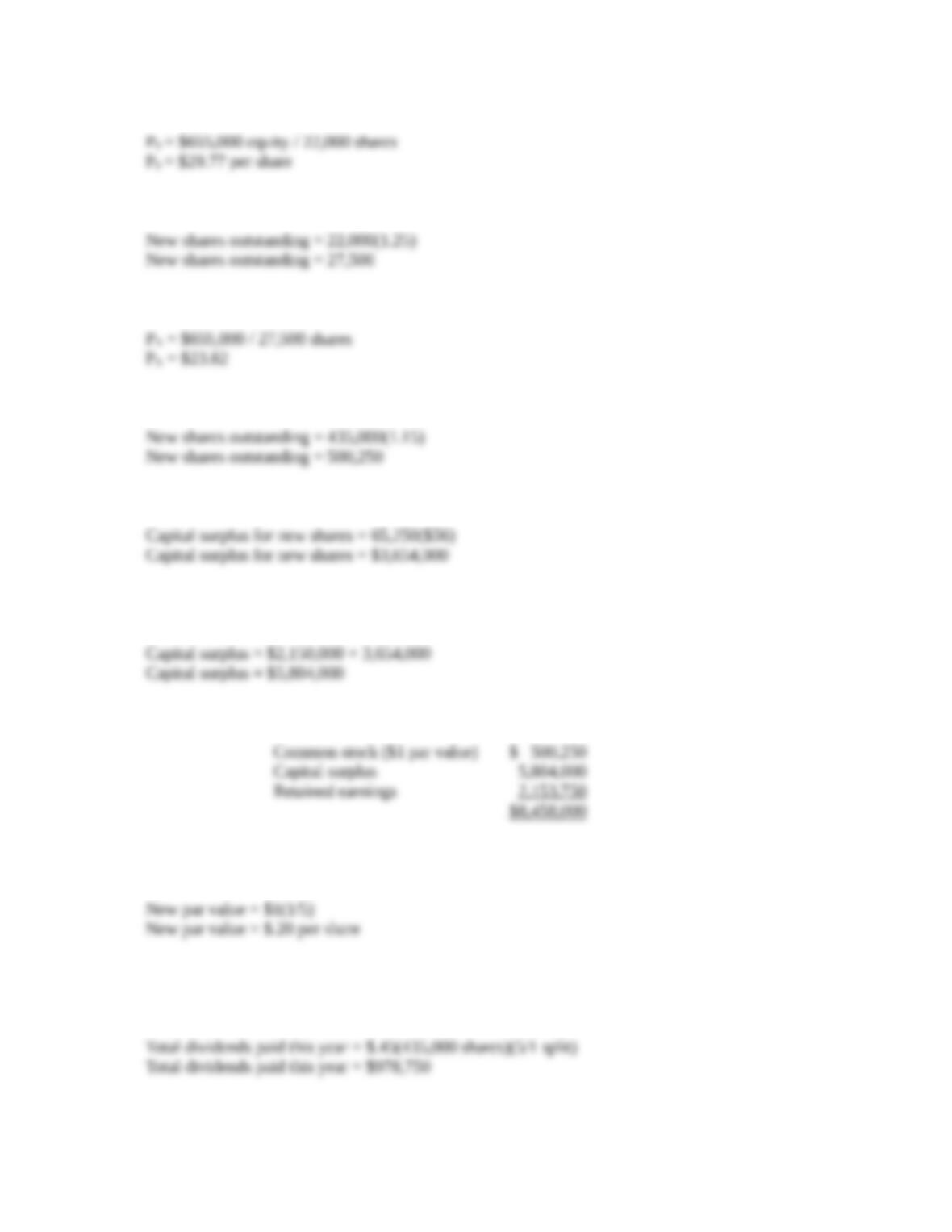
The shares outstanding will increase by 25 percent, so:
The new stock price is the market value of equity divided by the new shares outstanding, so:
8. With a stock dividend, the shares outstanding will increase by one plus the dividend amount, so:
The capital surplus is the capital paid in excess of par value, which is $1, so:
The new capital surplus will be the old capital surplus plus the additional capital surplus for the new
shares, so:
The new equity portion of the balance sheet will look like this:
9. The only equity account that will be affected is the par value of the stock. The par value will change
by the ratio of old shares to new shares, so:
The total dividends paid this year will be the dividend amount times the number of shares
outstanding. The company had 435,000 shares outstanding before the split. We must remember to
adjust the shares outstanding for the stock split, so:
The dividends increased by 10 percent, so the total dividends paid last year were:
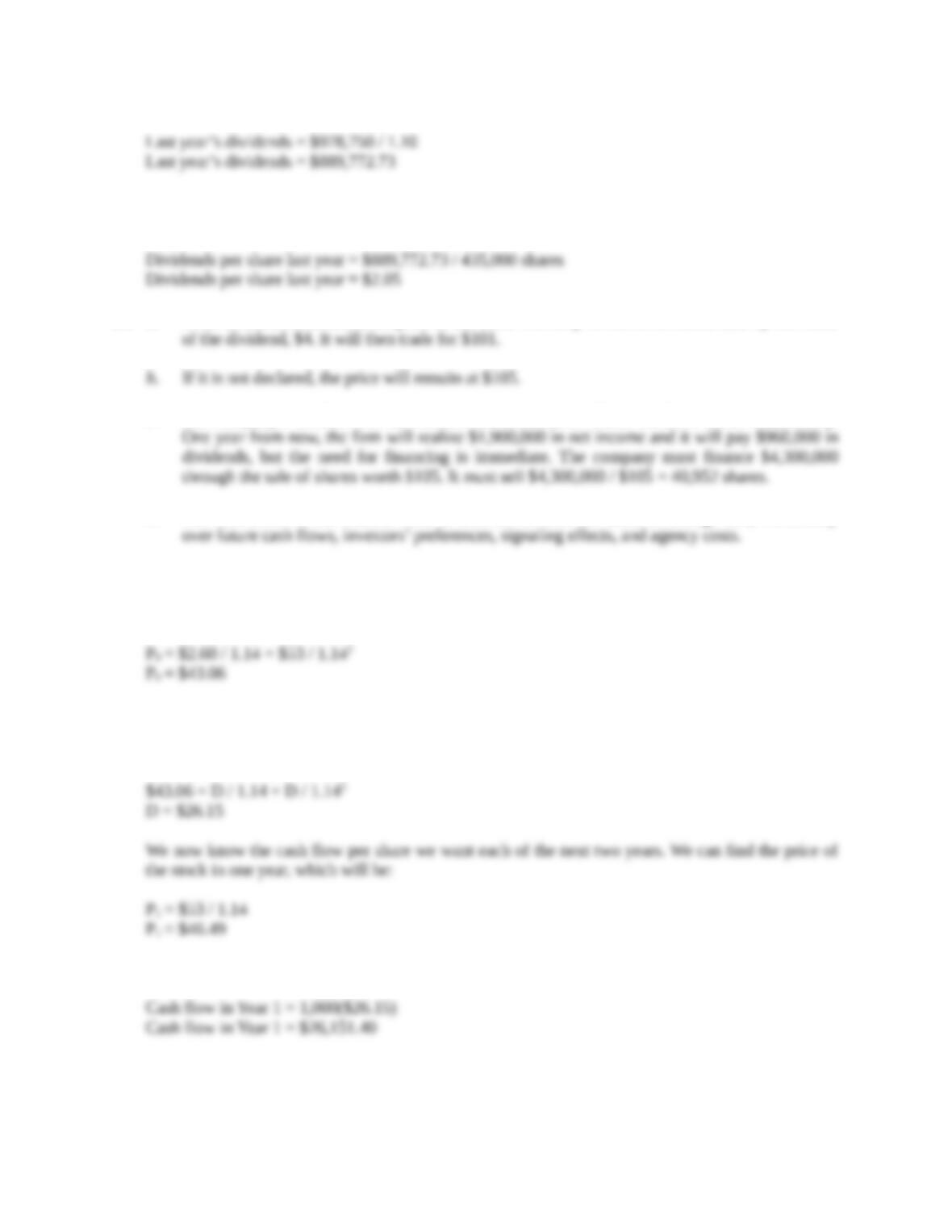
And to find the dividends per share, we divide this amount by the shares outstanding last year. Doing
so, we get:
10. a. If the dividend is declared, the price of the stock will drop on the ex-dividend date by the value
c. The company’s outflows for investments are $4,300,000. These outflows occur immediately.
d. The MM model is not realistic since it does not account for taxes, brokerage fees, uncertainty
Intermediate
11. The price of the stock today is the PV of the dividends, so:
To find the equal two year dividends with the same present value as the price of the stock, we set up
the following equation and solve for the dividend (Note: The dividend is a two year annuity, so we
could solve with the annuity factor as well):
Since you own 1,000 shares, in one year you want:
But you’ll only get:
Dividends received in one year = 1,000($2.60)
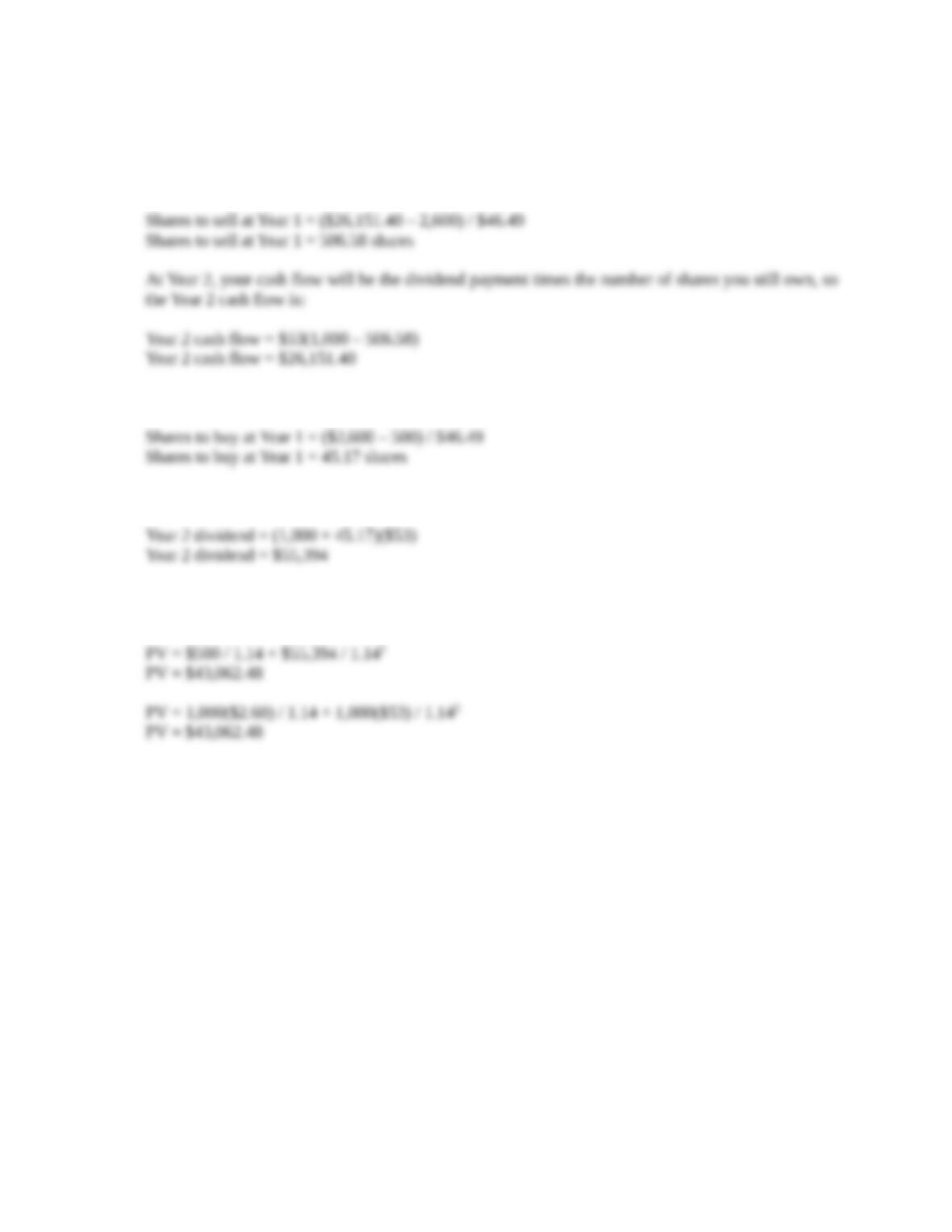
Dividends received in one year = $2,600
Thus, in one year you will need to sell additional shares in order to increase your cash flow. The
number of shares to sell in year one is:
12. If you only want $500 in Year 1, you will buy:
at Year 1. Your dividend payment in Year 2 will be:
Note that the present value of each cash flow stream is the same. Below we show this by finding the
present values as: