CHAPTER 18 –
11. If the company had to issue debt under the terms it would normally receive, the interest rate on the
debt would increase to the company’s normal cost of debt. The NPV of an all-equity project would
remain unchanged, but the NPV of the financing side effects would change. The NPV of the
financing side effects would be:
Using the NPV of an all-equity project from the previous problem, the new APV of the project
would be:
The gain to the company from issuing subsidized debt is the difference between the two APVs, so:
Most of the value of the project is in the form of the subsidized interest rate on the debt issue.
12. The adjusted present value of a project equals the net present value of the project under all-equity
financing plus the net present value of any financing side effects. First, we need to calculate the
unlevered cost of equity. According to Modigliani-Miller Proposition II with corporate taxes:
Now we can find the NPV of an all-equity project, which is:
Next, we need to find the net present value of financing side effects. This is equal to the aftertax
present value of cash flows resulting from the firm’s debt. So:
Each year, an equal principal payment will be made, which will reduce the interest accrued during
the year. Given a known level of debt, debt cash flows should be discounted at the pre-tax cost of
debt, so the NPV of the financing effects is:
1
CHAPTER 18 –
So, the APV of project is:
13. a. To calculate the NPV of the project, we first need to find the company’s WACC. In a world
with corporate taxes, a firm’s weighted average cost of capital equals:
The market value of the company’s equity is:
So, the debt–value ratio and equity–value ratio are:
Since the CEO believes its current capital structure is optimal, these values can be used as the
target weights in the firm’s weighted average cost of capital calculation. The yield to maturity
of the company’s debt is its pretax cost of debt. To find the company’s cost of equity, we need
to calculate the stock beta. The stock beta can be calculated as:
2
Now we can use the Capital Asset Pricing Model to determine the cost of equity. The Capital
Asset Pricing Model is:
Now, we can calculate the company’s WACC, which is:
Finally, we can use the WACC to discount the unlevered cash flows, which gives us an NPV of:
2
CHAPTER 18 –
b. The weighted average cost of capital used in part a will not change if the firm chooses to fund
the project entirely with debt. The weighted average cost of capital is based on optimal capital
14. We have four companies with comparable operations, so the industry average beta can be used as the
beta for this project. So, the average unlevered beta is:
A debt-to-value ratio of .40 means that the equity-to-value ratio is .60. This implies a debt–equity
ratio of .67{=.40/.60}. Since the project will be levered, we need to calculate the levered beta, which
is:
Now we can use the Capital Asset Pricing Model to determine the cost of equity. The Capital Asset
Pricing Model is:
Now, we can calculate the company’s WACC, which is:
Finally, we can use the WACC to discount the unlevered cash flows, which gives us an NPV of:
Challenge
15. a. The company is currently an all-equity firm, so the value as an all-equity firm equals the
present value of aftertax cash flows, discounted at the cost of the firm’s unlevered cost of
equity. So, the current value of the company is:
The price per share is the total value of the company divided by the shares outstanding, or:
3
CHAPTER 18 –
b. The adjusted present value of a firm equals its value under all-equity financing plus the net
present value of any financing side effects. In this case, the NPV of financing side effects
equals the aftertax present value of cash flows resulting from the firm’s debt. Given a known
So, the value of the company after the recapitalization using the APV approach is:
Since the company has not yet issued the debt, this is also the value of equity after the
announcement. So, the new price per share will be:
c. The company will use the entire proceeds to repurchase equity. Using the share price we
calculated in part b, the number of shares repurchased will be:
And the new number of shares outstanding will be:
The value of the company increased, but part of that increase will be funded by the new debt.
The value of equity after recapitalization is the total value of the company minus the value of
debt, or:
The price per share is unchanged.
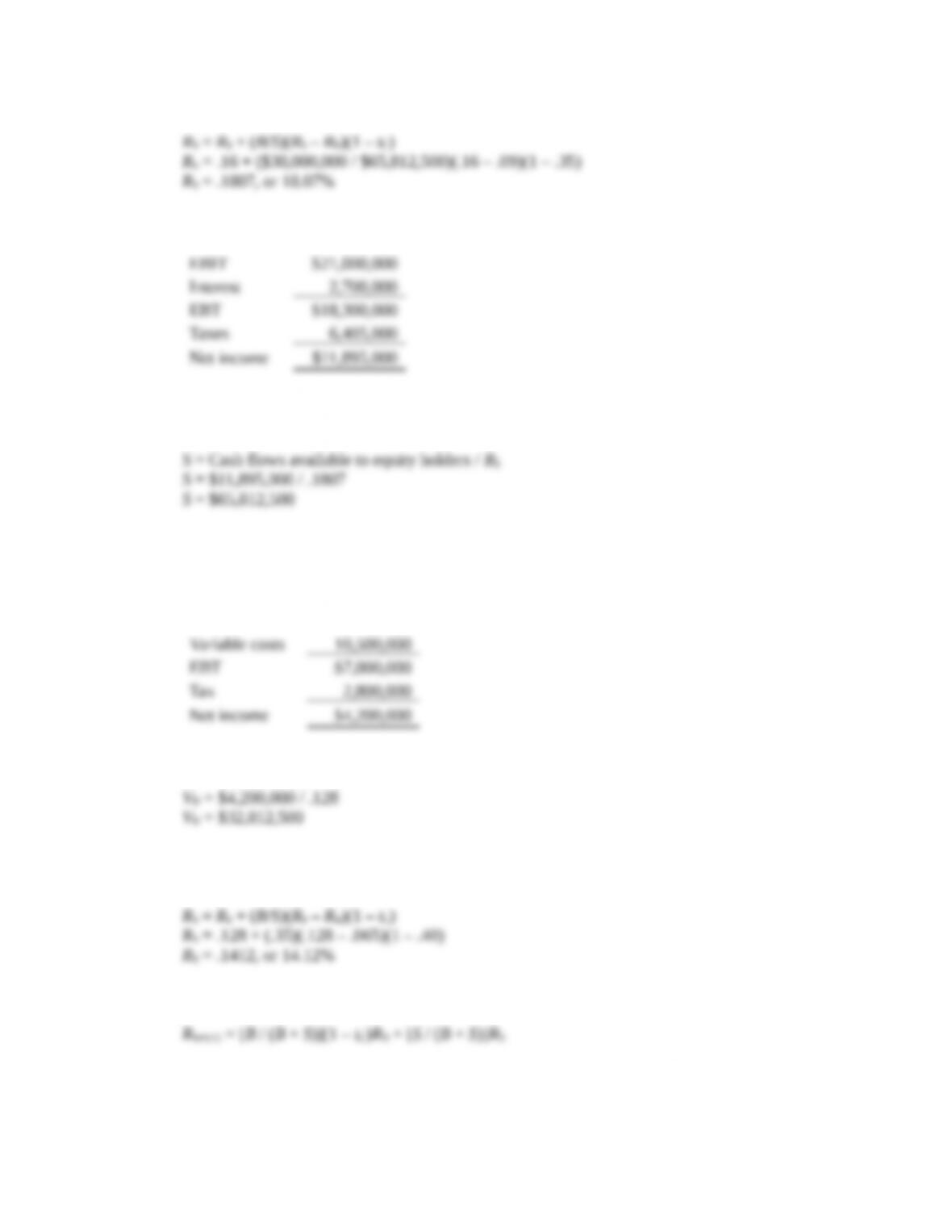
d. In order to value a firm’s equity using the flow-to-equity approach, we must discount the cash
flows available to equity holders at the cost of the firm’s levered equity. According to
Modigliani-Miller Proposition II with corporate taxes, the required return of levered equity is:
4
CHAPTER 18 –
After the recapitalization, the net income of the company will be:
The firm pays all of its earnings as dividends, so the entire net income is available to
shareholders. Using the flow-to-equity approach, the value of the equity is:
16. a. If the company were financed entirely by equity, the value of the firm would be equal to the
present value of its unlevered after-tax earnings, discounted at its unlevered cost of capital.
First, we need to find the company’s unlevered cash flows, which are:
Sales $17,500,000
So, the value of the unlevered company is:
b. According to Modigliani-Miller Proposition II with corporate taxes, the value of levered equity
is:
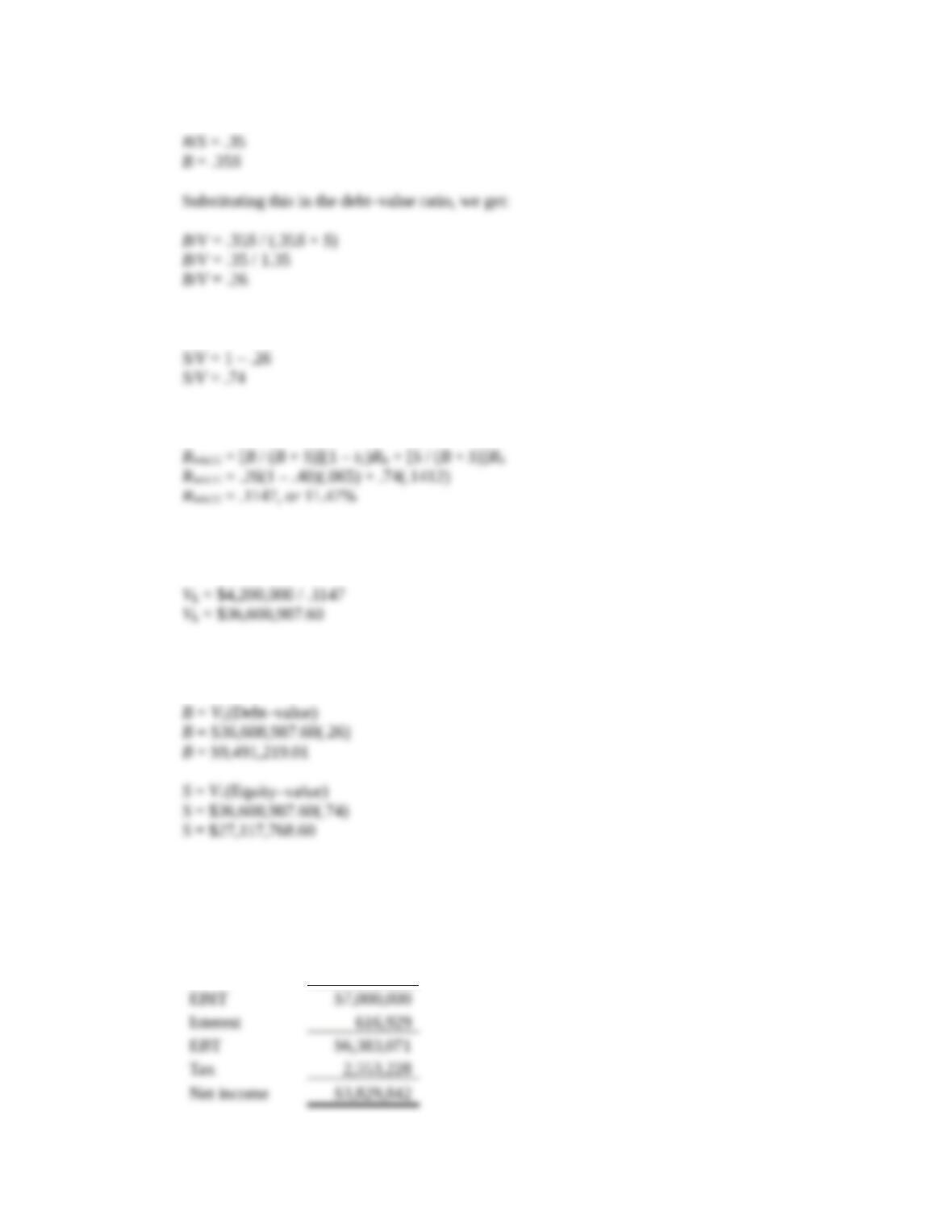
c. In a world with corporate taxes, a firm’s weighted average cost of capital equals:
So we need the debt–value and equity–value ratios for the company. The debt–equity ratio for
the company is:
5
CHAPTER 18 –
And the equity–value ratio is one minus the debt–value ratio, or:
So, using the capital structure weights, the company’s WACC is:
We can use the weighted average cost of capital to discount the firm’s unlevered aftertax
earnings to value the company. Doing so, we find:
Now we can use the debt–value ratio and equity–value ratio to find the value of debt and
equity, which are:
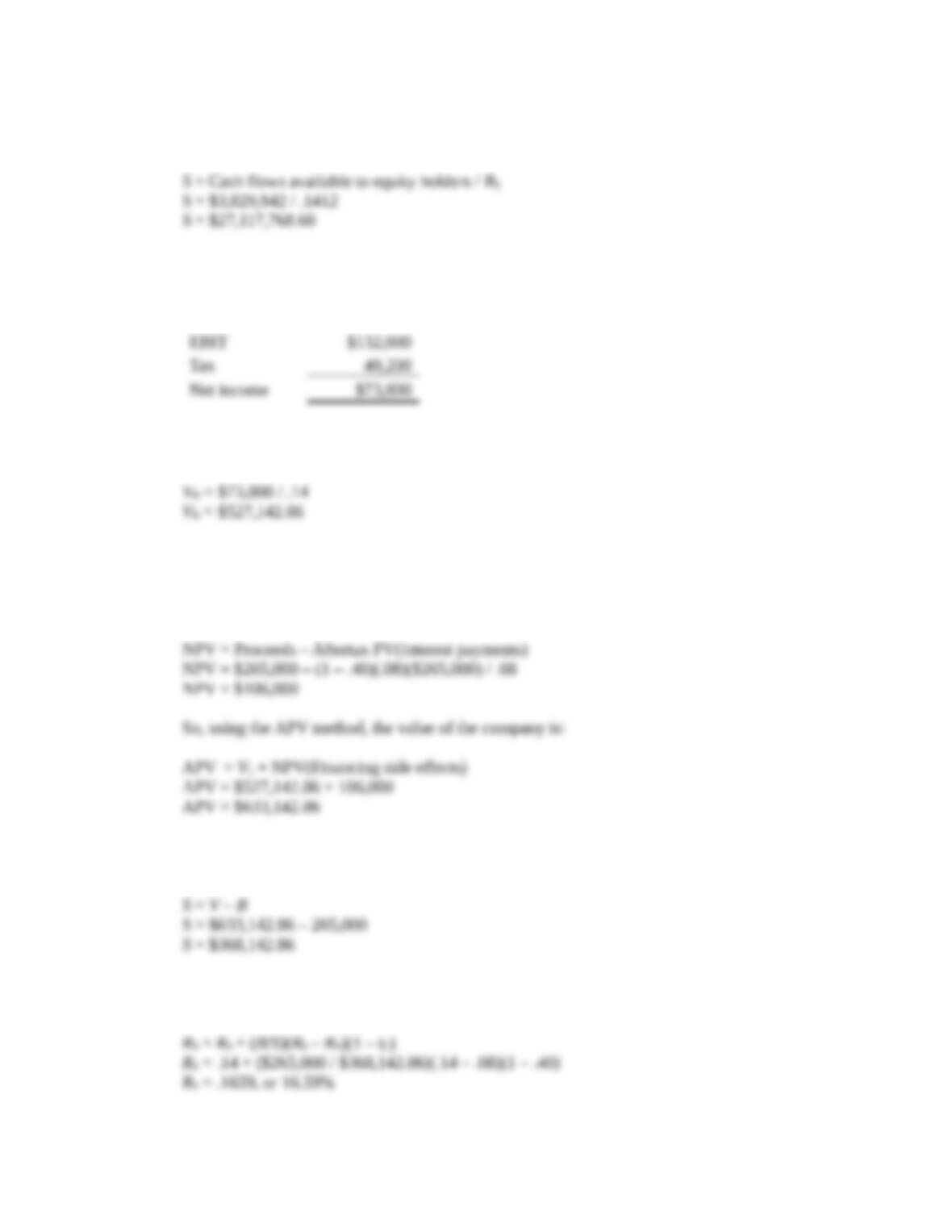
d. In order to value a firm’s equity using the flow-to-equity approach, we can discount the cash
flows available to equity holders at the cost of the firm’s levered equity. First, we need to
calculate the levered cash flows available to shareholders, which are:
Sales $17,500,000
Variable costs 10,500,000
6
CHAPTER 18 –
So, the value of equity with the flow-to-equity method is:
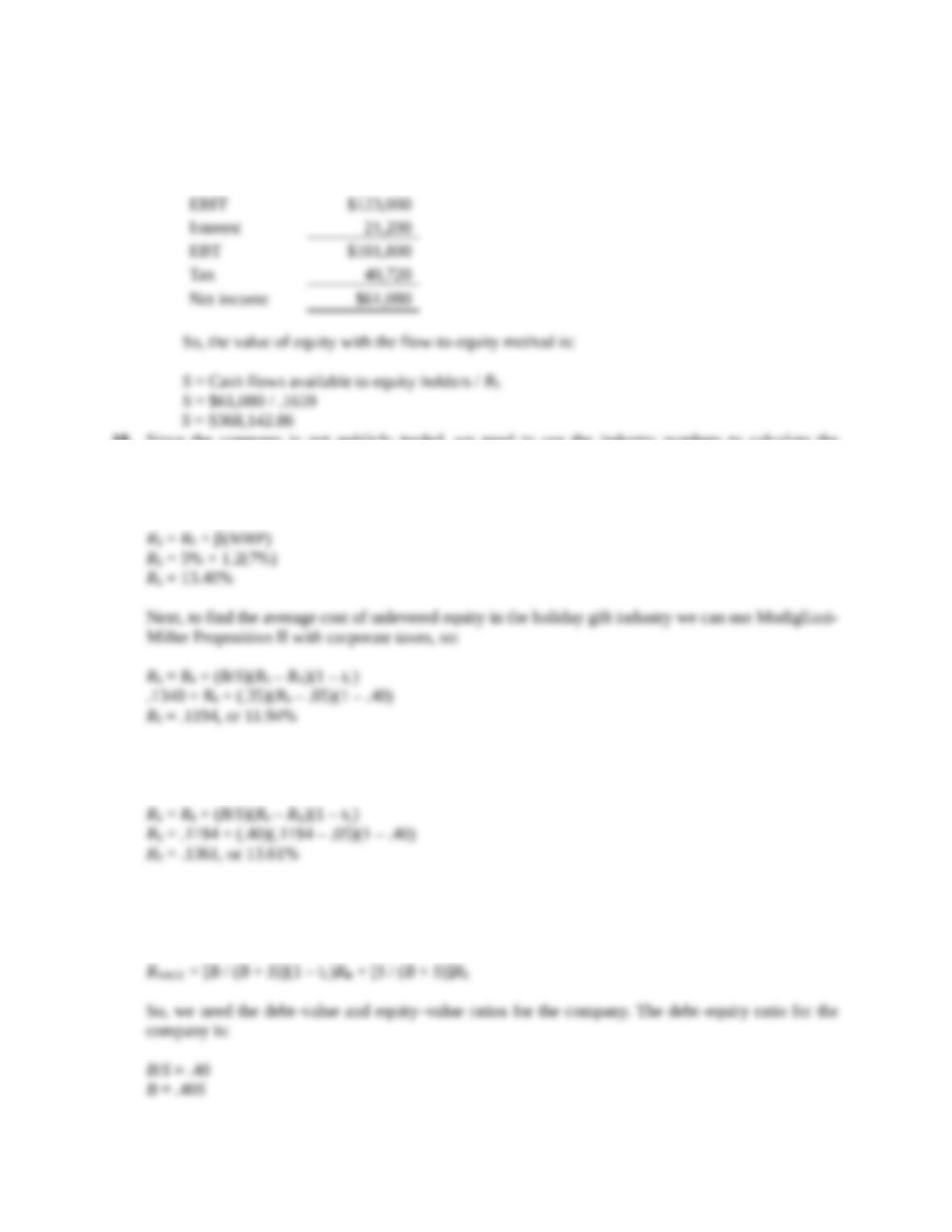
17. a. Since the company is currently an all-equity firm, its value equals the present value of its
unlevered after-tax earnings, discounted at its unlevered cost of capital. The cash flows to
shareholders for the unlevered firm are:
So, the value of the company is:
b. The adjusted present value of a firm equals its value under all-equity financing plus the net
present value of any financing side effects. In this case, the NPV of financing side effects
equals the after-tax present value of cash flows resulting from debt. Given a known level of
debt, debt cash flows should be discounted at the pre-tax cost of debt, so:
The value of the debt is given, so the value of equity is the value of the company minus the
value of the debt, or:
c. According to Modigliani-Miller Proposition II with corporate taxes, the required return of
levered equity is:
7
CHAPTER 18 –
d. In order to value a firm’s equity using the flow-to-equity approach, we can discount the cash
flows available to equity holders at the cost of the firm’s levered equity. First, we need to
calculate the levered cash flows available to shareholders, which are:
18. Since the company is not publicly traded, we need to use the industry numbers to calculate the
industry levered return on equity. We can then find the industry unlevered return on equity, and re-
lever the industry return on equity to account for the different use of leverage. So, using the CAPM
to calculate the industry levered return on equity, we find:
Now, we can use the Modigliani-Miller Proposition II with corporate taxes to re-lever the return on
equity to account for this company’s debt–equity ratio. Doing so, we find:
Since the project is financed at the firm’s target debt–equity ratio, it must be discounted at the
company’s weighted average cost of capital. In a world with corporate taxes, a firm’s weighted
average cost of capital equals:
8
CHAPTER 18 –
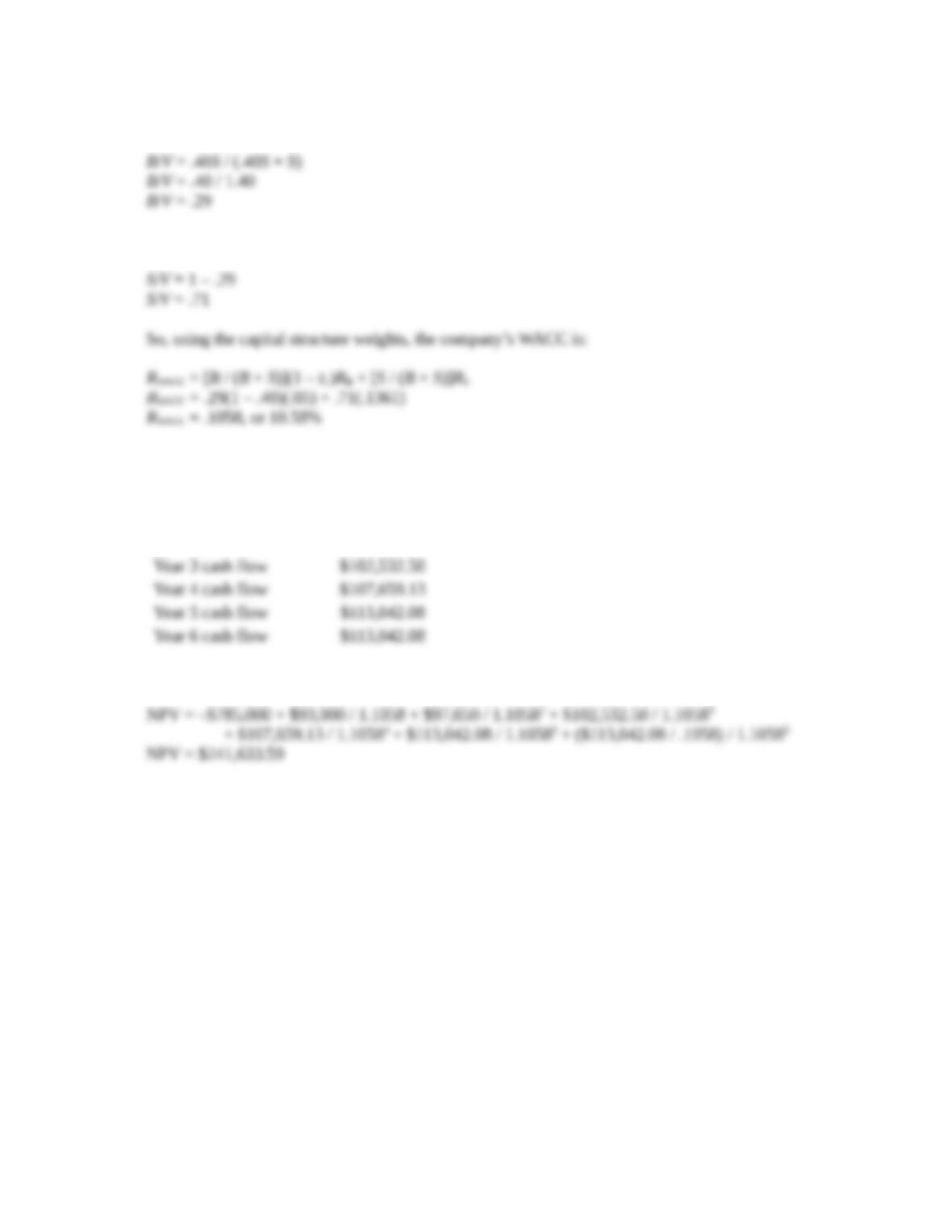
Substituting this in the debt–value ratio, we get:
And the equity–value ratio is one minus the debt–value ratio, or:
Now we need the project’s cash flows. The cash flows increase for the first five years before leveling
off into perpetuity. So, the cash flows from the project for the next six years are:
Year 1 cash flow $93,000.00
Year 2 cash flow $97,650.00
So, the NPV of the project is:
9